Shift Left Security: A Practical Guide for Modern Teams
 Reza Khosravi
Table of Contents
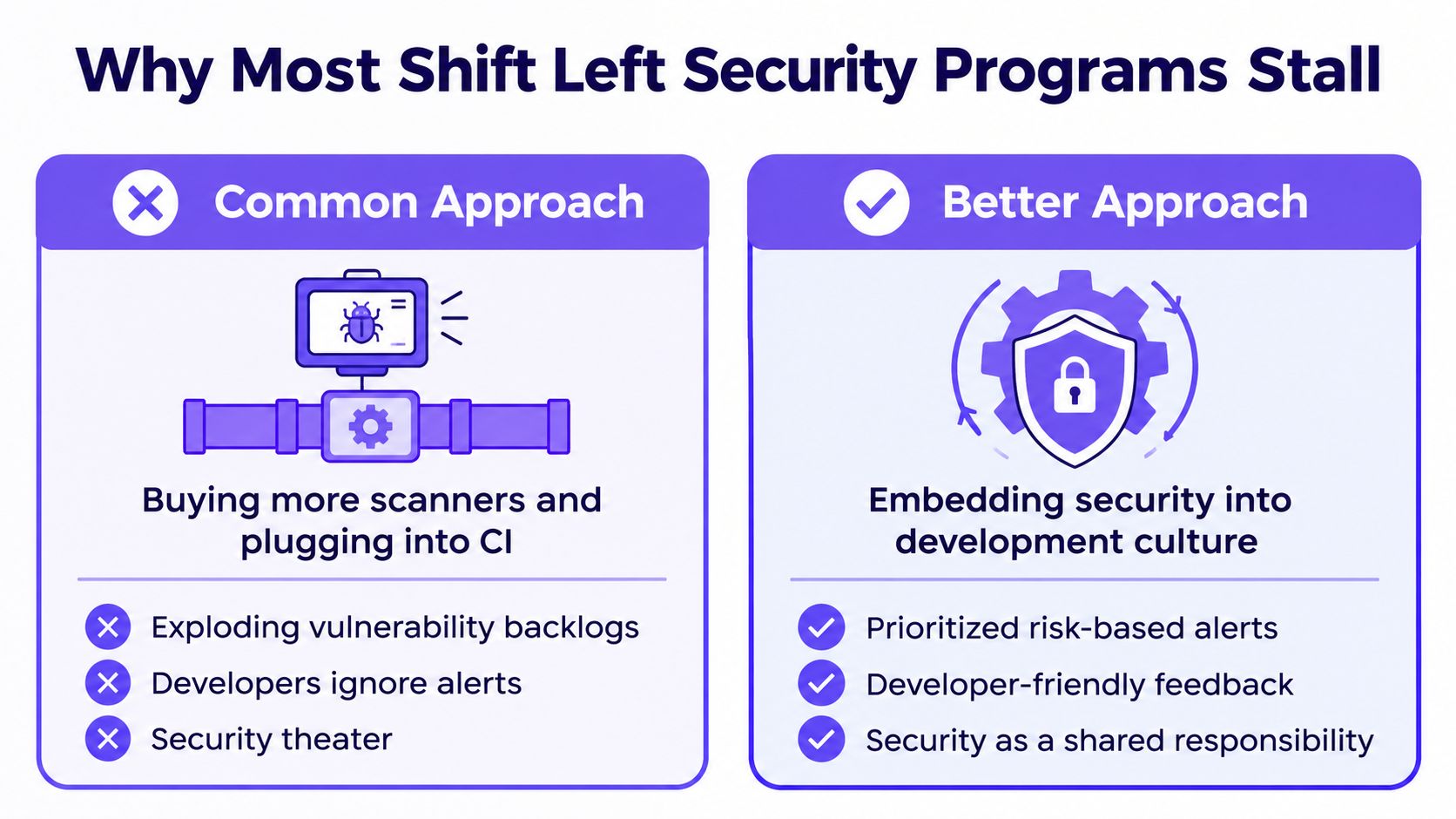
Buying more scanners isn't the same as shifting security left. A team can run SAST, SCA, secret scanning, container analysis, and policy checks on every pull request, yet still ship the same risks if developers can't tell which findings matter, who owns them, or how to fix them without leaving the workflow.
Shift-left security works when security context travels with the change. That means threat modeling during planning, feedback inside developer tools, ownership attached to findings, and enforcement that reflects an approved design decision. Earlier detection matters, but detection without remediation is just earlier logging.
Why Most Shift Left Security Programs Stall
Shift-left programs stall when they optimize for scan coverage instead of execution. An organization can connect several security tools to CI, enable broad rulesets, and report more findings every quarter while developers still lack the context, ownership, or workflow support needed to resolve them. The pipeline produces evidence of risk, not necessarily less risk.
A survey of 250 security and engineering professionals found that 47% of organizations had implemented shift-left security. Yet 35% identified false positives as their biggest challenge, 31% said they couldn't integrate security tools into developer workflows, and 25% said developers were overloaded by vulnerability alerts (survey findings on shift-left security adoption). Adoption therefore says little about whether teams can act on findings consistently.
Coverage isn't ownership
A scanner can identify a vulnerable dependency. It cannot determine whether the affected path is reachable, assign the right owner, explain the required change, or record an approved exception. Those decisions require security context that stays current as the design and code change.
Programs lose momentum when findings appear in a separate portal, disconnected from the pull request, ticket, service owner, and release decision. Developers must reconstruct the situation manually. Urgent issues then compete with low-confidence alerts, exceptions accumulate, and AppSec spends its time requesting updates instead of reducing exposure.
Continuous threat modeling closes part of this gap. Reassessing trust boundaries, data flows, and abuse cases as a feature changes gives teams a current reason for each control. It also helps distinguish a real design risk from a scanner result that lacks a meaningful attack path.
Practical rule: A security finding should arrive with an owner, a reason it matters, and a next action.
Gates need guidance
A merge block can stop a risky change, but a block without remediation guidance creates delivery friction. Teams eventually weaken the gate, add broad suppressions, or work around it because release pressure remains real.
Use risk-based enforcement. High-confidence violations of explicit policy can block a merge. Lower-confidence findings can create review tasks, comments, or tracked backlog items. The developer should see the relevant code, affected asset, policy rationale, and resolution path in the tools already used for the change.
Shift-left security succeeds when continuous threat modeling supplies living context and in-workflow enforcement turns that context into an actionable decision. The goal is not to detect more issues. It is to help the person who understands the change fix the right issue before release.
The Case for Early Security Integration
Early security integration earns its place in the delivery workflow because design choices about authentication, authorization, data flow, and trust boundaries shape everything built afterward. Challenge those choices during planning, and the team can change direction before implementation creates dependencies across code, tests, infrastructure, and documentation.
Carnegie Mellon's Software Engineering Institute recommends an initial system-level risk assessment before the software development process begins (SEI guidance on early risk assessment). The cited research also frames the problem through defect volume: roughly 5% of software defects are security vulnerabilities, while code quality can range from up to 30 vulnerabilities per million lines of code in best-in-class code to as many as 300 per million lines in average-quality code. These figures do not justify chasing raw counts. They show why late discovery is inefficient. Security defects sit within a wider set of engineering defects, so a final review or penetration test forces specialists to examine more completed work and negotiate changes under greater delivery pressure.
Design decisions create rework
A new data store illustrates the difference between checking implementation and shaping the design. Input validation matters, but the team must also decide:
- Trust boundaries: Which services, users, and workers can call the store?
- Identity controls: How does the application authenticate and authorize each request?
- Data handling: Which fields require encryption, retention limits, or masking?
- Failure behavior: What happens when authorization, dependency, or policy checks fail?
If these decisions remain implicit, developers make local choices that can conflict with the system architecture. A late review may then require coordinated changes to source code, tests, infrastructure, and documentation. That work is harder to assign because ownership is spread across several teams, and the original design context may no longer be available.
| Phase Identified | Relative Cost Multiplier | Typical Remediation Time | Rework Scope |
|---|---|---|---|
| Planning and design | Lowest relative rework | Shortest practical cycle | Requirements, architecture, acceptance criteria |
| Coding and review | Moderate rework | Fits an active development cycle | Source code, tests, dependencies |
| CI/CD and pre-release | Higher coordination cost | Can affect release timing | Build configuration, infrastructure, release artifacts |
| Production | Highest operational disruption | Depends on incident and remediation scope | Deployed code, data exposure analysis, operations, customer communication |
The table uses qualitative comparisons because cost varies with architecture, ownership, regulatory obligations, and the vulnerability itself. The operating principle remains consistent: the earlier a team resolves a flawed design choice, the less surrounding work it has to revisit.
Early doesn't mean one-time
A kickoff review becomes stale as soon as the system changes. New integrations, altered data flows, permission changes, and infrastructure work can invalidate its assumptions.
Effective shift-left security pairs early analysis with explicit review triggers. A meaningful architecture change should refresh the threat model, update security acceptance criteria, and assign an owner for the resulting work. Continuous threat modeling keeps security context current, while in-workflow enforcement turns that context into a decision a developer can act on. A high-confidence policy violation may block a merge. A lower-confidence result may create a review task with the affected asset, rationale, and resolution path. Coverage alone does not reduce exposure unless the workflow helps the right owner fix the issue.
Embedding Security Into Planning and Development
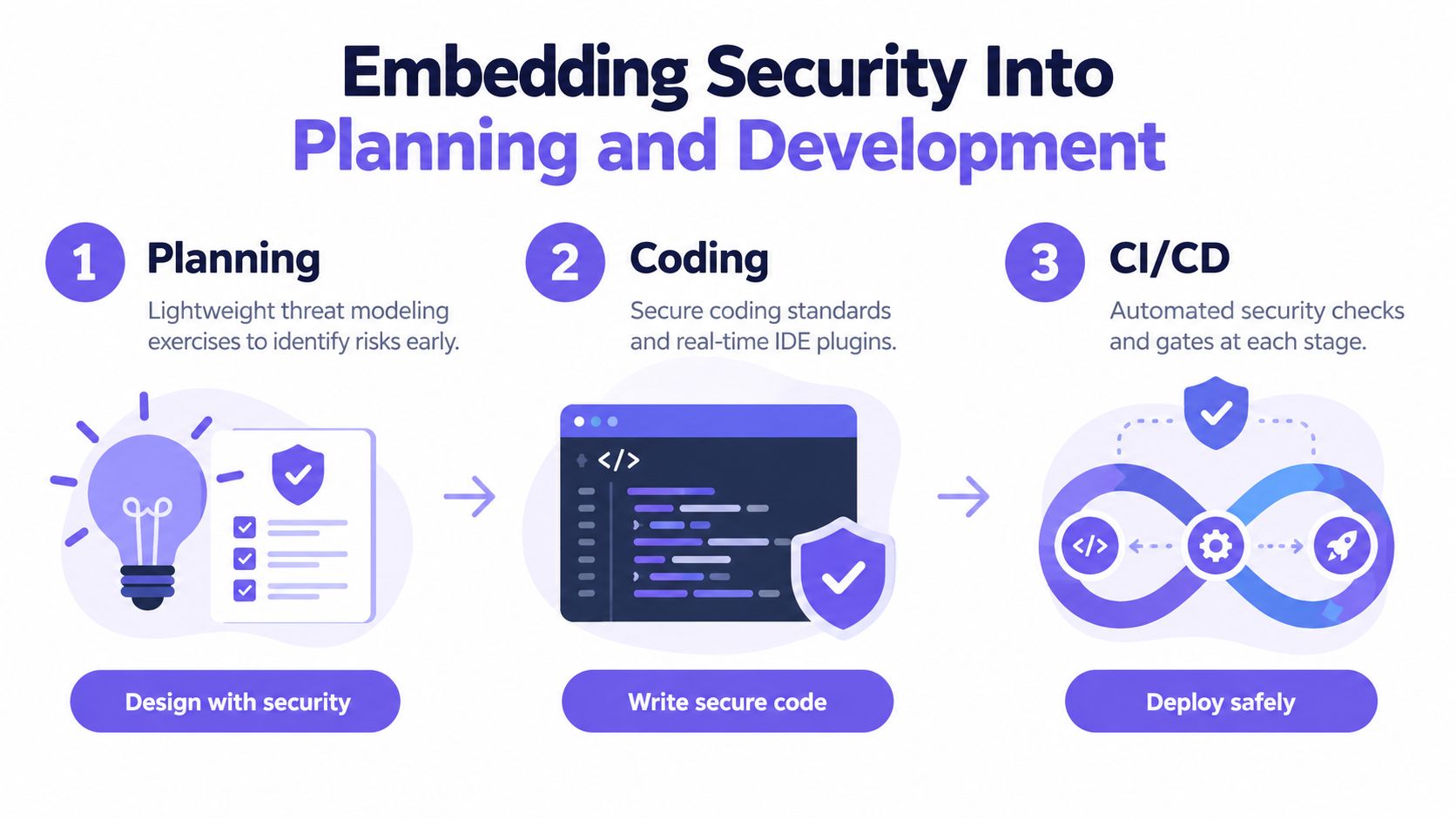
Security becomes practical when it appears at the same points where engineering already makes decisions. The strongest programs don't ask developers to visit a separate security process for every change. They attach security requirements to stories, code, pull requests, and deployment policies.
Start in planning
During story grooming, run a lightweight threat-modeling exercise for changes that introduce new assets, identities, integrations, or trust boundaries. STRIDE can help structure the conversation, while attack trees can clarify how an attacker might reach a sensitive operation.
Keep the output concrete. A useful story might include acceptance criteria such as:
- Authorization: Requests must verify the caller's permission for the specific resource.
- Secrets: Credentials must come from an approved secret-management path, not source code or configuration committed to the repository.
- Auditability: Security-relevant actions must produce the required audit record.
- Abuse resistance: The design must address relevant rate, replay, or enumeration risks.
Teams that want a broader process reference can use this Agile security integration guide to connect security activities with common Agile practices. The useful test is whether the requirement changes implementation behavior, not whether a document exists.
Continuous threat modeling can keep those decisions connected to changing tickets, designs, and repositories through in-workflow threat modeling. That connection matters when the implementation changes after the original review.
Meet developers in the editor
IDE feedback is valuable because it appears close to the authoring decision. SAST plugins can flag insecure patterns while a developer is working. Secret scanning can run through pre-commit hooks. Dependency checks can identify risky package changes before the pull request reaches the shared pipeline.
The feedback still needs restraint. Show the relevant line, explain the consequence, identify the rule, and offer a safe alternative where possible. AI-assisted coding adds another requirement: secure coding guidance should be available as context while the developer or coding agent generates the change, rather than arriving only after the code has been written.
Put controls in CI/CD
CI/CD should validate what planning and coding established. A practical pipeline commonly includes:
- Source and secret checks: Catch high-confidence insecure patterns and exposed credentials.
- SCA analysis: Evaluate dependency risk, license requirements, and whether a vulnerable component is reachable.
- Container and IaC checks: Review images, manifests, and infrastructure definitions against approved controls.
- Policy enforcement: Use policy-as-code with tools such as Open Policy Agent or Kyverno to express deployment and repository requirements.
- Actionable results: Post findings to the pull request or issue tracker with ownership and remediation context.
The guardrail should match the risk. Block a merge when a change violates a clear, high-confidence policy. Route uncertain findings to review, and make the exception process explicit, time-bound, and attributable.
Maintaining Living Security Context Across Changes
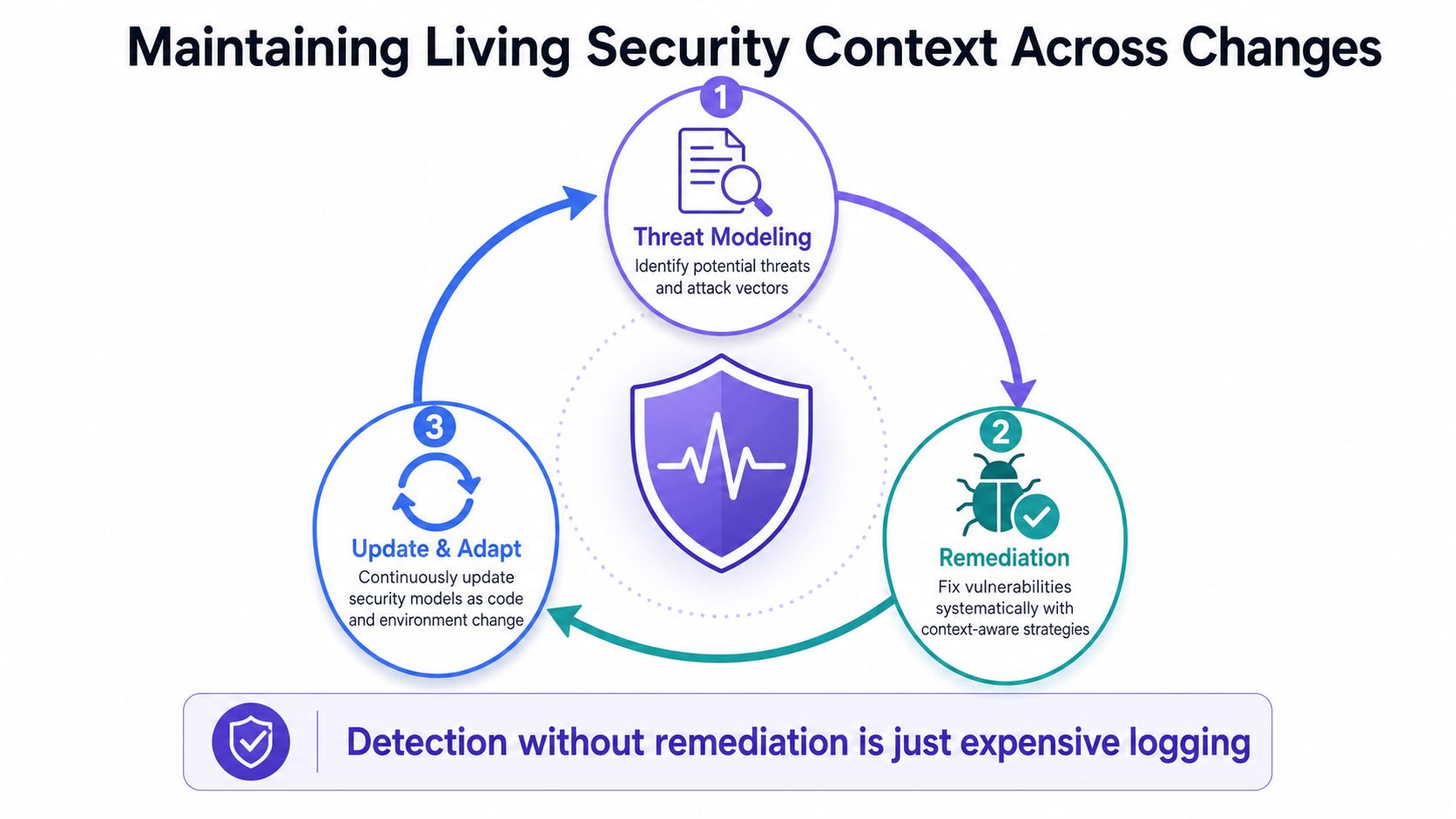
A threat model becomes operational only when it changes with the system. A static document can describe an approved architecture, but it won't automatically reflect a new service account, data flow, third-party integration, or AI-generated code path.
The practical unit of security context is a relationship between intent, implementation, and enforcement. Intent describes what the system is supposed to do. Implementation shows what the repository and infrastructure do. Enforcement checks whether the change remains within approved boundaries.
Version security decisions like code
Store threat-model artifacts, security requirements, and policy definitions alongside the work they govern. Link a model to the relevant Jira epic, repository, service, and deployment configuration. When a pull request changes a protected data flow, the review should surface the corresponding decision and ask whether the change still satisfies it.
Machine-readable annotations help preserve this context when teams change. An annotation can identify a data classification, trust boundary, required authentication method, or approved dependency behavior. The precise format matters less than consistency and traceability.
Policy-as-code tools such as OPA can turn those decisions into repeatable checks. The policy should explain not only what fails, but which design decision it protects. A developer is more likely to resolve a merge-time violation when the message connects the technical rule to a known requirement.
Detect drift between approval and reality
Implementation verification closes a gap that ordinary scanning often misses. A repository may pass a review while infrastructure later diverges from the approved baseline. Infrastructure-as-code checks and drift detection can flag changes to network exposure, identity permissions, storage settings, or deployment configuration.
The response shouldn't always be an automatic block. Some deviations require immediate prevention. Others need a review task with an owner and a reason. What matters is that the organization can distinguish an intentional change from an undocumented one.
Detection without remediation is just expensive logging.
A living model also needs lifecycle management. Retire obsolete threats, update assumptions, and preserve the decision trail for regulated teams. That produces more useful evidence than a folder of old review documents because it shows how security intent evolved with the system.
Overcoming False Positives and Alert Fatigue
Security tooling loses credibility when developers repeatedly investigate results that do not lead to action. False positives and excessive vulnerability alerts create pressure, weaken trust in scanners, and encourage teams to ignore or bypass feedback. Scan coverage alone does not solve that problem. Findings need clear ownership, useful context, and a workflow that supports a decision.
The practical goal is to separate detection from prioritization, then route each result to the right person and control.
Compare the failure modes
| Anti-Pattern | Effective Pattern | Measured Impact |
|---|---|---|
| Enable every SAST rule with identical severity | Tune rules by language, framework, confidence, and exploitability | Less distracting feedback and clearer developer action |
| Create tickets for every dependency alert | Prioritize by reachability, exposure, service importance, and ownership | Smaller queue of issues that require investigation |
| Block every merge on scanner output | Block high-confidence policy violations and route uncertain results to review | Stronger enforcement with less bypass pressure |
| Allow informal suppressions | Require documented, attributable risk acceptance with review dates | Exceptions remain visible instead of becoming permanent debt |
| Send findings only to a security portal | Comment in pull requests and IDEs, with links to the owning service | Fewer handoffs between security and engineering |
These impact descriptions are operational outcomes, not performance benchmarks. Measure results in the organization's own repositories because rule quality, application architecture, and risk appetite vary.
Tune each testing method differently
SAST works better with rules adapted to internal frameworks and secure coding patterns. A generic rule may flag a dangerous-looking function even when a local wrapper enforces the required control. Developers need a way to challenge the result, attach evidence, and request a rule improvement rather than suppressing it without notice.
SCA requires reachability and usage context. A vulnerable library that the affected application never loads should not receive the same treatment as an exposed component handling sensitive data. Prioritization should also include service ownership, deployment exposure, and whether a fix can be tested safely.
DAST belongs in environments where the application can be exercised realistically. Findings should identify routes, builds, and owners instead of arriving as anonymous endpoint alerts after a release candidate has formed. The result should enter the same remediation workflow as code and dependency findings.
For JavaScript-heavy repositories, teams can use this guide to JavaScript static analysis when tuning rules and deciding where inline feedback belongs.
Make exceptions part of governance
A suppression should record why the finding is not actionable, who accepted the risk, and when the decision must be revisited. It should also state whether the exception covers one location, a service, or an entire rule category. That context prevents temporary decisions from becoming invisible permanent debt.
Security champions can review disputed findings and recurring suppressions with the AppSec team. The review should produce concrete changes, such as refining a rule, improving remediation guidance, or changing where enforcement occurs. Continuous threat modeling adds another control: when architecture or data flows change, teams can reassess whether an old exception still reflects the system's current risk.
Feedback must stay inside the developer workflow. Pull requests, IDEs, and issue trackers give engineers a place to act, while ownership and review dates keep unresolved decisions visible. That connection turns scanner output into accountable remediation rather than another unattended queue.
Metrics That Prove Shift Left Impact
Raw finding counts rarely prove that a shift-left program is working. A higher total may reflect stronger detection, poorer code quality, duplicate alerts, or a newly enabled scanner. Useful metrics connect security activity to developer action, delivery performance, and the risk that remains after release.
Measure outcomes instead of activity
Track four categories:
- Remediation velocity: Measure the time from detection to a validated fix, segmented by severity, owner, repository, and lifecycle phase.
- Prevention: Record where issues were found, including design, coding, CI/CD, pre-release, and production.
- Feedback efficiency: Track scan duration, queue time, pull-request wait time, and the share of findings that receive a developer action.
- Residual exposure: Count high-risk issues that reach production and remain unresolved through the release process.
A useful dashboard answers two separate questions. Can security work fit the team's delivery cycle? Is unacceptable risk reaching production? Engineering leaders need the first answer, while CISOs need the second. Combining them into one vanity metric hides the trade-off between fast feedback and effective risk reduction.
Use evidence already in the delivery system
CI/CD logs show scan duration and pipeline impact. Pull-request data exposes review latency, rework, and merge outcomes. Issue trackers provide assignment, status, exception, and remediation timestamps. Production telemetry can show whether a finding affected a deployed asset, but runtime evidence should complement design and code controls rather than replace them.
Scan cadence matters only when developers can act on the feedback. As noted earlier, faster checks can support more frequent validation, while long queues and slow scans encourage teams to defer or bypass security work. Measure whether findings enter an owned workflow and receive a decision, not merely whether a tool ran.
| Metric Category | KPI | Target Benchmark | Data Source |
|---|---|---|---|
| Remediation velocity | Time to validated fix by severity | Improve from the team's baseline | Issue tracker and pull requests |
| Prevention | Findings resolved before production | Increase over successive releases | Scanner history and deployment records |
| Feedback efficiency | Scan and review wait time | Keep within the team's normal development flow | CI/CD telemetry |
| Residual risk | High-risk findings reaching production | Reduce and investigate exceptions | Release system and runtime inventory |
| Context quality | Findings with owner and remediation rationale | Make ownership and rationale standard | Security platform and repository metadata |
Metrics should also test whether security context stays current. Track the share of findings with an owner, affected asset, remediation rationale, and current threat-model reference. A finding without that context may inflate coverage while contributing little to actual risk reduction.
Teams seeking a broader framework can consult this application security posture guide. Establish a baseline, select a small set of defensible measures, and review trends with engineering. The goal is to show that continuous threat modeling and in-workflow enforcement turn detection into completed remediation, rather than another queue of unresolved alerts.
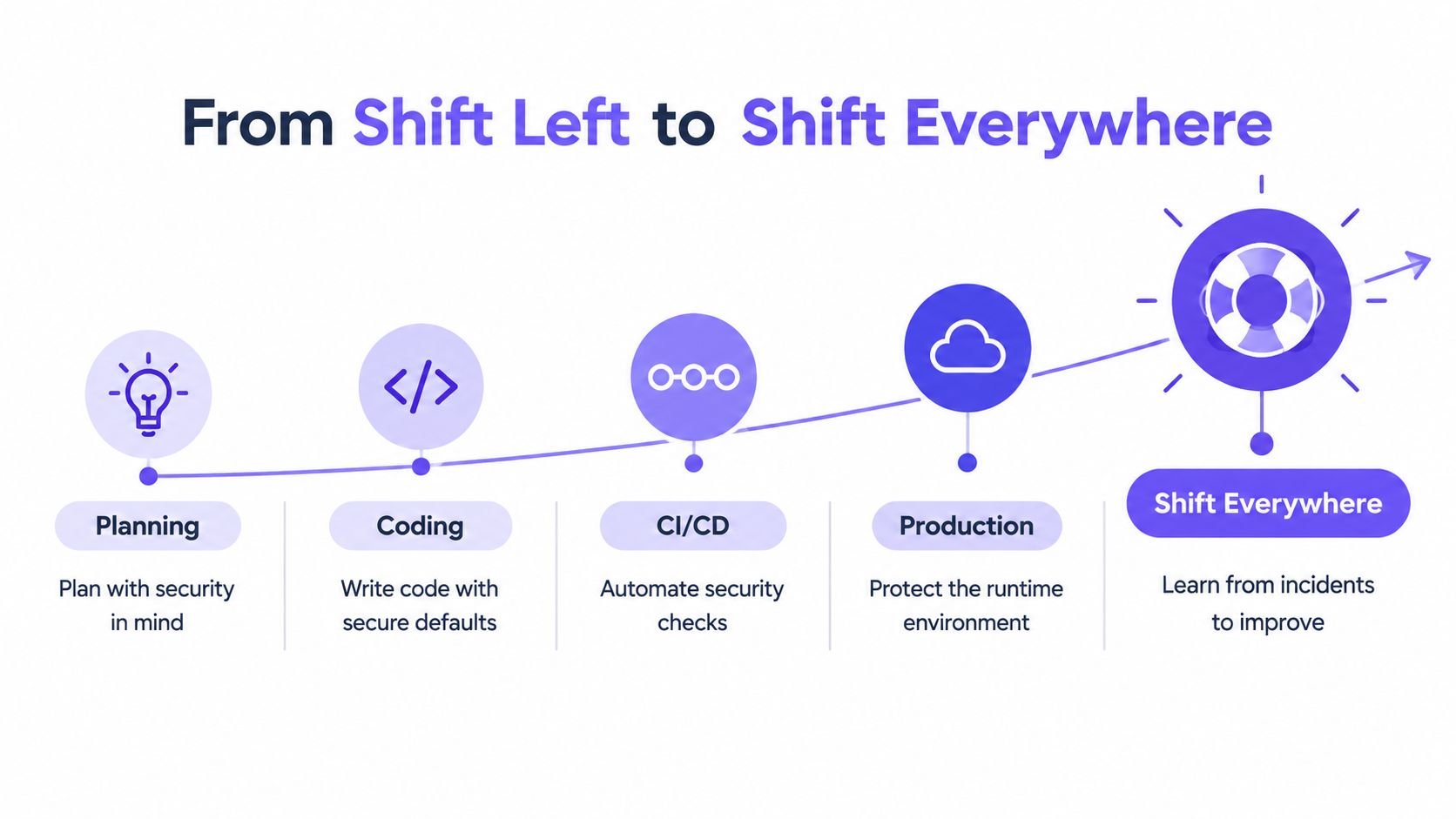
From Shift Left to Shift Everywhere
Shift-left security corrected a real failure in software delivery, but it becomes another silo when teams treat production as someone else's problem. A design can be approved, code can pass CI, and the deployed system can still develop new exposure through configuration changes, dependency updates, identity drift, or incident-driven discoveries.
A shift-everywhere posture carries security context through planning, coding, CI/CD, production, and incident response. Earlier controls remain important, while runtime signals and incident lessons update the assumptions that shaped those controls.
Keep context attached to the lifecycle
A mature workflow connects:
- Planning: Threats, assets, trust boundaries, and security acceptance criteria.
- Coding: Secure defaults, IDE feedback, secret prevention, and agent guidance.
- CI/CD: Reachability-aware analysis, dependency controls, infrastructure checks, and policy enforcement.
- Production: Runtime exposure, configuration drift, identity behavior, and deployed asset inventory.
- Incident response: Lessons that update threat models, controls, tests, and developer guidance.
AI-assisted coding makes this continuity more urgent. A coding agent can generate a plausible implementation that doesn't match the approved trust boundary or data-handling requirement. Static scans may catch some patterns, but they won't necessarily know which design decision the code violates. Secure prompting context, repository policies, and merge-time verification give the agent and reviewer a more precise boundary.
Regulated teams also need more than a final scan report. They need to reconstruct why a design was approved, which controls applied, who reviewed an exception, and how implementation matched the decision. Persistent security metadata can support that evidence without requiring engineers to recreate the entire history during an audit.
Build maturity without a big-bang program
Start with one high-value workflow, such as authorization changes in a regulated service. Add a threat-model trigger during planning, surface requirements in the repository, enforce them in pull requests, and connect the result to deployment and incident records.
Then measure whether ownership improved, remediation became faster, and developers received fewer irrelevant interruptions. Expand only after the workflow is reliable. A scanner added everywhere produces broad activity. A context-aware control that developers trust produces repeatable risk reduction.
DevArmor provides continuous threat modeling, security design reviews, and policy enforcement across planning, coding, source control, and pull requests, with security context intended for developers and coding agents. For teams that need to connect approved design decisions to implementation and maintain audit-friendly records, it's one option for making shift-left practices persistent rather than point-in-time.
Start by mapping one workflow where security findings regularly stall, then connect its threat model, owner, remediation path, and merge-time policy. Visit DevArmor to evaluate how continuous threat modeling and in-workflow enforcement can keep security context current as your code and delivery process change.
Related reading
- Application Security Automation That Actually Ships — automating testing, policy enforcement, and threat modeling across delivery.
- SDLC Cyber Security: Embedding Controls Across Every Phase — practical controls for each development phase.
- Secure Code Review Best Practices: A Complete Guide — policy-as-code and reviewer strategies that scale.
Table of Contents
Subscribe