SDLC Cyber Security: Embedding Controls Across Every Phase
 Reza Khosravi
Table of Contents
Most advice about SDLC cyber security still assumes a stable sequence: a human writes code, a reviewer checks it, scanners run, and a security team approves release. That model was never sufficient, and AI-assisted development has made its limits impossible to ignore. A coding agent can generate a complete component, introduce a dependency, alter authorization logic, and open a pull request before the security context behind the change has been updated.
The answer isn't to add another late-stage scanner or schedule more review meetings. Security has to travel with requirements, architecture, tickets, repositories, pull requests, deployments, and the agents producing code. The practical question is no longer whether a team has an SDLC checklist. It's whether the controls remain accurate and enforceable while the system changes.
Why Traditional SDLC Security Is Failing Modern Teams
A team can run SAST, dependency scanning, and a release review, then ship an authorization defect in the same deployment. The controls inspect artifacts at specific moments, but they may not know why the change was made, which trust boundary it crosses, whether the approved design still applies, or what instructions an AI coding agent followed.
The human-authored code assumption
Traditional workflows place human judgment at the center of code review. That judgment still matters, but AI-generated code changes the volume, origin, and shape of the work. A developer can accept an implementation that looks idiomatic while missing a subtle authorization failure, an unsafe default, or a dependency that does not exist as described.
Independent 2025 reporting found security problems in 45% of AI-generated code tasks (Cloud Security Alliance research on AI-generated code security). The figure does not mean every generated line is unsafe. It shows why familiar-looking code cannot be treated as evidence of meaningful security review.
The failure modes extend beyond ordinary coding mistakes:
- Prompt injection can alter an agent's instructions or retrieved context.
- Hallucinated dependencies can direct developers toward nonexistent, unmaintained, or unsuitable packages.
- Over-privileged agents can change repositories or deployments with access broader than the task requires.
- Stale assumptions can make generated code follow an old architecture or policy.
A scanner may find a vulnerable function after generation. It will not determine whether the agent should have been permitted to create that function, whether the threat model covers it, or whether the pull request violates a design constraint. Those decisions require context connected to the repository, ticket, and change.
Why gates lose their value
A periodic security gate works best when it evaluates a bounded change against current requirements. It weakens when teams use it to compensate for missing context. By the time a reviewer receives a large pull request, the architecture may have changed, the ticket may have been rewritten, and the model may describe a system that no longer exists.
The problem is operational as much as technical. Industry reporting found that 60% of organizations lack formal processes to assess vulnerabilities or errors in AI-generated code. Teams need controls inside the generation and review workflow, rather than only after an agent has produced a large batch of code.
Continuous deployment adds another failure point. A threat model stored in a document can remain technically correct while the repository, tickets, and deployment configuration drift away from it. Security context must update with those changes or enforcement will judge new work against obsolete assumptions.
Practical rule: Treat generated code as an untrusted contribution with machine-readable provenance, not as ordinary code that merely arrived faster.
Modern SDLC cyber security therefore needs three connected capabilities: security requirements attached to work, threat models synchronized with system changes, and enforcement that can block or redirect unsafe changes before deployment. Scanning still matters, but it cannot carry the process alone.
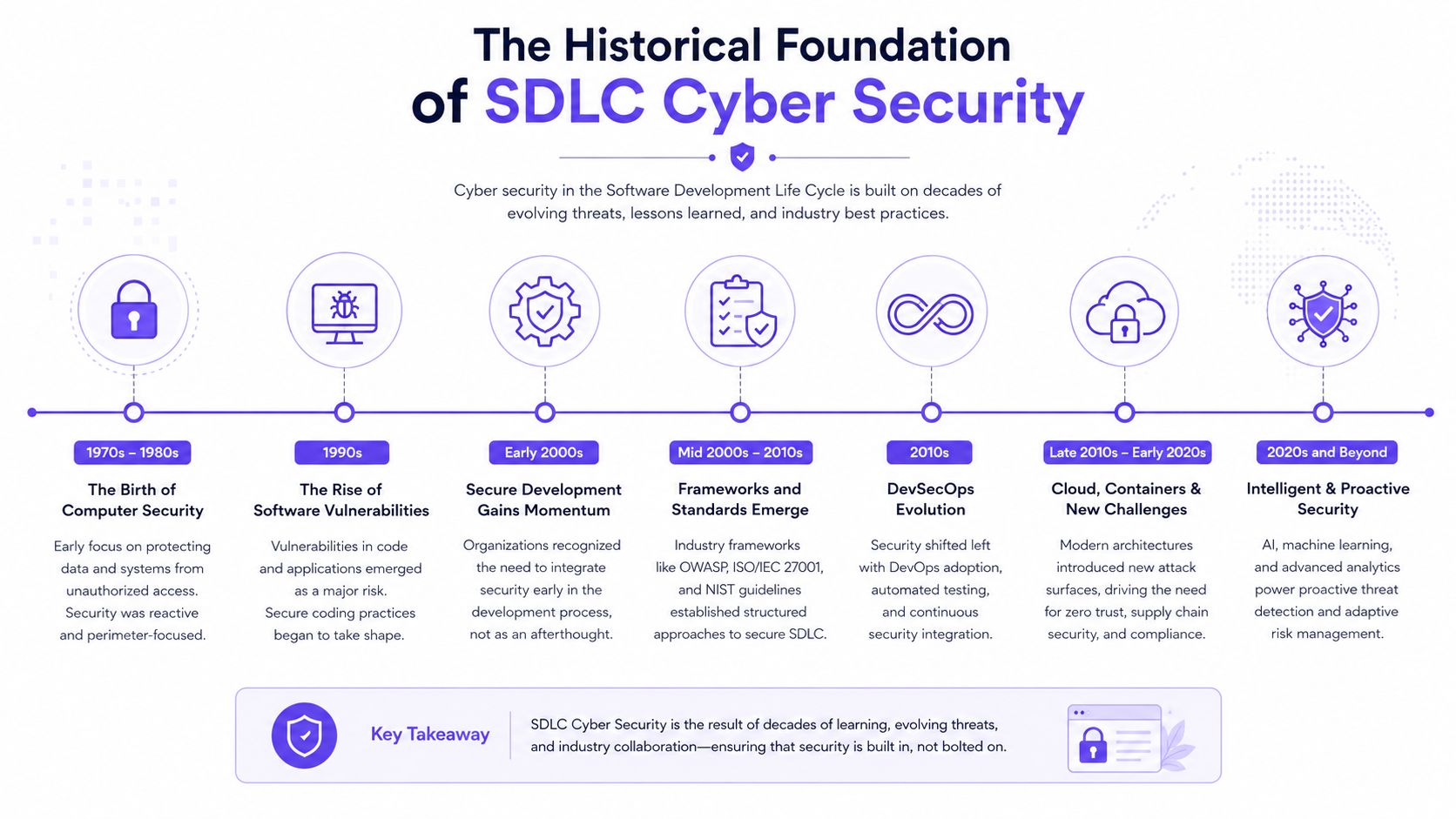
The Historical Foundation of SDLC Cyber Security
The strongest modern practices grew from a simple correction to ad hoc security checklists. Security shouldn't appear only after implementation. It should be planned, designed, tested, operated, and eventually retired as part of the system lifecycle.
NIST's foundational SDLC guidance formalized that approach through five lifecycle phases: initiation, development and acquisition, implementation and assessment, operations and maintenance, and disposal. It mapped security tasks to each phase, including security planning, information-system categorization, privacy-impact assessment, risk assessment, security architecture, documentation, and developmental, functional, and security testing. The framework made security a governance practice with assigned activities rather than an informal responsibility left to the final reviewer. (NIST foundational SDLC guidance.pdf))
From lifecycle guidance to measurable outcomes
Microsoft's Security Development Lifecycle supplied a widely cited operational benchmark for shifting security into design, coding, and verification. Microsoft reported a 70% reduction in security bugs found at code review and a 99% reduction in reported vulnerabilities from external attackers after adoption (NIST Secure Software Development Framework). These results are historically important because they connected process discipline with outcomes. Threat modeling, secure coding requirements, verification gates, and response practices worked together rather than operating as isolated tools.
The lesson isn't that every organization should copy Microsoft's implementation. Large engineering organizations have resources and operating conditions that smaller teams may not share. The transferable principle is earlier intervention. A design decision that prevents an unsafe trust relationship is usually more useful than a late finding that merely describes the resulting defect.
The SSDF updates the lifecycle logic
NIST's Secure Software Development Framework, SSDF SP 800-218, published in 2022, organizes secure development into four practice groups:
- Prepare the Organization, by establishing people, processes, and policies.
- Protect the Software, by securing source code, tools, and release artifacts.
- Produce Well-Secured Software, through requirements, design, implementation, and verification.
- Respond to Vulnerabilities, by handling issues discovered after release.
The structure modernizes the language without abandoning the lifecycle principle. Security starts before code exists, continues through implementation and release, and remains active during operations. AI-native teams need to extend that logic to agent permissions, generated-code provenance, prompt context, and continuously changing design evidence.
Security Controls Mapped to Each SDLC Phase
A useful control map assigns four things to every phase: the security decision, the person responsible, the evidence produced, and the point where a violation can stop progress. Without all four, teams often create documentation that nobody consults or alerts that nobody owns.
Initiation and requirements
Start by identifying the system's purpose, data, users, integrations, and security obligations. Product and engineering leaders should define security requirements alongside functional requirements, while security and privacy specialists assess risk, data handling, and privacy impact before architecture choices become expensive to reverse.
Capture requirements in the work system, not only in a separate document. A ticket should state authentication expectations, authorization boundaries, retention requirements, logging needs, and prohibited behaviors in language that can later support pull-request checks.
Design
Threat modeling belongs in design because architecture and data-flow changes are still comparatively cheap before implementation. A practical review defines security requirements, represents the system with data-flow diagrams and trust zones, identifies threats using approaches such as STRIDE and relevant weakness knowledge bases, and prioritizes mitigations for implementation and testing (MITRE threat-modeling guidance).
The output shouldn't be a meeting note that becomes stale. Record decisions such as which service may access a data store, where trust boundaries exist, how identities are propagated, and which abuse cases require explicit tests.
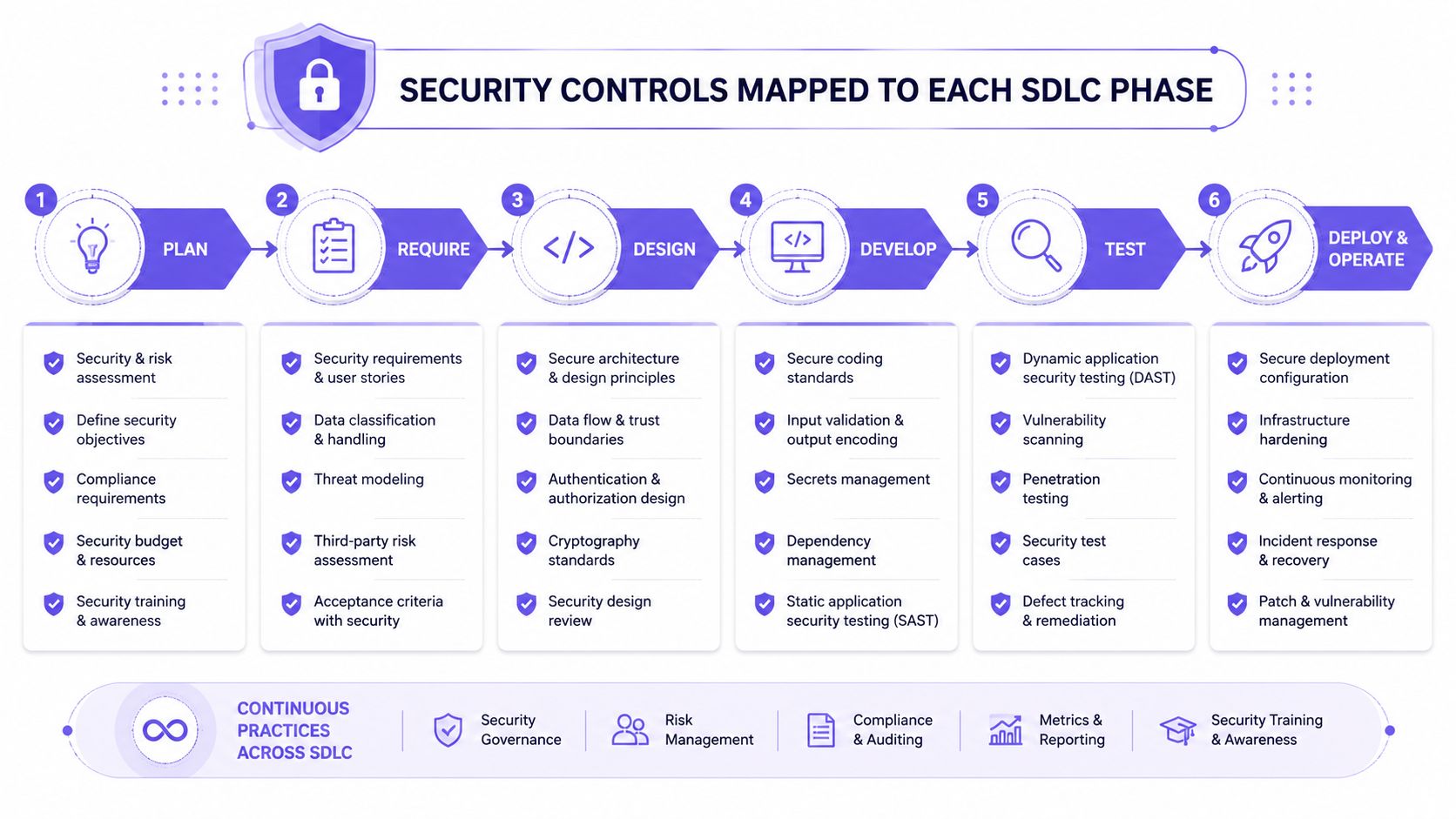
Development and implementation
Developers need secure coding standards that apply to the languages and frameworks they use. Peer review should verify behavior against the approved design, not just search for suspicious syntax. For AI-generated changes, require provenance, limit agent permissions, and make the relevant security requirements available in the IDE or coding workflow.
Use policy-as-code for repeatable conditions, such as prohibited secrets, unsafe dependency sources, missing ownership, required reviewers, or changes to protected components. Keep exceptions explicit, time-bound, and attributable.
Assessment, operations, and disposal
Testing should combine developmental, functional, and security checks. SAST, dependency analysis, infrastructure checks, dynamic testing, and targeted abuse-case tests each reveal different classes of failure, but none replaces architectural review.
Operations teams need monitoring, vulnerability triage, patch decisions, and incident response tied back to the original service and owner. Disposal requires revoking access, removing data and credentials, and preserving the evidence needed to demonstrate that the system was retired safely. The lifecycle ends only when its operational trust relationships have been dismantled.
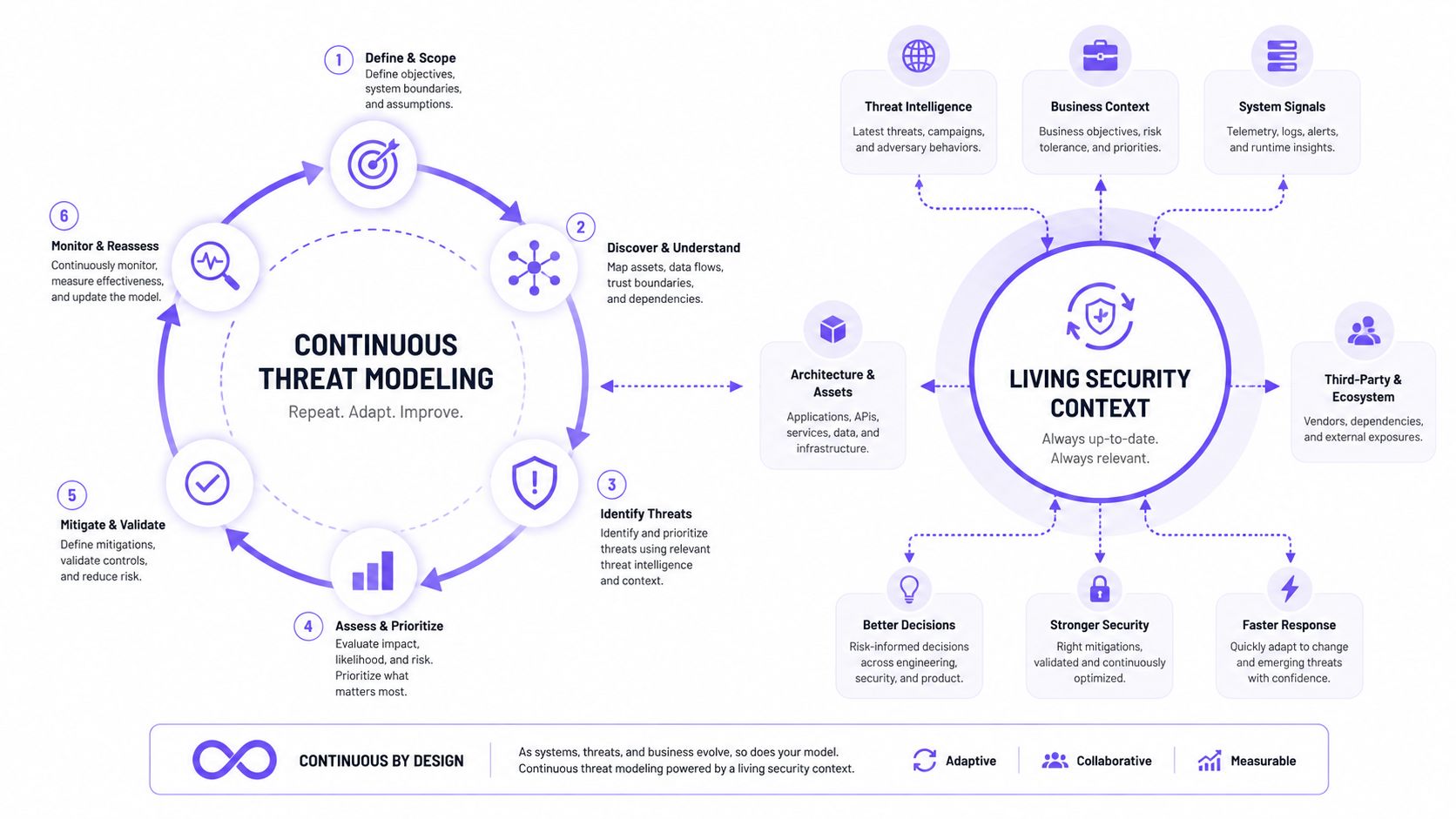
Continuous Threat Modeling and Living Security Context
A threat model becomes unreliable when it describes yesterday's repository. Modern teams change tickets, APIs, infrastructure, dependencies, and deployment paths continuously. A review held at project kickoff can't remain authoritative unless the organization connects its decisions to the artifacts that change afterward.
From scheduled workshops to synchronized evidence
Manual workshops still have a place for complex architectural decisions. They fail when teams treat them as the only update mechanism. A living model should draw evidence from design documents, planning tickets, repositories, service metadata, pull requests, and deployment changes. When an important relationship changes, the system should identify the affected security decision and request the right level of review.
This doesn't mean generating a diagram and calling it threat modeling. The model must preserve reasoning. It should show which asset is protected, which actor or service can reach it, what assumption justifies that access, and which control verifies the assumption.
A 2025 research summary cited a 37.6% increase in critical vulnerabilities after five agent iterations without continuous embedded security checks (Splyce agentic security report.pdf)). The specific operational lesson is broader than the number. Repeated automated changes need security feedback inside the loop, because a later review may not reconstruct every decision that influenced the result.
Linking models to implementation
Implementation verification closes the gap between approved design and delivered code. A pull request that changes authentication, data access, or an external integration should be evaluated against the threat model and requirements associated with that component. If the change violates a policy, the workflow can request remediation or block the merge.
Teams designing this operating model can use continuous threat modeling practices as a reference point for keeping repositories, tickets, and security decisions connected. The important design principle is portability. Developers shouldn't need to leave GitHub, Jira, VS Code, or their coding-agent interface to understand why a control applies.
Security context is useful only when a developer can act on it before the change becomes expensive to undo.
Auditability improves as a side effect of synchronization. The organization can show the decision, the affected change, the review outcome, and the deployment relationship without reconstructing the history from scattered meetings and chat messages.
Enforcement Mechanisms That Actually Work
Security controls work best at moments when developers already make decisions. Pull requests, dependency updates, infrastructure changes, and agent actions are natural enforcement points. A control that appears there can guide behavior. A control that arrives in a separate queue after deployment often becomes another item in a backlog.
Point-in-time review versus embedded enforcement
A final security review can provide valuable independent judgment, especially for high-risk systems. It also creates a bottleneck when every change waits for the same specialists. Embedded controls distribute routine checks while preserving escalation for changes that require deeper analysis.
A large-scale study of modern code review found a negative relationship between pull-request review and reported security bugs, supporting mandatory peer review, merge policy checks, and traceable approvals as practical SDLC controls (Promise and Peril of Pull Requests). The study doesn't justify treating review as a complete security program. It supports putting review where developers already collaborate and making the outcome enforceable.
Useful enforcement patterns include:
- Pull-request policy checks: Evaluate ownership, required approvals, security requirements, changed trust boundaries, and prohibited patterns before merge.
- Selective blocking: Block high-confidence violations, while routing ambiguous findings for human review instead of stopping every change.
- Agent guardrails: Restrict tools, repositories, credentials, and permitted actions based on task scope.
- Traceable exceptions: Record who accepted a risk, why it was accepted, and when the decision must be revisited.
- In-workflow feedback: Surface findings in GitHub, Jira, VS Code, Cursor, or the system where the developer is already working.
Teams also need operational detection after release. Guidance on best practices for anomaly detection can help security engineers connect development controls with runtime signals, so unusual behavior informs future requirements and threat models.
For organizations evaluating automation, automated security reviews describe an approach that ties review outcomes to policies and design decisions rather than producing an unprioritized scanner queue. DevArmor is one option in this category, providing continuous threat modeling, workflow-based security design reviews, pull-request policy enforcement, implementation verification, and guardrails for AI-assisted coding.
Meeting Compliance Requirements in Regulated Industries
Regulated teams need more than evidence that a scanner ran. They need to demonstrate how security requirements were defined, who approved design decisions, how controls were tested, how exceptions were handled, and whether the delivered system still matches the approved architecture.
Static documentation creates a predictable problem. Architecture diagrams age, threat models remain attached to old tickets, and compliance teams launch preparation sprints to reconstruct decisions that should have been captured during delivery. The result is expensive evidence collection and weak confidence that the documents reflect production reality.
Make evidence a byproduct of delivery
A living security context can generate audit-friendly artifacts as work happens:
- Architecture records show services, data flows, trust zones, and ownership.
- Decision records connect security requirements to approved design choices.
- Review traces show pull-request approvals, policy outcomes, and exceptions.
- Verification evidence links implementation checks to deployments and affected controls.
- Response records preserve vulnerability handling and remediation decisions.
This structure supports SOC 2, ISO 27001, and comparable governance programs without pretending that a tool alone creates compliance. Organizations still need suitable policies, accountable control owners, risk treatment, access governance, and independent assessment. The advantage is that the evidence is connected to engineering activity rather than produced after the fact.
Auditability without freezing delivery
FinTech and HealthTech teams face a difficult trade-off. They can't weaken controls to match rapid delivery, but they also can't route every small change through a meeting-heavy approval process. Risk-based enforcement gives low-risk changes a fast path and escalates architectural or data-sensitive changes.
Teams beginning the compliance journey can use this practical guide on how to get SOC 2 certified to understand the broader certification process. For SDLC security, the key is to map each relevant control to an artifact that engineers already produce, then preserve the relationship as repositories and tickets evolve.
The standard for a regulated pipeline should be reconstruction. An auditor, incident responder, or new service owner should be able to determine what was approved, what changed, which control applied, and why the release was permitted without relying on one person's memory.
Modernizing Your SDLC Security Practice
Modernization starts with an inventory of enforcement points, not a shopping list of scanners. Map where requirements are written, where architecture is reviewed, where agents generate changes, where pull requests are approved, and where deployments can be stopped. Mark every place where security depends on a manual handoff.
A practical sequence
Measure the current workflow. Identify stale threat models, recurring review delays, unowned findings, and controls that run only after release. Treat these as process defects, not merely tooling gaps.
Attach requirements to work. Put authentication, authorization, privacy, data-flow, logging, and dependency expectations into tickets and design records. Use stable identifiers so a pull request can reference the relevant decision.
Create a living model. Refresh security context when repositories, tickets, service metadata, and design documents change. Start with high-risk systems and expand after the team understands false positives and ownership.
Enforce at pull request. Use policy-as-code for deterministic rules, require appropriate reviewers, and block only violations with enough confidence to justify interruption. Preserve every approval and exception.
Secure agent workflows. Limit permissions, provide current architectural context, inspect generated dependencies, require tests for security-sensitive behavior, and prevent agents from merging their own unreviewed changes.
Close the deployment loop. Tie approved decisions and implementation verification to the deployed service. Feed runtime anomalies and post-release findings back into requirements and models.
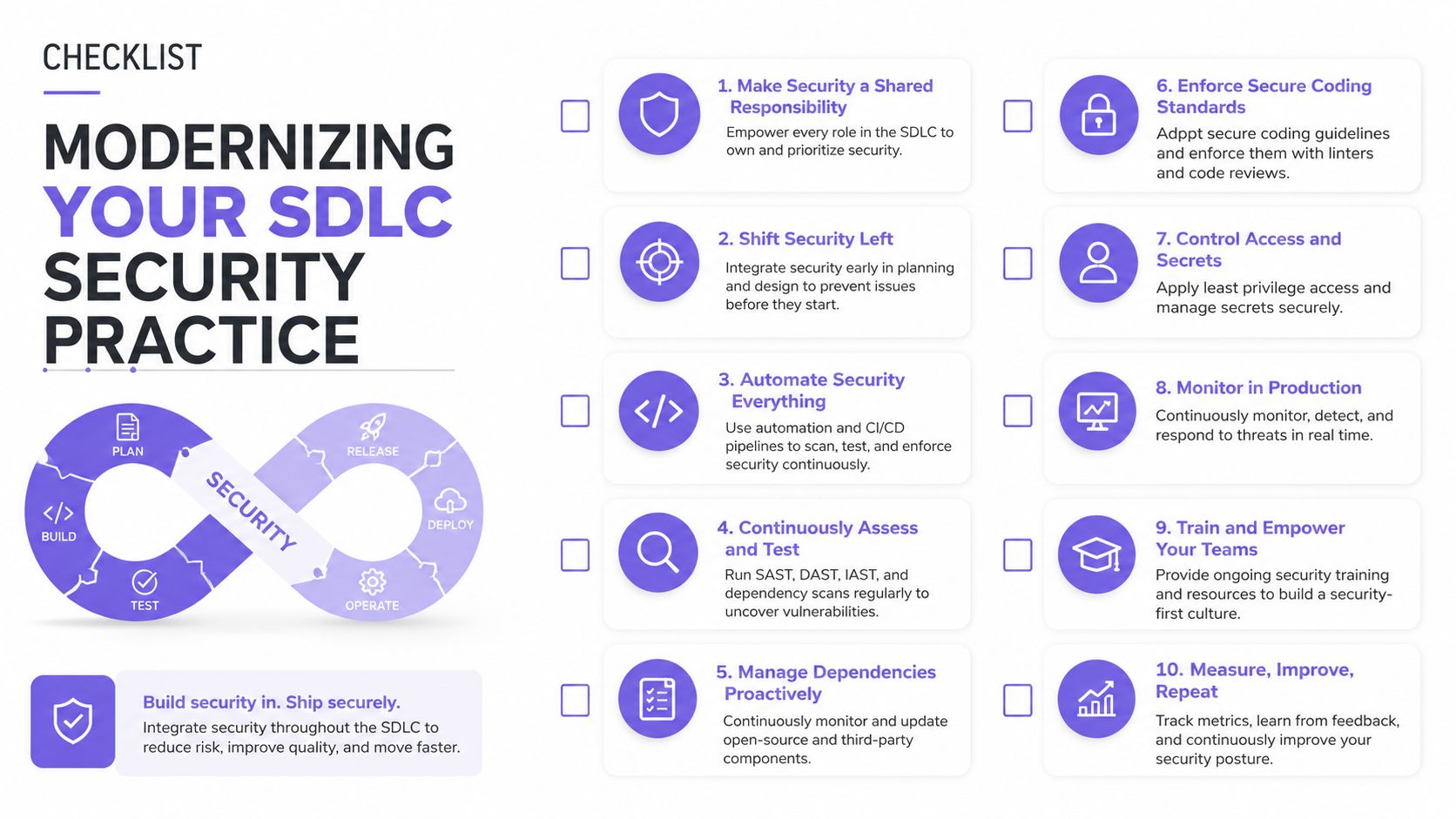
Track whether security decisions stay current, whether high-risk changes receive the right review, whether exceptions remain visible, and whether developers can resolve findings without leaving their workflow. Teams can use this SDLC implementation checklist to organize the transition from static documents to connected controls.
The target isn't maximum friction. It's continuous, proportionate enforcement that gives developers useful context before they commit to an unsafe design or merge an unsafe change.
DevArmor connects continuous threat modeling, security design reviews, implementation verification, and pull-request policy enforcement across the software delivery lifecycle. Visit DevArmor to see how living security context can support developers and AI coding agents while producing traceable evidence for regulated environments.
Related reading
- Secure Code Review Best Practices: A Complete Guide — policy-as-code and reviewer strategies that scale.
- Security Development Lifecycle Explained for Modern Teams — how the SDL evolved and what it looks like today.
- What Is Threat Modeling and Why It Matters in 2026 — from static diagrams to continuous security context.
Table of Contents
Subscribe