Application Security Posture: A Complete Guide
 Reza Khosravi
Table of Contents
Most Monday mornings in application security start the same way. A security lead opens a dashboard, sees a green CI pipeline, maybe a clean SCA report, and a stack of scanner findings that look manageable on paper. Then the CTO asks the one question the dashboard can't answer cleanly, which applications are safe to ship, and the room goes quiet.
That gap is why application security posture matters. Teams often have plenty of findings, but not a defensible view of the portfolio, the control coverage behind those findings, or the residual risk that still needs a decision. The harder truth is that posture is shaped long before a scanner runs, by what's in the inventory, what was decided in design, and what the organization has agreed is acceptable risk.
Why Application Security Posture Is Harder Than It Looks
A lot of teams think posture is just a fancier word for scan results. If the scanner came back clean, the app must be in good shape. If the dashboard is red, the posture must be bad. That shortcut breaks down fast once you have multiple repositories, shared services, APIs, and exceptions that live in different systems.
The problem starts upstream. A posture view is only as good as the inventory it sits on, and most organizations don't have a single, authoritative picture of what they run. That's why the 2016 survey is still relevant, it found that 57% of respondents said lack of visibility into the application layer was the main barrier to a strong application security posture, and 63% said application-layer attacks were harder to detect than network-layer attacks, while 67% said they were harder to contain. The same survey also reported that organizations devoted only 18% of IT security budget to application security on average, compared with 39% for network security, and that respondents estimated an average of 1,175 applications, with 33% considered mission-critical. Those figures show the scale of the coordination problem, not just the tooling problem. See the original survey context in the 2016 application security posture research summary.
Practical rule: if you can't name the owning team, the data class, and the exposure of an application, you don't have posture yet, you have findings.
Why scanners alone mislead
Scanner output is useful, but it's only one slice of the picture. A vulnerability in dead code is not the same as the same issue in an internet-facing payments service. A clean scan in a repo that nobody can confidently map to production can still leave you exposed.
That's why posture has to include design intent and business context, not just tool output. Management wants a clear answer to a different question than engineering does. Engineers want to know what to fix next. Leaders want to know which risks are acceptable, which ones are blocked, and which ones need an exception with an owner and an expiry.
The clean dashboard and the defensible posture are not the same thing. The rest of this guide turns that difference into something you can measure, govern, and audit.
What Application Security Posture Actually Means
Application security posture is the observable state of an application portfolio's design decisions, control coverage, and residual risk at a given moment. That sounds abstract until you compare it with the thing many teams already know. A single pentest, SCA scan, or DAST run shows a snapshot. Posture is the summary of many snapshots plus the context that tells you whether the result matters.
A credit score or a building inspection report. A credit score doesn't tell you every transaction, but it does synthesize history, current behavior, and risk judgment into one answer people can use. A building inspection doesn't just say the roof leaked once, it tells you whether the property is in acceptable condition for use. Posture plays that same role for an application portfolio.
The important distinction is that posture is a management artifact, not just a technical report. A customer, insurer, or auditor usually doesn't want the raw scanner feed. They want a defensible answer about what exists, which controls are in place, what remains risky, and who owns the next decision.
How it differs from network posture
Network posture is largely about exposure, perimeter configuration, and traffic control. Application posture goes deeper into code, dependencies, identity, build pipelines, secrets, and the decisions made during design. A firewall can be perfect and the application can still be brittle if the inventory is incomplete or the controls never made it into the delivery process.
The OWASP SAMM model makes that operational reality visible. It rates application security as one of the hardest IT security functions at 4.10/5, and only 42.2% of organizations have fully implemented secure coding and code review, which suggests weak posture is usually rooted in incomplete SDLC controls rather than one broken tool (OWASP SAMM model). That's the difference between “we ran a test” and “we built a reliable control environment.”
What a defensible posture answer sounds like
A strong answer sounds boring in the best way. You can say which applications are in scope, which controls are enforced, which risks are accepted, and which ones are blocked until fixed. You can also show the trail behind that answer.
That trail matters because posture isn't a static property. It's the current state of a living system, and the system changes every time code ships, an owner changes, or a dependency moves.
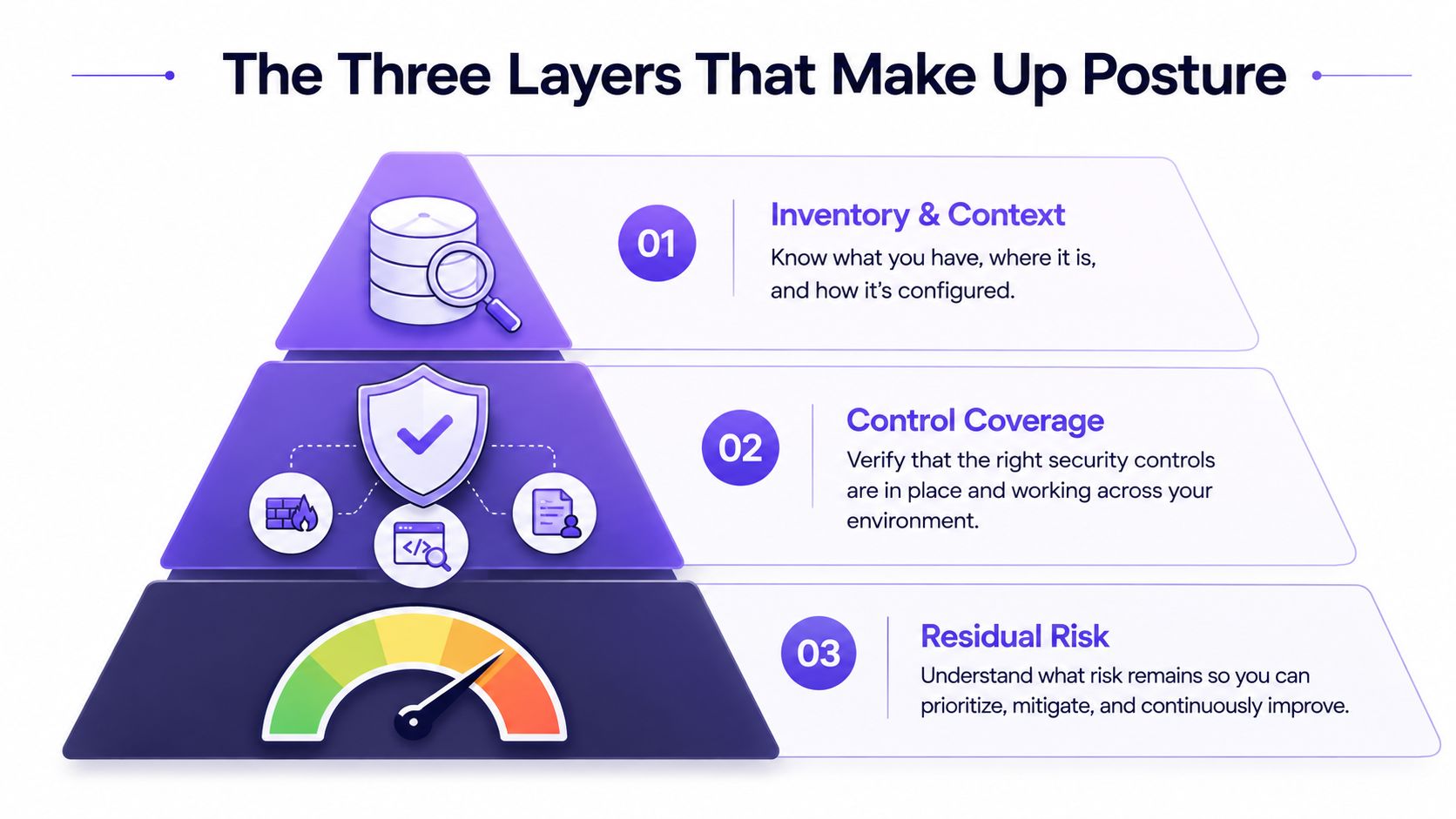
The Three Layers That Make Up Posture
Posture falls apart when teams flatten it into one number. They look at a scanner dashboard, see a low count of criticals, and assume the portfolio is healthy. In reality, a durable posture has three layers that have to line up: inventory and context, control coverage, and residual risk.
Inventory and context first
If you don't know what exists, the rest of the posture conversation is shaky. Inventory means more than a list of services. It includes ownership, data sensitivity, deployment status, exposure, and whether the application is tied to a critical business process.
That upstream context is what makes findings meaningful. A vulnerability attached to an internal sandbox shouldn't be treated the same way as the same issue in a payment API. Without context, the posture report turns into a counting exercise, and counting is not management.
Control coverage second
Control coverage asks whether the right safeguards are in place across the portfolio. That includes authentication, secrets handling, dependency hygiene, secure build steps, logging, and review gates. It's not enough to say a control exists somewhere in the program, it has to apply consistently where the risk lives.
Many teams fool themselves with partial success. A tool may catch insecure code in one repo, but if the build pipeline doesn't enforce the same rule in the next repo, the posture is fragmented. The 2025 ASPM research says 59% of security leaders believe today's attack surface is completely unmanageable, 63% think CISOs aren't investing enough in code security, and budgets were projected to grow by an average of 50% over the next 12 months (Cycode State of ASPM). That doesn't prove control failure on its own, but it does show how much pressure teams are under to keep coverage consistent at scale.
Residual risk is the output that matters
Residual risk is what remains after controls run. It should be prioritized by business criticality, exploitability, and exposure, not by raw scanner count. A posture conversation becomes useful to leadership, because it tells them what still needs a decision.
A good posture view doesn't just list problems. It tells you which problems are still allowed to exist.
A clean scanner dashboard can only tell you that some checks passed. A real posture model tells you whether the portfolio is safe enough to operate, and where that safety depends on a conscious exception.
How To Assess Posture and The KPIs That Matter
A posture assessment should be repeatable. If the result changes wildly each time you run it, the process is too loose to trust. Start with the inputs that can stand up to scrutiny, then force them into a consistent decision model.
- Current inventory. You need a current list of applications, APIs, owners, and business criticality.
- Control mapping. Map controls to known threats and to the application tiers they're supposed to protect.
- Recent incidents and exceptions. Pull in accepted-risk records, expired waivers, and anything that has already failed in production.
- Tool normalization. Merge scanner output into one severity scale so one noisy tool doesn't dominate the narrative.
The useful KPI is rarely “how many findings do we have.” A better question is whether the applications that matter most are covered, whether critical issues are being fixed, and whether the evidence trail is current enough for audit.
| KPI | What It Measures | Defensible in Audit? | Common Pitfall |
|---|---|---|---|
| Coverage of crown-jewel apps | Whether your highest-value applications are in scope for posture governance | Yes | Measuring all apps equally and missing the business-critical subset |
| Mean time to remediate critical findings | How quickly serious issues are closed after validation | Yes | Counting ticket closure without checking whether the fix removed risk |
| Percent of repos with an up-to-date threat model | Whether design context still reflects current architecture | Yes | Treating an old threat model as still valid because the document exists |
| Rate of accepted-risk exceptions | How often risk is formally approved instead of silently ignored | Yes | Letting exceptions pile up without expiry or review |
| Audit-evidence age | How fresh the supporting records are when someone asks for proof | Yes | Presenting screenshots that don't show when enforcement actually happened |
| Raw vulnerability count | How many findings a tool produced | No | Using volume as a proxy for risk, which hides exposure and ownership |
For a practical way to structure the underlying assessment process, the workflow in this application security assessment guide is a good companion to the posture model. It pairs naturally with a posture review because both start with what exists, who owns it, and what changed.
The KPI you should defend in a steering meeting is the one that changes a decision. Raw volume doesn't do that. A validated remediation SLA on critical applications does.
Why Posture Decays and What Continuous Management Looks Like
Posture decays because software changes faster than most governance processes do. A new dependency lands, a repo gets renamed, an owner leaves, or a service moves behind a different gateway, and the posture record is stale before the next quarterly meeting starts. If the inventory and context aren't updated with the same speed as delivery, the report drifts away from reality.
That's why quarterly reviews miss the point. They sample a past state, then try to describe a system that's already moved on. Continuous management has to be event-driven, because the risk changed when the code changed.
The minimum viable continuous loop
The loop is simple enough to describe, even if it's hard to implement well.
- Ingest signals. Pull in merges, deployments, dependency changes, threat intel, and control validation results.
- Correlate to inventory. Attach each signal to the correct app, API, repo, and owner.
- Update risk. Recalculate posture using business context, exposure, and exception status.
- Route decisions. Send the result to the right owner, not a generic queue.
- Re-baseline on cadence. Reconfirm the portfolio view on a fixed schedule so drift gets caught.
That is the difference between a living posture record and a quarterly slide deck.
Teams working through broader supply chain exposure can use strategies for supply chain resilience 2026 as an adjacent reference point, especially where third-party dependencies and upstream changes affect the application layer. The point isn't to collect more diagrams. It's to keep the posture record aligned with actual system change.
The operational warning is simple. If posture data sits still for too long, it stops describing risk and starts describing old paperwork.
Connecting Posture To Policy Enforcement And Audit Readiness
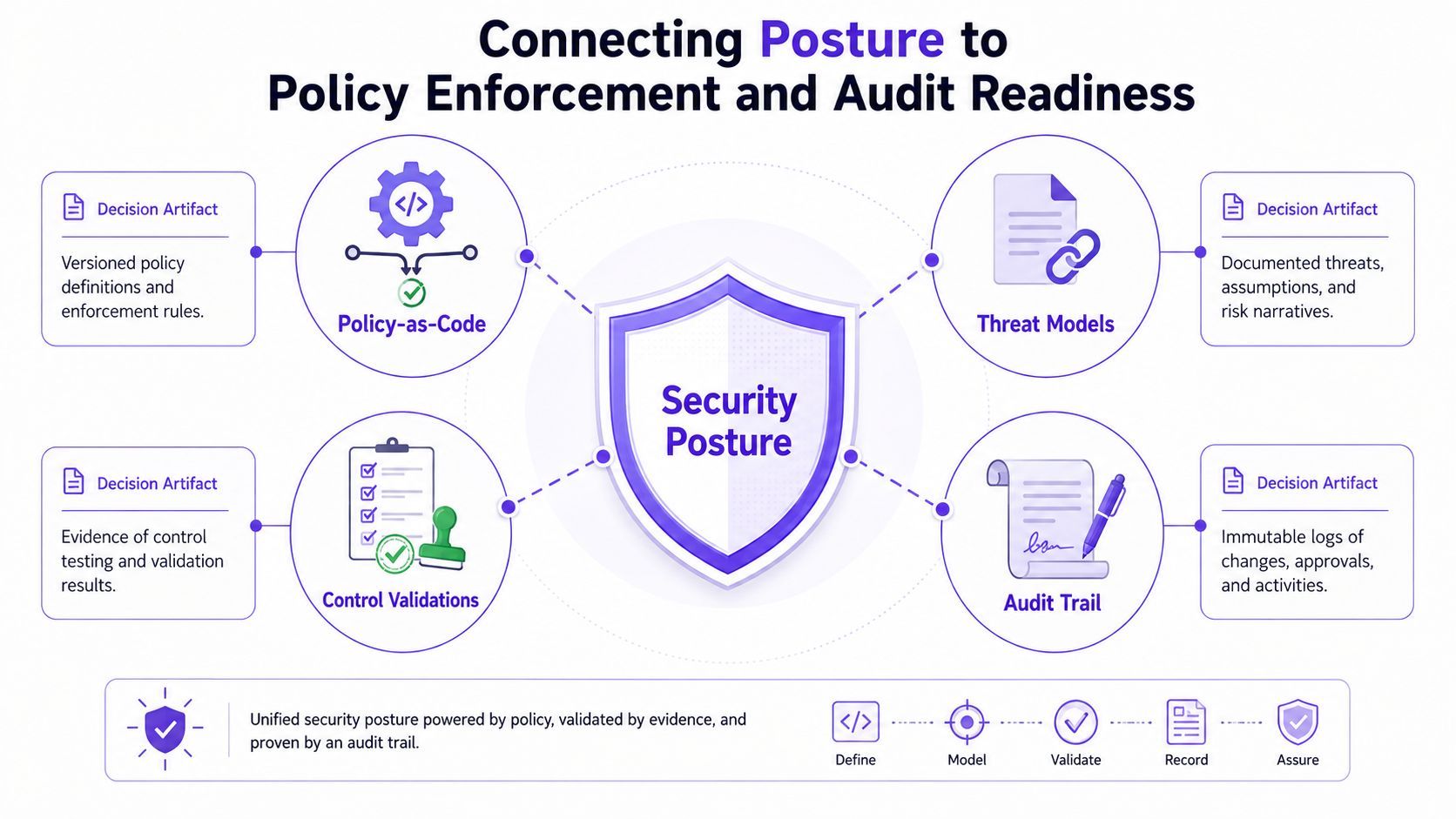
Posture earns its keep when it leaves an evidence trail. A scanner finding alone doesn't prove a decision, and a dashboard screenshot doesn't prove enforcement. What matters is whether every meaningful control produces a record that someone can trace back to policy, ownership, and remediation.
The cleanest version of this looks like a chain. A policy-as-code rule blocks a merge, the threat model identifies the risk behind that rule, the exception register records the accepted deviation, and the implementation evidence shows whether the control held at release time. That sequence is what an auditor can follow.
If you want that chain to be queryable, the posture data can't live in a side system nobody uses. It needs to flow into GRC, change management, or whatever record system your auditors already trust. A screenshot of a dashboard says, “we think this was true.” A queryable system says, “this was enforced on this date, for this service, with this owner.”
The mechanics matter here, so it helps to look at the policy side directly. The policy-as-code tooling guide is useful because posture becomes stronger when enforcement happens inside the delivery workflow instead of after the fact.
What good evidence looks like
Good evidence is specific, tied to an application, and linked to a decision. It should show the policy, the service, the approver, the exception expiry, and the control outcome. It should also be retrievable without a scavenger hunt through screenshots and email threads.
A platform such as DevArmor fits this model when teams use it for continuous threat modeling, security design reviews, and policy enforcement in pull requests. It's not the only way to do it, but it illustrates the point well, posture improves when design decisions, code changes, and enforcement outcomes stay linked in the same working system.
For teams comparing vendors that bundle evidence and enforcement, even Vanta pricing details for startups can be helpful context because it shows how much of the conversation is really about audit packaging versus actual control design. The pricing question matters, but it shouldn't distract from the more important question, which is whether the tool can trace a risk to a policy decision and then prove what happened.
A strong posture program doesn't just reduce ticket volume. It produces artifacts that survive audit, incident response, and leadership review.
A Real-World Example of Posture Under Audit
A payments platform preparing for SOC 2 and PCI renewal walks into audit season with two very different stories available to it. In the weak version, the security lead brings scanner screenshots, a Jira board, and a promise that the criticals are “under control.” In the stronger version, the lead brings an authoritative inventory, merge-gate policy logs, and a decision history for each exception.
The auditor's questions are usually plain. Which applications are in scope, who owns them, what controls are enforced, and where is the evidence that those controls ran when the change shipped. The answer that satisfies those questions is not “we scanned everything.” It's “this service is in scope, this policy blocked the merge, this exception was approved with compensating controls, and this deployment record shows the outcome.”
That difference is why posture is so much more than vulnerability management. The vulnerability count may be the same in both versions, but only one version can show the chain of decisions behind the risk.
| Audit Question | Strong Posture Response | Weak Posture Response |
|---|---|---|
| Which applications are in scope? | An authoritative inventory with owner, data type, and exposure attached | A spreadsheet that may not match production |
| How were security controls enforced? | Policy logs from the delivery workflow and linked review outcomes | Screenshots from different tools with no shared timeline |
| Why was this exception accepted? | A documented decision with compensating controls and an expiry date | A Jira ticket comment asking for a later fix |
| Can you prove the control was active at release time? | A traceable record in the system that handled the merge or deployment | A board view that shows the issue was eventually closed |
| Who owns the next action? | Named application owner and accountable security reviewer | A shared queue that nobody clearly owns |
Teams that want to see how control enforcement can be built into code review can look at secure Claude Code deployment as one practical example of how policy can be applied in an AI-assisted coding context. The point isn't the vendor, it's the pattern, posture gets stronger when the decision happens where the code changes.
The three artifacts that matter most are the inventory, the decision record, and the enforcement trace. If any one of those is missing, the audit story gets weaker fast.
Building a Stronger Posture in the Next 90 Days
The fastest path from reactive scanning to enforced posture is not a grand platform overhaul. It's a disciplined 30-60-90 plan that cleans up the source of truth, then wires controls into the workflow, then makes the evidence durable.
Days 1 to 30, establish inventory authority
Start by choosing one inventory source of truth for applications and APIs. Remove duplicates, retire stale entries, and assign an accountable owner to each critical service. If two systems disagree about what exists, resolve that before you argue about risk.
Days 31 to 60, enforce control coverage
Map security policies to application tiers and make the important ones executable in CI. Standardize exception handling so every deviation has a decision record, a compensating control, and an expiry. This is the point where posture stops being a report and starts becoming a gate.
Days 61 to 90, move to continuous management
Trigger reassessment on merges, deployments, dependency changes, and threat intelligence updates. Tie the dashboard to risk decisions, not raw findings, and package the evidence as if the next audit starts tomorrow. For a practical rollout checklist, this implementation checklist is a useful companion.
The single decision that changes everything is assigning one accountable owner per application, with engineering and security sharing the posture model instead of sharing a vague queue. When that happens, the posture record becomes something the organization can manage, defend, and improve.
If you want to turn posture from a dashboard into an enforceable operating model, DevArmor gives teams continuous threat modeling, security design reviews, and policy enforcement in the delivery workflow. It's built for the exact problem this guide covered, keeping inventory, decisions, and audit evidence tied to the code as it changes.
Related reading
- Application Security Automation That Actually Ships — automating testing, policy enforcement, and threat modeling across delivery.
- App Security Assessment: A Step-by-Step Guide for Modern — step-by-step assessment workflow from scoping to sign-off.
- Shift Left Security: A Practical Guide for Modern Teams — embedding protection into planning, coding, and CI/CD.
Table of Contents
Subscribe