JavaScript Static Analysis: Tools, Techniques, and Workflow
 Reza Khosravi
Table of Contents
Most advice about JavaScript static analysis starts with the wrong prescription: add more scanners. That sounds sensible until developers receive overlapping findings from ESLint, SonarQube, Semgrep, CodeQL, dependency tools, and framework-specific checks, then stop trusting the entire queue. Security improves when analysis produces findings people can validate and fix, not when a pipeline produces the largest possible alert count.
The harder problem is the gap between soundness and usefulness. A sound analyzer aims to account for every possible execution path, while a useful analyzer must finish on real applications, understand enough of the surrounding ecosystem, and avoid turning uncertain guesses into mandatory manual review. JavaScript's dynamic features make that balance unusually difficult. Static analysis remains valuable, but only when teams define what it can reliably answer, where it needs runtime evidence, and how findings will enter an existing engineering workflow.
Why More Scanners Do Not Mean Better Security
Adding scanners doesn't automatically add coverage. It often adds duplicate detection, inconsistent severity ratings, and competing remediation advice. One tool may flag a user-controlled value flowing toward a browser sink, while another reports the sink without enough context to determine whether the value is attacker-controlled. Developers then spend time reconciling tools instead of fixing the underlying issue.
The problem is especially visible in JavaScript because analysis depends heavily on assumptions about runtime behavior. A property may be selected dynamically, a function may arrive through a callback, or a module may be loaded only after a runtime condition. If one scanner models those paths conservatively and another ignores them, their findings won't line up. More output doesn't resolve that uncertainty.
ESLint illustrates the difference between a focused tool and a general security scanner. Created in June 2013 by Nicholas C. Zakas, ESLint was designed as an open-source linter with configurable and extensible rules, addressing limitations in earlier tools such as JSLint and JSHint. Its history, including movement to the OpenJS Foundation in March 2019, reflects the maturation of JavaScript analysis, but its core strength remains configurable source-level feedback rather than complete security proof (ESLint's project history and design).
Practical rule: Choose the smallest set of tools that answers distinct questions, then tune those tools until developers trust the results.
A large empirical study examined 168,214 open-source projects and found that static analysis use was widespread but not universal, while projects commonly lacked strict enforcement policies (the large-scale evaluation of static analysis in open-source software). That matters operationally. Adoption proves that analysis belongs in engineering workflows, not that every rule deserves a blocking gate.
Before adding another scanner, ask three questions:
- What distinct signal does it provide? If it repeats an existing pattern, it may increase noise without improving decisions.
- Who owns the finding? A security alert without a developer-facing remediation path will age in the backlog.
- What happens after failure? A check that blocks routine work for uncertain findings teaches teams to bypass or disable it.
Threat modeling should decide which rules matter before scanning begins. A design review can identify trust boundaries, authorization assumptions, and dangerous data flows that pattern matching won't infer reliably. Teams that want to make that shift can use threat modeling instead of treating scanning as the starting point.
How JavaScript Static Analysis Actually Works
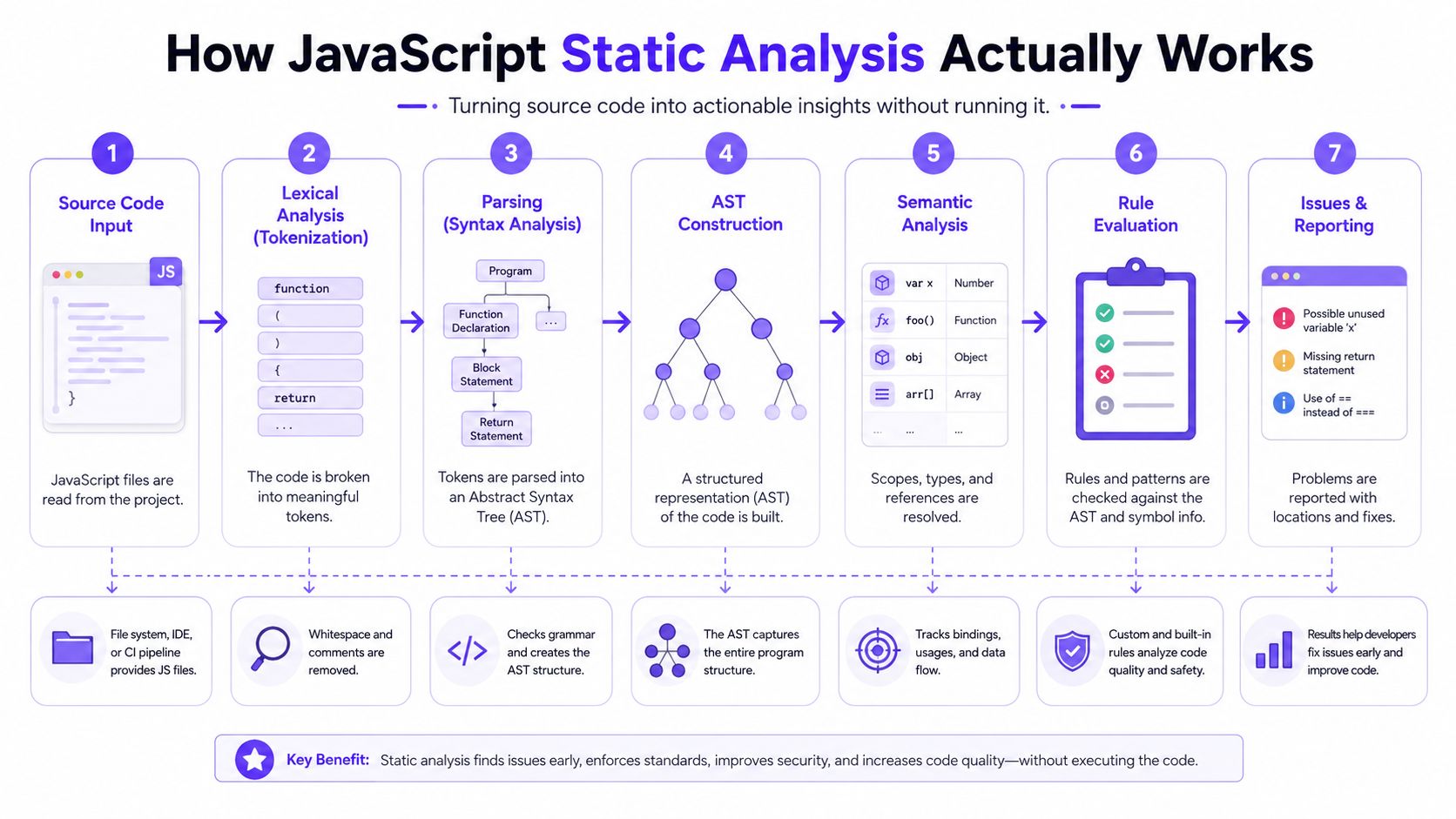
Most JavaScript static analysis begins by turning source text into an abstract syntax tree, or AST. The tree represents declarations, calls, operators, imports, property access, control flow, and other language constructs without executing the application. A rule can then inspect the tree for patterns such as eval, suspicious DOM assignments, hardcoded credentials, or unsafe use of object properties.
Modern syntax makes parsing a real engineering concern. A tool must understand modules, JSX, optional chaining, decorators, TypeScript syntax, generated framework code, and the project's parser configuration. Babel-based parsers and the TypeScript compiler can expose different representations and type information, so a rule that works against one tree may miss or misclassify an equivalent construct in another.
From syntax to data flow
AST matching is the shallowest layer. Deeper tools build control-flow graphs and track how values move through assignments, function calls, returns, object properties, and module boundaries. A taint rule might mark request input as untrusted, follow it through helper functions, and report a path to an HTML rendering sink or a database query.
That path becomes uncertain quickly. The analyzer may need to infer which function a variable references, whether a callback runs, which object property is selected, or which package implementation sits behind an import. In untyped JavaScript, type inference can narrow possibilities but rarely eliminates them. TypeScript improves available information, yet runtime values can still violate declared expectations.
What tools detect well
Static analysis is effective when the source pattern is explicit and the surrounding assumptions are stable. Common examples include:
- Direct dangerous calls, such as
evalor obvious child-process execution. - Known sinks, including DOM APIs or query builders used with visibly untrusted values.
- Hardcoded secrets, when credentials appear in recognizable formats and aren't generated or transformed.
- Prototype pollution patterns, especially assignments to attacker-controlled keys or unsafe object merges.
- Insecure configuration, such as permissive options represented directly in source.
It performs less reliably when behavior is assembled indirectly. Reflection, dynamic imports, generated code, runtime configuration, and third-party wrappers can hide the relationship between input and sink. A scanner may report a conservative path that isn't exploitable, or miss a path that only becomes visible after the application loads a module or receives a particular event.
The unavoidable trade-off
Security analysis often describes two competing goals as soundness, accounting for possible bugs, and precision, avoiding false positives. JavaScript's runtime flexibility makes it difficult to maximize both. A tool that assumes every dynamic property could refer to every object may avoid missed paths but produce an unmanageable graph. A tool that follows only obvious references runs quickly but omits behavior.
Research on scalable JavaScript analysis found that root causes of imprecision were concentrated in less than 2% of functions in the studied library applications, and a specialized approach could finish within seconds when the original analysis couldn't finish within 10 minutes (research on scalable JavaScript static analysis). The practical lesson is to find the small number of constructs driving uncertainty rather than demanding that every analysis model the entire runtime perfectly.
Comparing Linters and SAST Tools for JavaScript
Tool choice should follow the question you need answered. ESLint asks whether code violates configured rules. Semgrep asks whether code matches patterns you define, with data-flow support for selected cases. CodeQL can express deeper relationships across a codebase, but teams must invest in query design, modeling, and maintenance. SonarQube adds centralized quality management and enterprise reporting, while Snyk Code focuses on developer-oriented security findings alongside a broader application security platform.
No product has a universally low false-positive rate for JavaScript. The result depends on framework conventions, generated code, custom wrappers, repository structure, and the quality of the project model. Treat the table below as a starting point for evaluation, not a promise about outcomes in your codebase.
JavaScript Static Analysis Tool Comparison
| Tool | Best For | Detection Depth | False Positive Rate | Setup Complexity | CI/CD Integration |
|---|---|---|---|---|---|
| ESLint with security plugins | Fast feedback and rule enforcement | Shallow to moderate, mostly syntax and local patterns | Usually manageable after rule tuning | Low to moderate | Straightforward in common JavaScript pipelines |
| SonarQube | Centralized quality and security governance | Moderate, with broader repository analysis | Varies substantially by framework and configuration | Moderate to high | Strong enterprise integration |
| Semgrep | Custom rules and targeted patterns | Moderate, with useful data-flow capabilities for modeled cases | Depends heavily on rule quality and scope | Moderate | Flexible across CI systems |
| CodeQL | Deep, query-driven security analysis | High for supported models and carefully written queries | Can be significant when libraries and flows are under-modeled | High | Strong, especially where query maintenance is staffed |
| Snyk Code | Developer-facing SAST within an application security program | Moderate to deep, depending on code and framework support | Requires validation in the target repository | Moderate | Convenient for integrated application security workflows |
ESLint is the sensible first layer for teams that need immediate feedback and already have a JavaScript linting culture. It won't replace data-flow analysis, but a small set of relevant security rules can prevent obvious mistakes without introducing a large platform project.
Semgrep is useful when your application has recognizable internal conventions. A rule for an unsafe wrapper or a forbidden API can be more valuable than a generic rule copied from another ecosystem. The trade-off is ownership. Someone must test rules against real examples, document intentional exceptions, and retire rules that produce noise.
CodeQL earns its complexity when the team can maintain models for frameworks, libraries, and application-specific sources and sinks. SonarQube can suit organizations that need broad governance views across many repositories, but centralized reporting doesn't solve weak framework modeling. Snyk Code may fit teams that want a managed workflow, provided developers still validate findings rather than treating vendor severity as proof of exploitability.
For teams combining code checks with broader verification, QA test automation for security offers useful context on how security testing can sit alongside static checks. The key is to define which tool owns each signal and prevent duplicate gates from competing in the same pull request.
Integrating Static Analysis Into Developer Workflows
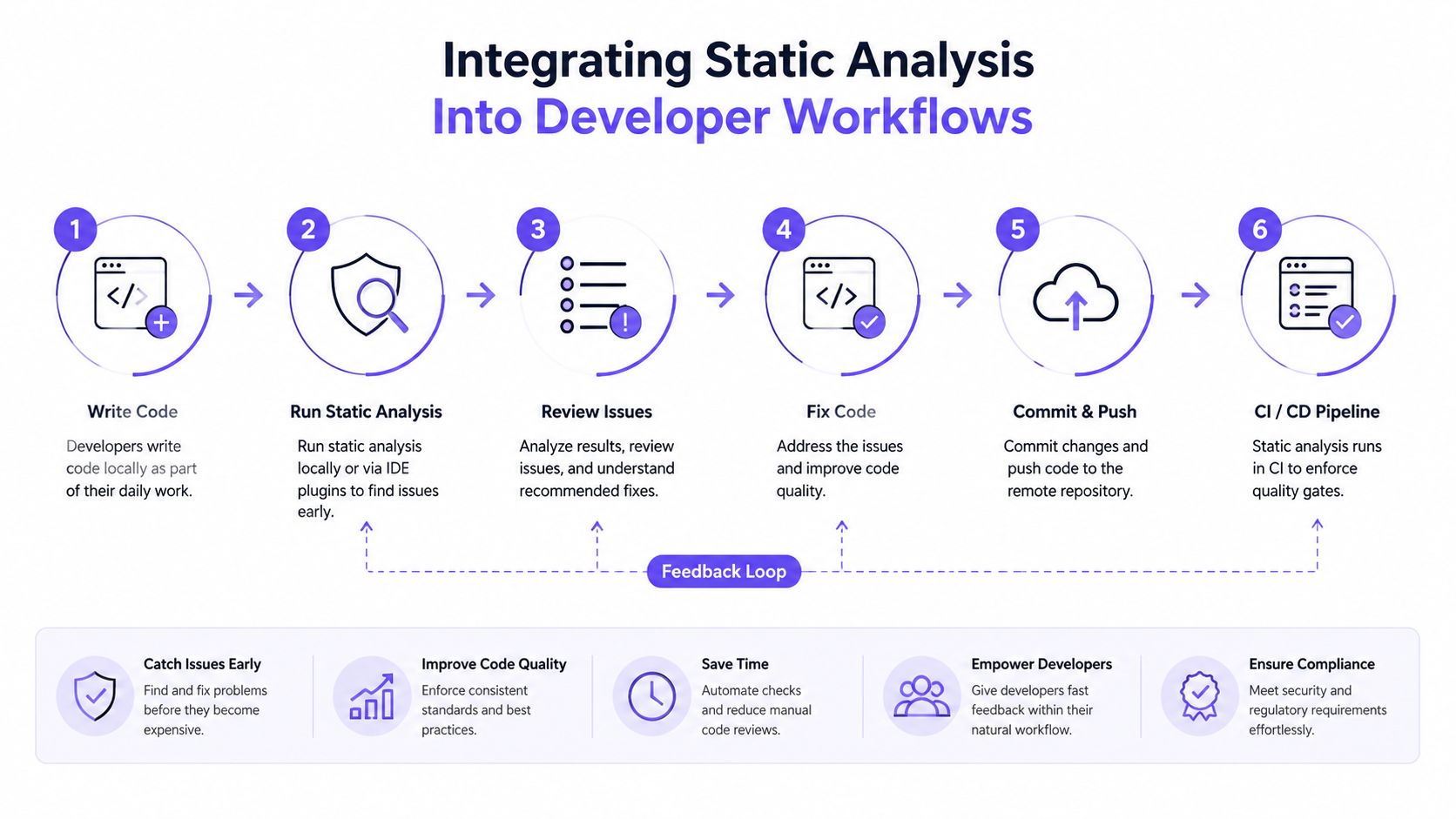
A scanner should meet developers where they make decisions. That usually means local feedback first, selective pre-commit checks next, and broader CI analysis after the change enters the shared pipeline. The workflow should expose new risk without making developers responsible for unrelated historical debt.
Start with local feedback
Configure ESLint or SonarLint in the IDE with the repository's actual parser, framework settings, and shared configuration. Inline feedback works best when rules explain the risk and show a safe alternative. A warning about a dangerous sink is less useful than a finding that identifies the untrusted source, the relevant code path, and the preferred API.
Don't enable every available security rule on the first day. Start with rules tied to the application's threat model, then review findings with developers who own the affected code. For teams formalizing those decisions, security across the software development lifecycle provides a useful framing for connecting design, implementation, and delivery controls.
Keep hooks narrow
Pre-commit checks should inspect staged files, not force a repository-wide audit on every commit. Husky and lint-staged can run formatting and fast lint rules against the changed scope, while deeper analysis waits for CI. This keeps local feedback responsive and avoids making a developer pay for unrelated legacy findings.
A baseline is essential for an established codebase. Record accepted historical findings, require justification for new suppressions, and make the baseline reviewable in source control. A baseline isn't a permanent exemption. It is a boundary that lets the team prevent regression while separately reducing old debt.
Make CI gates reflect risk
Run fast checks early, publish richer findings as annotations, and block merges only for findings that meet a clearly defined confidence and severity threshold. Cache parser artifacts and analysis results where the tool supports it, and scope incremental checks to changed code when that doesn't weaken the control you need.
A pipeline that fails on every uncertain result destroys trust faster than a pipeline that reports a confirmed issue clearly. Developers should know which findings require immediate action, which need security review, and which are informational. The security team should review gate behavior regularly, because a rule that was useful for one framework version may become noisy after a migration.
Where Static Analysis Falls Short in Modern Codebases
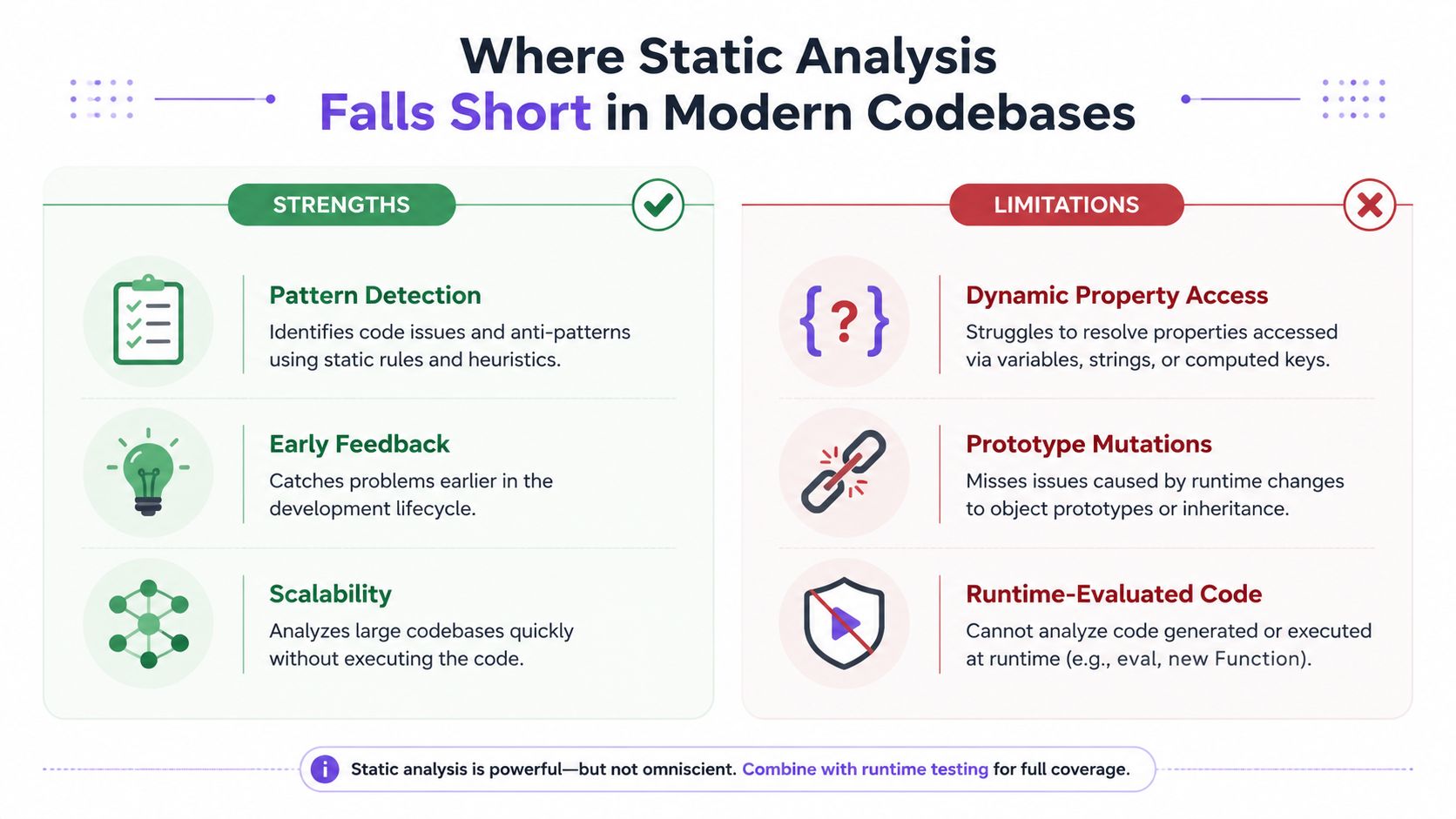
A clean scan result doesn't mean the application is secure. It means the configured analyzer didn't produce a finding under its model, its rules, and the code it could interpret. That distinction is easy to lose when dashboards turn an incomplete analysis into a green status.
JavaScript exposes the limitation directly. Runtime-evaluated property names, prototype mutations, higher-order functions, callbacks, and event-driven control flow make precise call-graph construction difficult. A browser application may spread behavior across JSX transformations, template compilation, routing conventions, generated bundles, and asynchronous handlers. A Node.js service may load modules conditionally or construct capabilities from configuration.
The model is often the failure point
Academic work continues to treat JavaScript call-graph precision as an unresolved problem. The difficulty isn't that tools lack advanced algorithms. Analysts must also model incomplete libraries, browser and DOM APIs, framework behavior, dynamic loading, hidden exception edges, and undocumented control-flow paths (research on JavaScript static analysis limitations).
One cited study found that analyzers including SAFE, TAJS, and WALA couldn't analyze all versions of jQuery, a reminder that success is workload-dependent (technical research on JavaScript analysis). If an analyzer struggles with a major library, a team shouldn't interpret successful analysis of its own application as universal coverage.
What static analysis cannot infer reliably
Static analysis can identify a suspicious authorization check, but it usually can't determine whether the business rule is correct for every role and workflow. It can find a dangerous API, but it may not know whether a runtime policy, gateway, or trusted wrapper constrains the input. It can inspect first-party code, while the most important behavior may live in dependencies, generated artifacts, deployment configuration, or external services.
Use complementary controls deliberately:
- Threat modeling tests architecture, trust boundaries, abuse cases, and authorization assumptions before implementation.
- DAST and staging tests exercise deployed behavior, including routing, configuration, authentication, and cross-service interactions.
- Runtime monitoring watches production behavior that source inspection can't establish, such as unexpected process activity or abnormal data access.
- Dependency and package controls address third-party risk that ordinary SAST may model only superficially.
Static analysis is worthwhile when it can provide a fast, repeatable signal for code patterns your team understands. It becomes dangerous when a green badge substitutes for design review and runtime verification.
Triage Strategies That Reduce Alert Fatigue
Triage should classify findings by action, not by the scanner's default severity alone. A high-severity label attached to an unreachable path may deserve less attention than a moderate finding in an exposed administrative flow. The reviewer needs enough context to decide whether the finding is real, relevant, and owned by the current change.
Use three dispositions:
- Suppress with evidence. Apply this to a known false positive or an intentional pattern that has been reviewed. Require a short justification, use a scoped rule exclusion, and keep the decision visible in the repository or baseline.
- Investigate and fix. Use this when the source, sink, or data flow matches the application's threat model. Confirm reachability, understand the exploit condition, and fix the design or implementation rather than merely silencing the alert.
- Escalate and redesign. Choose this when repeated findings expose a systemic issue, such as an unsafe internal abstraction, missing authorization boundary, or architecture that forces every feature through a dangerous sink.
Make suppression reviewable
Inline suppression can be appropriate when the exception belongs to a single line and the reason is stable. Project-level baselines work better for inherited debt, but they should distinguish accepted findings from findings awaiting review. Rule exclusions should target file patterns or known generated directories, never the entire repository by default.
Track the feedback loop around rules:
- Mean time to triage, to show whether reviewers can reach a decision quickly.
- False-positive rate by rule category, to identify noisy sources and sinks.
- Fix rate for confirmed findings, to measure whether the workflow turns detection into remediation.
- Repeat suppression patterns, to find rules that need better modeling or narrower scope.
A team spending more than fifteen minutes per day on scanner triage has a configuration problem, not a security problem. That threshold is a practical operating rule, not a universal benchmark. If review consumes more time, reduce rule scope, improve source and sink modeling, or move uncertain checks out of the blocking path.
Static Analysis Triage Decision Matrix
| Finding Category | Confidence Level | Recommended Action | Example |
|---|---|---|---|
| Direct dangerous API with reachable input | High | Investigate and fix | Request data passed directly to an unsafe evaluation function |
| Known internal wrapper with verified validation | Medium | Suppress with documented justification | A reviewed sanitizer wrapper consistently applied before a sink |
| Generated or vendored code | Low for ownership | Scope out and monitor separately | A generated bundle creates repeated findings outside developer control |
| Repeated architectural flow violation | High at design level | Escalate and redesign | Multiple services bypass a shared authorization boundary |
| Unmodeled dynamic dispatch | Uncertain | Investigate with runtime or manual review | A callback target depends on runtime configuration |
A disciplined secure code review process complements automated triage by resolving the questions scanners can't answer alone. The objective isn't to make every alert disappear. It is to ensure every remaining alert has a defensible decision.
Building a Layered Security Approach Beyond Scanning
Static analysis is a valuable signal, but it isn't a security boundary by itself. Its strongest contribution is early, repeatable feedback about code patterns and data flows. Its weakest contribution is proving that a flexible JavaScript application behaves safely across runtime configuration, external services, business rules, and changing dependencies.
A layered program assigns different questions to different controls:
- Design controls use threat modeling and security design reviews to test trust boundaries, authentication, authorization, data handling, and abuse cases before implementation.
- Code controls use linters, SAST, peer review, and policy checks to catch unsafe patterns and enforce agreed implementation rules.
- Runtime controls use DAST, application monitoring, WAF capabilities, or RASP where appropriate to observe and constrain deployed behavior.
- People controls give developers secure coding guidance and a clear escalation path when a tool reports an uncertain result.
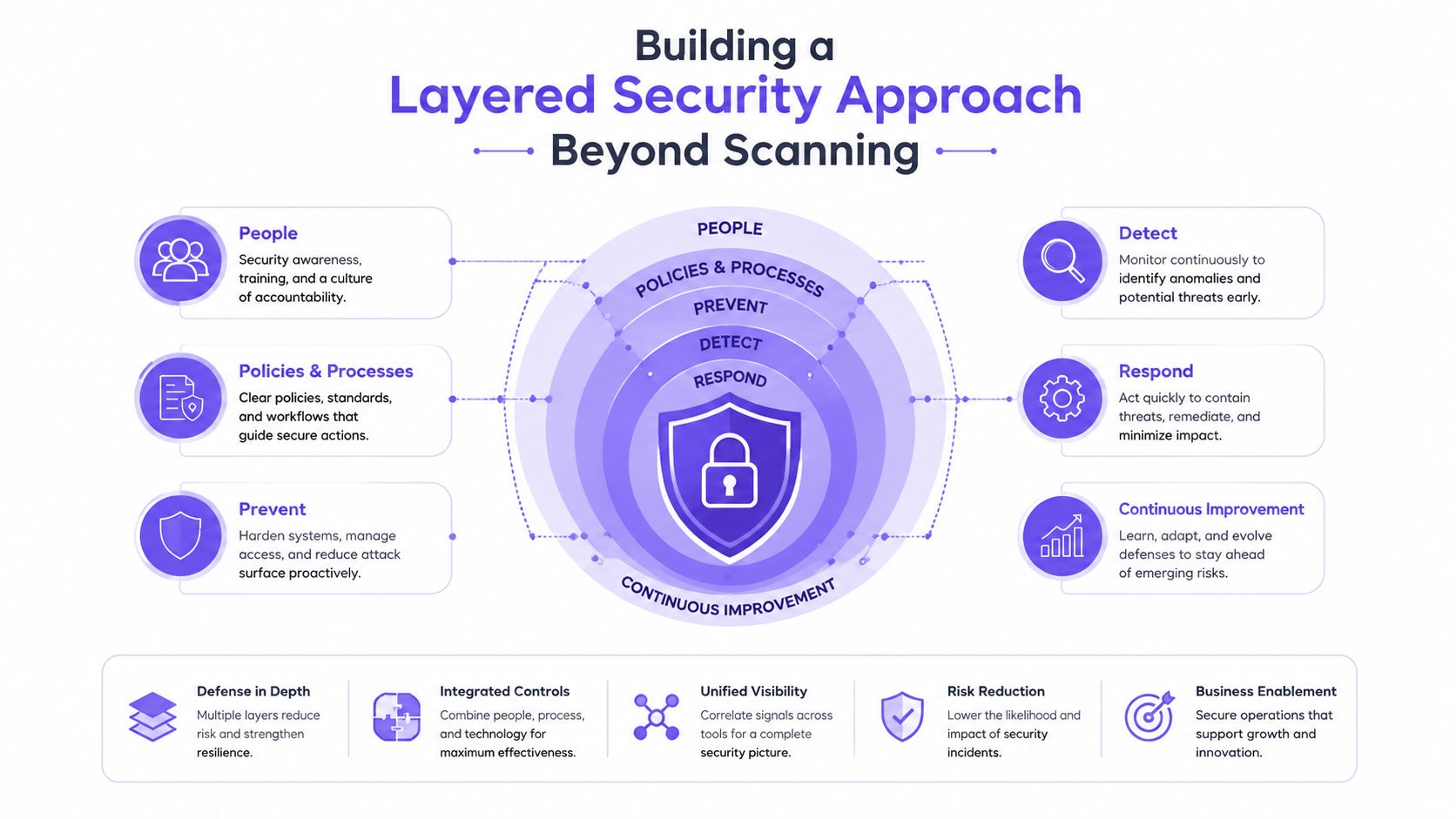
The design layer deserves more attention because it catches failures that scanners generally can't infer. A code-level rule may identify an unsafe authorization check, but a threat model can reveal that the entire service trusts a client-controlled role. A pull-request policy can enforce a required review, while implementation verification can check whether an approved security decision still matches the changed code.
DevArmor offers continuous threat modeling, workflow-based security design reviews, pull-request Code Review checks, and policy-as-code enforcement that can block merges when code changes violate approved security designs. Used alongside JavaScript static analysis, that approach gives teams a way to connect scanner findings with the architectural decisions that determine whether a finding matters.
The right standard isn't “static analysis catches everything.” The right standard is that each control has a defined purpose, measurable ownership, and a failure mode the team understands. Use scanners for precision, design reviews for intent, runtime testing for behavior, and monitoring for what reaches production.
DevArmor helps teams connect continuous threat modeling and security design reviews with pull-request Code Review and policy-as-code enforcement. Visit DevArmor to see how your team can add security context to JavaScript development without relying on noisy scanning alone.
Related reading
- 10 Security Issues JavaScript Developers Must Fix — common JavaScript vulnerabilities with detection and fixes.
- Secure Code Review Best Practices: A Complete Guide — policy-as-code and reviewer strategies that scale.
- Shift Left Security: A Practical Guide for Modern Teams — embedding protection into planning, coding, and CI/CD.
Table of Contents
Subscribe