Application Security Automation That Actually Ships
 Reza Khosravi
Table of Contents
Most AppSec advice starts with the wrong prescription: add another scanner. Teams layer SAST, SCA, DAST, container, secrets, and infrastructure checks onto a pipeline, then wonder why developers still merge risky changes. The problem usually isn't detection coverage. It's the gap between a scanner finding and the decision a developer must make inside a pull request.
Application security automation works when it reduces that gap. A developer needs to know whether a finding affects changed code, whether the vulnerable path is reachable, what policy applies, who owns the fix, and whether the pull request should block. A dashboard full of disconnected alerts answers none of those questions.
The market's direction reinforces the strategic shift. One estimate places the global application security market at USD 10.65 billion in 2025, with a projection of USD 42.09 billion by 2033 and an 18.8% CAGR from 2026 to 2033. Another estimates USD 13.61 billion in 2025 and projects USD 28.11 billion by 2031, with a 13.64% CAGR from 2026 to 2031. These projections from Grand View Research's security automation market analysis point to automation becoming part of the delivery system, not a collection of optional security add-ons.
Why More Scanners Have Not Made Us Safer
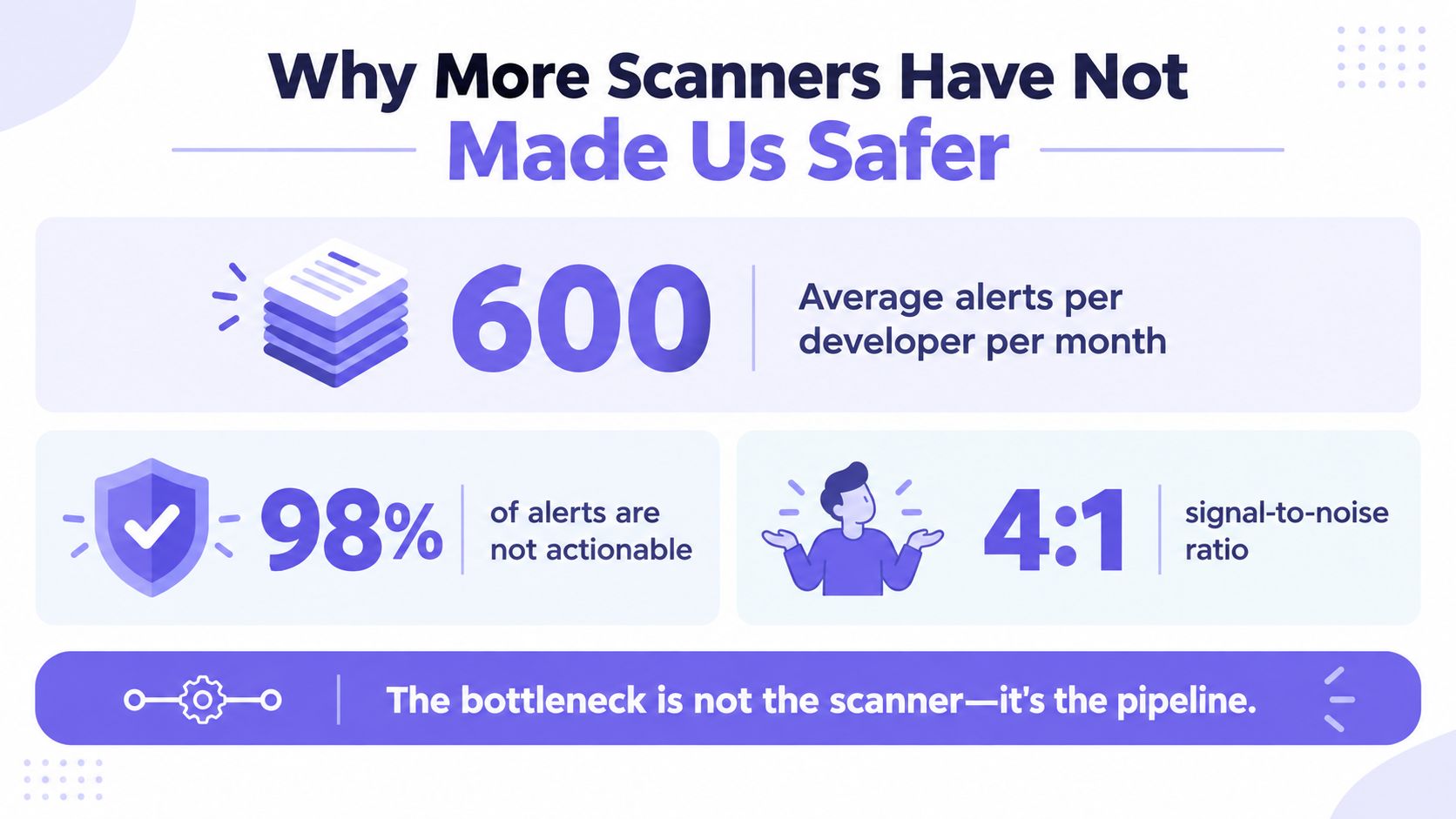
More scanners don't automatically produce safer software. They produce more output. If that output arrives without ownership, context, deduplication, or an enforcement path, the security program has automated report generation rather than risk reduction.
The most common failure looks familiar. A developer opens a pull request and receives findings from several tools, each with its own severity model, duplicate detection, remediation advice, and ticketing workflow. The developer skims the list, fixes the obvious item, suppresses a noisy one, and merges because the release still has to ship. Security later measures scanner coverage and dashboard activity, while the actual merge decision remains informal.
That's a decision-support failure, not necessarily a coverage failure. Web applications were cited as the most commonly exploited vector in both incidents and breaches in 2023, ahead of email and human error, according to the breach pattern discussed in Security World Market's security automation coverage. The lesson isn't to buy every available web scanner. It's to connect application-layer findings to decisions developers can act on before release.
Design for the pull request
At pull request time, automation should answer a short set of questions:
- What changed: Is the finding on modified code, a new dependency, an infrastructure change, or an inherited condition?
- Can it matter: Is the affected component reachable, exposed, connected to sensitive data, or protected by another control?
- Who acts: Which team owns the service, dependency, endpoint, or infrastructure resource?
- What happens now: Should the check block the merge, request a review, create a scheduled remediation task, or record an exception?
- How is it fixed: Does the developer receive a code-level explanation, a safe version upgrade, a policy reference, or a design decision?
The best programs intentionally block fewer things. They reserve hard gates for findings that are new, relevant, actionable, and tied to a clear remediation path. Lower-confidence results still matter, but they belong in a workflow that batches, assigns, and revisits them instead of interrupting every merge.
Practical rule: A finding without a decision path is inventory, not control.
BSIMM14 documents a measurable move toward embedded testing. Automated, event-driven security testing increased by 200% over the prior two years, while mandatory code review grew by 68% over five years, as reported in the BSIMM14 application security findings. The useful interpretation is straightforward: automation belongs in the software lifecycle, but it must be designed around repeatable decisions rather than broader alert collection.
The Four Automation Layers Every Modern AppSec Stack Needs
A durable AppSec program separates responsibilities. Each layer has a job, a handoff, and a boundary. Without that separation, teams duplicate scans, create conflicting gates, and make developers interpret security architecture from raw tool output.
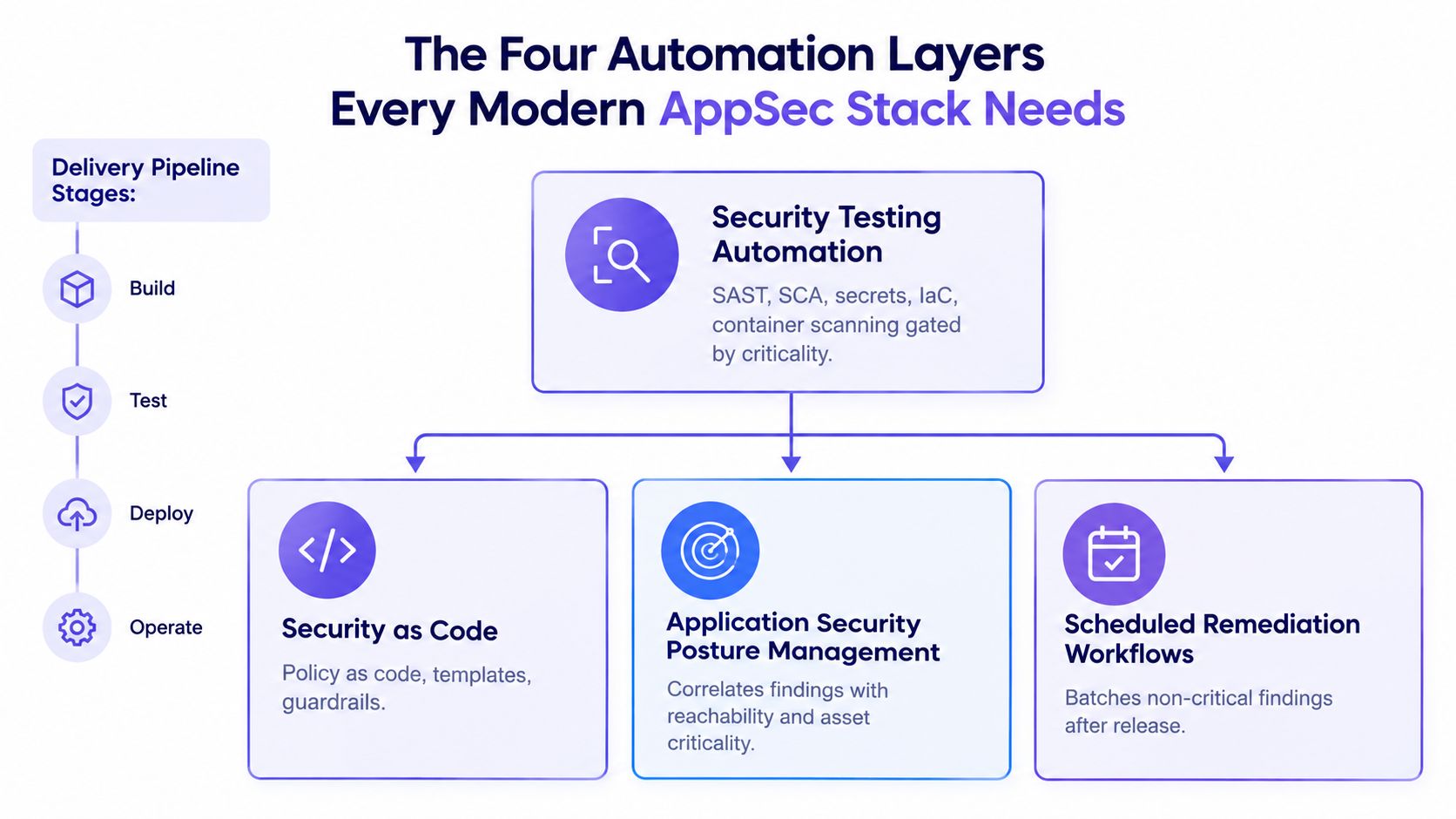
1. Security testing automation
This layer detects technical conditions. It includes SAST for source code, SCA for dependencies, repository secret scanning, IaC scanning, container checks, and, where appropriate, DAST or IAST. OWASP's DevSecOps guidance places these controls across the pipeline because each targets a different failure mode.
Run fast, changed-code checks on pull requests. Run broader scans in builds or scheduled jobs. Deduplicate results before they reach developers, and attach each result to a repository, service, owner, and commit. This layer shouldn't decide every business exception or create a threat model. It supplies evidence.
2. Policy enforcement
Policy converts evidence into a decision. It defines which findings block a merge, which require an approval, which create a ticket, and which remain informational. Policies should account for application criticality, data sensitivity, reachability, exploitability, and whether the issue is new.
Keep the rules versioned and reviewable. A policy change should have the same traceability as a code change, including an owner, rationale, test coverage, and effective date. This layer shouldn't replace technical scanners. It interprets their output.
3. Continuous threat modeling
Threat modeling supplies architectural context that scanners rarely understand. It tracks services, identities, trust boundaries, data flows, external dependencies, and abuse cases as the system changes. A new public endpoint or altered authentication flow can then change the controls required at pull request time.
This layer shouldn't become another quarterly document repository. It should produce structured context that policy enforcement and testing automation can consume.
4. CI/CD integration and provenance
The pipeline layer makes the controls reliable. It manages execution order, workload identity, credentials, artifact provenance, deployment approvals, and evidence capture. Security checks that developers can bypass with a pipeline edit aren't enforceable controls.
Use least-privilege identities, centrally maintained templates, and consistent failure handling. The pipeline shouldn't own risk prioritization or threat analysis. It should guarantee that the approved testing and policy steps run for the right repositories and deployment paths.
The handoff should be explicit: testing produces evidence, threat modeling adds context, policy decides, and CI/CD enforces and records. That division keeps automation useful instead of turning one platform into an unreviewable tangle.
Policy-as-Code That Developers Actually Read
Security intent becomes useful only when developers can see how it applies to the change in front of them. “Protect sensitive data” is a reasonable objective, but it isn't a pull request control. “Every new REST endpoint requires an authentication middleware declaration” is testable, reviewable, and enforceable.
The engine matters less than the attachment point and feedback quality. Open Policy Agent with Rego often fits admission control and infrastructure decisions. Cedar is designed for authorization logic. HashiCorp Sentinel fits policy enforcement around Terraform and related workflows. None of them fixes a badly written rule or a poor review experience.
| Engine | Policy Language | Best Fit | PR Feedback Quality |
|---|---|---|---|
| Open Policy Agent | Rego | General policy evaluation across infrastructure and services | Strong when the pipeline posts the violated resource and remediation |
| Cedar | Cedar | Authorization and access-control decisions | Clear for authorization logic, less useful for broad repository scanning |
| Sentinel | Sentinel | Terraform and HashiCorp ecosystem governance | Useful when plan output is attached directly to the review |
| Custom repository checks | Team-defined language or configuration | Narrow application-specific controls | Excellent only when ownership and remediation are explicit |
Write rules around observable changes
Good pull request rules have a subject, condition, consequence, owner, and exception path. Examples include:
- Public storage: Reject a new public S3 bucket unless an approved exception identifies the business owner and expiration.
- Endpoint authentication: Require every REST endpoint to declare an authentication mechanism or an explicitly approved public classification.
- Dependencies: Reject packages that don't come from approved registries or that violate the repository's dependency policy.
- Pull request secrets: Prevent secrets from appearing in pull request descriptions, comments, or generated metadata.
Severity alone isn't enough. A blocked pull request should show the violated rule, affected file or resource, reason for the control, remediation guidance, owner, and documentation. Teams that need to improve the writing behind those controls can use these 2026 policy writing tips, particularly for making requirements precise and actionable.
Policy tests belong beside policy code in the same repository. Test allowed and denied examples, edge cases, and exception behavior. If the prose policy says one thing while the enforced rule does another, auditors see drift and developers lose trust.
Teams often need concrete patterns before they start. The Policy-as-Code examples from DevArmor can help translate broad requirements into pull request checks, but every example still needs adaptation to the organization's architecture and ownership model.
A rule developers can't understand inside their workflow is a rule they'll work around.
Continuous Threat Modeling Without the Quarterly Review
Quarterly threat modeling fails in systems that change continuously. By the time a review meeting updates a diagram, the service may have new endpoints, a different identity provider, altered data flows, and infrastructure changes that never made it into the document.
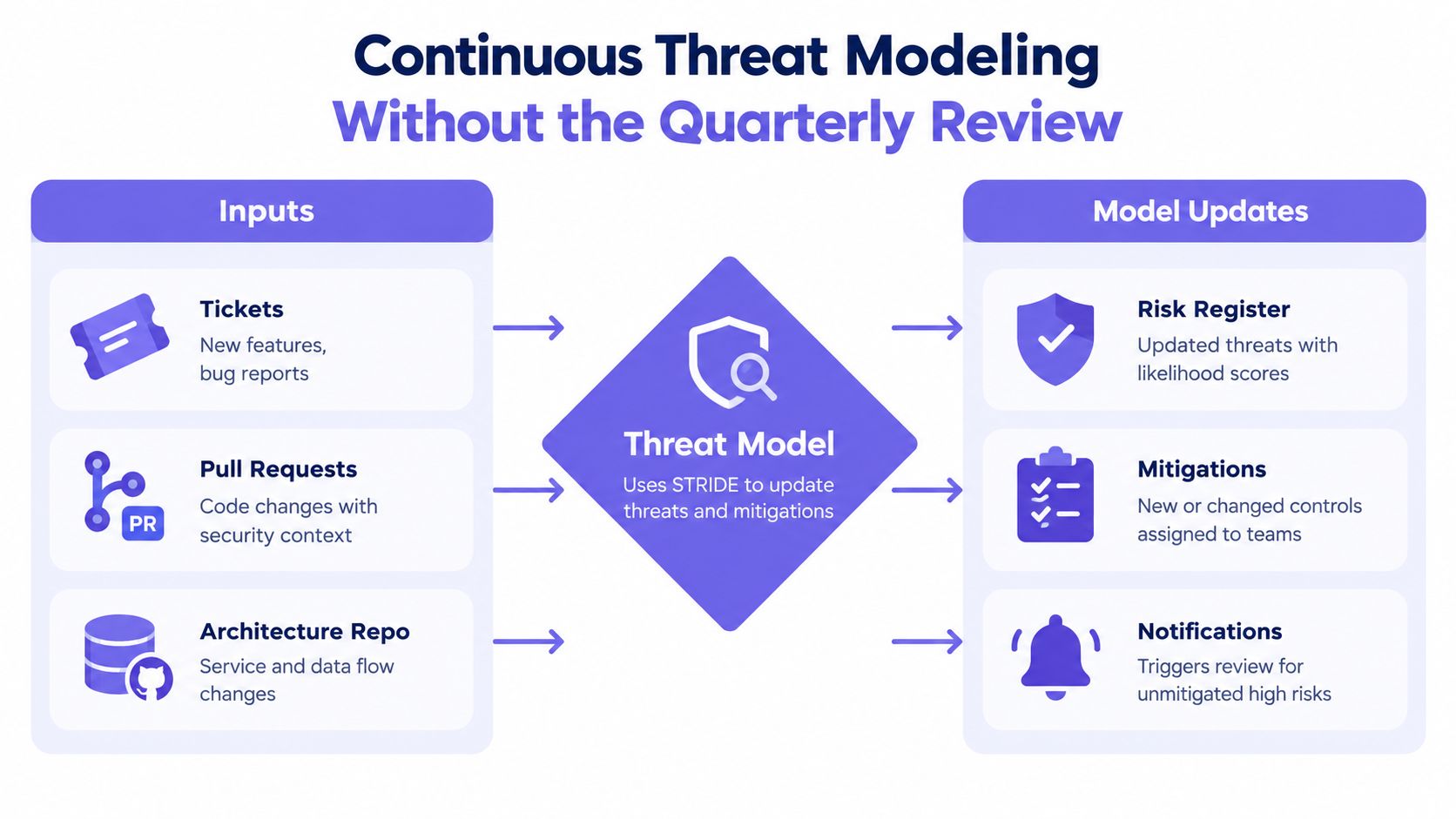
A living model starts with the artifacts teams already maintain. Tickets describe features and bug fixes. Pull requests show implementation changes. Architecture repositories hold service definitions, decision records, and data-flow changes. Connect those inputs to a service catalog and extract structured events, such as a new trust boundary, a new external integration, a new data classification, or a changed authentication path.
Turn changes into model updates
Use STRIDE or another consistent framework to map changes to threats and mitigations. The automation doesn't need to generate a beautiful diagram for its own sake. It needs to update a structured model that downstream controls can use.
For example, a ticket that adds a patient identifier to an existing flow should update the data inventory and relevant trust boundary. A pull request that changes authentication middleware should trigger a review of authorization assumptions. A new cloud route should create a corresponding infrastructure and exposure check. The model should then update the risk register, assign mitigations, and notify an owner when a high-risk condition has no approved control.
Risk scores must remain explainable. Store the input that changed the score, the rule that responded, the person or team responsible, and the decision taken. An opaque “AI risk increase” isn't an audit trail or useful developer feedback.
Feed context back into the merge
The model earns its place when it changes the pull request experience. It can prioritize tests for an affected data flow, require an authentication policy, request a design review, or block a merge when a required mitigation is missing. Developers shouldn't need to leave GitHub or their IDE to discover why the change matters.
Teams building a business case for this operating model may also find the discussion of enterprise compliance monitoring ROI useful, especially where evidence collection and control monitoring currently sit in separate processes. For implementation detail, the threat modeling process guide from DevArmor provides a practical reference for connecting models to delivery workflows.
The right test is simple: when the architecture changes, does the security context change with it? If not, the organization has documentation automation, not continuous threat modeling.
Where to Enforce Controls in the Delivery Pipeline
Runtime controls and pre-merge controls solve different problems. A WAF can block an attack against a deployed endpoint. RASP can observe application behavior at runtime. Anomaly detection can surface activity that static analysis couldn't predict. None of these controls tells a developer, before merge, that a new endpoint lacks authentication or that a secret entered the repository.
Pre-merge enforcement usually creates better evidence because the decision is tied to a commit, pull request, reviewer, policy version, and resolution. Runtime alerts still matter, but they often require investigation before anyone can determine whether the underlying issue came from code, configuration, identity, or an operational change.
| Pipeline Stage | Control Type | Catches | Blind Spots |
|---|---|---|---|
| IDE and pre-commit | Local SAST and secret checks | Obvious insecure patterns and exposed credentials before repository submission | Local configuration may differ from CI, and deeper context may be unavailable |
| Pull request | SCA, changed-code SAST, IaC checks, policy gates | New vulnerabilities, prohibited changes, dependency and infrastructure violations | Existing debt and some runtime behavior remain outside the change review |
| Build and test | Full scans, container analysis, security regression tests | Broader code paths, built artifacts, dependency trees, and image contents | Results can arrive too late if the team blocks only at this stage |
| Deploy approval | Provenance and release policy | Unapproved artifacts, missing evidence, or unresolved release conditions | It can't repair design flaws discovered after implementation |
| Runtime | WAF, RASP, drift detection, anomaly monitoring | Attacks, unauthorized changes, and production behavior outside expected baselines | Alert noise, incomplete attribution, and larger blast radius after deployment |
Assign each stage a narrow responsibility
- IDE hooks should provide fast guidance, not blocking.
- Pull request checks should make the primary merge decision for changed risk.
- Build gates should validate artifacts, images, and deeper analysis.
- Deployment approvals should verify provenance, required reviews, and exceptions.
- Runtime guardrails should contain attacks and detect drift that escaped earlier checks.
The shift-left security guidance from DevArmor is relevant here because shifting left isn't merely moving a scan earlier. It means moving the decision to the person who can still change the code, with enough context to make that decision correctly.
Use runtime controls as a backstop, not an excuse to weaken pre-merge enforcement. The earlier control generally offers a smaller blast radius and a cleaner explanation of what changed.
What This Looks Like in Regulated Industries
A payments team building a PCI-relevant microservice doesn't need a separate compliance ceremony for every pull request. It needs a delivery path that records the controls already required for the service.
The team can configure SAST, SCA, IaC scanning, and policy-as-code checks on every pull request. A policy can require approved dependency sources, prohibit exposed secrets, enforce protected infrastructure patterns, and block a merge when a new high-risk condition lacks an approved disposition. The pipeline stores the commit, scan result, policy version, reviewer decision, exception rationale, and deployment relationship.
When the assessor asks how the team controls software changes, the answer comes from the delivery record. The team can produce a traceable history for the relevant release and connect each failed or passed control to the change that generated it. No screenshot campaign is required because the evidence was created during normal engineering work.
A HealthTech example
A HealthTech team changes a patient portal so a new workflow stores an additional PHI field. The repository or ticket update triggers a threat model change. The model identifies the affected data flow, updates the relevant trust boundary, and requires a data-flow policy and access-control review before merge.
The pull request then displays the changed requirement and the control expected from the implementation. A successful release produces a signed control attestation tied to the commit and deployment artifact. If the developer chooses an exception, the exception includes the reason, owner, approval, and expiration rather than living in an informal message thread.
Compliance as a byproduct
These scenarios use the same operating pattern:
- A change creates structured security context.
- Policy converts that context into a review or gate.
- The pipeline records the result automatically.
- The release carries its evidence forward.
That design matters more than the industry label. PCI and HIPAA obligations differ, but both benefit when security decisions occur inside the workflow where engineers already work. Compliance shouldn't be a parallel documentation project that reconstructs decisions after deployment. It should be an observable consequence of disciplined engineering controls.
Building a Realistic Automation Roadmap
Don't roll out every scanner at once. Build the decision path first, then expand coverage only when the team can route and enforce what it finds.
Months one to three
Start with inventory. Identify critical repositories, services, owners, build paths, and deployment targets. Wire SCA and secrets scanning into pull requests, establish a baseline for existing findings, and define what counts as a new violation.
The first success criterion isn't a clean dashboard. It's a reliable pull request experience with clear ownership and useful remediation.
Months four to six
Add SAST tuning, baseline suppression rules, and the first policy-as-code controls for critical repositories. Keep gates narrow. A rule that blocks every inherited finding will teach developers to disable the check, while a rule that blocks a new exposed secret or prohibited infrastructure change has a clear decision path.
Months seven to nine
Introduce continuous threat modeling from tickets, architecture decision records, repositories, and IaC changes. Use the model to adjust test priority and policy requirements instead of maintaining it as a separate documentation artifact.
Months ten to twelve
Operationalize evidence pipelines for SOC 2, ISO 27001, and PCI reporting. Standardize policy versions, exception records, release attestations, and retention. Consider an application security platform that correlates findings with service context, and use scheduled workflows for lower-priority remediation rather than blocking every release.

Measure decisions, not scanner activity
Track DRE, mean time to remediate, and the percentage of builds blocked by security gates. Vulnerability counts alone reward teams for finding more problems and say little about whether developers are making better merge decisions.
The operating model needs attention because automation coverage doesn't guarantee workflow maturity. Nearly all organizations report some vulnerability-management automation, yet fully automated workflows fell from 41% to 35% in 2025, while almost 40% still reported that more than half of the process was manual, according to the 2025 Remediation Operations Report. Skills gaps were identified as the top barrier to scaling automation in that report.
AI-assisted development makes context even more important. Recent reporting says 60% of respondents struggle with application visibility, 63% identify cloud misconfigurations as the biggest AppSec challenge, and 58% rank API security as a major concern. Only 37% said they currently use AI in AppSec activities, while 30% said they don't and 32% were unsure, as reported in the 2025 web application security report. AI can accelerate code generation, but its security controls must remain deterministic, reviewable, and auditable.
The biggest traps are predictable: treating tool deployment as the goal, allowing scanner configurations to drift between teams, and measuring alert volume instead of decision quality. Fix those operating-model problems before buying more detection.
DevArmor connects continuous threat modeling, security design reviews, and Policy-as-Code enforcement across planning, coding, pull requests, and deployment workflows. If your team needs application security automation that turns architectural context into traceable merge decisions, visit DevArmor to see how the platform fits into your delivery process.
Related reading
- Shift Left Security: A Practical Guide for Modern Teams — embedding protection into planning, coding, and CI/CD.
- Enterprise Application Security: Key Strategies for 2026 — threat modeling, policy enforcement, and compliance at enterprise scale.
- Secure Code Review Best Practices: A Complete Guide — policy-as-code and reviewer strategies that scale.
Table of Contents
Subscribe