Secure Code Review Best Practices: A Complete Guide
 Reza Khosravi
Table of Contents
A secure code review can fail even when every reviewer follows the checklist. The problem is that reviewers often verify syntax and familiar vulnerability signatures instead of verifying whether the implementation still matches an approved design decision, threat model, and security requirement. Evidence supports that distinction: a 2024 study of 135,560 code review comments found security concerns across 35 of 40 coding-weakness categories, while those weaknesses appeared 21 to 33.5 times more often than explicit vulnerability discussions (Empirical Software Engineering study).
That makes secure code review a security verification discipline, not a longer checklist. The reviewer's job is to connect changed code to trust boundaries, authorization decisions, data handling rules, operational assumptions, and the threat model that justified them. Scanners contribute coverage, but they can't decide whether a user is allowed to perform an action in a particular business context, whether a new API crosses a sensitive boundary, or whether a design control made it to production code.
The Shift Toward Developer-Owned Code Review Security
Secure code review used to sit largely with application security specialists. Developers submitted code, security teams inspected it later, and release gates tried to compensate for the distance between implementation and review. That model is increasingly misaligned with pull requests, short delivery cycles, and teams that own services from design through operation.
A 2022 survey of 182 developers found that 78%, or 142 respondents, identified as software developers, while 69%, or 126 respondents, said developers were responsible for ensuring security during code reviews in their company or project (the survey on software security during modern code review). The same study describes secure code review as one of the most effective techniques for identifying security bugs early in the software development lifecycle. Developer ownership, then, isn't just an organizational preference. It follows from placing security verification next to the code, context, and design decisions.
Why ownership moved closer to the pull request
A centralized security team can bring deep expertise, but it rarely has complete knowledge of every business rule, service dependency, feature flag, and operational constraint in a fast-moving repository. Developers usually know those details because they made the implementation choices. They can explain why a permission check exists, which identity source is authoritative, and whether a data flow is expected or accidental.
Ownership doesn't mean developers should work without security guidance. It means security teams need to provide clear requirements, reusable threat patterns, review support, and escalation paths instead of acting as the only people allowed to make security judgments.
Practical rule: Put the person who understands the business behavior in the review, then give that person security context that can be applied consistently.
The transition creates real friction. Developers may lack secure coding experience, while security teams may distrust reviews performed without specialist oversight. Vague policies make both problems worse. “Follow secure coding standards” doesn't tell a reviewer how to verify tenant isolation, privilege transitions, token audience validation, or safe use of a framework API.
What replaces the old gate
A productive model divides responsibility without dividing context:
- Developers verify implementation intent: They confirm that the code behaves according to the approved design and identify security consequences of local changes.
- Security engineers define reusable controls: They turn recurring risks into requirements, threat patterns, review guidance, and escalation criteria.
- Automation enforces objective conditions: Pull request checks can require evidence, reject prohibited patterns, and preserve traceable outcomes.
- Engineering leaders manage exceptions: A risk acceptance should identify the decision owner, scope, rationale, and expiry conditions rather than disappear in a chat thread.
Teams also need operational reliability around these controls. Where reviews influence production releases, access, and incident response, it helps to evaluate operational reliability features alongside security functionality. A control that fails, produces inconsistent results, or lacks an audit trail becomes another source of risk.
Developer ownership works when the organization treats secure code review as part of normal engineering quality. It fails when leaders transfer accountability without supplying the design context and policy machinery needed to exercise it.
Building an Effective Secure Code Review Workflow
The strongest review process isn't the one with the most approvers. It's the one that gives reviewers enough time, relevant context, and a manageable change boundary to detect meaningful defects.
A 2021 case-control study of Chromium OS code reviews compared 516 reviews that identified security defects with 374 reviews where defects escaped. A logistic regression model using nine review attributes achieved an AUC of 0.91, indicating that review context and structure strongly influenced detection outcomes (the Chromium OS code review case-control study). The study associated longer review time, mutual review history, and bug-fix reviews with better detection, while larger scope, reviewer over-participation, and more prior commits in the file reduced detection odds.
Design the review around the change
Start before the diff is opened. Require the pull request to identify the security-relevant design decision, affected assets, trust boundaries, identity assumptions, and tests that demonstrate the control. The required evidence should reflect the change. An endpoint that changes authorization needs different evidence from a dependency update or a logging modification.
Keep security-sensitive changes narrow enough to review. A large pull request can hide an authorization regression among refactoring, formatting changes, generated files, and unrelated feature work. Splitting changes isn't bureaucracy when it gives reviewers a better chance of following data and control flow.
Reviewer selection also matters. Assign someone who understands the feature and someone who can challenge its security assumptions when the risk warrants it. Adding reviewers indiscriminately can create participation without attention, especially when everyone assumes someone else is performing the deep review.
Use a layered workflow
A practical sequence looks like this:
- Record intent: Link the pull request to its design decision, threat model, and security requirements.
- Inspect the behavioral diff: Follow inputs, identity, authorization, secrets, sensitive data, and external calls through the changed paths.
- Run deterministic checks: Use SAST, dependency analysis, secret detection, tests, and repository-specific policy checks.
- Perform contextual review: Ask whether the implementation satisfies the approved control, not merely whether it compiles or passes a scanner.
- Resolve and preserve evidence: Record findings, remediation, exceptions, approvals, and the final decision in the pull request.
- Enforce merge conditions: Block merging for defined high-risk violations, while routing uncertain findings to human review rather than failing the entire pipeline.
Repository hygiene supports this workflow. Teams working across mobile repositories can also benefit from practical version control best practices for mobile teams, particularly around branch discipline, reviewable changes, and avoiding generated artifacts that obscure the security diff.
Automation should reduce repetitive inspection, not replace judgment. A documented automated security review workflow can connect pull request checks with requirements and review records, but reviewers still need to decide whether the observed behavior is safe in its business context.
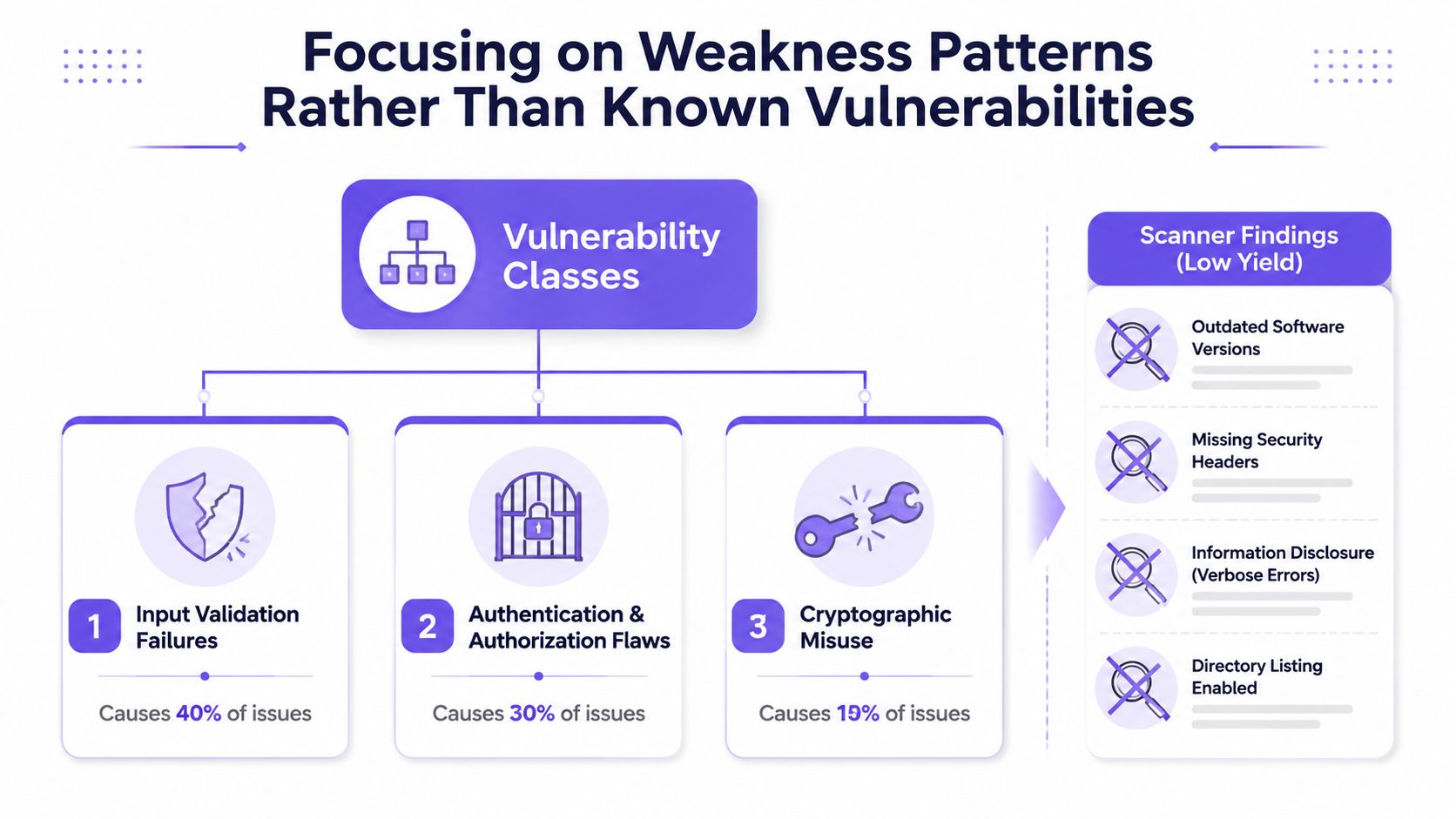
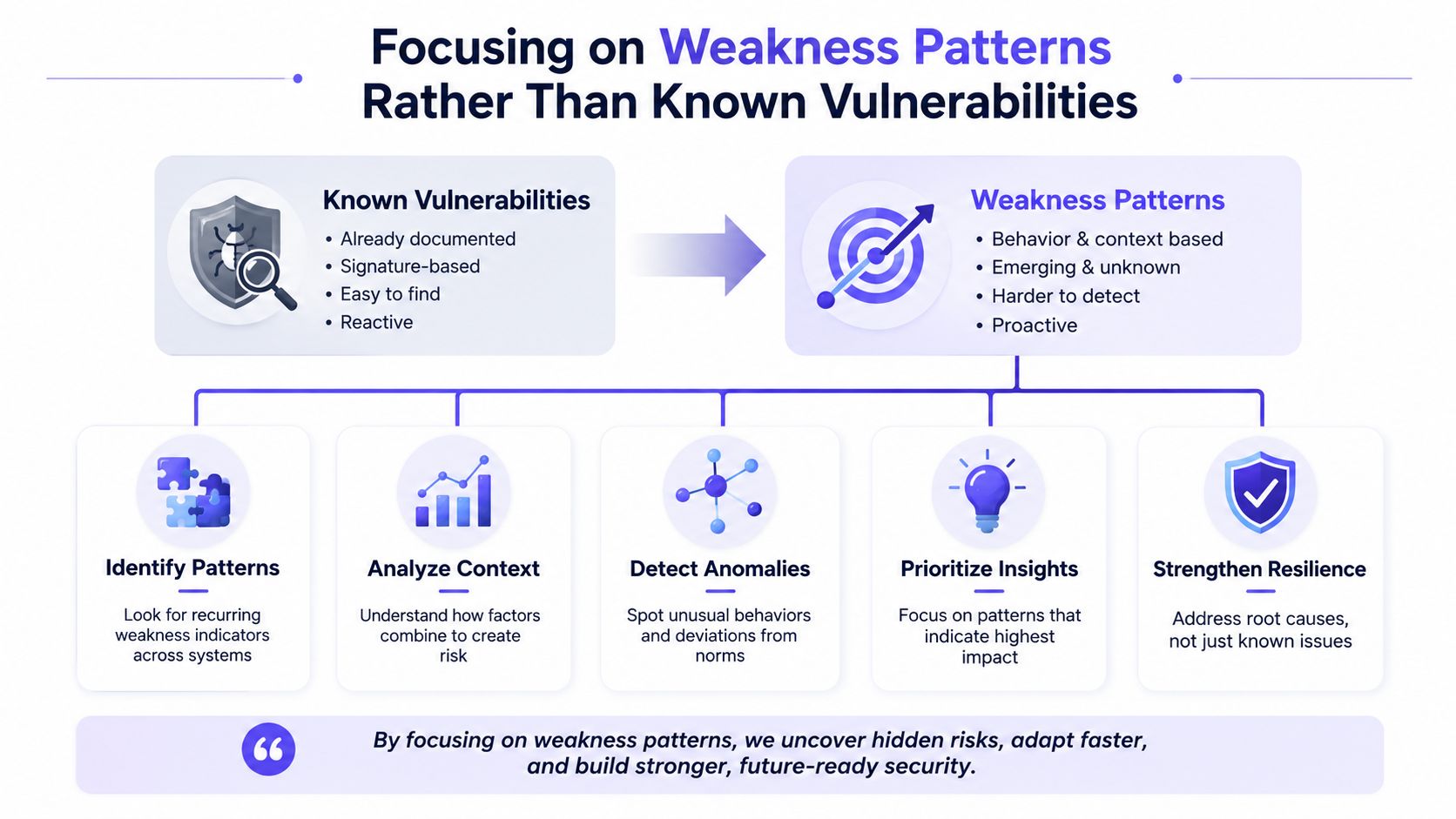
Focusing on Weakness Patterns Rather Than Known Vulnerabilities
A CVE is a useful identifier after a flaw has been recognized. It isn't a complete review strategy. Many dangerous changes involve a weakness pattern that doesn't correspond neatly to a known vulnerability, scanner rule, or single file.
The evidence points toward a broader review target. The study of 135,560 code review comments found that reviewers raised security concerns in 35 of 40 coding-weakness categories, and those weaknesses were discussed 21 to 33.5 times more often than explicit vulnerabilities (the 2024 analysis of security-related code review comments). Coding-weakness comments were also frequently paired with actionable remediation guidance. Reviewers were not merely naming abstract problems. They were helping developers change the implementation.
Turn threat patterns into review questions
A useful checklist follows the application's security behavior.
Authorization logic should prompt questions such as:
- Which identity is being authorized?
- Does the check use the resource owner, tenant, role, or a value supplied by the request?
- Does the same decision apply to read, write, export, delete, and administrative actions?
- Can a user reach the function through another route, background job, or alternate API version?
Framework API usage deserves scrutiny because secure defaults vary by library and configuration. Reviewers should verify encoding context, deserialization behavior, redirect handling, file access, query construction, and cryptographic API choices. “The framework handles security” is not evidence unless the code uses the framework's safe path correctly.
Trust-boundary changes often hide in ordinary refactoring. A new service call, cache, queue consumer, webhook, or internal endpoint can change which component is trusted. Ask what data crosses the boundary, how the receiver authenticates it, whether integrity is protected, and whether the receiving service repeats authorization rather than trusting the caller's claim.
Write guidance that leads to a fix
Weakness-focused policies should explain the unwanted behavior, the required control, and acceptable remediation. A rule that says “check access control” creates debate. A better requirement states which actor must be authorized against which resource and where that decision must occur.
Threat context should travel with the review. Link the finding to the asset, attacker capability, affected boundary, and design decision. This keeps reviewers from treating every match as equally urgent and helps developers understand why a seemingly harmless shortcut violates the system's security model.
Scanners remain valuable for repeatable patterns and broad coverage. They become less useful when teams measure success by alert volume instead of verified risk. The reviewer should ask whether the code preserves the intended security property, including cases where no scanner finding exists.
Integrating Policy-as-Code at the Pull Request Stage
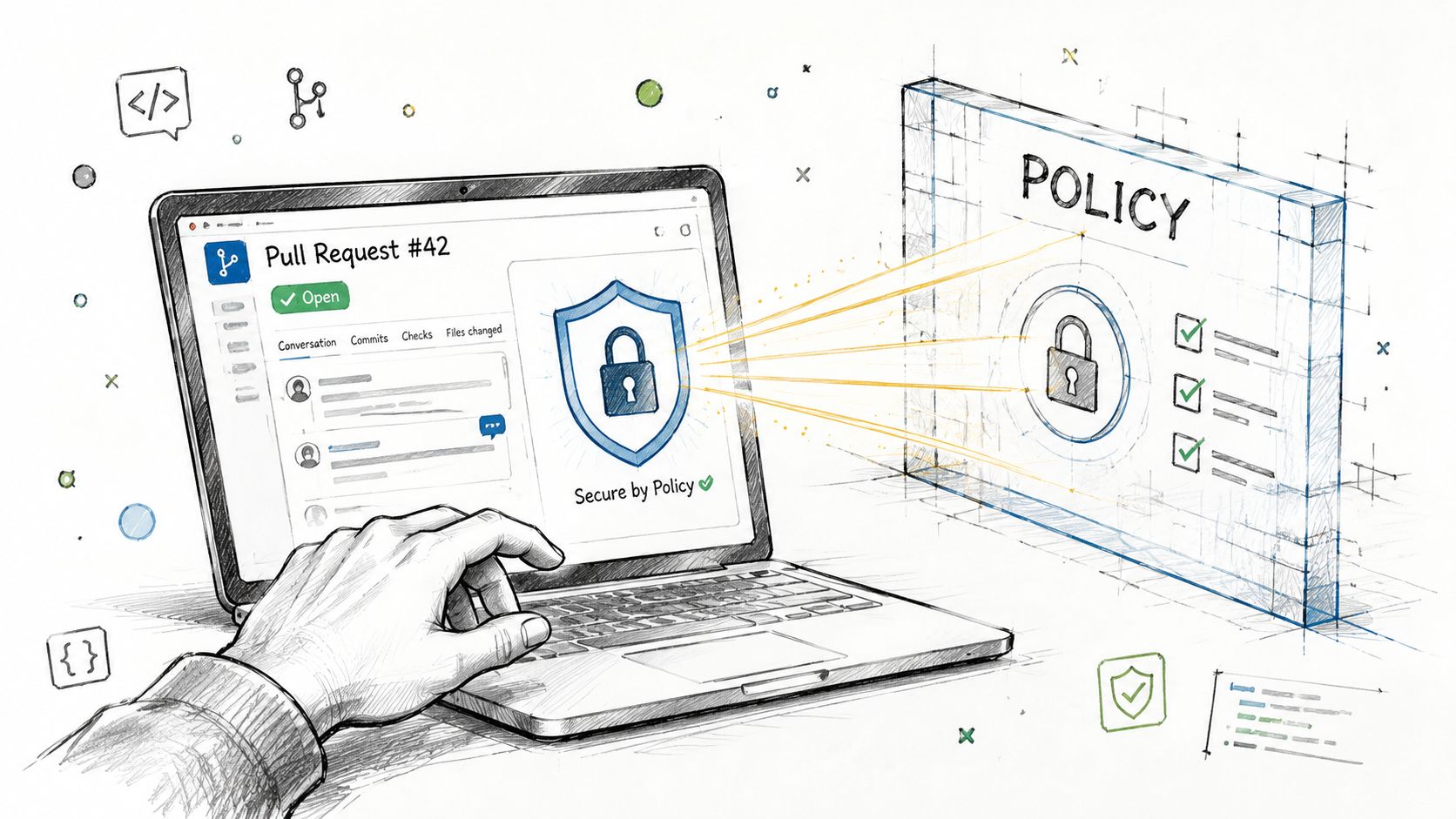
Manual review identifies problems. Policy-as-code prevents known violations from becoming mergeable changes and records the decision in a place developers already use. The difference is important in regulated environments, where an organization must show not only that someone reviewed code, but also which requirement applied, what evidence was considered, and how exceptions were handled.
Start with controls that can be stated precisely. Examples include requiring authorization checks for protected resource operations, prohibiting direct use of an unsafe API, requiring an approved encryption mechanism for a sensitive data path, or demanding a threat-model reference when a pull request changes a trust boundary.
Map controls to decisions
The policy should point back to an approved design decision rather than exist as an isolated rule file. That relationship creates a verification chain:
- A product or architecture decision identifies the asset, threat, and required control.
- The repository records the relevant requirement and scope.
- The pull request identifies the implementation change.
- Automated checks test deterministic parts of the control.
- A human reviewer evaluates behavior that requires context.
- The merge result preserves approval, findings, remediation, or risk acceptance.
This approach avoids a common failure mode in SAST-heavy programs. Teams scan every line, accumulate findings, suppress noisy rules, and lose sight of the design property they needed to protect. Policy-as-code should focus attention on what must be true, while static analysis helps determine whether the changed implementation supports that condition.
Make enforcement proportional
Not every policy violation should block a merge. Use blocking for requirements that are objective, consequential, and sufficiently reliable. Route ambiguous findings to review with a clear owner and deadline. An exception should never be a hidden bypass. It should capture the affected requirement, rationale, decision authority, compensating control, and conditions for reassessment.
Repository policies should also distinguish new violations from inherited debt. Blocking every historical issue can halt delivery and encourage teams to disable the control. Enforcing the policy on changed code creates a practical adoption path while allowing a separate program to reduce existing debt.
Teams evaluating implementation details should review policy-as-code tools with attention to rule ownership, pull request integration, exception handling, and evidence retention. The product choice matters less than whether the controls remain understandable and maintainable.
A living policy system updates when architecture, repositories, tickets, and deployment assumptions change. If the rule still reflects an old design, automated enforcement only produces confidently outdated decisions.
Reviewing AI-Generated Code and Agentic Workflows
AI-generated code changes the review problem from “can a reviewer find the vulnerability?” to “can the organization verify a much larger stream of code without losing design context?” Treating generated code as trustworthy because it looks idiomatic is a serious mistake.
A 2025 GenAI code security report found that AI-generated code introduced risky security flaws in 45% of tests, and larger newer models did not improve security (the 2025 GenAI code security report). CSA research citing Stack Overflow survey data also reports that 66% of developers spend more time fixing almost-right AI-generated code, which captures the practical burden: the output may be plausible enough to pass a fast visual inspection while still requiring substantial correction.
Change the review boundary
Don't review AI-authored code as a special exemption or as automatically unsafe. Review it against the same security requirements, but add provenance and behavioral checks:
- Record generation context: Identify whether a copilot, coding agent, or external model contributed to the change, subject to organizational policy.
- Require human ownership: A named developer should understand and defend the code, including generated tests and configuration.
- Inspect dependencies and APIs: AI suggestions often choose familiar libraries or patterns without understanding the repository's approved versions, wrappers, or security constraints.
- Test abuse cases: Positive tests show intended behavior. Authorization bypasses, malformed input, replay, tenant crossover, and privilege transitions test the security boundary.
- Limit agent permissions: Agents should receive only the repository, tools, credentials, and write access required for the task.
Agentic workflows need stronger controls because an agent can modify multiple files, invoke tools, and iterate without the same pause points as a human author. Require explicit scope, branch isolation, approval before merge, and logs that preserve the requested task, tool actions, generated changes, and policy results.
Teams designing those controls can consult guidance on securing AI agents at scale, especially when agents operate across repositories or enterprise systems. The goal isn't to stop useful automation. It's to ensure speed doesn't remove accountability.
AI coding security guidance should connect prompts and agent context to the same threat model and policy set used for human-written code. A generated diff still needs to prove that the approved design survived implementation.
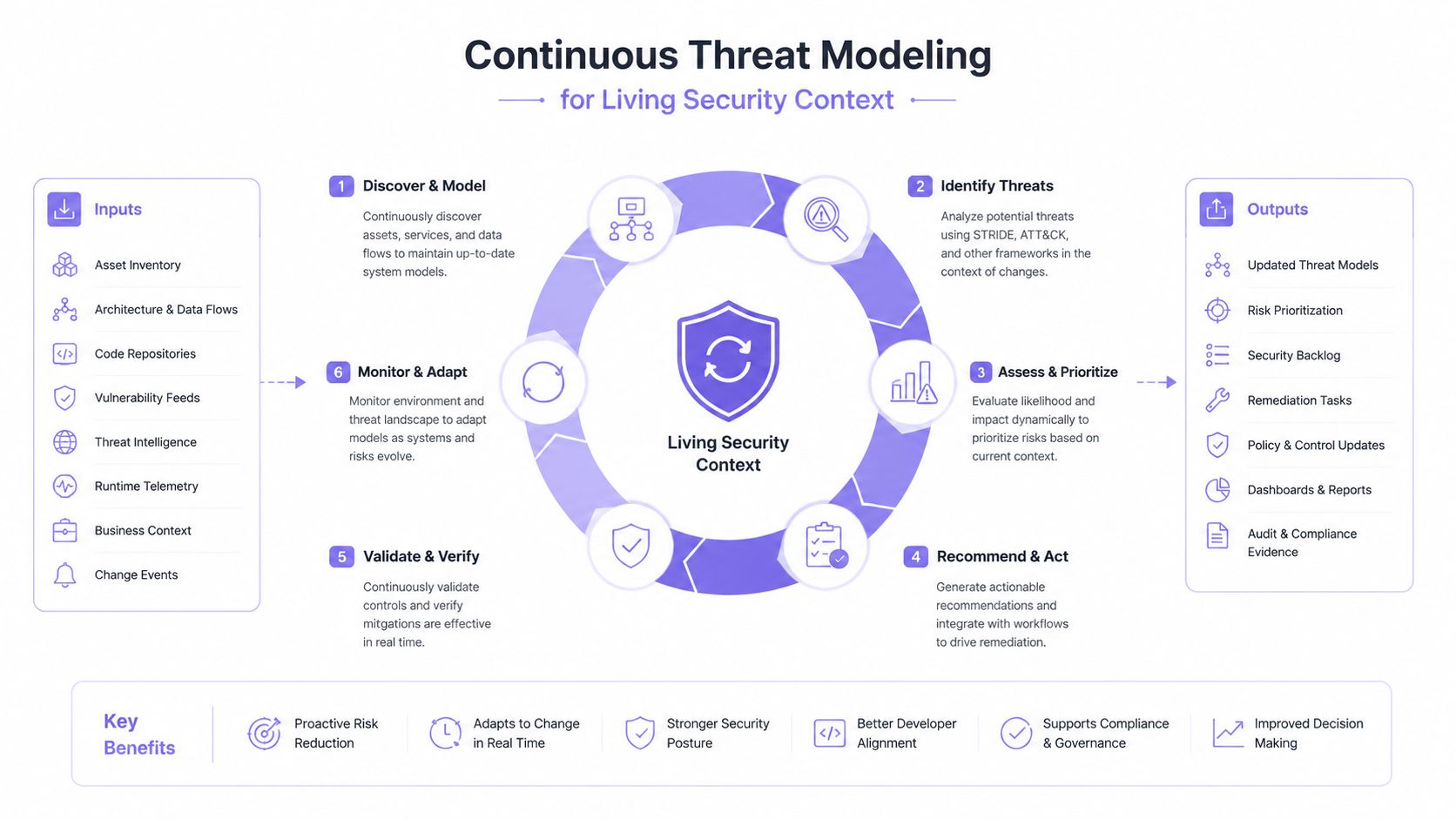
Continuous Threat Modeling for Living Security Context
A threat model becomes security debt when it describes an application that has already changed. Teams approve a design, modify the data flow during implementation, add an integration under delivery pressure, and leave the original model untouched. The document remains polished while the deployed system diverges.
Continuous threat modeling addresses that drift by treating security context as a maintained system of records. Tickets, design documents, repositories, service metadata, pull requests, and deployment information can each provide evidence of how an application works. The model should update when those artifacts change, then surface relevant security feedback inside the tools where developers make decisions.
Replace meetings with useful moments
A design review meeting can be valuable for a major architectural decision. It's a poor default for every feature, endpoint, and integration. Developers need feedback when a ticket is refined, a design is written, a pull request opens, or a code path changes.
The practical pattern is to generate context from existing artifacts and return focused decisions in workflow:
- A planning ticket identifies the feature, asset, actor, and intended control.
- A design review highlights missing assumptions before implementation.
- An IDE or pull request check surfaces the relevant requirement while code is being written.
- Implementation verification confirms that the control appears in the changed behavior.
- Deployment records preserve the relationship between the decision and the released implementation.
This reduces the delay between a security decision and its verification. It also gives reviewers a way to reconstruct context when formal documentation is incomplete, using repository structure, code paths, configuration, and related planning artifacts as evidence rather than treating missing paperwork as proof that no model exists.
Keep context specific
Continuous doesn't mean continuously generating generic alerts. The system needs stable identifiers for services, assets, requirements, and decisions, plus rules for detecting meaningful changes. A renamed variable shouldn't trigger the same response as a new external trust boundary.
False-positive churn also falls when policies express design controls instead of broad vulnerability categories. A reviewer can evaluate “this service must not trust caller-supplied tenant identifiers” more effectively than a stream of disconnected warnings about possible access-control weaknesses.
The strongest implementation keeps security context close to source control and developer tools, while allowing security teams to govern requirements centrally. That combination gives developers immediate guidance without turning every change into a scheduled assessment.
Measuring Secure Code Review Effectiveness in Regulated Teams
A compliant review process can still be ineffective. AppSec leaders should measure whether reviewers find meaningful weaknesses, whether developers receive decisions early enough to act, and whether the organization can reconstruct why a change was approved.
A 2022 to 2023 industry survey of 109 cybersecurity and application-development professionals found that 64% said their organizations already used manual code review as part of application security. The remaining respondents reported planned adoption within 6 months, 1 year, or 2 years, meaning 100% either used or intended to adopt manual code review. The same report found 57% of organizations were implementing DevSecOps, showing that review was being incorporated into broader delivery modernization (the State of Code Security report).
The important question isn't whether a review checkbox exists. Ask whether the review verifies the intended control and produces evidence an auditor, incident responder, or future maintainer can understand.
Compare the operating models
| Dimension | Traditional Approach | Continuous Approach |
|---|---|---|
| Latency | Security feedback arrives during scheduled meetings or late-stage gates. | Feedback appears in planning, design, IDE, and pull request workflows. |
| Context | Reviewers rely on documents that may no longer match the repository. | Requirements and threat context update as connected artifacts change. |
| Accuracy | Broad scans and manual interpretation can create noisy queues. | Design-specific policies narrow attention to relevant controls, with human judgment for ambiguity. |
| Developer experience | Teams hand work between engineering, AppSec, and compliance. | Developers receive actionable findings in familiar tools, with escalation when needed. |
| Audit readiness | Evidence is assembled retrospectively from tickets, chats, and approval records. | Decisions, findings, exceptions, and implementation checks remain traceable in the delivery workflow. |
| AI governance | Human-authored diffs are the assumed baseline. | Generated changes carry provenance, constrained permissions, policy checks, and explicit ownership. |
Use outcome-oriented signals
Track review latency by risk category, not as a vanity average. Examine how long high-impact findings remain unresolved, how often reviewers override automated findings, and whether exceptions contain enough information to support later challenge. Also inspect the ratio of findings that produce a concrete remediation change versus findings that are repeatedly suppressed.
Audit readiness is another operational test. Select a released feature and reconstruct its security story from the design decision through the pull request and deployment. If the team can't identify the requirement, reviewer, evidence, exception, and final implementation state without searching multiple disconnected systems, the control isn't yet reliable.
The program should improve developer judgment rather than solely increase rejection rates. A secure code review process is working when teams make security decisions earlier, reviewers focus on meaningful weakness patterns, policies remain aligned with the current design, and regulated evidence is created as a byproduct of delivery.
DevArmor provides continuous threat modeling, security design reviews, pull request policy enforcement, and implementation verification that connects approved controls to code changes. If your team needs secure code review that preserves living security context and audit-ready evidence without relying on meeting-heavy gates, visit DevArmor to evaluate how it fits your delivery workflow.
Related reading
- SDLC Cyber Security: Embedding Controls Across Every Phase — practical controls for each development phase.
- Enterprise Application Security: Key Strategies for 2026 — threat modeling, policy enforcement, and compliance at enterprise scale.
- Shift Left Security: A Practical Guide for Modern Teams — embedding protection into planning, coding, and CI/CD.
Table of Contents
Subscribe