Enterprise Application Security: Key Strategies for 2026
 Reza Khosravi
Table of Contents
The most popular advice in enterprise application security is also the least complete: scan everything, fix the critical findings, and repeat. That model assumes security can inspect software after engineering has made the important decisions. Modern enterprises don't work that way. AI-assisted development, autonomous coding agents, cloud services, APIs, and third-party components can change an application faster than a quarterly review or a static threat model can describe it.
The practical alternative is continuous security governance. Security context should follow a change from its planning ticket and design decision through code review, dependency resolution, deployment, and runtime operations. The aim isn't to block every change. It's to make approved design patterns, business risk, identity requirements, and supply chain trust visible at the moment people and coding agents make decisions.
Why Reactive Scanning Fails Modern Enterprises
Reactive scanning fails because it turns application security into a queue of findings instead of a control system for engineering decisions. A scanner can identify a vulnerable package or unsafe data flow, yet it rarely knows whether the component is reachable, whether the path handles sensitive data, or whether the change conflicts with an approved architecture. Engineers receive a backlog with little context, while security teams spend time separating urgent risk from technical noise.
The scale problem is substantial. A 2025 application security benchmark found that the average organization used 469 active applications and faced 569,354 security alerts, while only 6,023 were considered critical. Context-based prioritization could reduce that volume to 11,836, allowing about 95% of alerts to be safely deprioritized. The benchmark also found that 32% of issues had low exploit risk and 25% involved indirect or development dependencies. Those findings support risk-based workflows rather than equal treatment of every result. (Application Security Benchmark Report)
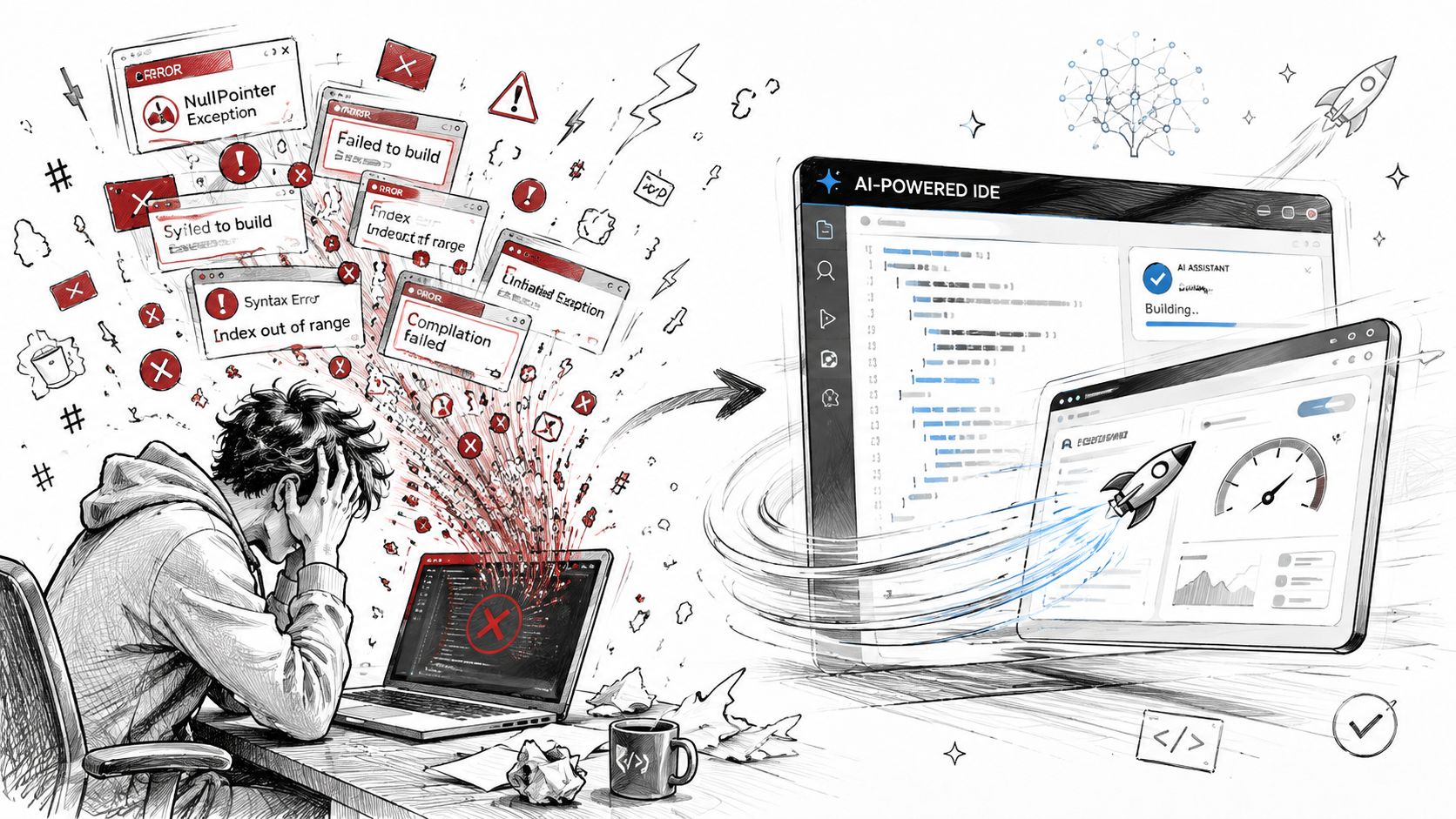
Security needs to move before the pull request
AI-native IDEs and autonomous agents make late detection less effective. Generated code may introduce a trust boundary, alter authorization behavior, or add a package without making the architectural consequence clear. A pull-request scan can flag symptoms, but the design choice has already been buried in implementation details.
Security reviews held through meetings and point-in-time documents have the same weakness. They provide useful evidence, but that evidence ages as repositories, service metadata, tickets, and deployment paths change. A living security context should connect the intended design with the controls that implement it, so reviewers can assess a change before it becomes code.
This also changes how teams should manage developer productivity. Agent fleets can produce parallel changes, but leaders still need ownership, scope boundaries, approval rules, and escalation paths. Guidance on how to coordinate agent fleets is relevant because coordination becomes a security control when multiple agents can modify application code or infrastructure.
Practical rule: Ask whether the team can explain why a change is allowed, what it can reach, and which control proves that the remaining risk is acceptable.
Reactive scanning still has a role. SAST, DAST, secret detection, infrastructure checks, and dependency analysis catch defects that design controls can miss. They should provide targeted evidence after security context has been established, not serve as the program's primary source of judgment. Enterprise AppSec needs continuous context first, focused scanning second, and enforcement tied to business impact.
The Pillars of Continuous AppSec Governance
A mature program replaces security gatekeeping with guardrails that engineers can use without leaving their workflow. Three pillars support that shift: living threat models, Policy-as-Code, and runtime protection. Each addresses a different failure mode, and none is sufficient alone.
Living threat models
A living threat model connects business intent to technical reality. It should capture the assets being protected, trust boundaries, data flows, identities, entry points, and accepted assumptions. It should update when a ticket changes, a service is added, or a repository introduces a new integration.
The useful unit isn't a diagram stored in a wiki. It's a traceable decision linked to the artifacts that implement it. If a product requirement introduces customer data processing, the model should identify the relevant authorization, logging, retention, and encryption expectations before development begins.
Policy as code
Policy-as-Code converts those expectations into checks that tools can evaluate consistently. Examples include requiring an approved authentication pattern, rejecting unreviewed external calls, enforcing dependency provenance rules, or demanding an explicit owner for a sensitive service.
The strongest policies produce an actionable result inside the pull request. They explain which design decision applies, identify the changed resource, and tell the developer what evidence or remediation is required. Optional merge blocking is often better than universal blocking because teams can begin in advisory mode, tune rules, and reserve hard enforcement for material controls.
Runtime protection
Design and build controls can't predict every production behavior. Runtime protection supplies the final feedback loop through application telemetry, API monitoring, access enforcement, anomaly detection, and response controls. It should confirm whether deployed behavior matches the approved model and provide evidence when it doesn't.
This structure matters for teams operating in emerging environments. A practical approach to risk management for Web3 and AI teams also depends on connecting unusual trust models, automated actors, and rapidly changing components to enforceable controls rather than leaving them in narrative risk registers.
A useful governance chain looks like this:
- Plan: Record the security properties required by the business change.
- Design: Map threats, trust boundaries, identities, and approved patterns.
- Build: Enforce relevant policies during code review and CI/CD.
- Release: Verify that artifacts, dependencies, and configuration match expectations.
- Operate: Monitor runtime behavior and feed material changes back into the model.
The goal isn't to make developers wait for security. It's to make security decisions available where developers already work, with evidence that auditors and incident responders can reconstruct later.
Implementing Continuous Threat Modeling
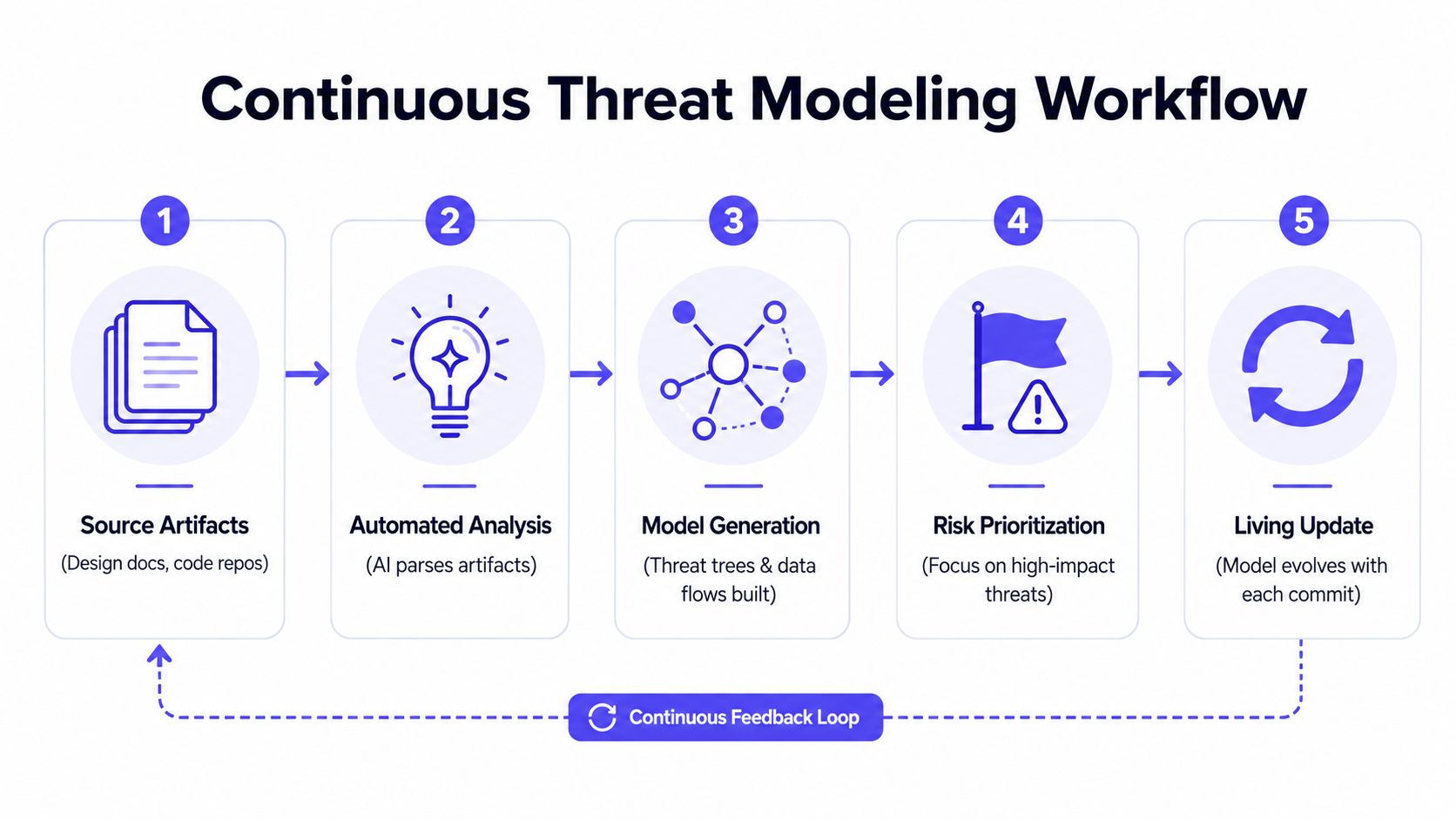
Continuous threat modeling starts with artifacts you already own. Don't begin by asking teams to redraw every architecture diagram. Begin with planning tickets, design documents, repository structure, service metadata, API specifications, infrastructure definitions, and deployment manifests. Those artifacts contain enough information to build a useful initial model, even when formal documentation is incomplete.
Start with change-triggered inputs
Connect the model to the systems where change is declared. A Jira ticket may describe a new payment flow. A design document may identify a new data store. A repository may reveal an outbound integration that wasn't mentioned in the ticket. The model should ingest these signals and record their relationships instead of treating each artifact as an isolated source.
Establish ownership at this stage. Every service, data classification, trust boundary, and exception needs a responsible team. Without ownership, automated analysis can identify risk but can't produce a decision.
Generate and validate the model
Use automated analysis to extract data flows, external dependencies, authentication paths, and likely assets. AI can accelerate parsing and identify inconsistencies, but it shouldn't approve a sensitive design by itself. A security engineer or accountable system owner still needs to validate assumptions and decide which risks are accepted, mitigated, transferred, or rejected.
A practical threat model should produce concrete outputs:
- Threat trees: Show how an attacker could reach a protected asset.
- Security requirements: Translate threats into controls such as authorization checks, rate limits, or isolation.
- Evidence links: Connect requirements to tickets, commits, tests, configurations, and deployment records.
- Ownership: Assign each unresolved decision to a named team with an expected resolution path.
Update on meaningful change
Not every commit needs a full human review. Trigger model reevaluation when a change affects an identity provider, sensitive data flow, public API, privilege boundary, deployment environment, dependency trust, or agent permission. A routine styling change should not receive the same treatment as a new administrative endpoint.
The key is preserving history without freezing the design. Keep the previous decision, record what changed, and show whether the new implementation still satisfies the original requirement. This gives auditors a defensible trail and gives engineers a fast answer when a pull request touches a protected area.
A threat model earns its place in delivery when it changes the next engineering decision, not when it merely survives an audit.
Teams should also test the model against production reality. Compare declared services with observed endpoints, approved identities with actual access paths, and documented dependencies with built artifacts. Any mismatch becomes a governance task rather than a discovery made during an incident.
Enforcing Policy as Code in Developer Workflows
Policy-as-Code works when it behaves like a precise engineering rule, not a security opinion pasted into a ticket. The pull request is the right enforcement point because the change is visible, the author is still engaged, and the result can be linked to a review record. Waiting until deployment pushes the conversation later, when remediation is more expensive and release pressure is higher.
A good policy has four properties. It has a clear scope, a deterministic test, an owner, and an explanation that helps the developer act. For example, a policy can require an approved authorization middleware for a sensitive route, reject a package without an accepted provenance record, or require a design review when a service crosses a defined trust boundary.
Advisory first, blocking where it matters
Universal merge blocking creates resistance and encourages teams to bypass controls. Start with advisory feedback for new policies, measure which rules generate ambiguity, and refine the messages. Then block only controls where the organization has a clear requirement and a reliable remediation path.
The pull request should show more than a red or green status. It should expose:
- The matched rule: Name the policy and the protected business or architectural property.
- The affected change: Identify the file, service, dependency, or route that triggered evaluation.
- The required action: Provide an approved pattern, reviewer, exception process, or test.
- The decision record: Preserve who approved the outcome and why an exception exists.
Developers also need security context in their normal tools. Feedback can appear in GitHub, VS Code, Cursor, or CI logs, while design requirements remain connected to the originating planning artifact. Teams evaluating implementation approaches can use this overview of Policy-as-Code tools to compare enforcement patterns and workflow integrations.
The trade-off is deliberate. A policy that blocks an unsafe merge protects the enterprise only if developers trust its accuracy. A policy that never blocks anything becomes documentation. Effective programs separate high-confidence controls from exploratory checks, publish exception rules, and review policy quality as carefully as application code.
The strongest implementation also verifies the result after merge. If an approved design requires a particular identity boundary or data-handling control, CI/CD should confirm that the deployed configuration and artifact still reflect it. That closes the gap between policy declaration and production behavior.
Securing the Software Supply Chain End to End
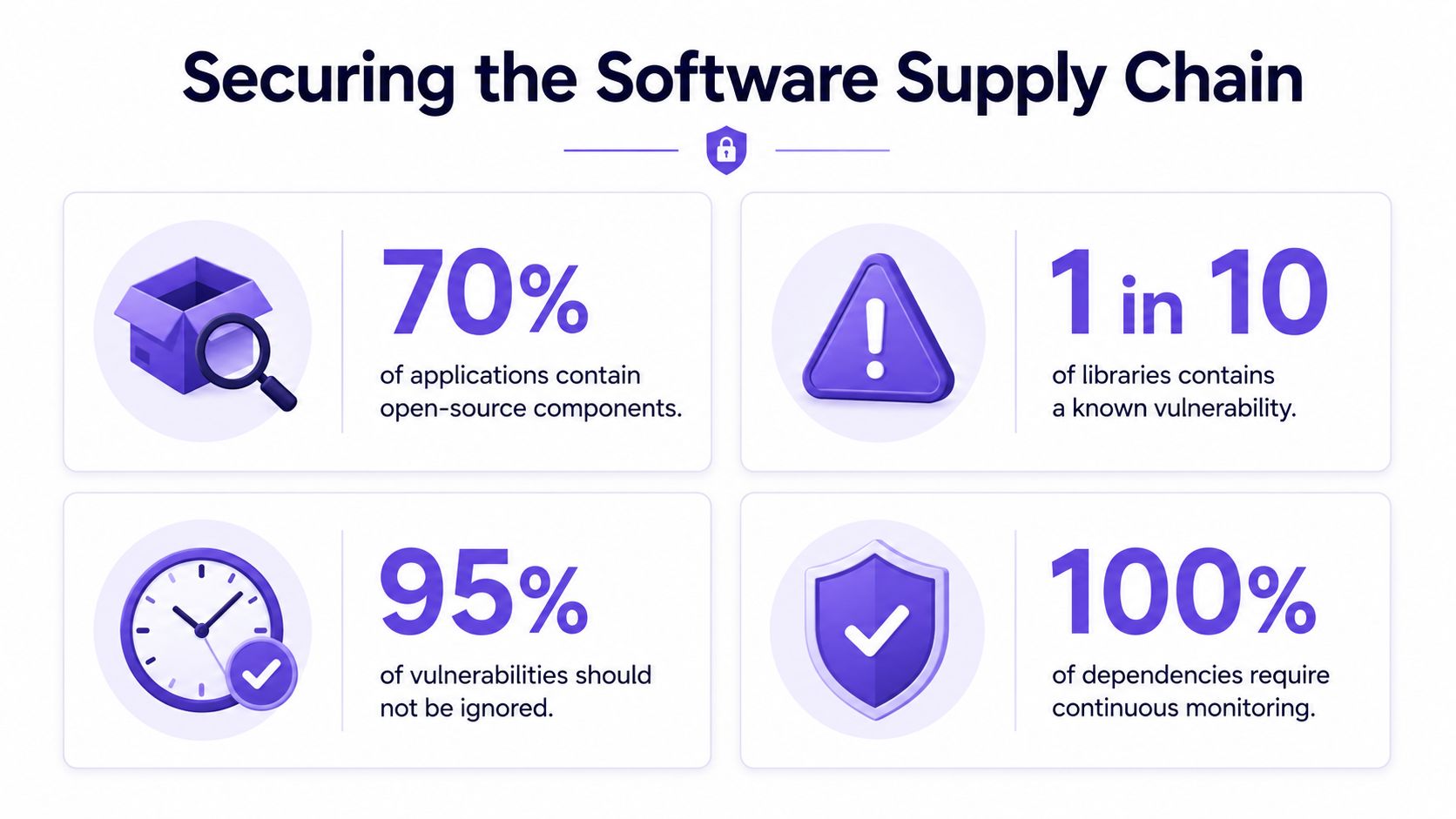
Source scanning alone cannot establish supply chain security. An enterprise application may pass review while relying on an indirect package, importing an untrusted build input, running a compromised action, or releasing an artifact that differs from the reviewed commit. The control objective is verifiable trust from component selection through deployment, supported by continuous governance rather than a vulnerability list.
Independent enterprise research found that 91% of organizations experienced a software supply chain incident in the previous 12 months. Reported incidents included zero-day exploitation in third-party code, misconfigured cloud services, attacks against open-source software and container images, stolen repository secrets, and API data breaches. The research also found that 88% considered accurate inventory of third-party APIs and cloud services critical or important, while 86% considered knowledge of application composition and access critical or important. (Software Supply Chain Security research)
Build an inventory that reflects reality
Track direct and indirect dependencies, container images, build actions, APIs, cloud services, signing identities, and release artifacts. Software composition analysis should resolve the dependency graph that ships, including development and indirect dependencies, rather than reading only the manifest. Earlier benchmark findings showed that 25% of issues related to indirect or development dependencies, which makes that distinction important.
Inventory also needs ownership and usage context. A vulnerable package used only in testing calls for a different response from a reachable library handling regulated data. Context sets priority, but it does not replace the need to locate every component.
AI-assisted coding adds another verification point. Generated code, agent-selected packages, and automated pull requests should enter the same inventory and approval path as human-authored changes. Governance must cover how agents select dependencies, access repositories, and modify build configuration.
Verify the path to release
Use provenance records, reproducible builds where feasible, artifact signing, protected build identities, and controlled promotion between environments. Treat the pipeline as production code. A trusted dependency can still become dangerous if an attacker changes a build step, substitutes an artifact, exposes a secret, or bypasses approval.
A practical supply chain review asks:
- Can we identify every component in the released artifact?
- Can we connect that artifact to reviewed source and an authorized build?
- Can we detect unexpected changes between build and deployment?
- Can we revoke or replace a component without losing the inventory trail?
Continuous monitoring outperforms a one-time component report because dependencies, registries, APIs, cloud permissions, and agent workflows change. Integrate selected checks with pull requests, build pipelines, deployment gates, and release evidence. The result is a traceable chain from design decision to production artifact, with exceptions visible before they become incidents.
Governance for Regulated and High-Scale Industries
Regulated engineering teams don't need a separate security universe. They need the same delivery controls to produce reliable evidence. In FinTech, a design review should show how a transaction service authenticates callers, separates duties, protects sensitive data, and records material decisions. In HealthTech, the review should connect data flows and authorization rules to the application behavior that enforces them.
The difficult part is maintaining that evidence while the product changes. A PDF architecture review may satisfy a meeting, but it won't automatically reflect a new API, service account, or third-party integration. Audit-friendly governance requires traceability from requirement to implementation, including the reviewer, exception, test, and deployment state.
Treat identity as an application control
SSO doesn't prove that an application authorizes every action correctly. A 2025 application-level assessment report found that 44% of cases had at least one access path bypassing the enterprise IdP, 40% lacked login protections such as rate limits or lockouts, and 37% used insecure or nonstandard authentication approaches. Those findings support continuous verification of application-level identity and session behavior, rather than assuming enterprise identity controls automatically extend into every application. (2025 Software Supply Chain Security Report coverage)
For a regulated team, that means testing authorization paths after release, reviewing service-to-service access, checking token handling, and confirming that privileged operations use approved policy. The evidence should be generated as part of delivery, not assembled from memory before an audit.
High-scale organizations also need clear operating boundaries for automation. Agent leadership resources for SaaS teams, such as this SaaS page on agent leadership, can inform ownership models, but security leaders must still define which agents may read repositories, propose changes, execute builds, or approve releases.
The practical standard is simple: if a control matters to the regulator, the business, or an incident responder, attach it to an artifact that changes with the system. Tools such as DevArmor can generate continuous threat models, surface design reviews in delivery workflows, enforce Policy-as-Code on pull requests, and retain traceable security decisions for regulated teams. That doesn't remove judgment. It makes judgment visible and repeatable.
The Future of AppSec in an Agentic World
Agentic development changes the unit of security from the human-written change to the authorized action performed by a human, IDE assistant, or autonomous agent. An agent can read a large codebase, modify several files, add dependencies, update infrastructure, and open a pull request in one workflow. Speed is useful, but speed without bounded authority turns a coding assistant into an uncontrolled change mechanism.
Security leaders should establish guardrails before expanding agent permissions. Start with approved architecture patterns and define which repositories, branches, environments, tools, and secrets an agent can access. Require the agent to receive relevant threat-model context and policy constraints before it generates code. Then evaluate the resulting diff, dependency graph, tests, and deployment plan through the same controls applied to human work.
Use context, not vague AI restrictions
A useful agent policy is specific. It might prohibit direct access to production credentials, require human approval for changes to identity boundaries, restrict new external packages to approved registries, or demand a design decision when a change introduces a new data flow. The agent should receive the reason for the constraint and the approved alternative, otherwise it will repeatedly produce the same unsafe proposal.
Don't confuse an AI label with a security control. Some organizations describe ordinary automation as agentic without defining capabilities, identity, or accountability. That kind of agent washing obscures the question: what can this system do, on whose authority, with which evidence and rollback path?
AI-assisted coding security also needs implementation verification. A generated change may appear to satisfy a requirement while bypassing a middleware layer or weakening a session control. Guidance on AI coding security is most useful when it connects generation guardrails to design requirements, pull-request enforcement, and runtime confirmation.
The operating model should include:
- Constrain: Limit tools, repositories, environments, and credentials.
- Contextualize: Supply approved designs, threats, policies, and data classifications.
- Evaluate: Inspect generated diffs, dependencies, tests, and deployment changes.
- Approve: Require human decisions for sensitive boundaries and exceptions.
- Verify: Confirm that production behavior still matches the approved design.
Enterprise application security won't remain effective if it only reacts to what agents have already produced. Build continuous governance into the agent workflow now, then give engineering teams the context and guardrails needed to move quickly without surrendering accountability.
DevArmor provides continuous threat modeling, security design reviews, and Policy-as-Code enforcement across planning tools, IDEs, source control, and CI/CD workflows. Visit DevArmor to see how your team can connect approved design decisions to AI-assisted development, pull-request controls, and audit-ready security evidence.
Related reading
- SDLC Cyber Security: Embedding Controls Across Every Phase — practical controls for each development phase.
- Application Security Architecture: Patterns, Threat Models — proven patterns and component-level threat modeling techniques.
- Secure Code Review Best Practices: A Complete Guide — policy-as-code and reviewer strategies that scale.
Table of Contents
Subscribe