Application Security Architecture: Patterns, Threat Models
 Reza Khosravi
Table of Contents
Most security teams are told to start with a threat model, approve the architecture, and then let engineering build against it. That advice sounds disciplined, but it breaks down in systems that change continuously. The diagram gets approved, the repository evolves, a new service appears, an external API is added, and the original security decision becomes background material nobody checks during implementation.
Application security architecture works only when it remains connected to the work that changes the system. A useful model isn't a document preserved in a shared drive. It's a set of decisions, boundaries, and enforceable requirements that developers encounter in tickets, pull requests, infrastructure changes, and deployment workflows.
OWASP's history supports this shift from isolated bugs toward structural controls. Its Top Ten has evolved with application architecture, and the 2025 edition still ranks Broken Access Control first, with 3.73% of tested applications affected by one or more of the 40 CWEs in that category. Security Misconfiguration ranks second, affecting 3.00% of tested applications across 16 CWEs in the same release (OWASP Top Ten data and architecture context). Those results point to a practical conclusion: secure code matters, but design decisions determine whether insecure code paths, privileges, and configurations can spread.
Why Most Threat Models Fail Before Implementation Starts
The common assumption is that threat modeling is a workshop. A group meets, draws data flows, lists threats, assigns owners, and closes the action items. That process can produce useful insight, but it fails when the organization treats the meeting as the deliverable.
A threat model usually becomes stale before the first meaningful release. Engineering changes an authentication flow, splits a service, introduces a queue, or connects a vendor API. The diagram remains unchanged because updating it requires another meeting, another round of coordination, and another interruption to delivery. Developers then implement against the architecture that exists in source code, not the architecture that security reviewed.
OWASP's own evolution shows why one-time reviews aren't enough. The project has updated repeatedly as applications moved toward distributed and API-heavy designs. The 2017 edition added Insufficient Logging & Monitoring and Using Components with Known Vulnerabilities, while the 2021 edition promoted Insecure Design to a top-level category (OWASP Top Ten project history). Those changes reflect a recurring reality: security failures often originate in system structure, dependency choices, and operating assumptions.
The gap between decisions and implementation
Security teams often record decisions in prose:
- “All internal service calls must be authenticated.”
- “Customer records must remain within the approved trust boundary.”
- “Administrative actions require stronger authorization.”
- “External dependencies require ownership and provenance.”
The statements are reasonable, but they aren't yet controls. A developer needs to know which service calls require mTLS, which policy evaluates the authorization decision, which data fields may cross a boundary, and what a pull request must prove before merge.
Practical rule: A security decision isn't operational until a developer can encounter it during implementation and a pipeline can validate it during delivery.
Static models also fail because ownership is unclear. Security may own the document, architecture may own the diagram, and engineering may own the code. When the system changes, each group assumes another group will update the context. The result is familiar in regulated environments: a polished model for the last review, paired with an implementation that has moved on.
Treat the model as governance
A living model should change when the architecture changes, not when a calendar reminder fires. New services, new data classifications, new identity providers, new third-party integrations, and changes to network placement should trigger an evaluation. Small changes can receive lightweight annotations, while changes to trust boundaries or privileged operations deserve deeper analysis.
The important shift is from producing threat-model documents to maintaining security constraints. Store decisions beside the artifacts that create change. Link requirements to service ownership, repositories, infrastructure definitions, and acceptance criteria. Then surface the relevant context in the pull request instead of expecting a developer to search through old diagrams.
The strongest teams don't eliminate human review. They reserve it for decisions that require judgment, while automation handles repeatable checks. That approach keeps architecture governance close to implementation without turning every change into a security committee event.
The Core Components of Application Security Architecture
Application security architecture is the set of design decisions that governs identity, data movement, component interaction, and failure behavior. It determines where policy checks, scanners, and runtime controls can operate. A diagram alone has little value if the deployed system no longer matches it.
Start with identity and authorization. Define identities for users, services, workloads, and agents, then enforce authorization at both API and data layers. Internal network placement should not grant implicit trust. Broken access control remains OWASP's highest-ranked concern in the 2025 list, so privilege boundaries belong in the architecture and its enforceable controls, not only in endpoint-level code (OWASP application security architecture evidence).
Boundaries, flows, and durable controls
Data protection begins with classification and flow design. Identify sensitive assets, mark where encryption starts and ends, document key-management responsibilities, and specify which logs must mask data. A design can look controlled while a queue, analytics job, support tool, or downstream service receives more information than its function requires. Those decisions become expensive once interfaces and data contracts are established.
API architecture needs its own boundary model. Gateways can centralize authentication, schema validation, rate controls, and routing. They cannot decide every object-level permission. The gateway may establish that a caller is authenticated, while the service still must determine whether that caller can read a particular record or perform a sensitive operation.
Logging and auditability require architectural decisions too. OWASP reported that Security Misconfiguration appeared in 90% of applications in its 2021 data, with an average incidence rate of 4.5% and more than 208,000 CWE occurrences (OWASP 2021 findings). Treating logging as a few statements added during implementation leaves gaps in evidence and protection. Define the events that demonstrate authorization, data access, configuration changes, and administrative activity, then restrict alteration and access to the logs.
Prioritize what's expensive to change
Architecture reviews should focus on decisions that become costly after deployment:
- Trust boundaries: Moving data or privileges across a boundary can require service redesign.
- Identity propagation: Consistent service identity is harder to retrofit than to carry through communication paths from the start.
- Data ownership: Shared databases blur access-control, retention, and audit responsibilities.
- Failure isolation: Without isolation, a compromised or overloaded component can affect unrelated capabilities.
- Dependency governance: Provenance and update paths remain relevant throughout a component's use.
These decisions also provide durable signals for workflow-native enforcement. Put ownership, required controls, and verification criteria beside repositories, infrastructure definitions, and service specifications. A pull request can then surface the relevant context when a boundary, identity path, or dependency changes, rather than relying on a meeting that may occur after implementation.
Attack surface analysis helps teams inventory interfaces, dependencies, identities, and exposed services instead of reviewing only source-code findings. The same inventory approach applies to distributed customer environments and workloads managed by service providers. See attack surface analysis for MSPs for that operational perspective.
A formal benchmark for microservice architecture security shows how design-time rules can express requirements for service decomposition, connector permissions, and conformance (microservice architecture security rules benchmark). Such rules help evaluate whether the architecture still preserves intended trust and privilege relationships as services evolve. Human review remains necessary for judgment-heavy decisions, while automated checks handle repeatable violations close to the change that introduced them.
Building Threat Models That Actually Get Used
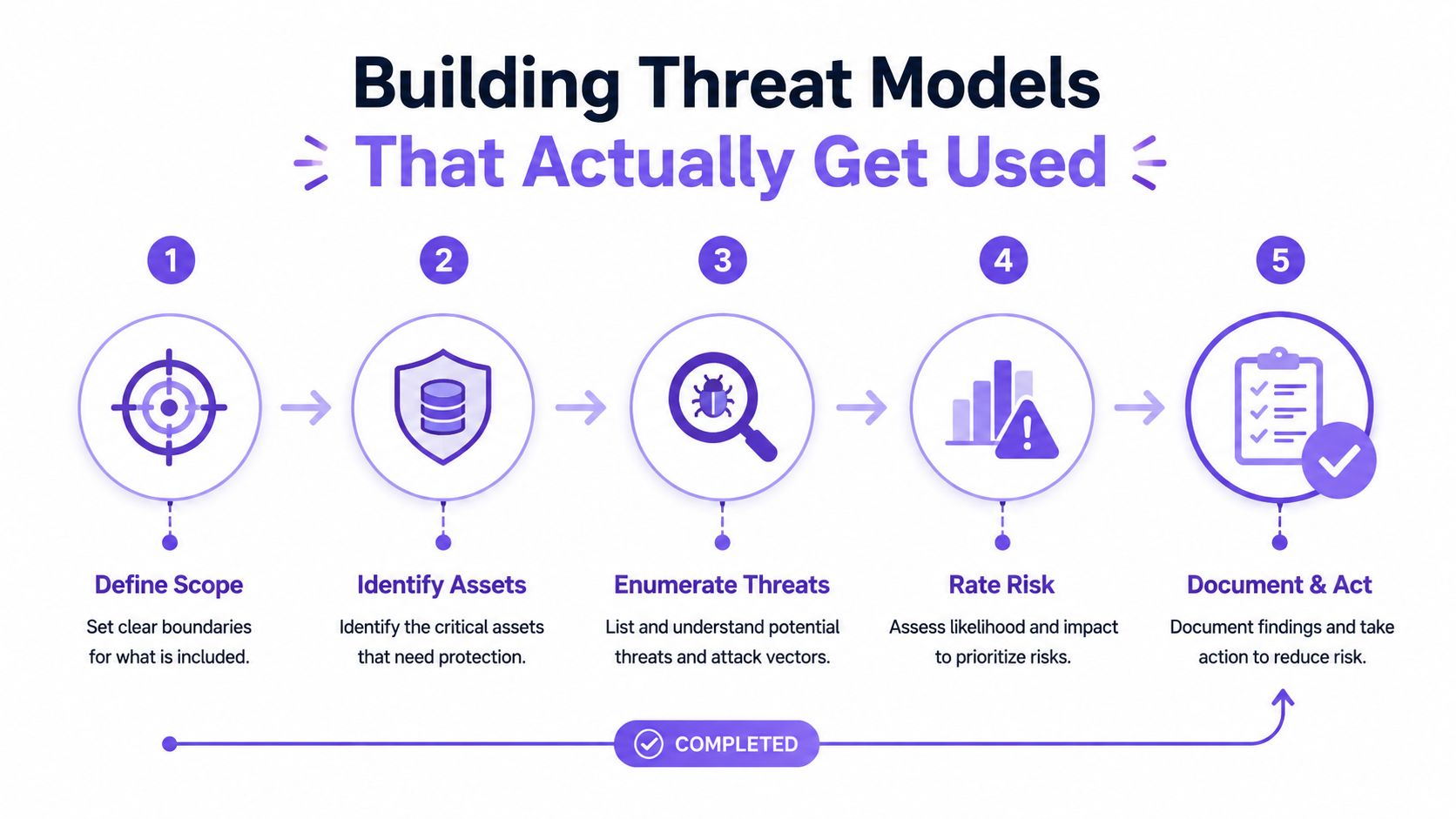
A threat model that lives in a shared drive is documentation, not a working control. The practical test is simple: can an engineer use it while implementing a feature, and can the delivery system verify the resulting decision?
Start with scope. Pick a system, feature, or meaningful architectural change, and state what isn't included. Microsoft's secure-by-design guidance recommends using at least a Data Flow Diagram, defining trust boundaries, and scoping the session to the specific system or feature. It also suggests reserving about 2 hours, with the first hour used to establish a common understanding of the architecture (Microsoft secure-by-design guidance).
Use artifacts developers can act on
A useful session should produce more than an attack tree. Capture:
- Assets and owners, including sensitive data, privileged operations, credentials, and business-critical functions.
- Trust boundaries, showing where identity, data, or control moves between components.
- Abuse cases, written against actual interfaces and workflows.
- Security requirements, tied to services, endpoints, infrastructure, or data stores.
- Architecture decisions, including the rejected alternatives and the reason for the choice.
- Verification criteria, suitable for code review, infrastructure checks, tests, or runtime validation.
Avoid writing requirements such as “secure the API.” Write “the service must authorize object access using the caller's tenant context before returning a record,” then connect that requirement to a test or policy. Developers don't need an abstract threat category. They need a constraint they can implement and verify.
Put the review inside delivery
Threat modeling fits sprint planning when teams define triggers instead of scheduling every review by habit. A new external integration, a new privileged role, a change to regulated data, or a new public endpoint should create a review task. A refactor that doesn't alter assets or boundaries may only need an annotation and an automated check.
Keep the output close to the workflow. Link the model to the ticket, show the relevant requirement in the pull request, and assign ownership to the team that will maintain the component. Continuous threat modeling is one practical way to keep those decisions synchronized with changing repositories and planning artifacts, as described in DevArmor's continuous threat modeling approach.
The review should end with an action list that has a clear disposition. Each item should be implemented, accepted by an accountable owner, or rejected with a documented rationale. If no one can explain how a finding changes code, configuration, deployment, or monitoring, the model hasn't finished its job.
Security Patterns for Modern Application Architectures
Patterns are useful only when they address a defined threat and fit the team that must operate them. A pattern chosen as a maturity badge can increase latency, failure modes, debugging effort, and ownership gaps.
| Pattern | Primary Threats Addressed | Operational Complexity | Best For |
|---|---|---|---|
| API Gateway | Unauthenticated access, abusive traffic, inconsistent edge validation | Central policy, availability, routing, and observability concerns | Public APIs and services needing a shared entry boundary |
| Sidecar | Unencrypted service traffic, inconsistent service identity, scattered secrets handling | More components to deploy, observe, and troubleshoot | Polyglot platforms with a mature service mesh |
| Circuit Breaker | Cascading failure, resource exhaustion, denial-of-service amplification | Threshold tuning, fallback behavior, and operational testing | Distributed services with meaningful dependency failure modes |
| Strangler Fig | Legacy attack surface and risky monolith replacement | Parallel operation, data consistency, and migration governance | Incremental modernization of high-value legacy systems |
Choose patterns by threat and team capability
An API Gateway can centralize authentication, rate limiting, request validation, and routing before traffic reaches services. That central boundary also concentrates risk. It may become a single point of failure, a performance bottleneck, or a policy blind spot if teams treat edge validation as a substitute for internal authorization. Keep object and tenant authorization at the service boundary, then test both paths.
A Sidecar can provide mTLS, identity propagation, and secrets integration across applications written in different languages or frameworks. The trade-off is another operational layer, with added resource use and more failure paths. Before adopting it as a default, teams need ownership for certificate rotation, policy distribution, telemetry, upgrades, and behavior when the sidecar is unavailable.
A Circuit Breaker limits the blast radius of slow or unavailable dependencies. It can stop one stressed endpoint from creating a chain reaction across services, including a denial-of-service amplification path. Poor thresholds create false positives and reject legitimate requests. Set and review thresholds using realistic load and dependency-failure tests, with fallback behavior defined for each operation.
The Strangler Fig pattern supports incremental replacement of legacy functionality and avoids the risk of a big-bang rewrite. During migration, however, two systems may enforce different identity, logging, retention, and authorization rules. Define the authoritative system for each control, record routing decisions, and monitor drift between the old and new paths.
These patterns also need a living security context. A gateway policy may be correct when deployed and wrong after a new service, role, data flow, or agent integration appears. Store pattern decisions with the service configuration, require workflow checks when boundaries change, and make ownership visible in pull requests rather than relying on a periodic architecture meeting.
Agent workflows add another identity boundary. Browsers, agents, and delegated sessions need explicit ownership of session state, authorization scope, and revocation. AWS's guidance on isolated browser sessions for agents helps when evaluating cases where a user session and an automated actor could be confused.
Architecture Decisions in Regulated Industries
Regulation does not remove architectural trade-offs. It makes undocumented decisions harder to defend when an incident, audit, or product change exposes an old assumption. In regulated systems, the architecture record must stay connected to the controls that operate in production.
A payment platform may split authorization, ledger updates, notifications, and settlement across services. A Saga pattern coordinates that workflow through compensating transactions when a later step fails. Its security value extends beyond recovery. Each state change can create an auditable record, and explicit transition ownership makes it easier to identify which service is responsible for authorization, integrity, and evidence.
For a health records platform, event sourcing preserves an immutable, append-only history of changes. That history supports investigation and point-in-time reconstruction, while creating obligations for access control, encryption, retention, deletion processes, and storage operations. Append-only storage does not establish compliance by itself. The team still needs to show who can read or append events and how sensitive values are protected.
Separate paths when the controls differ
Both payment and health platforms can use CQRS to separate read and write models. This lets teams apply stricter authorization, encryption, and audit controls to sensitive writes while tuning high-volume reads for their own access patterns. It also requires clear decisions about which data may be replicated and how permissions follow each copy.
Keep the following records connected to implementation:
- Architecture Decision Records: Explain why the team selected Saga, event sourcing, or CQRS, and link each decision to applicable control obligations.
- Data Flow Diagrams: Show encryption boundaries, service ownership, replication paths, and points where regulated data crosses trust boundaries.
- Control matrices: Map technical mechanisms to requirements, evidence sources, owners, and review triggers.
- Review traces: Preserve approvals, exceptions, implementation checks, and changes made after deployment.
The purpose is not paperwork for auditors. It is a current explanation of how the system handles regulated data and who owns each control. Broader practices covering application ownership, design review, and delivery controls are discussed in enterprise application security guidance.
Static documentation loses value as services, roles, data flows, and integrations change. A control matrix should therefore point to living evidence: the policy, repository, deployment check, and current owner. Workflow checks can require an updated decision or model when a trust boundary changes, while pull requests preserve the reasoning and exceptions close to the implementation. This approach keeps security context current without depending on a periodic architecture meeting.
Enforcing Security Design Through Code Review
Architecture decisions become dependable when code review can test them at the point of implementation. An ADR that exists only in documentation depends on memory. A rule encoded in Open Policy Agent, repository settings, CI checks, or deployment controls can stop a change that violates the approved design before it reaches production.
Use policy-as-code for constraints that are clear and repeatable. OPA can evaluate infrastructure and deployment configuration for network segmentation, permitted external dependencies, identity permissions, and required labels. Each failure should explain the violated decision, identify the affected resource, and provide an exception path with an accountable owner.
Put checks at the point of change
Target checks at the context a pull request changes:
- Secrets detection: Block credentials before they enter version control, then route confirmed findings to the responsible owner.
- Infrastructure validation: Reject changes that expose an internal datastore, weaken segmentation, or create an unauthorized trust path.
- Dependency controls: Check approved sources, ownership, provenance, and vulnerability policy before a new component is merged.
- Service communication checks: Verify that service identity and encryption settings remain present in mesh or deployment configuration.
- Architecture synchronization: Require a linked decision or model update when a change alters a boundary, asset, or privileged action.
A gate should be narrow and high confidence. Blocking every warning trains developers to bypass it. Blocking a clear violation protects the architectural decision without turning security into an approval queue.
These checks also address the gap between a static threat model and a changing system. A pull request can require updated context when code changes a trust boundary, privileged action, or external dependency. The check then connects the decision to the implementation, rather than waiting for a meeting after the system has already changed.
Automated review does not eliminate architects. It moves their work from repeating the same implementation checks to designing reusable constraints, tuning exceptions, and investigating genuine risk shifts. Repository and policy history also provide audit evidence by showing what changed, who approved it, and how the control was evaluated.
For teams connecting design requirements to pull requests and implementation checks, automated security reviews offer a model for replacing meeting-heavy review with traceable workflow enforcement.
Keeping Security Context Current as Systems Evolve
Static threat models decay because software changes through many small decisions. A pull request adds an endpoint, a platform team changes an ingress rule, a product team integrates a vendor, and a data owner reclassifies a field. Each change may look minor alone, but together they can alter trust boundaries and privilege paths.
Treat security context as a living system of linked artifacts. Connect architecture decisions to repositories, tickets, service metadata, infrastructure definitions, and ownership records. When one of those artifacts changes, the system should identify which assumptions may no longer hold.
Use event-driven review triggers
A full re-model isn't necessary for every refactor. Use a risk-based distinction:
- Full re-modeling: Required when a change introduces a new trust boundary, regulated data flow, privileged identity, public interface, external dependency, or major failure path.
- Focused review: Appropriate when a component changes its authorization logic, storage behavior, logging coverage, or service-to-service communication.
- Lightweight annotation: Suitable for internal refactors that preserve assets, boundaries, identities, and data flows.
- Automated verification only: Sufficient when the change affects implementation details already covered by enforceable policies and tests.
The model should also accept evidence from the codebase when formal documentation is incomplete. Repository structure, deployment manifests, API definitions, and dependency graphs can reveal that the running architecture differs from the approved one. That comparison gives architects a way to reconstruct context instead of waiting for perfect documentation.
The case for continuous practice is reinforced by the current state of threat modeling operations. A 2025 community report benchmarked only 60 organizations, an indication that standardized, widely adopted operating models are still limited (Threat Modeling Connect State of Threat Modeling 2025-2026). Separately, recent reporting states that 60% of organizations struggle with application visibility across workloads, APIs, and cloud environments (application security root-cause reporting). Those figures don't prove that automation solves the problem, but they do show why static documentation and fragmented visibility leave a persistent gap.
Security architects should become context providers, not permanent gatekeepers. DevArmor is one option for teams that want continuous threat modeling, workflow-based security design reviews, implementation verification, and Policy-as-Code enforcement tied to approved decisions. Visit DevArmor to see how its living security context can connect architecture changes with developer workflows and auditable review evidence.
Related reading
- What Is Threat Modeling and Why It Matters in 2026 — from static diagrams to continuous security context.
- Enterprise Application Security: Key Strategies for 2026 — threat modeling, policy enforcement, and compliance at enterprise scale.
- SDLC Cyber Security: Embedding Controls Across Every Phase — practical controls for each development phase.
Table of Contents
Subscribe