AI Coding Security: Guardrails for Agentic Development
 Reza Khosravi
Table of Contents
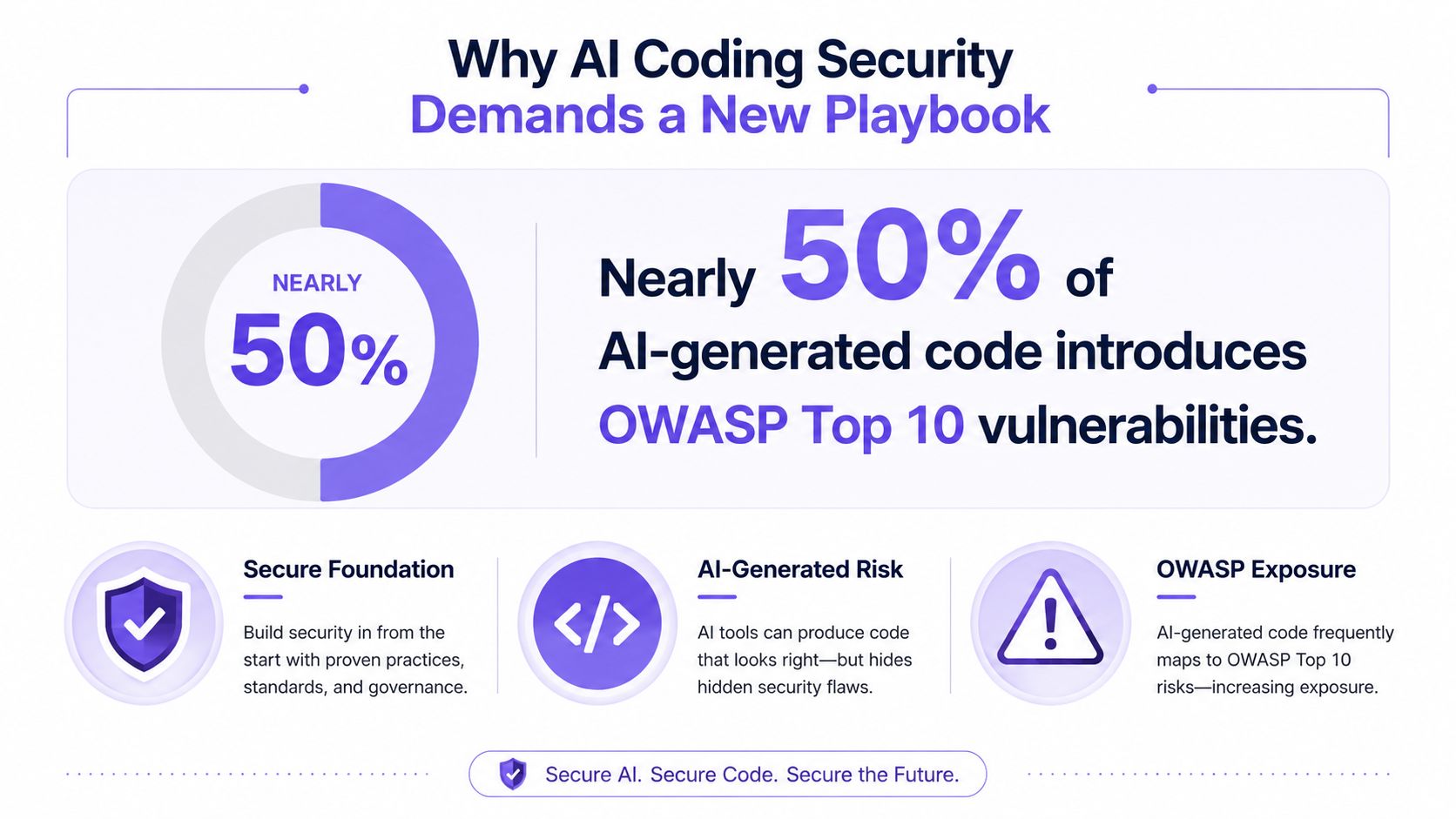
AI coding security is no longer a question of whether a model can write vulnerable code. Veracode's 2025 testing found that 45% of AI-generated code samples introduced OWASP Top 10 vulnerabilities across more than 100 models, and its later 2026 report still put the average security pass rate at 56% source note. That's the number that should change how teams think about agentic development, because the problem isn't just bad code. It's code that arrives fast, looks plausible, and may never pass through a human who fully understood what the agent generated.
Why AI Coding Security Demands a New Playbook
A coding agent can draft a feature, open a pull request, and push it through CI before a reviewer has time to inspect the full change. That speed changes the security problem. The old model assumed a developer wrote code, a reviewer read it, and a scanner caught what both people missed. AI collapses those steps, so security teams lose the clean line between authorship, review, and merge.
Veracode's testing makes the core issue plain. 45% of AI-generated samples introduced OWASP Top 10 vulnerabilities, and the later benchmark still showed a roughly 44 to 45% failure rate across test cycles from 2025 into early 2026 Veracode's 2026 benchmark summary. The same body of testing showed the problem is uneven, with Java failing 72% of tasks, 86% of generated samples failing against cross-site scripting defenses, and 88% vulnerable to log injection Veracode's GenAI code security report. Those are repeatable failure modes, and they matter because they show where guardrails have to be enforced, not just where scanners should complain after the fact.
Ungoverned speed is the real risk
Blanket bans usually fail for a simple reason, developers route around them. Recent research on AI-assisted coding governance points out that bans can push teams toward unsanctioned tools with zero oversight, which makes the security problem worse, not better AI coding governance research. Once that happens, the organization loses traceability over prompts, generated changes, and approval paths.
A regulated team needs a different control point. If an agent drafts code from a ticket, the ticket context should be logged, the agent identity should be known, the prompt should be tied to the repository and the branch, and the resulting pull request should carry evidence of who approved the merge and under what policy. If that chain breaks anywhere, the review is incomplete.
Practical rule: if you can't tell which AI tool produced a change, you can't claim you reviewed that change with confidence.
That is why ai coding security has to move from “find the vuln after the fact” to “control the generation path, preserve the review trail, and enforce policy where the code enters the workflow.” In practice, that means security teams need to govern the agent, not just inspect its output.
The Three Risk Layers of AI-Assisted Development
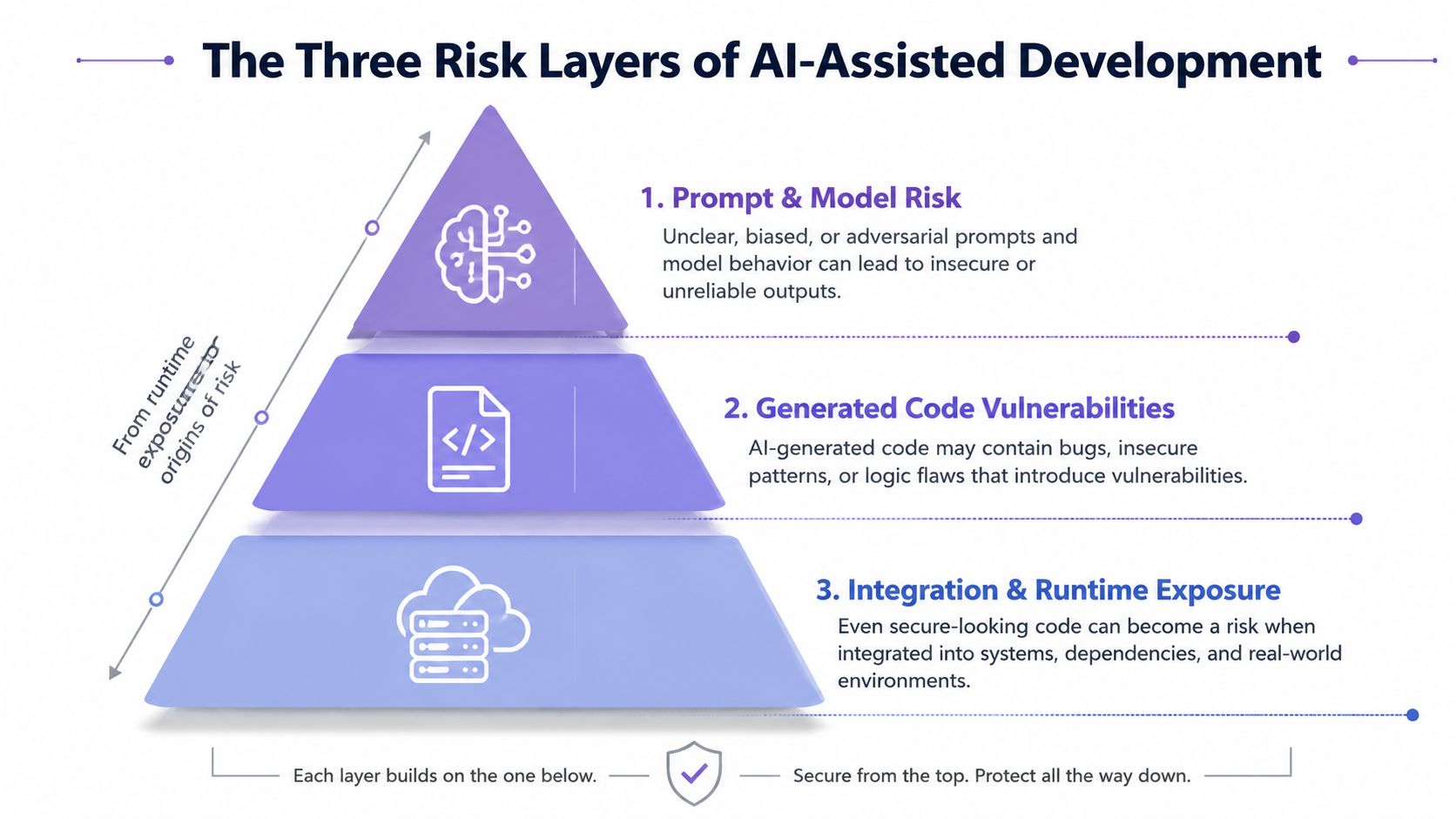
Many groups talk about AI-generated code as if all the risk lives in the source file. That's too narrow. In real systems, the exposure shows up in three layers, and each one needs a different control set.
Prompt and model risk
The first layer is what the model sees. If the agent ingests tickets, design docs, architecture notes, or snippets from a repository, it can leak sensitive context through prompts, logs, or downstream outputs. Research on AI coding governance highlights this shift from authorship to review, because the danger isn't just that the model writes insecure code, it's that it acts on context the organization never meant to expose AI coding governance research.
Generated code vulnerabilities
The second layer is the obvious one, the code itself. Veracode's testing showed that AI-generated code often misses context-sensitive sanitization and output-encoding requirements, which is why cross-site scripting and log injection failures show up so often Veracode's GenAI code security report. That's the difference between code that compiles and code that fits your application's trust boundaries.
Integration and runtime exposure
The third layer is where the code lands. An agent that opens pull requests, updates dependencies, or edits infrastructure code can push risky changes straight into CI/CD if no policy gate understands the origin of the change. This layer is where governance gaps become audit gaps, because the organization may be unable to prove what was generated, what was approved, and what shipped.
A useful way to triage the problem is to ask which layer hurts you most today. If developers are using unsanctioned tools, start with governance. If approved agents still write unsafe code, start with generation guardrails. If security reviews happen too late, focus on enforcement in the merge path.
Building Secure Prompting Context and Guardrails
The fastest way to improve AI coding security is to control what the agent can see before it writes anything. Good prompt guardrails don't try to make a model “smart enough” to infer your policy, they make the policy visible in the context the model receives. That includes approved frameworks, forbidden patterns, input-handling rules, and the security assumptions that should never be violated.
Put policy into the prompt, not into hope
A secure prompt template should name the application's constraints plainly. For example, if a service handles user-generated content, the prompt should say that output encoding is mandatory and string concatenation for templates is forbidden. If a feature touches authentication or logging, the prompt should explicitly call out secret-handling, auditability, and safe serialization. For a broader primer on types and patterns of prompt guardrails, the taxonomy at Prompt Builder's guide to prompt guardrails is a useful reference point when you're defining categories of controls.
Reject bad patterns before they reach the editor
Guardrails work best when they stop unsafe output early. That can mean filtering generated code for known insecure idioms, rejecting snippets that match forbidden library calls, or surfacing a policy explanation in the IDE before the developer ever pastes code into the repo. DevArmor's approach to feeding living security context into the model is described in what you feed the model is the model, and that principle matters because an agent without context tends to produce generic code instead of architecture-aware code.
Practical rule: don't ask the model to remember security. Make security part of the input and part of the rejection logic.
The strongest guardrails don't claim to prevent every flaw. They reduce the number of unsafe drafts developers have to review, and they keep obvious policy violations from reaching source control in the first place.
Enforcing Security Policy at Pull Request Time
Prompt controls reduce risk, but they don't close the loop. AI agents still generate edge cases, and human reviewers still miss things when the diff is large or the feature looks routine. Pull request enforcement is where organizations turn security policy from documentation into a control that can block unsafe merges.
Turn approved design decisions into checks
Policy-as-code works best when it's tied to specific architectural choices rather than generic scanner output. If the design review approved one authentication flow, one logging pattern, and one data-handling rule, the PR gate should check the change against those exact decisions. That gives reviewers a known rationale for every finding, which is far more useful than a pile of isolated alerts.
For teams that need workflow-level controls around identities and traceability, Donely's security policy for RBAC and audit logs is a good example of how access controls and review trails can be formalized. The same logic applies to AI-assisted merges, policy has to say what's allowed, what's blocked, and what evidence counts as approval.
Block high-risk merges without blocking everything
Not every violation needs the same response. A missing comment isn't a merge blocker, but an unsafe auth path or an unaudited data flow usually should be. That's why merge blocking should be reserved for the violations that map to approved controls and known risk thresholds, while lower-severity issues can route to remediation tasks.
Here's the operational pattern that works:
- Check the change against approved controls: validate the diff against the design decision it claims to implement.
- Attach a remediation path: every flag should point to the policy it violated and the fix that satisfies review.
- Preserve the decision trail: keep the review outcome traceable so auditors can see who approved what and why.
- Escalate only when needed: block merges for violations that break the approved security posture.
DevArmor's workflow for automated security reviews fits this model because it keeps policy enforcement tied to the approval path instead of to a noisy after-the-fact scan.
Verifying AI-Generated Changes Against Design Intent
A passing scan doesn't prove the code matches the design. That's a gap many teams underestimate. In AI-assisted development, the core question is whether the code implements what the organization already approved, not just whether it compiles or satisfies a checklist.
Reactive scanning versus design-traceable verification
Reactive scanning starts after the code exists. It catches some vulnerabilities, but it also creates alert fatigue because the scanner has no native understanding of which risks were intentionally accepted and which were never supposed to exist. Design-traceable verification starts earlier. It ties changes back to a living threat model or approved design decision, then checks whether the implementation still matches the security intent.
That distinction matters in regulated environments. A FinTech or HealthTech team often needs to prove not only that a vulnerability was fixed, but also that the feature was built within the approved control set. When documentation is sparse, the security team may need to reconstruct context from source code, commit history, and linked tickets. That's not elegant, but it's often the only way to build an audit trail that holds up under review.
DevArmor's implementation verification is relevant here because it connects approved decisions to the code and deployment path, which is exactly what auditors and security reviewers need when AI agents have touched the implementation.
Security review gets much easier when you can answer one question cleanly, which approved decision authorized this code change?
The practical takeaway is simple. If your verification process can't explain design intent, it's not really verifying security. It's just scanning for leftovers.
Continuous Security Context Over Point-in-Time Reviews
Point-in-time reviews made sense when code moved slowly and architecture changed on a release calendar. AI-assisted development changed that rhythm. Agents generate changes continuously, tickets get edited after approval, and repo state drifts faster than a quarterly review can keep up.
Living security context solves that mismatch. Instead of locking a review into a single document, the security model updates as the repository, planning tools, and service metadata change. That keeps the threat model aligned with the codebase, which matters when an AI agent is working from the latest issue description but the audit doc still reflects last month's architecture.
The other advantage is workflow placement. Security guidance inside Jira, GitHub, VS Code, or Cursor reduces handoffs, which is where a lot of review debt gets created. In regulated teams, that also makes the evidence easier to collect, because the decision history is already embedded in the work artifact rather than scattered across meetings and follow-up emails.
Static artifacts age quickly. A living model doesn't eliminate the need for human judgment, but it keeps the security team from approving one architecture while the agents ship another. That's the reason continuous context matters in ai coding security, especially where compliance, traceability, and speed all have to coexist.
Implementing AI Coding Security Without Blocking Delivery
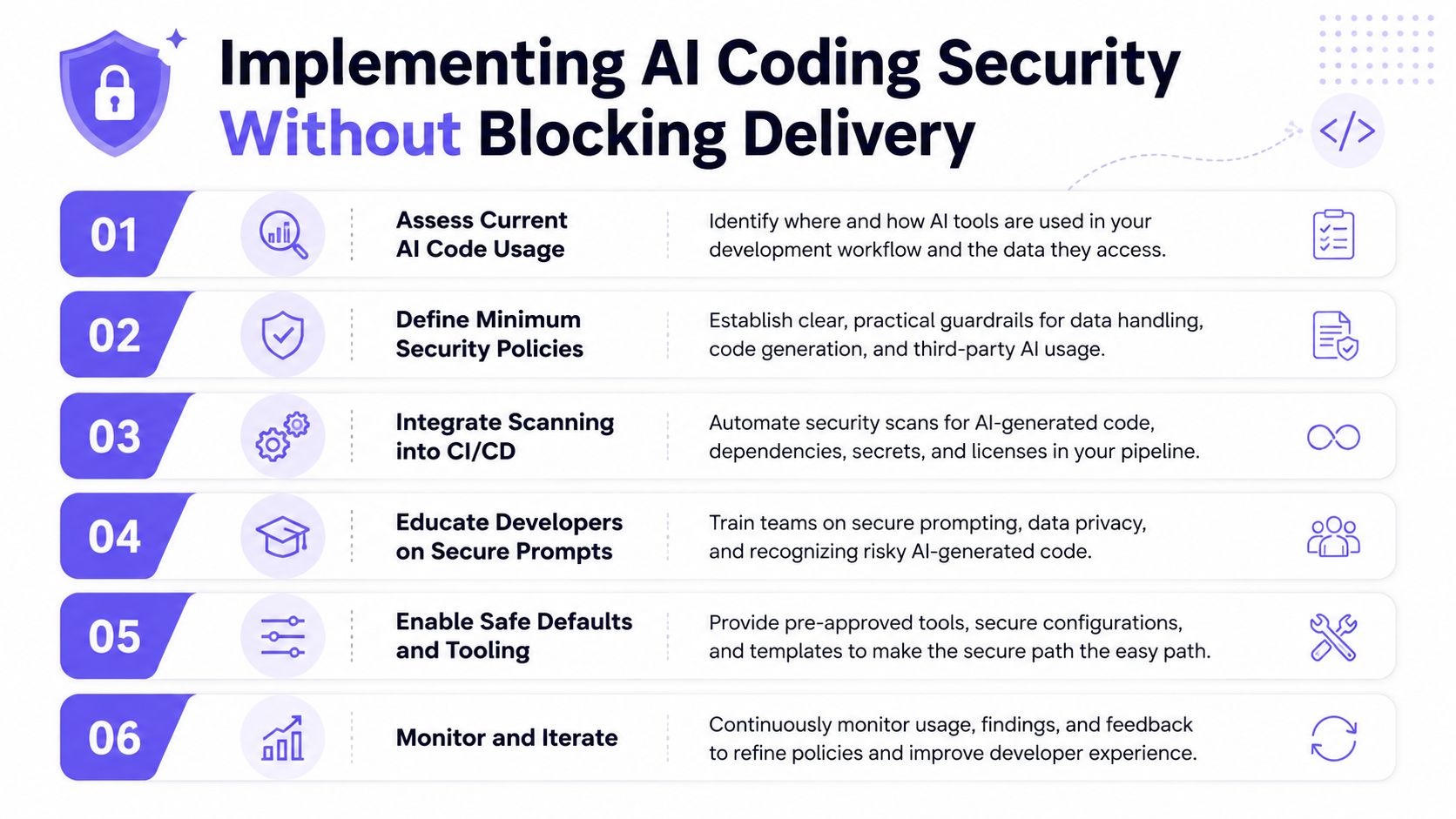
The easiest way to get ignored is to launch security controls that break developer flow. If every safeguard adds friction without reducing real risk, the team will bypass it. A workable rollout starts with visibility, then adds targeted controls at the points where AI changes enter the system.
A practical rollout sequence
- Map AI usage first. Identify which teams use assistants, which IDE plugins are approved, and where autonomous agents already touch code.
- Add secure prompting context. Feed policy, architecture constraints, and forbidden patterns into the tools developers use.
- Enforce policy on pull requests. Catch unsafe merges where the change is already visible and the approval trail is still open.
- Connect policy to design intent. Make sure every gate maps back to a decision the team can defend.
- Keep context living. Update models and review rules as tickets, services, and repositories change.
- Review exceptions quarterly, not ad hoc. Exception handling should be explicit, traceable, and rare.
For a pilot, start with one regulated product team or one service with clear data-handling rules. That gives you a smaller blast radius and a cleaner view of what's working. If you need a platform that combines continuous threat modeling, secure guardrails for AI-assisted coding, policy enforcement on pull requests, and implementation verification, DevArmor is one option to evaluate alongside your existing workflow tools.
If you're building guardrails for AI-assisted development, don't stop at scanning code after it lands. Visit DevArmor to see how continuous threat modeling, policy enforcement, and implementation verification can keep AI agents inside the security decisions your team already approved.
Related reading
- AI in SDLC: Safe Patterns, Risks, and Guardrails — real benefits, security risks, and integration patterns for AI in development workflows.
- SDLC Cyber Security: Embedding Controls Across Every Phase — practical controls for each development phase.
- Secure Code Review Best Practices: A Complete Guide — policy-as-code and reviewer strategies that scale.
Table of Contents
Subscribe