Software Composition Analysis: A Practical AppSec Guide
 Reza Khosravi
Table of Contents
93% of companies with at least 100 employees used open source software as of 2024, and that's why software composition analysis exists. Modern applications are assembled from dependencies, not written line by line from scratch, so the question is whether you can see what's inside the build before it ships.
Why Software Composition Analysis Matters Now
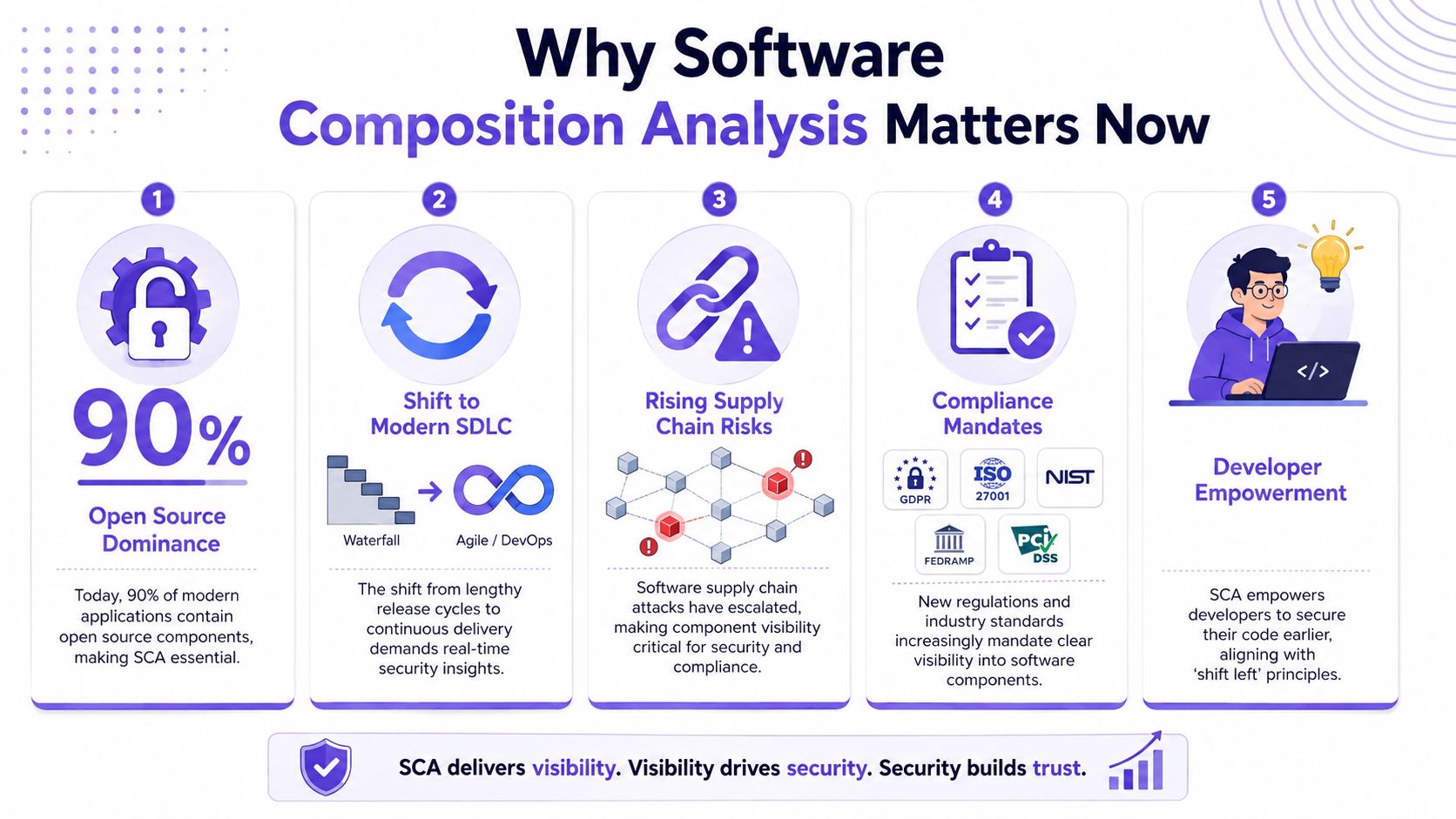
The center of gravity in AppSec has shifted. Industry guidance notes that modern applications often contain 80% to 90% open-source code, Snyk reports that more than 70% of applications contain flaws stemming from open source, and IDC survey data cited in IBM's software composition analysis overview shows that 93% of companies with at least 100 employees used open source software as of 2024. That combination makes software composition analysis a practical control, not a nice-to-have report.
Open source dominance changes the risk model
A team can write solid custom code and still ship a risky application because the exposure is hidden in packages, transitive dependencies, and container layers. The old model of reviewing a handful of internal repositories doesn't hold up when most of the application is sourced from elsewhere. SCA is the visibility layer that turns that dependency sprawl into something a security team can govern.
In regulated environments, that visibility isn't just for engineering comfort. Every third-party component becomes an audit-relevant decision, especially when license obligations, vulnerability disclosure, and change control all land on the same release. If you can't answer what's in the build, you can't defend why it was approved.
Continuous delivery needs continuous evidence
A one-time scan ages badly. New package releases, new advisories, and new build paths appear constantly, so the security answer has to move with the code. That's why software composition analysis works best when it's treated as a living control tied to the pipeline, not a quarterly inventory exercise.
Practical rule: if dependency risk can change after merge, the control has to run after merge too.
That's the reason this guide focuses on process, enforcement, and audit evidence, not just scanner output. The goal is to show how SCA fits into delivery without turning the team into a triage desk.
What Software Composition Analysis Actually Does
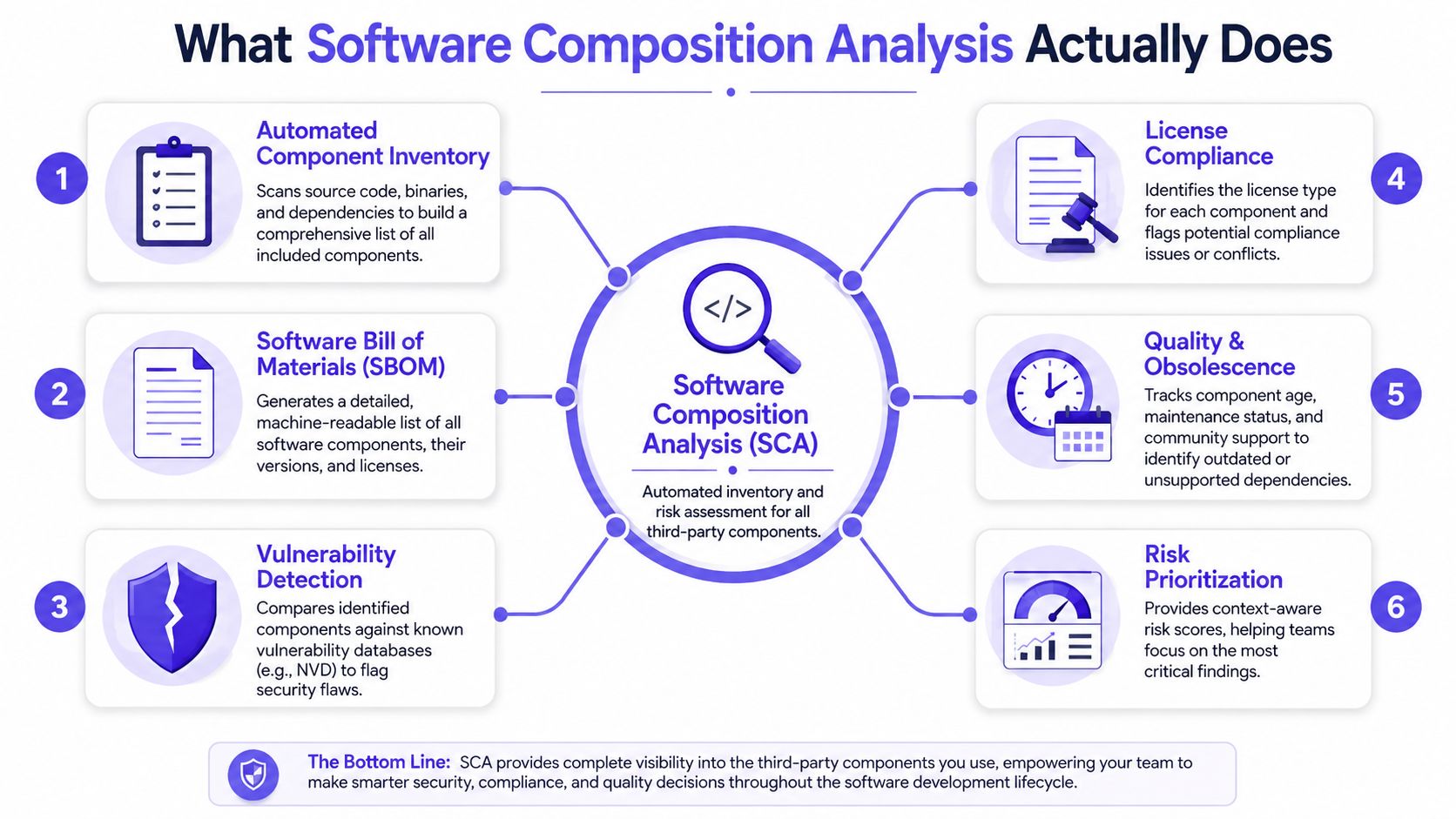
Software composition analysis is an automated inventory and risk check for third-party software. It identifies what is in an application, compares those components with vulnerability and license data, and produces a machine-readable record that security, compliance, and release teams can use to make decisions.
That matters because modern applications rarely fail at the code you wrote. They fail in packages, transitive dependencies, and base images that get pulled in long before a reviewer sees the final build. SCA gives AppSec a way to govern that dependency chain instead of treating it as an after-the-fact surprise.
The SBOM is the durable output
The most useful output is the Software Bill of Materials, or SBOM. Auditors, security reviewers, and incident responders care about it because it shows what shipped, which versions were present, and which licenses were attached. The SBOM is the evidence trail, not just a scan result.
That distinction matters in a regulated environment. A scan report can be useful in the moment, but a durable artifact gives you something you can defend later when a release is challenged or a component is disclosed as risky. If a team ships vulnerable software, the SBOM and the policy decision around it show what was known, what was approved, and who accepted the exposure.
SCA has to look in more than one place
Strong implementations use manifest scanning, binary or container scanning, and transitive dependency resolution. Manifest scanning reads files such as package.json, requirements.txt, pom.xml, and go.mod. Binary and container scanning catch embedded packages and packaged artifacts that never show up in source manifests. Transitive analysis matters because the component that creates the risk is often several layers removed from the one a developer intentionally added.
SCA is only as good as the parts it can see.
That is why depth of analysis matters more than the brand name of the tool. A scanner that stops at the top-level manifest gives a comfortable but incomplete picture. A scanner that fingerprints binaries, resolves nested dependencies, and maps each component back to source evidence is far more useful for real AppSec decisions, especially when you need to explain the result to auditors or connect it to graph-based source code analysis, where component relationships are treated as connected structure instead of isolated files.
How a Continuous SCA Workflow Operates
A continuous SCA workflow starts the moment a developer adds or changes a dependency. The tool watches the files that define the build, then follows that component through correlation, enrichment, and reporting so the result stays tied to the actual software path, not just a static inventory.
What the scan touches first
The first pass usually reads dependency manifests and lock files. That lets the scanner see declared packages early, before build artifacts exist. After that, it fingerprints binaries and container layers to catch dependencies introduced by the build system, the base image, or a package manager that resolved more than the developer expected.
Declared dependencies are only the starting point. The scanner also has to resolve nested components, because the risky package is often not the one in the manifest. That separation matters during an incident review, when a shallow inventory cannot explain how an exposure entered the build.
Correlation is where the signal gets useful
Once components are identified, the platform correlates them with vulnerability sources such as NVD, OSV, GHSA, and vendor advisories. Some tools then score findings by CVSS, EPSS, CISA KEV status, and reachability so teams do not treat every match as equally urgent. In a regulated environment, that enrichment separates a usable queue from a pile of noise.
StageWhat It InspectsKey SignalsManifest discoverypackage.json, requirements.txt, pom.xml, go.modDeclared dependencies, versions, lock filesArtifact inspectionBinaries, container layers, packaged buildsEmbedded packages, copied libraries, base image contentsDependency resolutionDirect and transitive componentsNested packages, indirect exposure, hidden riskVulnerability correlationNVD, OSV, GHSA, vendor advisoriesKnown CVEs, vendor fixes, disclosure contextRisk enrichmentSeverity and operational contextCVSS, EPSS, KEV, reachabilityReportingPolicy outcomes and evidenceBlock, warn, approve, audit trail
The workflow only matters if the evidence lands where people work. Otherwise the scan becomes another dashboard someone checks during an audit scramble.
Integrating SCA into CI and Policy-as-Code Enforcement
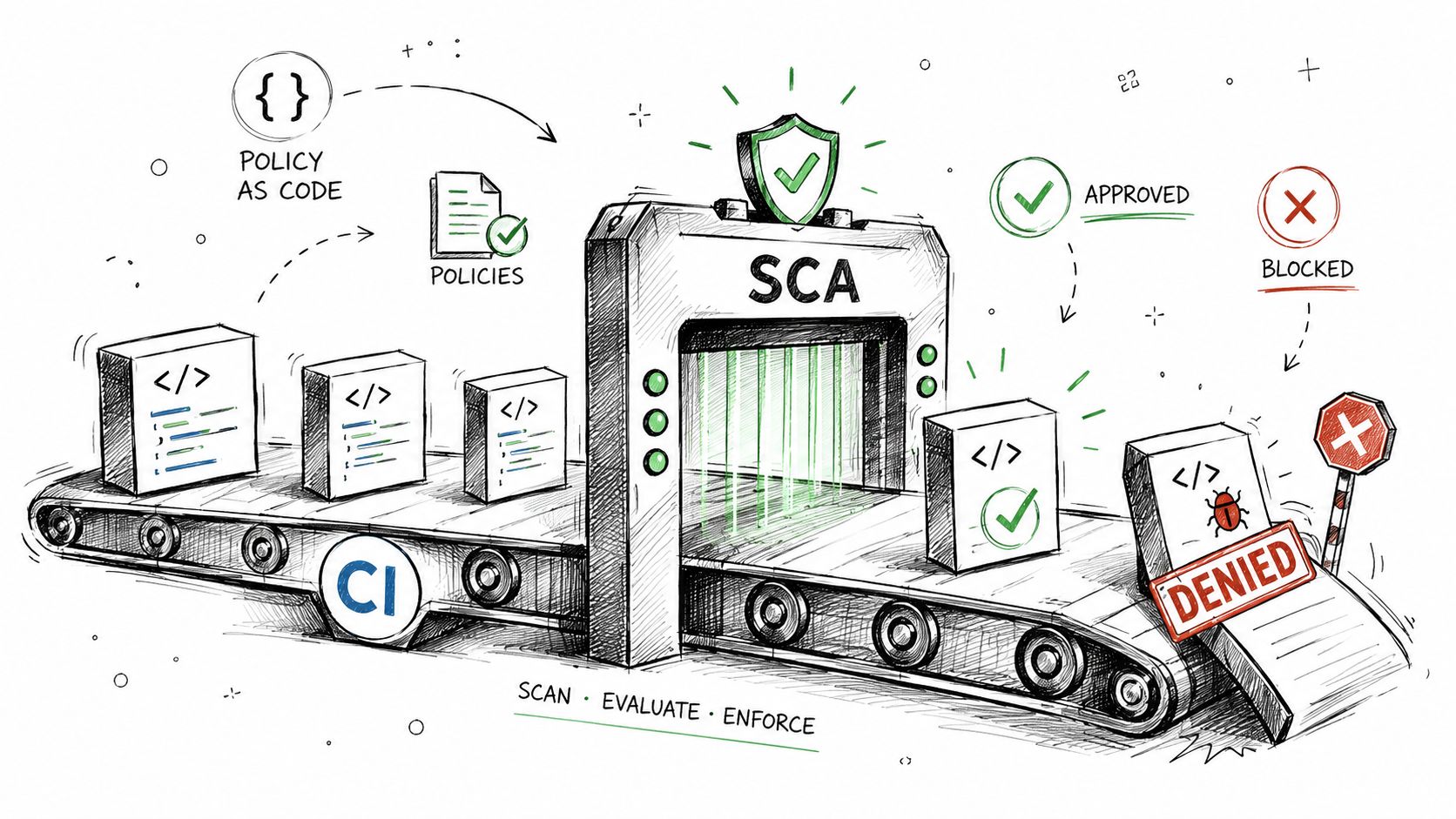
Continuous SCA earns its keep in pull requests and build pipelines. If findings only appear in a weekly report, developers treat them as background noise. If the same finding appears at review time, in a policy file, and in the merge gate, it becomes part of the shipping decision.
Put the control where the change happens
The cleanest pattern is to scan dependency changes in CI, then surface the result directly in the pull request. That's where developers are already deciding whether a package belongs in the release. If the scanner detects an unapproved version, a vulnerable transitive dependency, or a license conflict, the reviewer should see it before merge instead of after deployment.
Policy-as-Code is the bridge between scan output and enforcement. The rules live in version control, so security, platform, and engineering can review them like any other code artifact. That makes the control explainable, auditable, and less dependent on tribal memory.
Block only what your policy truly requires
Merge blocking works best when it's selective. A pipeline that blocks every issue turns into a productivity tax, while a pipeline that blocks nothing teaches the team to ignore alerts. The useful middle ground is simple, critical, and explicit. Block only the findings that violate an approved design decision, a threat model requirement, or a policy threshold the business has accepted.
A good reference point for teams automating this kind of review is GitDocAI's guide to automation in DevOps, because the operational lesson is the same: automation works when it removes repetitive judgment, not when it hides the judgment. If you want a concrete pattern for review gating and traceable outcomes, this implementation-verification workflow shows how a coded policy can be tied back to delivery decisions.
Operational rule: the policy should explain why a finding is blocked, not just that it's blocked.
That's the seam where SCA connects to broader AppSec work. The scanner finds the dependency, the policy decides what it means, and the merge gate enforces the answer.
Where Traditional SCA Falls Short
Traditional SCA is useful, but it isn't the whole supply-chain defense. Vendor materials often imply that inventory plus vulnerability matching solves the problem, yet that still leaves meaningful gaps in modern delivery pipelines.
The missing risks are not theoretical
As Anchore notes in its supply chain security guidance, malicious packages, dependency confusion, build tampering, and maintainer compromise can all sit outside the narrow question of whether a known dependency has a known CVE. A tool that only maps packages to advisories won't tell you whether the package itself was poisoned, whether a build step altered the artifact, or whether the maintainer account was taken over after the last good release.
That's why the buyer question changes. "Do we have SCA?" is too shallow. The better question is, "What risks remain after SCA is deployed?" That framing forces you to look at package provenance, build integrity, and release trust, not just the vulnerability database.
Coverage gaps show up in real programs
A mature AppSec team treats SCA as one control among several. Threat modeling, code review, provenance checks, and release governance all have a role because each one catches a different failure mode. SCA is strongest when it inventories known components and weak when the problem is adversarial manipulation of the delivery path.
If that sounds like a threat-modeling problem, it usually is. The control boundary matters, and teams that don't define it end up over-trusting the scanner. Secure software starts with threat modeling, not scanning is the right mental model because it keeps dependency scanning in context instead of treating it as a universal answer.
SCA tells you what was present. It doesn't guarantee that what was present was safe to trust.
That honesty helps when you're talking to auditors, architects, or product teams. It's better to state the control's actual scope than to promise coverage it doesn't have.
Reducing Alert Fatigue with Smarter Prioritization
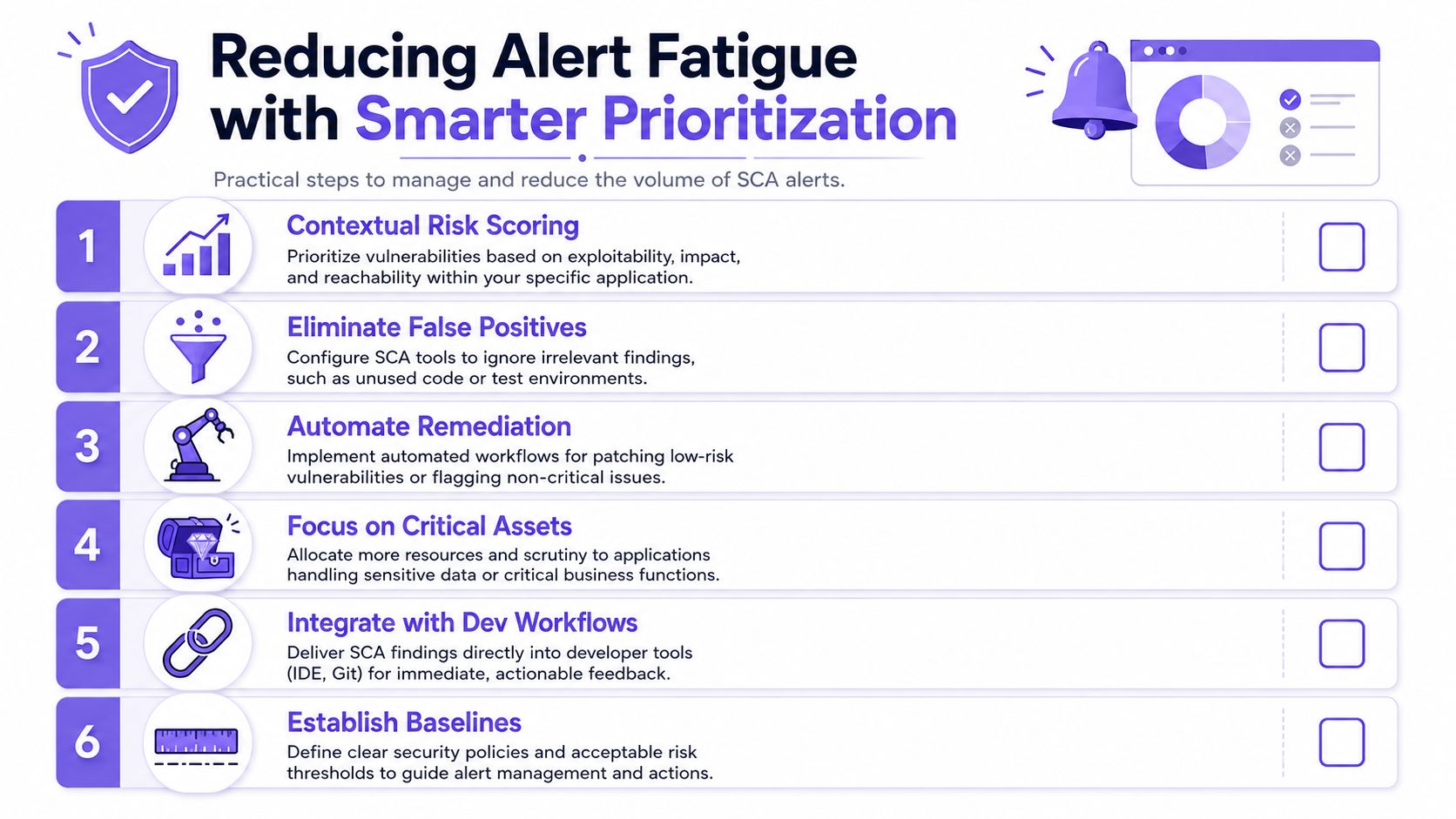
SCA can overwhelm teams because it surfaces direct dependencies, transitive dependencies, licenses, outdated components, and package metadata in one pass. The problem is not finding issues. The problem is deciding which findings need a patch, which ones need a warning, and which ones can stay on the watchlist until the context changes.
Rank by exploitability, not by volume
CVSS is a starting point, not the full answer. A finding matters more when it is reachable, present in an exposed workload, or tied to a package that sits on a hot path in production. Reachability, EPSS, and CISA KEV status help cut through raw volume and make the alert queue closer to operational reality.
Business context matters too. A medium-severity issue in a non-production utility library should not get the same response as a lower-scoring issue in a customer-facing service that handles sensitive data. Teams that ignore placement and use case end up treating every line item as equally urgent, and that is a fast route to remediation paralysis.
Tune the policy to the team's operating model
A practical policy usually has three buckets.
- Block: actively exploited issues, reachable issues in critical services, or anything that violates a mandated design decision.
- Warn: issues that need a fix plan but do not justify stopping the merge.
- Accept with context: findings that are documented, not reachable, and covered by a deliberate risk decision.
That structure keeps SCA from turning into a backlog generator. It also gives engineers a clear mental model for why one dependency gets a hard stop and another only gets a ticket. The scanner still does the discovery work, but the policy decides how the team reacts.
Practical rule: if every alert is urgent, none of them are.
The best programs keep the review queue small enough that the findings still feel actionable.
Turning SCA Output into Audit-Ready Evidence
Continuous SCA becomes most valuable when auditors show up. A one-time scan can prove you looked at dependencies once, but it can't show how the decision evolved over time. A living control can.
Build a traceable evidence chain
For SOC 2, ISO 27001, and similar reviews, the useful artifacts are the SBOM, policy records, merge decisions, and remediation history. Those records show what was present, what the policy said at the time, who approved the exception, and how quickly the issue moved. That's the kind of traceability auditors ask for during implementation verification.
The point is not to generate more paperwork. It's to make evidence fall out of the development process naturally. If SCA runs in CI and the policy is versioned, the audit trail is already there when someone asks for it.
Tie evidence to design intent
The strongest evidence set isn't just a dependency list. It also connects the control decision to the threat model or approved design review that justified it. That keeps the record understandable months later, when the original reviewer has moved on and the exception still needs explaining.
Audit readiness is easier when the decision happened in the workflow, not in a spreadsheet after the fact.
That approach also reduces the annual scramble. Instead of rebuilding the story from commit history and Slack threads, the team can point to a continuous timeline of scans, decisions, and fixes.
Making SCA Part of a Living Security Context
SCA has the most value when it's connected to design decisions, policy enforcement, and the actual services a team ships. Used that way, it becomes part of a living security context instead of a separate scanner that produces another queue.
The most impactful next step is simple. Pick one current service, review its top transitive dependencies, and map them to the design controls already approved for that system. If a dependency creates risk the design never accounted for, that gap tells you more than the scan result alone. If the control already exists, the scan gives you proof that the control is still working.
That's what "good" looks like in practice. The inventory is continuous, the policy is explicit, and the evidence is available when someone needs to defend the release.
DevArmor helps teams keep that security context alive across design, code, and deployment, so dependency risk doesn't get separated from the decisions that created it. If you're trying to connect software composition analysis to threat models, policy enforcement, and audit-ready evidence, visit DevArmor and see how it fits into a regulated delivery workflow.
Related reading
- Enterprise Application Security: Key Strategies for 2026 — threat modeling, policy enforcement, and compliance at enterprise scale.
- Application Security Automation That Actually Ships — automating testing, policy enforcement, and threat modeling across delivery.
- Shift Left Security: A Practical Guide for Modern Teams — embedding protection into planning, coding, and CI/CD.
Table of Contents
Subscribe