App Security Assessment: A Step-by-Step Guide for Modern
 Reza Khosravi
Table of Contents
You've got a release candidate, a security dashboard full of findings, and an audit request asking for evidence that connects design decisions to tested controls. The scan ran successfully, but nobody can explain which version was assessed, whether the highest-risk alerts are exploitable, or where the remediation history lives. That's the practical problem with treating an app security assessment as a periodic scan. A report can exist without producing a reliable security decision.
A useful assessment follows the application as it changes. It draws from engineering artifacts, tests the right attack paths, validates noisy findings, records decisions in the systems teams already use, and produces evidence that an auditor can reconstruct later. The focus isn't maximum tool coverage. It's repeatable signal, clear ownership, and controls that continue working after the assessment is signed off.
Why App Security Assessment Has to Be Continuous
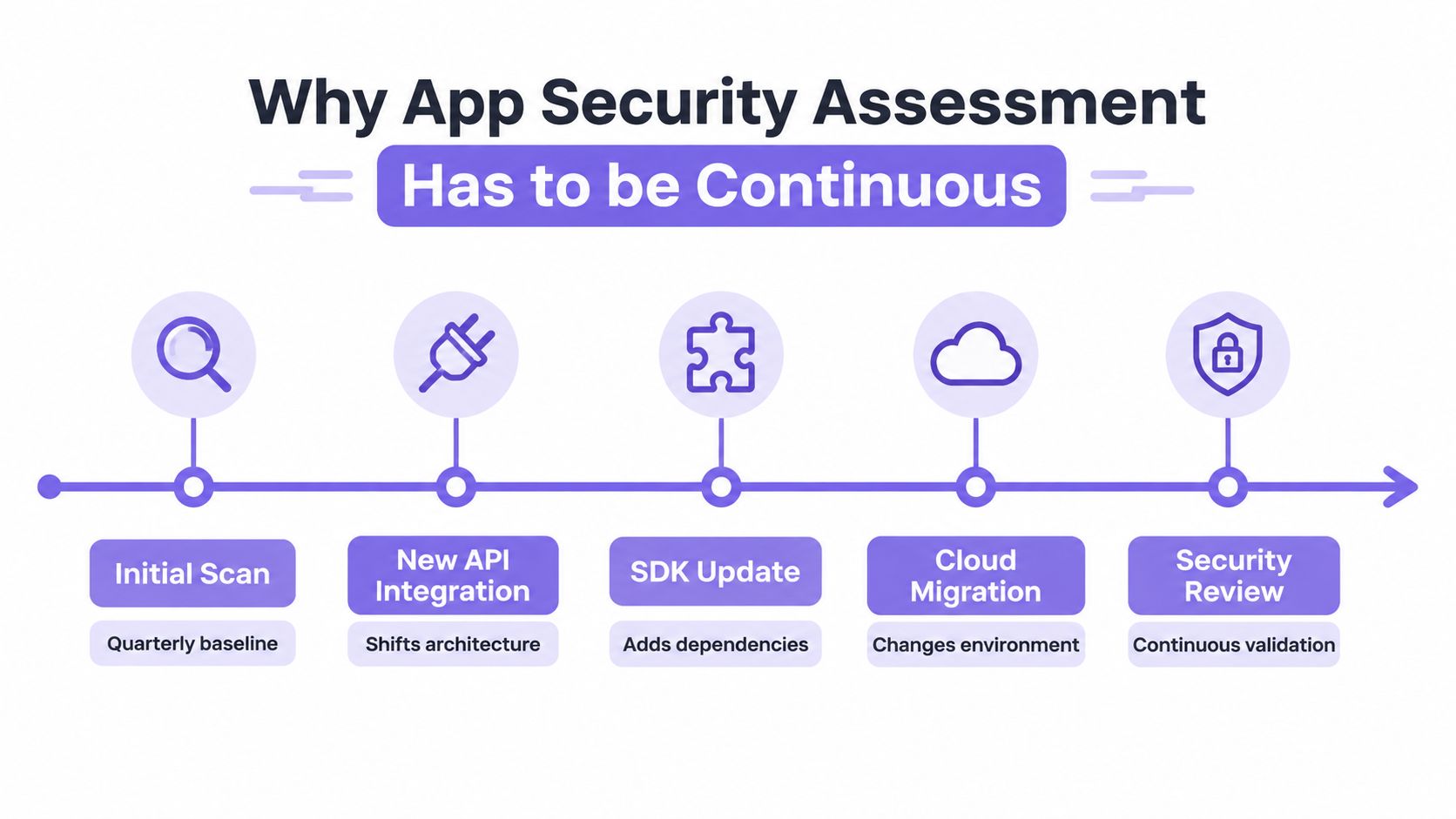
A quarterly assessment gives you a snapshot. Modern applications change through new APIs, dependency updates, infrastructure-as-code edits, cloud migrations, and deployment configuration changes. By the time a point-in-time report reaches its final reviewer, the tested system may already differ from the system serving users.
The case for continuous assessment is reinforced by current application flaw prevalence. Veracode's 2025 State of Software Security analysis found that 80% of applications tested over the previous year had at least one security flaw, while the median organization had flaws in 66% of its applications. The same report found that OWASP Top 10 pass rates improved from 32% to 52% over the last five years, but that progress doesn't mean baseline risk has disappeared. Security debt remained present in about 42% of actively tested applications.
Use engineering changes as assessment triggers
Don't wait for a calendar date when the system changes materially. Restart or expand an assessment when one of these events occurs:
- Trust-boundary change: A new data flow crosses from an internal service to a partner, browser, mobile client, or public API.
- Dependency change: A material SDK, framework, authentication library, or transitive dependency changes.
- Incident learning: A post-incident review identifies an untested path, missing control, or incorrect risk assumption.
- Infrastructure change: A cloud migration, network-policy change, new container image, or modified IaC module alters exposure.
- Control change: A customer requirement, regulatory interpretation, or internal policy changes the evidence expected.
The workflow should ride on existing tickets, architecture decision records, pull requests, deployment records, and test results. That creates audit-ready evidence as a byproduct rather than a separate documentation exercise. Teams working with coding agents should also account for how agent permissions, generated changes, and approval boundaries affect the security model. Guidance on agent governance with Agntz is useful when defining those boundaries.
A continuous cycle starts with artifact ingestion, updates the threat model, selects tests, validates findings, tracks remediation, and ends with a signed report. The signed report closes a review window, not the security process.
Building the Artifact-Driven Threat Model
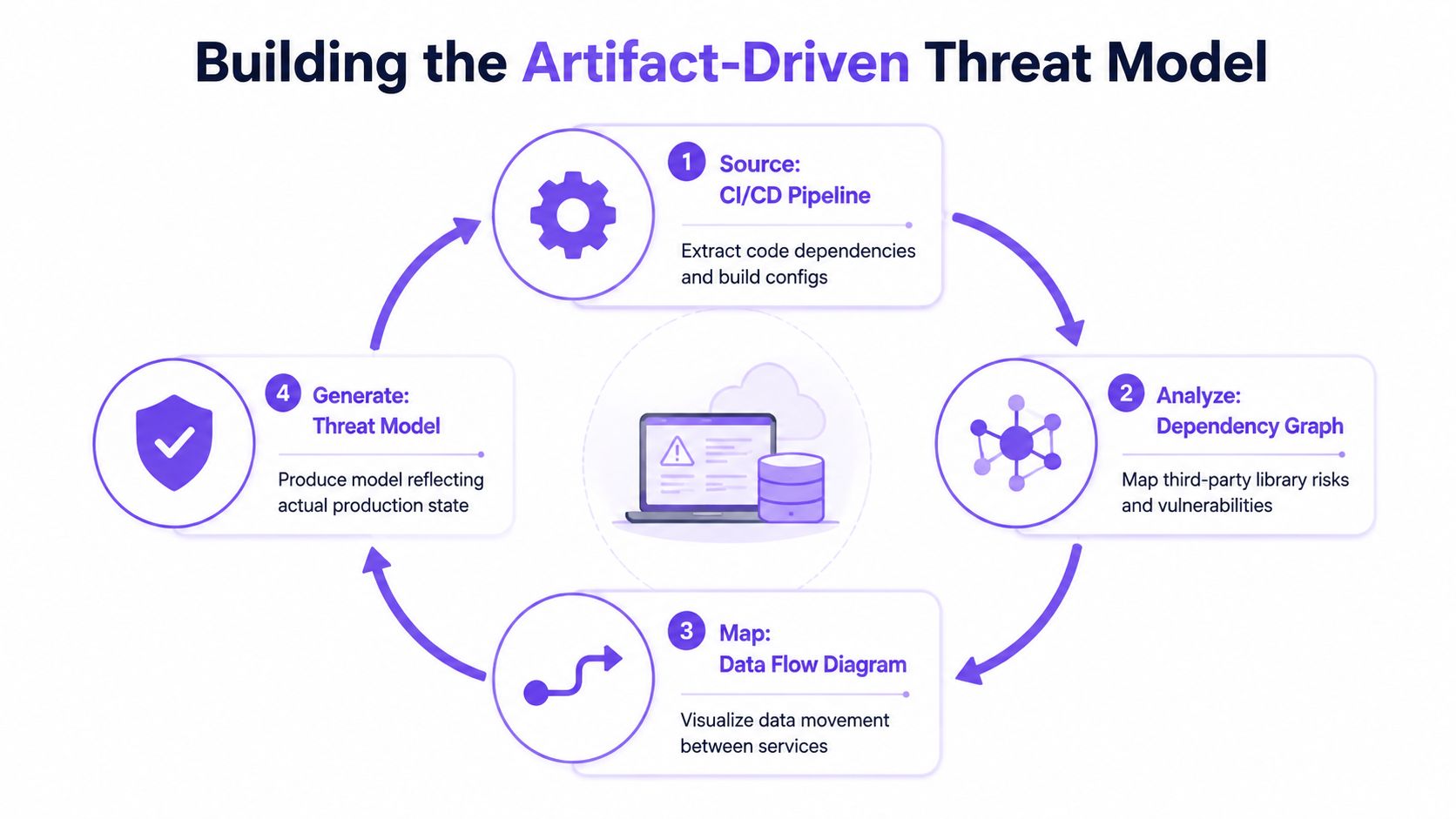
A threat model becomes unreliable when it describes the architecture people intended to build rather than the one they shipped. Start with evidence that changes alongside the product.
Pull planning context from Jira or Linear tickets. Use ticket themes to identify new entry points, privileged workflows, data stores, and integrations. Read architecture decision records to understand why a trust boundary, identity provider, queue, or storage pattern exists. OpenAPI specifications and sequence diagrams provide concrete service relationships and data movement. Infrastructure-as-code modules and network policies reveal where those relationships become reachable in an environment. Incident retrospectives add paths that normal design reviews often miss.
Map artifacts to model elements
Use a traceable mapping instead of copying everything into a standalone diagram.
| Artifact | Model signal | Review question |
|---|---|---|
| OpenAPI specification | API entry points and request flows | Which callers can reach each operation? |
| Sequence diagram | Service-to-service data movement | Where does validation occur? |
| Architecture decision record | Trust boundaries and security assumptions | What decision created the boundary? |
| IaC module | Resources, permissions, and exposure | Does deployed state match the design? |
| Ticket and incident record | Assets, abuse cases, and changed paths | What changed, and who owns the control? |
Tag STRIDE categories against actual components and code paths. “Spoofing” should point to a specific login flow or token validation function. “Elevation of privilege” should identify the endpoint, role mapping, or service account that permits the transition. Reviewers should be able to open the linked repository, ticket, or design record and verify the model's basis.
For mobile systems, the same discipline must include local storage, deep links, update channels, device trust, and mobile-to-API flows. A practical guide to how to perform threat modeling for mobile can help teams avoid treating the mobile client as a thin interface with no independent attack surface.
Store the model beside the artifacts that generate it, or maintain durable links to them. A change to an OpenAPI document should identify affected data flows. A changed ADR should trigger review of its associated trust boundaries. Continuous threat modeling follows this principle by keeping security context connected to changing engineering inputs rather than allowing a diagram to age in a shared folder.
Practical rule: If a threat-model statement can't be tied to a component, artifact, owner, or test, it's an assumption, not assessment evidence.
Choosing the Right Tooling Mix
Tool categories matter less than the defect families they cover. A scanner is useful only when its output answers a question in the threat model and can be routed to an owner.
SAST examines source or compiled code and is well suited to taint flows, injection patterns, unsafe API use, hard-coded secrets, and insecure cryptographic usage. It gives developers fast feedback before deployment, but it lacks runtime context and needs tuning for the languages, frameworks, and coding conventions in the stack. Teams comparing static analyzers and AI platforms should evaluate rule customization, data-flow precision, pull-request integration, and evidence retention, not just the size of a finding catalog.
DAST tests a running application from the outside. It can expose runtime authentication, session, routing, configuration, and authorization problems that source analysis can't confirm. Its coverage depends on reachable routes, test identities, API specifications, and scripted multi-step workflows. A DAST run against a shallow unauthenticated surface may produce a reassuring report while missing the application's sensitive operations.
SCA inventories direct and transitive dependencies, images, manifests, and lockfiles. It addresses supply-chain exposure that SAST and DAST don't identify directly. The operational challenge is deciding which dependency findings matter in the deployed application, whether a vulnerable function is reachable, and how quickly an upgrade can be tested. A focused software composition analysis workflow should preserve the dependency inventory and the release relationship as evidence.
Select for coverage, not scanner volume
IaC scanning checks cloud resources, network exposure, identity permissions, encryption settings, and insecure defaults before deployment. Design-phase controls catch architectural decisions that code scanners may never understand, such as an overly broad service trust relationship or a data flow that violates a boundary.
The trade-offs are straightforward:
- Speed versus depth: Pull-request scans should be fast enough to support review. Full repository, runtime, and environment analysis can run asynchronously with clear ownership.
- Agent-based versus agentless collection: Agents can provide richer runtime or host context, while agentless approaches reduce deployment friction. Choose based on the evidence needed and the environments you can reliably instrument.
- Overlap versus gaps: Two SAST tools with similar rules may increase duplicate alerts without improving meaningful coverage. Use the threat model to identify missing test types first.
- Audit evidence versus convenience: A tool that exports only a dashboard snapshot is weaker for audits than one that preserves scan configuration, version, timestamp, scope, raw output, and disposition history.
A category is essential when it covers a material threat-model element, a high-impact technology, or a control required by your risk and compliance posture. It's optional when it duplicates existing signal without improving decisions.
Running the Assessment from Scoping to Sign-Off
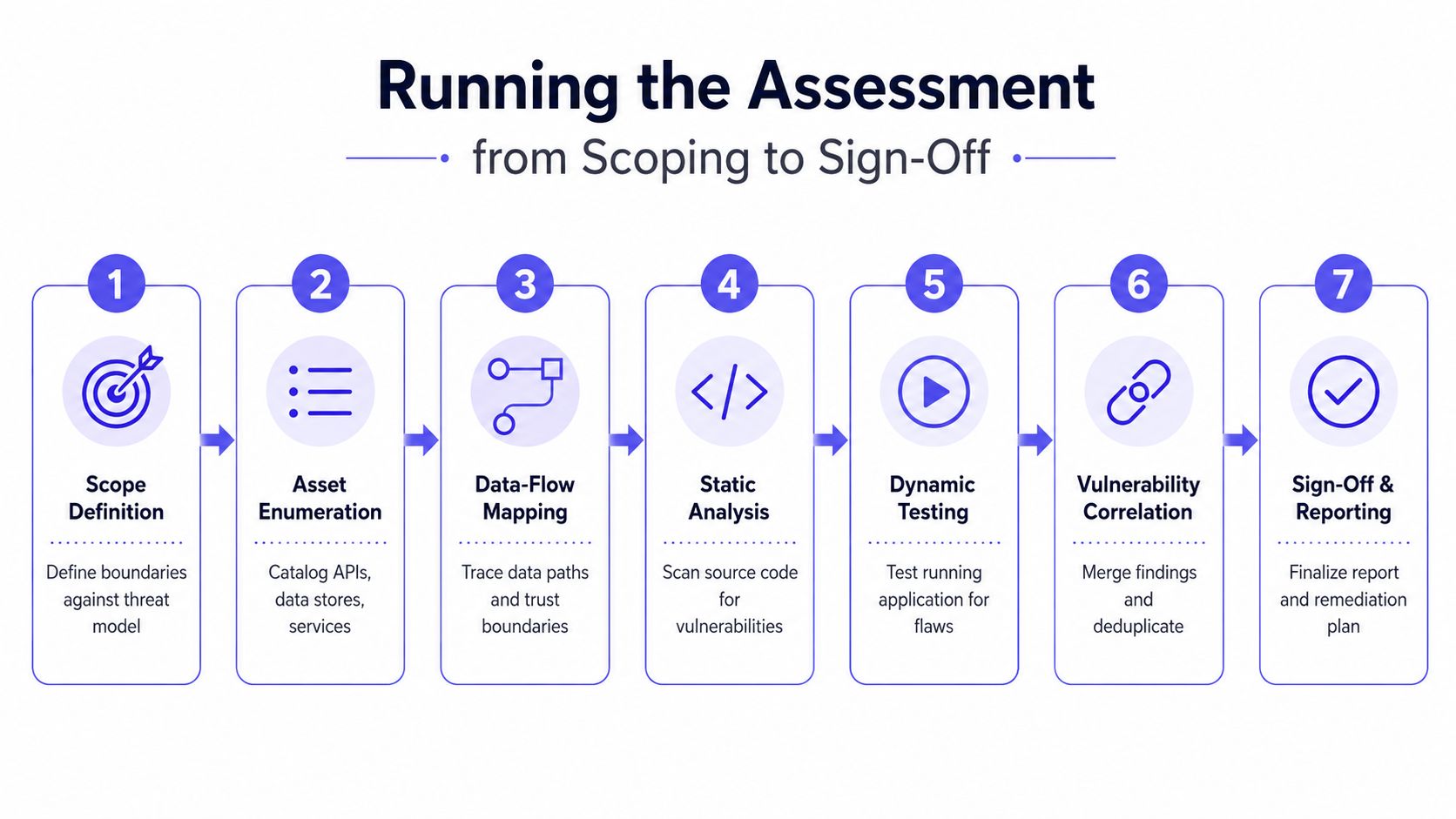
A defensible assessment cycle has seven phases. Each phase should leave an artifact behind, so the final conclusion doesn't depend on someone remembering what happened during a meeting.
1. Define the scope
Start from the live threat model, not a frozen project brief. Record repositories, services, APIs, environments, identities, data classes, dependency boundaries, and exclusions in a scope memo. Explain why each exclusion is acceptable and identify the owner who approved it.
2. Enumerate assets and flows
Build an inventory from service metadata, OpenAPI files, deployment definitions, data stores, queues, identity systems, and network policies. Record the expected data path and the trust boundary at each transition. Undocumented production behavior often becomes visible.
3. Execute static and dynamic tests
Run SAST and SCA against the exact commit or release candidate. Run IaC checks against the deployment configuration that will be promoted. Use DAST against a representative environment with authenticated workflows, API specifications, and test accounts that can reach sensitive paths.
4. Validate high-risk findings manually
Raw tool output is an input, not a verdict. Reproduce the behavior, inspect the relevant code or configuration, confirm reachability, and document prerequisites. Preserve request traces, screenshots where appropriate, code references, and the analyst's reasoning.
5. Verify exploit chains
A finding's importance can change when it connects to another weakness. Test whether an exposed endpoint leads to sensitive data, whether a permission allows lateral movement, or whether a dependency issue is reachable through the deployed path. Keep the validation controlled and scoped.
6. Track remediation in tickets
Create or update tickets with the affected component, risk rationale, owner, due date, fix commit, and regression test. Don't close a finding because a developer says it's fixed. Link the remediation to a test that would fail if the weakness returned.
7. Sign off formally
The sign-off packet should contain the scope memo, test plan, raw outputs, correlation decisions, validation notes, ticket trail, residual risks, exceptions, and closure statement. Require a named security reviewer and business or system owner where the risk warrants it.
The implementation checklist can help teams standardize the operational details around ownership, gates, remediation, and verification. A good assessment is reconstructable months later. An auditor should be able to follow the chain from changed artifact to test, finding, decision, fix, and approval.
Cutting Through False Positives and Drift
False positives and configuration drift attack trust from different directions. False positives make analysts doubt the scanner. Drift makes yesterday's clean result irrelevant to today's deployment.
Generic SAST rules can lag behind framework conventions or misunderstand project-specific sanitization. SCA results can include transitive packages that aren't reachable in the running service. Severity labels often describe theoretical impact without accounting for authentication, exposure, data sensitivity, or compensating controls.
The operational cost can be substantial. Independent benchmark reporting cited SAST false-positive rates above 68% for some tools and languages, NIST findings as high as 78% for Java, and DAST false-positive rates of 82% in OWASP Benchmark-based comparisons. These figures come from ISACA's application security risk assessment and modeling discussion, and they support a practical conclusion: triage cost must be measured alongside detection coverage.
Calibrate the assessment loop
Use a small, recurring calibration process rather than a major cleanup after every audit:
- Assign a triage rotation: Give a named engineer or analyst responsibility for reviewing new findings and escalating ambiguous cases.
- Set a severity rubric: Combine exploitability, exposure, data sensitivity, privilege requirements, and business impact.
- Expire suppressions: Every accepted false positive or exception should have a reason, owner, review date, and removal condition.
- Diff baselines: Compare findings and configuration state between assessment runs to identify new, resolved, reopened, and unchanged issues.
- Track analyst effort: Record time spent per actionable finding, not only alert counts.
The OWASP Benchmark provides a useful measurement model. It compares tool findings with labeled test cases and uses true-positive, false-positive, true-negative, and false-negative outcomes. Its core metrics are TPR = TP/(TP+FN) and FPR = FP/(FP+TN). A high true-positive rate doesn't make a tool operationally effective if the alert volume overwhelms the team.
Drift requires the same discipline. Reconcile repository, IaC, cloud, and deployment state against the threat model. If a new storage resource, API route, or permission appears without a corresponding model update, treat that mismatch as an assessment task.
Enforcing Controls Where Code Actually Changes
An assessment report in a shared drive doesn't block an unsafe merge. Risk reduction begins when the relevant control runs inside the pull request, deployment pipeline, or runtime environment where the change occurs.
Policy-as-code is the practical bridge. Encode requirements for sensitive paths, authentication flows, secrets, dependencies, infrastructure permissions, and data handling. A pull request that changes an identity module should receive the corresponding security checks and reviewer requirements without waiting for a security team to notice the change manually.
Put enforcement at the decision points
Use layered controls rather than one universal blocking rule:
- Pull-request checks: Run targeted SAST, secret detection, dependency checks, IaC validation, and policy evaluation against changed files.
- Required reviewers: Route changes to authentication, payment, health, tenant isolation, or privileged administration paths to qualified reviewers.
- Merge gates: Block only findings that meet a defined risk threshold or violate an explicit approved policy. Let lower-risk findings create tracked work without stopping every release.
- Deployment checks: Re-evaluate image, infrastructure, identity, and exposure conditions before promotion.
- Runtime guardrails: Monitor and respond to risks that emerge after deployment, including unexpected exposure, unsafe configuration, and suspicious behavior.
Every control should emit evidence. A blocked pull request comment shows the violated policy. A signed approval records who accepted the risk. A successful pipeline stores the test result. A runtime alert links the observed condition to the deployed service and subsequent response.
The enforcement model must fit developer behavior. If a gate takes too long, lacks a clear owner, or produces unexplained noise, teams will seek workarounds. Keep fast checks close to code review, move deeper analysis to asynchronous workflows, and make exceptions visible rather than allowing invisible bypasses.
The point isn't to make developers perform security theatre. It's to make the secure path the easiest path, while preserving a record of the decision whenever someone chooses an exception.
Producing Audit-Ready Evidence and Reports
An evidence-grade report connects four things: what changed, what could go wrong, what was tested, and what decision was made. Start with a control matrix that maps each requirement to its threat-model element, test method, owner, result, and evidence location.
For every finding, preserve the source artifact that justified the test, the affected component, the tool and rule version, the raw output, the validation notes, and the remediation record. Store hashes or immutable references for tool outputs where your evidence system supports them. Link the closure decision to the commit, ticket, deployment, and regression test that verified the fix.
A useful report has different layers for different readers:
- Executive summary: Scope, material risks, residual exposure, and the sign-off decision.
- Engineering view: Reproduction details, affected code or configuration, recommended fix, owner, and regression evidence.
- Governance matrix: Control mapping, exceptions, approvals, dates, and review status.
- Evidence appendix: Tool configuration, output references, test identities, environment details, and artifact hashes.
That structure lets one assessment support a SOC 2 evidence bundle, an ISO 27001 Statement of Applicability row, or a customer security questionnaire without repeating the assessment. The summary can remain readable, while the appendix answers the auditor's harder questions.
Automate collection from pull requests, CI/CD runs, ticket systems, source control, design records, and deployment platforms. Capture evidence when the decision occurs, not during audit preparation. If a reviewer must reconstruct events from memory, the workflow has already lost important context.
A mature app security assessment is therefore both a testing process and a system of record. It shows how the application's design changed, how controls responded, how analysts separated signal from noise, and why the final risk decision was reasonable.
DevArmor helps teams maintain living threat models, run security design reviews, and enforce approved policies directly across planning, source control, pull requests, and CI/CD workflows. To connect your assessment artifacts with continuous design context and audit-ready review traces, visit DevArmor and evaluate how it fits your delivery process.
Related reading
- Enterprise Application Security: Key Strategies for 2026 — threat modeling, policy enforcement, and compliance at enterprise scale.
- Application Security Automation That Actually Ships — automating testing, policy enforcement, and threat modeling across delivery.
- Shift Left Security: A Practical Guide for Modern Teams — embedding protection into planning, coding, and CI/CD.
Table of Contents
Subscribe