AI in SDLC: Safe Patterns, Risks, and Guardrails
 Reza Khosravi
Table of Contents
AI adoption has already crossed the experimentation line. The 2025 Stack Overflow Developer Survey found that 84% of developers were using or planning to use AI tools, up from 76% in 2024, across more than 49,000 developers in 177 countries. The leadership question is no longer whether engineers can generate code faster. It's whether the organization can verify that code, prove who approved it, and stop unsafe changes before they reach production.
Why AI in SDLC Is Now a Verification Problem
AI in SDLC has changed the shape of delivery. Engineers can draft requirements, generate implementation code, create tests, summarize pull requests, and investigate incidents with assistance from models and agents. That sounds like a productivity story, but productivity is only the upstream metric. Downstream, teams still need to determine whether each change is correct, secure, maintainable, licensed appropriately, and supported by an evidence trail.
The verification burden is growing alongside AI adoption. More generated pull requests can create review queues, regression risk, and pressure to approve changes that look plausible but haven't been understood. In regulated environments, a successful build isn't enough. Teams may need to reconstruct the security decision, reviewer identity, test result, policy outcome, and deployment record that supported a release for frameworks such as SOC 2 or ISO 42001.
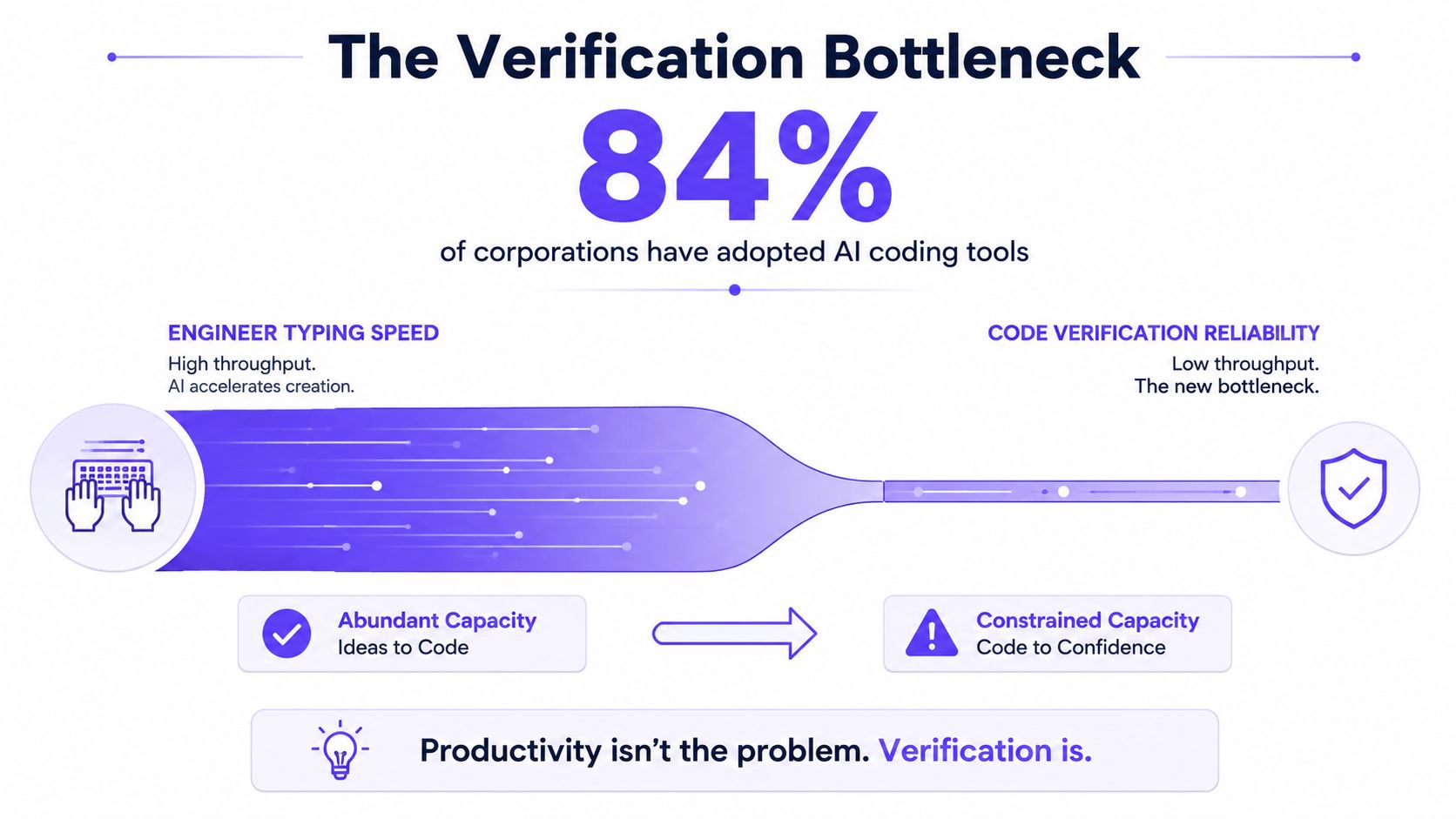
Adoption isn't the same as control
Leaders who equate AI adoption with delivery progress are measuring the easiest part of the workflow. Faster generation can increase throughput only until review, testing, security analysis, and release approval become the constraint. At that point, an organization has accelerated production of changes without accelerating confidence in those changes.
The strongest evidence supports a balanced view. A study of ChatGPT use reported 6.4% higher developer productivity, 9.6% higher knowledge sharing, and 8.4% higher skill acquisition in its published findings. Those gains matter, especially for routine work and skill transfer, but they don't establish that an AI-generated change is safe to merge.
Leadership test: If your team can't show how an AI-assisted change was evaluated, approved, and monitored, you haven't operationalized AI. You've only introduced a faster author.
A useful AI-SDLC program therefore starts with verification. It defines where AI may propose, where it may act, which controls must run continuously, and what evidence must survive an audit. The sections that follow establish that definition, map AI across the lifecycle, weigh gains against reliability limits, update the threat model, and lay out guardrails and integration patterns for regulated teams.
What AI in SDLC Actually Means
The software development lifecycle still has familiar stages: plan, build, test, deploy, and operate. AI doesn't replace that lifecycle. It changes who performs parts of the work, how quickly changes appear, and how much isolation and verification the organization needs before promotion.
The term AI in SDLC covers several distinct capabilities that vendors often collapse into one label. A manager should distinguish them by autonomy and authority, not by branding.
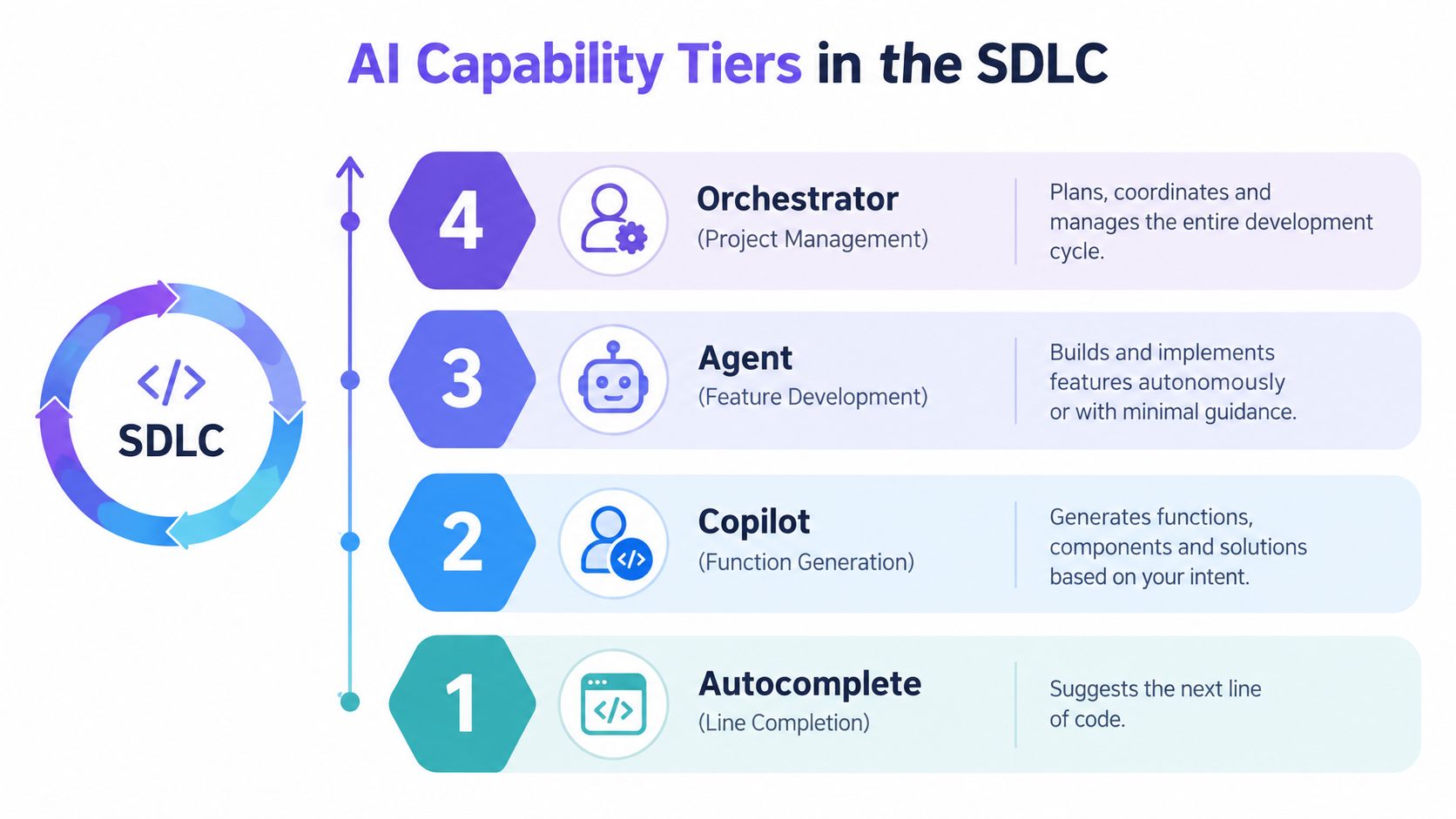
Four capability tiers
Autocomplete suggests the next line, expression, or small code fragment. It operates close to the keystroke and usually has limited context or authority.
Copilot generates functions, tests, explanations, refactors, and conversational answers. The engineer chooses what to accept, edits the result, and remains responsible for the change.
Agent plans a multi-step task, edits several files, runs commands, calls tools, and may open a branch or pull request. This is agentic AI, because the system pursues an outcome through a sequence of actions rather than returning one answer.
Orchestrator coordinates work across requirements, coding, testing, deployment, and operations. It may assign tasks to specialized agents and connect multiple systems. This tier has the broadest blast radius and needs the strongest separation of duties.
Autonomy determines the control model
Assistive AI proposes content inside a human-controlled activity. Agentic AI can take actions, inspect results, and retry. The distinction affects permissions, sandboxing, logging, and approval gates.
An autocomplete suggestion may need secure context handling and normal code review. An agent that can install dependencies or modify infrastructure needs restricted credentials, isolated execution, deterministic pipeline controls, and explicit approval before privileged actions. An orchestrator needs governance across the entire chain, because a weak control at planning or deployment can undermine strong controls in the pull request.
Treat capability as a maturity curve. Increase autonomy only when the team can demonstrate reliable verification at the lower tier. A model that writes a function isn't equivalent to an agent that changes authentication code, and neither is equivalent to a system that can ship the result.
Where AI Shows Up Across the Software Lifecycle
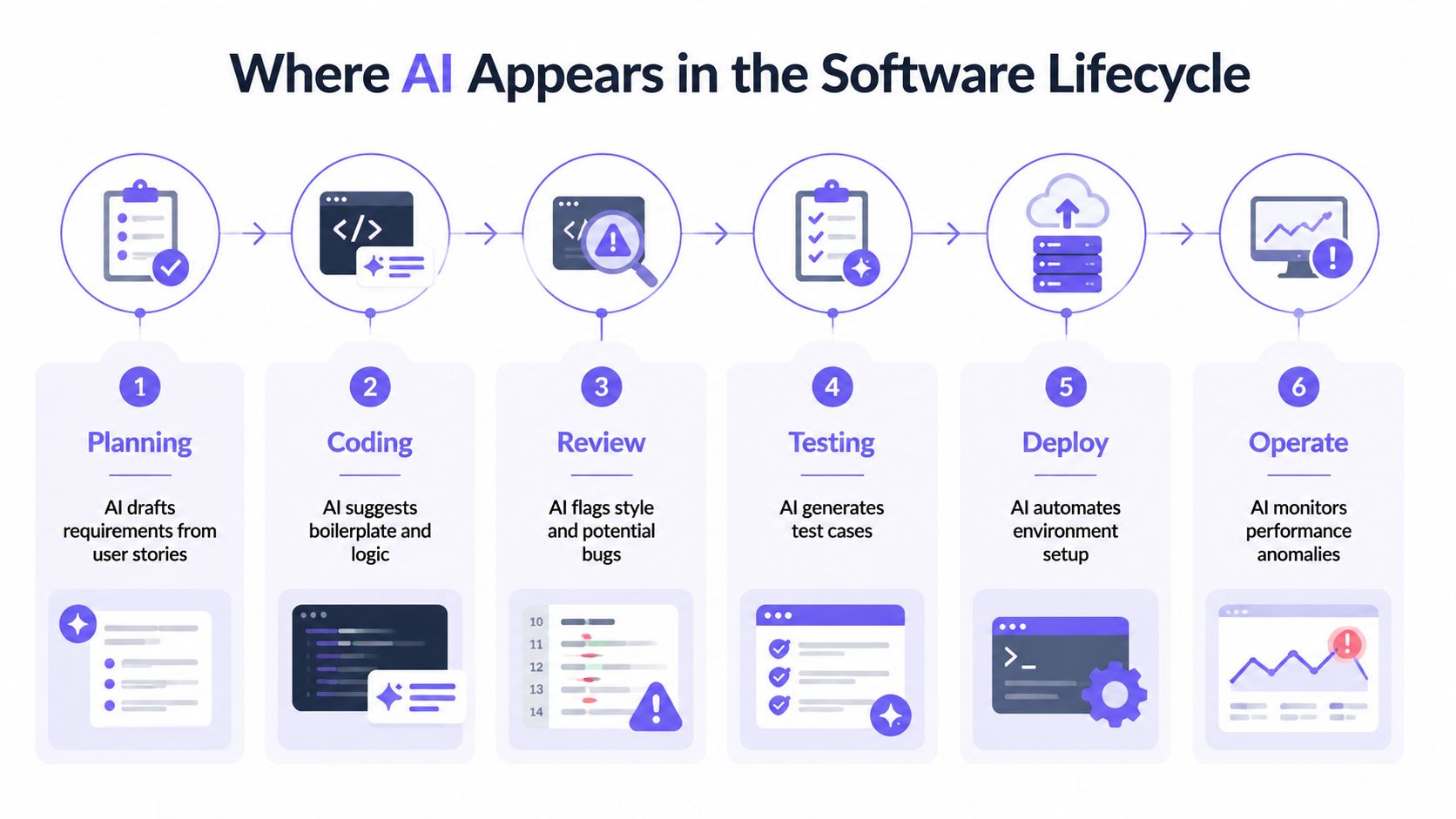
AI can participate in every lifecycle stage, but participation doesn't mean authority. The right design gives models the work that benefits from pattern recognition and repetition while reserving decisions about risk, intent, and production impact for accountable engineers.
Planning and architecture
At the planning stage, AI can turn user stories into draft requirements, acceptance criteria, service summaries, and architecture notes. It can identify missing assumptions and suggest security questions. A product manager or architect still approves the requirement, resolves ambiguity, and decides whether the proposed design fits business and regulatory constraints.
A useful pattern stores the approved specification with the work item. The spec becomes an input to implementation and a reference for later verification, rather than an informal prompt that disappears in a chat window.
Coding and dependency work
In the build phase, assistants can generate boilerplate, refactor repetitive code, create test stubs, explain unfamiliar modules, and propose dependency upgrades. Agents can take a scoped issue, edit multiple files, run tests, and prepare a pull request.
The control boundary should remain clear. Generated code enters version control, runs in an isolated environment when the agent executes commands, and follows the same dependency, secret, and policy rules as human-authored code. AI shouldn't receive broader repository or cloud privileges just because it can work faster.
Teams working on mobile products can also benefit from practical implementation guidance, including the AI driven mobile app development tips resource from AppLighter. The useful principle is the same across platforms: use AI to accelerate routine implementation, then verify behavior in the actual application context.
Review and testing
AI-assisted review can summarize a diff, explain affected components, flag suspicious patterns, and identify possible missing tests. It should support human review, not replace it. Reviewers need the change rationale, test results, runtime behavior, dependency changes, and security impact before approving a consequential pull request.
Testing assistance includes synthetic test generation, flaky-test triage, and coverage-gap detection. These capabilities shift engineers from writing every test manually toward evaluating whether the generated tests express meaningful behavior. A test that merely satisfies a model's interpretation of the implementation can provide false confidence.
Deploy and operate
During deployment, AI can draft release notes, summarize changes, check infrastructure definitions against policy, and identify configuration differences. Deployment itself should stay deterministic wherever possible. A model may recommend a promotion, but release controls should decide whether the artifact, scans, approvals, and environment conditions are satisfied.
Operations teams can use AI to triage logs, summarize incidents, correlate signals, and suggest runbook actions. Human responders should approve changes to production, secrets, access controls, schemas, and traffic. The organization also needs a record of the model's recommendation and the operator's decision, especially when the action affects regulated data or customer availability.
Measured Benefits and the Honest Limits
The evidence supports using AI for focused work. The ChatGPT productivity study reported gains in productivity, knowledge sharing, and skill acquisition, with the strongest productivity effects among novice developers and stronger collaborative-learning benefits for experienced engineers in the same research. That points to a practical deployment strategy: use assistants to reduce repetitive work and help less experienced engineers handle unfamiliar tasks, while experienced engineers supervise risk-heavy changes.
The limits appear when teams treat generated output as verified output. Benchmark performance has improved sharply, but end-to-end software engineering remains difficult. On SWE-bench Verified, reported success rose from 1.96% in October 2023 to roughly 78% by spring 2026, while the benchmark continues to test repository navigation, real patches, and hidden tests as described in the benchmark research. A strong benchmark result still doesn't mean an agent understands business intent, security boundaries, operational dependencies, or the consequences of a migration.
Security verification is an even harder ceiling. Research cited in the security reporting found OWASP Top 10 vulnerabilities in 45% of test cases involving AI-generated code, while a separate 2026 industry report gave the average security pass rate as 56% across more than 100 models in the reported findings. The generation step is fast. The audit step remains expensive.
| Dimension | Reported Gain or Limit | Evidence Type |
|---|---|---|
| Developer productivity | 6.4% increase | Study of ChatGPT use |
| Knowledge sharing | 9.6% increase | Study of ChatGPT use |
| Skill acquisition | 8.4% increase | Study of ChatGPT use |
| End-to-end task success | Roughly 78% on SWE-bench Verified by spring 2026, after 1.96% in October 2023 | Software engineering benchmark |
| Secure coding | 56% average security pass rate across more than 100 models | Industry report cited in security reporting |
| Vulnerability exposure | OWASP Top 10 vulnerabilities in 45% of test cases | Security research |
AI compounds value in boilerplate, test scaffolding, legacy migration support, and incident summarization. It loses value when a multi-file refactor, authorization change, dependency update, or infrastructure edit requires more verification than generation saved.
AI buys throughput, but it invoices the organization for verification.
That trade-off should shape budgets, staffing, and release design. Don't measure only lines generated or pull requests opened. Measure review capacity, policy failures, security defects, escaped defects, rollback readiness, and the completeness of evidence attached to each release.
Security Risks That Change the Threat Model
The threat model changes in two directions. AI can generate insecure code, and the AI tool can become an attack surface inside the developer environment. Security teams that review only the resulting diff miss attacks aimed at the model, its context, its tools, and the credentials available during execution.
A malicious instruction can hide inside an issue, pull request comment, repository file, dependency README, or documentation page. When an agent reads that content, it may treat attacker-controlled text as task guidance. The result could include secret disclosure, unsafe dependency installation, altered CI logic, or a misleading implementation that passes superficial review.
Recent independent research describes converging threats across the coding-assistant ecosystem, including direct and indirect prompt injection, supply-chain compromise through skill and extension marketplaces, and leakage of source code and credentials through tool interactions. The same reporting identified more than 30 vulnerabilities in AI coding tools that combined prompt injection with legitimate features to enable data exfiltration or remote code execution in the research note.
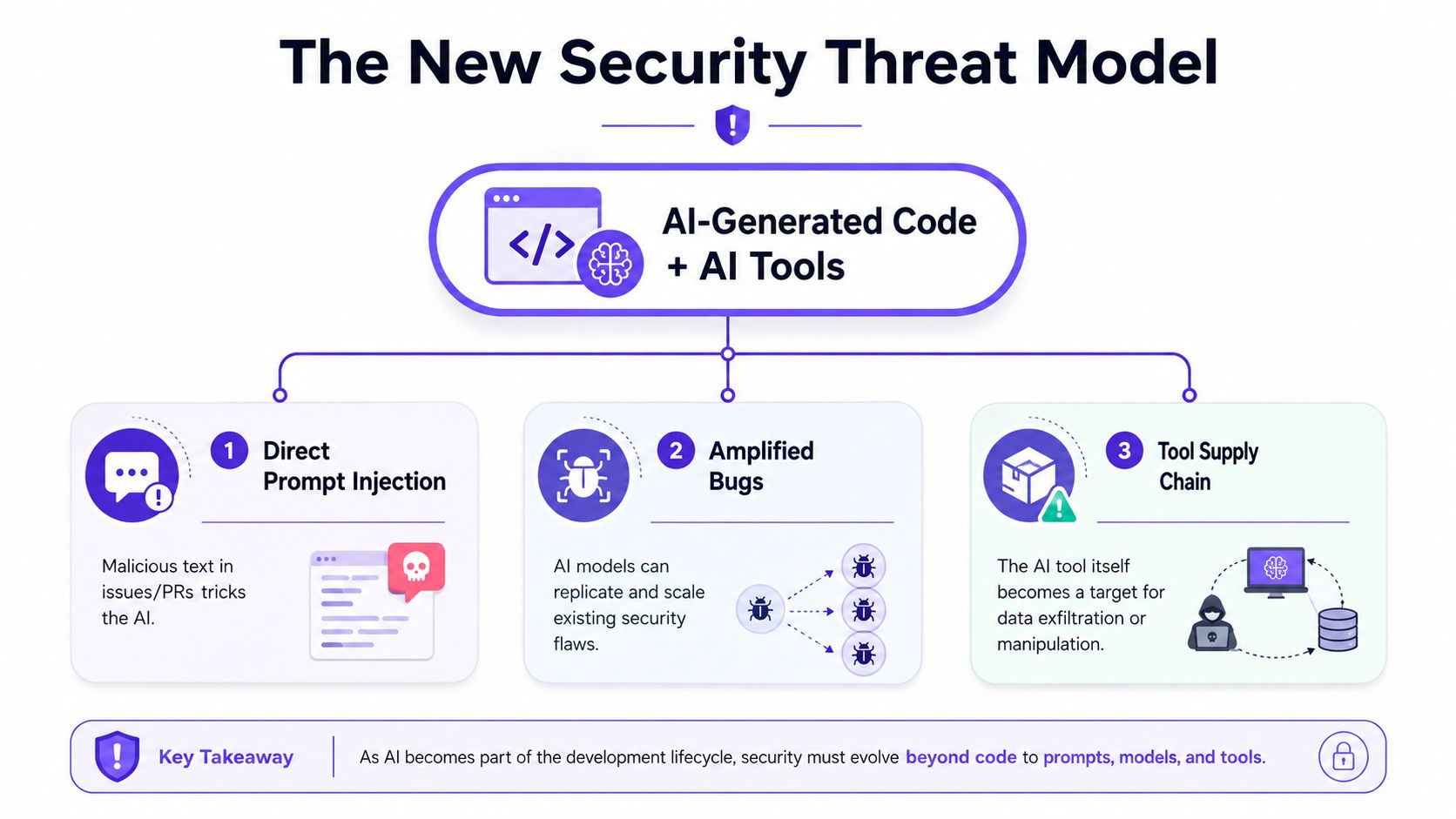
Three attacker goals
Influence the model. The attacker places instructions in content the model is likely to retrieve. Direct prompt injection targets the immediate conversation or task. Indirect injection targets documents, issues, repositories, or web content that enter the model's context later.
Influence the generated code. The attacker aims for insecure suggestions, fabricated API calls, malicious dependencies, weakened tests, license-incompatible snippets, or altered security controls. Syntactic correctness makes these changes dangerous because a clean build can conceal a flawed design.
Persist in the developer environment. Extensions, marketplace skills, tool integrations, model providers, and agent credentials create persistence opportunities. A compromised assistant may exfiltrate source code or secrets, manipulate files, or use legitimate tool permissions for actions the developer didn't intend.
Security teams should map these goals to controls instead of chasing every new attack label. Apply the principles in this threat modeling guidance to the AI tool, its data flows, its plugins, its execution environment, and the code it produces.
The resulting threat model includes familiar risks, such as injection and supply-chain compromise, but changes the trust assumptions. The assistant isn't a neutral teammate. It's a third-party dependency that processes sensitive context and may act through privileged tools.
Guardrails That Keep AI Assistance Safe
Guardrails hold up under audit when they are continuous, enforceable, and reconstructable. A wiki page telling developers not to paste secrets into prompts doesn't provide the same control as a redaction rule that blocks transmission and records the outcome.
Five controls for continuous verification
Policy as code sets the baseline. Store repository-scoped rules for secret handling, approved licenses, permitted dependencies, banned API surfaces, data classification, and protected paths in machine-readable files. Make the policy version part of the evidence for every change.
Merge-time verification gates should run SAST, SCA, secret scanning, infrastructure policy checks, and provenance validation. Block on material failures. A warning that developers can routinely ignore isn't a control, and a single pull request check isn't enough if later stages can bypass it.
Living threat models update from tickets, architecture changes, pull-request diffs, and incident findings. A change to an authentication module should trigger focused review of identity, authorization, session handling, abuse cases, and relevant tests. The model must evolve with the repository instead of remaining a stale document.
Human approval for privileged actions preserves accountability. AI may propose a merge, deployment, schema change, permission update, or rollback. An identified approver must authorize the action, and emergency overrides should create a traceable waiver rather than bypassing the workflow.
Audit-ready telemetry records the model and tool versions, relevant prompts or suggestions, repository context, reviewer identity, policy outcomes, overrides, and deployment result. Teams need enough detail to reconstruct an AI-assisted change during an incident or regulator inquiry without exposing unnecessary sensitive content.
Teams designing autonomous workflows can use guidance on how to build safe AI agents as a complementary reference, particularly when agents call tools or operate across multiple systems. The core design principle remains simple: narrow permissions, isolate execution, require approval for impact, and retain evidence.
For organizations implementing these controls, AI coding security guardrails should connect planning context to code review rather than treating security as a final scanner result. That connection is what prevents a clean-looking patch from bypassing the security decision that should have governed it.
Integration Patterns for Regulated Teams
Regulated teams shouldn't bolt an AI review bot onto the end of an existing pipeline and call the problem solved. The reliable pattern uses three trust hooks, plan, code, and deploy, with each hook producing context and evidence for the next.
Plan establishes intent
At the plan hook, AI can draft requirements, architecture summaries, abuse cases, and threat models from approved product artifacts. A human owner approves the resulting specification, including data handling, trust boundaries, regulatory obligations, and security requirements. The signed or versioned spec then becomes the reference used by coding and verification tools.
For healthcare products, plan-stage controls should identify protected data flows and permitted processing contexts. For financial services, the plan should make authorization boundaries, segregation, and audit expectations explicit. The model can accelerate analysis, but it shouldn't decide that a sensitive data flow is acceptable.
Code enforces implementation boundaries
At the code hook, assistants and agents work inside repositories with constrained context, approved dependency lists, secret redaction, protected branches, and policy-as-code. Generated changes must pass the same checks as human changes, including static analysis, software composition analysis, secret scanning, and tests.
This is also where teams should isolate agent execution. An agent that can run commands or install packages should operate in a sandbox with limited credentials. It should submit changes through version control and pull requests, not write directly to production or bypass review.
Deploy generates release evidence
At deploy, continuous verification ties the approved plan to the artifact being promoted. The pipeline can compare threat-model requirements with code changes, run SAST and infrastructure scans, generate or update SBOM evidence, evaluate environment policy, and check runtime behavior after release.
The control mapping should be explicit:
- SOC 2: retain approval, policy, test, and deployment evidence with the release.
- HIPAA: verify data-handling requirements from planning through implementation and operation.
- PCI: enforce segmentation and protected payment-flow controls during code and deployment review.
Assign a named owner to each hook. Maintain a waiver register for deviations, and review the AI tool posture regularly as model versions, extensions, providers, and permissions change. Continuous threat modeling and policy enforcement platforms such as DevArmor can connect planning artifacts, IDE context, source control, and deployment evidence into that operating model.
Common Misconceptions and a Practical Adoption Checklist
Four assumptions undermine AI-SDLC programs before the first agent reaches production.
- “Agentic” means autonomous. Many agents still operate within human approval loops. The meaningful question is which tools they can call and which actions they can take.
- Post-hoc scans equal safety. Scans catch many code-level issues, but they may miss prompt injection, poisoned context, unsafe intent, or a legitimate feature used for data exfiltration.
- Productivity gains translate linearly into features. Review capacity, testing capacity, and release controls cap throughput. More generated code can increase the queue.
- Disabling AI removes the risk. Developers may adopt unmanaged tools instead, moving usage outside approved logging, data, and policy boundaries.
Use this implementation checklist to structure the rollout, then validate the following twelve controls:
Governance
- Approved tools: Maintain a reviewed list of models, agents, extensions, and providers.
- Data classification: Define what code, tickets, secrets, and customer data each tool may process.
- Provider assessment: Complete privacy, security, and impact reviews for model providers.
- Named ownership: Assign accountable owners for tool posture, policy, and exceptions.
Engineering
- Pinned versions: Record model, agent, extension, and prompt-policy versions.
- Dependency allowlists: Restrict packages and registries available to agents.
- Secret redaction: Prevent credentials and sensitive tokens from entering prompts or tool context.
- Sandboxed execution: Isolate agents that run commands, install packages, or modify infrastructure.
Verification
- Tool threat model: Assess prompt injection, supply chain, data leakage, and privilege abuse.
- Continuous gates: Run security and policy checks across pull requests and deployment.
- Evidence telemetry: Preserve suggestions, approvals, policy outcomes, and release records.
- Escape metrics: Track AI-assisted defect escape rate, override patterns, and repeated control failures.
Treat the AI tool as a third-party dependency with its own threat model, not as a teammate.
DevArmor helps teams maintain continuous threat models, perform security design reviews, and enforce policy across planning tools, IDEs, source control, and deployment workflows. Visit DevArmor to connect AI-assisted development with living security context, traceable review decisions, and audit-ready verification evidence.
Related reading
- AI Coding Security: Guardrails for Agentic Development — practical guardrails and PR-time policy enforcement for AI-generated code.
- Enterprise Application Security: Key Strategies for 2026 — threat modeling, policy enforcement, and compliance at enterprise scale.
- SDLC Cyber Security: Embedding Controls Across Every Phase — practical controls for each development phase.
Table of Contents
Subscribe