What Is Threat Modeling and Why It Matters in 2026
 Reza Khosravi
Table of Contents
Threat modeling is often introduced as a workshop: gather architects, security engineers, and developers around a whiteboard, draw a few boxes and arrows, list possible attacks, then save the document in a wiki. That advice was never sufficient for fast-moving software teams, and it's even less credible when AI-assisted coding and rapid deployment can change an application faster than a meeting-based review can follow.
The practical answer to what is threat modeling is more demanding. It's a structured way to understand what a system must protect, how it could be attacked, which risks matter most, and what engineering decisions will address them. A useful threat model isn't a finished report. It's living security context that changes with architecture, code, infrastructure, tickets, and deployment decisions.
Why Most Threat Modeling Explanations Miss the Point
The familiar explanation isn't wrong, but it's incomplete. A diagram can help a team understand a system, and a workshop can expose risks that developers hadn't considered. The failure starts when the workshop becomes the product.
A document created before implementation rarely stays aligned with implementation. Teams change an authentication flow, add a third-party integration, move data into a managed cloud service, or introduce an asynchronous queue. If those changes don't update the original model, the organization now has documentation that describes an earlier system. The model may still look professional while offering little guidance for the code being shipped.
That problem becomes sharper when developers use AI coding assistants. A developer or coding agent can introduce new endpoints, data transformations, dependencies, and authorization paths during ordinary work. Security reviewers can't reasonably expect a recurring meeting to inspect every design mutation. The answer isn't to eliminate human judgment. It's to place threat reasoning closer to the artifacts and tools where change occurs.
Practical rule: A threat model that doesn't influence a design decision, code change, deployment choice, or security test is documentation, not an operating control.
Why shelfware develops
Static models usually fail for operational reasons:
- Ownership is unclear: Security creates the document, while engineering owns the changing system.
- Updates are expensive: Every architectural adjustment requires another meeting and manual editing.
- Context is separated: Findings sit in a security repository instead of the ticket, pull request, or IDE where work happens.
- Risk decisions disappear: Teams record threats but don't preserve why they accepted, mitigated, or deferred them.
- AI-generated changes bypass assumptions: The model reflects human design intent but not necessarily the implementation produced during coding.
A continuous practice treats each meaningful change as a potential update trigger. A new data store can prompt asset and trust-boundary review. A new service identity can reopen authorization questions. A pull request can inherit approved requirements and check whether the implementation still matches them.
That doesn't mean automating every judgment or generating endless alerts. It means maintaining a connected chain from design intent to implementation evidence. The most useful question isn't whether a team held a threat-modeling session. It's whether the team's current security assumptions remain visible, testable, and enforceable as the system evolves.
The Evolution from Attacker Thinking to Engineering Discipline
Threat modeling developed through a shift from informal attacker thinking to a repeatable software security discipline. Microsoft introduced STRIDE in 1999, a classification model covering Spoofing, Tampering, Repudiation, Information disclosure, Denial of service, and Elevation of privilege. The book Threat Modeling by Frank Swiderski and Window Snyder followed in 2004, helping establish threat modeling as a structured practice rather than an activity dependent entirely on individual expertise. These milestones are documented in the history of threat modeling.
NIST later formalized the practice in SP 800-154, published in March 2016, describing a structured, data-centric approach and reinforcing that threat modeling belongs throughout a system's lifecycle, not only in a one-time review. That progression matters because it shows the discipline's underlying purpose. Threat modeling translates security concerns into engineering decisions that teams can repeat, explain, and revisit.
From method to governance
Modern frameworks make that lifecycle expectation explicit. NIST SP 800-53 Revision 5 includes control SA-11(2), Threat Modeling and Vulnerability Analyses, and states that updates during development and before delivery are critical to effective operation. This connects threat modeling with secure development controls, delivery readiness, and governance rather than leaving it as an optional architecture exercise. See the NIST SA-11(2 control reference for the control language.
AWS's Well-Architected Framework treats threat modeling as a practical design activity. Teams identify assets, actors, entry points, trust levels, threats, mitigations, and a risk matrix. That vocabulary is useful because it gives engineers a common structure for discussing an unfamiliar service without reducing the conversation to a vague question such as “is this secure?”
Threat modeling also sits beside operational detection rather than replacing it. A design review may identify the attack paths and trust assumptions that a security operations team later monitors. Teams building that operational layer can use a SOC threat detection framework to connect adversary behavior with detection and response thinking.
Why the history matters now
The historical lesson is straightforward. Threat modeling was institutionalized because organizations needed a scalable way to reason about risk across complex software environments. A process that produces one immutable artifact after one meeting contradicts that development. The modern interpretation is a lifecycle practice with durable decisions, explicit assumptions, and updates tied to system change.
How Threat Modeling Actually Works in Practice
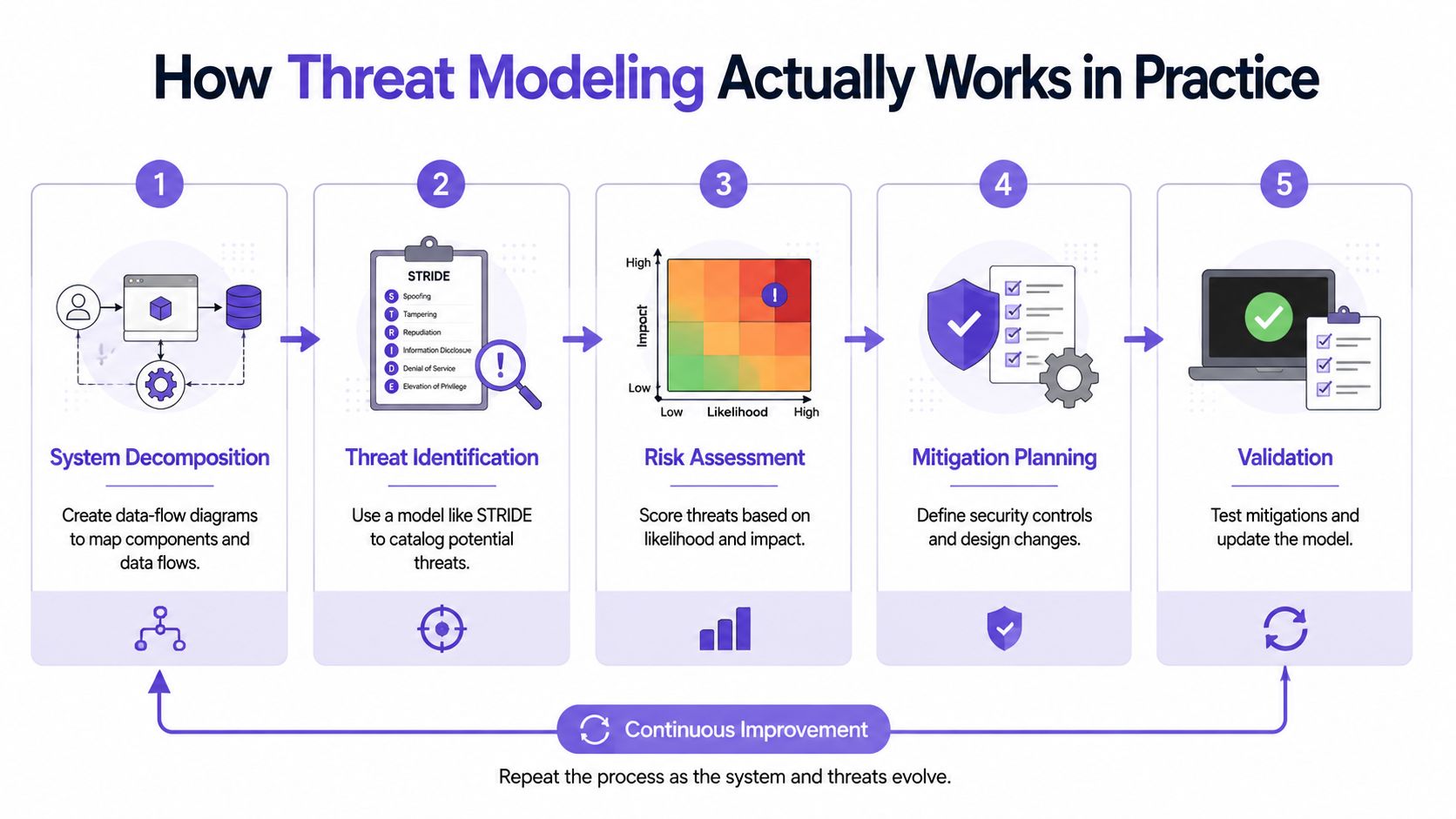
A practical threat-modeling workflow starts with the system, not with a list of frightening attack names. OWASP recommends using data-flow diagrams, examining trust boundaries, assessing impact and likelihood, selecting mitigations, and validating those mitigations through security testing. Its threat modeling guidance provides the core workflow.
1. Decompose the system
Map the components that matter to security: users, clients, APIs, services, queues, databases, identity providers, administrators, external vendors, and operational interfaces. Draw the data flows between them, then label the information moving across each flow.
The goal isn't to create an architectural diagram that captures every implementation detail. It's to identify where security properties can change. A payment request entering through a public API, crossing an authorization service, reaching a transaction processor, and being written to a ledger creates a useful chain for analysis.
2. Mark trust boundaries
A trust boundary exists where data, identity, authority, or assumptions change. Common examples include a browser-to-API boundary, an internal service-to-vendor boundary, a tenant boundary, and a transition from application code into an administrative plane.
Teams often draw boundaries around network zones and stop there. That misses logical boundaries. Two services may share a network but operate with different identities and privileges. A trusted queue may accept messages from multiple producers. A service may validate a token but fail to verify that the token's subject is authorized for the requested object.
3. Identify threats
Use STRIDE or another suitable method to ask what can go wrong at each component and boundary. The method matters less than the discipline of connecting every threat to a specific asset, actor, flow, and security property.
Avoid writing threats as abstract categories alone. “Information disclosure” is a classification. “A support operator can retrieve another tenant's export by changing an object identifier” is an analyzable scenario with a likely control path.
4. Rank the risk
Risk ranking should reflect impact and likelihood, while making assumptions visible. A threat affecting a low-value test artifact shouldn't receive the same treatment as one exposing regulated customer data or granting administrative authority.
A risk matrix helps teams prioritize, but it shouldn't create false precision. Record why a threat received its ranking, what conditions must be true for exploitation, and whether the organization is mitigating, accepting, transferring, or deferring the risk.
5. Select and validate mitigations
A mitigation becomes useful when it maps to an engineering change or a testable control. That might mean enforcing object-level authorization, reducing service permissions, validating message provenance, isolating a sensitive data store, adding audit events, or introducing abuse controls.
Validation closes the loop. Add security tests, review the implementation, inspect deployment configuration, and update the model when the control changes. A model that identifies a missing authorization check but never verifies the fix has discovered a risk without managing it.
Static Documents Versus Living Security Context
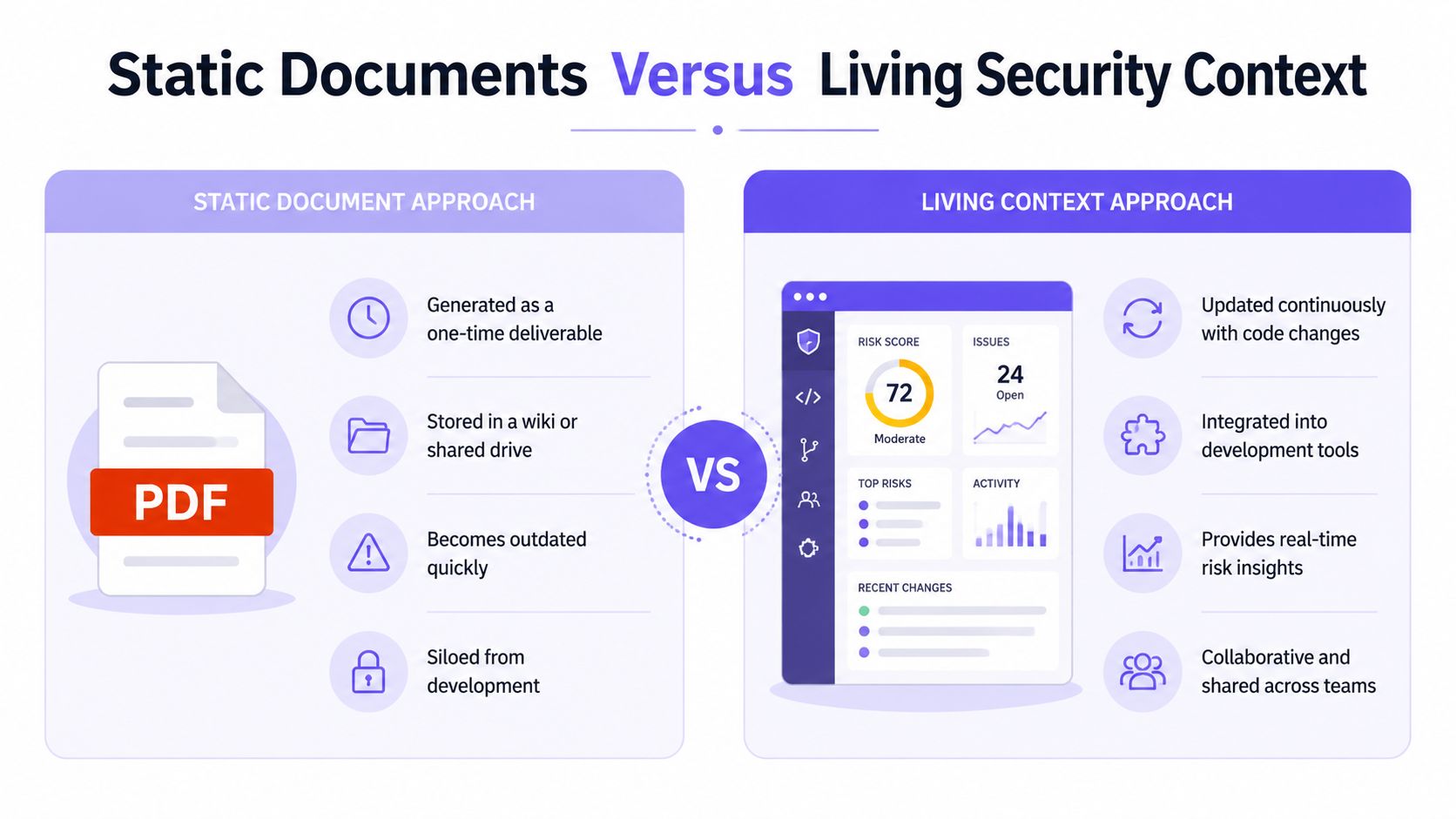
A static threat model has a clear advantage: it's easy to understand, archive, and present during a review. It can provide a useful snapshot of design intent, especially when a team needs to align on an unfamiliar system. The problem is that the snapshot starts losing value as soon as the implementation diverges from it.
A living security context treats the model as connected engineering information. The architecture description, threat scenarios, requirements, review outcomes, code changes, and deployment evidence should remain related even when they live in different systems. When a repository, ticket, or infrastructure definition changes, the relevant security context can be revisited instead of waiting for a scheduled workshop.
The operational difference
| Static document approach | Living security context approach |
|---|---|
| Created as a point-in-time deliverable | Updated as relevant code, tickets, and infrastructure change |
| Stored separately from daily development work | Connected to planning, coding, review, and deployment workflows |
| Depends on people remembering to revisit it | Uses change signals to prompt or support reassessment |
| Records intended architecture | Compares intended design with implementation evidence |
| Often produces a review artifact | Produces decisions, controls, tests, and traceable outcomes |
Continuous threat modeling doesn't require every code edit to launch a full analysis. Good programs define meaningful change classes. A new external integration, a changed data classification, a privilege modification, a new exposed endpoint, or a material identity-flow change deserves more attention than a harmless formatting update.
The practice also needs a clear source of truth. If a finding exists in a slide deck, a ticket, a scanner, and a spreadsheet with different statuses, developers won't know which instruction governs the pull request. Teams should preserve the current decision, its owner, its rationale, and the evidence required to close it.
For teams assessing implementation options, continuous threat modeling in the software lifecycle describes the central operating model: keep security context attached to the delivery process rather than treating it as a document that security owns alone.
Bringing Threat Modeling into Developer Workflows
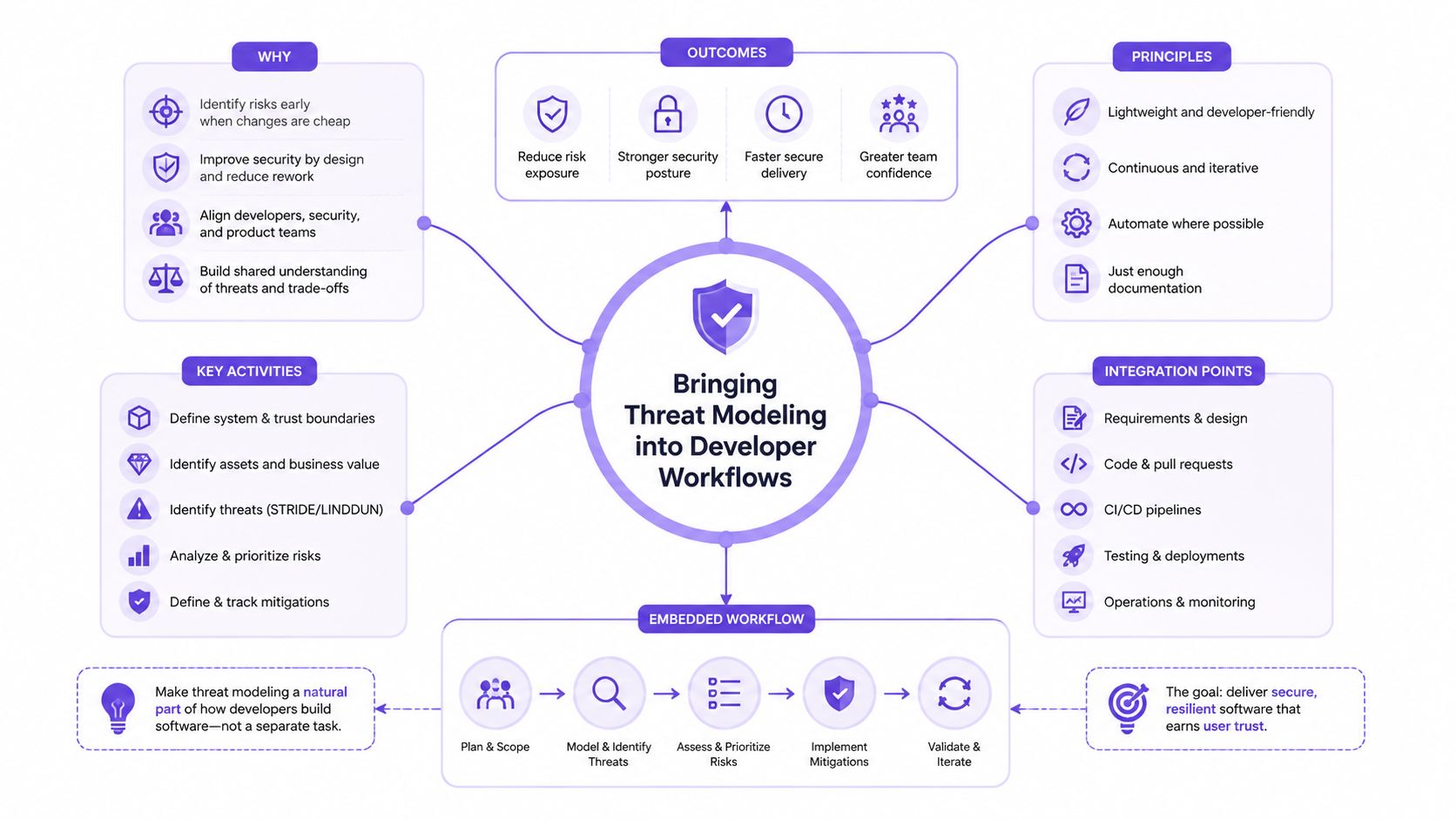
Threat modeling fails when developers encounter it only as a meeting invitation or a late security gate. The practice becomes more durable when it appears in the same places where engineers already make decisions, including IDEs, planning tools, pull requests, and build pipelines.
Start with the work item
A product ticket or design document can carry the initial security context. Identify the assets, actors, trust boundaries, assumptions, and intended controls before code exists. Keep the questions specific enough to guide implementation:
- Data movement: What sensitive information enters, leaves, or changes state?
- Authority: Which identity can perform each action, and on whose behalf?
- Exposure: Which interface is public, partner-facing, internal, or administrative?
- Failure behavior: What happens when identity, storage, messaging, or an external dependency fails?
- Operational evidence: Which events must the team record so it can investigate misuse?
This gives developers a design target rather than a generic requirement to “follow security best practices.”
Put feedback where code changes
An IDE integration can surface the relevant threat scenarios while a developer edits an authentication flow, adds a data access method, or introduces a new outbound request. The feedback should be contextual and restrained. A long list of generic warnings trains developers to ignore the channel.
Pull requests provide a stronger enforcement point. A policy can require an approved decision for a new data flow, a review when a sensitive resource is exposed, or evidence that a required control has been implemented. Policy-as-Code is valuable here because it turns an agreed design decision into a repeatable check, while still allowing an explicit exception with an accountable owner.
AI-assisted coding needs the same guardrails. Coding agents can receive the approved security requirements and threat assumptions as context, but generated code still needs review and tests. The agent should not be allowed to redefine trust boundaries or weaken a policy because the requested implementation is convenient.
Teams building a broader development security program may also benefit from practical app security insights from PullNotifier, particularly when deciding how security feedback should enter pull-request workflows.
Reduce handoffs without removing accountability
The objective isn't to make security invisible. It's to make security decisions available at the point of action. A security engineer can define policy, review high-impact designs, and investigate exceptions, while developers handle routine context in their existing tools.
For teams implementing this model, real-time design reviews and security feedback describes how design decisions can remain connected to developer activity instead of waiting for a separate review queue.
DevArmor is one platform that supports this approach by generating and maintaining threat models from artifacts such as tickets, design documents, repositories, service metadata, and code, then connecting design reviews with developer workflows and pull-request policy enforcement. The important design principle is broader than any product: security context must travel with the work.
Measuring What Actually Matters in Threat Modeling
Holding threat-modeling sessions doesn't prove that software became safer. The 2026 multivocal literature review of 109 white- and gray-literature sources found no direct causal evidence from controlled experiments that threat modeling itself improves software security outcomes, as reported in the Computer Society review. That finding shouldn't be read as a dismissal of the practice. It's a reason to measure what the practice produces.
Threat modeling is primarily a design-time risk discovery and decision-support activity. Its value appears downstream, when a team changes architecture, defines a requirement, implements a control, writes a test, or documents an explicit risk acceptance.
Better evidence than session counts
Avoid using the number of workshops or diagrams as the main success measure. Those metrics reward activity, not effect. A team can produce many models while leaving the same high-risk design decisions unresolved.
Track artifacts such as:
- Mitigations defined: Which threats resulted in specific architecture or implementation requirements?
- Controls implemented: Can the team point to code, configuration, identity policy, or operational controls?
- Validation completed: Which security tests or review checks demonstrate that the mitigation works?
- Review coverage: Which material systems and change types receive threat-modeling attention?
- Decision traceability: Can the team connect a threat to an owner, status, exception, and approval?
- Model freshness: Does the documented context still match the current repository and deployed architecture?
These measures give leadership a defensible view of security investment. They also expose where the process breaks. If threat discovery is high but implemented controls remain low, the problem may be prioritization, ownership, engineering capacity, or an approval workflow that treats security findings as optional.
Measurement principle: Count decisions carried into the system, not meetings completed around it.
Make uncertainty visible
A mature program records accepted risks and unresolved assumptions instead of hiding them. It distinguishes a threat that's prevented by design from one that's mitigated, addressable, or knowingly open. That distinction helps teams focus engineering effort and gives auditors a more honest record than a polished diagram with no decision history.
The review's conclusion supports a cautious posture. Organizations shouldn't claim that threat modeling automatically reduces risk. They should show how it improves the quality and coverage of security decisions, then verify whether those decisions survive implementation and deployment.
A Real-World Scenario from Design to Deployment
Consider a FinTech team adding a payment feature in a regulated environment. The work begins with a product ticket and design document, not with a security workshop. The team records the assets involved, the actors allowed to initiate and approve transactions, the data flows between the customer interface and payment services, and the trust boundaries around the ledger and external provider.
The security review attaches those decisions to the planning work. The product and engineering teams can see which assumptions need confirmation, while security can identify the controls that must be present before release. A threat model is useful here because it creates a shared vocabulary for decisions that otherwise get scattered across product requirements, architecture notes, and implementation discussions.
From design to code
As developers implement the feature, the relevant context appears in their normal workflow. An engineer adding an endpoint sees the authorization requirements associated with the transaction resource. A developer changing an outbound provider integration can review the expected data handling and failure behavior. An AI coding assistant can use the approved requirements as constraints, but the team still evaluates the generated implementation rather than treating model output as evidence of correctness.
The pull request then becomes an enforcement point. Checks can verify that required reviews exist, that sensitive flows have an associated decision, and that implementation evidence addresses the approved controls. If a developer changes the design materially, the workflow should reopen the affected analysis instead of preserving an approval that no longer applies.
Evidence for release and audit
Before deployment, the team links security tests and review outcomes to the relevant threats. The result isn't merely a diagram. It's a record of the design assumptions, identified risks, mitigations, code changes, validation evidence, and exceptions that informed the release.
A practical implementation checklist for threat modeling can help teams turn that operating model into repeatable release criteria. The checklist should support engineering decisions rather than become another disconnected compliance document.
After deployment, changes to repositories, tickets, service metadata, or infrastructure can trigger reassessment. That ongoing connection reduces the drift between what the team approved and what the system does. It also gives compliance reviewers current architecture and decision evidence without forcing engineers to recreate the history manually.
The scenario illustrates the central answer to what is threat modeling in modern delivery. It's not a document produced before coding. It's a way to keep security reasoning attached to the system as the system changes.
If your team needs threat models, security design reviews, and policy enforcement that stay connected to tickets, code, IDEs, and deployments, explore DevArmor to see how its continuous security context can support regulated, fast-moving software delivery. Use it to connect design decisions with implementation evidence and make threat modeling part of the workflow rather than another meeting on the calendar.
Related reading
- SDLC Cyber Security: Embedding Controls Across Every Phase — practical controls for each development phase.
- Application Security Architecture: Patterns, Threat Models — proven patterns and component-level threat modeling techniques.
- Threat Modeling Process: From Diagrams to Living Models — turning static diagrams into continuously updated models.
Table of Contents
Subscribe