Threat Modeling Process: From Diagrams to Living Models
 Reza Khosravi
Table of Contents
Most threat modeling advice starts with a whiteboard, a Data Flow Diagram, and STRIDE. That's useful, but it leaves teams with the wrong finish line. A diagram can describe the system accurately on review day and become misleading after a new service, dependency, ticket, or AI-generated pull request changes how the system handles trust, data, or privilege.
The threat modeling process works better as a lifecycle artifact. It should connect architecture assumptions to requirements, repositories, pull requests, deployments, owners, and review evidence. OWASP describes threat modeling as a structured, repeatable process for actionable security insight, and its lifecycle guidance treats it as an activity that must be revisited as systems change. OWASP's threat modeling guidance provides the foundation, but the operational question is harder: how do you keep the model aligned with the system engineers are shipping?
Why the Threat Modeling Process Needs to Outlive the Whiteboard
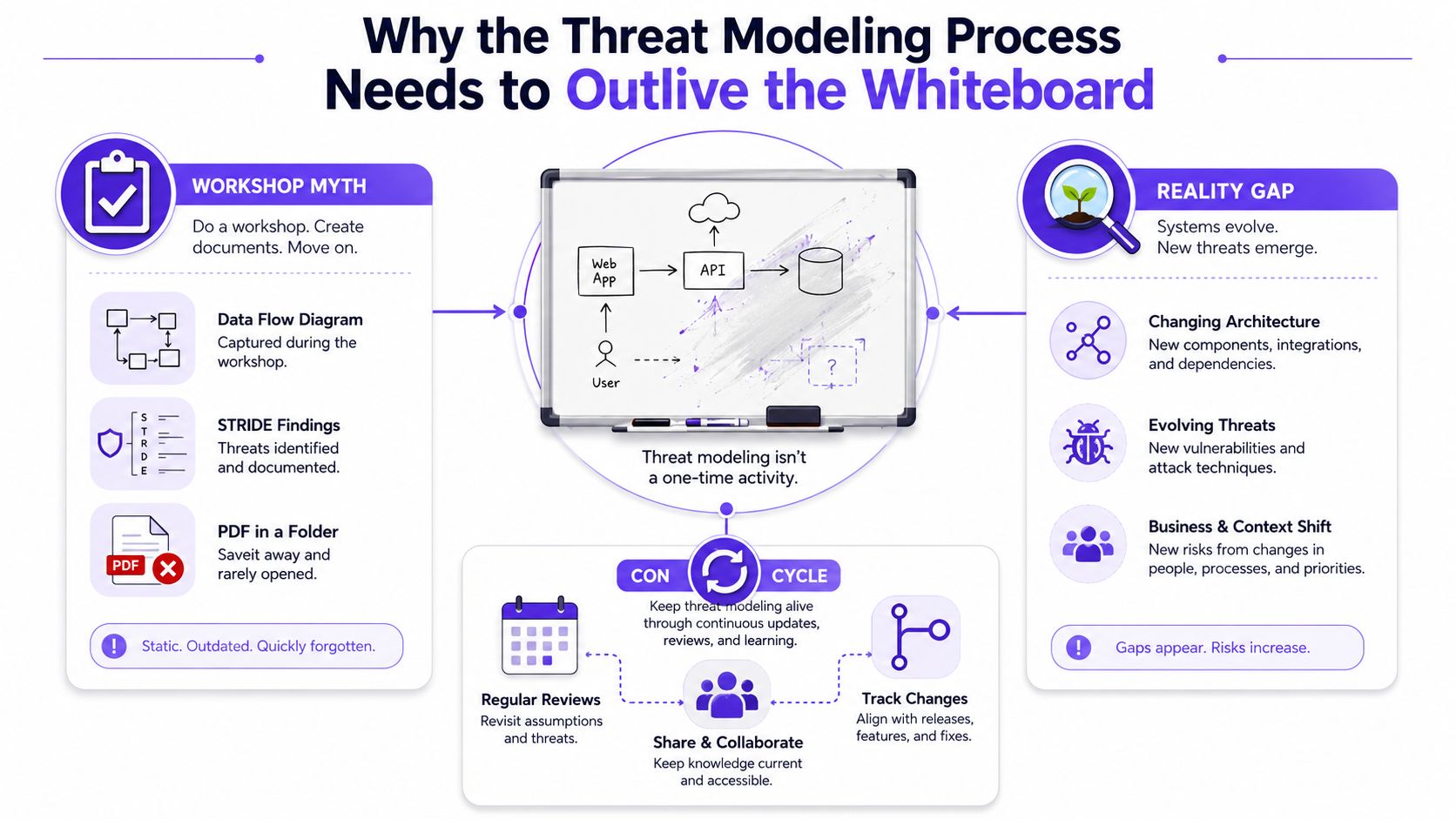
The common assumption is that threat modeling ends when the workshop ends. A team decomposes an application, draws trust boundaries, applies STRIDE, records mitigations, and exports a document. Everyone leaves with a sense of completion.
That workflow can identify important design flaws, especially when the team performs it early. NIST recommends using threat modeling early to focus verification on high-risk design decisions, and its secure development guidance places risk modeling during design, before implementation hardens architectural choices. NIST's developer verification guidance supports that early intervention.
The problem starts when the document becomes the record of the system rather than a record of one review. A payment service may add a fraud-checking sidecar. A vendor SDK may change its authentication behavior. A developer may move a handler into another service, while an AI coding agent refactors authorization logic in a pull request. If the model stays in a PDF, the team's security assumptions have stopped moving even though the application hasn't.
The real artifact is the alignment
A useful model records more than threats. It captures:
- System boundaries: Services, clients, queues, databases, external providers, and administrative paths.
- Security assumptions: Which identities are trusted, what data requires protection, and where validation occurs.
- Decisions: Why the team selected a control, accepted residual risk, or rejected an architectural option.
- Ownership: The person or team responsible for each component, boundary, mitigation, and review.
- Change signals: Events that should force a refresh, such as a new integration, endpoint, data type, or security-sensitive code path.
OWASP's Threat Dragon project offers a useful historical marker for this shift. Its roadmap lists a beta release in May 2017, a production 1.0 release in February 2020, and a Dev Lifecycle Integration milestone later in 2020. OWASP Threat Dragon reflects the broader movement from standalone diagrams toward tool-supported workflow integration.
A living model doesn't need to update after every harmless line change. It does need to react when architecture or security-relevant behavior changes. The rest of the process therefore treats the model as a system-of-record that travels with delivery, receives explicit refresh triggers, and produces evidence as a normal byproduct of engineering work.
The Four Core Stages of the Threat Modeling Process
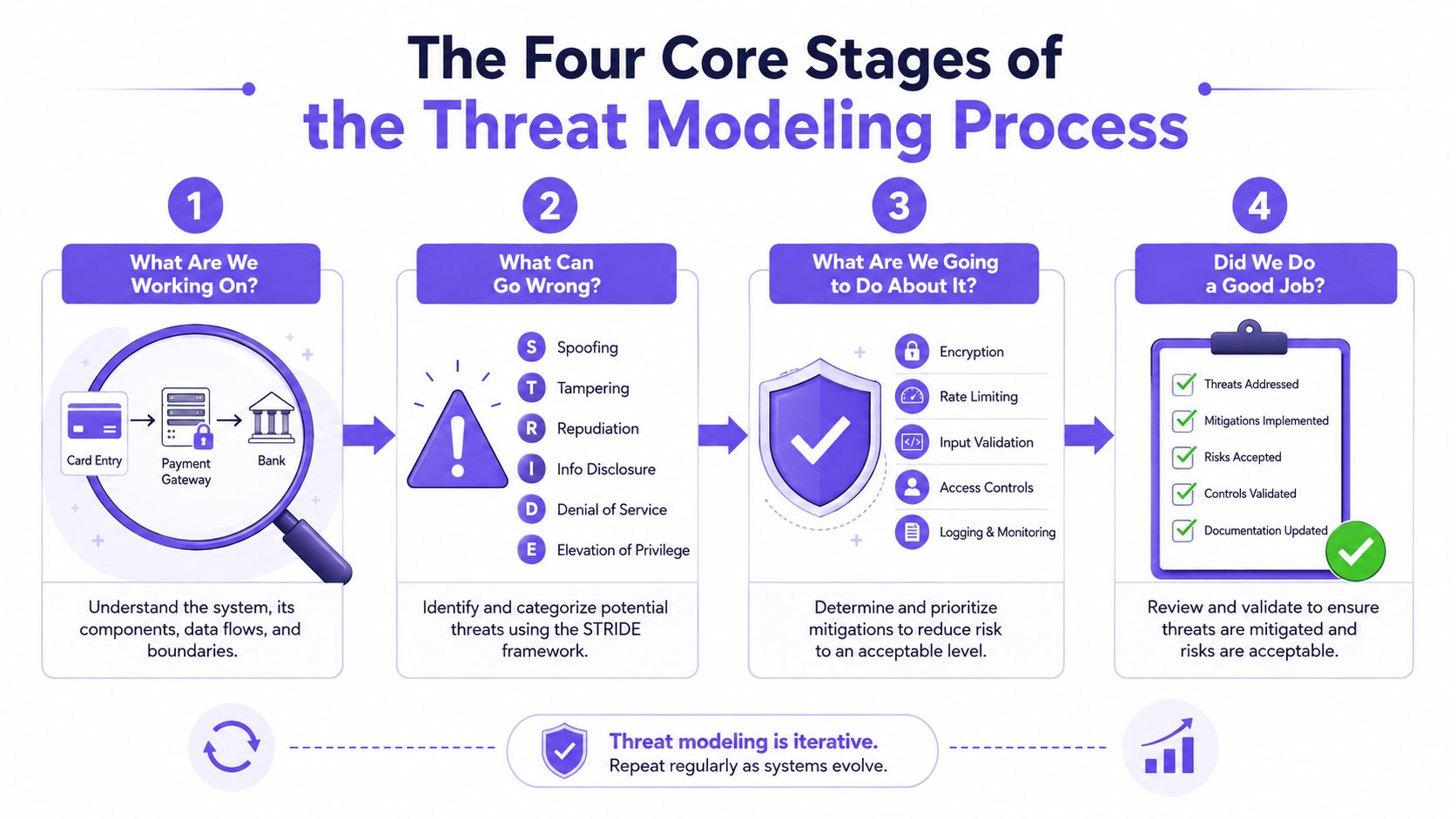
OWASP's practical framework can be expressed through four questions: What are we working on? What can go wrong? What are we going to do about it? Did we do a good job? The questions are simple, but each one prevents a different failure.
Take a small payment service. It exposes a checkout API, receives payment-provider webhooks, and stores payment intents in a database. The service also crosses several trust boundaries, including the public internet, the application environment, the payment provider, and a restricted area containing sensitive payment records.
1. What are we working on?
Start with application decomposition. Map the checkout client, checkout API, webhook receiver, payment provider, message queue, and database. Show data flows, authentication points, administrator access, and trust boundaries. Don't draw only boxes. Label what crosses each boundary and identify whether the sender, payload, or destination has been validated.
The output is a shared view of the system. Without it, one engineer may think the webhook receiver accepts only provider-generated events, while another knows that a retry tool or internal support workflow can also submit event-shaped requests.
2. What can go wrong?
Apply a method such as STRIDE to each relevant element and flow. For the webhook receiver, ask whether an attacker could spoof the provider, tamper with an event, or cause repudiation by removing useful audit context. For payment intents, examine unauthorized modification, information disclosure, denial of service, and elevation of privilege.
A concrete finding might be a forged webhook callback that marks an unpaid transaction as completed. Another might be tampering with an amount or currency field between the checkout API and the payment provider.
3. What are we going to do about it?
Turn findings into owned decisions. The webhook receiver may require HMAC verification, reject invalid timestamps or event states, and record enough context to investigate disputes. Payment-intent updates may need strict state transitions and idempotency controls so retries don't create duplicate effects.
The mitigation should link to an implementation task, an owner, and verification evidence. For a broader view of automating this work, teams can review threat modeling automation in the software lifecycle.
4. Did we do a good job?
Review whether the controls match the actual design. Confirm that HMAC verification is enabled on every relevant path, state transitions reject invalid changes, and tests exercise replay, duplication, malformed input, and authorization boundaries. Record the evidence rather than marking the mitigation complete based on intention.
OWASP frames threat modeling as a lifecycle activity that includes decomposition, threat identification and ranking, mitigations, and review or validation. A strong review also records the next refresh trigger, such as a provider integration change or a modification to the webhook contract.
Practical rule: A threat is not closed when someone writes a mitigation. It's closed when the team can show that the mitigation exists, is enforced on the relevant path, and remains aligned with the current design.
Choosing a Method That Fits Your System
No single method answers every security question. Use the payment service as a fixed comparison point, then choose a primary method based on the decision you need to make.
STRIDE is usually the fastest starting point for a small engineering team. It gives reviewers an element-level vocabulary for spoofing, tampering, repudiation, information disclosure, denial of service, and elevation of privilege. On the payment service, it quickly surfaces forged webhooks and unauthorized payment-intent changes. Its limitation is that categories can produce a broad inventory without showing which attacker path deserves attention first.
PASTA is more attacker-centric. It helps the team connect business impact, application design, and adversary scenarios. For a payment feature where fraudulent completion or refund abuse would create serious business consequences, PASTA encourages the team to ask what an attacker wants, which route could achieve it, and which controls interrupt that route. It requires more context and participation than a rapid STRIDE review.
LINDDUN adds privacy analysis that STRIDE doesn't cover directly. Use it when customer records, payment histories, or behavioral data are in scope and questions about linkability, identifiability, or disclosure matter. It may add useful depth, but it can distract from immediate integrity or authorization risks if the team applies it without a clear privacy objective.
Attack trees model exploit paths rather than only threat categories. For example, a refund-abuse tree can show the combination of account access, weak refund authorization, and missing transaction-state checks an attacker would need. Trees work particularly well when the team knows the adversary's goal or plans to validate controls through adversarial testing.
| Method | Primary Output | Best Stage | Strength on Payment Example | Limitation |
|---|---|---|---|---|
| STRIDE | Element-level threat categories | Early design review | Quickly identifies forged callbacks and tampered fields | Can create an inventory without clear attack-path priority |
| PASTA | Business-impact and attacker scenarios | High-impact design and risk analysis | Connects payment fraud objectives to application decisions | Needs more business and security context |
| LINDDUN | Privacy threat analysis | Data-flow and privacy review | Surfaces linkability and identifiability concerns in customer records | Doesn't replace integrity or authorization analysis |
| Attack trees | Structured exploit paths and control points | Deep analysis and validation | Models webhook replay, refund abuse, or credential misuse | Requires a clearly defined attacker goal |
Vendor assurance can also shape the review. If the payment service depends on third parties, understanding why ISO 27001 matters for vendors helps the team ask better questions about supplier controls, evidence, and risk ownership.
A practical rule is STRIDE for speed, PASTA for high-impact systems, LINDDUN when personal data is in scope, and attack trees when the adversary and objective are well understood. Combining methods is often more useful than debating which one is universally correct.
Where Traditional Threat Modeling Breaks Down
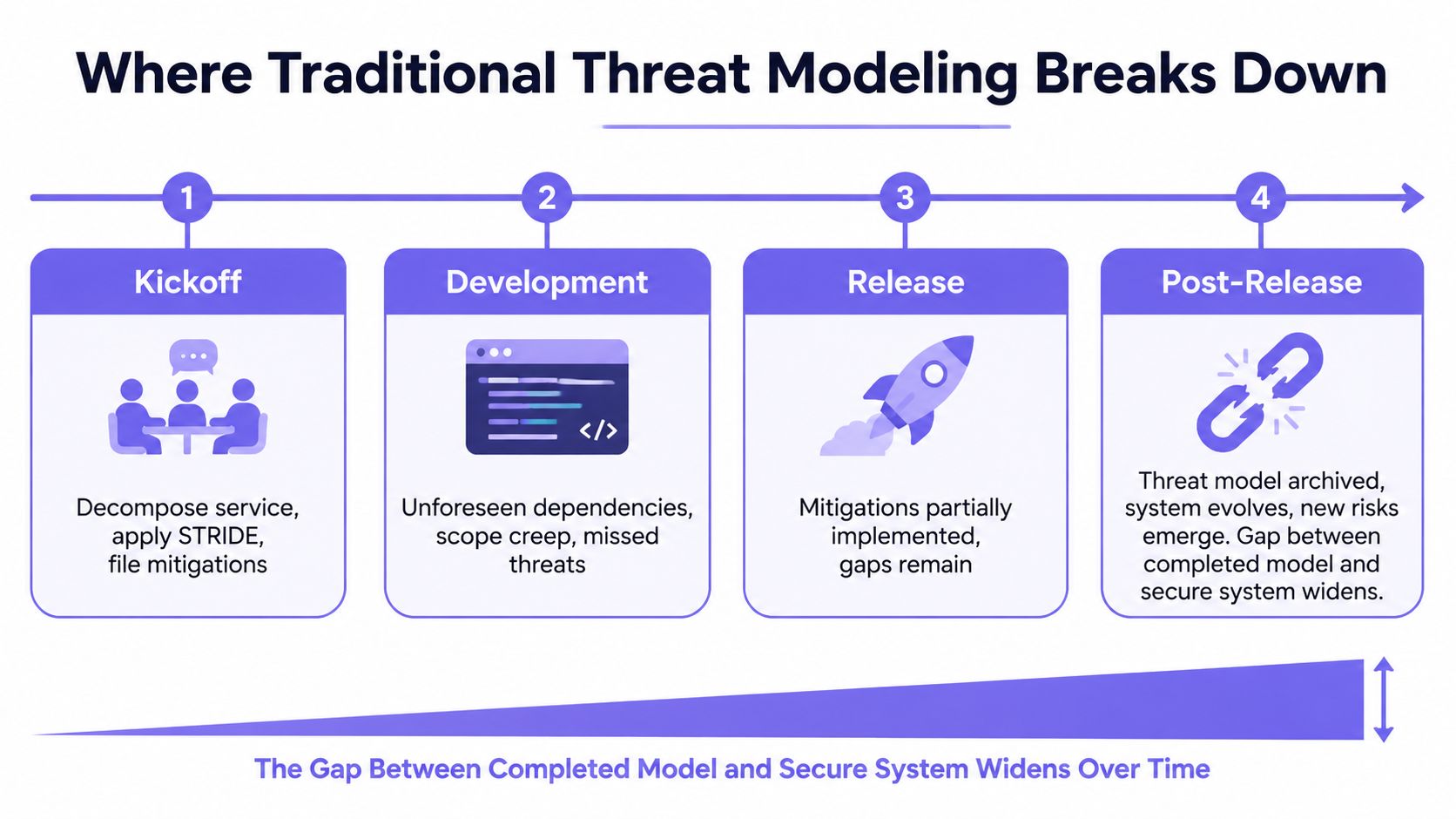
A payment feature can pass a design review and still drift away from its threat model before release. The failure usually isn't that the team selected the wrong taxonomy. It's that the team treated the result as finished documentation.
At kickoff, the team maps the checkout API, webhook receiver, provider, and database. STRIDE exposes a design flaw: the webhook path trusts a callback without adequate authenticity checks. The team files a mitigation, assigns it to an engineer, and leaves the meeting satisfied.
During development, the implementation changes. A developer routes fraud checks through a sidecar that isn't on the original diagram. An AI coding assistant refactors authentication in a pull request and changes how a handler obtains identity context. The repository now contains security-relevant behavior that the workshop never reviewed.
Four structural gaps create the drift
- Snapshot timing: The model describes the architecture at kickoff, not the architecture at merge or deployment.
- Manual reconciliation: Engineers must compare diagrams with repositories, tickets, infrastructure, and runtime topology by hand.
- Weak post-sign-off ownership: The original reviewers may not own the service after the feature enters normal sprint work.
- Machine-generated blind spots: AI-assisted changes can alter authentication, authorization, cryptography, data handling, or tool access without creating a new workshop.
The Dropbox MCP Dash case study provides a useful warning about review-to-implementation drift. Its 2026 reporting measured 79 verified design-review-to-PR pairs, and 54% of implementation pull requests were opened more than a month after the review was filed. The Dropbox security discussion shows why context can decay before code is written.
A completed threat model proves that someone analyzed a design. It doesn't prove that the shipped system still matches it.
The operational fix is to make reconciliation part of delivery. A pull request that changes a trust boundary, authentication path, sensitive handler, external integration, or agent capability should surface the related model and require an explicit decision. The model must travel with the codebase, not remain behind in an archived folder.
Keeping the Threat Modeling Process Continuous
Continuous threat modeling doesn't mean convening a full workshop for every commit. It means defining the changes that can invalidate security assumptions, assigning responsibility for those changes, and creating a lightweight path for updating the model.
Start with refresh triggers
A trigger should be specific enough for an engineer or pipeline to recognize. Useful examples include:
- Boundary changes: A new service, queue, sidecar, administrator path, or external provider enters the flow.
- Data changes: The feature begins collecting, storing, exporting, or transforming a more sensitive class of information.
- Identity changes: Authentication, authorization, service identity, token exchange, or privilege scope changes.
- Dependency changes: An SDK, identity provider, payment integration, or security-sensitive library changes behavior.
- AI-assisted changes: Generated code touches authentication, cryptography, sensitive handlers, tool execution, memory, or agent-to-agent communication.
A trigger should open a review or require an explicit “no model impact” decision. Silent assumptions are what make drift difficult to detect.
Give each boundary an owner
Map every important service and trust boundary to a named engineering owner. That owner maintains the model context, confirms whether changes affect it, and coordinates mitigation verification. Security should provide methodology, challenge assumptions, and help with high-risk analysis, but the service team must remain accountable for the system's current behavior.
Record ownership alongside the model rather than in a separate spreadsheet. A model without a responsible team becomes stale as soon as the original reviewers change roles.
Reconcile the model with delivery artifacts
Store diagrams, decisions, and threat records in the repository or a connected system that can reference the repository. Compare model elements with source-controlled routes, service metadata, deployment definitions, dependency manifests, and planning tickets. The check doesn't need to understand every line of code. It should flag meaningful differences, such as a new externally reachable endpoint or a new integration that isn't represented in the model.
For AI coding workflows, add guardrails at several points:
- Prompt context: Tell the coding agent which security decisions, boundaries, and prohibited changes apply.
- Pre-merge analysis: Scan pull requests for changes to security-relevant behavior and compare them with the approved model.
- Human gates: Require review when generated code changes identity, privilege, secrets, cryptography, or high-impact agent actions.
- Post-merge verification: Confirm that the deployed topology and configured permissions still match the approved design.
Teams looking to formalize this operating model can use continuous threat modeling guidance as a reference point.
Start with one critical service. Instrument the drift signal, make ownership visible, and measure whether the team can close the loop without excessive meeting overhead. Expand only after the workflow reliably detects changes, routes decisions, and records verification.
From Living Models to Audit-Ready Evidence
Auditors don't need a beautiful diagram by itself. They need evidence that the organization identifies risk, treats it, assigns responsibility, and reviews whether controls remain appropriate.
A living threat model can produce that evidence during normal delivery. Each meaningful revision can carry a timestamp, reviewer, reason for change, affected boundary, linked mitigation, owner, and verification result. A deployment or pull request can then connect the approved decision to the implementation that followed.
What the evidence should show
The useful chain is threat, decision, control, owner, implementation, verification, and review. If an auditor samples a change, the team should be able to explain which security assumption changed, who assessed it, what control was selected, and how the team confirmed that the control works.
| Audit Question | Living Model Artifact | Source |
|---|---|---|
| How does the organization identify application risk? | Current architecture decomposition, data flows, trust boundaries, and threat register | Repository model and linked design review |
| How does it treat identified risk? | Threat-to-mitigation mapping with owners, status, and recorded decisions | Issue tracker, pull request, or risk record |
| How does it review changes? | Version history, reviewer attestations, and drift reports tied to changes | Source control and workflow history |
| How does it verify implementation? | Test evidence, policy results, deployment references, and residual-risk decisions | CI records, test systems, and release metadata |
SOC 2 and ISO 27001 work is easier when these artifacts already exist. The specific control mapping depends on the organization's scope and audit program, but a continuously maintained record is more credible than documentation rebuilt shortly before fieldwork.
Annual reconstruction also creates a sampling problem. A team may produce a polished document that describes the intended architecture while having limited evidence that reviews occurred when the system changed. A living history gives auditors a sequence of decisions and confirms that security review is part of engineering rather than a separate compliance exercise.
The operational benefit matters just as much as the audit benefit. Engineers can use the same record to understand why a boundary exists, which controls are mandatory, and what must be reconsidered before changing the design. Compliance evidence becomes a byproduct of useful technical work.
Common Misconceptions About the Threat Modeling Process
Threat modeling programs often fail because teams inherit convenient folklore. Four beliefs cause particular trouble.
“We only need it for new systems”
Legacy services still contain trust boundaries, sensitive data, external dependencies, and accumulated design assumptions. Apply the process when those properties change, even if the service has been running for years. A new integration or authorization path can invalidate an old model just as quickly as a brand-new application can.
“STRIDE is the whole program”
STRIDE is a useful taxonomy, not an operating model. It helps categorize threats, but it doesn't assign ownership, define refresh triggers, reconcile architecture with code, or verify mitigations. Pair it with a lifecycle and use PASTA, LINDDUN, or attack trees when the system's business impact, privacy scope, or adversary paths require more context.
“Developers can do it without security guidance”
Developers understand implementation details, but they may not know the business consequences of a payment workflow, the privacy implications of a data flow, or the attack patterns affecting an unfamiliar integration. Security participation should improve the questions and decisions, not turn the work into a handoff.
“The output is a PDF”
A PDF can preserve a snapshot, but it can't own a service or detect a changed repository. Store the model near the components and decisions it describes, link it to tickets and pull requests, and require an explicit review when the system changes.
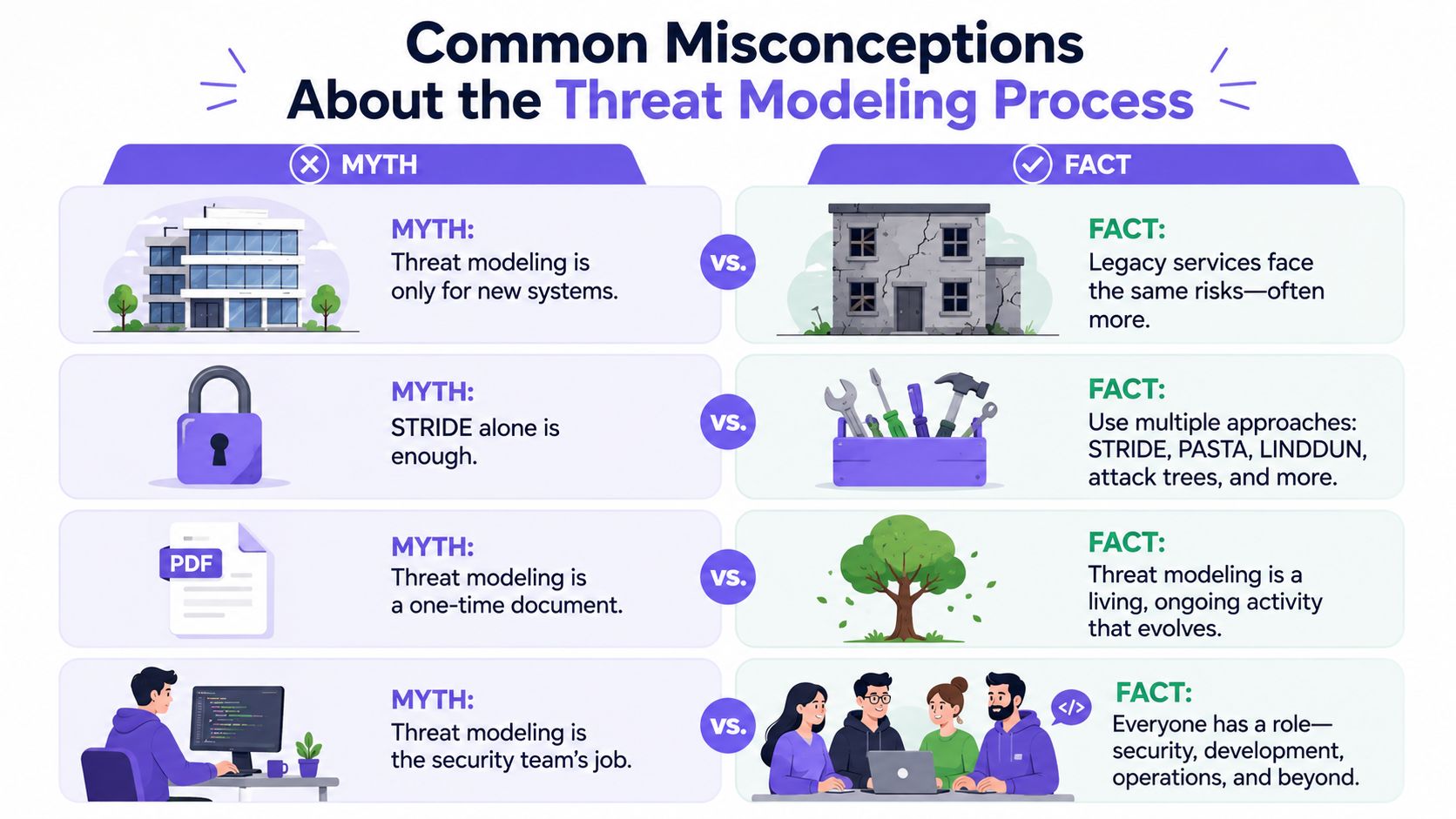
The corrective operating assumption is simple: model the system whenever its security-relevant behavior changes, and keep the record where engineers can act on it.
A Practical Checklist to Start and Sustain the Process
A team can begin without designing an enterprise-wide program. Choose a critical service and make the first loop small enough to complete, inspect, and improve.
Phase one, the first two weeks
- Select one service: Choose a system with meaningful data, external exposure, or important business behavior.
- Map the flow: Draw the checkout, API, integrations, storage, identities, and trust boundaries.
- Model one release slice: Apply STRIDE to the selected change, record findings, and assign owners.
- Validate one control: Pick a high-priority mitigation and connect it to a test or implementation check.
Phase two, weeks three through six
Move the model into the repository as Markdown, Mermaid, or another reviewable format. Add architecture decision records and link each important threat to its mitigation and owner. Choose a primary method, such as STRIDE for a fast baseline, PASTA for attacker-centered analysis, or STRIDE combined with attack trees for a high-impact path.
Name an owner for each trust boundary. A boundary without an owner is a predictable place for assumptions to decay.
Phase three, weeks seven through twelve
Add refresh triggers to CI and workflow tooling. Flag new endpoints, dependency upgrades, external integrations, changes to identity or cryptography, and AI-generated pull requests that touch sensitive handlers. Require the author to confirm whether the model changed, then route meaningful diffs through the same review path as code.
For broader implementation planning, teams can consult this threat modeling implementation checklist.
Ongoing operation
- Review model diffs: Treat architecture and threat-model changes as reviewable artifacts.
- Verify deployments: Compare approved boundaries and permissions with the deployed system.
- Preserve evidence: Keep decisions, attestations, test results, and drift findings linked to releases.
- Inspect stale services: Schedule reviews for systems that haven't changed visibly but remain important.
- Track update speed: Watch how long it takes to refresh the model after a security-relevant design change.
DevArmor is one platform option for this workflow. It connects design reviews, repositories, planning artifacts, pull requests, and AI-assisted development context, with policy enforcement and implementation verification tied to approved security decisions. Visit DevArmor to see how its continuous threat modeling capabilities can help your team keep security context aligned with changing software.
Related reading
- What Is Threat Modeling and Why It Matters in 2026 — from static diagrams to continuous security context.
- Application Security Architecture: Patterns, Threat Models — proven patterns and component-level threat modeling techniques.
- SDLC Cyber Security: Embedding Controls Across Every Phase — practical controls for each development phase.
Table of Contents
Subscribe