SQL Query Parameterization: A Practical Guide
 Reza Khosravi
Table of Contents

A search endpoint can look harmless in a pull request. The developer adds filtering, concatenates the search term into a LIKE clause, and the tests pass with ordinary names. The defect only becomes obvious when someone submits a quote, a comment marker, or a boolean expression and the database receives a different query than the developer intended.
That pattern is still common in legacy services, ORM raw-query methods, admin tools, and code produced with AI assistance. SQL query parameterization is the durable fix for value-based injection, but it isn't a magic shield around every database operation. You also need to handle identifiers, authorization, raw execution paths, stored data, and execution-plan behavior.
Why SQL Query Parameterization Matters in 2026
I've reviewed search handlers where the risky line was effectively:
WHERE name LIKE '%" + input + "%'The code often sits beside input validation, authentication, and a familiar ORM, so it looks less dangerous than it is. The problem isn't that one character was escaped incorrectly. The problem is that the application lets request data become part of the SQL program.
SQL injection became a major security concern because it represented a substantial share of reported vulnerabilities for years. A paper published in Information and Software Technology stated that, since 2002, SQL injection vulnerabilities accounted for more than 10% of total cyber vulnerabilities (the 2008 SQL injection research paper). That history helps explain why OWASP's query parameterization guidance identifies injection as the number one item in both the 2013 and 2017 OWASP Top 10 editions.
The bug is structural
A concatenated query gives an attacker influence over grammar. Depending on the statement, that can enable tautology bypasses, comment injection, UNION extraction, or stacked statements. Filtering a few characters doesn't change the underlying design, and escaping routines are easy to misuse when multiple database engines, encodings, or query paths are involved.
The modern attack surface is broader than a login form. It includes tenant filters in SaaS APIs, reporting endpoints, background jobs, internal administration screens, and raw SQL escape hatches inside otherwise safe frameworks. AI coding assistants can also reproduce unsafe concatenation when repository examples teach that pattern, which makes review discipline more important, not less. For teams evaluating AI-generated code, this factual verification for compliance is useful because it encourages checking security claims and implementation details rather than trusting generated output.
Practical rule: Treat every value that crosses a trust boundary as data until the database driver binds it. Never let request input decide SQL syntax.
Parameterization became foundational because it addresses the primitive directly. It separates the statement structure from the values, so the database can parse the intended SQL without allowing an input string to redefine it.
How Parameterized Queries Actually Prevent Injection
Consider an unsafe login query:
SELECT * FROM usersWHERE email = 'user@example.com'AND password = '...'If the application constructs that text by concatenating email and password, an attacker can submit a value such as ' OR '1'='1. The resulting SQL may change the predicate instead of treating the submission as an ordinary value.
A parameterized version keeps the SQL structure fixed:
SELECT * FROM usersWHERE email = ? AND password = ?The application sends the statement and binds the two values separately. The database parser sees ? as a parameter marker, not as a location where arbitrary SQL grammar can appear. The malicious input remains a literal string, so it doesn't create a new OR condition or alter the query's intended logic.
Code and data stay separate
Prepared statements and bind variables enforce this separation through the database interface, not through a blacklist. OWASP explains that an input such as tom' or '1'='1 is handled as plain text when it is bound correctly, rather than changing query intent (OWASP Injection Prevention guidance).
The implementation sequence is straightforward:
- Write the complete SQL structure with placeholders.
- Pass user-controlled values through the driver's binding API.
- Let the driver marshal types and transmit values separately.
- Execute the prepared or parameterized statement.
That distinction matters because escaping and filtering depend on every caller remembering the same rules. Parameterization makes code-data separation part of the execution contract. It also means a password containing quotes, comment markers, or boolean syntax remains a password value.
SQL Server adds an operational dimension. Microsoft documents counters for auto-parameterization attempts, including safe, unsafe, and failed attempts, and explains that safe parameterization can support reuse of cached execution plans (SQL Server statistics and optimization documentation). A guide aimed at engineering leaders, such as this CTO-focused SQL injection prevention guide, can help turn the implementation rule into an organization-wide development standard.
Parameterization Patterns Across Common Languages
The syntax varies, but the security rule doesn't: the SQL string contains placeholders, and the driver receives values through a separate argument. Never use f-strings, template literals, string formatting, or concatenation to place untrusted values inside SQL text.
Python with psycopg
cursor.execute("SELECT id FROM accounts WHERE email = %s",(email,))row = cursor.fetchone()The tuple is important. It gives psycopg the value as a bind argument rather than as text to append to the statement.
Java with JDBC
PreparedStatement statement = connection.prepareStatement("SELECT id FROM accounts WHERE email = ?");statement.setString(1, email);ResultSet rows = statement.executeQuery();PreparedStatement owns the binding boundary. Avoid building the SQL string with String.format before creating it.
C# with SqlClient
using var command = new SqlCommand("SELECT id FROM accounts WHERE email = @email", connection);command.Parameters.AddWithValue("@email", email);using var reader = command.ExecuteReader();In production code, use an explicit database type and size when type inference could produce an unsuitable type. The essential property is that email is supplied through Parameters, not interpolated into the command text.
Node.js with pg
const result = await client.query("SELECT id FROM accounts WHERE email = $1",[email]);const account = result.rows[0];The pg client sends the SQL template and parameter array independently. The same principle applies to mysql2 when using its placeholder or named-parameter support.
Go with database/sql
rows, err := conn.QueryContext(ctx,"SELECT id FROM accounts WHERE email = $1",email,)if err != nil {return err}defer rows.Close()Go's database/sql package delegates placeholder handling and value conversion to the driver. Use the placeholder format required by that driver and keep the value in the argument list.
| Language / Driver | Placeholder syntax | Minimal example |
|---|---|---|
| Python / psycopg | %s | cursor.execute("... email = %s", (email,)) |
| Java / JDBC | ? | statement.setString(1, email) |
| C# / SqlClient | @email | command.Parameters.AddWithValue("@email", email) |
| Node.js / pg | $1 | client.query("... email = $1", [email]) |
| Go / database/sql | $1 | QueryContext(ctx, "... email = $1", email) |
Two rules survive every language choice. Prefer positional or named placeholders over formatting, and let the driver marshal types. That prevents values, including binary data and embedded null characters, from being interpreted as part of the SQL statement. Teams that also review JavaScript query construction can pair these practices with JavaScript static analysis guidance to catch unsafe construction before it reaches review.
ORM Escape Hatches and Where They Break
An ORM's normal query builder usually binds values safely. The danger appears when a developer needs a database-specific function, complex join, migration query, or reporting statement and reaches for raw SQL.
The raw API isn't automatically unsafe. It becomes unsafe when interpolation happens before the ORM or driver receives the query.
| ORM | Safe builder example | Raw escape hatch | Default behavior | Correct binding |
|---|---|---|---|---|
| Django | User.objects.filter(email=email) | cursor.execute(sql) | Executes the supplied SQL text, including unsafe formatting | cursor.execute("... email = %s", [email]) |
| SQLAlchemy | select(User).where(User.email == email) | text() | Treats interpolated text as SQL | text("... email = :email").bindparams(email=email) |
| Hibernate | Criteria API or JPQL parameters | createNativeQuery() | Native SQL remains the developer's responsibility | query.setParameter("email", email) |
| Prisma | prisma.user.findMany({ where: { email } }) | $queryRaw | Safety depends on the tagged-template or binding form used | Use a tagged template with values kept as parameters |
Review the boundary, not the brand
SQLAlchemy's text() doesn't rescue an f-string. Django's cursor doesn't sanitize a formatted string. Hibernate's native query API can execute a statement whose identifiers or values were assembled earlier. Prisma's raw APIs require particular care because a safe tagged-template form and an unsafe raw string form don't offer the same guarantees.
Raw SQL is a capability, not a security control. The binding review must continue wherever raw execution is allowed.
Add lint rules for interpolation inside raw-query calls, and make the rule visible in pull requests. A reviewer should be able to identify the SQL template, the binding call, and the source of every dynamic fragment without reconstructing several helper layers.
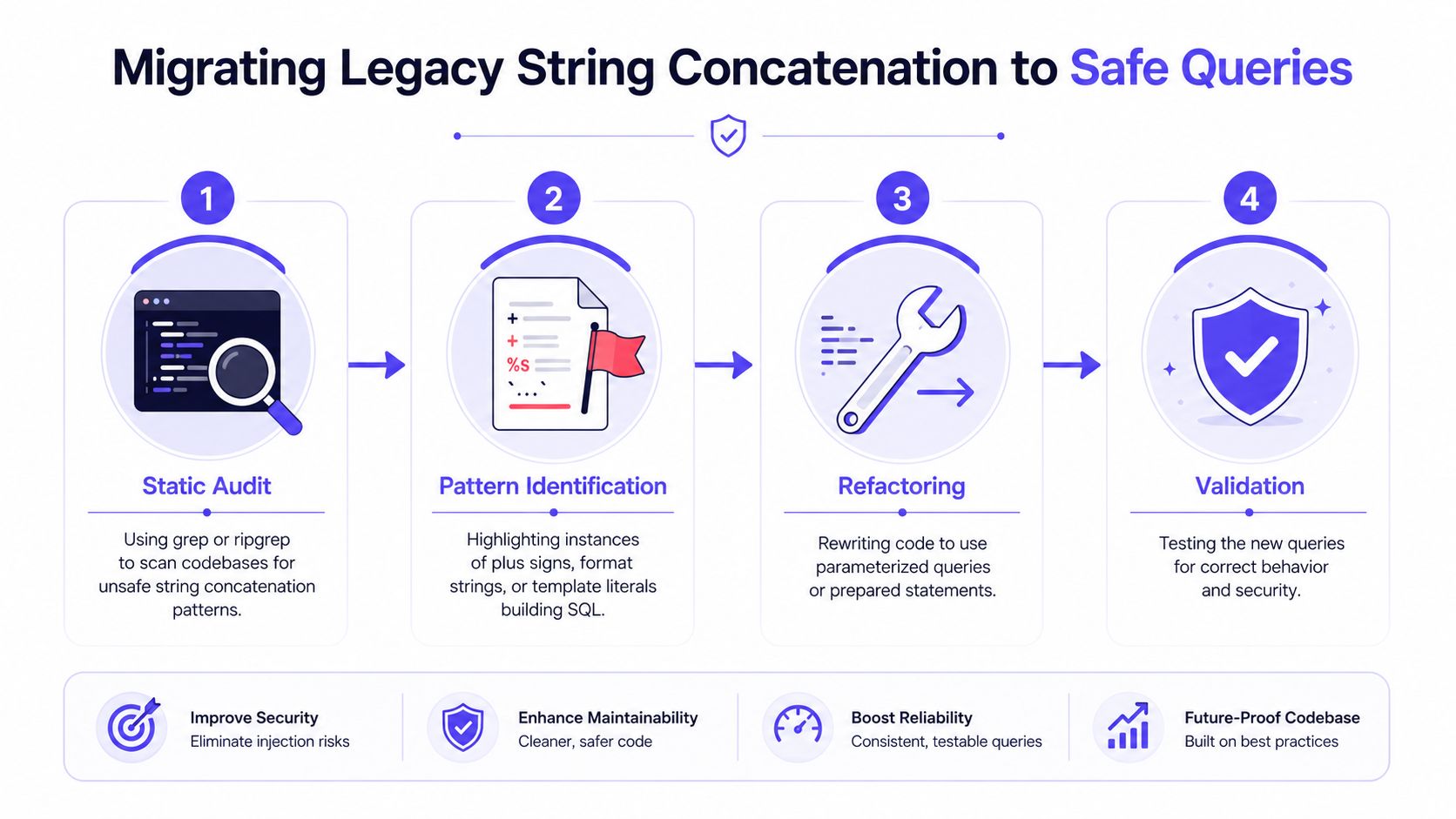
Migrating Legacy String Concatenation to Safe Queries
A production migration needs more than replacing plus signs. The safe approach preserves behavior, identifies the highest-risk paths first, and verifies both security and database behavior.
Start with an inventory
Search repositories with grep, ripgrep, or Semgrep rules for concatenation and interpolation near SELECT, INSERT, UPDATE, and DELETE. Search separately for raw ORM methods, template literals, format functions, and helper methods that return SQL strings.
Then rank the findings:
- Request-reachable code: Prioritize handlers that consume query parameters, form fields, headers, cookies, or JSON bodies.
- Privileged jobs: Review batch workers, administration scripts, and support tooling because their database credentials may have broad access.
- Internal reporting: Triage these after externally reachable paths, while still fixing them because internal users and stored data can be hostile.
Use this secure-code review perspective to sharpen the review question: what data enters the query, where does it travel, and which function finally executes it?
Refactor one call site at a time
Write the fixed SQL structure first, then replace each value insertion with a placeholder. Keep conversions explicit, especially for dates, numeric filters, and nullable values. If the code dynamically selects a table or column, don't force that fragment into a value placeholder. Map the external choice to a server-controlled allowlist instead.
Before deployment, compare query logs and execution behavior for the old and new paths. Run the integration suite, add a regression test with a known injection payload, and assert that the operation returns the expected result without unintended reads or writes. A feature flag gives the team a quick rollback path while traffic exercises the replacement.
Edge Cases Parameterization Does Not Cover
Bind variables protect values. They don't automatically protect SQL structure that the application still constructs.
A request may choose a sort field, table, column, or sort direction. Many drivers can't bind those elements as ordinary parameters because the database parser expects identifiers or keywords, not data values. The safe pattern is a server-side map:
sort_columns = {"recent": "created_at","name": "display_name",}column = sort_columns.get(requested_sort, "created_at")query = f"SELECT id FROM users ORDER BY {column}"The user selects a key from a known set. The user never supplies the identifier inserted into the statement. Apply the same approach to table names, column lists, and direction values such as ascending or descending.
Security logic remains separate
Parameterization won't repair an authorization flaw. A tenant query can be perfectly parameterized and still return another tenant's rows if the tenant predicate is missing or derived from attacker-controlled input. It also doesn't address insecure direct object references, mass assignment, excessive database permissions, or a report process that later concatenates safely stored data into a new query.
Second-order injection deserves specific attention. An input can be stored harmlessly, then become dangerous when a later maintenance script, export job, or reporting query reads it and builds SQL through concatenation. Every execution site needs the same binding discipline, not just the original request handler.
Performance can still regress
Parameterized statements may share execution plans. SQL Server's optimizer uses statistics and passed parameter values when estimating cardinality, but a plan that suits one distribution can perform badly for another. This is commonly called parameter sniffing.
Don't respond by removing parameterization. Inspect the plan and workload with Query Store, then consider a targeted strategy such as OPTION (RECOMPILE), an appropriate plan guide, or a more deliberate parameter type. Microsoft's documentation connects parameter values, statistics, and cardinality estimates, while database practitioners discuss plan-cache trade-offs and remedies in this parameterized-query performance discussion.
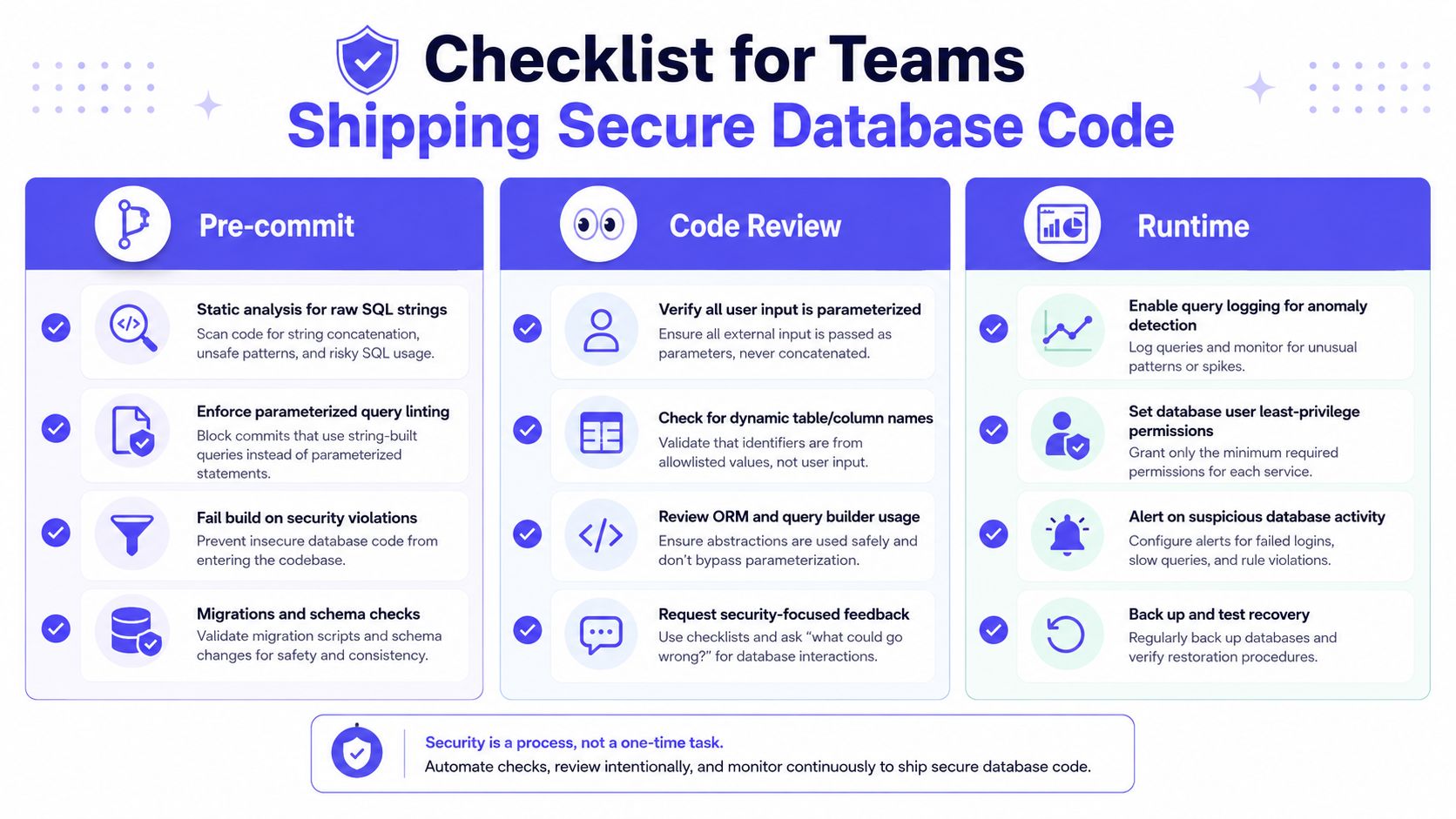
Checklist for Teams Shipping Secure Database Code
A reliable control works at three points: before code reaches review, while a reviewer examines the change, and after the service runs in production. Each layer catches a different failure.
Pre-commit
- Scan SQL construction: Flag concatenation, format strings, and interpolation near SQL verbs before a pull request opens.
- Enforce bind APIs: Reject raw execution calls that don't include a separate parameter collection.
- Test raw-query methods: Add ORM-specific rules for Django cursors, SQLAlchemy
text(), Hibernate native queries, Prisma raw calls, and equivalent APIs.
Code review
- Trace every value: Confirm that request data, headers, cookies, and stored fields reach bind arguments rather than SQL text.
- Inspect structure separately: Check that table names, column names, selected fields, and sort directions come from strict server-side allowlists.
- Check authorization: Verify that parameterized predicates still enforce tenant and object access boundaries.
- Review plan behavior: For high-volume or skewed queries, inspect execution plans and decide how the service will handle plan instability.
A secure code review workflow helps turn these checks into repeatable review evidence instead of relying on the memory of one experienced engineer.
Runtime
- Use least privilege: Give each service only the database permissions its operations require, limiting the blast radius of an overlooked query flaw.
- Log safely: Capture query identities, timings, errors, and anomaly signals without logging passwords or sensitive parameter values.
- Test deployed behavior: Exercise injection payloads in integration or security tests and verify that unauthorized reads and writes don't occur.
- Watch regressions: Monitor latency, plan changes, and failed parameterization paths after deployment.
The durable safety net is continuous review. Static analysis and policy checks can flag a new raw-query escape hatch at pull-request time, while threat modeling and implementation verification keep the approved database boundary aligned with the code that ships.
DevArmor helps teams maintain living threat models, enforce secure-query and coding policies in pull requests, and give developers and coding agents security context inside their existing tools. Visit DevArmor to connect parameterization requirements with design reviews and continuous policy enforcement before unsafe database code reaches production.
Related reading
- How to Prevent SQL Injection: A Complete Guide — layered defenses against SQL injection.
- 8 Examples: What's Wrong with This Code? — spot the security flaw in real code samples.
- Protect REST API Step by Step Defenses That Work — layered, step-by-step defenses for REST endpoints.
Table of Contents
Subscribe