How to Prevent SQL Injection: A Complete Guide
 Reza Khosravi
Table of Contents
OWASP's 2021 Top 10 recorded 274,228 injection occurrences, with a maximum incidence rate of 19.09% and an average incidence rate of 3.37% across tested applications. (OWASP's injection guidance) SQL injection isn't an outdated textbook problem. It remains a practical application security failure caused by one recurring mistake, allowing untrusted input to influence SQL structure.
Introduction to SQL Injection Prevention
Learning how to prevent SQL injection starts with treating every external value as hostile until the application has handled it safely. Search terms, login fields, URL parameters, API payloads, cookies, and values retrieved from other systems can all reach database code. Authentication doesn't make those values trustworthy, and client-side validation doesn't protect an endpoint from a crafted request.
The primary control is parameterized querying, which keeps user data separate from SQL commands. Supporting controls matter too: positive server-side validation, context-aware escaping where parameterization isn't possible, restricted database accounts, secure stored procedures, code review, and continuous automated testing.
OWASP describes safe APIs, parameterized interfaces, server-side input validation, and careful escaping as foundational defenses. The same principle applies across frameworks and deployment models: prevent input from changing query intent, then limit what the database account can do if another control fails.
Teams that need broader application security context can also review Managed system security insights, particularly when database controls form part of a wider security program. The practical sections below focus on implementation, including the awkward cases that basic SQL injection checklists often skip.
Understanding SQL Injection Mechanism and Risks
SQL injection happens when an application constructs SQL by combining fixed query text with untrusted input. A vulnerable login example might look like this:
query = "SELECT id FROM users WHERE username = '" + username + "'"If the input contains quote characters or SQL operators, the database may parse part of that input as syntax instead of treating it as a username. The attacker isn't merely submitting an unusual value. They're attempting to change the query's grammar, predicates, returned rows, or executed operations.
The key distinction is between data and commands. A safe query tells the database which parts are SQL and supplies user values through a separate binding mechanism. A vulnerable query asks the database to interpret one assembled string, so the parser has no reliable boundary between application instructions and attacker-controlled content.
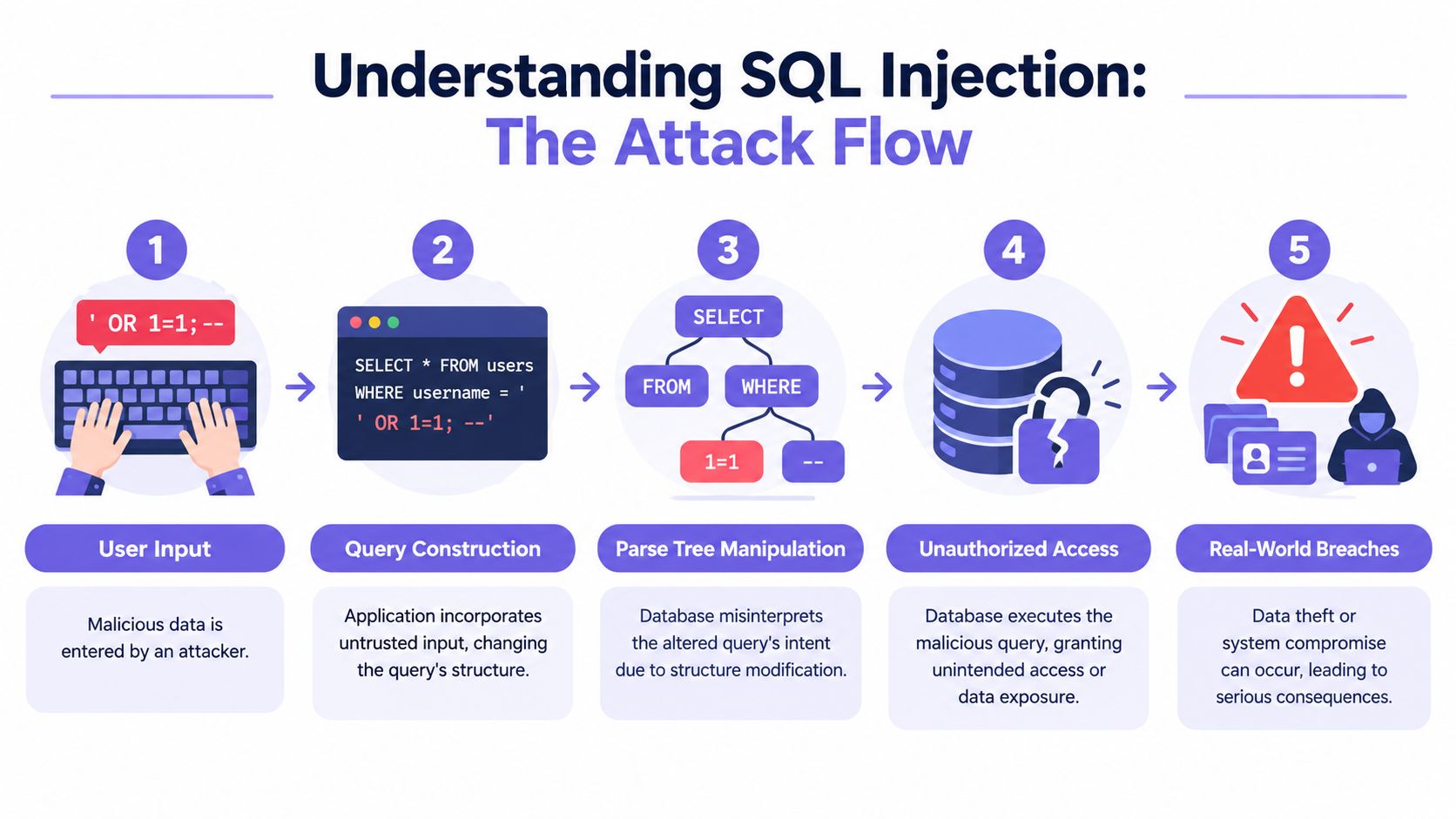
Why simple inputs can create serious exposure
A successful injection can alter a filter, bypass an intended condition, expose records, modify stored data, or trigger database functionality available to the application account. The exact impact depends on the driver, database engine, query context, network placement, and account permissions. That variability is why teams shouldn't rely on a single payload test or assume that hidden errors mean the code is safe.
SQL injection is also historically persistent. It was first documented in December 1998 in Phrack magazine and had gained much wider security-community attention by 2002. A later review of OWASP data still identifies SQL injection as a prevalent and heavily tested injection subtype. (Historical and OWASP analysis)
For code review, flag string concatenation, interpolation, formatted SQL strings, raw-query escape hatches, and query-builder methods that accept complete fragments. Also inspect background jobs and administrative endpoints. Attackers don't care whether a query originated in a polished web controller or an old reporting script.
Implement Parameterized Queries and Prepared Statements
Prepared statements should be the default path for every value that can be represented as data. OWASP recommends defining the SQL code first, then passing each user value separately as a bound parameter. One cited study reported 100% mitigation of tested SQL injection payloads with prepared statements, while the vulnerable implementation had a 93.3% bypass rate. (OWASP SQL Injection Prevention Cheat Sheet)
The unsafe pattern is conceptually the same in every language:
sql = "SELECT * FROM accounts WHERE email = '" + email + "'"The safe pattern moves the value into a parameter slot:
sql = "SELECT * FROM accounts WHERE email = ?"execute(sql, [email])Practical patterns across common stacks
Java with JDBC:
String sql = "SELECT id, status FROM accounts WHERE email = ?";try (PreparedStatement stmt = connection.prepareStatement(sql)) {stmt.setString(1, email);try (ResultSet results = stmt.executeQuery()) {// Process results}}C# with ADO.NET:
using var command = new SqlCommand("SELECT id, status FROM accounts WHERE email = @email",connection);command.Parameters.Add("@email", SqlDbType.NVarChar, 320).Value = email;using var reader = command.ExecuteReader();PHP with PDO:
$stmt = $pdo->prepare('SELECT id, status FROM accounts WHERE email = :email');$stmt->execute(['email' => $email]);Python with a DB-API driver:
cursor.execute("SELECT id, status FROM accounts WHERE email = %s",(email,))The placeholder syntax differs, but the security property is the same. Don't build the final SQL string first and then assume a later escaping step will restore safety.
For teams standardizing implementation details, this guide on SQL query parameterization can complement framework-specific database documentation.
A decision tree for the difficult query parts
Parameterization doesn't replace SQL identifiers or keywords. Use this decision process:
- Is the input a value? Bind it. This includes IDs, names, dates, search text, and filter values.
- Is it an identifier, such as a column, table, or schema name? Map a small, fixed external token to a hard-coded identifier. Never accept the identifier directly from the request.
- Is it a sort direction or operator? Convert it to an enum or allow-list, then select a fixed SQL fragment.
- Is it inside a stored procedure? Review the procedure for dynamic SQL and concatenation. A stored procedure isn't automatically safe if it assembles SQL internally.
- Is it generated by a legacy query builder? Use its parameter-binding API, isolate raw fragments behind a reviewed wrapper, and add regression tests before changing behavior.
- Is no safe API available? Treat context-specific escaping as a last resort, with strict validation and a migration plan toward parameterization.
For dynamic ordering, accept created, name, or another documented token, then map each token to a fixed identifier. For multi-tenant schema selection, resolve the tenant through trusted server-side metadata rather than copying a client-supplied schema name into SQL. This is the difference between controlling a query option and allowing a request to write SQL.
Apply Input Validation and Safe Escaping
Validation is most useful when the application knows what a value is supposed to be. Use positive validation, meaning the server accepts only expected values, rather than trying to list every malicious string that should be rejected. OWASP's 2025 injection guidance reinforces that positive validation is only part of the defense, and that context-specific escaping may still be needed for query parts that can't be parameterized. (OWASP 2025 injection guidance)
Validate structure, not just characters
A sort field should be selected from a server-owned map:
SORT_FIELDS = {"newest": "created_at","name": "display_name",}sort_key = request.args.get("sort", "newest")sort_column = SORT_FIELDS.get(sort_key)if sort_column is None:raise ValueError("Unsupported sort field")sql = f"SELECT id, display_name FROM users ORDER BY {sort_column}"cursor.execute(sql)The request controls the token, not the SQL identifier. Apply the same pattern to filter operators, report names, export formats that select query paths, and tenant routing choices.
Validation should also enforce the expected type and shape at the server boundary. Convert numeric identifiers using a strict numeric parser, constrain enum-like values to known choices, and reject unexpected structures rather than attempting to repair them. Validation won't make concatenated SQL safe by itself, but it narrows the permitted structure and catches mistakes early.
Escaping belongs at the edge of the decision tree
Escaping is database- and context-specific. A routine designed for one engine, character encoding, or SQL context may be unsafe in another. Don't hand-roll quote replacement, and don't use HTML escaping as a substitute for SQL escaping. Use the database driver's documented escaping function only when a parameterized API cannot represent the required query part.
A common example is a LIKE search. The search term should still be bound as a parameter, while wildcard characters may need explicit handling according to the product's intended behavior. Keep that logic separate from SQL construction, document the context, and test quotes, backslashes, encoding boundaries, and wildcard input.
The practical rule is simple:
If you can bind it, bind it. If you can't bind it, allow-list it. Escape only the narrow remainder, using the correct database-specific API.
API boundary design also matters because validation is easiest to enforce before values spread through service layers. Teams reviewing that boundary can use REST API protection guidance alongside their framework's validation and database documentation.
Enforce Least Privilege and Secure Database Configurations
Parameterized queries prevent input from changing query intent. Least privilege limits the damage when code, credentials, or configuration still fail. The application shouldn't connect as a database owner, schema administrator, or account with broad operational powers even if that makes local development convenient.
Create separate roles for separate responsibilities. A read-only reporting service needs different access from a transactional API, and migration tooling shouldn't share credentials with normal application traffic.
CREATE ROLE app_runtime;GRANT SELECT, INSERT, UPDATE ON app.orders TO app_runtime;REVOKE DELETE ON app.orders FROM app_runtime;The exact syntax varies by database engine, so verify role and privilege behavior against the engine's documentation. Apply the same discipline to stored procedures, sequences, views, and schemas. Grant access to the smallest useful surface, and avoid broad privileges inherited through shared roles.
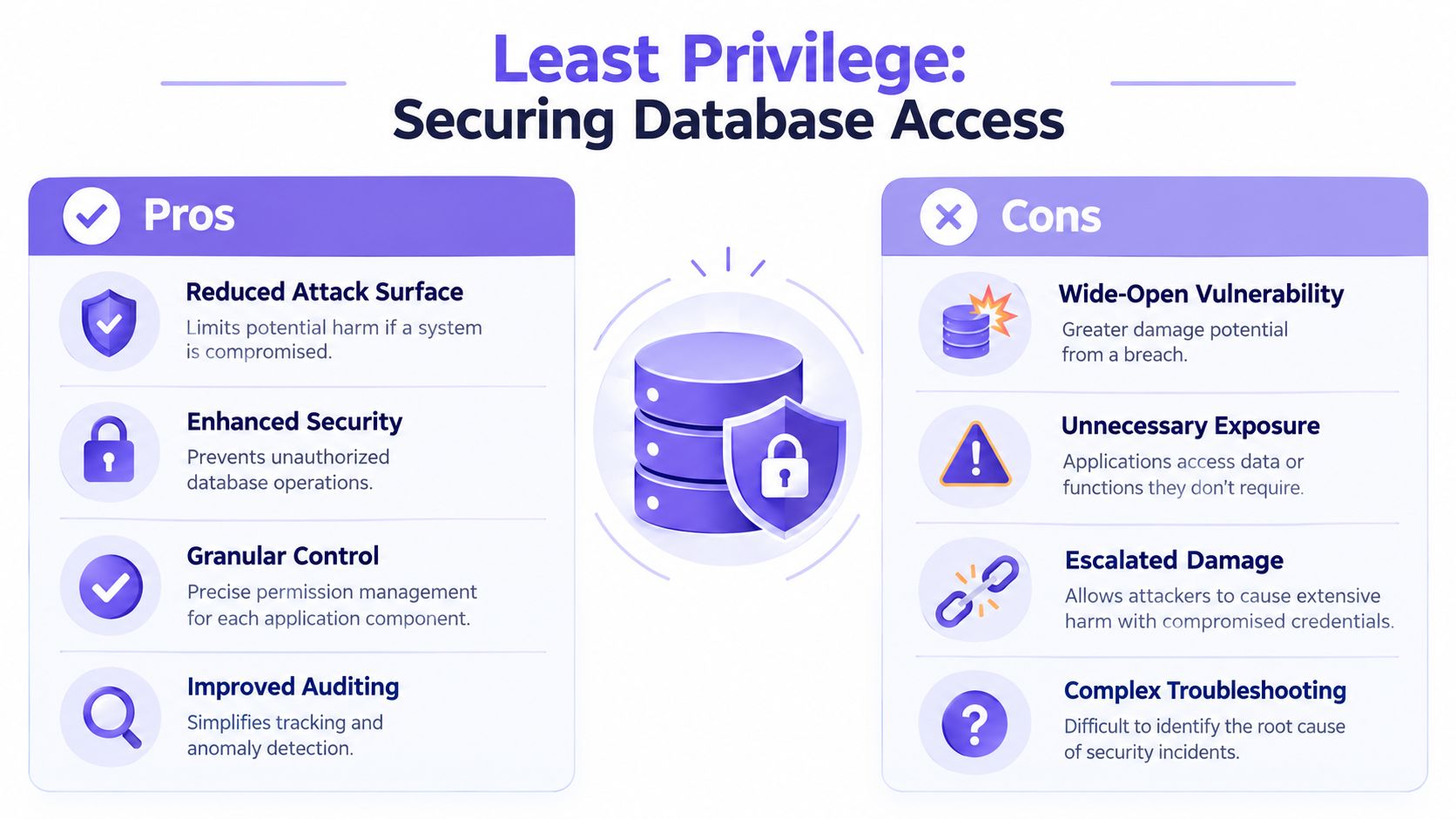
Separate runtime access from deployment access
The trade-off is operational friction. Developers may prefer one powerful account because migrations, debugging, and application behavior all work without permission errors. That convenience makes an injection flaw more consequential and makes accidental destructive operations easier.
Use a controlled deployment identity for schema changes, then keep runtime credentials restricted. Store credentials in an approved secret-management system, rotate them through the normal release process, and monitor failed authorization attempts. Don't solve a migration failure by permanently elevating the production application role.
Least privilege also improves investigation. A database audit trail is easier to interpret when each service has a defined role and expected query scope. Teams working on enterprise application permissions may find Workday finance security guides useful as broader access-governance context, even though SQL role design must remain specific to the database engine and service architecture.
Test and Automate Security Checks
SQL injection prevention degrades when new code introduces a raw-query shortcut. Treat query safety as a release property, not a one-time remediation task. Recent public reporting says SQL injection advisories rose each full year from 2023 through 2025, reaching 3,944 items in 2025, with a 49.1% year-over-year increase. (Aikido's SQL injection trend analysis)
Build checks around the failure modes
A useful pipeline combines different test types:
- Static analysis: Flag string concatenation, interpolation, raw SQL calls, unsafe ORM escape hatches, and stored procedures that assemble dynamic SQL.
- Unit tests: Supply quotes, unexpected types, operators, wildcard characters, and boundary encodings to repository methods.
- Integration tests: Run against a disposable database and confirm that inputs remain values, errors stay generic, and authorization boundaries hold.
- Dynamic scanning: Use SQLMap or an approved DAST tool only against owned, isolated environments with test data and explicit authorization.
- Regression gates: Fail the build when a previously fixed query path becomes raw SQL again or when a security test produces an unexpected database response.
Custom tests are especially valuable for report builders, tenant routing, and legacy query abstractions. Generic scanners may miss a vulnerability when the application transforms input across several services before the final query executes.
For human review, inspect every new database call and ask:
- Are all user-controlled values bound?
- Does any request value choose a table, column, operator, or SQL fragment?
- Does a stored procedure construct dynamic SQL?
- Does the database role have permissions beyond the feature's needs?
- Are validation and error handling enforced server-side?
- Does a regression test cover the query's unusual paths?
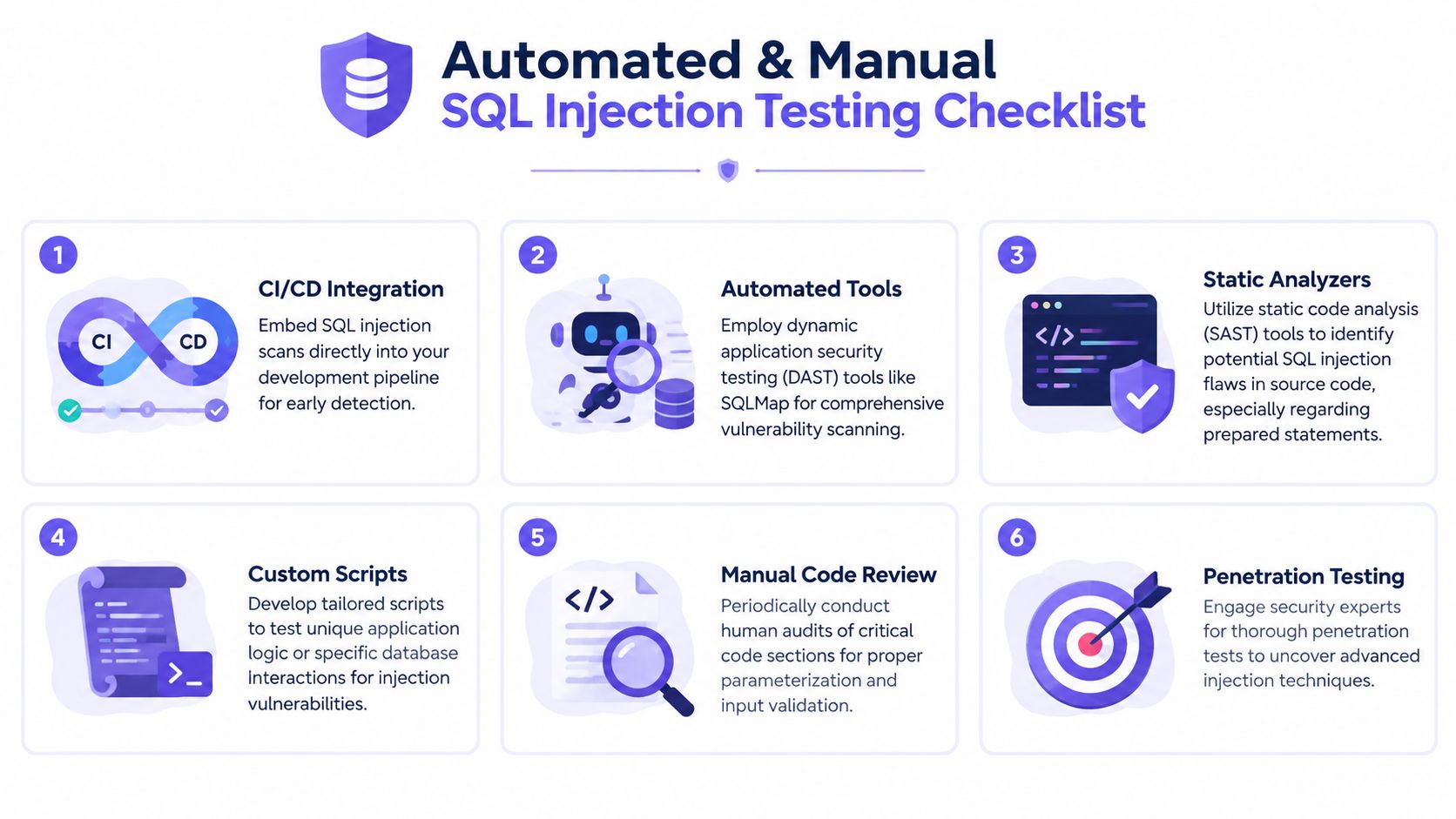
Put the checklist into pull-request templates and make raw-query exceptions require security review. Secure code review practices can help teams formalize that process. DevArmor is another workflow option that connects threat models and security policies to development artifacts, including Policy-as-Code checks for unsafe query construction before merge. Use whichever mechanism fits your delivery process, but make ownership explicit and record why an exception exists.
Conclusion and Quick Best Practices
The reliable answer to how to prevent SQL injection is defense in depth:
- Parameterize every value you can.
- Allow-list identifiers, operators, and sort choices.
- Escape only narrow, non-parameterizable contexts with the correct API.
- Restrict database roles and separate runtime from migration access.
- Test continuously with static analysis, integration tests, approved DAST, and human review.
Reviewers should focus on exceptions, raw-query escape hatches, dynamic stored procedures, and privilege drift. SQL injection prevention isn't finished when one vulnerable query is fixed. It stays effective when teams enforce the same rules across new services, legacy paths, generated code, and deployments.
DevArmor helps teams connect threat modeling, security design reviews, and Policy-as-Code enforcement across the software delivery lifecycle, including checks that can prevent unsafe SQL construction from reaching a merge. Visit DevArmor to evaluate how those controls could fit your application security workflow.
Related reading
- SQL Query Parameterization: A Practical Guide — parameterized queries done right across languages.
- 8 Examples: What's Wrong with This Code? — spot the security flaw in real code samples.
- Protect REST API Step by Step Defenses That Work — layered, step-by-step defenses for REST endpoints.
Table of Contents
Subscribe