Protect REST API Step by Step Defenses That Work
 Reza Khosravi
Table of Contents
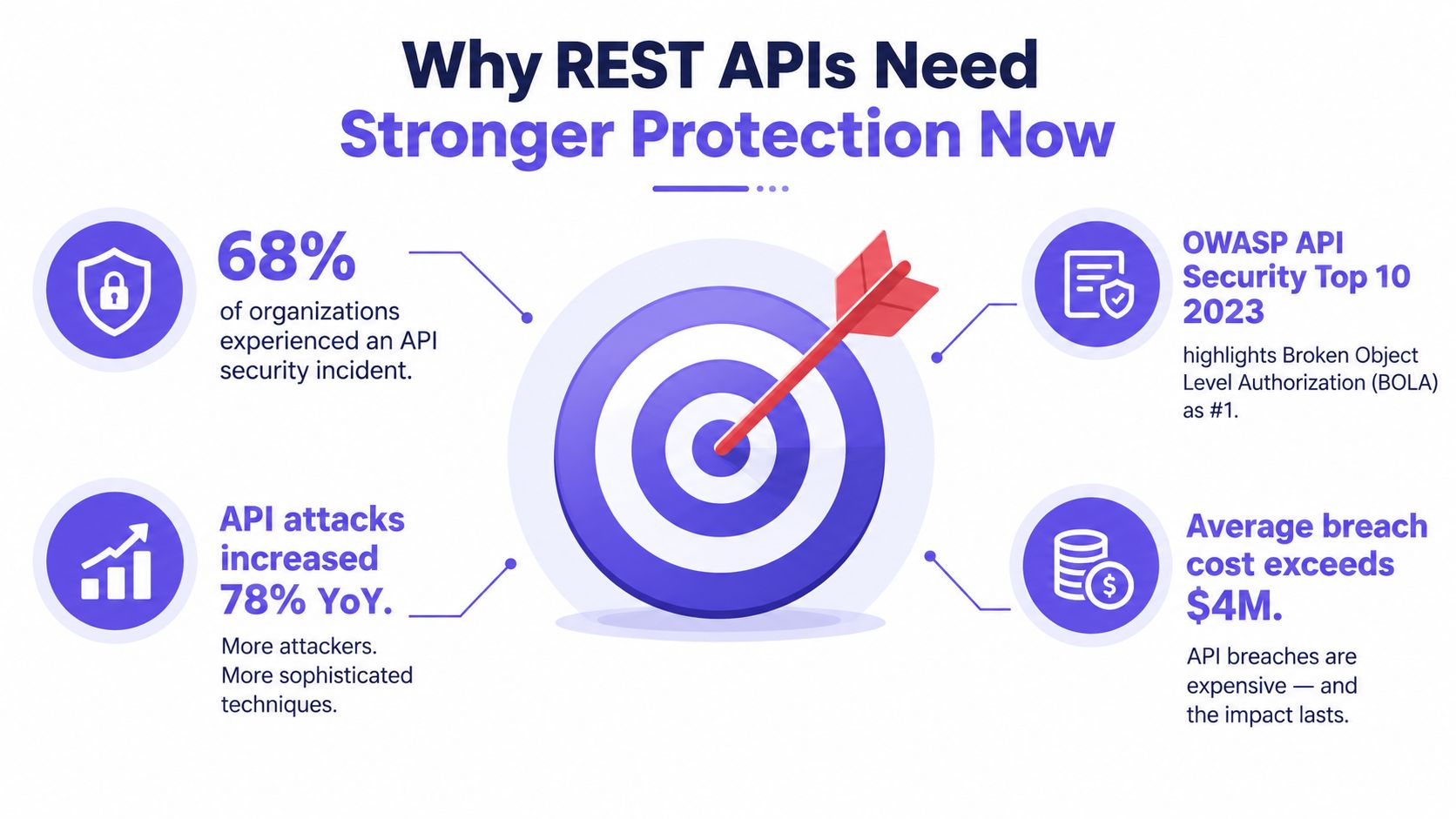
In 2024, one industry report found that 37% of organizations experienced an API security incident in the prior 12 months, compared with 17% in 2023. A separate report found that API data breaches increased by 80% year over year, while 78.2% of incidents were driven primarily by authentication or authorization failures. (Salt Security's 2024 State of API Security Report)
That changes how engineering teams should think about protecting REST APIs. The main problem usually isn't a clever exploit bypassing an otherwise mature system. It's an endpoint that authenticates the caller but fails to check whether that caller can access a specific object, perform a sensitive function, consume an expensive resource, or reach an undocumented service.
Why REST APIs Need Stronger Protection Now
REST APIs expose business capabilities through predictable resources, methods, parameters, and response formats. That predictability helps legitimate clients integrate quickly, but it also gives attackers a structured surface to enumerate, probe, and automate. A public gateway may protect the documented production API while an internal route, deprecated version, staging endpoint, or partner integration remains poorly governed.
The most important shift is authorization. OWASP formally updated its API Security Top 10 in 2023, and three of its top five categories relate directly to access control: Broken Object Level Authorization, Broken Authentication, and Broken Function Level Authorization. The revised list also added Unrestricted Access to Sensitive Business Flows and Server Side Request Forgery, making clear that protecting a REST API requires more than validating a login token. (OWASP API Security Top 10 2023)
Checklist security versus defensive capability
A checklist asks whether the API has authentication, rate limiting, validation, and a WAF. A defensive program asks whether those controls work for every route, every identity type, every object relationship, and every deployment path.
That distinction matters because visibility is often incomplete. Shadow APIs, internal APIs, and third-party APIs can fall outside the inventory used by security reviewers. The result is a false sense of coverage. A gateway may enforce policy for known routes while attackers reach an unregistered endpoint through another hostname, service path, or integration.
Recent reporting illustrates the gap between having controls and operating them effectively. In 2025, only 21% of organizations said they had a high ability to detect API-layer attacks, and only 13% said they could prevent more than half of API attacks. The same reporting identified shadow and third-party APIs as significant operational blind spots and recorded 639 API-related CVEs in Q2 2025. (Traceable 2025 State of API Security)
Practical rule: Protect the API you actually run, not only the API described in the OpenAPI file.
A durable approach has four properties: identity is verified, access is checked at the object and function level, inputs and resource use are constrained, and telemetry continuously reveals drift. The following controls are designed around that operating model.
Lock Down Authentication and Authorization That Actually Holds
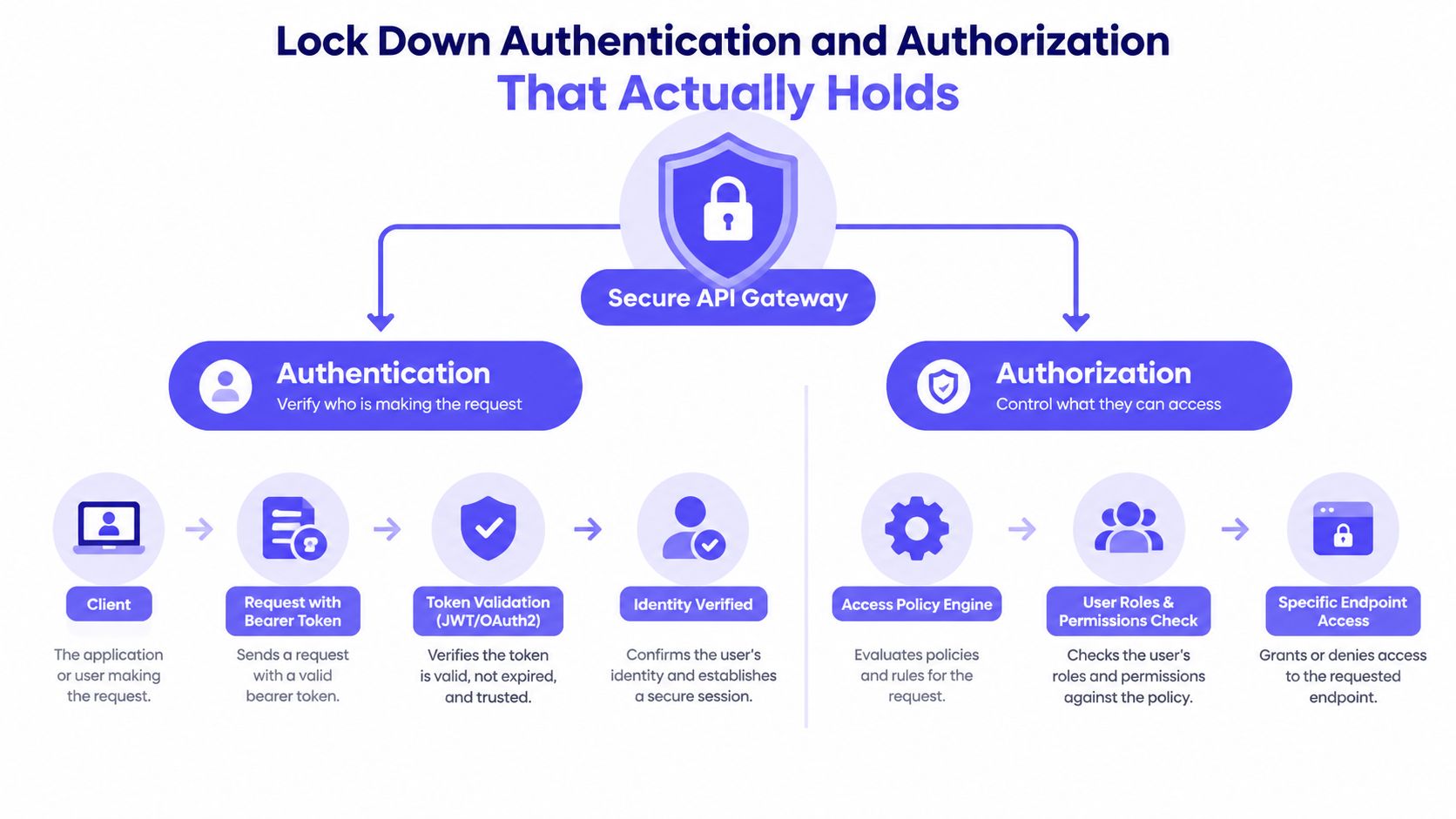
Authentication answers who is calling. Authorization answers what that caller may do, and on which object. REST API protection fails when teams implement the first decision and assume the second follows automatically.
Start by selecting an authentication mechanism that matches the caller. API keys can identify server-to-server integrations, but they shouldn't authorize user-scoped access by themselves. OAuth 2.0 access tokens are more appropriate when a client acts on behalf of a user or service identity, provided the API validates the token's signature, issuer, audience, expiry, and intended scopes on every request.
Bearer tokens create a specific operational weakness. Anyone who obtains one can present it, which is why OWASP recommends sender-constrained tokens, including mTLS or DPoP, to reduce replay and token-theft risk. OWASP also recommends refresh-token rotation, so reuse of a stolen refresh token can invalidate the token family. (OWASP API Security guidance)
Teams choosing an authentication design should also document how credentials are issued, stored, rotated, revoked, and associated with an owner. For a broader comparison of approaches, the 2026 authentication methods guide provides useful context for evaluating authentication patterns beyond a simple bearer-token decision.
Enforce authorization where the object is loaded
The most reliable object-level check runs beside the data access operation. Don't load an object using only a client-supplied identifier and perform the ownership check later, because a later code path may forget it.
A safer pattern conceptually combines the requested object identifier with the caller's allowed tenant, account, or ownership context. If the query returns no authorized object, the handler shouldn't reveal whether a different user's object exists. This protects against ID enumeration and prevents authentication from becoming a universal data-access key.
Function-level authorization needs its own decision. A user who can read an invoice may not be allowed to export all invoices, change billing settings, approve a refund, or invoke an administrative route. Model sensitive actions as explicit permissions, then enforce them in the service or policy layer, not only in a client interface or gateway route.
Use the application security architecture guidance to connect gateway checks with service-level policy enforcement. The gateway can reject missing or malformed credentials, but the application still understands the resource relationship and business permission needed for the request.
A workable request sequence is:
- Authenticate the principal: Validate the credential and establish a stable identity.
- Resolve the tenant and context: Determine which organization, account, or service boundary applies.
- Authorize the action: Check the required scope, role, relationship, and function permission.
- Authorize the object: Confirm that the requested resource belongs to or is accessible by that principal.
- Record the decision: Emit a decision event without logging secrets or complete sensitive payloads.
Don't trust role, user ID, tenant ID, or permission fields supplied in the request body. Derive security context from validated identity and server-side policy.
Validate Every Input and Tighten Data Exposure
Authentication doesn't make input trustworthy. An authenticated user can send malformed, excessive, or deliberately manipulative data, and a compromised client can call the API without using the intended user interface.
Treat every path parameter, query parameter, header, and JSON field as untrusted. Define an explicit schema for each operation, reject unexpected fields where appropriate, enforce content types, and set boundaries for strings, arrays, nested objects, pagination values, and uploaded content. Validation should happen before business logic or database access, not after an unsafe query has already executed.
Use allowlists for fields and operations
A query such as ?sort=created_at should resolve against a server-side list of permitted sort fields. A filter such as status should accept only documented values. Don't pass arbitrary field names, operators, expressions, or serialized query fragments directly into a database adapter.
For PATCH requests, validate field-level permissions separately from data shape. A caller may be allowed to change a display name but not an account owner, approval state, risk classification, or internal status. Schema validation confirms that a value is well formed. Authorization confirms that the caller may change it.
Parameterized database access remains important when validated values reach SQL queries. The SQL query parameterization reference offers practical guidance for keeping data values separate from query structure.
Input rule: Validate syntax at the boundary, enforce business rules in the service, and authorize sensitive field changes explicitly.
Response design deserves equal attention. Return only fields the client needs for that use case. Avoid serializing internal objects wholesale, because a new database column can become an accidental public disclosure when response mapping relies on automatic model conversion.
Handle errors and outbound requests carefully
Production errors should help clients recover without exposing stack traces, internal paths, database details, or authorization logic. Use stable error codes and request identifiers for support correlation, while keeping detailed diagnostic context in protected server-side logs.
REST APIs that fetch a URL, preview a webhook, import a document, or call a remote integration also need SSRF defenses. Accept only approved schemes and destinations, resolve and validate destinations through a controlled network layer, restrict outbound access, and prevent redirects from bypassing those checks. Never assume a URL is safe because an authenticated user supplied it. OWASP's 2023 update specifically added SSRF as an API risk category, reflecting the danger of unsafe third-party API consumption.
Data minimization, validation, and outbound controls work together. A request can be legitimate, authenticated, and correctly shaped, yet still trigger an unsafe business operation or expose more data than the caller needs.
Control Abuse With Rate Limiting and Resource Protections
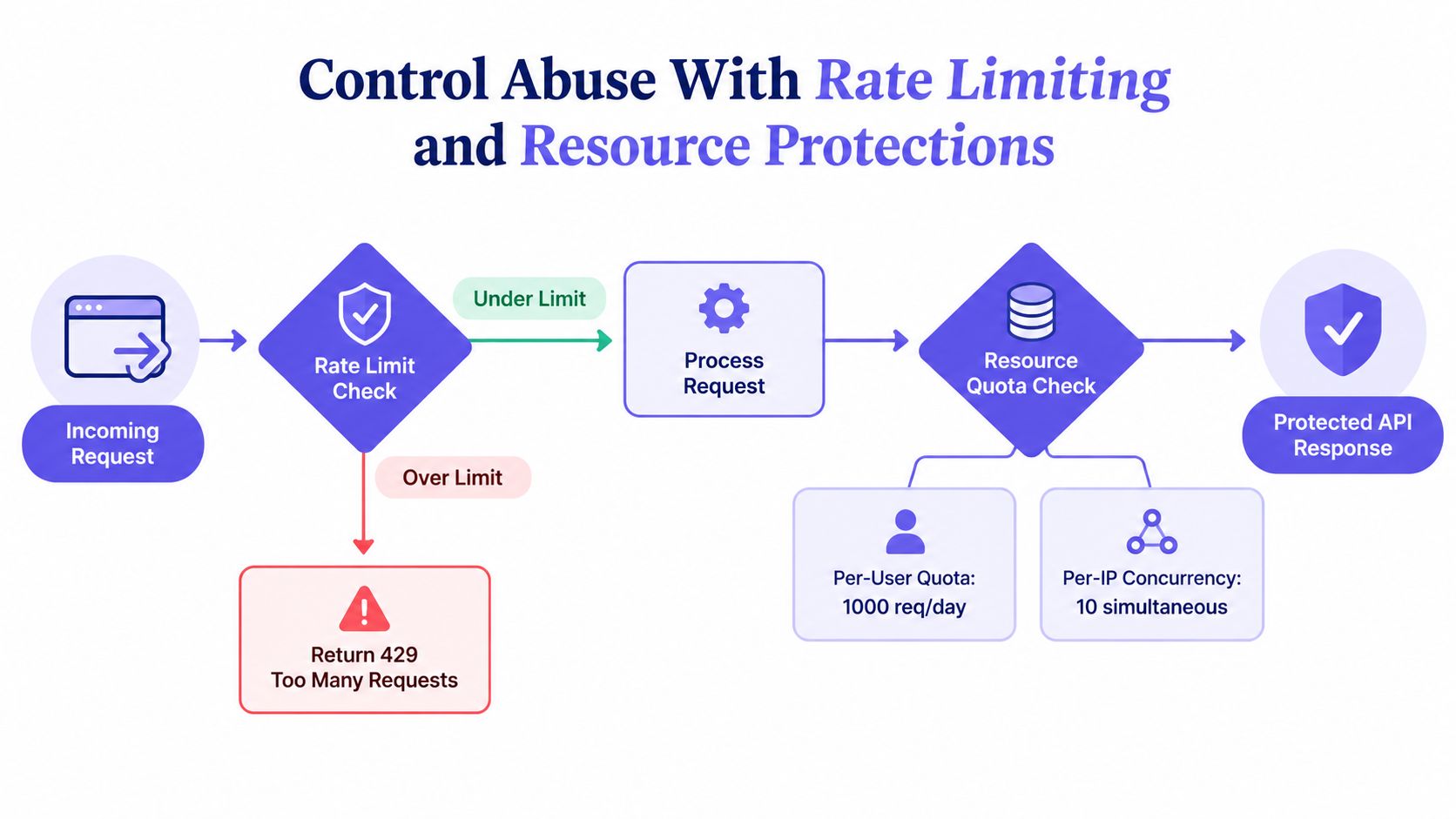
Rate limiting isn't only an availability feature. It limits credential guessing, enumeration, scraping, repeated expensive searches, bulk extraction, and abuse of sensitive workflows.
A single global request threshold rarely works. Apply controls at several dimensions, then tune them against real client behavior:
- Per identity: Limit activity by user, service account, API key, or access token so one credential can't consume the shared budget.
- Per network source: Use IP or network-level controls to slow anonymous abuse and scanning, while recognizing that shared egress can affect legitimate users.
- Per endpoint: Apply stricter protection to login, password recovery, search, report generation, exports, and administrative actions.
- Per resource: Bound page size, export scope, upload size, query complexity, execution time, and concurrent work.
- Per business flow: Add friction to workflows such as coupon redemption, account recovery, or repeated payment attempts, where request volume isn't the only signal.
OWASP's 2023 categories for Unrestricted Resource Consumption and Unrestricted Access to Sensitive Business Flows are useful reminders that request count alone doesn't describe risk. Ten cheap reads and ten expensive exports aren't equivalent, even if both are ten requests.
Make throttling predictable for legitimate clients
Return 429 Too Many Requests when a client exceeds a limit, and provide a retry signal where the client can safely resume. Consistent responses let SDKs implement backoff instead of creating a retry storm.
Distributed systems need a shared enforcement point or coordinated counters. A process-local limiter can behave inconsistently across replicas, allowing bursts through one instance while blocking a client on another. Gateways, distributed stores, queues, and worker concurrency controls can work together, but each adds operational complexity and cost.
Don't treat a WAF as the complete answer. A WAF can identify broad traffic patterns and block known signatures, but it usually doesn't understand whether a user is repeatedly accessing unrelated objects or abusing a legitimate refund operation. Application-aware quotas and authorization decisions must remain close to the business logic.
Measure rejected requests alongside latency, queue depth, downstream load, authentication failures, and business outcomes. A limit that protects infrastructure but blocks normal clients is a product defect. A limit that permits expensive abuse is a security gap.
Keep Visibility With Logging Inventory and Continuous Testing
A REST API can't be protected continuously if the team can't answer basic questions about its surface. Which endpoints exist, who owns them, which identities call them, what data do they return, and which policies protect them?
Start with an inventory assembled from source repositories, gateway configurations, service discovery, deployment metadata, traffic, documentation, and third-party contracts. Reconcile those views instead of trusting one file. The difference between declared routes and observed routes is where shadow APIs, forgotten versions, and unexpected integrations appear.
Log decisions without creating a second breach
Useful API telemetry includes the request method, normalized route, response status, latency, request ID, caller identity type, authorization outcome, policy identifier, and downstream service. Record enough context to investigate repeated failures, object-access anomalies, and unusual business flows.
Never place passwords, access tokens, refresh tokens, or sensitive response bodies into ordinary logs. Redact authorization headers and query values, and apply retention and access policies appropriate to the data. Security teams need searchable events, not an unprotected copy of production traffic.
Inventory and logs become more valuable when they share stable identifiers. A route, policy, service owner, and deployment can then be connected across design review, code review, runtime monitoring, and incident response.
Test the controls that matter
Automated tests should exercise denied access, cross-tenant object requests, missing scopes, altered roles, malformed schemas, oversized inputs, SSRF attempts, rate-limit boundaries, and sensitive workflow abuse. Add tests when an incident or design review reveals a new failure mode.
Dynamic testing can discover behavior that static review misses, while contract tests can expose drift between an OpenAPI definition and the running service. Fuzzing should target parsers, filters, nested structures, pagination, and authorization-relevant parameters, not only random strings.
Point-in-time hardening fails because routes, schemas, integrations, and policies change at different speeds. A living application security posture gives teams a way to track whether approved controls still match the deployed surface.
For teams using workflow-based enforcement, DevArmor can connect continuous threat modeling, security design reviews, Policy-as-Code checks, and implementation verification across planning and code changes. That approach is particularly useful when API authorization decisions must remain traceable as repositories and service contracts evolve.
Operational test: Every new endpoint should produce an owner, an inventory record, an authorization policy, a validation contract, a telemetry plan, and automated negative tests.
Your Next Moves to Keep REST APIs Protected
Teams don't need another unprioritized scanner report. They need a short sequence that closes the highest-consequence gaps and prevents those gaps from returning.
Begin with an endpoint and identity inventory. Include public, internal, shadow, deprecated, and third-party-connected routes. Mark each route's owner, data classification, authentication method, object authorization rule, function permissions, resource cost, and monitoring coverage.
Then review authorization before polishing lower-risk controls. The 2023 OWASP update puts access control near the center of API risk, and the incident reporting cited earlier shows that authentication and authorization failures remain dominant. Test the negative path deliberately. Ask whether a valid user can access another tenant's object, invoke an administrative function, alter a protected field, or repeat a sensitive workflow without the required business permission.
A practical prioritization sequence
- Map the exposed surface: Reconcile documentation, code, gateway routes, deployment metadata, and observed traffic.
- Close authorization gaps: Enforce object-level and function-level checks in application services, with explicit tenant and ownership rules.
- Harden token handling: Validate issuer, audience, signature, expiry, and scopes. Use sender-constrained tokens and refresh-token rotation where the threat model warrants them.
- Constrain data flow: Apply request schemas, field-level permissions, response minimization, safe error handling, and SSRF protections.
- Control expensive behavior: Set identity, network, endpoint, concurrency, quota, and business-flow protections.
- Build the feedback loop: Log safe decision context, alert on anomalies, test denied paths, and reconcile inventory after every meaningful API change.
- Preserve evidence: Store review decisions, policy results, test outcomes, ownership, and deployment relationships so auditors and incident responders can reconstruct why a control exists.
Measure progress through coverage and evidence, not scanner counts alone. A useful review can show which routes have tested authorization, which policies changed, which exceptions remain open, and whether runtime traffic matches the approved design.
Protecting a REST API is an operating discipline. Authentication, validation, rate limiting, gateways, and WAF rules matter, but they don't compensate for an unknown endpoint or an authorization policy that no longer matches the code. The durable standard is simple: every route has an owner, every sensitive action has an explicit decision, every resource has bounded consumption, and every change updates the security context.
DevArmor helps teams maintain that security context through continuous threat modeling, workflow-based design reviews, Policy-as-Code enforcement, and implementation verification tied to code changes and deployments. Visit DevArmor to see how you can keep REST API authorization, validation, resource controls, and audit evidence aligned as your API surface changes.
Related reading
- Application Security Checklist: 10 Essential Controls — ten essential controls to harden applications end to end.
- 10 Security Issues JavaScript Developers Must Fix — common JavaScript vulnerabilities with detection and fixes.
- 8 Examples: What's Wrong with This Code? — spot the security flaw in real code samples.
Table of Contents
Subscribe