Security Development Lifecycle Explained for Modern Teams
 Reza Khosravi
Table of Contents
Most security development lifecycle advice is wrong for modern engineering teams. It treats SDL as a document, a sequence of approval gates, or a checklist someone completes before release. That model may satisfy an audit request, but it breaks as soon as repositories, infrastructure, tickets, dependencies, and AI-generated code change faster than a security review can be updated.
A useful SDL is different. It's a continuous governance model that keeps security requirements connected to architecture, implementation, deployment, and response. The practical question isn't whether your team has a threat model. It's whether the threat model still matches the code, whether policy is enforced in the tools developers use, and whether an AI coding agent can introduce a design decision that nobody approved.
Why Traditional Security Checklists Fail Modern Teams
A checklist assumes that security work happens in a predictable order. An engineer completes requirements, a security reviewer signs off on design, developers write code, testers scan the build, and a release manager approves deployment. That sequence is easy to describe and difficult to operate when teams merge continuously and AI tools generate code, dependencies, configuration, and workflow changes inside the same delivery system.
The problem isn't that checklists contain bad activities. Security requirements, threat modeling, code review, testing, and release controls still matter. The failure comes from treating those activities as completed events instead of controls that must remain connected to changing engineering artifacts.
A threat model written for an architecture diagram can become inaccurate after a repository changes. A ticket can gain a new data flow without triggering a design review. A coding agent can generate a privileged integration while the original approval only covered a narrower use case. A final security gate may detect some symptoms, but it often lacks the context needed to determine whether the implementation still matches the approved design.
Gates create friction when context is missing
Point-in-time reviews tend to produce two bad outcomes. Security teams either block releases because they can't quickly establish what changed, or they approve changes based on stale documentation. Developers experience the first as arbitrary friction and the second as false confidence.
The better alternative is continuous security context. Each important decision should have a traceable relationship to the requirement, threat model, code change, and deployment state that implement it. When one of those artifacts changes, the workflow should identify the affected decision and request the appropriate review.
Practical rule: A control that exists only in a document is guidance. A control connected to a pull request, build, or deployment is enforceable governance.
This doesn't mean every change needs a meeting or a full threat-model workshop. Low-risk changes should move through lightweight automated checks. Changes affecting trust boundaries, sensitive data, authorization, agent permissions, or external integrations deserve stronger review. Risk-based automation reduces unnecessary interruption while preserving scrutiny where the design has materially changed.
AI exposes the weakness
AI-assisted development makes the old checklist model even less reliable. Code can be synthesized from a prompt, modified by an agent, and merged through a workflow that changes as quickly as the source code. Human reviewers may see the final diff without seeing the assumptions that shaped it, the instructions supplied to the agent, or the security context it was allowed to use.
That's why modern SDL must govern how code is produced, not only how code is inspected. Secure prompting context, constrained tool permissions, explicit policies, and merge-time verification turn security from a late inspection into a property of the workflow itself.
The Origin and Evolution of the Security Development Lifecycle
Security Development Lifecycle, or SDL, began as a response to a practical failure: security reviews added after delivery could not keep pace with software complexity. Microsoft created its SDL in 2004 through the Trustworthy Computing initiative and made it a company-wide mandatory policy that year. The initiative established an early example of embedding security responsibilities across engineering rather than treating them as a final inspection. Microsoft documents that history in its account of the Security Development Lifecycle.
The model spread because large software organizations needed a repeatable way to define security requirements, assess designs, review implementation, test releases, and respond to vulnerabilities. A formal lifecycle gave engineering and security teams shared terminology, assigned ownership, and evidence for internal governance or external scrutiny.
From initiative to operating model
SDL changed through successive versions rather than remaining a fixed policy. Its documented history identifies version 1 in January 2004 and version 6 released in 2024. That progression shows an operating model adjusted to engineering practice, not a one-time transformation project.
Its lasting contribution was a set of decisions that teams could apply repeatedly:
- Requirements belong early: Define security expectations with functional requirements, where engineers can act on them.
- Design carries security decisions: Use threat modeling to identify trust boundaries and abuse cases before implementation fixes those choices in code.
- Verification needs structure: Test and review explicit security properties instead of searching randomly for defects.
- Release is accountable: Make a deliberate decision about residual risk before deployment.
- Response completes the lifecycle: Feed production findings back into engineering and security practices.
These principles made SDL useful to regulated industries and large software organizations that needed traceability and repeatable controls. The questions remain relevant. The delivery systems answering them now change far faster.
What changed after the original model
Modern delivery links planning systems, source control, infrastructure definitions, deployment platforms, runtime telemetry, and third-party services. AI assistants add another production path, allowing an instruction to influence code or configuration without appearing in a traditional design document.
The original principles still hold, but static evidence cannot govern a system that changes continuously. Teams must connect security decisions to the code, pipeline, deployment, and runtime state they govern. In AI-assisted workflows, that context also includes the instructions, tools, permissions, and policies available to the model or agent.
A documented review captures one point in time. Living security context lets controls follow the change, identify affected decisions, and trigger review when risk shifts. That is the practical evolution of SDL: preserve its security-by-design foundation while replacing paperwork that quickly becomes stale with enforcement connected to engineering activity.
Core Phases and Artifacts of a Modern SDL
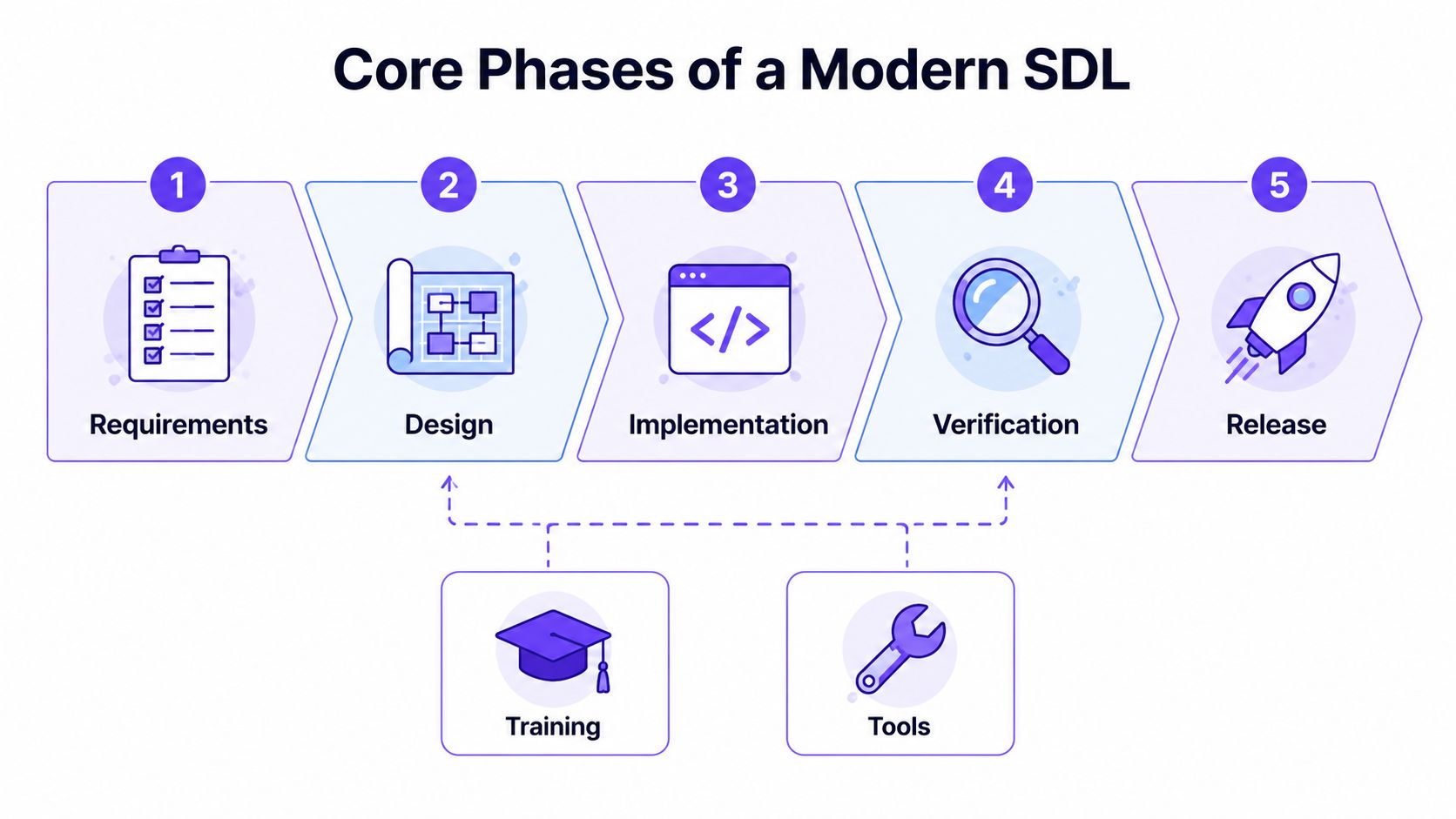
Microsoft organizes SDL into seven parts, five core phases and two supporting activities. The core phases are requirements, design, implementation, verification, and release. Training and response support the lifecycle across those phases, and Microsoft states that the structure is intended to reduce the number and severity of vulnerabilities while lowering development cost, as described in its SDL assurance guidance.
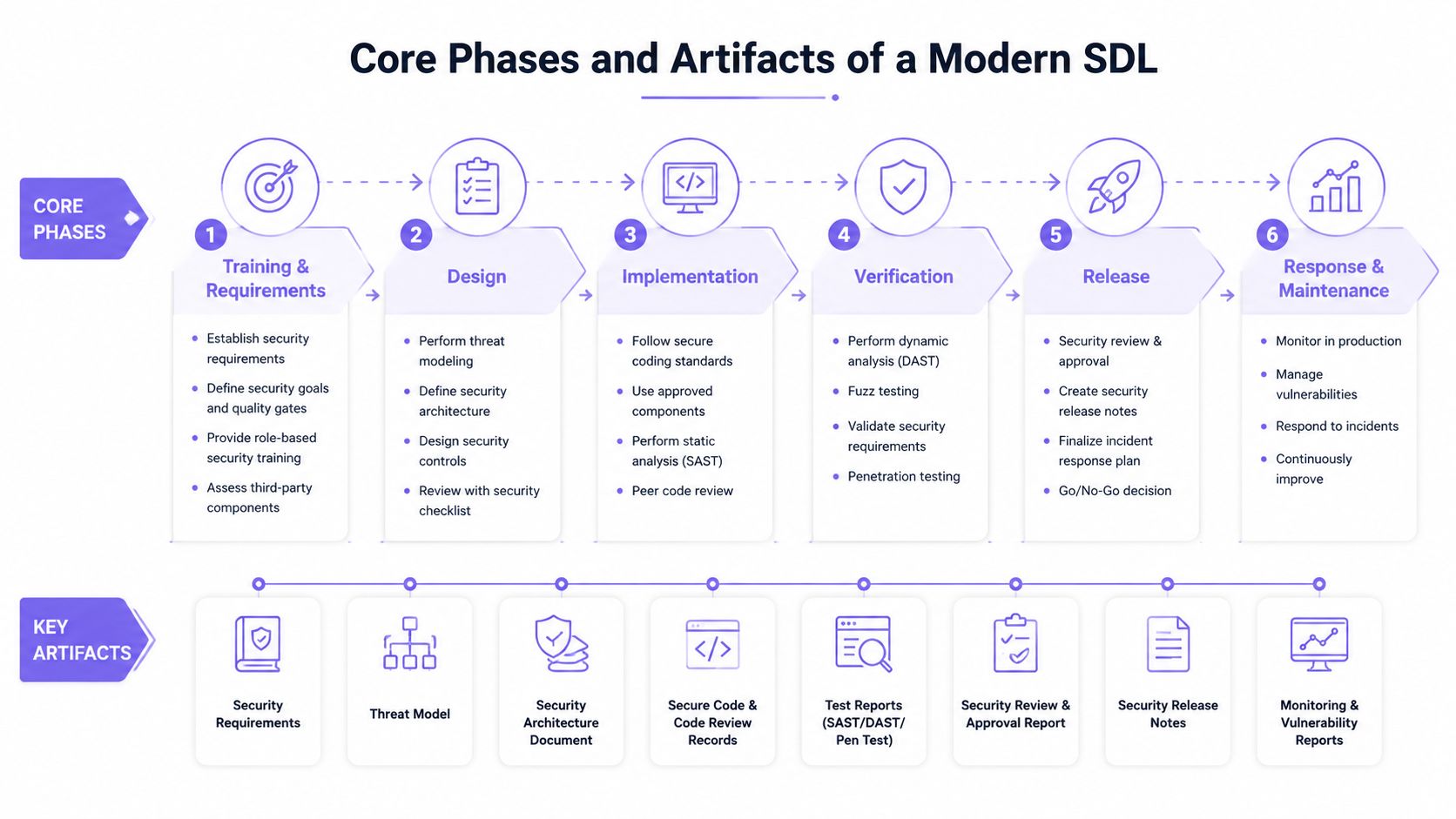
The phases are useful only when each produces artifacts that the next activity can consume.
Requirements establish the security contract
Requirements should define the security properties the system must preserve. That includes access expectations, data handling rules, authentication behavior, logging needs, resilience requirements, and relevant obligations. The artifact might be a set of acceptance criteria linked to a product ticket, not a separate security document.
Design turns those requirements into architecture decisions. Teams document trust boundaries, important data flows, privileged operations, external dependencies, and abuse cases. A threat model should explain why controls exist and what would invalidate the assumptions behind them.
Implementation makes those decisions visible in code and configuration. Secure coding guidance, review rules, dependency controls, secrets detection, and developer-facing analysis belong close to the change. A scanner finding without architectural context can create noise, so the workflow should connect findings to the requirement or design decision they threaten.
Verification tests the intended properties
Verification combines automated and human checks. The exact toolchain varies, but the evidence should show that implementation satisfies the defined security requirements. Teams commonly use source analysis, dependency inspection, infrastructure checks, runtime testing, targeted review, and security-focused test cases.
A useful test plan answers more than “did the scan pass?” It identifies which threats were addressed, which controls were exercised, which findings were accepted, and which changes require additional review. The output should be attached to the change or release record.
Release makes residual risk explicit
Release controls should verify that required checks ran, unresolved findings have an owner, exceptions have an expiration path, and deployment configuration matches the approved design. A gate should be narrow enough to be trusted. Blocking every warning teaches developers to bypass the gate, while allowing important violations through makes the control meaningless.
Training and response complete the operating model. Training gives engineers enough understanding to act on security requirements, while response feeds production incidents, vulnerability disclosures, and monitoring results back into future requirements and designs.
For teams mapping the lifecycle to broader capability planning, a cybersecurity services overview can provide useful context alongside a more focused SDL and cyber security guide. The important implementation choice is to make artifacts machine-readable, traceable, and usable inside existing workflows, rather than storing them as static evidence that no tool can evaluate.
The Gap Between Threat Models and Code Enforcement
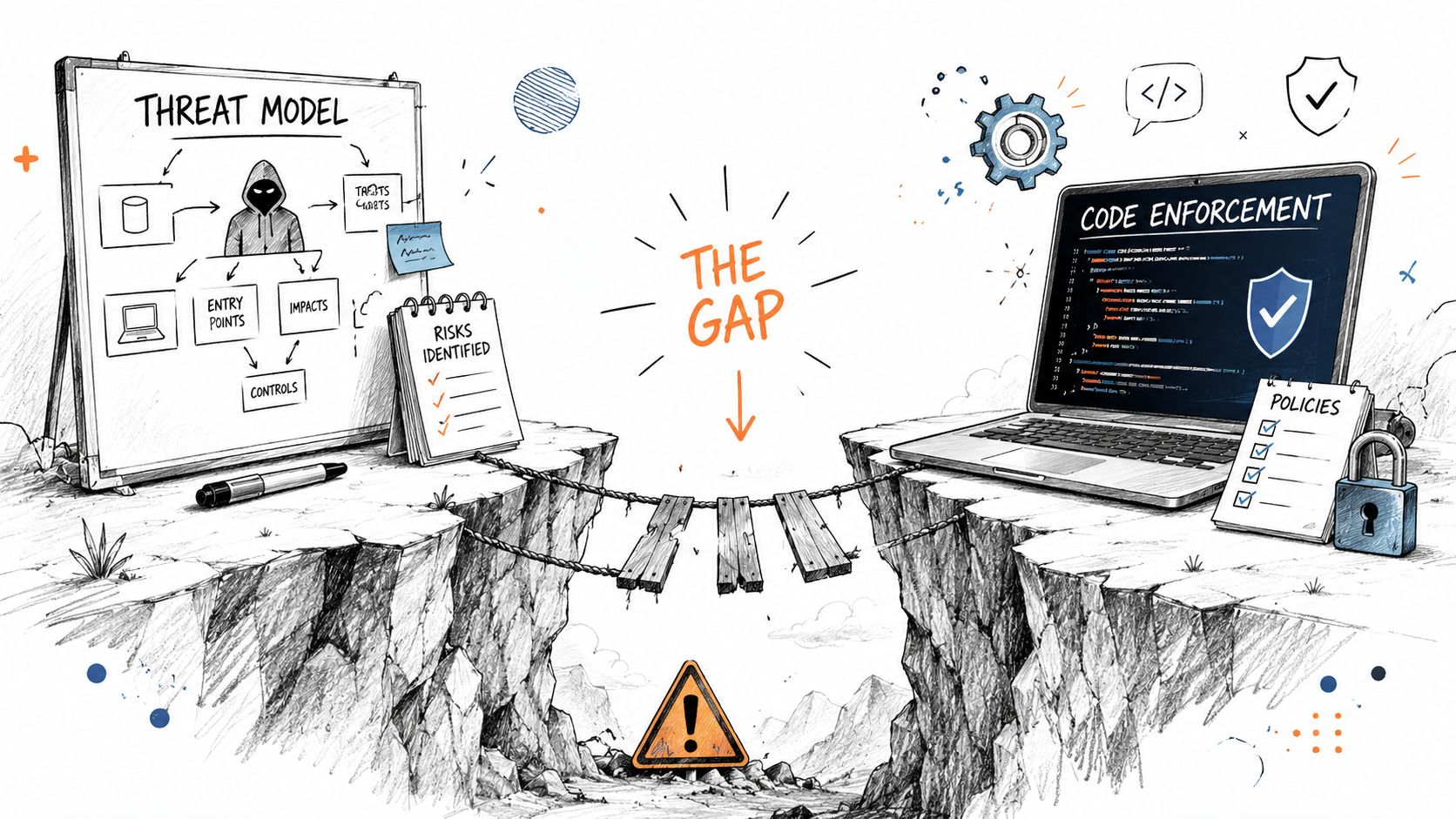
Threat modeling often succeeds during design and fails during implementation. The workshop is productive, the diagram is approved, and the team records sensible mitigations. Months later, the repository has new services, the ticket has changed scope, and infrastructure definitions introduce a new integration. The threat model remains available, but it no longer represents the system engineers are building.
This gap is recognized in newer SDL guidance. Security only works when requirements, design, implementation, testing, deployment, and post-release monitoring are enforced together, rather than treated as disconnected phases, as discussed in guidance on SDL commit-stage controls.
Drift is a data problem
A threat model becomes stale when teams can't identify which implementation changes affect its assumptions. The answer isn't to schedule more meetings. It's to represent security decisions in a way that can be compared with changes in tickets, repositories, service metadata, and deployment configuration.
Consider an authorization decision that assumes one service owns a sensitive operation. If a pull request adds another caller, the workflow should recognize that the trust relationship changed. The developer shouldn't need to remember a design meeting from an earlier release. The change should surface the relevant decision and request focused review.
Policy-as-code connects intent to action
Policy-as-code provides the enforcement layer. Policies can require a threat model for a new external integration, prohibit unapproved privilege changes, require review for sensitive data paths, or block merges when implementation evidence is missing. The precise rules depend on the organization, but the principle is consistent: security intent must produce a deterministic workflow result.
That result doesn't always have to be a hard block. Teams can use graduated responses:
- Inform: Show the relevant requirement and explain the detected condition.
- Require review: Route the change to an accountable security or service owner.
- Block merge: Prevent integration when the change violates a mandatory control.
- Record exception: Capture the rationale, owner, expiry, and remediation commitment.
This approach preserves speed for routine work while making high-impact changes visible. It also creates evidence that auditors and security leaders can inspect without reconstructing decisions from chat messages and meeting notes.
The practical test is simple. If a design decision can't influence a code review, it isn't governing implementation.
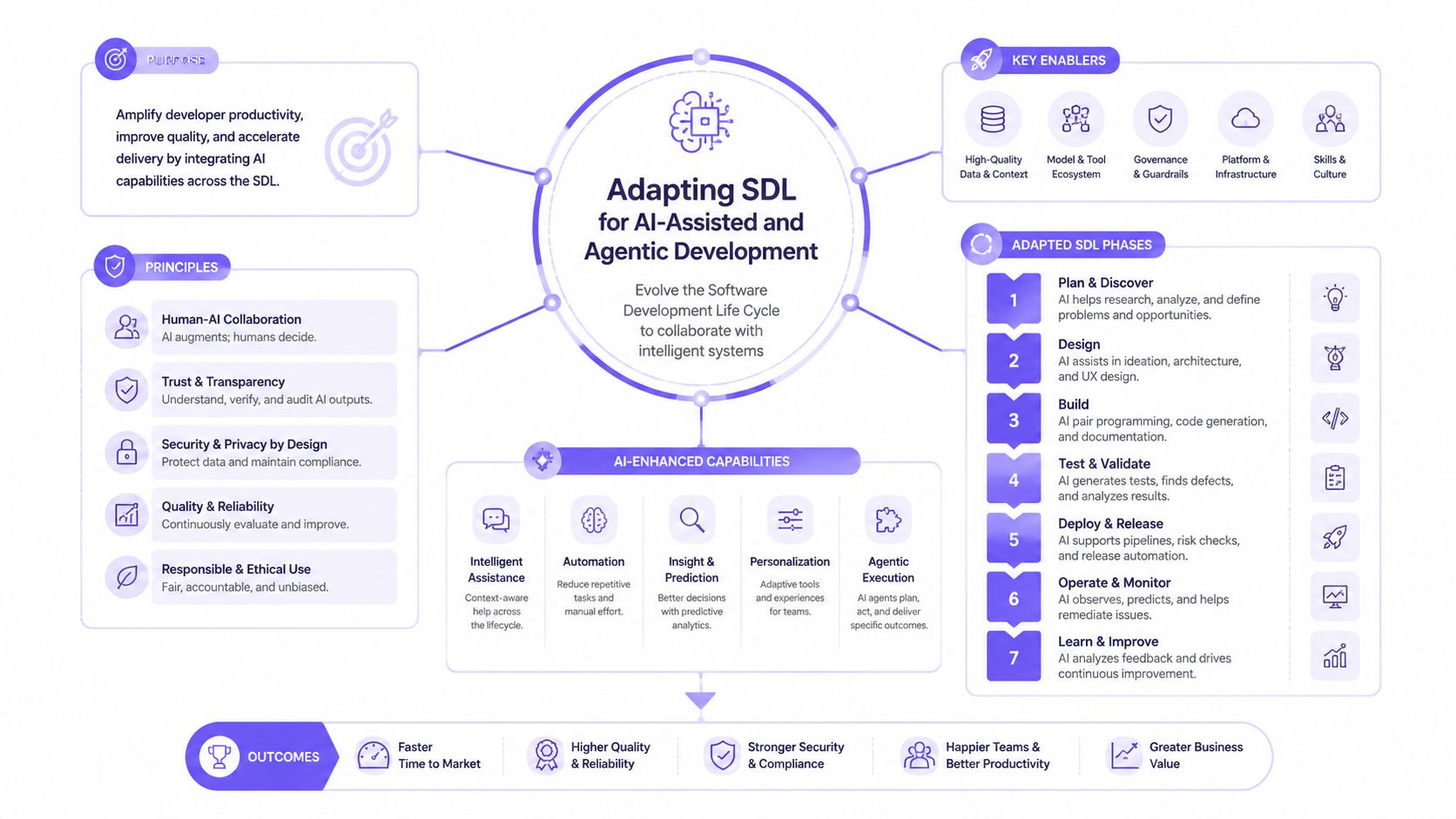
Adapting SDL for AI-Assisted and Agentic Development
AI-assisted development changes the source of risk. A developer may write the code, an assistant may propose it, or an agent may generate code, dependencies, and CI workflow changes while acting on a task. Traditional review often sees only the resulting diff, not the security assumptions, retrieved context, tool permissions, or instructions that shaped it.
Industry coverage citing a 2025 analysis reported that 62% of AI-generated code contained design flaws or known vulnerabilities, as described in coverage of secure SDL for AI-assisted development. The figure shouldn't be used as a universal prediction for every team or model, but it makes the operational point clearly: AI output requires verification, not automatic trust.
Guard the generation path
An AI-aware SDL starts before code appears. The agent should receive the security constraints relevant to the task, including data sensitivity, allowed dependencies, authorization boundaries, prohibited actions, and required tests. Its tools should follow least privilege, and workflows should record which agent or assistant created or modified the artifact.
Prompt context doesn't replace review. It improves the quality of the proposed implementation and gives reviewers a clearer basis for evaluating it. Teams should also treat retrieved documentation, issue content, and tool output as potentially untrusted input. Guidance on securing LLM agents from injection is relevant because an agent can follow malicious instructions embedded in content it reads.
Enforce at merge time
The merge boundary is where AI-assisted speed must meet deterministic policy. Controls should inspect the resulting code, dependencies, permissions, workflow changes, and required evidence. They should also verify that the implementation still matches the approved design.
Useful guardrails include:
- Permission boundaries: Limit what an agent can read, write, execute, and deploy.
- Sensitive-change detection: Require review when code touches identity, secrets, data exports, or external tools.
- Dependency controls: Reject unapproved or unsafe component changes according to organizational policy.
- Traceable outcomes: Record the policy decision, reviewer, exception, and remediation path.
- Implementation verification: Compare the merged change with the security requirements and threat assumptions that authorize it.
The AI coding security guidance offers additional context for teams connecting development speed with security controls. The goal isn't to prohibit AI. It's to make unsafe output harder to merge than safe output, without forcing developers into a separate security process.
Measuring SDL Effectiveness with Real Metrics
SDL earns engineering support when leaders can see whether it changes outcomes. Microsoft publicly reported that vulnerabilities were reduced by 45% in Windows Vista and 91% in SQL Server 2005 compared with previous versions after applying SDL-style practices, according to its documented SDL presentation. Those results connect lifecycle engineering with defect reduction, although modern teams should avoid treating historical product comparisons as a universal benchmark.
A metrics program should combine outcome measures with workflow measures. Vulnerabilities discovered after release matter, but they're lagging indicators. Merge-time policy violations, remediation speed, review coverage, and exception quality help teams understand whether the system is preventing problems or just documenting them.
Use metrics that influence decisions
| Metric | What It Measures | Target Benchmark |
|---|---|---|
| Defect escape rate | Security findings discovered after release compared with findings identified before release | Establish a baseline and reduce escapes over time |
| Remediation time | How quickly owners resolve validated security findings | Set a service expectation by risk category |
| Merge policy violations | How often changes violate defined security controls | Reduce repeat violations through better guidance and automation |
| Review coverage | Whether security-sensitive changes receive the required review | Maintain complete coverage for mapped high-risk change types |
| Exception quality | Whether accepted risks have owners, rationale, and follow-up | Ensure every exception has traceable accountability |
| Audit preparation time | Effort required to assemble lifecycle evidence | Generate evidence continuously rather than retrospectively |
The table deliberately uses target benchmarks as operating objectives, not invented industry averages. Your baseline should come from your repositories, release process, and risk profile. A regulated payment system and an internal prototype shouldn't have identical thresholds.
Compare point-in-time and continuous models
A traditional SDL can produce strong evidence during scheduled reviews, but it tends to miss changes between those reviews. A continuous model creates more workflow signals and may require initial investment in integrations, policy design, and ownership. It also creates a risk of alert fatigue if every event produces the same severity or blocks delivery.
The answer is measurement discipline. Track whether developers receive findings in the workflow where they made the change, whether reviewers can understand why a control triggered, and whether exceptions close instead of becoming permanent bypasses. A mature program measures security outcomes and the quality of the feedback loop together.
Building a Continuous Security Context for Regulated Industries
Regulated teams need more than secure code. They need evidence that security decisions were made, controls operated, exceptions were managed, and implementation matched approved intent. Static documents can provide part of that evidence, but they rarely explain what changed after approval or whether the deployed system still reflects the design.
A continuous security context connects the artifacts that already exist in delivery workflows. Tickets describe intent, repositories show implementation, infrastructure definitions describe deployment, and reviews capture decisions. The security layer should relate those artifacts instead of asking engineers to duplicate them in a separate system.
Teams beginning this work should start with a narrow, high-value scope:
- Map critical change types: Identify changes involving identity, sensitive data, external integrations, privileged operations, and agent capabilities.
- Define required evidence: Specify which requirements, design decisions, tests, approvals, and exceptions must exist for each change type.
- Surface context in workflow: Put feedback in pull requests, planning tools, IDEs, and review systems where developers already work.
- Enforce selected policies: Begin with controls that are clear enough to explain and important enough to justify interruption.
- Reconcile continuously: Update threat assumptions when tickets, code, dependencies, or infrastructure change.
- Generate audit evidence: Preserve decisions, control results, approvals, and exceptions as part of normal delivery.
Make compliance a by-product of delivery
A good regulated-industry implementation doesn't create a second process for auditors. It produces traceable evidence as engineers build and release software. Review outcomes should show who approved a security decision, what implementation satisfied it, which tests ran, and how the team handled residual risk.
Threat modeling remains central, but teams should treat it as a living engineering activity rather than a diagramming exercise. A practical introduction to the discipline is available in what threat modeling is, while implementation should connect the resulting decisions to source control and deployment evidence.
For FinTech and HealthTech teams, the trade-off is clear. Manual reviews may offer deep discussion but create queues and inconsistent records. Fully automated scanning offers speed but can miss architectural intent and produce noisy findings. The strongest model combines continuous context, targeted human judgment, and policy-as-code enforcement at the points where changes become real.
DevArmor supports this model with continuous threat modeling, security design reviews, implementation verification, and policy enforcement across developer workflows and coding-agent use cases. If your team needs living security context instead of disconnected SDL documents, visit DevArmor to evaluate how those controls can fit your delivery process.
Related reading
- SDLC Cyber Security: Embedding Controls Across Every Phase — practical controls for each development phase.
- Secure Code Review Best Practices: A Complete Guide — policy-as-code and reviewer strategies that scale.
- What Is Threat Modeling and Why It Matters in 2026 — from static diagrams to continuous security context.
Table of Contents
Subscribe