What Is PDLC and Why Security Teams Need to Know
 Reza Khosravi
Table of Contents
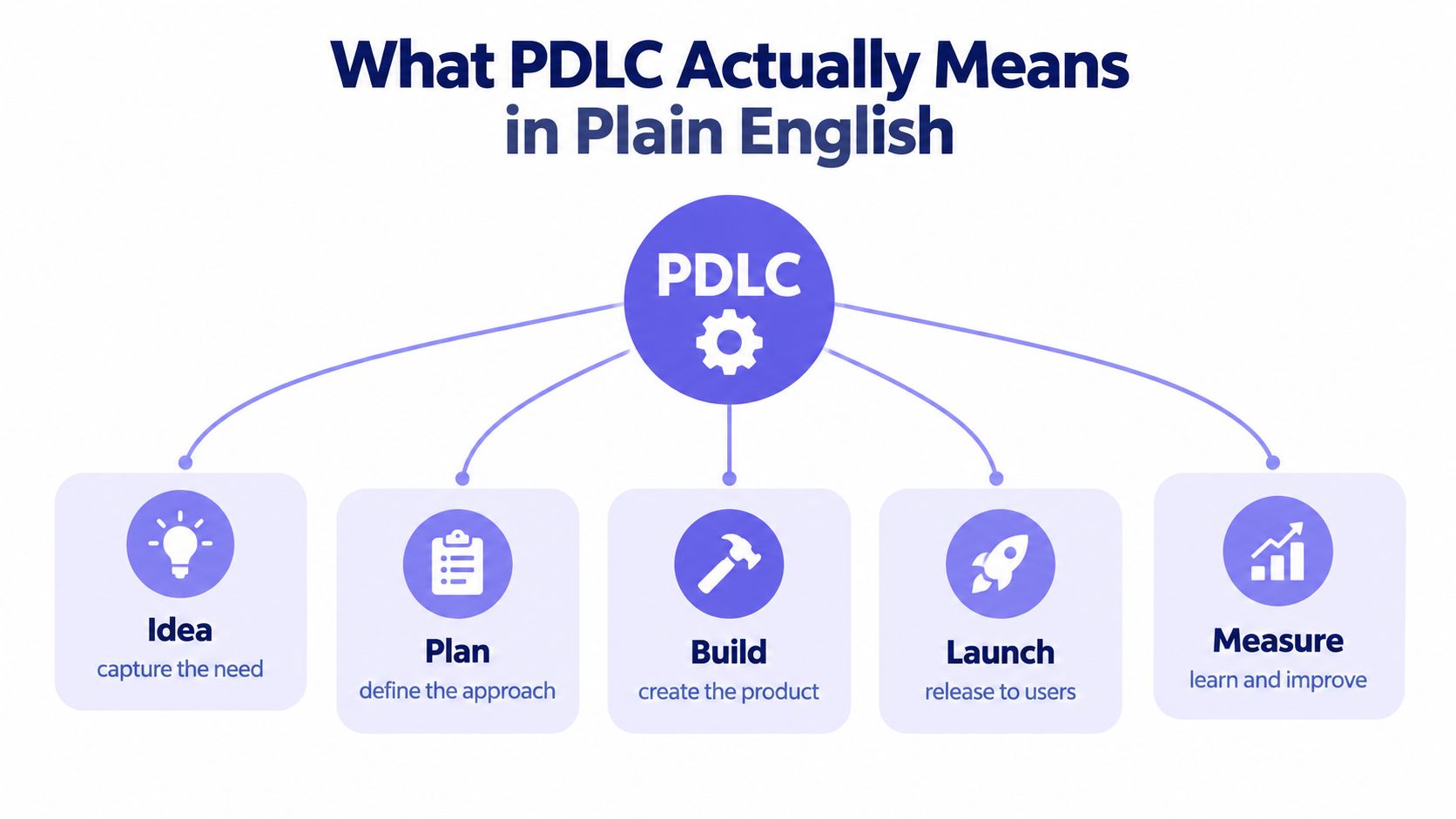
The Product Development Life Cycle (PDLC) is the structured process that takes a product from its initial idea through research, requirements, design, development, testing, launch, measurement, iteration, and eventual retirement. The Software Development Life Cycle (SDLC) focuses on how software is built and operated; PDLC is broader, governing why the product should exist, what it needs to do, and how it changes after release.
The popular advice to treat PDLC as a tidy sequence of boxes misses the hard part: deciding what a team is committing to, what evidence supports that commitment, and which security risks need attention before code is written. Software teams ship continuously, so a lifecycle only works when its decisions and safeguards travel with the product as it changes.
What PDLC Means in Plain English
PDLC is a decision-boundary framework connecting a product's intent to its architecture, implementation, launch, and operation. At each boundary, the team decides whether evidence supports proceeding, what risks need addressing before code is written, and what outcomes will trigger a change or retirement. The term “what is PDLC” therefore describes more than a set of stages. It points to the decisions that shape a product throughout its lifespan.
The acronym refers to three related but distinct concepts:
- Product Development Life Cycle: How a team takes a product from an idea through discovery, design, delivery, learning, and retirement.
- Software Development Life Cycle: How a team specifies, builds, tests, releases, and maintains software, usually within the broader PDLC.
- Product Life Cycle: How a product evolves in the market over time, viewed through a product and business lens rather than as a development process.
Consider an account recovery feature. SDLC practices guide how engineers specify and build it. PDLC decisions come first: whether customers need the feature, which outcome it should support, which security assumptions the design depends on, and how the team will assess its effect after release. Those early gates should surface threats and constraints before implementation. Otherwise, a feature can pass engineering checks and still solve the wrong problem.
PDLC draws on sequential engineering models, including the waterfall tradition associated with Winston Royce's 1970 paper on developing large software systems, as described in the U.S. National Academies' history of software development. Iterative delivery changes how teams revisit decisions, but the work remains: manage uncertainty, examine security assumptions before code is written, and keep decisions connected through operation. In practice, the gates matter more than a fixed sequence. Teams can move quickly while still pausing at consequential choices.
The Stages of PDLC From Discovery to Retirement
The stages are useful as a map, not as a relay race. A team can revisit discovery after a prototype exposes a misunderstanding, or revise the design when a risk review shows that a proposed data flow is unacceptable.
Consider a team planning a service that lets customers manage account access. In discovery, product and engineering investigate the user problem and identify the people, systems, and information involved. The output isn't just an idea. It's a clearer problem statement, assumptions to test, and early abuse cases, such as an attacker trying to take over an account.
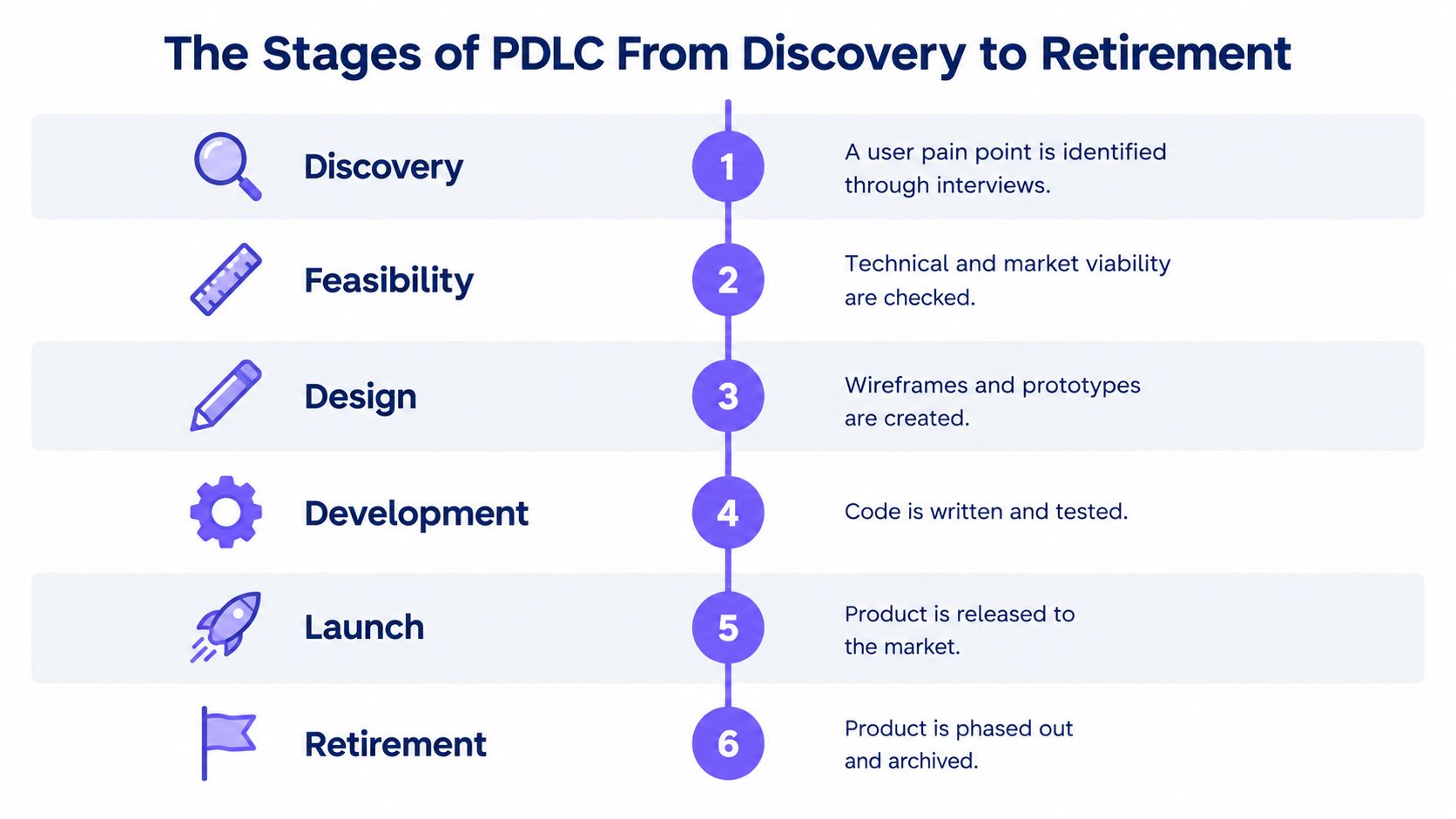
In feasibility and validation, the team checks whether the solution can meet user needs and fit its technical, commercial, and regulatory constraints. A proposed recovery method may work for customers but create unacceptable account-takeover risk, or depend on a system the team can't reliably support. Those findings can change the idea before implementation makes it expensive to change.
Design and delivery are connected decisions
During design and architecture, the team defines user flows, services, data handling, trust boundaries, and failure behavior. For account recovery, a choice about identity verification affects both usability and the threat model. The useful artifact is not only a wireframe. It's also the reasoning behind the architecture and its security assumptions.
In development and verification, engineers implement the solution and check both behavior and safeguards. Tests can confirm that recovery works as intended, while reviews and security checks look for gaps in authorization, validation, or policy. The SDLC carries much of this work, but product decisions still determine what “correct” means.
At launch, the team prepares deployment, customer communication, support, and monitoring. After release, post-launch learning uses feedback and operational signals to challenge assumptions and prioritize changes. Eventually, retirement requires a plan for user migration, data retention or deletion, system shutdown, and the records the organization needs to keep.
The stages overlap because real product work overlaps. The key is to preserve the decisions and evidence as work moves between discovery, design, engineering, operations, and end of life.
Where PDLC Forces Real Decisions
A stage becomes meaningful when it has a decision owner and a clear standard for proceeding. If a team can't say what evidence would change its mind, the gate is probably a status meeting, not a control.
Ask for evidence before commitment
At problem validation, ask who experiences the problem, what evidence supports the need, and what outcome would show that the product addresses it. A problem statement and research findings should make the assumptions visible rather than turning stakeholder preference into an untested requirement.
At feasibility and risk review, ask whether the proposed approach can work within technical, privacy, security, accessibility, and regulatory constraints. Require an architecture sketch, key data flows, identified dependencies, and an initial view of threats and mitigations. Teams that need a more systematic way to make these calls can use a structured risk-management approach for application security.
At design approval, ask whether the design has accounted for trust boundaries, access, sensitive data, abuse cases, and failure states. The relevant evidence might include reviewed flows and recorded decisions, not just a design file marked approved. If a material risk remains open, name the owner and decide whether it blocks work or needs a compensating control.
Make release and learning gates real
At implementation verification, compare what engineers built with the approved design and requirements. Tests, code review, and policy checks provide evidence, but only if they cover the risks the team identified.
At launch readiness, ask who can approve the release, what unresolved risks are accepted, how rollback works, and who responds to incidents. After launch, review whether usage and incidents support the original assumptions. When the product reaches end of life, decide how to migrate users, handle data, and close down dependencies.
Practical rule: A gate should produce a decision, a named owner, and evidence someone can revisit. A checkbox without those elements creates paperwork, not governance.
Why Bolting Security On at the End Breaks
Release testing matters, but it can't undo every risky decision made earlier. If a team designs a feature around a broad data collection model, a weak trust boundary, or a third-party integration with excessive access, a scanner may find defects in the implementation without questioning whether the design should exist that way.
That's the structural problem with treating security as a final approval. Product and engineering teams make consequential choices during discovery and design, often before code is available to inspect. The authentication model, data flows, service boundaries, and recovery behavior define the conditions under which later code will operate. Security reviews that begin only at pull requests see the implementation, but they may not see the product assumptions that shaped it.
Late controls still have a job. Static analysis, dependency review, testing, and code review can catch implementation defects and policy violations. They're less effective as substitutes for asking whether the feature collects the right data, whether a user can abuse the intended workflow, or whether an architecture gives a component more authority than it needs.
Security work can also become noisier when teams discover design problems after implementation. Engineers may have to retrofit controls across services, redesign flows, or revisit requirements that stakeholders already approved. The cost isn't just rework. Late changes can leave teams choosing between delaying release and accepting risk they haven't adequately understood.
The useful alternative isn't to put a security meeting in every phase. It's to attach proportionate security decisions to the moments when the product's direction is still changeable. A short risk review during discovery can expose a problematic assumption before a team writes code. A focused architecture review can settle trust boundaries while the design is still fluid. Then implementation checks can verify that the approved decisions made it into the product.
What Security Work Looks Like at Each PDLC Stage
Security belongs where a decision is made and where its implementation can be checked. That doesn't mean every feature needs the same review. It means the team should be able to trace its risk decisions from planning to shipped behavior.
| PDLC stage | Primary security activity | Required evidence |
|---|---|---|
| Discovery | Frame risks and consider abuse cases alongside user needs. | Problem statement, assumptions, affected users, initial risk notes |
| Feasibility | Review dependencies, sensitive data, and regulatory constraints. | Feasibility findings, data categories, dependency and risk assessment |
| Design | Threat-model architecture, user flows, and trust boundaries. | Reviewed data flows, threat scenarios, decisions, and mitigations |
| Build | Apply secure defaults and enforce agreed rules with code-level checks. | Code review, relevant tests, policy results, and links to design decisions |
| Launch | Verify security requirements and agree on release, rollback, and response readiness. | Release checks, open-risk approvals, deployment and response plans |
| Post-launch | Monitor relevant security signals and update assumptions after incidents or product changes. | Reviewable monitoring context, incident learnings, updated risks |
| Retirement | Plan access removal, data handling, and service shutdown. | Decommission plan, data disposition record, dependency closure |
Keep responsibilities and evidence connected
Discovery teams should record who and what the proposed feature affects, not just the customer request. At design, an architecture diagram alone won't show why a boundary was chosen; link it to threat scenarios and the decision to mitigate, accept, or avoid each risk. In build, developers need those constraints where they work, such as pull requests, IDEs, and planning tickets.
Security leaders building the right operating model can use this guide to DevSecOps staffing for enterprises as a reference for roles and responsibilities. The important distinction is between assigning security work and making sure it is actionable in the development workflow. A named reviewer can still become a bottleneck if teams have to stop work to find context scattered across documents.
At launch, don't let a passing tool result stand in for a decision about unresolved risk. Record what was verified, what remains open, and who accepted it. After release, update the model when incidents, architecture changes, or new product behavior invalidate the assumptions. At retirement, security work continues until accounts, data, and dependencies have been addressed.
Continuous Threat Modeling Through the Lifecycle
A threat model loses value when it sits in a document nobody updates after the architecture changes. The practical goal is living security context: the risks, design decisions, and controls remain connected to the product artifacts that teams change.
Start with what already exists. A product ticket may describe the intended user behavior; a design document may show a data flow; a repository may reveal services and dependencies. A review can use those artifacts to identify where trust boundaries or security assumptions have changed. Teams looking to formalize the method can follow a repeatable threat modeling process, then keep its outputs tied to the decisions and changes that matter.
The workflow matters as much as the model. If a design review happens in a separate meeting, engineers still have to translate its conclusions into implementation work. Put decisions where they can affect delivery: a requirement in a planning ticket, a review comment in the design, or an enforceable policy in source control. Policy-as-code can check changes against approved rules during code review, with blocking reserved for violations that the team has agreed are release-critical.
A useful threat model isn't the one with the most pages. It's the one that changes when the product changes, and tells engineers what to do next.
This approach also makes drift easier to notice. If an approved design says a service should not store a particular category of data, but a code change introduces that storage, the discrepancy should trigger review. If a new integration changes who can access a resource, the model and its controls need another look. Continuous threat modeling doesn't mean every commit requires a full architecture review. It means material changes update the security context, while routine changes proceed under appropriate guardrails.
PDLC as a Loop in an AI-Assisted World
AI-assisted development makes it easier to produce code quickly, but it doesn't decide whether the code matches the product's approved intent. When an agent creates or modifies implementation, it may act on incomplete requirements, outdated architecture notes, or security assumptions that never made it into its working context. Faster output can therefore widen the gap between what a team approved and what it ships.
That gap is governance debt. It builds when product tickets change but threat models don't, when approved design decisions don't reach code review, or when nobody can explain why a control exists. The debt becomes harder to manage when the team relies on disconnected documents and memory rather than a traceable chain from roadmap decision to deployment.
Not every change deserves the same approval path. A contained interface adjustment may fit existing requirements and guardrails. New data collection, automated decisions, payment behavior, or a change that affects regulated users can alter the product's risk profile and should trigger proportionate review. The team needs to define those boundaries before delivery pressure makes every change seem routine.
Preserve a traceable chain
A working loop connects the product ticket, design decision, threat model, code change, review outcome, deployment, and user or operational feedback. Teams should be able to follow that chain without asking someone to reconstruct it from memory. In an AI-assisted workflow, this also gives coding tools more relevant constraints and lets reviewers compare generated changes with the decisions those changes should implement.
The challenge isn't to slow every release with a manual gate. It's to make the right controls automatic where possible and reserve human attention for changes that alter risk or product intent. Teams exploring how AI affects engineering workflows can review AI in the SDLC as part of that discussion.
When the product changes daily, the PDLC still applies. The loop runs more often. Teams that update context with the work can learn and adapt; teams that skip the updates may ship quickly while losing track of the assumptions and safeguards their product depends on.
How to Tell If Your PDLC Is Working
A process is working when teams can show how decisions shaped the product, not just name the stages. Put these questions to product, engineering, and security this week. Ask for examples from current work.
- Decision rights: Who approves the move from discovery to design, accepts unresolved risk, and authorizes release?
- Evidence: Can the team show what informed a product decision and which assumptions remain untested?
- Security freshness: Does the threat model match the current architecture and data flows?
- Design to code: Can reviewers trace a merged change to the design decisions and security requirements it implements?
- Change triggers: Do teams know which product changes call for another risk review?
- Post-launch learning: Do incidents and user feedback update requirements, controls, or retirement decisions?
If people can describe the process but cannot produce evidence, the gates are theater. Repeated requests for the same missing context point to a broken decision boundary, not a need for more meetings. Make decisions traceable, put security feedback in the tools teams use, and define a clear review route for each material change.
DevArmor provides continuous threat modeling, security design reviews, and policy enforcement across software delivery workflows, connecting approved decisions to code changes and deployments. Teams can explore how it fits their planning and development process at DevArmor.
Table of Contents
Subscribe