Application of Risk Management in Modern Software Teams
 Reza Khosravi
Table of Contents
A release is scheduled for Friday. On Wednesday, the application security team is staring at a large scanner backlog, with findings marked “critical” but no reliable connection to customer impact, exploitability, or ownership. The risk register offers little help. It describes an architecture and threat environment from months ago, while the product now includes new services, short-lived infrastructure, third-party dependencies, and code produced with AI assistance.
That gap is the practical problem behind the application of risk management in modern software teams. Enterprise risk management became more formal and widespread over time, but software delivery changed faster than many risk processes did. The answer isn't another static report or a larger checklist. Teams need security context that follows the application from design through production and changes when the code, data flows, or operating environment changes.
Why Application Risk Management Needs a Reset
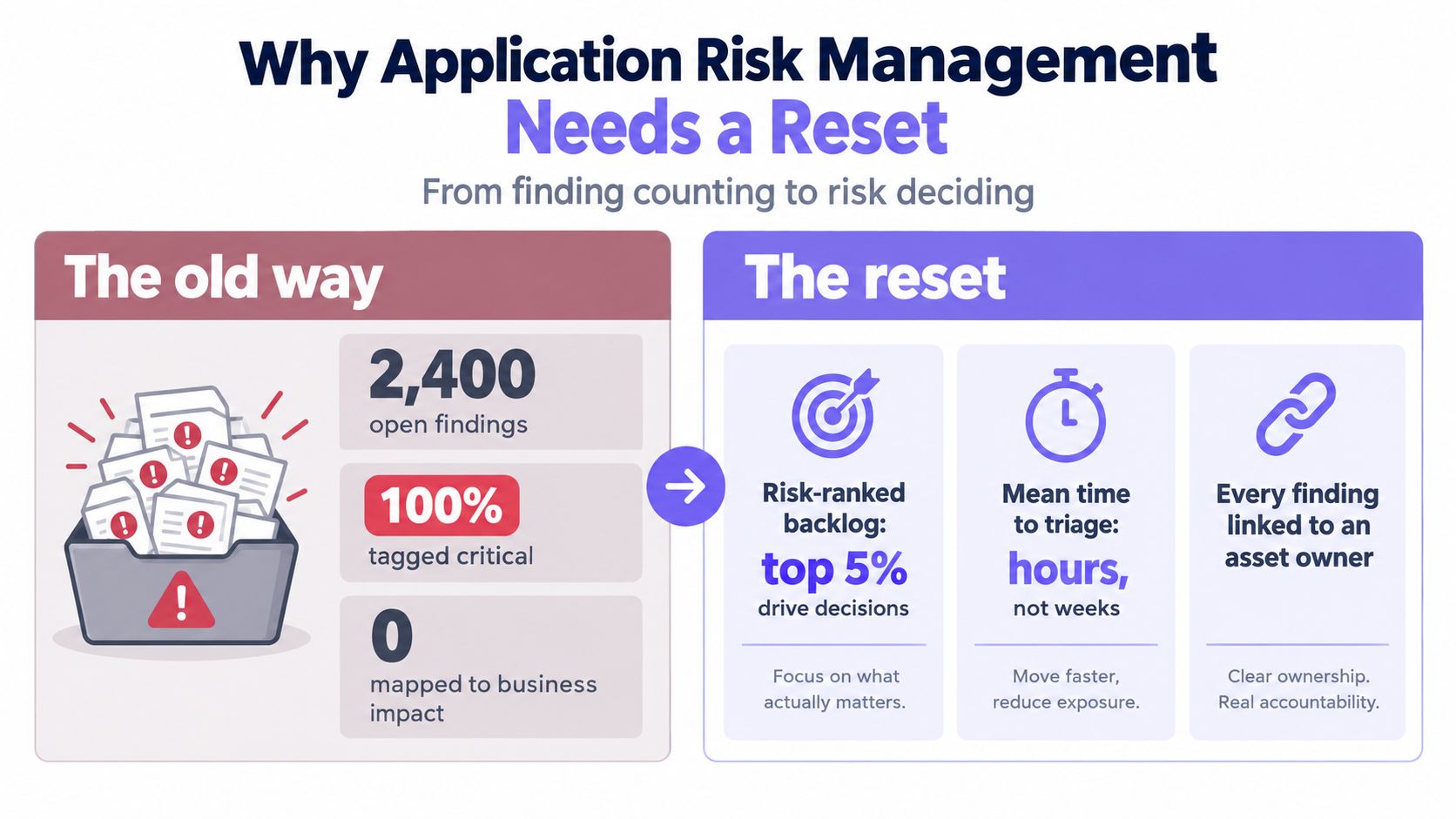
A security backlog can create the appearance of control while making prioritization harder. If every finding carries the same urgent label, engineers can't distinguish a reachable authentication flaw in a payment path from a low-impact issue in an isolated administrative tool. The queue becomes a negotiation about noise instead of a decision about exposure.
The same failure appears in many risk registers. A quarterly document may list broad threats such as data loss, fraud, or service disruption, yet say little about which service owns the risk, which data flow creates it, or which control should change in the next pull request. A register that doesn't reflect the current system is an archive, not an operating instrument.
Practical rule: A risk entry should help an engineer make a decision this week. If it can't identify the asset, scenario, owner, treatment, and evidence, it isn't ready for workflow use.
Enterprise risk management still provides useful discipline. Survey evidence from the AICPA and North Carolina State University ERM series shows that complete ERM processes rose from 9% of organizations in 2009 to 31% in 2018 and 33% in 2022, while organizations without a formal process declined over the same period. The 2018 survey also found that 69% of organizations still lacked full ERM, which underlines an important point: formal adoption advanced, but maturity remained uneven.
The problem is scope and cadence. Finance, compliance, and board reporting can tolerate periodic aggregation. Weekly deployments, ephemeral services, infrastructure changes, and AI-assisted coding can't. A risk decision made after a penetration test has missed the point if the design decision that created the exposure was already merged months earlier.
Move decisions upstream
A useful reset changes where risk information appears:
- Architecture reviews identify trust boundaries, sensitive data, abuse cases, and required controls before implementation.
- Design documents record decisions that engineers can verify rather than burying them in meeting notes.
- Merge requests carry risk context into the exact change that may alter exposure.
- Runtime telemetry tests whether controls operate as intended after deployment.
- Risk registers aggregate living signals for leadership instead of serving as disconnected compliance inventories.
The historical shift toward enterprise-wide risk practice matters because it established risk as a management concern, not merely a security team's concern. The modern shift must go further. It must connect that management discipline to code, infrastructure, service ownership, and operational evidence.
What Application of Risk Management Actually Means
Application risk management is the disciplined practice of identifying, assessing, treating, and monitoring risks tied to a particular software system, service, or product line. The treatment must lead to a control that lives somewhere real, such as code, cloud configuration, deployment workflow, identity policy, operating procedure, or monitoring rule.
A house inspection is a useful analogy. The inspection identifies structural defects and safety concerns. The punch list turns those observations into planned work. The contractor's repairs are the controls. A report that never reaches the person responsible for the repair has documented a problem without managing it.
Application risk management differs from enterprise risk management mainly through scope. ERM considers risk across portfolios, business units, and strategic objectives. Application risk management stays close to the system. It asks which assets matter, how a specific service can be abused, what the business consequence would be, and which team can reduce the exposure.
The four artifacts that make it operational
A workable program should produce four connected artifacts:
- An asset and data profile, including service ownership, sensitive data, dependencies, trust boundaries, and important business functions.
- A threat model, linking assets to abuse cases, attack paths, likelihood considerations, and potential impact.
- A treatment record, showing the selected control, accountable owner, delivery status, residual risk, and any accepted exception.
- Evidence of operation, such as code reviews, policy results, test outcomes, telemetry, and incident feedback.
These artifacts shouldn't live in separate repositories with different owners. A change to a data flow should update the relevant threat context. A control change should affect the verification evidence. An incident should feed back into the model rather than becoming a report that nobody connects to future design work.
Three questions every decision must answer
Every application risk discussion should answer:
- What can hurt us? Name the asset, threat, attack path, or failure mode.
- How much does it matter? Explain business impact, affected users, regulatory exposure, operational consequence, and realistic likelihood.
- What are we doing about it? Specify the control, owner, due date or expiry, and evidence that will demonstrate effectiveness.
This approach avoids two common errors. Teams shouldn't treat a framework label as proof that risk is managed, and they shouldn't confuse a scanner's severity with a business decision. A vulnerability becomes actionable when its technical signal is connected to system context and a treatment that someone can implement.
Core Principles Behind Effective Application Risk Programs
Effective programs don't measure activity alone. They measure whether engineers and leaders make better decisions with current information.
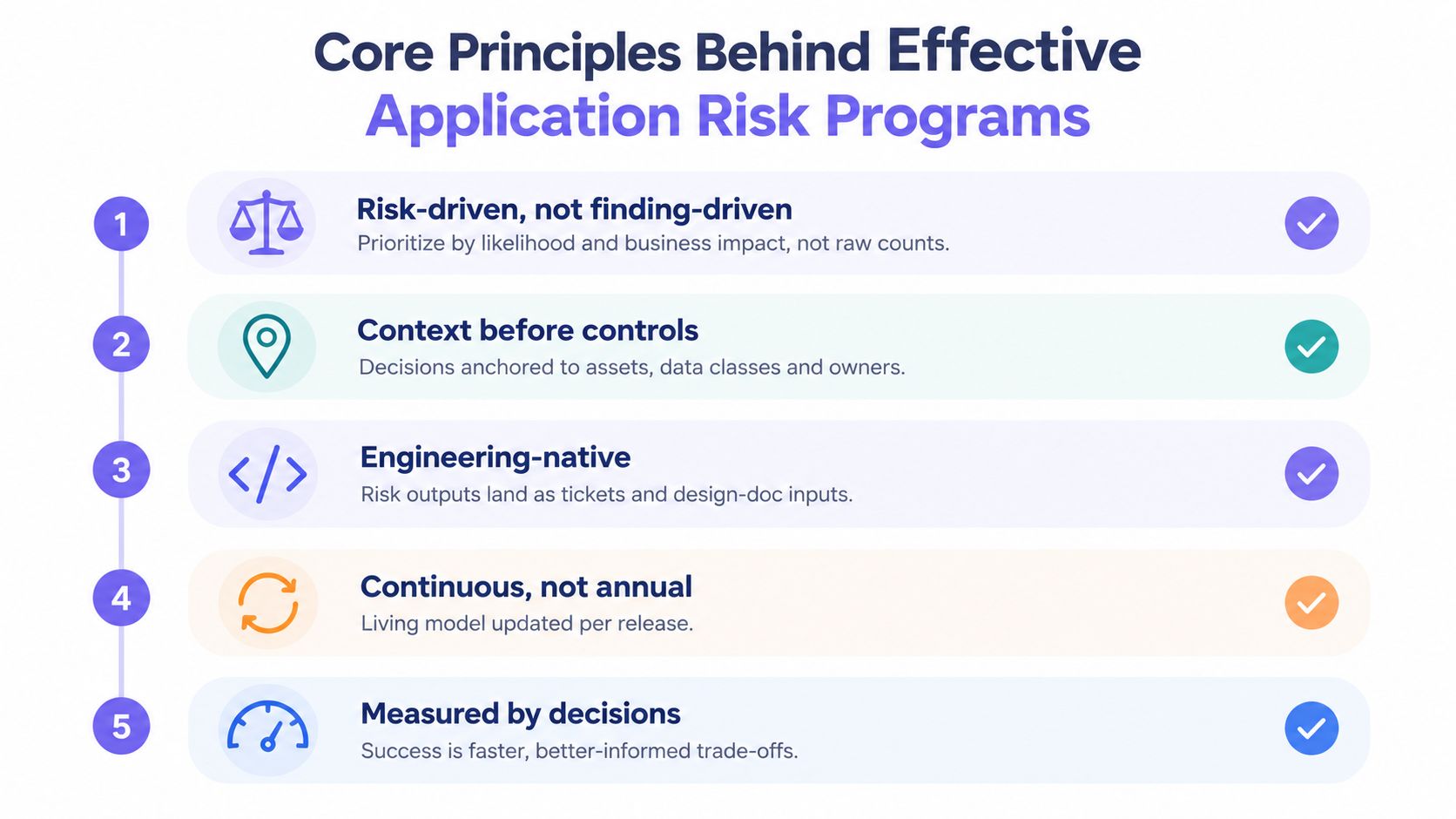
Risk-driven, not finding-driven
Raw finding counts are a poor prioritization method. Rank exposure using likelihood, reachability, asset value, business impact, and existing controls. A vulnerable library in a public payment endpoint deserves a different response from the same library in an unreachable build utility.
CVSS can contribute technical severity, but it shouldn't decide business priority by itself. The security lead and service owner should be able to explain why a risk is urgent, tolerable, transferred, or accepted.
Context before controls
Start with the asset and its role. For a payment service, record the transaction path, authentication boundary, tokenization point, settlement integration, and accountable team before selecting controls. Without that context, teams apply generic requirements that may miss the actual abuse path or create unnecessary delivery friction.
Engineering-native
Risk outputs should land where engineering work happens. That may mean a design comment in a pull request, an issue linked to a service, a failing policy check, or a test derived from a threat model. Slide decks can support governance, but they shouldn't be the primary delivery mechanism.
Continuous, not annual
Threat context must change when architecture and code change. The academic review of threat modeling describes threat modeling as an iterative process that profiles assets, identifies and prioritizes threats, and evaluates controls. That model fits software better than a calendar-based review because the system itself keeps moving.
Measured by decisions
Track whether teams resolve uncertainty earlier, assign owners, close important control gaps, and maintain evidence. Don't treat the number of scans or meetings as a proxy for reduced risk. A smaller backlog can mean improved treatment, or it can mean suppressed findings. The decision trail tells you which.
The Five-Step Process From Assets to Controls
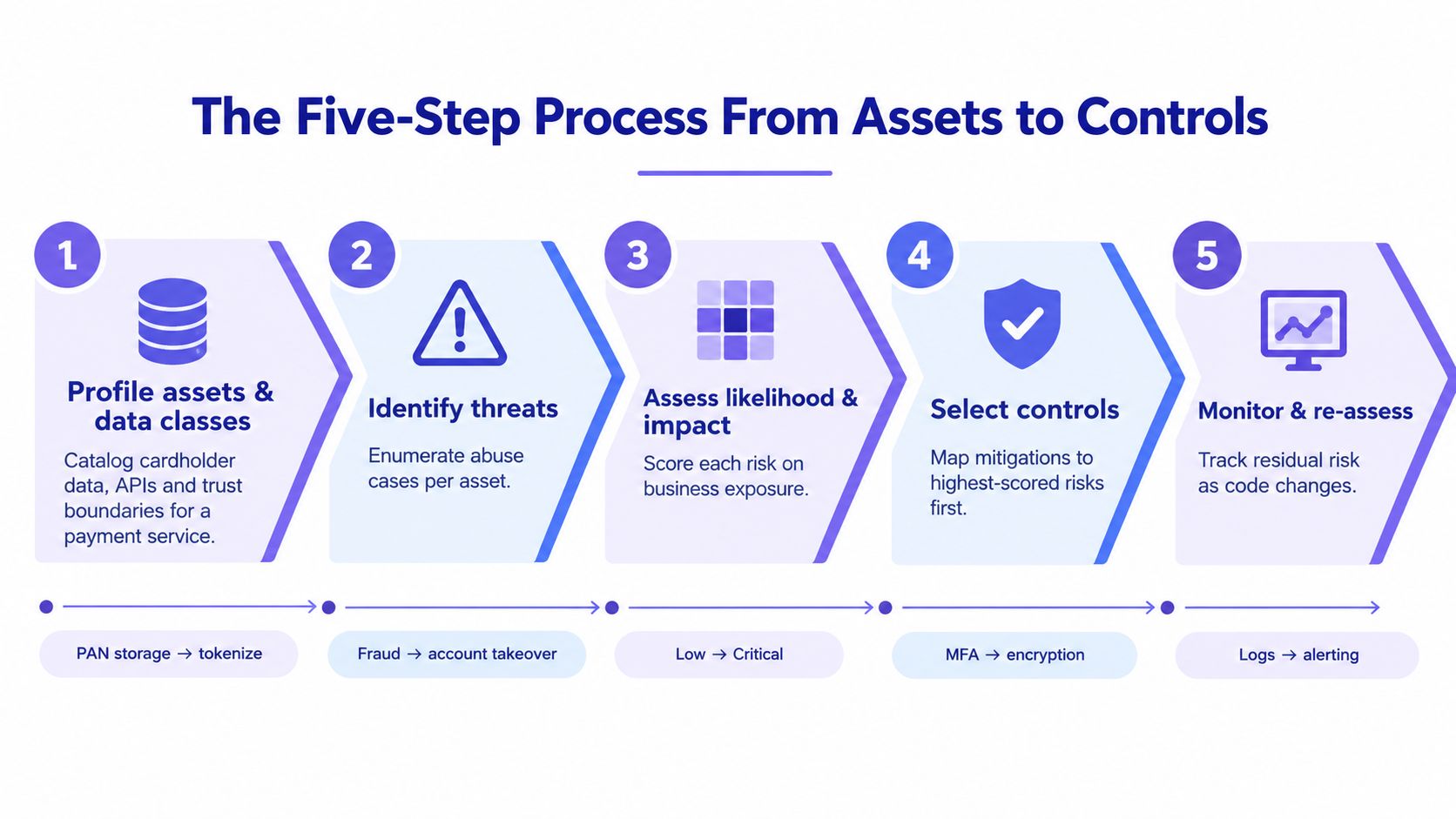
A payment service shows how risk management becomes a repeatable engineering process. The important detail is that each step produces information used by the next step, and later operational evidence improves the following cycle.
1. Profile assets and data classes
Catalog the service's payment flows, tokenization endpoints, settlement APIs, credentials, dependencies, and trust boundaries. Identify where sensitive payment data enters, where tokens are stored, which services can initiate transactions, and who owns each component.
The output isn't a perfect inventory. It's a usable system profile that tells the team what matters and where a change could expand exposure. The security risk management guide from Blocsys Technologies provides additional context for organizing risk practices around assets, controls, and accountability.
2. Identify threats and abuse cases
Use a lightweight STRIDE analysis, then add business-specific abuse cases. For the payment service, those might include replaying a valid request, changing a transaction amount, bypassing authorization, causing a double-spend condition, or abusing a settlement callback.
The threat model should connect each scenario to an asset and trust boundary. A generic statement such as “the API may be attacked” isn't useful. “An authenticated client can replay a settlement request after a timeout” gives engineers a scenario they can test and control.
For a detailed treatment of the activity itself, teams can use this threat modeling process guide as a practical reference.
3. Assess likelihood and impact
Score the scenario using evidence and context. Consider exposure, attacker access, control strength, transaction value, fraud consequences, service availability, customer harm, and regulatory obligations. Don't reduce the decision to a single technical number.
A replay risk on a settlement endpoint may have a different priority from an equivalent flaw in a read-only reporting API. The assessment should explain why, so another reviewer can challenge the assumptions and reach a consistent decision.
4. Select layered controls
Map controls to the highest-priority scenarios first. Depending on the design, the payment service may need input validation, idempotency keys, rate limiting, mutual TLS between services, strong authorization, secret protection, and segregation of duties in deployment.
Layering matters because no single control should carry the entire treatment. An idempotency key reduces duplicate processing, but authorization, transaction logging, alerting, and reconciliation provide additional opportunities to detect or contain failure.
5. Monitor and reassess
Feed control telemetry, incident findings, failed tests, unusual transaction patterns, and architecture changes back into the asset profile. If the service adds a new settlement partner, the trust boundary changes. If a control fails in production, the residual risk changes even if the original threat model document hasn't been edited.
Static review becomes a living capability. The model doesn't need to be rewritten for every line of code, but material changes should update the relevant scenarios, owners, controls, and evidence.
Mapping Risk Management Across the Software Lifecycle
Risk work is strongest when each software phase leaves behind an artifact that the next phase can consume. Design creates assumptions and required controls. Build turns those requirements into implementation checks. Test challenges the highest-value abuse paths. Operations supplies evidence about what really happened.
A continuous lifecycle
| Phase | Risk activity | Engineering output |
|---|---|---|
| Design | Identify assets, trust boundaries, threats, and decisions | Versioned threat model and control requirements |
| Build | Surface insecure patterns and policy violations | Pull request annotations, tickets, and policy results |
| Test | Exercise priority abuse cases and control failures | Security tests linked to risks |
| Deploy | Confirm release-level residual risk and ownership | Evidence-based release decision |
| Operate | Watch telemetry, incidents, and architecture changes | Updated context, reassessments, and follow-up work |
In design, put a lightweight threat model inside the design document. In coding, use IDE assistance, pre-commit checks, and pull request annotations to catch predictable mistakes before review. In CI/CD, apply policy according to the service's risk tier instead of forcing identical gates on every repository.
Staging should exercise abuse paths derived from the model, not just confirm that the happy path works. Production should return observability data, threat intelligence, and incident lessons to the service registry. This creates compounding context rather than resetting the conversation at every gate.
The SDLC cybersecurity guidance is useful for teams mapping security activities to delivery phases. For broader ownership and coordination questions, a lifecycle management overview can help frame how artifacts, responsibilities, and controls persist across the product lifecycle.
Replace gates with evidence
A static gate asks whether a review happened. A continuous model asks whether the current change preserves the assumptions behind the review. That distinction matters when services evolve through small changes that individually appear harmless but collectively alter data access, trust boundaries, or deployment privileges.
The release decision should therefore be represented as data. It can include changed assets, affected risks, control results, unresolved exceptions, approving owner, and residual exposure. A meeting may still be useful for difficult decisions, but the evidence should exist before the meeting and remain usable afterward.
Sector Considerations for FinTech, HealthTech, and Media
The same threat modeling method doesn't produce the same priorities in every sector. Teams need a common process, but the asset value, harm model, regulatory evidence, and acceptable residual risk differ by product.
| Sector | Primary risk drivers | Key regulations | Audit priorities |
|---|---|---|---|
| FinTech | Transaction integrity, fraud, identity abuse, availability, and financial loss | PCI DSS, SOX, and PSD2 | Reproducible control evidence, payment data flows, access separation, change traceability |
| HealthTech | Patient safety, PHI exposure, consent failure, clinical workflow disruption | HIPAA and emerging EU EHDS requirements | Data minimization, consent, access control, medical software assurance, incident evidence |
| Media | Account takeover, content integrity, platform abuse, availability, and reputation | More variable and less prescriptive, depending on service and market | Abuse prevention, identity protection, moderation controls, dependency provenance, operational resilience |
FinTech
A FinTech team should model transaction integrity as carefully as confidentiality. Threats include tampered amounts, replayed requests, fraudulent account linking, privileged deployment changes, and failures in reconciliation. Audit evidence must be reproducible, so the team needs a direct relationship between a risk, a control, the implementation, and the evidence showing that the control operated.
External material can also help teams working through adjacent obligations. For example, crypto compliance guidance from BroLabel offers context for teams dealing with anti-money-laundering concerns alongside technical controls.
HealthTech
HealthTech risk decisions carry patient and clinical consequences, not just data exposure. Threat models should include incorrect or unavailable information, unsafe workflow changes, inappropriate access, consent failures, and dependencies that affect clinical operations. Data minimization and purpose-bound access often matter as much as perimeter defenses.
The audit trail should show how the product protects sensitive information and how teams validate safety-relevant assumptions after changes. A generic OWASP checklist won't capture those product-specific risks.
Media
Media platforms face a different balance. High-scale account abuse, coordinated manipulation, content integrity problems, and availability failures can damage trust and revenue even where prescriptive regulation is lighter. Engineering teams need controls for identity, rate limits, provenance, moderation workflows, abuse detection, and rapid rollback.
Across all three sectors, several fundamentals converge:
- Dependency provenance: Teams should know what enters the build and who maintains it.
- Secrets hygiene: Credentials must be protected, rotated, and prevented from entering repositories.
- Ownership: Every important risk needs a service owner who can make or fund a treatment decision.
- Traceability: Policy, implementation, and evidence should connect without manual reconstruction.
Policy-as-Code provides the bridge. A sector requirement can become a reusable rule, while the living security context supplies the asset classification and scope that determine where the rule applies.
Living Security Context and Policy Enforcement in Practice
A living security context attaches risk information to the things developers already change. A service can carry its owner, data classification, trust boundaries, regulatory scope, approved controls, and unresolved decisions. A pull request can then show which risks it touches and which expectations apply.
This is more useful than a wiki page because the context participates in delivery. Design decisions feed the context graph. The graph feeds policies. Policies evaluate repositories, infrastructure, and pull requests. Failed checks update developer guidance and create a traceable decision path.
A payment-service example
Suppose a payment service inherits a PCI scope: high tag in its service metadata. That classification can trigger required secret scanning, dependency pinning, protected deployment approvals, stronger authentication checks, and evidence collection in CI. If a pull request introduces an unpinned dependency or changes an authentication boundary, the policy engine can block the merge or require an explicit review.
Tools such as OPA, Conftest, and Sentinel can enforce these kinds of rules, but the engine isn't the difficult part. The difficult part is maintaining accurate context and ensuring that exceptions have owners, reasons, and expiry conditions.
The policy should fail for a reason a developer can act on. “Control violation” is weak feedback. “This service handles high-scope payment data, and the new dependency isn't pinned to an approved version” points to a fix.
Wiki-based enforcement drifts because documentation changes more slowly than repositories and service configurations. Teams then face two bad outcomes: they follow stale instructions, or they bypass guidance they no longer trust. A living model keeps the decision close to the artifact and allows implementation verification after approval.
For teams assessing their broader posture, the application security posture overview provides a relevant frame for connecting design, code, and delivery signals.
Adoption still requires restraint. Don't begin by blocking every repository with a broad rule set. Start with a small number of high-confidence policies, map them to clearly owned services, log exceptions, and review false positives with engineering. Track meaningful signals such as time to assign ownership, age of accepted risk, recurrence of control failures, percentage of material changes with updated threat context, and whether production evidence confirms the intended control.
DevArmor is one platform option for this operating model. It creates continuous threat models from design documents, tickets, repositories, and service metadata, surfaces security design reviews in developer workflows, and applies Policy-as-Code checks to pull requests with traceable outcomes. Its value depends on how well the organization defines ownership, policy scope, and escalation, not on automation alone.
DevArmor helps security and engineering teams maintain living threat models, run design reviews in existing workflows, and enforce approved security requirements on pull requests. If your risk register no longer matches your codebase, visit DevArmor to see how continuous threat modeling and policy enforcement can connect design decisions to delivery evidence.
Table of Contents
Subscribe