Static Code Analysis Java: A Practical Integration Guide
 Reza Khosravi
Table of Contents

Most advice about static code analysis in Java starts with the wrong question: which tool should you buy? The harder question is what your team will do after the scanner reports a warning. A strong analyzer can still produce a queue that developers stop reading when the baseline, ownership model, suppression policy, and CI gates aren't designed first.
A large-scale 2016 study of static analysis across Java, JavaScript, Ruby, and Python examined 168,214 open-source projects, with 122 projects studied in depth. It found that tool use was widespread but not universal, configurations generally stayed close to defaults, few projects added custom analyses, and settings changed little after adoption. That pattern explains why many rollouts stall. Teams install a scanner, accept its default profile, and mistake visibility for risk reduction. The study's findings on static-analysis adoption and configuration support a workflow-first approach.
Why Tool Choice Is the Easy Part of Java Static Analysis
The popular recommendation is to compare analyzers, run a proof of concept, select the one with the strongest detection results, and add it to the build. That sequence reverses the work. In a Java monorepo, the difficult decisions concern which findings deserve attention, who owns them, how exceptions are recorded, and what the pipeline is allowed to block.
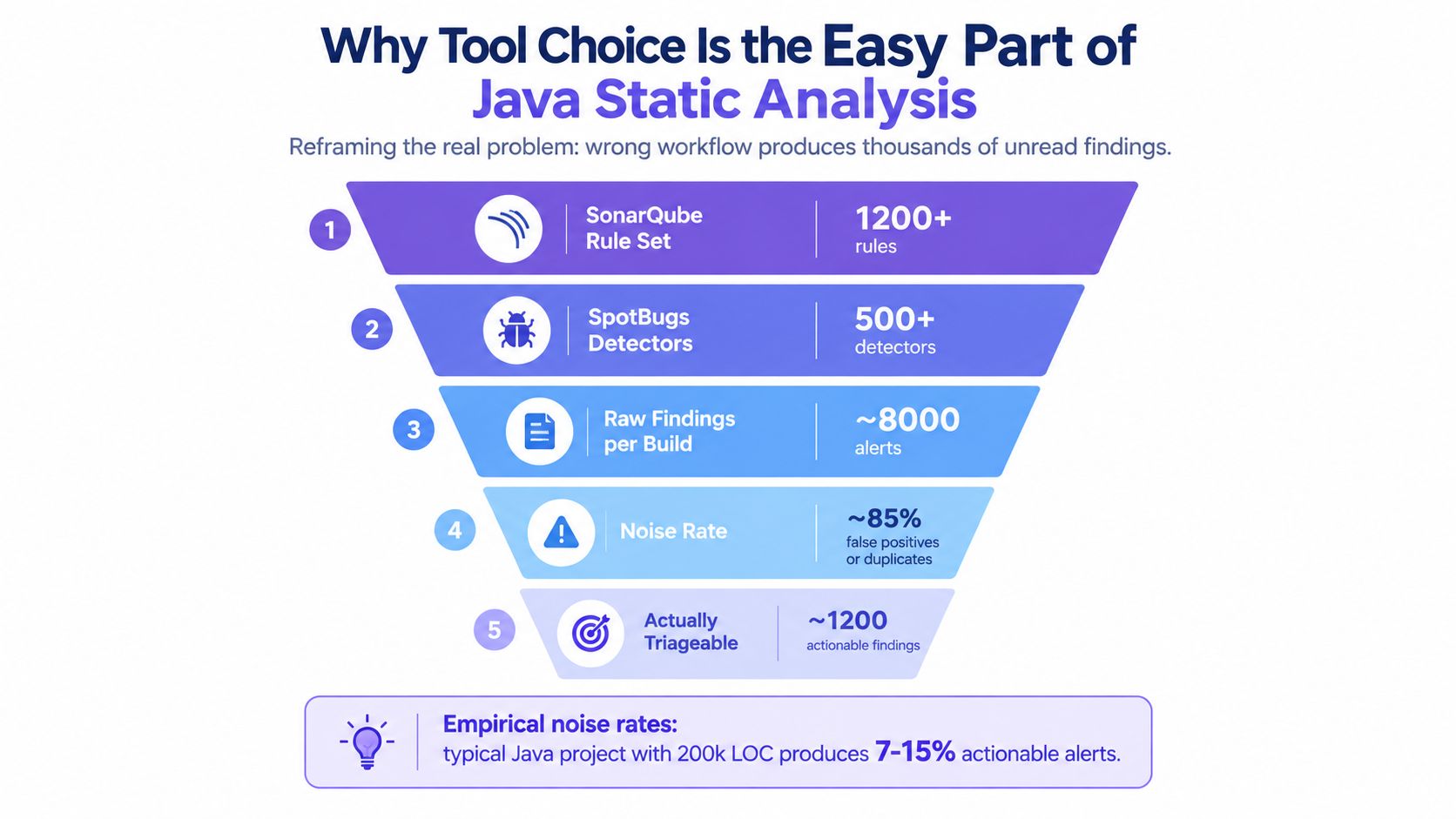
Research shows why raw detection counts aren't a useful success metric. A Java-specific evaluation using Juliet Test Suites reported precision ranging from 83% to 90.7%, with Java Pathfinder reaching 90.7%, YASCA 88.7%, and Bandera 83%. In a separate vulnerability study, the tested tools missed 13% of the vulnerability categories present in the experiment. The Java evaluation and vulnerability findings make two points clear: precision varies, and no analyzer provides complete coverage.
A comparison of six static analysis tools across 47 Java projects also reported little to no agreement among tools and low precision against manually defined ground truth. That doesn't mean teams should abandon static analysis. It means a single-tool strategy creates two predictable problems, missed issues and excessive noise. The practical response is calibration, not blind accumulation. Use severity thresholds, suppression rules, and manual triage gates so the team can distinguish a plausible defect from a theoretical warning.
Practical rule: Treat the scanner as a signal generator. Treat the workflow as the security control.
Tool evaluation still matters, but it should test integration behavior rather than only rule count. Can the analyzer understand your Java version and frameworks? Can it run against changed modules quickly? Does it preserve a stable fingerprint when code moves? Can engineers see the source path and rationale inside the pull request? These questions affect adoption more than an impressive catalog of detectors.
Teams formalizing their rollout should pair code scanning with broader software security best practices and define the shift-left boundary in their delivery process, as described in this shift-left security guidance. The important decision isn't whether a finding exists. It's whether someone can make a consistent, auditable decision about it.
Comparing the Major Java Static Analysis Tools
Java analysis works best as a portfolio. SonarQube, SpotBugs, Error Prone, PMD, Checkstyle, Semgrep, and PVS-Studio answer different questions, so choosing one universal winner usually creates gaps or redundant noise.
| Tool | Primary Focus | False-Positive Rate | Build Overhead | License |
|---|---|---|---|---|
| SonarQube | Code quality, maintainability, security rules, dashboards, and Quality Gates | Requires project tuning; varies by profile and codebase | Moderate to high, depending on scope and enabled analysis | Community and commercial editions |
| SpotBugs | Bytecode-level bug patterns and correctness checks | Requires triage; framework and generated-code patterns can create noise | Moderate; depends on compiled scope | Open source |
| SpotBugs with Find Security Bugs | Java and JVM security patterns | Security context and framework behavior require review | Moderate to high when security detectors are enabled | Open source components |
| Error Prone | Compile-time bug detection during Java compilation | Often focused and actionable, but depends on project conventions | Low to moderate because it runs with compilation | Open source |
| PMD | Source-level design, complexity, duplication, and code smells | Highly dependent on the selected ruleset | Low to moderate | Open source |
| Checkstyle | Formatting, naming, and structural coding standards | Usually controllable with a team-specific configuration | Low | Open source |
| Semgrep | Fast pattern matching and custom security rules | Rule quality determines signal quality | Low to moderate | Open source and commercial options |
| PVS-Studio | Deep defect and security analysis across supported languages | Requires operational tuning and review | Moderate to high | Commercial |
SonarQube is often the operational front door. Its dashboard, issue workflow, and Quality Gates give engineering managers a visible control point. Its weakness is that a dashboard doesn't resolve ownership, and advanced capabilities can sit behind licensing boundaries. It also becomes noisy when teams enable broad profiles without first establishing which rules map to real defects.
SpotBugs examines compiled Java behavior and catches bug patterns that source-only checks may miss. Add the Find Security Bugs plugin when security coverage matters, because plain SpotBugs isn't a complete application security analyzer. Its findings still need review around reflection, generated classes, framework conventions, and library behavior.
Error Prone belongs close to compilation. It works well for defects that can be identified while Java code is being compiled, so developers get feedback early. PMD is more useful for source-level smells, complexity, duplication, and maintainability rules. Checkstyle should stay focused on agreed coding standards, not security claims.
Semgrep is valuable when the security team needs to express a project-specific pattern quickly. Its lightweight rule model supports fast experimentation, though teams shouldn't assume that a concise pattern provides the same interprocedural data-flow depth as a heavier analyzer. PVS-Studio is a candidate for organizations that need deeper analysis and can support commercial procurement and operational overhead.
A practical composition is SonarQube for Quality Gates, SpotBugs plus Find Security Bugs for bug and security patterns, and Semgrep for custom security rules. Add PMD, Checkstyle, or Error Prone where their focused feedback fits the developer workflow. The portfolio should be justified by distinct coverage, not by the number of scanners a team can install.
Tuning Rules and Building Suppressions That Stick
The first scan isn't a verdict on code quality. It's a discovery exercise. If the initial result becomes a mandatory gate, developers learn to bypass the control before they learn what the findings mean.
Start by separating rules into three operational classes:
- Gate candidates: Findings that represent a credible defect or security condition and can block new code after manual validation.
- Review candidates: Findings that may indicate risk but need context from the owner, framework, or deployment model.
- Advisory rules: Style or maintainability observations that should inform refactoring without interrupting delivery.
Don't promote every informational rule to a gate. A rule belongs in the blocking set only when the team understands the defect class, can identify an owner, and has a remediation path. Built-in profiles such as SonarQube's standard profile, SpotBugs defaults, or PMD's recommended rules can provide a starting point, but they shouldn't become permanent policy without local review.
Tune for the code you actually maintain
Framework-heavy Java code needs explicit treatment. Reflection required by dependency injection, generated equals and hashCode methods, serialization conventions, and logging wrappers can all look suspicious to a generic analyzer. Disable or narrow the rule when the pattern is structurally unavoidable, then preserve a separate control that can catch the unsafe version.
Suppression syntax should communicate intent. Use @SuppressWarnings with a reason where the tool supports it. If NOSONAR is necessary, attach a ticket or review reference in the surrounding code. For SpotBugs, keep exclusion filters scoped to the smallest package or class area rather than excluding an entire repository.
A suppression without a reason is a hidden policy decision. Put the decision where reviewers can see it.
Every exception should have an owner, a justification, and a review point. An expiry date is useful when the tool supports it, but the repository process must also surface overdue exceptions. Code review should treat a new suppression as a change to security policy, not as harmless formatting.
Finally, map severity to evidence. A historical-issues study covering PMD, SpotBugs, and SonarQube identified recurring false-positive causes including flawed rule specifications, inconsistent implementations, unsupported language features or libraries, and ordinary programming errors. Earlier empirical work found Java false-alarm rates ranging from 1% to 19% and missed 11% of Java vulnerabilities in the tested benchmark, as summarized in the review of false negatives and false positives in static analyzers. Those findings argue for risk-based calibration tied to incident history, not severity labels copied from a vendor profile.
Wiring Static Analysis into Your CI Pipeline
A useful pipeline has different jobs for pull requests, protected branches, and scheduled full scans. Trying to make one scan perform all three roles usually creates slow feedback and weak gates.
Run an incremental analysis after the project compiles enough for the selected analyzer to understand changed code. Source-oriented tools can run early, while SpotBugs needs compiled artifacts. Publish findings in the pull request through SARIF or the platform's native annotation mechanism, and upload the complete report to a central dashboard for trend and ownership tracking.
| Pipeline Stage | Trigger | Tool Run | Gate Behavior |
|---|---|---|---|
| Developer feedback | Pull request update | Checkstyle, PMD, Error Prone, and targeted Semgrep rules | Annotate findings; block only agreed high-risk new findings |
| Compiled analysis | Pull request after compilation | SpotBugs with selected security detectors | Gate on validated critical findings introduced by the diff |
| Quality review | Protected branch | SonarQube analysis and Quality Gate evaluation | Enforce new-code policy while legacy debt remains visible |
| Coverage sweep | Nightly schedule | Full repository scans across the tool portfolio | Log and route findings; avoid interrupting active feature work |
| Governance reporting | Scheduled or release event | Aggregated SARIF and dashboard exports | Preserve evidence, ownership, suppression history, and decisions |
The most important gate is new code versus historical debt. A monorepo may contain years of findings that cannot be fixed during a feature pull request. If the pipeline blocks on the entire repository, developers inherit a problem they didn't create. Gate only on qualifying findings introduced or materially changed by the diff, while keeping the baseline measurable and visible.
Cache analyzer binaries, dependency indexes, and build outputs on dedicated agents. Keep cache keys tied to the analyzer version, rule configuration, and relevant build inputs, otherwise stale indexes create confusing results. Parallelize independent modules with build matrix runners, but preserve a final aggregation step that deduplicates findings and applies the same policy across modules.
Branch protection should require the status checks that represent the actual policy. Don't rely on a dashboard badge that isn't connected to merge permissions. The pipeline should record which rule, severity, file, commit, and decision caused a pass or failure.
For broader pipeline design, application security automation guidance provides useful context on connecting automated checks to development controls. The goal isn't maximum automation. It's an auditable path from finding to decision.
Designing a Triage Workflow That Actually Drains the Backlog
A backlog grows when findings arrive without a person, a deadline, or a disposition. The fix is operationally simple but requires discipline: assign an owner at intake, classify the risk, and review unresolved work on a predictable cadence.

A rotating triage champion reviews new findings each morning. The champion doesn't fix every issue. They confirm whether the finding is valid, apply the team's severity model, identify the owning service from repository metadata, and route anything needing specialist review.
The routing record should contain:
- Finding identity: Stable fingerprint, analyzer, rule, path, and commit.
- Risk decision: Confirmed defect, false positive, accepted risk, duplicate, or needs investigation.
- Ownership: Team, service, repository, and accountable engineer.
- Deadline: Remediation window based on severity and exposure.
- Evidence: Ticket, code review, exception rationale, or verification result.
A critical finding should be assigned within one business day. High-risk work needs a shorter remediation window than ordinary correctness or maintainability findings, while medium findings can enter planned engineering work. The exact timing should reflect the organization's threat model and incident history, but the matrix must be explicit enough that the triage champion doesn't negotiate every item from scratch.
Use source-control ownership metadata to route findings by module. If an item remains unresolved beyond two sprints, surface it in the service standup with the reason, owner, and next decision. A weekly burn-down chart should show whether the team is reducing old findings or merely processing new ones.
Closing a finding isn't the same as suppressing it. Record why the risk was accepted and who accepted it.
Stale findings need a documented disposition. A team can close a duplicate, reject an unreachable path, or accept a risk after review, but it shouldn't delete the evidence without transparency. Security review practices such as secure code review become more effective when the reviewer can see the analyzer context, prior decisions, and implementation owner in the same workflow.
The triage champion role should rotate, but the policy shouldn't. Consistency matters more than which engineer holds the queue this week.
Reducing Alert Fatigue Without Losing Coverage
Alert fatigue is usually a workflow failure, not a rule-count problem. Turning off security checks hides risk. A better design filters findings in layers, preserves their evidence, and limits which results interrupt developers.
The evidence supports that approach. Research on Java analyzer outcomes has documented false alarms ranging from 1% to 19%, while historical issue analysis found recurring causes such as incomplete rule specifications, inconsistent implementations, and unsupported language features or libraries. A 2023 survey of false-positive mitigation research also identified unresolved challenges. The historical-issues review supports operating for higher confidence and useful coverage, rather than maximizing the raw alert count.
Operational symptoms reveal whether filtering works: mean time to triage keeps rising, reviewers close findings as duplicates, and engineers stop opening analyzer links because prior alerts lacked actionable context. Track those signals alongside confirmed findings, rather than treating total detections as success.
A large industrial study of warning ranking at Google found that ranking models could distinguish false positives with over 85% accuracy and actionable warnings with over 70% accuracy. The practical lesson is to rank results using context before adding more detectors.
| Tactic | Noise Reduction | Coverage Risk | Implementation Effort |
|---|---|---|---|
| Severity floor | Removes low-value interruptions from gates | Low when advisory findings remain searchable | Low |
| Fingerprint deduplication | Merges repeated reports of one underlying issue | Low if the canonical finding retains all evidence | Moderate |
| New-code baseline | Prevents inherited debt from blocking current work | Medium if old findings disappear from ownership views | Moderate |
| Reachability and exploitability ranking | Moves plausible, reachable risk upward | Medium when context is incomplete | High |
| Quarterly rule review | Retires rules that do not fit the codebase and adds relevant ones | Low if changes are tested against known defects | Moderate |
Deduplicate by a stable issue fingerprint, not only by rule identifier. One defect can trigger several detectors. Collapsing identical rule names alone still leaves multiple tickets for one remediation.
Use baseline gating for new findings while keeping historical findings in a searchable backlog. The baseline marks the boundary for pull-request enforcement. It does not erase ownership of older risk or remove it from reporting.
Measure signal quality through confirmation rates, unresolved-item age, repeated suppressed patterns, duplicate-closure share, and time from detection to owner assignment. Review rules deliberately. Dormant rules can keep generating backlog without useful coverage after frameworks, libraries, or coding conventions change. Each review should compare proposed changes against known defects so noise reduction does not reduce detection.
Maturity Checklist and Frequently Asked Questions
A mature Java analysis program is visible in its decisions, not in the number of tools installed. Use the following five-level model as a self-assessment, and score the team's actual behavior rather than its intended process.

- Initial: Scans run inconsistently, no trusted baseline exists, suppressions are arbitrary, and CI doesn't enforce a clear policy.
- Repeatable: The team can reproduce scans, review findings on a regular cadence, and maintain a known baseline.
- Defined: Suppressions require reasons and ownership, CI gates new high-risk issues, and findings follow a documented triage path.
- Managed: Leaders review backlog age, remediation behavior, recurrence, and rule quality, then adjust the program based on evidence.
- Optimized: The workflow connects design decisions, code changes, analyzer findings, and verified remediation in a continuous feedback loop.
Frequently asked questions
Which tool fits a Spring Boot microservice?
Start with a composition. SonarQube can provide repository-level quality management, SpotBugs with Find Security Bugs can add compiled-code and security-pattern coverage, and Semgrep can express Spring-specific rules quickly. Validate framework support against real services before setting gates.
Should teams run SpotBugs and SonarQube together?
Usually, yes, when their enabled rules answer different questions. Overlap isn't automatically wasteful, but duplicate findings need fingerprinting and one owner. If both tools report the same pattern, keep the detector that gives the better path, explanation, or remediation workflow.
When should analysis run relative to compilation?
Run source-level checks as early as practical. Run SpotBugs after compilation, and run full-repository analysis on a scheduled cadence so untouched modules and newly introduced rules receive coverage.
How should generated code be handled?
Identify generated paths explicitly and exclude them only when regeneration is controlled and the source templates receive equivalent review. Broad exclusions hide defects when generated output contains application-specific changes.
Should findings block pull requests?
Block only validated, high-risk findings introduced by the change. Annotate lower-confidence or advisory findings, route them through triage, and keep historical debt visible without making unrelated pull requests inherit it.
The next practical step is to select one representative Java repository, establish a baseline, define ownership and suppression rules, and run the policy through real pull requests before expanding to every module. DevArmor can add a workflow layer around this process by reviewing pull requests for security requirements and controls, connecting implementation verification to approved security design decisions, and surfacing policy outcomes during code review. Visit DevArmor to evaluate how that approach fits alongside your existing Java analyzers and CI gates.
Table of Contents
Subscribe