Security Software Design: Principles, Patterns, and Practice
 Reza Khosravi
Table of Contents
The uncomfortable truth about security software design is that more detection can make security worse. The State of Software Security archive reports that 76% of applications had at least one vulnerability, while half of security findings remained open six months after discovery. It also found that nearly one-third of applications had more findings in third-party libraries than in native code. Those figures point to a design failure, not merely a tooling gap: teams can identify risk faster than they can govern, prioritize, and remediate it. (State of Software Security archive)
Modern security software design must therefore become a continuous, evidence-producing control system. It should connect business intent to threat models, architecture decisions, code-review policies, deployment controls, and proof that the approved design reached production. A document written at project kickoff and a scanner report generated after implementation are both incomplete when they can't explain who made a decision, under which assumptions, and whether later changes invalidated it.
Why Security Software Design Has to Move Upstream
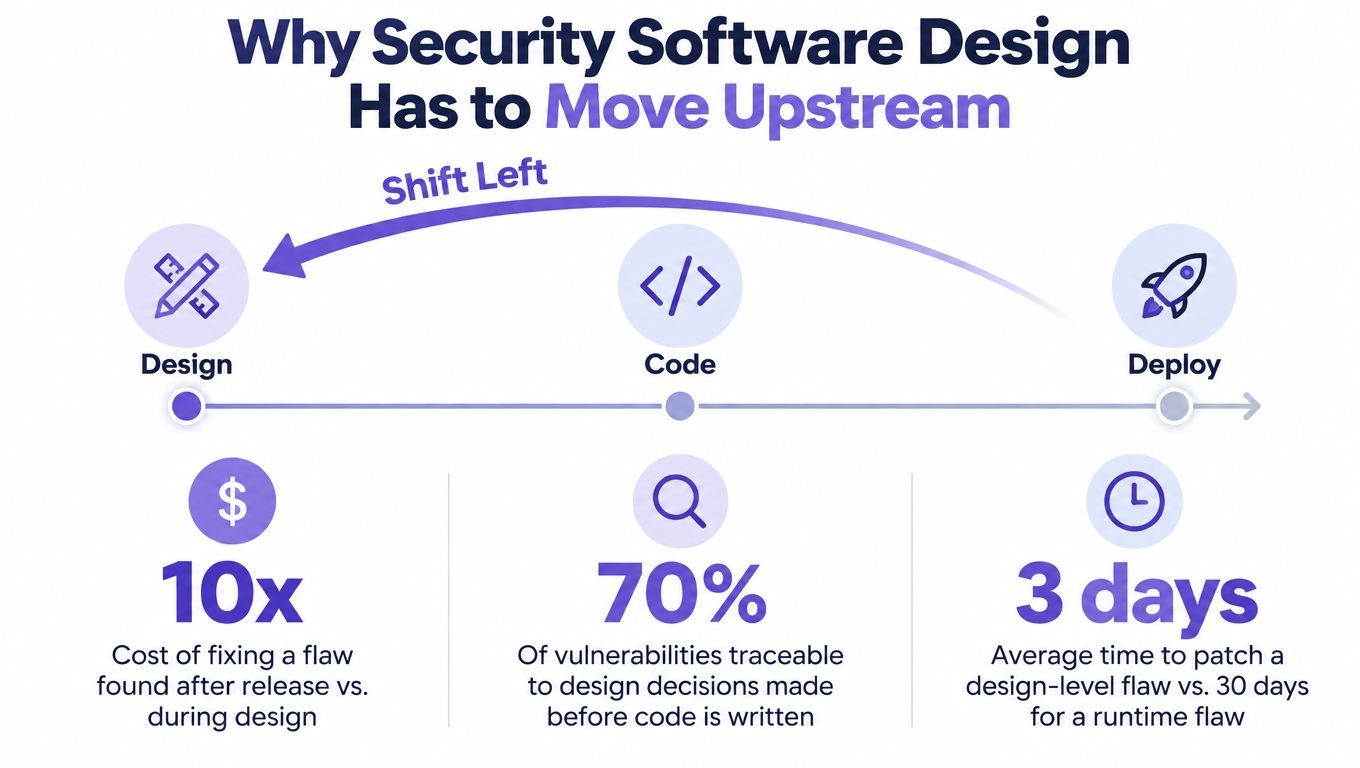
Security design isn't a document you write before development and file away after approval. It is the mechanism that governs the decisions producing the software.
NIST's systems-engineering guidance established this direction clearly. NIST Special Publication 800-160 treats security as a concern across the lifecycle, from initial design through implementation, operation, maintenance, and secure retirement. The guidance connects mission analysis, requirements engineering, architecture, design, implementation, verification, validation, and risk management instead of reducing security to vulnerability scanning after code exists.
That distinction matters because most expensive security mistakes begin as accepted design assumptions. A team may trust an internal service that later becomes internet-facing, permit broad data access because ownership is unclear, or allow an agent to modify authentication code without a stronger approval path. A scanner can find some consequences. It can't reliably reconstruct the business decision that created the exposure or determine whether the architecture still matches the original threat model.
The bottleneck is governance, not discovery
AI-assisted delivery makes the old model even less credible. The 2025 Stack Overflow survey found that 84% of professional developers were using or planning to use AI coding tools, while trust in their accuracy fell from 40% to 29% year over year. 66% said they spend more time fixing “almost-right” AI-generated code, and an empirical study of 733 AI-generated snippets found security weaknesses in 29.5% of Python and 24.2% of JavaScript samples across 43 CWE categories. The issue isn't that generated code is uniquely malicious. It is that the delivery rate has accelerated while architectural governance often remains meeting-based.
Security teams should move design controls into the intake, planning, pull-request, and deployment workflows engineers already use. That means a changed API can update the relevant trust boundary, a new data store can trigger a requirement review, and a sensitive code path can invoke a stricter merge policy without waiting for a separate security meeting.
Operating principle: Security design should produce an enforceable decision and replayable evidence, not a completed template.
A practical shift-left security operating model doesn't mean pushing every security task onto developers. It means putting the right decision at the earliest point where it can still change the architecture cheaply, then carrying that decision forward as code and infrastructure evolve. Regulated teams need this continuity because an audit question rarely stops at “Was a vulnerability closed?” It often reaches further: who approved the design, what risk was accepted, what control enforced the decision, and what evidence proves the deployed system still follows it?
Core Principles of Secure Software Design
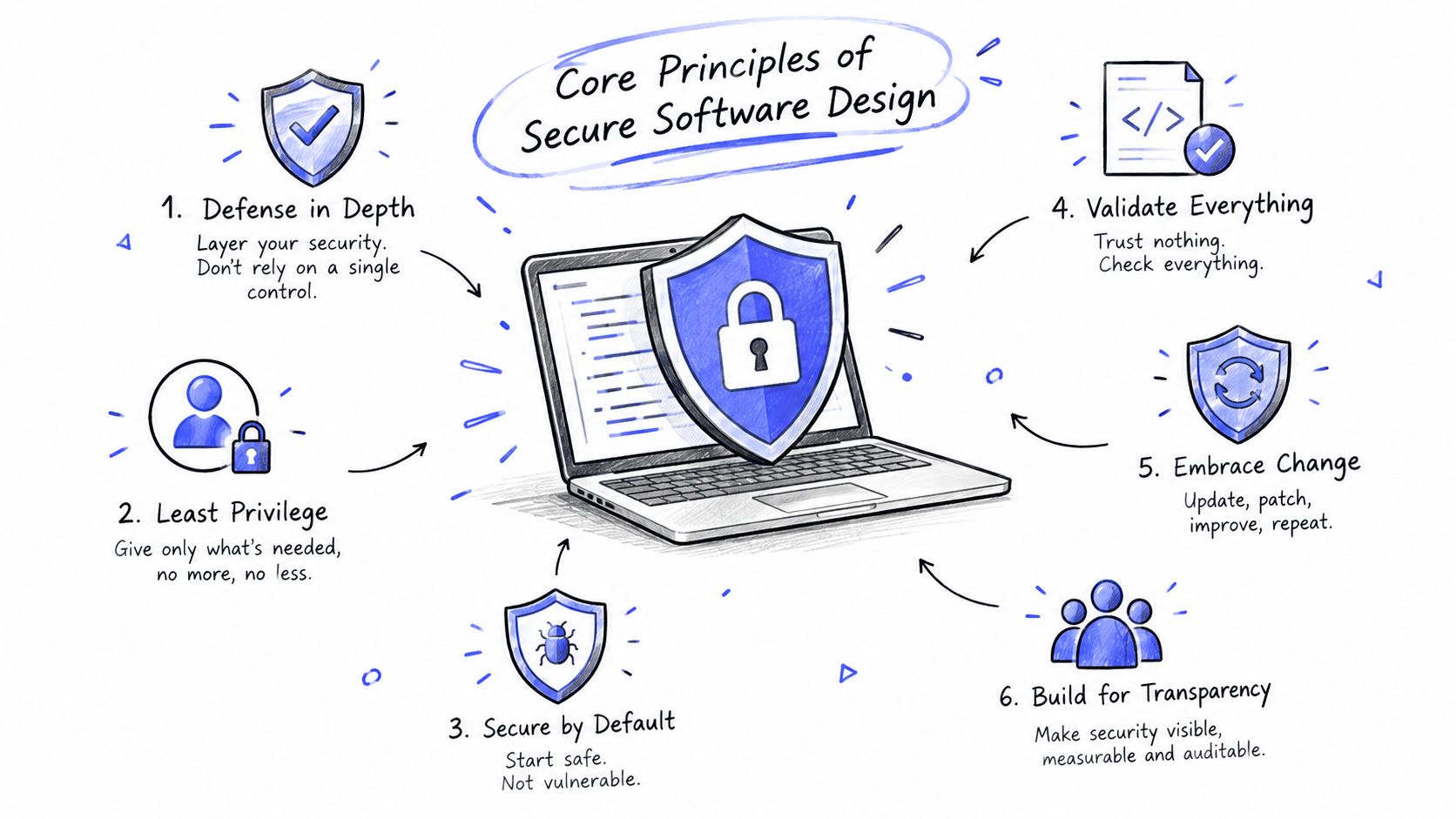
Secure software design starts with a simple stance: security properties are engineering requirements. Penetration testing, runtime monitoring, and vulnerability scanning remain useful, but they validate or detect outcomes. They don't replace the design work that defines what the system is allowed to do.
Take a payment service. “Process payments securely” is too vague to enforce. A useful requirement might state that only an authenticated payment-service identity can initiate a charge, that authorization must be checked against the merchant account, that card data must not enter application logs, and that repeated requests must be safe to retry without creating duplicate charges.
Build the chain from intent to control
The chain should remain intact:
- Business intent: Merchants need reliable payment processing without unauthorized charges.
- Threat model: An attacker may replay requests, compromise a client, abuse an internal route, or access sensitive data through logs.
- Trust boundaries: The client, API gateway, payment service, processor integration, data store, and observability platform don't share the same trust level.
- Design constraints: Require service authentication, merchant-scoped authorization, idempotency controls, encryption, restricted logging, and rate limiting.
- Implementation policy: Pull requests touching payment routes must demonstrate the approved authorization middleware, prohibit sensitive fields in logs, and require tests for replay behavior.
- Verification evidence: Store the review result, test output, policy decision, exception approval, and deployment reference together.
Threat modeling converts intent and assumptions into explicit security requirements. Attack-surface mapping identifies exposed interfaces and data paths. Trust boundaries show where authentication, authorization, validation, isolation, or encryption must change. Policy-as-Code turns those decisions into rules that tools can evaluate consistently.
NIST's Secure Software Development Framework describes secure development as a set of practices that can fit into an existing lifecycle. It emphasizes preparation, software protection, production of well-secured software, and vulnerability response. That makes it more useful than a methodology mandate. Teams can connect the practices to GitHub pull requests, Jira tickets, CI pipelines, infrastructure checks, and production evidence without pretending every organization works the same way.
Make the safe path the easy path
Secure-by-default design removes avoidable choices from developers and operators. A service should start with restrictive access, minimal data collection, protected secrets, and disabled features that aren't required for its purpose. Developers can still request an exception, but the exception should be explicit, owned, time-bound, and tied to a documented risk decision.
For implementation-level guidance on input validation, secrets, access control, testing, and deployment hygiene, a practical security guide for developers can complement the architectural model. The important distinction is that coding guidance should implement a known design decision, not substitute for one.
Threat-Model-Driven Architecture in Practice
Threat modeling earns its place in engineering workflow only when it changes as the system changes. A new public API, service, network zone, or deployment dependency should update the security context before implementation reaches production. Quarterly reviews cannot keep pace with those changes.
Start with the artifacts engineers already maintain, following a structured threat modeling process:
- Planning records: Capture the requested capability, affected users, data, and business consequence.
- Service metadata: Identify owners, environments, dependencies, interfaces, and operational responsibility.
- Repositories and APIs: Detect routes, authentication middleware, data access, external calls, and sensitive processing.
- Deployment topology: Track boundaries between clients, gateways, services, queues, databases, and third-party providers.
- Review history: Preserve approvals, rejected changes, accepted risks, and the assumptions behind them.
Convert those inputs into versioned security requirements. Every requirement needs an implementation control and a verification method. “Protect payment data” cannot guide engineering work. “Payment data must not be written to application logs” can drive structured logging rules, sensitive-field tests, pull-request checks, and runtime redaction validation.
The resulting traceability chain should connect business intent to deployed evidence:
| Stage | Artifact Produced | Example (Payment Service) |
|---|---|---|
| Business intent | Security objective | Prevent unauthorized merchant charges |
| Threat analysis | Threat and abuse cases | Credential misuse, replay, internal route abuse |
| Architecture | Trust boundaries and data flows | Client to gateway to payment service to processor |
| Requirements | Versioned security requirements | Merchant-scoped authorization and idempotent requests |
| Implementation | Code and infrastructure controls | Authorization middleware, replay protection, restricted logs |
| Verification | Tests and policy results | Pull-request checks, integration tests, deployment evidence |
| Risk decision | Exception record | Temporary processor limitation approved by a named owner |
This chain connects design decisions to the code and infrastructure that implement them. A route change can surface its related requirement beside the pull request. A change in data classification can trigger a stronger control. An expired exception, or an assumption that no longer holds, can reopen review instead of leaving an obsolete approval in place.
NIST's SSDF guidance on threat modeling and attack-surface analysis connects security requirements, operational risk, architecture, verification, and justified exceptions. The diagram matters only when engineers can explain why a control exists and whether a later change invalidated it.
A threat model that never reaches a pull request has stopped being architecture control and become architecture history.
For regulated teams, generate evidence through normal engineering work. Store the requirement revision, affected artifact, reviewer, policy result, test evidence, exception rationale, and deployed version. That record supports audits while keeping security evidence tied to code changes rather than a separate documentation system.
Enforcement Points from Design to Deployment
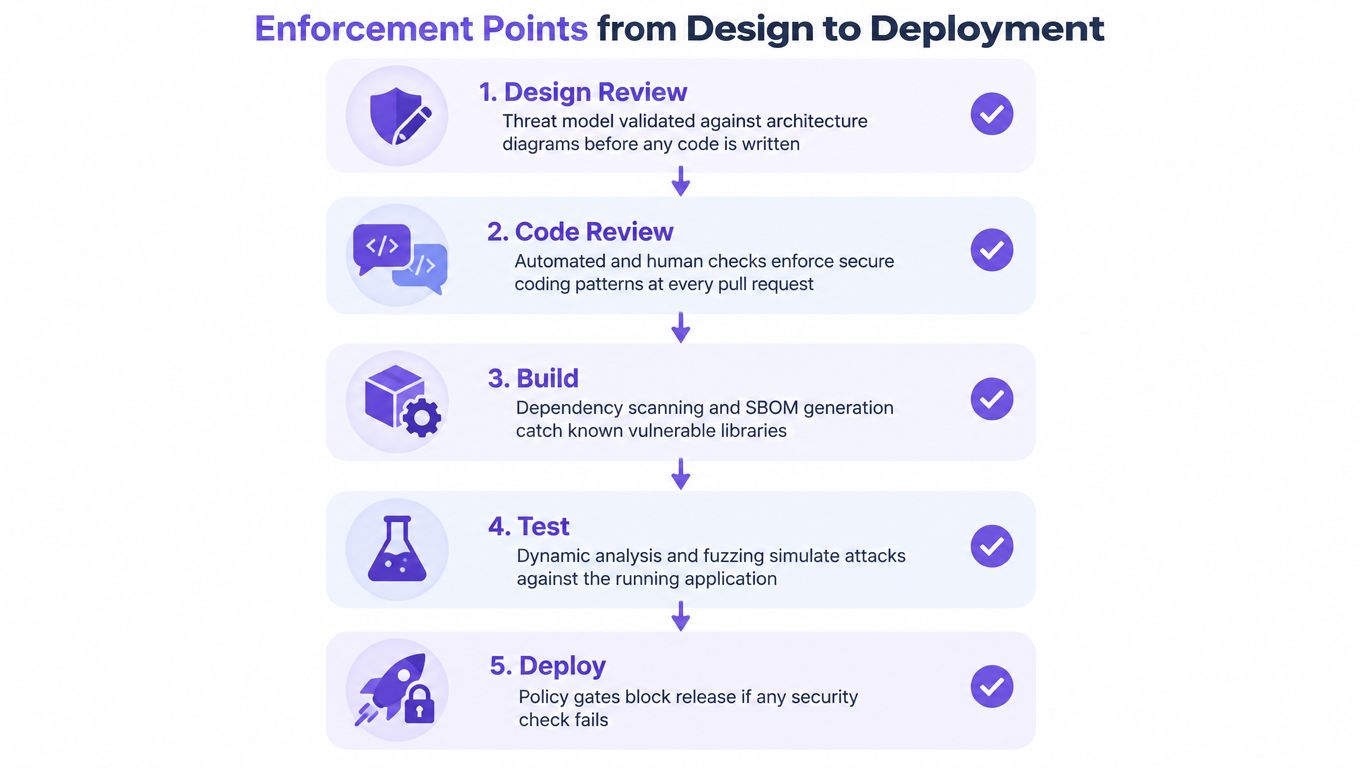
Security controls fail when teams place them at the wrong stage. A runtime alert can't prevent an unsafe merge, and a design approval can't prove that the approved authorization rule reached production. Each enforcement point needs a defined job and a clear handoff.
Assign each control to its strongest point
Design review validates the threat model against architecture, data flows, trust boundaries, and operational assumptions. It should approve requirements and record exceptions, not inspect every implementation detail.
Code review checks whether the change implements the approved design. Policy-as-Code delivers the most impact here. A rule can block missing authorization on sensitive routes, exposed secrets, prohibited dependency licenses, or unapproved cryptographic settings while routing lower-confidence findings for human triage.
Build controls verify dependency policy, provenance, artifact integrity, and software-bill-of-materials evidence. A build should establish what was compiled and which components entered the artifact.
Deployment controls enforce environment and topology requirements, secret handling, identity configuration, and release conditions. They should compare the intended deployment with the approved design rather than merely check whether a pipeline completed.
Runtime controls provide observability, detection, containment, and rollback. They catch behavior that static evidence can't fully predict, but they shouldn't become an excuse to ship known design violations.
The merge point deserves special attention because it sits close enough to code for developers to act and early enough to prevent downstream rework. The policy must be precise. Blocking every warning trains teams to bypass the system, while blocking only high-confidence violations makes the decision predictable and defensible.
That principle also applies to AI-operated workflows. Teams defining agent safety for DTC brands should distinguish an agent that can plan, choose tools, edit files, and open pull requests from deterministic automation that executes a fixed task. The former needs scoped permissions, provenance, approval boundaries, and rollback. The latter still needs integrity and access controls, but its behavior is easier to constrain.
A useful enforcement record includes the rule evaluated, the source artifact, the code revision, the result, the reviewer or automation identity, and the exception status. An auditor should be able to replay the decision without asking three teams to reconstruct it from chat history.
Governing AI-Generated Code at the Design Layer
AI-generated code creates a design-governance problem before it creates a scanning problem. The key question is whether an agent can modify a protected trust boundary, data flow, or security control without producing evidence that a human can review.
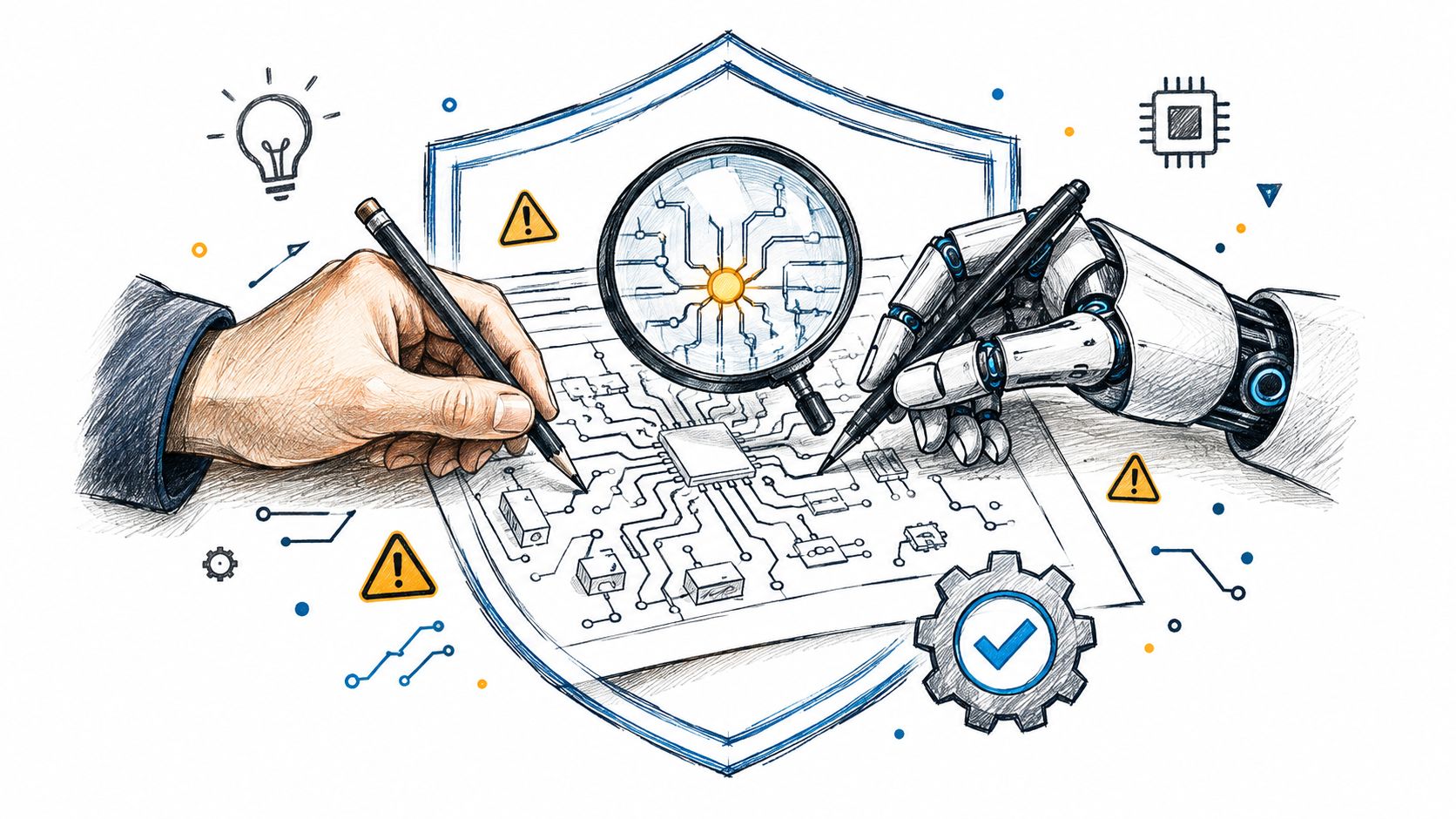
Treat AI coding as a controlled change source. The controls should apply while the agent plans, edits, tests, and opens a pull request.
Define the guardrails before generation
Start with permissions. An agent working on a presentation component shouldn't have authority to alter identity configuration, production secrets, payment authorization, or deployment policy. Use repository, directory, tool, and environment boundaries that match the risk of the work.
Then preserve provenance. Record which agent or assistant produced a change, what prompt or task context governed it, which files it touched, which tools it invoked, and which human approved the result. Provenance doesn't prove that code is secure. It makes investigation and accountability possible.
Sensitive changes need approval thresholds. Require explicit human review for authentication, authorization, cryptography, personal-data handling, tenant isolation, infrastructure permissions, and policy exceptions. Let lower-risk changes follow ordinary review, but don't treat a green test suite as approval for a security-sensitive architectural change.
A sound workflow also needs:
- Rollback: Revert generated changes cleanly when policy checks fail or assumptions change.
- Exception handling: Require a reason, owner, expiry, affected assets, and compensating controls.
- Implementation evidence: Link the approved requirement to the exact commit, test result, artifact, and deployment.
- Context injection: Give the agent current trust boundaries, prohibited data flows, approved libraries, and relevant policy rules before it edits code.
The AI in the software development lifecycle guidance is useful only when AI governance connects to these implementation records. An AI-use policy that says “developers must review generated code” is too weak if the organization can't show what changed, which design decision applied, and who approved the result.
The design layer should make unsafe generation difficult rather than relying on developer memory. If an agent proposes direct access to a sensitive store, the system should surface the boundary violation before merge. If it changes a route from internal to public, the threat model and approval path should change with it.
Measuring Whether Security Design Is Actually Working
Scanner counts measure that tools ran. A design program must measure whether context stays current, controls reach code review, and the supply chain remains explainable. These are operating measures for a control system, not a larger findings dashboard.
The State of Software Security archive reports that 76% of applications had at least one vulnerability, while half of findings remained open six months after discovery. It also found that nearly one-third of applications had more findings in third-party libraries than in native code. As the introduction noted, detection creates little control unless teams assign ownership, prioritize risk, enforce policy, and reserve capacity for remediation.
Use outcome measures
Track measures that expose drift and show whether design decisions reach implementation:
- Current-model coverage: The share of production services whose threat models match current interfaces, data flows, dependencies, and deployment topology.
- Architecture-to-policy latency: The time between approving an architecture change and updating the related Policy-as-Code rule.
- Dependency provenance: The share of production dependencies with verified origin, ownership, integrity, and approval evidence.
- Stale-review rate: The proportion of security decisions whose assumptions no longer match repository, ticket, or deployment changes.
- Exception age: How long deviations remain open, whether each has an owner, and whether compensating controls still operate.
- Pre-merge prevention: The high-confidence violations blocked before code reaches the build or deployment stage.
- Evidence completeness: Whether a reviewer can connect intent, requirement, implementation, verification, approval, and deployed artifact.
Compute latency for a single service, not only across the portfolio. If an approved change adds a public endpoint on Monday and the corresponding authentication policy reaches code review on Wednesday, architecture-to-policy latency is two days. That measure exposes whether threat-model decisions become enforceable controls or remain documentation.
Supply-chain visibility needs its own dashboard. Only 36% of 307 surveyed US and UK DevOps professionals reported complete visibility through artifact-management solutions, and 46% reported no or only partial pipeline automation. The same ITBrief coverage of software supply-chain visibility reports that 26% manually track and enforce restrictions on packages or components from public registries, while more than 71% allow developers to download directly from the internet.
These findings call for a context audit before another scanner purchase. Can the organization identify which service uses a dependency, why it was approved, who owns the exception, whether the deployed artifact matches reviewed source, and which design assumption permitted the component?
When documentation is incomplete, reconstruct context from repositories, tickets, build metadata, deployment records, API definitions, and review history. Mark inferred decisions as inferred. Never present reconstructed evidence as an approval that never occurred.
How a Living Design Context Compares to Traditional Reviews
Meeting-based reviews still serve major architectural changes, unusual risk decisions, and systems where participants have enough context to decide quickly. Their weakness is latency and drift. A document may be approved while the repository, service topology, or threat assumptions keep changing.
Scanner-led AppSec provides repeatable technical detection, but it rarely captures business intent or prioritizes findings by reachability and asset criticality. Engineers often receive a queue instead of a decision. Without ownership and merge policy, more scanners can increase backlog rather than reduce risk.
A living design context links intent, threat models, code-review policy, implementation evidence, and deployment records:
| Operating model | Latency | Auditability | Drift control | Developer experience |
|---|---|---|---|---|
| Meeting-based review | High when schedules conflict | Strong when records are complete | Weak after approval | Interruptive |
| Scanner-led AppSec | Low for tool execution | Mixed, often finding-focused | Limited | Noisy without precise policies |
| Living design context | Continuous and workflow-based | Strong when decisions map to evidence | Active as artifacts change | Integrated with planning and code review |
Use the models together. Keep human review for consequential decisions, scanners for detection, and living context where software changes faster than documents can be maintained. The practical test is whether a changed code path can be traced to its governing design decision, enforced policy, exception owner, and deployment evidence. That trace should also show whether AI-generated code had declared provenance and human approval.
Ask platform vendors:
- Which approved design decision governs a changed code path?
- Does a repository or ticket change refresh the relevant threat model?
- Can teams block precise, high-confidence violations at pull-request time?
- Are exceptions owned, time-bound, and replayable?
- Can AI-generated changes be linked to provenance and human approval?
- Can missing design context be reconstructed from engineering records?
- Does the platform measure supply-chain control, or only vulnerability volume?
DevArmor offers continuous threat modeling, workflow-based security design reviews, Policy-as-Code enforcement on pull requests, implementation verification, and guardrails for AI-assisted coding. It connects planning, source control, and deployment controls while producing audit-friendly evidence. Evaluate those capabilities against the questions above and test whether they reduce control latency and improve traceability, rather than generating more findings.
Operate security software design as a living control. Map one sensitive service from business intent through threat model, pull-request policy, deployment evidence, and exception ownership. Then use the evaluation workflow described above to keep that context current inside engineers' existing tools. Have application security, engineering, and compliance leaders review the evidence together, and remove controls that create noise without changing a decision.
Table of Contents
Subscribe