Security Policy Application: Stop Risky Merges Now
 Reza Khosravi
Table of Contents
A pull request is open. The feature looks harmless. It adds a new endpoint, a background job, and one small infrastructure change. The unit tests pass, the reviewer sees no obvious bug, and the release train is already moving. Then someone notices the endpoint bypasses the approved identity path, the job writes sensitive data into the wrong store, and the infrastructure change opens a path that the original design never approved.
That's the moment teams realize their security policy application isn't really part of delivery. It's a separate activity that runs too late, speaks in generic rules, and leaves reviewers guessing what matters.
The teams that handle this well don't treat policy as a pile of scanner findings. They map each policy to an approved design decision, enforce it where developers already work, and keep an audit trail that explains why a merge was blocked, allowed, or allowed with conditions. That's what holds up in regulated environments where speed matters and auditors still expect a clean story.
Why Security Policy Application Fails Without Workflow Context
A team approves a design that requires every customer-facing API to use the central identity provider. Two sprints later, a new partner endpoint lands under deadline pressure. CI passes. The reviewer checks tests and code style. The policy engine comments on a few generic findings, but nothing in the pull request says, "this change breaks decision AUTH-014." The merge looks routine because the policy never shows up in the workflow as a check against an approved decision.
That gap shows up even in teams that already use policy as code. A 2023 survey of 285 U.S. developers and technical decision-makers found that 87% said their organizations use policy as code in production and 97% said it matters for building software efficiently in the cloud, yet only 30% were using it in a significant capacity for most or all systems. Adoption is broad. Day-to-day enforcement inside delivery is still thin.
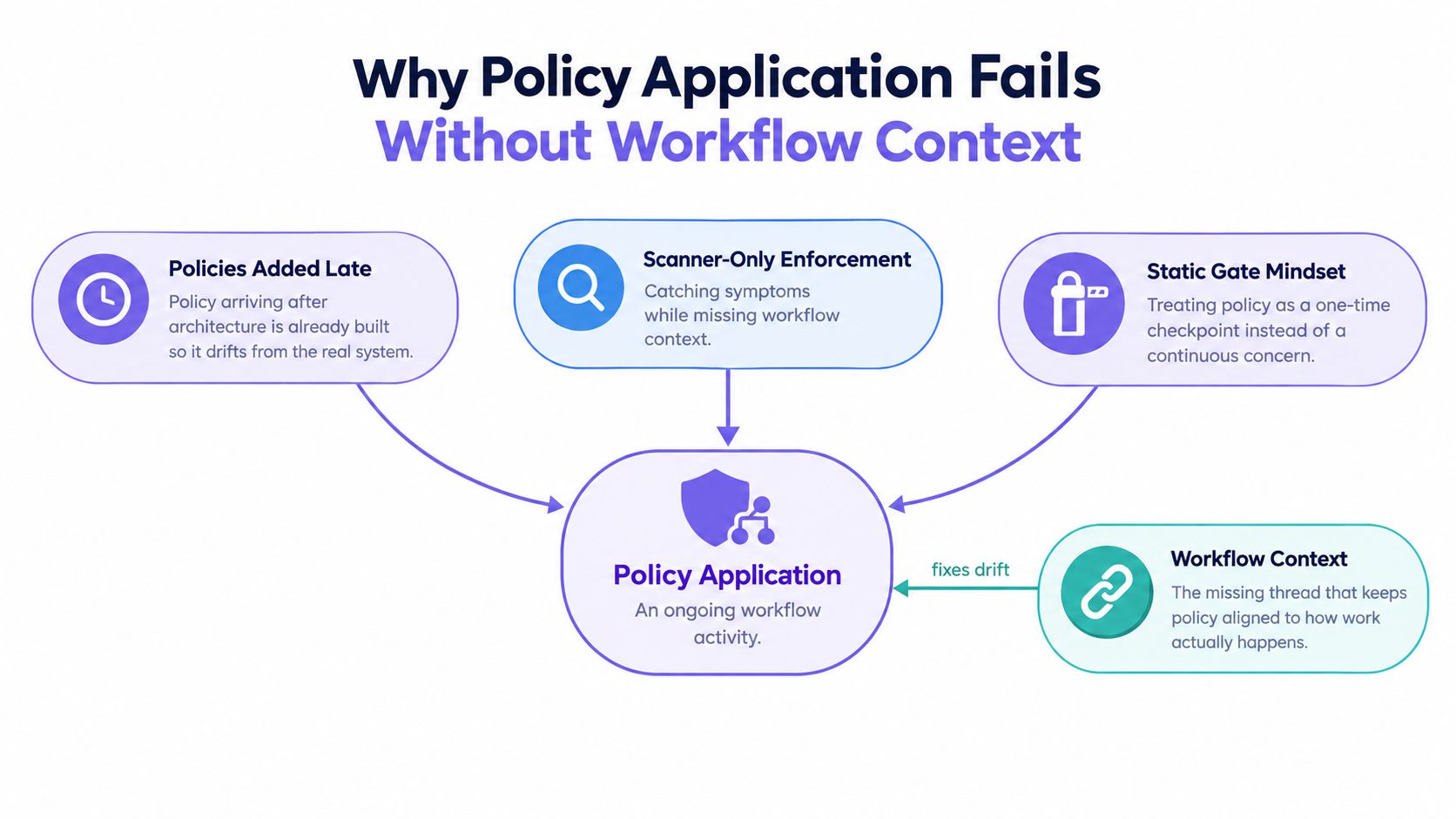
Policies added after architecture drift
Late policy usually turns into cleanup work.
Empirical research on open-source repositories found that only 28% adopted policy-as-code early, within the first 20% of development, and the median adoption point was after 43.4% of development had elapsed (empirical PaC adoption study). In practice, that means the hard choices are already in place. Data paths exist, service boundaries have calcified, and exceptions are being handled informally in chat or ticket comments.
At that stage, policy rarely steers design. It chases it. Teams end up writing rules against file patterns, config fragments, or scanner outputs because the original approval record was never connected to code review in a usable way.
Scanner-only enforcement produces findings without decisions
Scanners still matter. I use them. They are good at detecting classes of change quickly and at scale.
They are weak at answering the question reviewers need answered in a PR: does this change violate an approved decision for this service, and if it does, should the merge block now or proceed with a time-bound exception? A secret scanner can find a credential. An IaC scanner can spot a public ingress rule. Neither one, on its own, can tell the reviewer whether the change conflicts with an approved architecture choice, whether a compensating control exists, or whether security signed off on a narrow exception last week.
That is why policy application fails when it is treated as an isolated scanner rule set. The rule fires, but the decision context is missing. In regulated teams, that is the difference between useful enforcement and noisy advice.
For infrastructure teams trying to tie policy to the way systems are deployed, the AvenaCloud Hosting Provider guide is a useful reference because it stays close to hosting and environment decisions instead of abstract policy language.
Controls outside developer tools get ignored or worked around
Developers follow the shortest path that still gets work shipped.
If the merge decision happens in GitHub, but policy feedback lives in a separate dashboard or a late security review, people learn a predictable habit. They optimize for green CI first and treat policy as a second system to check later, if time allows. In a fast release cycle, "later" often means after the architecture has already drifted.
The fix is not more alerts. The fix is to bind each policy to a specific approved design decision, then enforce it in the pull request with two layers. One layer checks the technical change itself. The second checks for the decision reference, exception state, and required reviewer path. That gives the team a visible reason for every block, every advisory, and every override.
That model depends on having a living source of approved decisions upstream. Teams that need to tighten that link usually start by making threat modeling concrete enough to reference in code review. This guide on what threat modeling is and how teams use it in practice is a good place to start.
Designing Policies That Map Directly to Approved Decisions
Most weak policies fail in the authoring stage. They say things like “protect sensitive data” or “use approved auth” without naming the decision, owner, or system boundary. Developers can't act on that, and auditors can't trace it.
Strong policy authoring starts with one question: what approved decision is this policy enforcing?
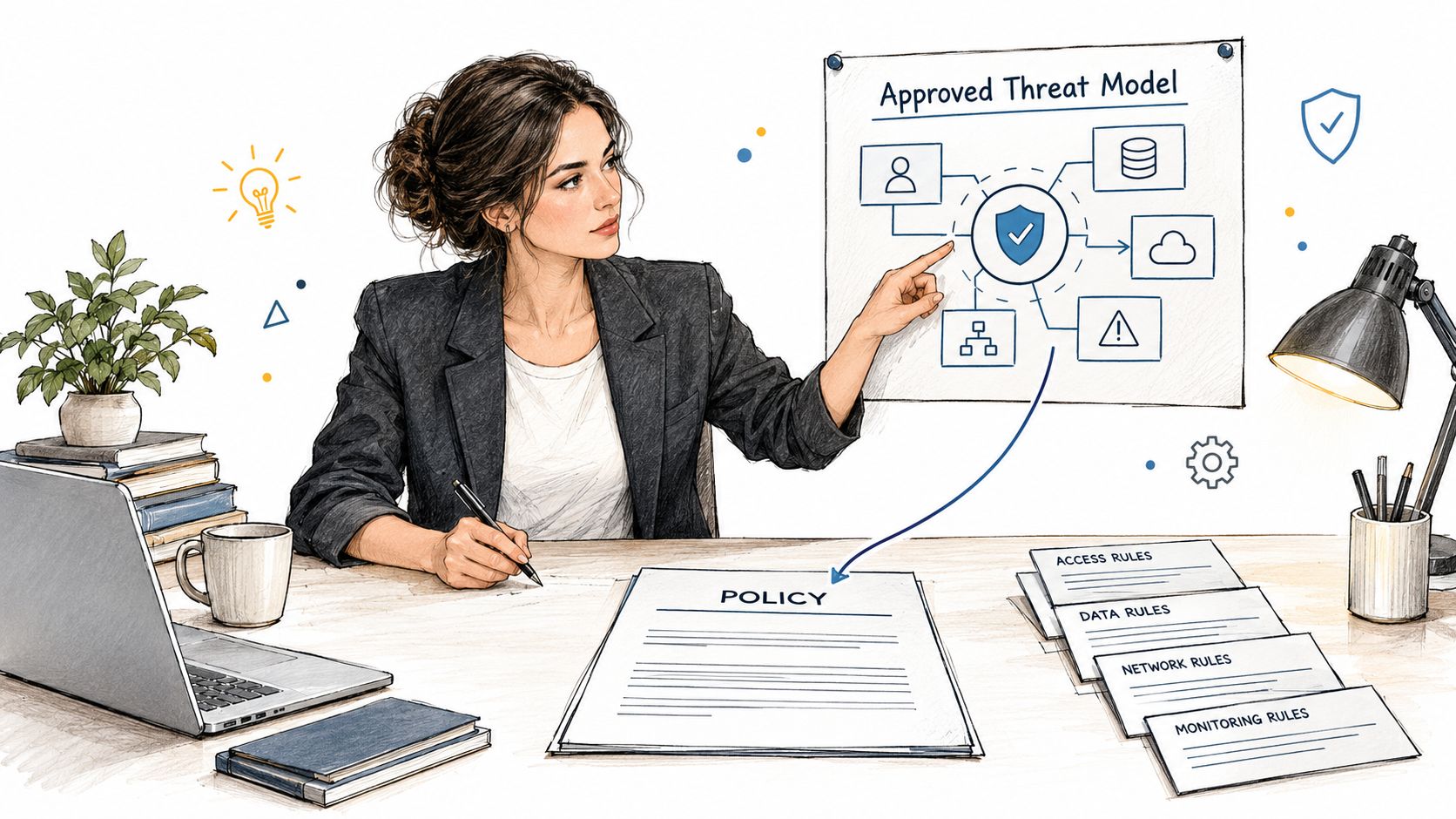
Write policies as decision guards
A useful policy has a direct parent. That parent is usually a threat model outcome, an architecture review decision, a data handling standard, or an exception with an expiration condition.
Instead of writing “all APIs must authenticate users,” write the rule so it points to the specific approved design decision. For example:
- Decision reference included: Link the policy to a decision ID, review record, or approved architecture note.
- System scope defined: Name the repos, services, paths, or infrastructure modules the policy applies to.
- Expected pattern stated: Say what compliant implementation looks like in code or configuration.
- Failure action chosen: Define whether the rule comments, soft fails, or blocks merge.
That changes the conversation in review. The reviewer isn't debating a generic best practice. They're checking whether the PR stays inside an already approved design boundary.
Keep the policy file lean
Policy files get messy fast when teams treat them as a dumping ground for every security preference. Don't write giant monolithic bundles that mix auth, secrets, cryptography, network exposure, and runtime exceptions in one place.
A maintainable structure usually separates:
| Policy element | What it should contain |
|---|---|
| Decision metadata | Decision ID, owner, approval date, linked artifact |
| Scope block | Repo, directory, service, environment, resource type |
| Enforcement logic | What to evaluate in PR, CI, or admission control |
| Exception handling | Approved deviation, rationale, expiry, reviewer |
Short files are easier to review, easier to test, and harder to misunderstand.
Practical rule: if a developer can't tell from the policy file what decision it protects and where it applies, the file isn't ready to enforce.
Name policies like contracts, not slogans
Names matter because they show up in PR checks, exceptions, and audit exports. “Secure API Rule 3” is useless. “Customer API must use central IdP token validation” is actionable.
Use names that answer three things at once:
- What asset is covered
- What approved behavior is required
- What reviewer should verify
That naming style also helps when policies need to span code and non-code content. If your organization has teams outside engineering who need concise guidance, a structured content standard like the safety reference for marketers is a good example of how policy language can stay clear without becoming vague.
Reuse logic without duplicating meaning
The same decision often needs checks in more than one place. An identity rule might appear in PR checks, CI validation, and Kubernetes admission control. Reuse the underlying policy logic where possible, but don't duplicate ownership or rewrite the same rationale in three systems.
The clean pattern is simple. Keep one canonical policy definition with decision metadata, then adapt the execution layer to the enforcement point. That way, the policy stays stable even when the toolchain changes.
Security policy application breaks down when teams copy rules into separate tools and maintain them by hand. One version drifts, another gains an exception no one remembers, and the reviewer no longer knows which result to trust.
Choosing Your Enforcement Model Without Slowing Delivery
A Friday release is waiting on one pull request. The change adds a new service endpoint, swaps an auth library, and updates Terraform for a queue subscription. If every policy blocks by default, the team sits in review arguing about ownership tags while a real identity bypass hides in the same diff. If nothing blocks, the endpoint ships with a path that ignores the approved token validation flow.
That is usually where enforcement programs lose trust. Teams do not object to policy. They object to controls that treat a missing annotation and a design-level security break as the same class of problem.
The enforcement mode should follow the decision the policy is protecting. Start with three questions. Was the underlying design decision formally approved? How reliable is the signal at this control point? What is the cost if this change merges and the policy was right?
In regulated environments, a bad block has a cost too. I have seen noisy checks create informal bypasses faster than any exception process could catch up. Once engineers stop trusting a gate, they stop reading its output.
Choose the mode by decision type, not by tool
The useful split is simple.
| Enforcement Mode | Best For | Trade-off to Manage |
|---|---|---|
| Advisory comment | New policies, low-confidence detections, documentation or hygiene gaps | Teams will tune it out if it stays advisory after the rule is stable |
| Soft gate | Changes that need explicit risk acceptance or named approval | Review quality drops fast if exception reasons and expiry are inconsistent |
| Hard merge block | High-confidence violations of approved design boundaries | A weak signal or vague policy will stop delivery for the wrong reason |
The key is to map the mode back to an approved decision. If architecture approved "customer APIs must use central IdP token validation," that policy can justify a hard block in the PR when a route bypasses the shared auth path. If the approved decision is "every service must declare ownership metadata for incident routing," advisory is usually the right starting point until coverage and auto-fix support improve.
That mapping keeps policy from turning into a pile of scanner findings with no hierarchy.
Use dual-layer checks in the PR
The PR should carry two kinds of checks, and they should answer different questions.
The first layer checks design alignment. It asks whether the change still matches the approved decision. Example: does this service still authenticate through the central provider, use the approved secrets path, or stay within the data residency boundary that legal and architecture signed off on?
The second layer checks implementation evidence. It verifies the code or config that should exist because of that decision. Example: the middleware import is present, the Terraform module is the approved one, the ingress annotation matches the expected control, or the policy exception includes an approver and expiry.
This split matters because a single pass/fail check hides too much. A reviewer needs to know whether the problem is design drift or an implementation miss. The fix path is different.
Layer PR enforcement with deployment enforcement
PR checks catch drift while the author is still in the change. They should not be the only control.
An empirical assessment of reusable policy-as-code across CI/CD validation and Kubernetes admission control reported full detection of intentionally introduced insecure configurations in the evaluated dataset, with no false positives or false negatives in that environment, and found that admission control still stopped the tested CI bypass paths (reusable PaC enforcement assessment). The practical lesson is straightforward. Reuse the same policy intent across control points, then test the bypass paths you know your delivery process allows.
A blocked merge helps. A deployment control that enforces the same approved decision is what keeps the control intact when someone force-merges, cherry-picks, or applies generated manifests outside the usual path.
Promote policies in stages
Teams usually get better results with a promotion path:
- Start as advisory while the rule is tuned against real pull requests.
- Move to a soft gate once the signal is stable and reviewers know the exception path.
- Promote to a hard block only when the policy maps to an approved decision, the false-positive rate is low, and the team has a fast remediation path.
That progression is how delivery stays fast. It gives the policy owner time to prove signal quality before the control starts deciding release timing.
A few patterns hold up in practice:
- Hard block identity and trust-boundary drift. If a PR adds an auth path outside the approved identity flow, block it.
- Soft gate temporary deviations. If a team needs an exception to ship, require named approval, a reason, and an expiry in the PR.
- Advisory for metadata and adoption gaps. Missing ownership tags, incomplete service annotations, or rollout-only checks should teach first, then tighten later if they support a real control objective.
For teams building the wider delivery pipeline around these controls, this guide to application security automation is a useful companion because it shows how policy checks fit into release workflows instead of sitting beside them as a separate scanner feed.
Applying Policies Across Pull Requests and Developer Workflows
A developer opens a pull request late in the day. The diff looks small. One new route, one middleware change, one Terraform update. By the time CI runs, the change has already crossed three control points. Editor, PR, and deployment. If those checks do not point to the same approved decision, the team gets noise in one place and surprises in another.
That is why policy application has to follow the delivery path the team already uses. A policy that lives only in a scanner dashboard gets ignored. A policy that shows up in the editor, explains itself in the PR, and runs again before deploy has a much better chance of changing behavior.
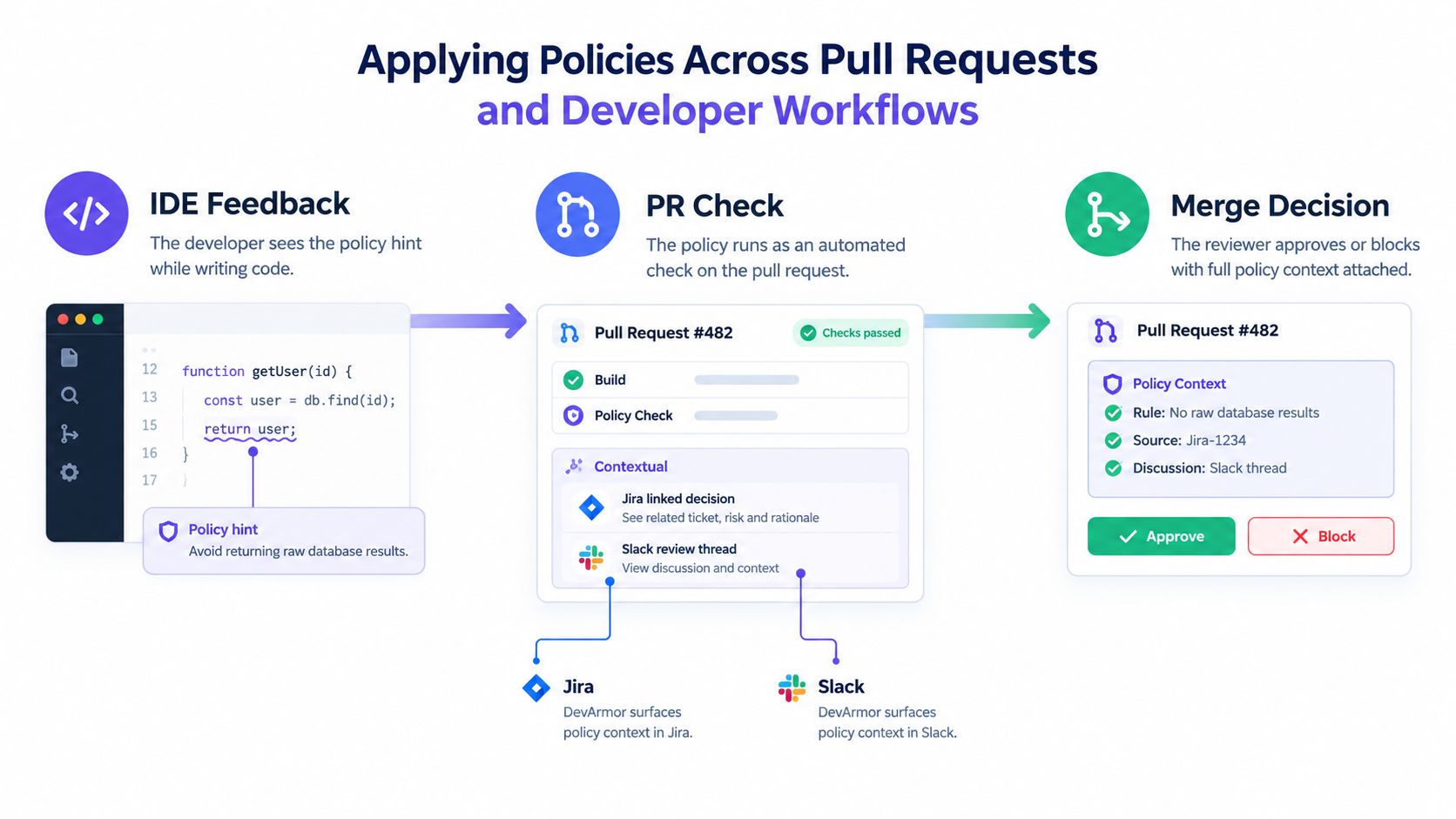
Start with the change surface developers actually touch
The first useful check is local. If a developer adds a public endpoint, modifies auth logic, or changes an IaC module that affects network exposure, the tooling should identify which approved design decision governs that change.
Keep that signal lightweight at first. In the editor, I want a clear prompt that says this file or resource maps to decision ADR-14 or threat model TM-22, plus the rule that will run in CI. That gives the developer enough context to fix the issue before a reviewer or build system gets involved.
DevArmor is one example of this model. It links approved design decisions and threat models to pull request policy checks, with the same context surfaced in GitHub, Jira, VS Code, and Cursor. The value is not the alert by itself. The value is that the alert names the decision being enforced.
Make the PR the place where policy and intent meet
A good PR check should read like a review aid, not a scanner dump. Reviewers need to see what changed, which decision the change touched, whether the policy passed or failed, and what the author should do next.
The fastest reviews happen when that context is already in the PR body and status checks. I usually want a template that asks for the design reference, flags exception requests, and records whether the change affects identity flows, data handling, or exposed services. That is enough structure to keep reviews honest without turning every PR into a compliance form.
Four questions should be answerable without leaving the PR:
- What approved decision does this policy enforce?
- Which file, resource, or behavior triggered the check?
- What evidence supports the result?
- Is the reviewer approving a fix, an exception, or a justified no-op?
If reviewers have to chase links across three systems to answer those questions, the workflow is still too loose.
Run the same policy twice for different reasons
The strongest pattern is a dual-layer check. Evaluate the policy in CI to catch problems before merge. Evaluate the same policy again at admission or deployment to catch bypasses, out-of-band changes, and generated artifacts that did not go through the expected PR path.
Those two checks serve different purposes. The PR check is for speed and guidance. The deployment check is for integrity. Teams that skip the second layer usually discover the gap when someone hotfixes a manifest, force-merges after disabling a status check, or applies infrastructure from a separate automation path.
This matters even more in regulated environments with mixed tooling. A service can pass a GitHub check and still drift at deploy time because the rendered manifest, Helm values, or Terraform plan no longer matches what the PR reviewers saw. Reusing the same policy logic across both stages closes that gap and gives security a cleaner story when someone asks why a change was allowed.
Treat AI-assisted changes like any other design-affecting input
AI coding tools increase output, but they also increase review load. The failure mode is rarely obvious syntax trouble. It is subtle drift from an approved identity pattern, network boundary, or data flow that still looks plausible in a diff.
Apply the same decision-linked checks to generated code, generated tests, and generated infrastructure patches. If an assistant proposes a route outside the approved auth path, the PR should say which decision it conflicts with. If an agent opens storage or messaging access beyond approved scope, the CI result should point to that control directly. For teams tightening this part of the workflow, code review automation for policy-aware pull requests is a useful reference.
Good policy application works because it stays close to how engineers already ship. It shows the rule early, explains it in the PR, and verifies it again before release. That is how teams keep policy tied to approved decisions instead of letting it decay into disconnected scanner rules.
Building Audit Traces That Prove Every Decision
A regulator asks why a change to payment service access shipped on Friday even though the policy check showed a warning on Wednesday. If the team can only produce a pipeline log and a Slack thread, the problem is no longer the warning. It is the missing chain between an approved design decision, the PR discussion, the exception, and the final deploy record.
That chain is the audit trace.
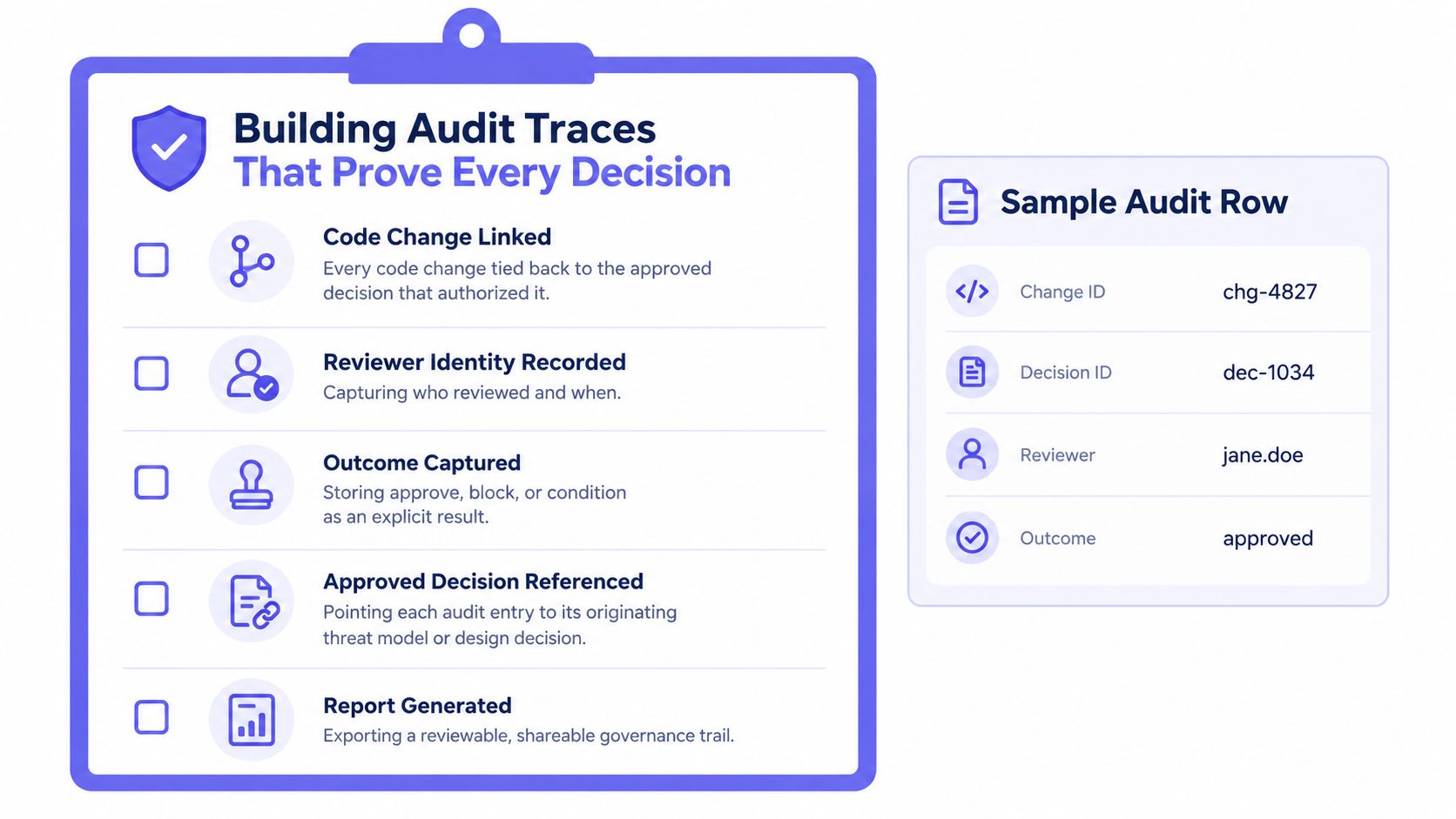
Auditors rarely question whether a scanner ran. They question whether the organization can prove why a specific change was allowed, blocked, or approved with conditions. A useful trace answers that from end to end. It starts with the approved decision the policy is enforcing, then ties that decision to the code change, the PR outcome, any override, and the final enforcement record.
Capture the minimum evidence that reconstructs intent
Teams do not need a large evidence model. They need one that lets another reviewer reconstruct the decision path without pulling people into a meeting six months later.
Store these fields together on the policy event:
- Change reference: PR number, commit SHA, or merge identifier
- Decision reference: Architecture decision record, threat model ID, or approved control record
- Policy result: Pass, block, advisory warning, conditional pass, or exception
- Enforcement layer: PR check, merge gate, deploy check, or admission control result
- Reviewer identity: Who approved, overrode, or accepted the exception, and when
- Reasoning artifact: PR comment, linked ticket, exception note, or approval record explaining the call
The extra field that teams often miss is the enforcement layer. That matters because a policy linked to a design decision should leave two traces when dual-layer checks are in place: one trace in the PR where the change was reviewed, and another where the same decision was verified before release. If those records disagree, the mismatch is often more useful than a pass. It shows drift, rushed overrides, or changes introduced after review.
Make the trace tamper-evident and reviewable
Screenshots, chat messages, and copied spreadsheet rows do not hold up well under audit. They also fail internal review because no one can tell which record is authoritative.
Keep the trace in systems with stable identifiers and access history. In practice, that usually means source control status checks, signed review events, linked ticket records, exception objects with expiry dates, and deployment logs that cannot be edited. If formal documentation is thin, repository history and policy metadata can still provide a defensible record, as long as the policy event points back to the approved decision it enforced.
The goal is simple. A reviewer should be able to open one record and answer four questions quickly: Which design decision applied? What changed? What did the policy report in the PR and at release? Who accepted the outcome?
A related example outside security is the PlotStudio AI audit trail, which focuses on preserving analyzable decision history instead of storing raw activity with no explanation.
If the record proves that a policy ran but does not prove which approved decision it enforced, the audit trail is incomplete.
Build the trace as part of delivery, not as audit prep
The strongest evidence is created during normal engineering work. The PR references the decision record. The policy check evaluates that decision against the proposed change. A reviewer either accepts the result or records an exception with scope and expiry. The deploy stage runs the second check and appends its own result to the same chain.
That model changes the audit conversation. Instead of assembling a story after the fact, the team can show the exact path from approved design to merged code to released artifact. It also exposes trade-offs clearly. If a team chose to warn in the PR but block at deploy time for a high-risk control, the trace shows that operating decision and who approved it. If a team allowed a short-lived exception to keep delivery moving, the expiration and approver are already in the record.
That is what makes policy application defensible in regulated delivery. The evidence does not sit beside the workflow. It is produced by the workflow and tied directly to the design decision the policy exists to enforce.
Practical Tips and Next Steps for Lasting Policy Success
Most programs don't fail because the policy engine is weak. They fail because the habits around it are inconsistent.
A durable operating model is usually simple:
- Start with one high-value decision: Pick a control that already has clear approval history, such as central authentication, restricted data egress, or approved secret handling.
- Enforce it in two places: Put the first check in the PR workflow and the second in deployment or admission control.
- Keep exceptions explicit: Require a named approver, written rationale, and a clear expiration condition.
- Review policy drift regularly: When repos, services, or ownership change, update the policy scope before the control goes stale.
- Treat AI-generated changes the same way: Generated code shouldn't get a separate trust model. It should face the same design-linked policy checks as handwritten code.
There's also a sequencing point that matters. Don't begin with a broad policy catalog. Begin with one end-to-end path that proves the pattern works. Tie one approved design decision to one policy, surface it in the IDE and PR, reuse it at deployment, and confirm you can export the trace cleanly.
Recent application security reporting shows a large identity-control gap, with 57% of analyzed applications not routing authentication through a central secure identity provider (state of modern application and AI security). That makes identity-linked policy a strong first candidate because the decision boundary is easy to explain and the review outcome is usually clear.
The teams that get lasting value from security policy application don't obsess over policy volume. They focus on whether policy protects a real approved decision, whether developers see it in their normal tools, and whether the organization can prove what happened later. When that loop is in place, policy stops feeling like a release tax and starts acting like a delivery control.
DevArmor helps teams turn approved threat models and design decisions into enforceable pull request policies with traceable outcomes across planning, coding, and review workflows. If you want security policy application to live inside delivery instead of outside it, visit DevArmor to see how continuous design context, policy enforcement, and audit-ready traces fit together.
Table of Contents
Subscribe