Code Review Automation: A 2026 Guide for Regulated Teams
 Reza Khosravi
Table of Contents
A payments pull request has been open for nine days. One reviewer flagged a possible PCI scope change, another requested a threat-model update, and a third never returned to the queue. The merge remains blocked, while an urgent fix moves through another branch with less scrutiny than the change it was meant to replace.
That pattern is familiar in regulated engineering teams. The problem isn't that people don't care about secure delivery. The problem is that the same engineers are handling on-call work, incidents, roadmap commitments, and reviews. Code review automation can restore a predictable baseline, but only when teams treat it as a control loop from design through deployment, not as a bot that comments on a diff.
Why Regulated Teams Need Code Review Automation Now
Manual review drift creates more than a slow queue. It produces inconsistent control application across services, concentrates review knowledge in a small group, and leaves auditors asking why one repository enforced a rule that another repository treated as optional. Under SOX, HIPAA, PCI DSS, and DORA-related governance expectations, a voluntary review process is difficult to defend when delivery pressure changes who is available.
The practical answer isn't to remove human reviewers. It's to ensure that every pull request receives the same baseline checks before a person spends scarce attention on business logic and architecture. Identity handling, secret exposure, dependency risk, required approvals, and compliance policies should be evaluated consistently, with the outcome recorded in the source-control system.
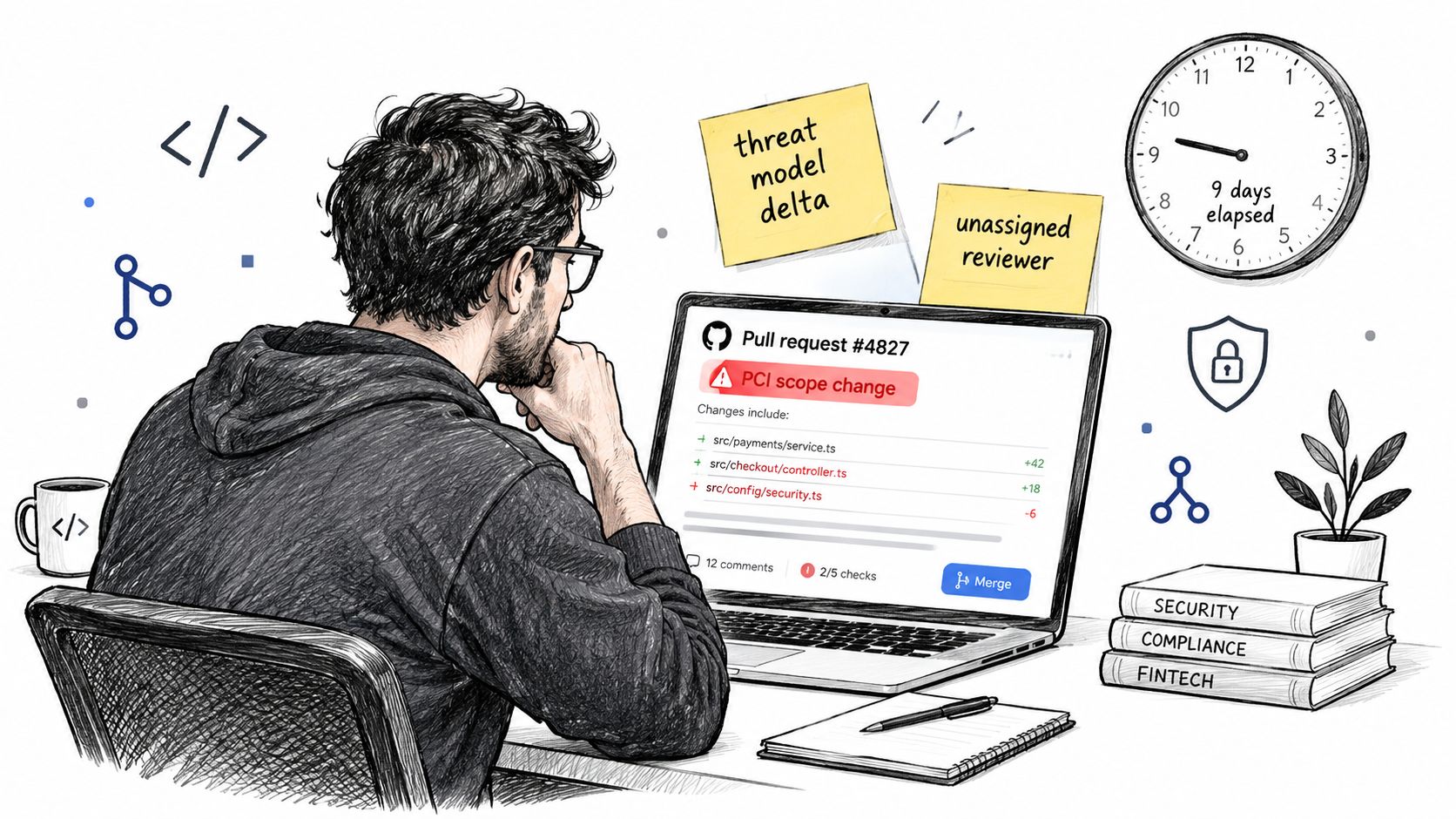
The cost of review drift
A stalled payments change creates one type of risk, but an unreviewed hotfix creates another. Teams may preserve the appearance of a gate while engineers route around it, leaving an incomplete audit trail and making it harder to reconstruct who approved what.
A useful starting point is to compare the developer tools already connected to your delivery workflow, including their CI/CD integration, review controls, and evidence capabilities. A practical comparison of developer tools for CI/CD can help teams evaluate that surrounding workflow without reducing the decision to a single scanner.
Practical rule: Automation should make the safe path the easiest path, while preserving a documented human exception for incidents.
The strongest implementation establishes a minimum review contract. Every pull request runs the same objective checks, every failure names the violated rule and evidence, and every override records the person, reason, and affected control. That gives security teams something concrete to test and gives developers feedback before a review becomes a meeting.
The Core Building Blocks of an Automated Review Stack
A defensible stack has four layers, and each answers a different audit question. Static analysis asks whether the changed source contains known defect patterns. Software composition analysis and secret scanning examine what the code relies on and whether credentials have entered the repository. Policy-as-code evaluates organizational and regulatory rules, while orchestration proves that the checks ran and influenced the merge decision.
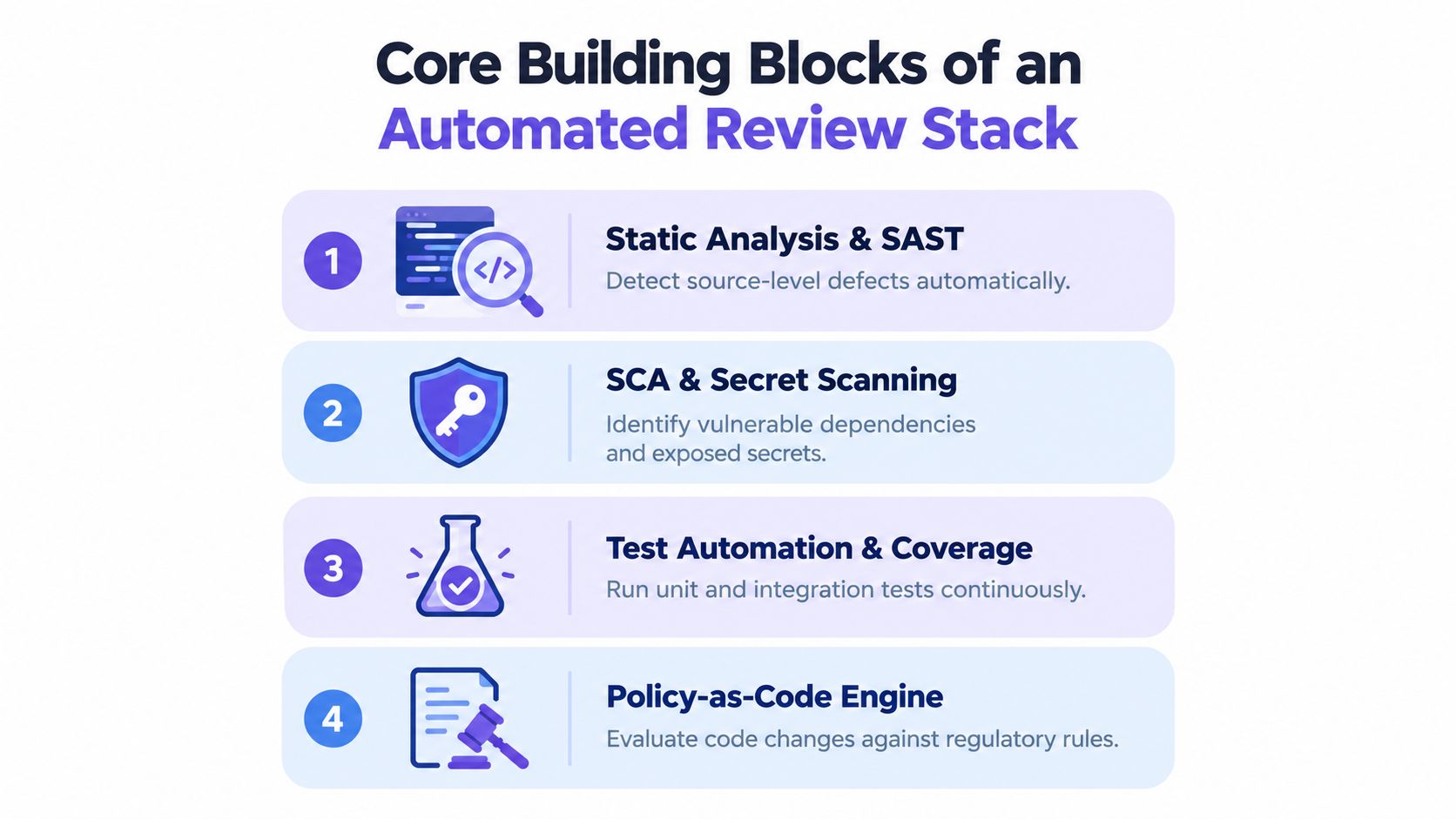
Four layers, one control path
Static analysis and SAST inspect source-level behavior. They can identify injection patterns, insecure API use, unsafe data handling, and other defects that are visible in code. The output must retain file, line, rule, severity, and remediation guidance, otherwise the finding becomes difficult to validate later.
SCA and secret scanning cover risks outside the immediate logic of a function. SCA checks dependencies against approved usage and known exposure, while secret scanning looks for credentials and sensitive tokens. These tools should pass structured results to the same review record rather than creating an unrelated security inbox.
Policy-as-code converts internal rules into executable assertions. A policy can require approved cryptographic libraries, restrict access to sensitive data, demand a design reference for certain service changes, or require specific reviewers for a protected area.
Review orchestration connects the tools to pull requests and merge controls. It starts jobs, posts check runs, normalizes results, retries recoverable failures, and records the final decision in the source-control platform.
The seams matter more than the individual products. SAST hands findings to policy evaluation, policy hands its verdict to the status gate, and the gate stores evidence with the pull request. Teams building this layer can use application security automation guidance as one reference point, but the control design still needs to match the repository and regulatory boundary.
A control walkthrough should answer four plain questions:
- Was the code assessed? Show the tool, version, commit, and result.
- Were dependencies and secrets checked? Show the relevant scan outputs.
- Did the change follow team rules? Show the policy version and violations.
- Could the change merge before clearing them? Show branch protection and status enforcement.
If those records live in separate systems with no stable identifiers, an auditor or incident responder must perform manual archaeology. That's a sign the orchestration layer isn't finished.
Selecting and Tuning Checks That Actually Get Resolved
A scanner earns trust when developers resolve its findings. A 2026 empirical study found that 73.8% of automated review comments were marked resolved and implemented, while the average developer rating was 3.46 out of 5, with a 1.79 standard deviation indicating uneven comment quality (the automated code review study). The useful benchmark isn't comment volume. It's whether the team can act on the output without learning to ignore the bot.
Start with the backlog, not the vendor defaults
Inventory every enabled rule, including rules inherited from shared configurations. For each one, record severity, affected file types, historical disposition, owner, and the remediation a developer is expected to perform. Then separate high-confidence blocking rules from advisory rules that need local context.
A FinTech team might treat MD5 usage as blocking in authentication paths while suppressing it elsewhere when the use is unrelated to security or integrity. A HealthTech team might hide a regular-expression denial-of-service rule when it repeatedly fires on harmless test fixtures, while retaining an explicit opt-in for production input handlers. The correct decision depends on the trust boundary, not the rule name.
| Signal Band | Resolution Rate | Action | Audit Treatment |
|---|---|---|---|
| High signal | Consistently resolved | Block or require documented approval | Keep in the mandatory control catalog |
| Mixed signal | Resolved after contextual review | Comment first, block only in defined paths | Record scope, exceptions, and owner |
| Low signal | Frequently dismissed or ignored | Disable by default and require opt-in | Document the rationale and review date |
The study also found that average pull request closure time increased from 5 hours 52 minutes to 8 hours 20 minutes, even while the resolution rate remained high (the study's practical findings). That trade-off is important in regulated delivery. A check can surface real issues and still reduce throughput if it generates too many comments or forces repeated verification.
Lock the baseline
Once the team chooses its enabled checks, the set becomes part of the control catalog. Store configuration in version control, require a documented change review, and assign an owner for each rule family. A monthly rule-review meeting gives reviewers a place to report false positives, recalibrate severity, and retire checks that no longer match the architecture.
Don't let developers solve noise with permanent inline suppressions. Require a reason, an expiry or review condition, and a link to the responsible decision. That keeps exceptions visible instead of turning the codebase into a collection of silent bypasses.
Wiring Up Policy-as-Code, PR Gating, and Merge Controls
Policy-as-code becomes a real control only when its verdict reaches the merge button. A passing message from a review bot isn't enough if a developer can merge while the underlying status check remains unresolved.
Encode the rule and enforce the result
Start with the requirements that matter to the repository. A PCI DSS policy module might inspect payment-service changes, restrict sensitive logging, require approved handling for cardholder data, and demand reviewers with the right ownership. Internal secrets-handling rules can enforce approved secret stores and reject credentials embedded in source or configuration.
Rego and CEL are practical policy languages, but the syntax isn't the main design decision. Each assertion needs a clear subject, evidence source, severity, remediation, and owner. The policy engine should evaluate the pull request commit and record the exact policy version used.
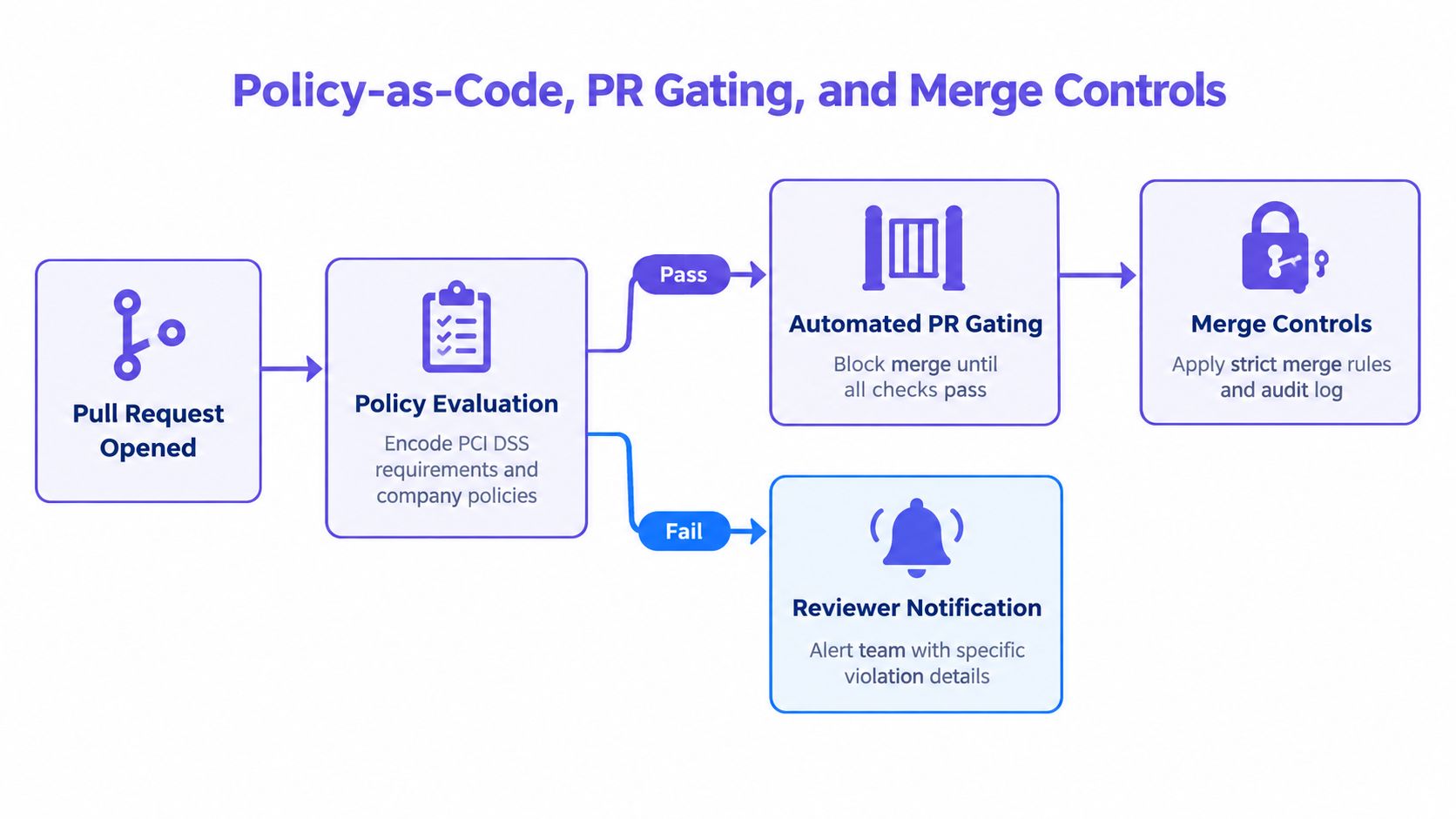
A tokenization-service change illustrates the flow. A developer opens a pull request that adds an unredacted payment account number to a log statement. The policy engine identifies the line, explains the prohibited data flow, and returns a failed status. Branch protection keeps the merge control disabled until the line is corrected or an authorized exception is recorded.
Configure branch protection to require the controls that match the risk:
- Critical policy result: No critical violations can remain unresolved.
- Review identity: Require signed commits where the repository's process demands them.
- Ownership: Use CODEOWNERS to route payment or patient-data changes to accountable teams.
- Approval count: Require the appropriate human reviewers for sensitive services.
- Security status: Require passing SAST, dependency, and secret checks before merge.
Make the audit trail automatic
Required-reviewer records, CODEOWNERS decisions, signed-off-by information, policy results, and commit identifiers should flow into a release evidence packet. Teams that need a plain-language overview of delivery stages can consult this DevOps pipeline guide for non-technical founders, but regulated engineers should translate that overview into enforceable repository controls.
The merge platform must enforce the decision at the platform layer. A red comment that leaves the merge button active is advice, not a gate. For implementation patterns and reusable examples, see policy-as-code examples.
Surfacing Context Where Developers and Agents Already Work
A pull request can pass every local scanner and still fail an audit because nobody can explain why the change was designed that way. Context loss occurs when the threat model stays in a meeting note, the design decision sits in a document, and the policy result appears only as a transient CI message.
The fix is to place the same security context in the tools where work already happens. An IDE integration can flag a sensitive API call while the developer is writing it. A Jira or Linear ticket can retain the linked design decision, threat-model excerpt, policy verdict, and resolved review discussion. The pull request then carries a traceable explanation instead of only a collection of findings.
Give coding agents the same contract
Coding agents should be treated as contributors to the same delivery process, not as a privileged path around it. Feed them the repository policy, security annotations, approved design constraints, and resolved review comments. Require generated changes to pass the same source, dependency, secret, test, and policy checks as human-authored changes.
This is especially important because trust depends on comprehensibility and perceived correctness. In a 2025 study of AI-assisted development, developers retained only 52% of original suggestions, showing that generated output is often edited, rejected, or reshaped before adoption (the research on developer trust factors). The system should preserve that decision history, including what was accepted and what was changed.
Prevent clean but contextless merges
A clean CI result doesn't prove that the implementation matches the approved architecture. If a PR changes authorization behavior but has no linked threat-model entry, the gate should request that linkage before merge. If the design changed during implementation, the workflow should route the difference back to security review rather than accepting documentation drift.
Useful context fields include:
- Design reference: The approved RFC, ticket, or architecture decision.
- Security rationale: The relevant threat-model item and treatment.
- Policy evidence: The rule, version, input, and verdict.
- Reviewer discussion: Resolutions, exceptions, and accountable approvers.
- Agent provenance: The coding agent or workflow that generated the change.
When on-call engineers investigate an incident, those links reduce reconstruction time and clarify whether the failure came from an incorrect design, an incomplete implementation, or a control that never ran.
Validating the Pipeline From Design Decision to Deployment
A passing pull request is only one point in the delivery chain. Regulated teams need to prove that the deployed artifact corresponds to the reviewed change and that the review evaluated the intended policy version.
Test four invariants
Build a validation harness that samples merged pull requests and checks the chain independently of the normal happy path. For each sampled change, assert that:
- A design document is linked to the pull request.
- The threat-model entry is approved for the affected behavior.
- The evaluated policy version is recorded in commit or release metadata.
- The deployed artifact matches the reviewed commit.
Store the result as structured evidence, not as a screenshot. A release packet can contain the pull request URL, reviewers, policy version, threat-model identifier, build hash, and deployment timestamp. The exact fields should reflect the organization's control catalog, but every field should be queryable and immutable after release.
Exercise the negative path
Teams often test whether a valid change passes and forget to test whether an invalid change fails. Run a quarterly drill that intentionally removes one required design link, changes the policy reference, or attempts to deploy an artifact built from a different commit. Confirm that the gate catches the defect and that the failure appears in the audit record.
Validation is not a green pipeline. It's evidence that the pipeline rejects the wrong chain.
Consider a HealthTech patient-data export endpoint. The approved RFC defines the endpoint's purpose and authorization boundary. The threat model records the risks of unauthorized export and identifies the required controls. The pull request links both artifacts, the policy engine checks authorization and sensitive-data handling, the build signs the reviewed commit, and deployment records the resulting artifact hash.
An investigator should be able to query that chain from production backward. If the deployed hash can't be matched to the reviewed commit, the review evidence no longer establishes what shipped.
Verification and validation are related but distinct disciplines, so teams formalizing this control should review the difference between verification and validation. Verification asks whether the implementation satisfies specified checks. Validation asks whether the resulting system and process support the intended use and risk posture.
Reconcile continuously
Run the harness after deployments, not only during an audit period. Compare repository metadata, build records, deployment records, and threat-model state. Alert when a service changes materially without a corresponding design or security update.
That feedback keeps the control loop alive. Otherwise, teams can preserve perfect historical evidence while the current architecture diverges from it.
Closing the Trust Gap With Layered Human and Automated Review
Automation shouldn't ask reviewers to trust an unexplained machine verdict. It should make the evidence easier to inspect and reserve human judgment for the decisions machines can't reliably own.
The trust problem is substantial. A 2025 developer survey reported that 33% of developers trusted AI-generated code, while 46% did not; a separate 2026 study found 96% of developers didn't fully trust AI-generated code, and only 48% always verified AI-assisted code before committing (the developer trust discussion). Those figures don't support replacing human review with an opaque agent. They support layering objective enforcement, contextual analysis, and accountable approval.
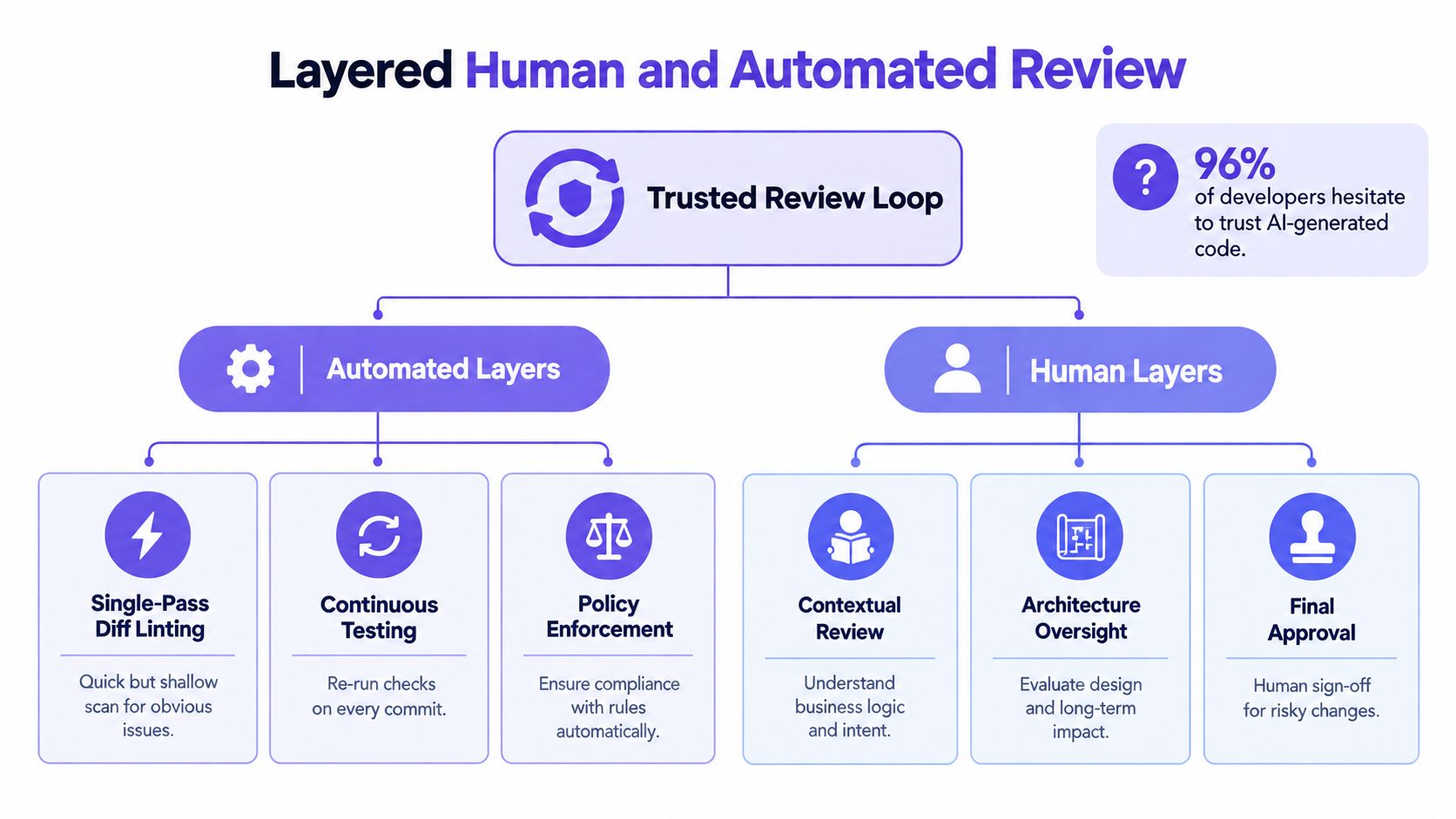
Assign each layer a job
Single-pass diff linting handles fast, obvious defects. It shouldn't claim architectural understanding.
Continuous testing reruns tests as commits change and catches regressions that a static rule can't see.
Policy enforcement blocks objective violations such as exposed secrets, missing approvals, prohibited data handling, or unapproved dependencies.
Contextual automated review can investigate data flow, authorization paths, and patterns across related files, but its findings need explanation and human challenge.
Architecture oversight remains with engineers who understand system intent, dependencies, operational constraints, and threat-model decisions.
Final approval belongs to an accountable human for risky changes, especially when the control outcome is ambiguous or the implementation departs from the approved design.
A useful review comment contains the rule, the evidence, the affected code, the severity, and a suggested remediation. It should also state what it didn't evaluate, such as downstream consumers or runtime behavior. Explainability isn't a presentation feature. It's what lets an engineer correct the issue and lets an auditor replay the decision.
Measure trust as an operating property
Track metrics that expose whether the system helps or obstructs review:
- Reviewer override rate: How often humans bypass or reject an automated decision.
- False-positive ratio by rule: Which controls create noise in specific repositories.
- Time to resolution by severity: Whether critical findings receive different treatment from suggestions.
- Audit-trace completeness: Whether merged pull requests retain the required design, policy, reviewer, build, and deployment evidence.
These measures reveal different failures. A high override rate may indicate excessive severity, weak context, or an emergency process that has become routine. A strong resolution rate paired with longer closure time may indicate that the findings matter but the bot is creating review friction, a trade-off documented in the empirical study of automated review (the measured review trade-off). Use the earlier benchmark once, but continue tracking the underlying behavior locally.
The payments scenario needs a gate that catches sensitive changes consistently without blocking legitimate incident work. The patient-data export needs a trace from approved design to deployed artifact. A layered stack handles both by producing reviewable evidence rather than deciding that a machine is right.
DevArmor connects continuous threat modeling, security design reviews, policy-as-code enforcement, and implementation verification across planning tools, IDEs, source control, and deployment evidence. If your FinTech or HealthTech team needs code review automation tied to living security context and auditable merge decisions, visit DevArmor to evaluate how it can fit into your delivery pipeline.
Table of Contents
Subscribe