Security by Default: Principles and Practical Guardrails
 Reza Khosravi
Table of Contents
Most secure configurations aren't created by heroic security work after deployment. They come from defaults shipped by the platforms teams already use, a pattern documented in HTTPS research covering more than 4 million websites, where major cloud providers' secure defaults accounted for most secure configurations, while server software defaults and online configuration advice were often insecure (Stanford HTTPS research). The counterintuitive lesson is that security improves when teams remove decisions from users, provided those decisions are enforced continuously.
Security by default therefore means more than enabling TLS or disabling an unused service during launch. It means designing the safest practical starting state, enforcing it through code review and delivery pipelines, and detecting overrides after deployment. The approach reduces dependence on individual judgment at exactly the points where modern engineering creates the most change, including ephemeral infrastructure, rapidly changing dependencies, and AI-assisted code generation.
Why Secure Defaults Are No Longer a One-Time Setting
Secure defaults fail when they are treated as a launch checklist instead of a control system. Teams may disable unnecessary ports, require stronger authentication, configure encryption, and close the ticket. That can establish a sound starting posture, but it does not preserve security through infrastructure changes, dependency updates, or urgent production fixes.
Cloud environments can recreate resources from a modified template. A package update can change transitive behavior. A developer can copy a permissive example into a new service, and an AI coding assistant can generate plausible configuration that violates an internal policy. None of these changes must intentionally weaken security. They only need to bypass the original hardening decision.
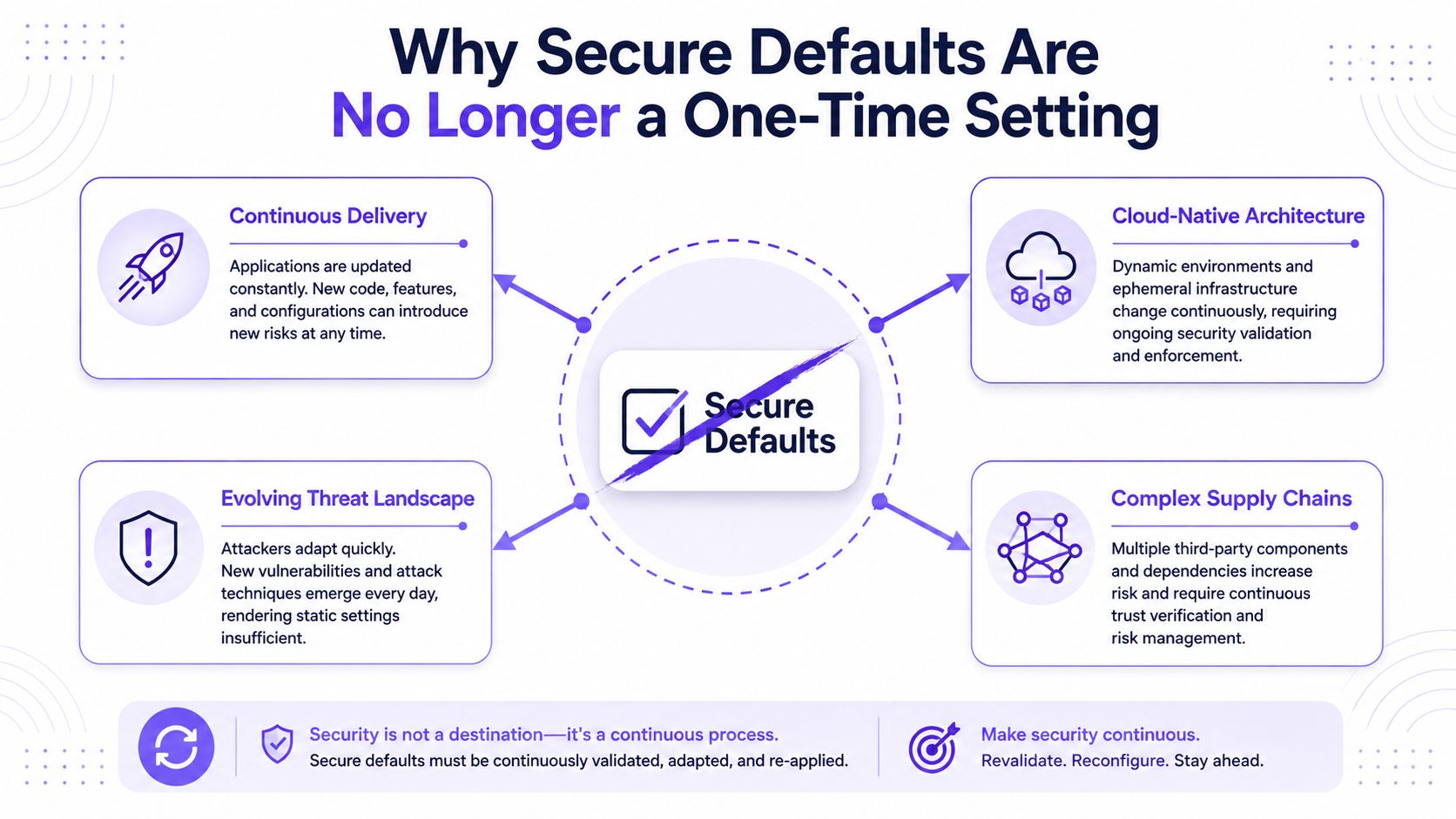
Drift changes the meaning of default
A setting remains secure only while the system continues to apply it. That requires policy-enforced guardrails across the engineering path:
- Design: Threat models and architecture decisions define acceptable access, encryption, and data-handling states.
- Code review: Repository policies reject unsafe patterns before they enter the delivery path.
- CI/CD: Build and deployment gates validate dependencies, infrastructure manifests, credentials, and provenance.
- Runtime: Admission controls and monitoring identify resources that no longer match the approved state.
Configuration drift is only one failure mode. Dependency rot and shadow infrastructure create the same exposure. A team may maintain a hardened primary deployment while a temporary environment, copied pipeline, or manually created cloud resource follows older rules. The original secure setting then becomes a historical artifact rather than a live control.
AI-assisted development adds another route around static defaults. Generated code and configuration should pass the same policy checks as manually written changes, with explicit controls for approved libraries, permissions, secrets, and deployment settings.
Practical rule: Treat every default as a policy with an owner, a test, and an enforcement point.
The CISA secure-by-design guidance defines secure-by-default products as resilient against prevalent exploitation techniques out of the box, without extra charge or additional user hardening. The principle assigns responsibility to the product and its manufacturer, rather than requiring each customer to discover and correct unsafe choices.
Engineering organizations should apply the same standard internally. A secure default that depends on a developer remembering a manual hardening step is an optional control, not a default. Continuous checks turn the intended state into an enforced one.
The Policy Milestones Behind Security by Default
Security by default became a policy expectation when governments began assigning responsibility for unsafe product choices to manufacturers, not customers. In April 2023, CISA and partner agencies from the United States, Australia, Canada, New Zealand, the United Kingdom, Germany, and the Netherlands published Shifting the Balance of Cybersecurity Risk: Principles and Approaches for Secure by Design Software (CISA's joint report announcement). Its position is direct: products should resist common exploitation techniques without requiring customers to pay for extra protection or perform additional hardening.
The guidance gained further definition in October 2023, expanding from an original 14-page paper to a 36-page document. That change signaled a shift from broad principle to operating model, covering product design, manufacturer responsibility, and customer expectations. For engineering teams, the implication is practical: a secure default must be encoded, tested, and enforced throughout the delivery path rather than documented as a preferred configuration.
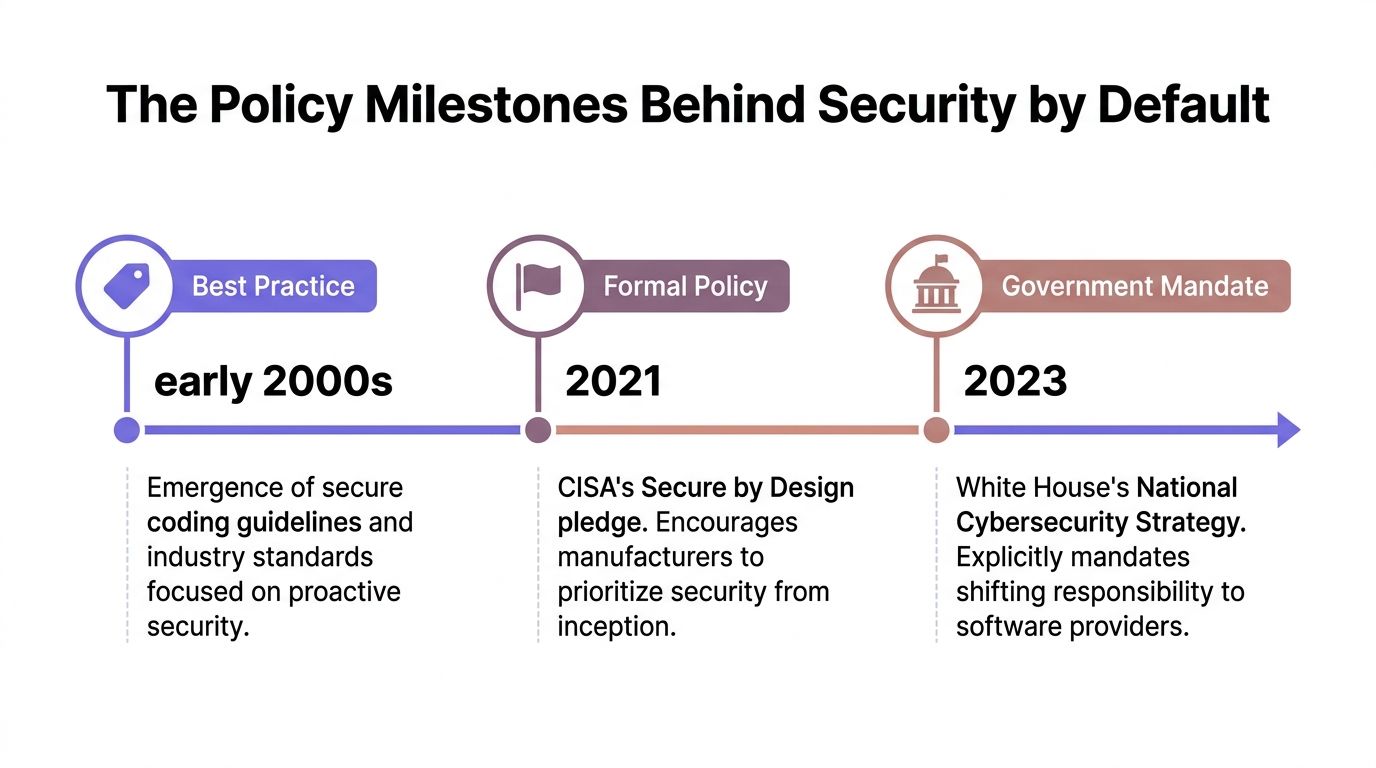
From principle to accountability
The United Kingdom's 2018 guidance established an important foundation, stating that security should be built into products from the beginning because it can't be added later (UK National Cyber Security Centre guidance). An available control does not protect users who do not know it exists, cannot configure it correctly, or must purchase it separately.
Australian guidance makes the operational expectation clearer. Secure-by-default products should require little or no extra setup, with multifactor authentication, auditing, and event logging included in the base product at no additional cost. A normal deployment should start in a defensible state, rather than depend on an expert administrator to correct unsafe settings.
CISA's 2024 Secure by Design pledge adds an accountability mechanism. Manufacturers commit to publishing a vulnerability disclosure policy that permits public testing and coordinated disclosure within one year of signing (CISA Secure by Design pledge). That deadline converts a general aspiration into a measurable commitment.
For regulated teams, reviews now require evidence across design, code, and AI-assisted development workflows. Security leaders should identify who owns each default, how it is tested, which policy validates it, and how exceptions are approved. A control documented in a standard but absent from deployment code is difficult to defend during an audit and harder to trust during an incident. Policy-enforced guardrails keep the approved state active as systems, dependencies, and generated changes evolve.
Core Principles That Define a Secure Default
A secure default is defined by the path taken when nobody makes a security choice. If a new deployment opens access, enables unnecessary features, exposes sensitive errors, or waits for manual hardening, the product is not secure by default. It may contain strong controls, but those controls do not protect the initial state.
The following principles give design reviews a practical standard. They also translate cleanly into tests, policy checks, and guardrails that can run across source code, infrastructure, and AI-generated changes.
Least privilege from first run
Grant only the permissions required for the declared function. A new service should not receive broad administrative access just to simplify its first deployment. Infrastructure templates should create narrowly scoped roles, separate read and write capabilities, and require explicit approval for sensitive operations.
Apply the same rule to human accounts. Avoid default administrator profiles, shared credentials, and inherited permissions that users must later remove. If a workflow needs higher-level access, make that access deliberate, time-bound where practical, and visible in audit records.
Deny unless explicitly authorized
Access controls should start from rejection. A new API route should require an authenticated identity and an allowed action before reaching protected data. Storage should remain private unless a reviewed policy permits public access. Cross-origin rules should name trusted origins rather than accept arbitrary origins for convenience.
The same default belongs in delivery pipelines. A dependency, container image, or infrastructure module that has not passed organizational policy should not reach production because a warning was overlooked. CI checks and admission policies should block the change, record the reason, and define a reviewable exception path.
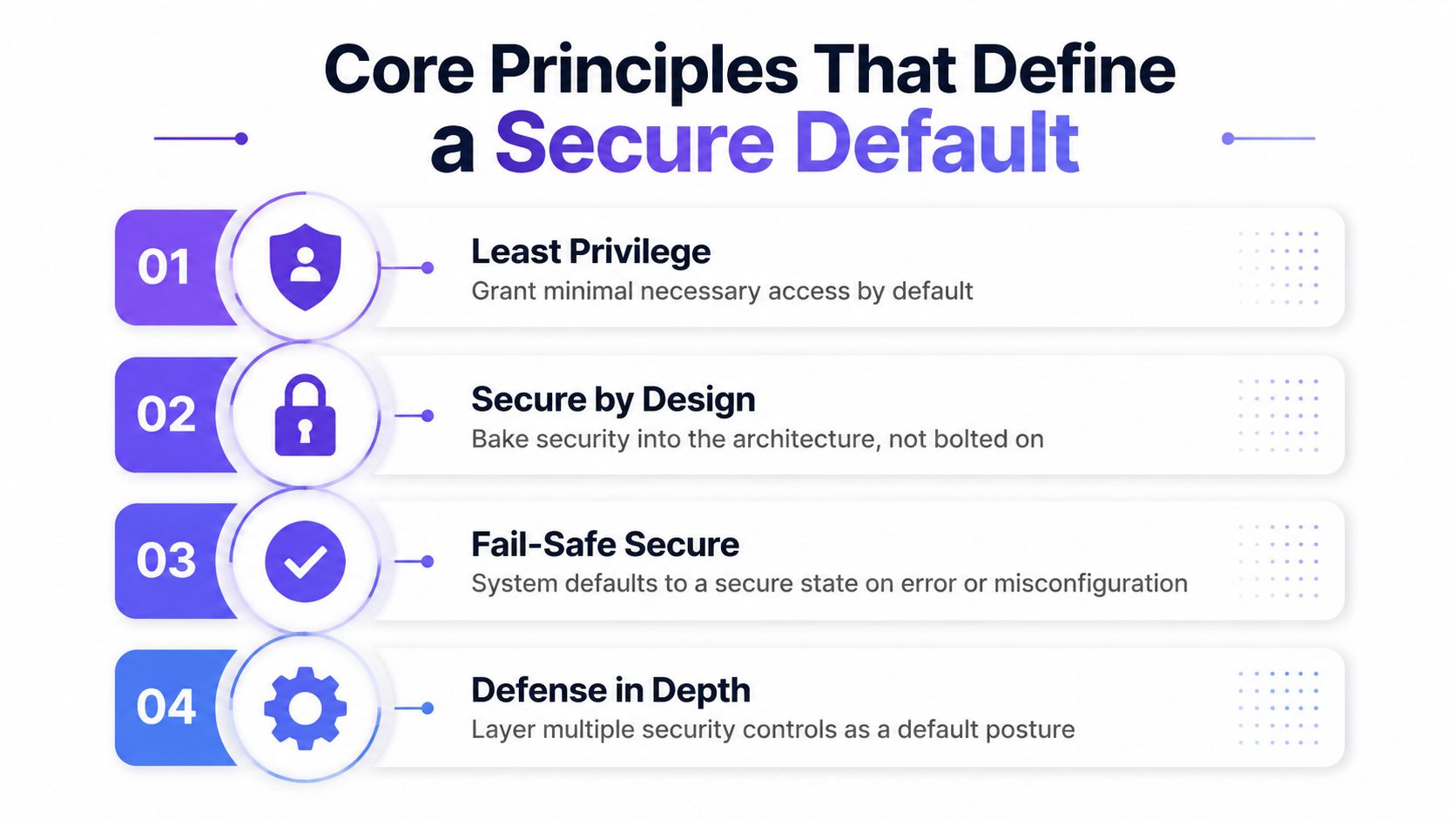
Protect data and reduce attack surface
Enable encryption in transit and at rest without a separate setup journey. Logging should capture security-relevant events, while production errors should provide useful, safe messages instead of stack traces, internal paths, tokens, or database details.
Reduce the number of components that require protection. Disable unused protocols, services, administrative endpoints, and sample applications. A smaller installation gives defenders fewer items to monitor and attackers fewer paths to test.
Fail safely and add layers
A secure system should fail into a state that preserves protection. If a policy service is unavailable, the application should not switch to unrestricted access. If configuration validation fails, deployment should stop or use a conservative fallback instead of accepting a permissive value.
Defense in depth limits the impact of a missed control. Combine identity checks, network restrictions, application authorization, encryption, logging, and runtime monitoring. Teams handling personal data can use GDPR compliant security practices to connect privacy obligations with concrete technical safeguards.
A default is secure when the safest practical behavior is also the easiest behavior to deploy.
Practical Defaults for Libraries Infrastructure and CI/CD
The most dangerous defaults often arrive through tools teams trust. Package managers, cloud consoles, infrastructure modules, and CI/CD platforms can all make the insecure path convenient. The remedy isn't to eliminate convenience. It's to move convenience toward a controlled, reviewable baseline.
| Domain | Insecure Default | Secure Default | Risk Mitigated |
|---|---|---|---|
| Libraries | Floating version ranges, unchecked transitive dependencies, disabled signature verification | Lockfiles, approved registries, dependency allowlists, and verification where supported | Unexpected code changes, dependency substitution, and vulnerable packages |
| Infrastructure | Broad IAM roles, publicly reachable storage, unencrypted volumes | Narrow roles, private networking, explicit exposure review, and encryption enabled in templates | Unauthorized access, data exposure, and lateral movement |
| CI/CD | Long-lived credentials and unrestricted secret access | Short-lived OIDC tokens, job-scoped secrets, and environment-specific permissions | Credential theft and pipeline takeover |
| Build integrity | No verifiable record of how an artifact was built | Signed build metadata and SLSA-aligned provenance practices | Tampered artifacts and uncertain supply-chain origin |
Libraries need deterministic inputs
A lockfile makes dependency resolution reproducible, but it isn't a complete security control. Teams still need an approved source, vulnerability policy, review of new transitive packages, and a defined process for urgent upgrades. Signature verification can improve confidence in origin, although it introduces key-management and registry-compatibility work.
The operational trade-off is real. Strict allowlists can delay a legitimate fix or block a package needed for a release. That trade-off is manageable when the exception process is fast, documented, and temporary. It isn't manageable when teams bypass the policy because the only alternative is a manual security escalation with no service-level expectation.
For a deeper treatment of dependency inventory and risk analysis, see this guide to software composition analysis.
Infrastructure should start private
Public storage, broad identity roles, and unencrypted volumes remain easy to create because cloud platforms optimize for fast provisioning. Secure templates should invert those assumptions. Create private resources first, require explicit network exposure, and define permissions around the exact actions and resources a workload needs.
Private-by-default networking can make debugging and integration slower. Developers may need approved test paths, temporary access mechanisms, or service-to-service identity that wasn't necessary in a permissive environment. Those are worthwhile engineering costs because they preserve a clear boundary between development convenience and production exposure.
CI/CD requires bounded trust
A pipeline shouldn't hold a reusable credential with broad access when a short-lived identity token can obtain narrowly scoped permissions for a specific job. Secret injection should be limited to the step that needs it, and production credentials should remain unavailable to untrusted pull requests.
Build provenance creates another useful boundary. An attestation can record which source, dependencies, workflow, and builder produced an artifact. Teams adopting provenance controls must maintain signing identities, verify attestations at deployment, and handle failures when older artifacts lack the required evidence. Guidance on how to secure your pipeline with ThreatExploit AI can complement that implementation work, but the enforcement decision belongs in your own pipeline policy.
Enforcing Defaults with Policy as Code and Guardrails
Documentation describes a desired state. Policy as code enforces it. That distinction determines whether secure defaults survive the next pull request, infrastructure migration, or emergency release.
A practical enforcement chain starts before commit and continues into deployment. Pre-commit checks can catch hardcoded secrets and prohibited configuration patterns. CI can evaluate dependencies, infrastructure-as-code, branch protections, and build evidence. Kubernetes admission controllers can reject manifests that request public exposure, excessive privileges, or missing security context.
Put controls where developers make changes
Open Policy Agent can express authorization and configuration rules across systems. Kyverno can validate and mutate Kubernetes resources at admission, while Checkov can inspect infrastructure-as-code before cloud resources exist. These tools don't replace design judgment, but they turn an approved design decision into a repeatable test.
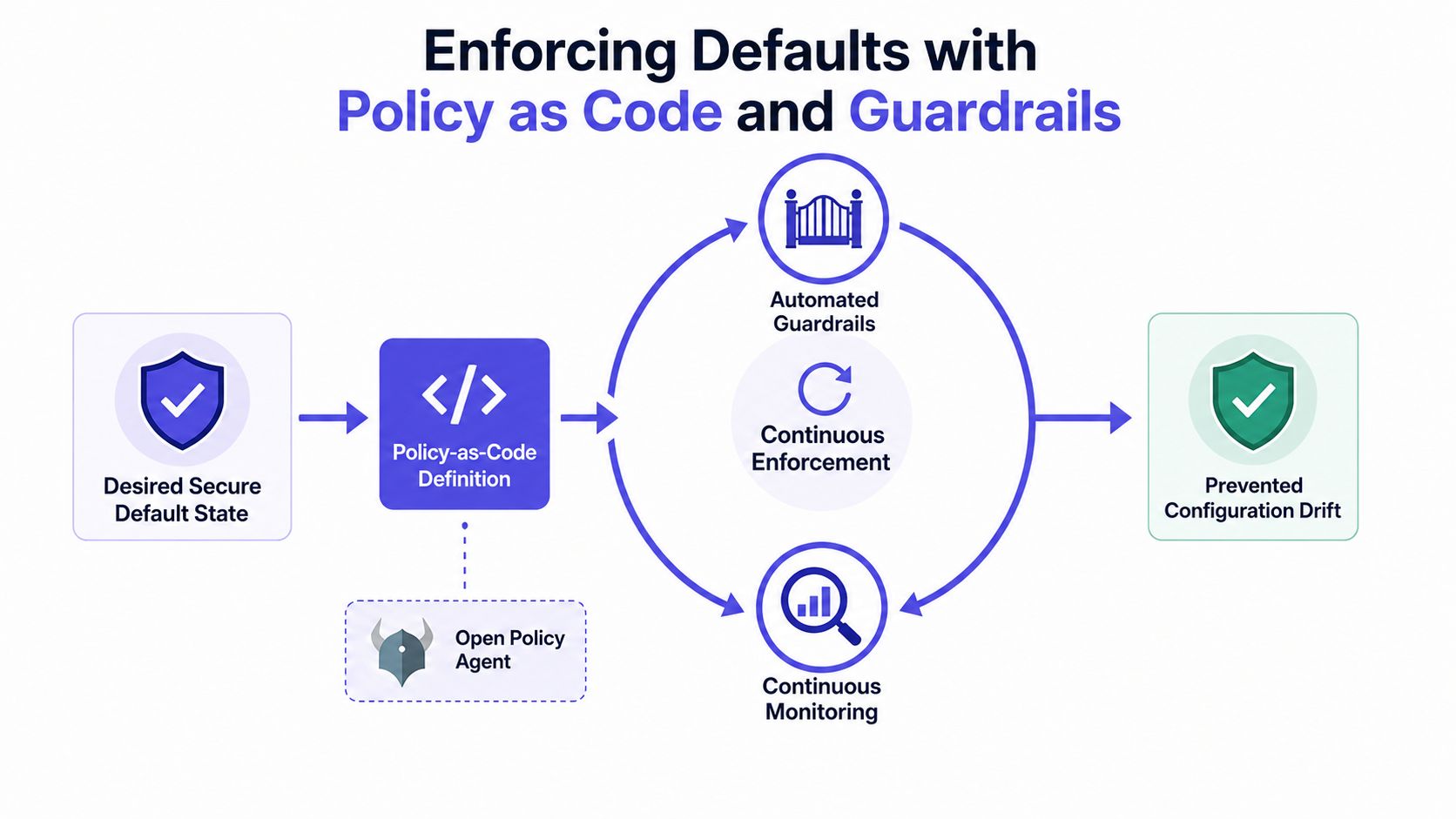
Warnings alone rarely hold under delivery pressure. If a rule matters, the default outcome should be a blocked merge or rejected deployment. Teams can still support controlled exceptions, but the exception must name an owner, a reason, an expiry condition, and the compensating control.
Policy repositories need the same discipline as application repositories:
- Version control: Store rules, tests, documentation, and ownership together.
- Peer review: Require security and engineering review for changes that weaken a default.
- Test coverage: Run policy tests against representative manifests and known failure cases.
- Exception records: Preserve approvals and expiry information in an audit-friendly system.
Close the loop with threat modeling
Continuous threat modeling makes guardrails responsive rather than frozen. When a design decision changes, the associated requirement should update the policy or trigger a review of the affected rule. A new service trust boundary, data flow, or deployment pattern can therefore create a concrete enforcement task instead of remaining trapped in a document.
Teams can use this overview of policy as code tools to compare implementation approaches. The important architectural choice is consistent across tools: define the acceptable state once, test it in the delivery path, and monitor the deployed state for deviation.
Securing AI-Assisted Development Workflows
An AI coding assistant can generate a useful endpoint quickly and still introduce several security defects in the same change. Consider a service that receives a prompt to add an authenticated API route. The generated example includes a secret in a configuration snippet, permits broad cross-origin requests, and adds a dependency that the organization's vulnerability policy doesn't allow.
Secure defaults contain those defects at different points instead of relying on one reviewer to notice everything.
The pre-commit hook scans staged content and blocks the secret before it enters version control. The dependency scanner resolves the new package and stops the build because the policy is deny-by-default for disallowed or vulnerable components. The deployment manifest then reaches an admission controller, which rejects the permissive CORS configuration because the route doesn't match the organization's approved network policy.
That sequence matters because AI-generated code often looks polished. A developer may review the endpoint's business logic closely while assuming familiar security patterns are correct. Manual review also can't scale indefinitely when assistants increase the volume and speed of proposed changes.
AI assistance increases the value of deterministic guardrails because generated code has no reliable awareness of your organization's trust boundaries.
The controls should be contextual, not merely syntactic. A secret scanner catches one class of error, but a design-aware rule can ask whether the endpoint handles regulated data, whether the caller has the right privilege, and whether the new dependency is permitted for that service. Teams exploring AI coding security practices should connect those checks to the same policies used for human-authored changes.
DevArmor is one example of a platform that maintains security context across design, code, and pull-request workflows, with policy enforcement capable of blocking unsafe merges. It should sit alongside repository scanning, CI controls, and runtime enforcement, not replace them.
Measuring and Auditing Your Secure Default Posture
A secure default posture becomes credible when an engineering team can prove three things: the default exists, the pipeline enforces it, and deviations are visible. Compliance mappings to SOC 2, ISO 27001, or FedRAMP can organize the evidence, but the underlying measurements should remain understandable to engineers.
Track controls that reflect actual enforcement:
- Repository protection: Measure repositories with enforced branch protection and required security checks.
- Infrastructure compliance: Compare compliant and non-compliant infrastructure modules against the approved baseline.
- Override detection: Record how quickly the organization detects a default override.
- Policy coverage: Map policy-as-code rules to repositories, pipelines, and deployment environments.
A dashboard should show trends and ownership rather than flood leaders with every failed check. Each exception needs the policy decision, approver, reason, scope, and expiry information. That record lets an auditor verify the control without asking engineers to reconstruct decisions from chat messages and old tickets.
| Maturity Level | Default Enforcement | Audit Evidence | Key Metric |
|---|---|---|---|
| Ad hoc | Manual checklists and reviewer knowledge | Screenshots, tickets, and scattered approvals | Checklist completion |
| Managed | Shared templates and CI checks | Versioned configuration and pipeline results | Compliant module ratio |
| Enforced | Blocking policy gates and admission controls | Rule evaluations, exceptions, and approvals | Override detection time |
| Continuously verified | Design-linked policies, runtime monitoring, and recurring validation | Reconstructable control history across the lifecycle | Policy coverage and drift trend |
The mature state isn't a perfect environment with no exceptions. It's an environment where exceptions are deliberate, bounded, and observable, and where teams can demonstrate that the secure state is continuously tested. For practical guidance on security testing that holds up, focus on evidence that connects the test, the decision, the responsible owner, and the resulting deployment state.
DevArmor helps teams turn security by default into a living control system by connecting continuous threat modeling, design reviews, AI-assisted development guardrails, and Policy-as-Code enforcement across pull requests. Visit DevArmor to see how your team can keep approved security decisions visible, enforceable, and audit-ready throughout delivery.
Related reading
- 8 Policy as Code Examples for Secure Delivery — concrete examples for PR gates, infrastructure, Kubernetes, and compliance.
- Enterprise Application Security: Key Strategies for 2026 — threat modeling, policy enforcement, and compliance at enterprise scale.
- Application Security Checklist: 10 Essential Controls — ten essential controls to harden applications end to end.
Table of Contents
Subscribe