Common Weakness Enumeration in AppSec
 Reza Khosravi
Table of Contents
The most popular advice about Common Weakness Enumeration, or CWE, is to add the right identifier to every scanner finding and call the job done. That approach produces tidy reports, but it doesn't produce secure systems. CWE is more useful when engineering teams treat it as a root-cause language that connects architecture, threat models, source code, pull requests, deployment controls, and AI-assisted development.
A vulnerability is a specific security failure in a product. A weakness is the underlying condition that can contribute to vulnerabilities. MITRE defines a weakness as a condition in software, firmware, hardware, or a service component that can contribute to vulnerabilities, which makes CWE a design and engineering tool, not merely a list of defects (MITRE's CWE overview). The operational question, then, isn't “Which label belongs on this alert?” It's “Which weakness classes should our system prevent, detect, and continuously govern?”
Rethinking the Role of Weakness Classifications
Most AppSec programs attach CWE after the fact. A scanner identifies a suspicious data flow, a security engineer validates it, and the ticket receives an identifier such as CWE-79, Cross-Site Scripting, or CWE-862, Missing Authorization. That sequence is convenient for reporting, but it leaves the most valuable control point untouched, the design decision that made the defect possible.
CWE works better as a root-cause layer. A vulnerability describes a concrete exposure in a particular product and version. A weakness describes a recurring engineering condition, such as unsafe input handling, absent authorization checks, or insecure assumptions about trust boundaries. Fixing one finding closes one path. Changing the design rule can prevent an entire family of findings.
Practical rule: Use a CWE identifier to ask which engineering decision should change, not only which line should be patched.
That shift changes threat modeling. Instead of recording “an attacker can reach this endpoint,” a team can record the affected component, attack path, relevant weakness class, required mitigation, and verification method. The threat model becomes an input to implementation policy. A pull request can then check whether the approved authorization pattern exists, whether untrusted input reaches a sensitive sink, and whether the exception has a documented owner and expiry.
From labels to controls
A useful workflow has three layers:
- Design layer: Identify weakness classes associated with assets, trust boundaries, and abuse cases.
- Implementation layer: Map those classes to code patterns, static-analysis rules, tests, and review requirements.
- Operational layer: Confirm that runtime configuration and deployment controls preserve the intended mitigation.
This is also where infrastructure security belongs. Application teams often focus on code while platform decisions introduce the same underlying risk through identity, configuration, secrets, and service boundaries. Guidance on infrastructure security with PushOps can help teams connect application weaknesses with the infrastructure controls that contain them.
CWE doesn't replace CVE, CVSS, threat intelligence, or a scanner. It gives those systems a shared vocabulary for grouping causes and comparing patterns across products. The mistake is treating taxonomy coverage as security coverage. A catalog entry can describe a weakness precisely, while a team still lacks a prevention rule, a verification test, or an accountable owner.
The Evolution of a Global Security Standard
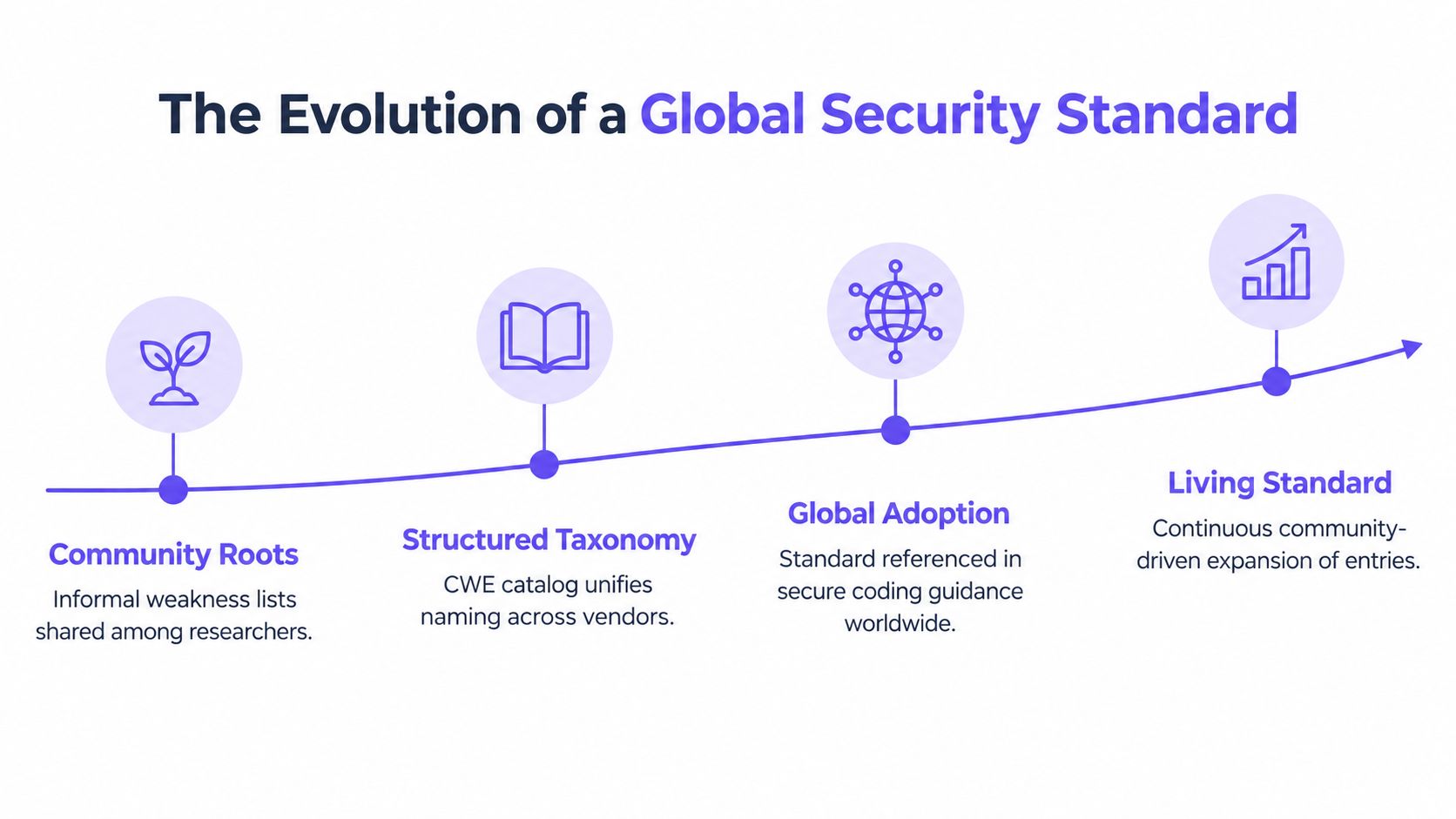
CWE became influential because it solved a coordination problem, not because a larger catalog automatically improves security. MITRE began working on software weakness categorization in 1999, and the first formal CWE release arrived in 2006 under the NIST SAMATE project (MITRE's CWE history). That effort built on PLOVER, which classified 1,500 illustrative CVE entries into 290 weakness types.
Researchers, vendors, and security tools had been describing similar defects with different terms. A shared dictionary made findings easier to compare, secure-coding guidance easier to organize, and individual vulnerabilities easier to connect to recurring causes. The same vocabulary still helps product teams, assessors, vulnerability databases, and analysis tools discuss a common failure pattern.
Growth reflects changing system risk
MITRE's 2011 security-automation paper reported that CWE 2.1 included 886 identified weaknesses and weakness categories, a substantial increase over the original 2008 release (MITRE's security-automation paper). The CWE site now lists 944 total weaknesses, or 58 more entries than that 2011 snapshot, an increase of about 6.5%.
The figures show an active standard responding to changes in languages, platforms, architectures, and attack surfaces. In 2020, CWE added hardware weaknesses, extending its coverage from software defects to broader system-design risks (MITRE's CWE history).
A wider taxonomy improves descriptive coverage, but it also creates an operational cost. Teams that treat every entry as equally actionable end up with policy noise and weak prioritization. Select a working subset according to architecture, data sensitivity, exposure, deployment model, and development practices. A payments API, embedded device, browser extension, and internal analytics service should not receive identical weakness policies.
Standardization is useful only with local interpretation
CWE supplies a stable reference point. It does not determine whether a finding is exploitable in a particular environment, whether a compensating control works, or whether remediation belongs in code, configuration, identity, or architecture. Those decisions require local threat and business context.
Use CWE as a controlled vocabulary inside a living security context. Keep the identifier in tickets, pull requests, tests, exceptions, and audit evidence, alongside business impact and environmental reachability. Policy can then connect a design concern to implementation checks and AI-assisted code review without treating the label as a verdict. This preserves consistency while leaving risk decisions with the teams that own the system.
Embedding Identifiers in Threat Models and Policies
A CWE identifier becomes operational when it appears before the scanner alert. Start with the system boundary, then select the weakness classes that could arise from its assets, trust boundaries, data flows, and privileged operations. Don't begin by importing the entire catalog. Select the entries that correspond to decisions your team can control.
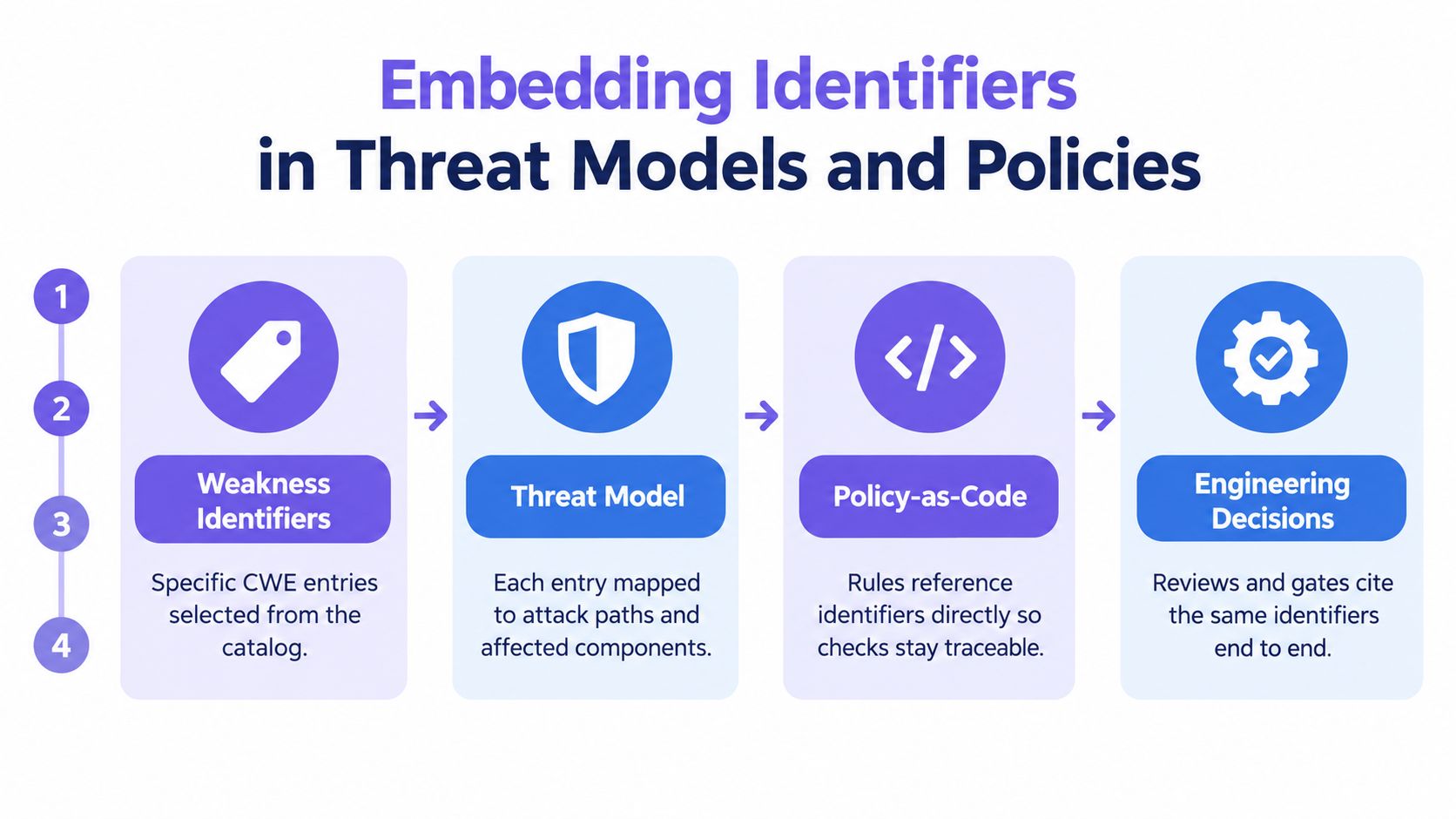
Build the mapping at design time
For each selected weakness, record five things:
- Affected component: Name the service, endpoint, library, workflow, or infrastructure boundary.
- Attack path: Describe how an untrusted actor reaches the relevant operation or data.
- Required mitigation: State the approved design pattern, such as centralized authorization or parameterized queries.
- Verification evidence: Define the test, static rule, review assertion, or runtime check that proves implementation.
- Exception handling: Require a reason, owner, compensating control, and review date when the standard pattern can't apply.
For example, a service that accepts user-controlled markup may map to CWE-79. The policy shouldn't merely say “avoid XSS.” It should require an approved output-encoding strategy, identify the rendering boundary, prohibit unsafe bypasses, and specify how a pull request demonstrates compliance. A service that exposes tenant data may map to CWE-862, with a policy requiring authorization at the resource boundary rather than relying on route-level authentication.
Threat modeling tools and templates can help teams create these records. A practical threat modeling workflow should produce artifacts developers can use, not a document that security reviews months later.
Turn the mapping into enforceable workflow rules
Policy-as-code should reference the same identifiers used by the threat model. A pull request rule can require a security review when a new privileged data flow appears, block a known unsafe API, or demand evidence that a mitigation test changed with the implementation. IDE guidance can surface the relevant design decision while a developer writes code. An AI coding agent can receive the same constraints in its prompt context.
The traceability chain should be easy to follow:
CWE identifier → threat scenario → approved control → code change → verification result → deployment evidence
Keep the rule narrow enough that developers understand why it fired. Overly broad gates create bypass pressure and teach teams that security policy is noise. Start with high-consequence boundaries, measure false positives qualitatively, and refine the rule instead of disabling the entire control.
Mapping Scanner Findings to Real Exploit Trends
A top-ten list is a poor substitute for prioritization. It tells you which weakness classes appear frequently in a defined dataset, but it doesn't tell you whether a flaw is reachable in your architecture, exposed to attackers, protected by another control, or already being exploited against your product category.
MITRE's 2025 CWE Top 25 used 39,080 CVE records, with CWE-79 retaining the top position and CWE-862 moving up 5 places to number 4 (MITRE's 2025 CWE news). That result supports investment in input handling and authorization controls, but it shouldn't become a universal queue-ordering formula.
Recent exploitation data points in the opposite direction. One H1 2026 analysis mapped 212 CVEs across 83 distinct CWE classes, with no single class exceeding 6%, while a separate 2026 report found sharp rises in CWE-74, CWE-119, and CWE-89 during 2025. The same analysis reported that advisories without a CWE fell 85% in 2025 GitHub advisory data (Recorded Future's H1 2026 vulnerability research). Better labeling helps analysis, but it doesn't remove the need for context.
Use the taxonomy to normalize, not to outsource judgment
Normalize scanner output into a finding record that includes:
- the CWE mapping and confidence in that mapping
- reachable entry points and affected assets
- authentication and authorization prerequisites
- exploitability evidence and attacker access
- production exposure and compensating controls
- remediation owner, deadline, and verification method
A scanner's severity score can start triage. It shouldn't finish it. For a practical catalog of implementation flaws such as SQL injection, XSS, broken authentication, insecure cryptography, and insecure configuration, teams can use DevArmor's vulnerability types guide as a vocabulary reference, then apply their own architecture and exposure data.
| Finding Type | Taxonomy Mapping | Contextual Risk | Remediation Action |
|---|---|---|---|
| Untrusted input reaches a browser sink | CWE-79 | Higher when attacker-controlled content reaches authenticated users | Apply the approved encoding or sanitization pattern, then add a regression test |
| Resource access lacks an authorization decision | CWE-862 | Higher in multi-tenant or privileged data services | Enforce authorization at the resource boundary and verify denial cases |
| Query construction combines data and commands | CWE-89 | Depends on database privileges and reachable query paths | Use parameterized access and reduce the service account's database permissions |
| A low-frequency weakness appears in an exposed component | Relevant CWE, validated during triage | Risk may exceed a common weakness in an isolated internal tool | Prioritize reachability, exploit evidence, and containment over ranking |
The useful question isn't “Is this a top CWE?” It is “Can an attacker reach this weakness here, and what control proves that the path is closed?”
This approach reduces alert fatigue because teams consolidate repeated manifestations into root causes. It also prevents a dangerous inversion, where a familiar label receives automatic priority while a less common but exposed weakness waits in the backlog.
Addressing Blind Spots in AI Assisted Coding
Existing taxonomies aren't complete governance models for autonomous software agents. Recent independent analysis of agentic software identified four recurring failure modes that CWE doesn't currently cover directly: goal misalignment, behavioral drift, memory poisoning, and delegation-chain privilege escalation (Cloud Security Alliance analysis of agentic security classification).
The gap matters because an AI agent can produce technically valid code while following the wrong objective, retaining poisoned instructions, changing behavior across iterations, or delegating work across privilege boundaries. A conventional code scanner may map a resulting implementation flaw to an existing CWE. It won't necessarily explain why the agent was allowed to make that change, what context it consumed, or which authority it exercised.
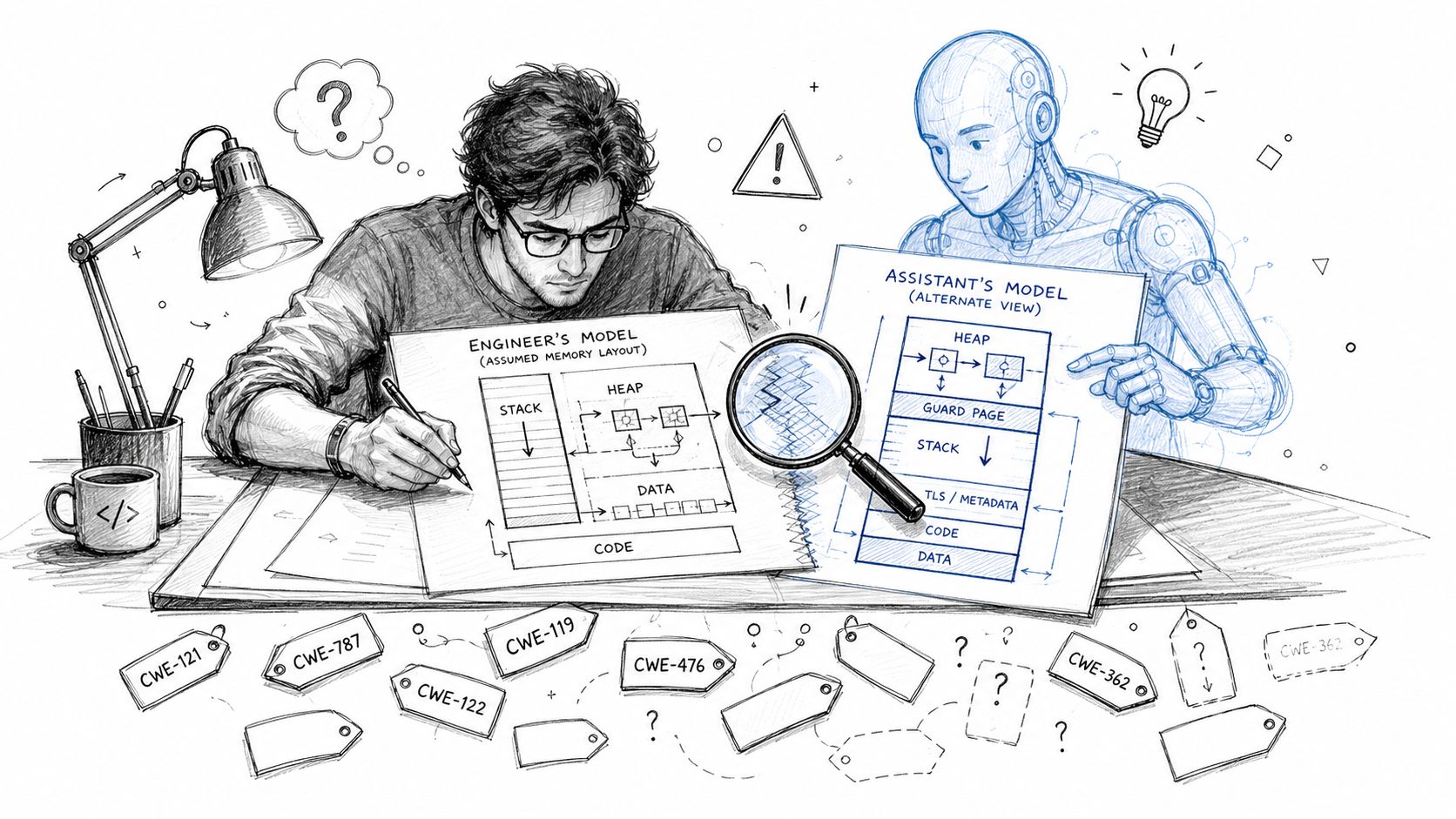
Govern the agent, not only its output
Treat AI-assisted development as a system with its own assets and trust boundaries. The repository is one asset. Prompt instructions, tool permissions, retrieved documents, memory stores, credentials, generated patches, and delegated tasks are others.
Controls should answer concrete questions:
- Authority: Which files, branches, environments, and tools can the agent modify?
- Intent: How does a human approve the task objective and acceptance criteria?
- Context integrity: Which instructions and retrieved artifacts are trusted?
- Persistence: What agent memory survives a task, and who can change it?
- Verification: Which tests and policy checks run before a generated change merges?
- Delegation: Can one agent grant another agent more access than the initiating user had?
Use CWE for implementation weaknesses where it fits, but maintain an adjacent control register for agent behavior that the taxonomy doesn't express. That register can link to threat scenarios, permission policies, review requirements, and incident signals without forcing every agent failure into an ill-fitting code category.
AI-specific coding guidance can help teams examine these risks alongside ordinary source defects. The DevArmor guide to AI coding security is relevant to teams connecting guardrails with development workflow controls.
The practical mistake is trusting a clean CWE report as proof that an agentic workflow is safe. A secure implementation can still come from an unsafe process, and the process must be governed at the boundaries where agents read, remember, decide, call tools, and delegate.
Maintaining a Living Security Context for Audits
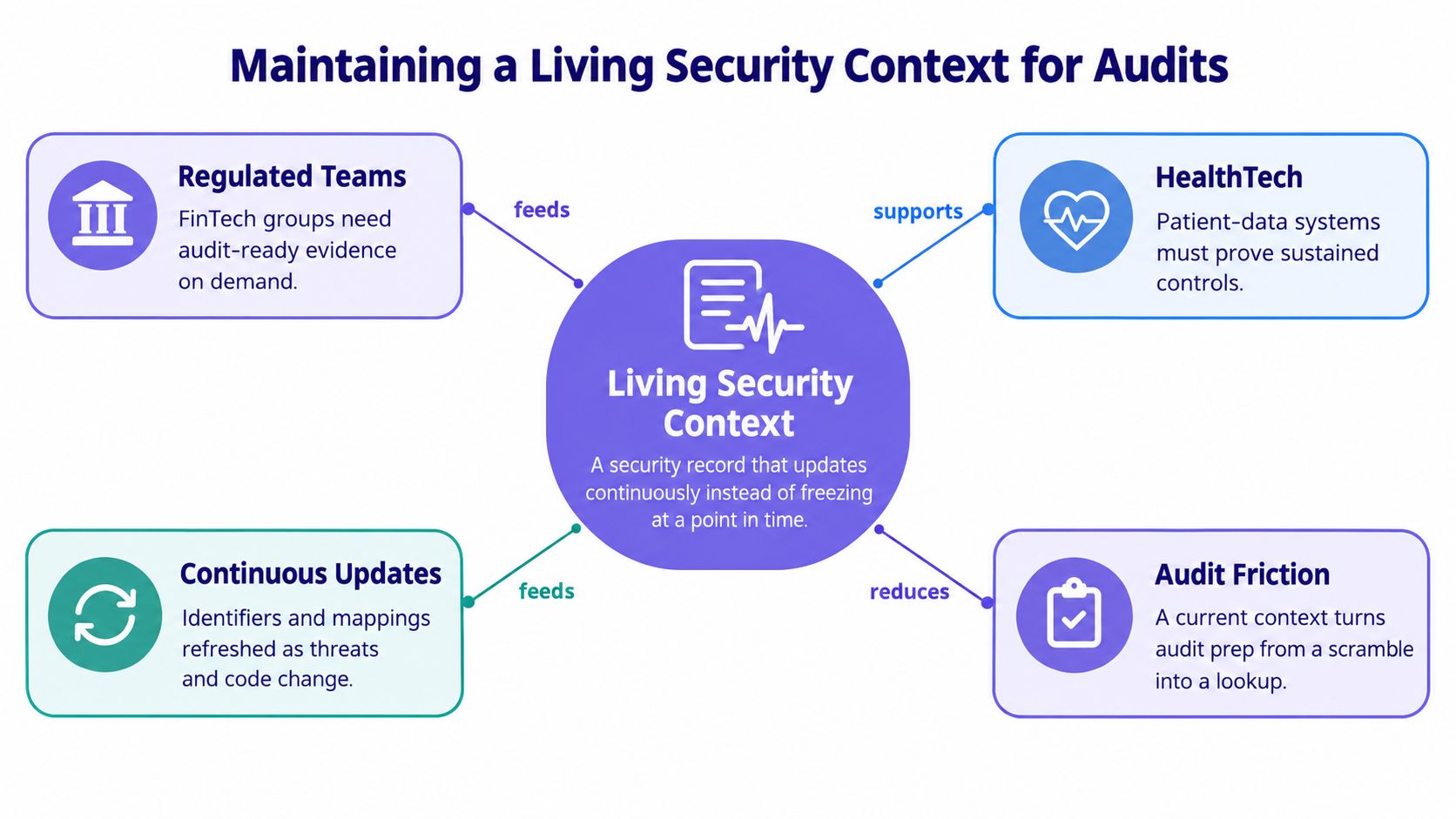
Point-in-time threat models decay as soon as repositories, tickets, dependencies, and deployment paths change. Regulated teams feel that decay during audits, when engineers reconstruct why a decision was approved, which control applied, and whether the deployed code still matches the reviewed design.
A living security context keeps those relationships current. It links security decisions to source files, planning artifacts, service metadata, policy results, and deployment evidence. CWE identifiers provide stable references inside that context, while the surrounding records explain applicability, ownership, exceptions, and verification.
Replace document retrieval with traceability
An audit-ready record should answer a reviewer without a meeting:
- What changed in the system?
- Which threat scenario and weakness classes were relevant?
- What design decision approved the implementation?
- Which policy or test verified the control?
- Who accepted any residual risk?
- Does the deployed artifact still correspond to the reviewed change?
That doesn't mean every commit needs a new formal threat model. It means material changes should update the relevant context automatically or prompt a targeted review. A new data store can trigger a data-flow check. A new privileged endpoint can invoke authorization policy. A changed AI workflow can require review of tool permissions and memory handling.
Make evidence a byproduct of delivery
The strongest audit evidence comes from normal engineering activity. Pull requests already contain diffs, reviewers, checks, and approvals. Issue trackers already contain requirements and ownership. Source control already records history. A platform that connects those artifacts can produce architecture decisions and review traces without asking teams to maintain a second paperwork system.
DevArmor is one example of this operating model. Its platform connects continuous threat modeling, security design reviews, implementation verification, and policy-as-code enforcement across planning tools, IDEs, source control, and deployment context. Teams can use that kind of system to keep CWE mappings tied to decisions and code changes, rather than storing them in an isolated spreadsheet.
For FinTech and HealthTech teams, the value is continuity. A current record supports control verification when auditors ask, while developers see relevant requirements during implementation. The result isn't “compliance documentation” separated from engineering. It's a security history generated by the same decisions and checks that govern release.
Shifting from Reactive Scanning to Continuous Enforcement
Reactive scanning starts after a design has already constrained the available fixes. The scanner finds a weakness, AppSec triages it, engineering negotiates priority, and the organization repeats the cycle when a similar defect appears elsewhere. Continuous enforcement moves the identifier earlier, where it can shape architecture, coding guidance, pull request checks, agent permissions, and deployment verification.
The operating model is straightforward:
- Select CWE classes that matter for the system.
- Map them to threat scenarios and approved controls.
- Encode the controls in developer and review workflows.
- Use scanners to verify implementation and discover drift.
- Triage findings with reachability, exposure, and exploit context.
- Feed confirmed lessons back into design policies and agent guardrails.
This approach doesn't eliminate scanning. It gives scanning a more valuable job. The scanner becomes a verification and discovery mechanism, while policy prevents known failure patterns from entering through ordinary coding or AI-generated changes.
A taxonomy becomes valuable when a developer encounters the control before the vulnerability reaches production.
Teams should also track security debt as a control problem, not just a ticket count. A useful discussion of risk control technical debt from Faberwork LLC reinforces why unresolved exceptions and stale controls need explicit ownership. A backlog full of CWE labels can still hide architectural debt if the organization keeps accepting the same design weakness.
Start with one exposed workflow, a small set of relevant identifiers, and one enforceable pull request policy. Connect each block to a clear remediation path, allow documented exceptions, and review the results with developers. Over time, the security context becomes a feedback loop between design, code, operations, and AI-assisted work, reducing repetitive triage without pretending that any taxonomy can replace engineering judgment.
DevArmor helps teams connect CWE-based threat scenarios to continuous design reviews, policy-as-code checks, implementation verification, and secure guardrails for AI-assisted development. Visit DevArmor to see how your team can maintain that security context inside its existing planning, coding, and review workflows.
Table of Contents
Subscribe