Application Security Vulnerabilities: A 2026 Guide
 Reza Khosravi
Table of Contents
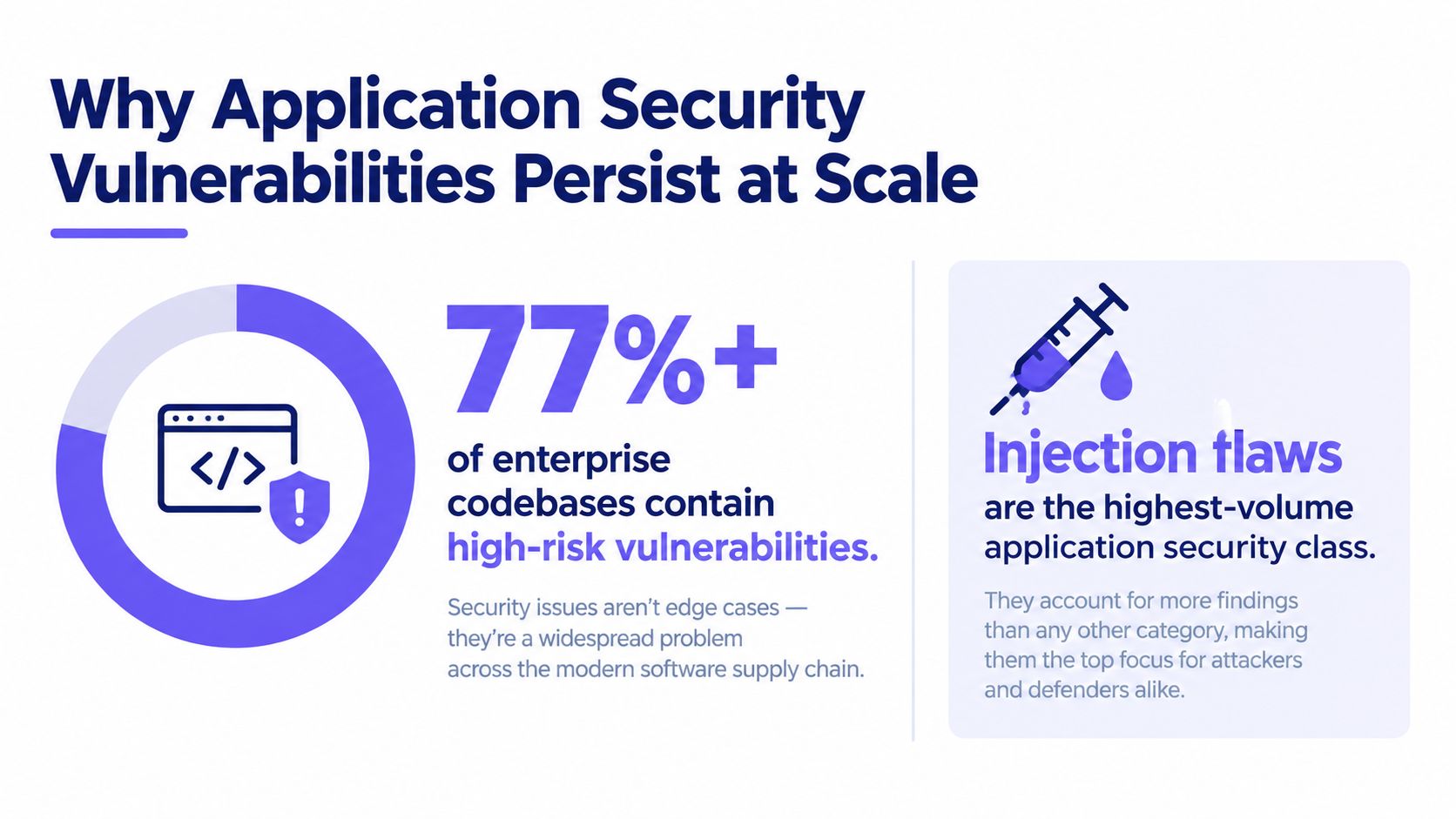
More than three-quarters, 78%, of enterprise codebases contain high-risk application security vulnerabilities, including critical flaws that can enable remote code execution and major data compromise. The practical answer is to treat security as a drift-control problem, not just a scanning problem, by keeping design intent, code changes, and deployed systems aligned through living security context and Policy-as-Code.
That reframes the work. Most engineering teams already know how to run a scanner, open a ticket, and assign a severity rating. The harder task is preserving the security decisions made during architecture while repositories, dependencies, cloud services, containers, and AI-assisted code continue to change.
A vulnerability that appears in a dashboard is only a snapshot of risk. By the time a developer receives the finding, the affected service may have changed, the vulnerable path may no longer be reachable, or a new deployment may have introduced a different exposure. Application security programs need controls that follow the system throughout its lifecycle.
Why Application Security Vulnerabilities Persist at Scale
The scope of the problem is broader than many engineering organizations assume. One independent industry report found that 78% of codebases contained high-risk vulnerabilities, including critical flaws capable of enabling remote code execution and major data compromise (application security statistics from ReversingLabs). A separate finding reported that more than 75% of applications had at least one flaw, while 61% contained a high-severity issue outside the OWASP Top 10 covered by the same source.
Those figures change the question. Application security vulnerabilities aren't limited to neglected applications or teams without security tooling. They persist in modern delivery environments because every stage can introduce security debt, and because teams often inherit risk faster than they can remove it.
Security debt crosses organizational boundaries
A product team may own the repository, a platform team may own the deployment configuration, and a security team may own the scanner. None of those boundaries match the path an attacker follows. A weakness in an API can depend on an architectural decision, an unsafe implementation pattern, an exposed service, and an identity control maintained by different groups.
Regulated organizations face an added governance problem. If teams can't show why a control exists, who approved it, and whether the deployed implementation still follows it, a vulnerability backlog becomes evidence of weak risk management rather than a simple list of engineering tasks.
Practical rule: Treat every security decision as something that must remain attached to the product, not as a document that belongs to one project phase.
Discovery doesn't equal control
A scanner can identify a vulnerable dependency or suspicious code path. It can't, by itself, preserve the reasoning behind the architecture or determine whether a later change invalidated an earlier assumption. That context must live alongside planning records, source control, service metadata, and deployment decisions.
The same principle applies to identity threats. Teams reviewing account takeover exposure should connect application controls with operational guidance such as credential stuffing prevention, rather than treating authentication findings as isolated scanner alerts. They also need to understand why alert volume becomes difficult to manage, especially when findings lack ownership or environmental context. The discussion of alert fatigue in application security provides useful context for that failure mode.
The organizations that manage vulnerabilities consistently don't merely collect more findings. They reduce the distance between an approved design, the code implementing it, and the system running in production. That is the foundation for controlling drift.
Root Causes Across Design, Implementation, and Deployment
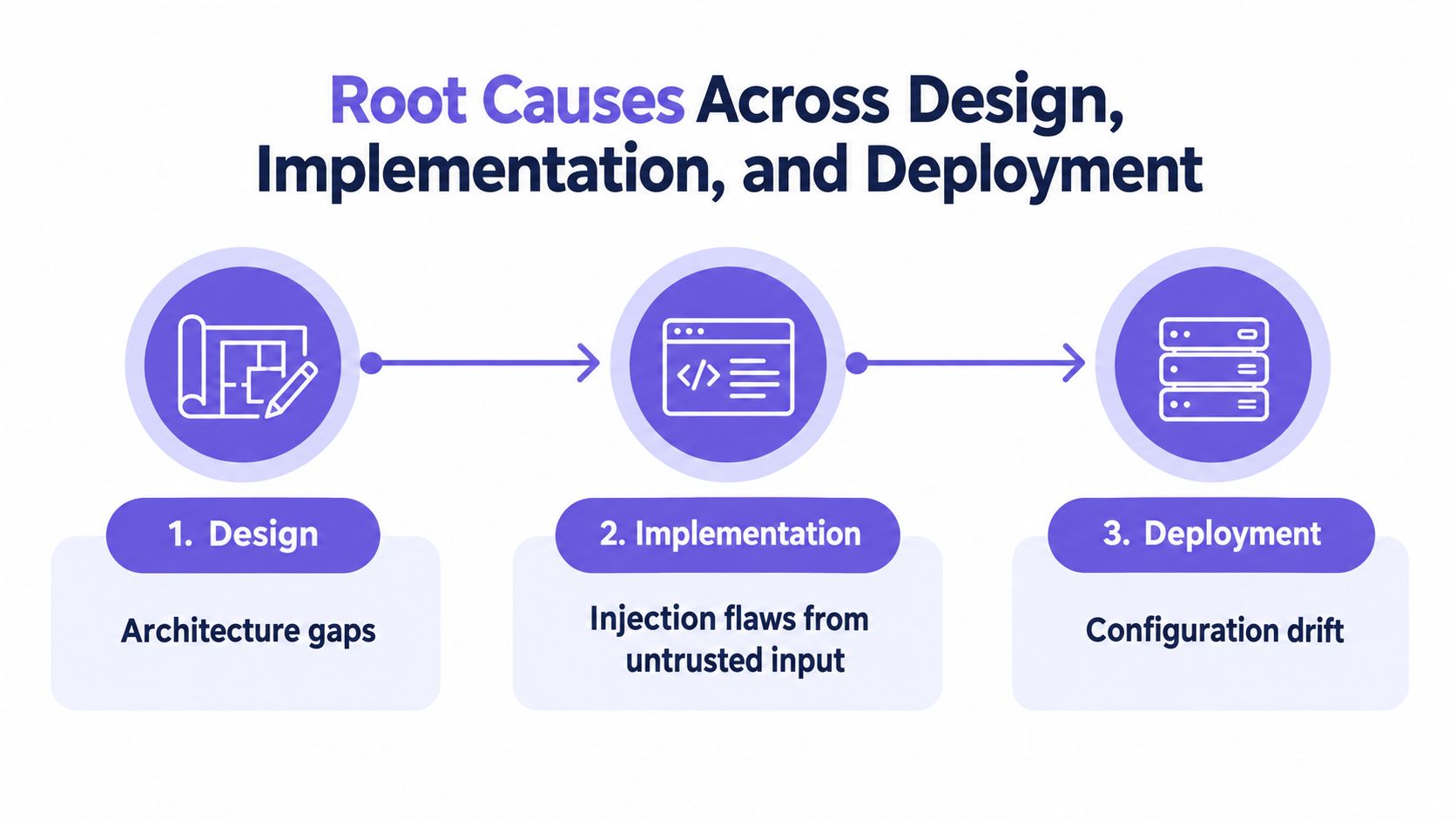
Application security vulnerabilities rarely originate in one phase. A design that permits unconstrained input creates implementation pressure. An implementation that relies on dynamic queries creates deployment risk when the service becomes externally reachable. A deployment change can expose a weakness that was relatively contained in a development environment.
Injection illustrates this chain clearly. OWASP's 2025 Top 10 states that injection was tested in 100% of applications and contains the greatest number of CVEs among its listed categories, including more than 30,000 XSS CVEs and more than 14,000 SQL injection CVEs (OWASP's 2025 Injection guidance). The technical cause is familiar: untrusted data reaches an interpreter without adequate validation, parameterization, filtering, sanitization, or context-aware escaping.
Design decisions become implementation constraints
A threat model should answer questions before a developer chooses a framework pattern. Which inputs are trusted? Which service owns authorization? Can a user-controlled value influence a query, command, template, or browser document? What must happen when an external dependency fails?
If those questions aren't recorded in the planning workflow, developers answer them implicitly while writing code. A code review may catch a dangerous concatenation pattern, but it may miss the architectural reason the input exists or the downstream service that consumes it.
The application security architecture guidance is useful when teams need to connect security requirements to system boundaries, trust zones, and implementation controls.
Deployment changes the risk profile
SQL injection remains the most common critical web application vulnerability in the 2024 EdgeScan statistics report, and the report notes that CWE-89 has held that position since 2022 (EdgeScan's 2024 vulnerability statistics report). The persistence of this old flaw class points to repeated failures in secure defaults and enforcement, not a lack of awareness.
A team may understand parameterized queries and still introduce unsafe search parameters through an ORM, a reporting feature, or a new integration. A deployment may then expose that endpoint to a broader audience than the original design assumed. Secure architecture therefore needs implementation checks and deployment verification. Each stage should test whether the current system still matches the decision that was approved.
The Exploitability Gap Most Teams Overlook
Finding an application security vulnerability doesn't answer the most important operational question: can an attacker exploit it in the running environment?
A 2026 Cloud Security Alliance report found that 54% of security teams considered distinguishing real threats from non-exploitable findings their biggest challenge. The same report found that 46% had experienced production incidents involving vulnerabilities they failed to identify during pre-production testing (Cloud Security Alliance on the application security proof bottleneck).
Those findings expose two different failure modes. The first is overreaction, where teams spend scarce engineering time fixing theoretical findings that have no reachable path or meaningful production exposure. The second is under-detection, where pre-production checks miss a combination of code, configuration, identity, and runtime conditions that attackers can use.
Discovery and exploitability answer different questions
| Discovery asks | Exploitability asks |
|---|---|
| Does a tool recognize a weakness? | Can an attacker reach the affected path? |
| What severity does the rule assign? | What controls exist around the asset? |
| Which file, package, or endpoint is involved? | What data or capability would exploitation expose? |
| Has the issue been recorded? | Does the deployed system still match the tested system? |
Scanner output remains valuable. Static analysis can identify dangerous patterns, dependency analysis can expose inherited risk, and dynamic testing can reveal runtime behavior. The mistake is treating every result as equally actionable without connecting it to asset ownership, trust boundaries, reachability, and deployed configuration.
A finding becomes useful when a developer can see what is exposed, why it matters, and which approved control should change.
This is why teams should separate detection, triage, and enforcement. Detection produces evidence. Triage establishes whether the evidence represents a meaningful exposure. Enforcement prevents the same design or implementation error from returning after remediation.
An attack surface analysis approach helps teams map those questions to real services and entry points. It also gives security reviewers a better basis for deciding whether a finding requires immediate remediation, compensating controls, or continued observation.
Continuous Threat Modeling for Living Security Context
Traditional threat modeling often produces a document at the beginning of a project. That document may describe the intended architecture accurately, but it becomes less reliable as teams add endpoints, change data flows, replace dependencies, or introduce new services.
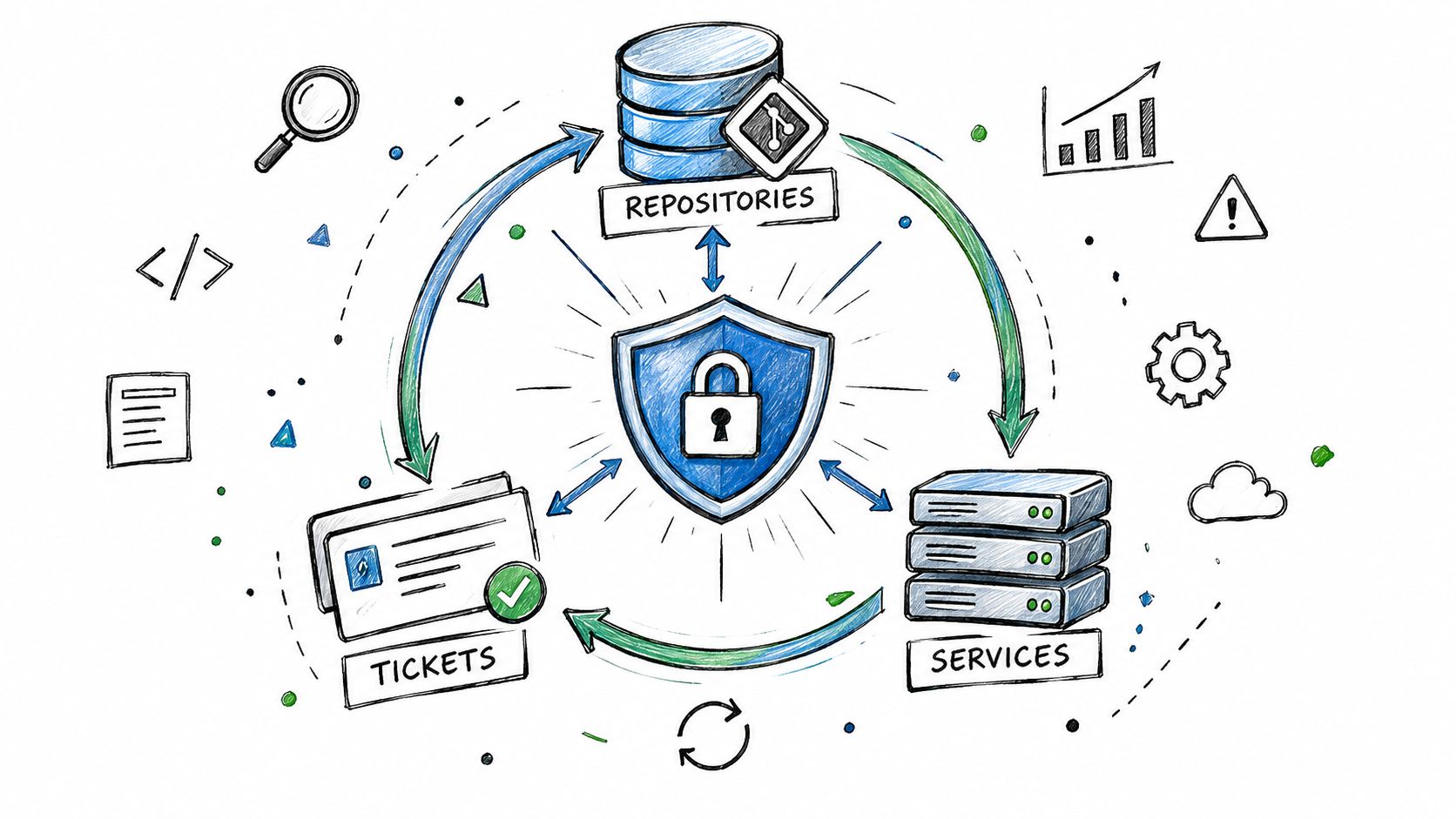
Continuous threat modeling treats security context as a living engineering asset. It draws context from the artifacts teams already maintain, including tickets, design documents, repositories, service definitions, and implementation changes. When those artifacts change, the security assumptions connected to them should be reviewed as well.
Build the context where engineering works
A useful living security context should answer four questions without forcing developers to search through disconnected systems:
- What is being built? Connect the feature, ticket, service, and data flow.
- What can go wrong? Record threats tied to trust boundaries and user-controlled inputs.
- Which controls are required? Express decisions as implementation requirements.
- How will the system prove compliance? Link requirements to code review and deployment checks.
The value isn't the document format. The value is the connection between a decision and the work that implements it. A requirement such as “only authorized account owners may retrieve records” becomes more useful when it is attached to the endpoint, service, test expectation, and pull request that change the authorization logic.
Keep pace with AI-assisted development
AI-generated code increases the speed at which implementation decisions enter a repository. Developers may accept a suggestion from an IDE, an agent may modify several files, and a pull request may contain behavior that wasn't present when the original threat model was written.
Manual review alone struggles with this pace because reviewers must reconstruct intent from the diff. A living context puts the relevant constraints closer to the code generation and review workflow. It can tell a developer or coding agent which inputs are untrusted, which libraries are approved, and which controls must not be bypassed.
That doesn't remove the need for human judgment. It makes judgment more consistent by ensuring reviewers start with current assumptions instead of relying on memory or stale project documents.
Policy-as-Code and Secure CI/CD Enforcement
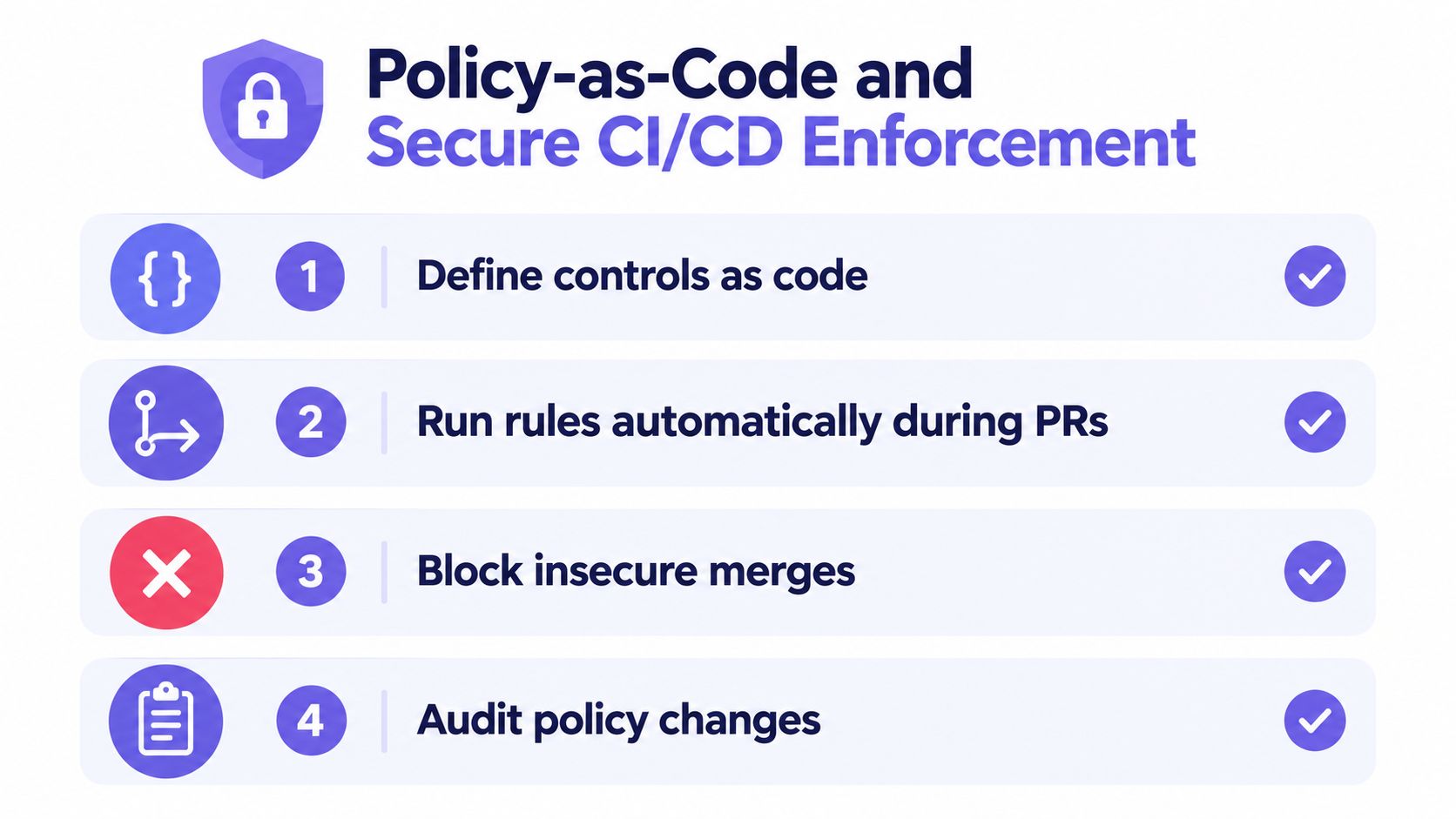
Security intent has limited value if it remains advisory. Policy-as-Code turns approved requirements into executable rules that can run during pull requests, build validation, and deployment checks.
The strongest policies are specific enough to evaluate and narrow enough to produce an actionable result. “Use secure coding practices” isn't a useful merge condition. “Reject a change that introduces a direct query built from untrusted request input unless the approved data-access abstraction is used” gives engineers a concrete control to implement and reviewers a clear reason for the result.
Put enforcement at the pull request
A practical enforcement flow looks like this:
- Define controls as code: Express architectural decisions as versioned rules with owners and review history.
- Run checks during pull requests: Evaluate changed files, services, dependencies, and relevant design requirements before merge.
- Block only meaningful violations: Use merge blocking for explicit policy failures, not every theoretical scanner warning.
- Record the outcome: Preserve the rule, decision, reviewer, exception, and remediation evidence for later investigation.
This structure improves the trade-off between security and delivery speed. Blocking every uncertain finding trains developers to bypass controls. Blocking a clearly violated requirement gives the team a defensible reason to pause and a specific path to resolution.
Make exceptions visible and temporary
No policy catches every legitimate business constraint. A service may need a special integration, a migration may require an interim pattern, or a legacy component may not support the preferred control immediately. The answer isn't to disable the policy globally.
Create an explicit exception with a named owner, a documented rationale, compensating controls, and a review condition. The exception should remain visible in the same system as the policy result. That turns risk acceptance into an auditable decision instead of an undocumented bypass.
For FinTech, HealthTech, and Media teams, this traceability also changes compliance work. Architecture decisions, policy results, and review outcomes become outputs of normal engineering activity rather than evidence assembled long after the code shipped.
Reducing Vulnerability Drift Over Time
The most dangerous security backlog is not necessarily the largest one. It's the backlog that remains disconnected from ownership, exploitability, and the system's current state.
A 2026 AppSec report found that 78% of organizations run applications with critical vulnerabilities in production, 77% leave high or critical container vulnerabilities unpatched for more than 90 days, and 54% of third-party-code CVE instances in production were published more than a year earlier (the 2026 State of Application Security report from Orca Security). These findings describe a persistence problem. Teams know that exposure exists, but inherited dependencies and operational priorities allow it to remain.
Drift begins with a broken connection
Vulnerability drift occurs when the deployed system no longer matches the assumptions behind its security design. A team approves one authentication flow, then adds an endpoint that uses a different middleware path. A dependency is accepted under one threat model, then a container image carries it into another service. An exception remains active after the original business need disappears.
Continuous guardrails reduce this divergence by checking changes against current requirements. They don't eliminate all vulnerabilities, and they can't replace remediation discipline. They make it harder for security debt to accumulate unnoticed.
Engineering principle: A control that runs only during an annual review can't govern a system that changes every day.
Prioritize the age and inheritance of exposure
Remediation programs should ask more than whether a finding is critical. They should ask:
- How long has the exposure existed?
- Which services inherited the same dependency or configuration?
- Is the vulnerable component reachable from an active entry point?
- What changed since the last approved threat model?
- Can a policy prevent the same pattern from returning?
This approach changes the role of vulnerability management. Teams still patch dependencies, update containers, and fix code. They also investigate why the issue survived, whether the design allowed it, and which enforcement point can prevent recurrence.
The objective isn't to claim that a system has no vulnerabilities. That standard is unrealistic for a living application. The objective is to shorten the period during which exploitable drift remains unrecognized and to keep inherited risk from spreading across the delivery estate.
Practical Next Steps for Engineering Leaders
Engineering leaders can shift from reactive scanning to proactive enforcement without trying to redesign the entire security program at once. Start with the points where decisions already enter the delivery lifecycle, then connect those decisions to evidence in code and deployment.
Establish one current security context
Bring together the architecture, threat assumptions, service ownership, data flows, and security requirements that currently live in separate tickets and documents. The context should update when repositories, services, or product requirements change. If formal documentation is incomplete, reconstruct the relevant context from the code and operational artifacts, then have the responsible teams validate it.
Move design review into delivery workflows
Security feedback should appear in planning and development tools, not only in meetings. Attach requirements to tickets, surface relevant controls in IDEs, and show reviewers which threat model applies to a pull request. Developers can act on a security decision when it appears beside the work that may violate it.
Encode the controls that matter
Choose a focused set of policies around authorization, input handling, secrets, dependency use, service exposure, and deployment configuration. Version those rules with clear ownership. Run them automatically during pull requests, and reserve merge blocking for violations that the team has explicitly agreed represent unacceptable risk.
Govern AI-assisted changes
Treat generated code like any other code, but account for its speed and scale. Provide coding agents with current security requirements, approved patterns, and prohibited behaviors. Require the same policy checks for agent-created changes as for manually written changes, so faster generation doesn't create a faster route around review.
Produce audit evidence as a by-product
Regulated teams should capture design decisions, policy evaluations, exceptions, and implementation verification during normal delivery. That evidence is more credible when it reflects actual workflow activity rather than a retrospective document created for an audit deadline.
The right success measure is not a smaller vulnerability count. It is faster alignment between what the team designed, what developers changed, and what the organization deployed. That alignment is what keeps application security vulnerabilities from becoming permanent architectural debt.
DevArmor provides continuous threat modeling, security design reviews, and Policy-as-Code enforcement across planning tools, IDEs, source control, and pull requests. Use DevArmor to connect approved security decisions with implementation checks, AI-assisted development guardrails, and traceable review outcomes.
Table of Contents
Subscribe