What Is Alert Fatigue in AppSec
 Reza Khosravi
Table of Contents
Alert fatigue is a measurable decline in responsiveness caused by excessive, low-value security signals, not just ordinary annoyance or burnout. In healthcare, one study of 66 adult ICU beds recorded more than 2 million physiologic monitor alerts in one month, a volume equal to 187 warnings per patient per day.
The AppSec version is familiar. A developer opens a pull request and sees SAST findings, dependency warnings, IaC violations, secrets alerts, container results, and policy messages from several disconnected systems. A security engineer reviews the queue, closes findings that lack context, suppresses duplicates, and postpones the difficult items until the next sprint. After repeated exposure to noisy signals, the team starts treating every notification as suspect, including the one that deserves immediate attention.
Defining Alert Fatigue in Modern Security Workflows
A pull request is ready to merge, but its author must first sort through SAST findings, dependency warnings, IaC violations, and policy messages from several tools. Some are relevant to the changed code. Others lack architectural or runtime context. After enough cycles like this, the engineer stops evaluating each signal on its merits and starts using shortcuts.
That pattern defines alert fatigue: repeated exposure to excessive or low-value notifications reduces a person's ability and willingness to respond appropriately. In AppSec, it is a cognitive processing failure and an operational control problem. The issue is not just that engineers feel frustrated. The workflow is consuming attention faster than the team can apply sound judgment.
The AHRQ review of alert fatigue describes a related clinical pattern involving excessive alerts, low specificity, and repeated overrides. Users learn to dismiss warnings, and that behavior can include signals that deserve action. Security workflows create the same risk when tools produce findings without enough information to distinguish an urgent exposure from an acceptable design choice.
The queue changes behavior
A data-flow pattern may be unsafe in one service but harmless in another. A vulnerable dependency may not be reachable in production. An IaC rule may flag a permissive setting in a disposable test account. Each result can be technically valid while still failing to answer the engineer's immediate question: what needs attention now, and why?
Teams often respond by adding filters, creating suppressions, or requesting a dashboard organized by severity. Those measures can reduce the visible backlog, but they do not necessarily improve decision quality. If the rules continue to generate low-value findings, developers keep learning that the tools are unreliable.
Practical rule: Measure whether people respond appropriately to meaningful alerts, not whether the dashboard contains fewer rows.
A 2026 systematic review of alert-fatigue measures identifies alert quantity, override rate, and acceptance rate as common measures. For AppSec, the useful application is to establish a baseline and track whether appropriate responses decline over time. That converts “the team feels overwhelmed” into a control-quality question.
Alert fatigue may appear as slow review, automatic dismissal, blanket suppression, or declining trust in scanner output. It also pushes security work toward the end of delivery, when remediation costs more and the original design context has faded.
The response cannot be a request for analysts to pay closer attention. Engineering leaders need to reduce low-value signals, attach runtime and ownership context, and place security decisions during planning and implementation. Scanners should confirm enforced policy and deliberate design choices wherever possible, rather than discovering the security model after code is waiting to merge.
The Cognitive Pathways of Information Processing Failure
Alert fatigue isn't a binary condition in which an engineer is either fatigued or unaffected. Recent hospital research identifies three information-processing pathways that map closely to modern security workflows: an alert may not be perceived, it may be recognized but processed superficially, or it may demand more cognitive effort than the responder can provide in context. The findings are discussed in recent research on cognitive pathways in alert processing.
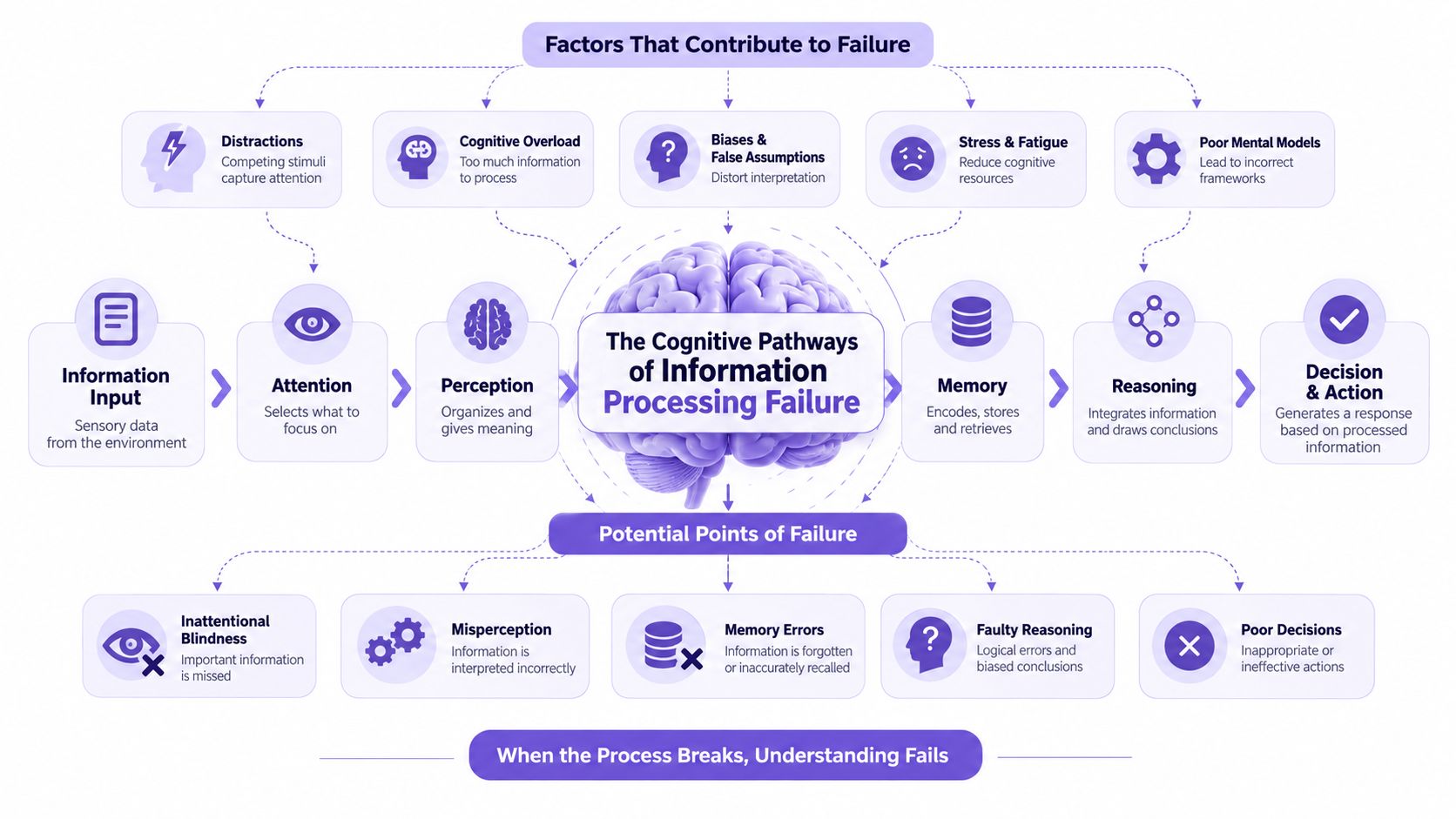
Three points where security judgment breaks
The first pathway is non-perception. The signal never receives meaningful attention. It may arrive in a crowded Slack channel, an email inbox, or a ticket queue that developers rarely open. A high-severity finding can be technically generated and operationally invisible at the same time.
The second pathway is superficial processing. The responder notices the alert but uses a mental shortcut based on previous experience. If similar dependency findings have repeatedly turned out to be unreachable or irrelevant, the engineer may close the next one after checking only the package name. This is faster than a full investigation, but it also creates a path for a meaningful exception to be dismissed.
The third pathway is excessive cognitive effort. The alert is visible and potentially important, but acting on it requires reconstructing the application architecture, tracing data flows, checking deployment context, and consulting several tools. The responder may understand the risk in principle and still defer it because the cost of interpretation is too high.
These pathways produce different symptoms, so a single alert-count metric won't diagnose them. Non-perception points to routing and ownership. Superficial processing points to trust, prioritization, and repeated false positives. Excessive effort points to missing context and poor workflow integration.
Measure degradation, not emotion alone
Teams can establish a baseline for appropriate response and then watch for sustained deterioration. Useful signals include override behavior, acceptance of recommended remediation, time to acknowledge meaningful findings, repeated suppressions, and the proportion of alerts that reach an owner with enough context to decide.
The aim isn't to eliminate human judgment. Security decisions often require it. The aim is to reserve human judgment for decisions that deserve attention, while policy, design context, and automation handle predictable cases.
Historical Roots and the Evolution of Systemic Overload
Healthcare encountered alert overload before AppSec had a name for it. In a 2014 AHRQ review, a study of 66 adult ICU beds generated more than 2 million physiologic monitor alerts in one month, or 187 warnings per patient per day. A Veterans Affairs primary-care study also found clinicians receiving more than 100 alerts per day, while computerized provider order entry warnings were overridden the vast majority of the time, including critical warnings. This history is documented in the AHRQ patient-safety literature.
The comparison with AppSec is about system design, not identical tools. Bedside monitors and security scanners both depend on people recognizing a signal, judging its context, and taking action. As low-specificity notifications accumulate, users adapt. A notification becomes background traffic rather than a prompt for careful review.
A safety problem, not a productivity quirk
The historical record shows why leaders should treat alert fatigue as an operational risk. The FDA's MAUDE reporting system received 566 reports of patient deaths related to monitoring-device alarms between 2005 and 2008. A contemporaneous Joint Commission analysis described alarm fatigue as a national patient-safety concern and indicated that sentinel-event reports likely captured less than 10% of actual alarm-related harms. These findings are summarized in the NIH Bookshelf discussion of alarm fatigue.
Other hospital settings recorded more than 59,000 alarms over 12 days at one academic medical center and 16,953 alarms over 18 days in another unit. False alarms represented roughly 85% to 90% of alerts in some settings, according to the same evidence base.
The operational lesson is direct: a signal can remain technically available while becoming functionally unusable.
The AppSec parallel
Modern AppSec teams face the same systems-engineering trade-off. A scanner that reports every possible weakness may appear thorough, but its output improves safety only when developers can distinguish urgent issues from contextual or low-impact findings. Tool sprawl adds context switching, and a dashboard that merely groups alerts can make the interface calmer without improving signal quality.
That requires more than tuning scanner thresholds. Teams need security controls embedded in design reviews, repository policy, pull-request checks, and deployment workflows, where ownership and context are available before findings become a queue. The durable principle is more detection is not automatically more protection. Detection must connect to a decision, an owner, and an action. Otherwise, the organization builds an expensive notification layer that gradually weakens trust in security feedback.
Quantifying the Operational Costs and Analyst Burnout
A queue can look manageable while analysts spend their shifts validating low-value findings. That is why alert fatigue is an operational risk, not only a burnout concern. It consumes investigation time, fragments attention, and increases the chance that meaningful signals receive delayed or shallow review.
A 2025 SOC study found that 76% of respondents identified alert fatigue as a top challenge and 73% cited analyst burnout. The same report also recorded 14.1 hours per week spent chasing false positives. These figures are summarized in the Pulse of the AI SOC report coverage.
Other survey findings point to the workflow behind the numbers. 73% of respondents said false-positive work harms their focus on real threats. A 2025 MSP study reported that 56% experienced alert fatigue daily or weekly, while 89% struggled with tool integration. Separate tools create context switching, and each switch forces analysts to reconstruct ownership, severity, and evidence before they can act.
The operational impact of security alert overload
| Metric | Impact |
|---|---|
| Alert fatigue as a top SOC challenge | 76% of respondents in a 2025 SOC study |
| Analyst burnout cited as a challenge | 73% of respondents in the same study |
| Weekly time spent chasing false positives | 14.1 hours |
| Teams experiencing fatigue daily or weekly | 56% in a 2025 MSP study |
| Teams struggling with tool integration | 89% in the same MSP study |
The table groups the first three metrics under the report cited above. These figures do not define a universal threshold for every engineering organization. They do support tracking alert volume, false-positive effort, integration friction, and burnout as related operating indicators. A useful review asks how much analyst time each control consumes, how often findings lack an owner, and whether developers receive actionable context early enough to fix the underlying issue.
Why AI can amplify the problem
AI-assisted workflows can remove repetitive steps, but automation does not guarantee selectivity. Low-confidence findings routed through more channels increase review work. If the system cannot explain its reasoning, analysts must validate both the finding and the automation that produced it, adding cognitive load rather than reducing it.
Automation works better within defined boundaries. Let systems enrich predictable findings, correlate related events, apply documented policies, and explain why human review is required. Keep ambiguous risk decisions, architectural trade-offs, and exceptions with accountable engineers. The larger control point sits earlier in the lifecycle: continuous design and policy enforcement can prevent classes of findings before scanners turn them into another queue.
Why Traditional Scanners and Triage Dashboards Fail
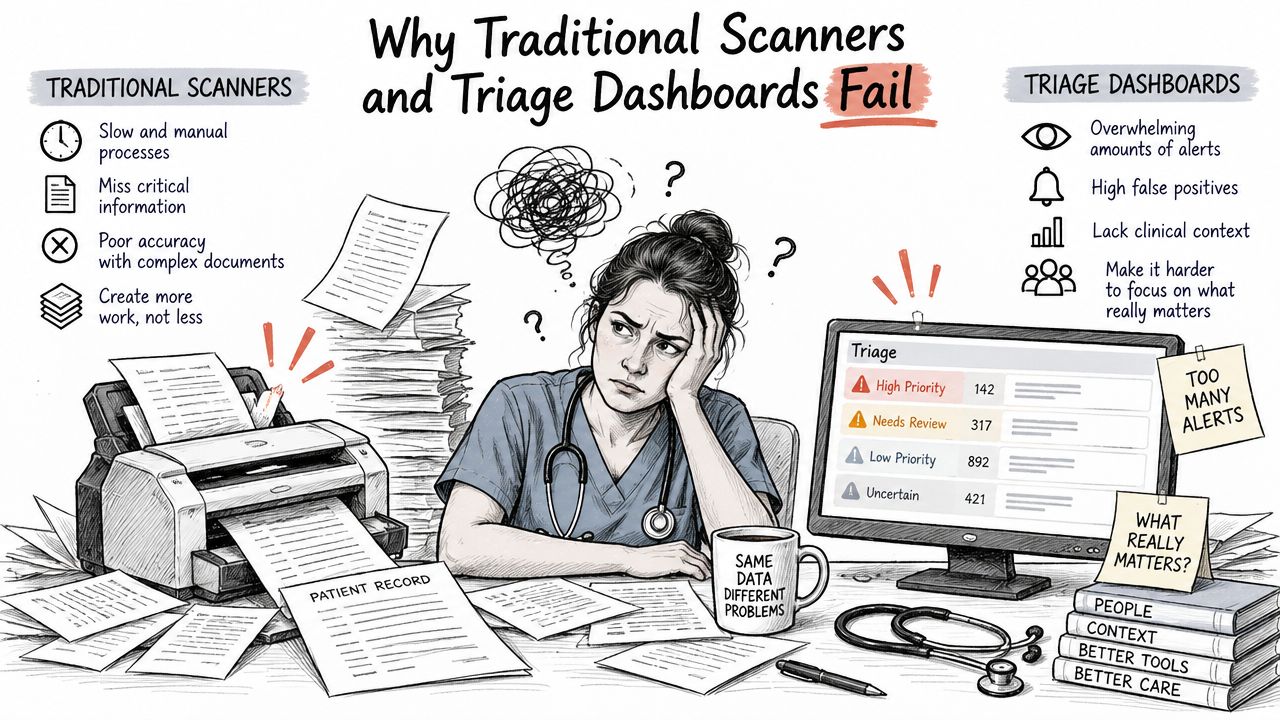
Adding another dashboard rarely fixes alert fatigue because dashboards organize output after the system has already generated it. They can sort, filter, and aggregate findings, but they can't supply architectural intent that was never captured. If SAST, DAST, software composition analysis, secrets detection, container scanning, and infrastructure checks each operate with separate assumptions, the team receives a pile of locally plausible results rather than one coherent security decision.
Filtering is not understanding
A filter can hide a finding based on severity, path, repository, or rule. That may be useful for presentation, but suppression creates a governance risk when nobody records why the finding was excluded or when the application changes later. Aggregation has a similar limit. Ten related alerts can become one card, yet the responder may still need to inspect ten events to understand the attack path or determine ownership.
AI-generated code adds another complication. The code may be produced quickly, but its security assumptions still need to be tied to system boundaries, data sensitivity, identity flows, and approved design decisions. A scanner sees the implementation pattern. It usually doesn't know whether that pattern is intentional, constrained, reachable, or prohibited by the product's policy.
That's why secure architecture needs to precede exhaustive scanning. The secure software guidance on threat modeling rather than scanning makes the practical case for identifying design risks before teams depend on end-of-pipeline findings to reconstruct intent.
The end-of-pipeline trap
Reactive scanning is still valuable. It catches mistakes that design reviews miss and provides evidence for release controls. The failure begins when scanning becomes the primary source of security context. By the time a finding appears in a pull request, the developer may have moved on, the relevant design discussion may be buried in a ticket, and the fix may require changes across several services.
A more effective workflow assigns different questions to different stages:
- Design controls decide which trust boundaries, data flows, and architectural patterns are acceptable.
- Implementation checks verify that code and configuration follow those decisions.
- Pull request policies block or route violations according to explicit, reviewable rules.
- Runtime detection watches for behavior that design and code controls can't fully prevent.
This division reduces the temptation to make every scanner alert a release blocker. It also makes exceptions visible, because the team can trace them to a policy or design decision instead of relying on an undocumented suppression.
Mitigation Strategies Through Continuous Design and Context
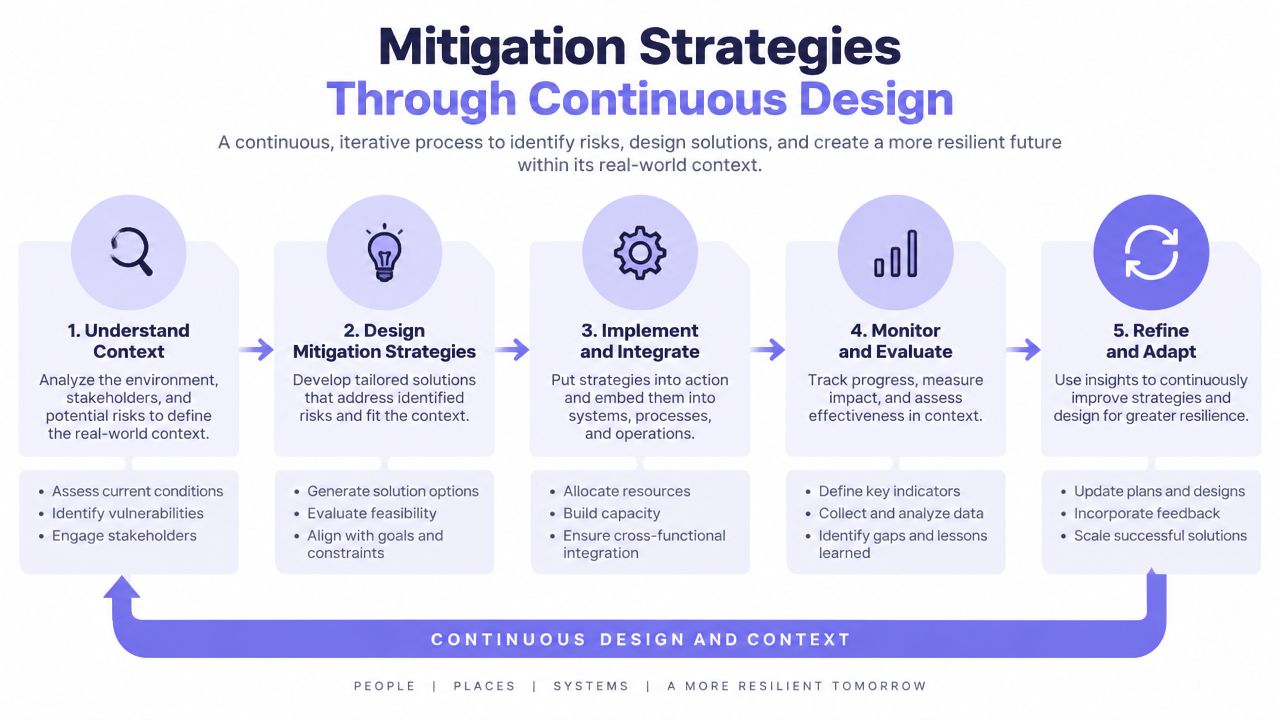
The practical answer to alert fatigue starts before the alert. Teams should make security intent explicit in planning and design, carry that context into implementation, and use scanners to verify compliance rather than generate a late stream of disconnected warnings.
Start with living security context
A useful process has five connected activities:
- Capture the change. Read the ticket, design document, repository metadata, and service ownership information together. The system should know what is changing and who can decide about it.
- Model the risk. Identify trust boundaries, sensitive data, privileged actions, external dependencies, and relevant abuse cases. Keep the model connected to the artifacts that will change.
- Write enforceable decisions. Convert approved security requirements into policies that can be checked consistently. “Use strong authorization” is guidance. A policy that requires an approved authorization control for a protected endpoint is enforceable.
- Verify in the developer workflow. Surface feedback in the IDE, planning tool, and pull request, where the developer can act without reconstructing context from separate systems.
- Review exceptions as decisions. Record who accepted a deviation, why it was acceptable, and when the decision should be revisited.
This approach doesn't eliminate scanners. It gives them a narrower, more useful job. A finding should answer what changed, which decision it violates, who owns the remediation, and what evidence supports the priority.
Put policy at the pull request
Policy-as-code works best when teams version policies, review changes, test them against representative code, and preserve the outcome. Pull request enforcement can block a merge when a clear rule is violated, while lower-confidence findings can route to an owner for review instead of stopping delivery automatically.
The surrounding workflow matters just as much as the policy language. Teams designing operational notifications can use guidance on how to design alerts that drive action, particularly when deciding what belongs in an immediate channel and what should become a tracked task.
DevArmor is one example of a platform that connects continuous threat modeling, security design reviews, developer workflow integrations, and Policy-as-Code enforcement across planning, coding, and source control. Its design-time remediation approach reflects the central operating principle: prevent ambiguous risk from becoming a large downstream queue.
Reduce cognitive load deliberately
Give each alert a clear owner, rationale, severity, evidence trail, and next action. Avoid sending the same finding to security email, Slack, a ticketing system, and a release dashboard unless each destination has a distinct purpose. Duplicate delivery feels like coverage, but it often creates competing states and repeated triage.
Finally, review policy outcomes and suppressions on a regular cadence. A suppression without an expiry or reason becomes invisible security debt. A documented exception becomes a decision that the team can reassess when the architecture changes.
Building a Sustainable Security Culture Without the Noise
Sustainable AppSec reduces the decisions developers must make under pressure. Fewer ambiguous warnings, clear ownership, and controls embedded in normal delivery workflows give teams a better chance of acting on meaningful risk. Security teams therefore need to design workflows, maintain policy, and provide context, not only operate scanners.
The cultural shift is visible in daily work. Developers should see why a control exists, which system property it protects, and what action satisfies it. Security engineers should trace a finding to a design decision, code change, or runtime condition. Engineering managers should distinguish unresolved risk from an unvalidated task created by a tool.
Build trust through consistent decisions
Trust grows when alerts behave predictably. If identical code patterns receive different treatment across repositories, developers learn to negotiate with the tool instead of following the control. If every finding blocks delivery regardless of exploitability or context, delivery managers will eventually push to disable the control.
A sustainable model separates mandatory policy violations, reviewable risks, and informational observations. Ownership belongs where the relevant decision is made. Architecture teams may own trust-boundary decisions, platform teams may own shared controls, and service teams may own implementation fixes. This structure prevents a central security queue from becoming the default owner of every exception.
Security education should also change decisions at the moment of risk. For human-centered controls outside the code workflow, teams can use phishing simulation training that changes behavior, with practical response as the goal rather than completion of a compliance exercise.
Measure control quality over notification volume
A useful scorecard tests whether the organization can respond to meaningful risk with confidence. Track alert quantity, override behavior, acceptance, ownership, remediation status, and the time needed to interpret a finding. Quantity alone cannot show whether a control is useful. Patterns in overrides and accepted findings can reveal unclear policy, weak context, or ownership gaps.
For regulated and fast-moving teams, shifting left means resolving design questions while engineers still have the relevant context, then enforcing those decisions throughout implementation. The shift-left security model works best when earlier design decisions connect to implementation evidence, rather than becoming another checklist.
Alert fatigue is ultimately a workflow and cognitive-load problem. Scanner tuning can reduce some noise, but it cannot repair fragmented ownership, missing context, or policies introduced after implementation. Treating alert volume, interpretation time, overrides, and remediation status as operational signals makes the failure measurable.
DevArmor helps teams maintain continuous threat models, conduct security design reviews in existing planning and coding workflows, and enforce traceable security policies on pull requests. If scanners are creating more triage debt than actionable context, visit DevArmor to examine how design-time decisions can guide implementation before findings accumulate.
Table of Contents
Subscribe