Application Security Solutions in 2026
 Reza Khosravi
Table of Contents

The most popular advice about application security solutions is also the least useful: buy more scanners, connect them to the pipeline, and assume coverage will translate into reduced risk. It rarely works that way. A security team can have excellent detection technology and still leave critical weaknesses unresolved if developers can't tell which findings matter, where to fix them, or whether a reported issue is exploitable in the deployed application.
The stronger buying criterion is security context. A capable platform should connect design decisions, source code, dependencies, infrastructure, runtime behavior, ownership, and delivery workflows into a living view of risk. It should help teams make better decisions earlier, not merely produce a larger queue of alerts.
The Problem with Traditional AppSec Tooling
More scanning doesn't automatically create more security. It often creates more work for the same engineers, more tickets for development teams, and more opportunities for serious findings to disappear among low-value notifications.
The operational gap is visible in recent benchmarks. Only 2–5% of AppSec alerts require immediate action, while more than 95% are informational, according to the Application Security Benchmark Report. The same source reports that 58% of teams experience frequent false positives, 62% knowingly deploy vulnerable code to meet deadlines, and only 36% involve security during planning. Those figures point to a workflow problem, not merely a shortage of scanning engines.
A scanner identifies a condition. It doesn't automatically explain whether the vulnerable function is reachable, whether the affected service is internet-facing, whether compensating controls exist, who owns the code, or whether the issue violates an approved design decision. Without those connections, triage becomes a manual investigation performed after the code has already moved through several teams.
Practical rule: If a finding arrives without ownership, exploitability context, and a clear remediation path, it isn't an actionable security control yet.
Why alert volume becomes a delivery problem
Teams commonly assemble separate products for SAST, SCA, secrets, containers, infrastructure as code, API testing, DAST, and runtime monitoring. Each product may work well in isolation. The problem appears when their outputs land in separate dashboards with different severities, duplicate identities, inconsistent asset names, and no shared understanding of business impact.
Engineers then spend time deduplicating results and disputing severity instead of fixing vulnerabilities. Security leaders respond by tuning thresholds, suppressing recurring rules, or adding another correlation product. This is how scanner sprawl develops. The organization has more technical coverage but less confidence in what requires action.
The practical guide to alert fatigue captures the core operational concern: repeated low-value alerts condition people to ignore security notifications. That response is rational when the system consistently asks developers to investigate issues that don't affect reachable or important application behavior.
What the market signals
Application security remains a significant and expanding software category. Industry forecasts place worldwide spending at about USD 13.61 billion in 2025, USD 14.83 billion in 2026, and USD 28.11 billion by 2031, while another forecast projects USD 23.45 billion by 2031 from USD 13.63 billion in 2026. The same application security market analysis reports projected CAGRs ranging from 11.5% to 13.64%, with North America representing roughly 34% to 39% of regional share depending on the forecast.
That growth reflects real demand, but it doesn't tell buyers which platform will improve outcomes. The useful question is narrower: can the solution turn a technical observation into a timely decision inside the workflow where the decision belongs?
Core Categories of Application Security Solutions
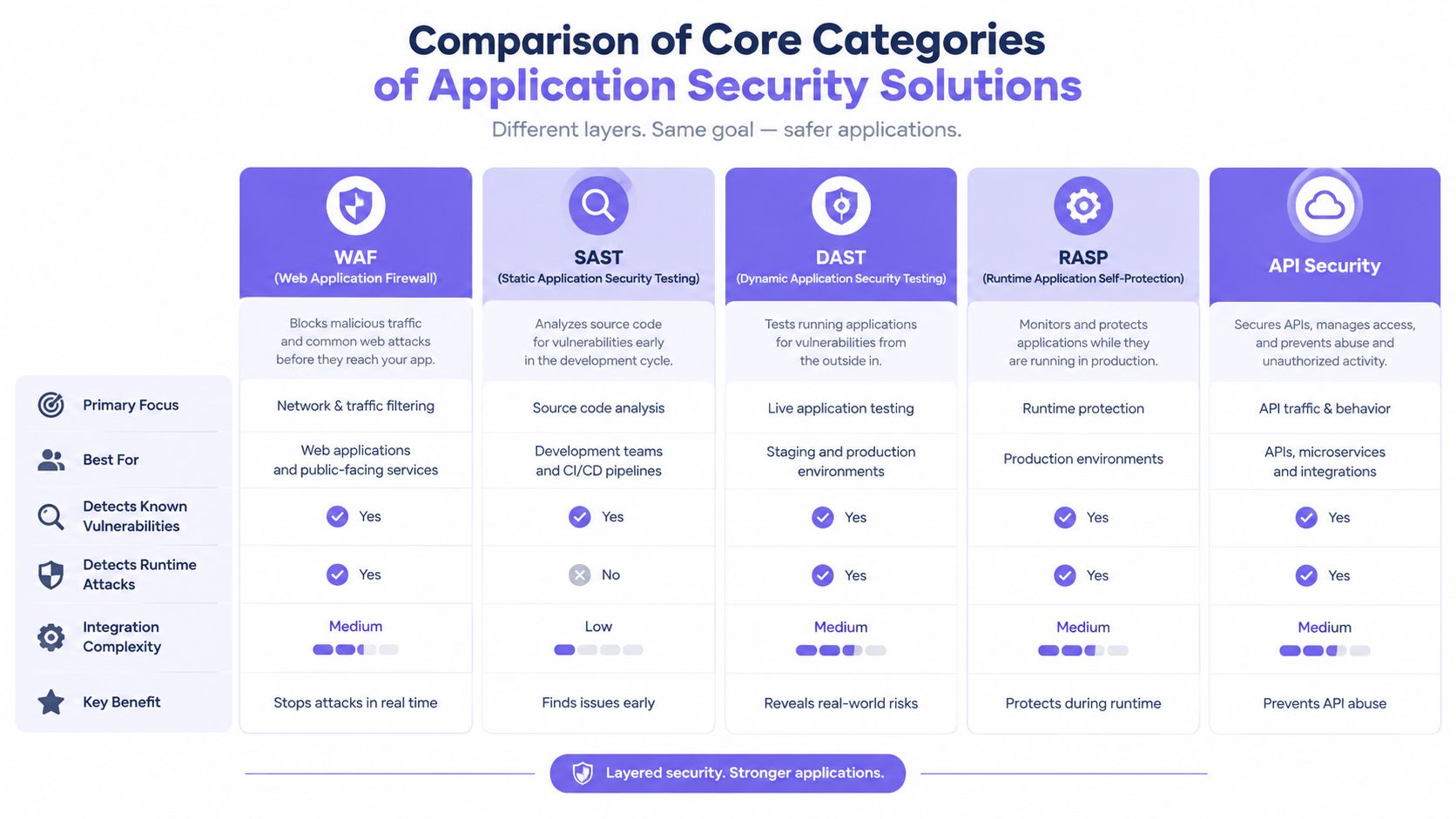
Application security categories overlap, but they don't solve the same problem. Treating them as interchangeable leads to predictable blind spots.
Code and dependency analysis
SAST examines source code, bytecode, or compiled representations without executing the application. It can identify insecure data flows, injection patterns, authentication mistakes, and misuse of security-sensitive functions early in development. Its strength is fast feedback before deployment. Its weakness is that it may not understand actual runtime configuration, reachable paths, or the behavior of external services.
SCA evaluates third-party and open-source components. It helps teams identify vulnerable packages, license concerns, outdated dependencies, and transitive relationships that developers can't reliably track by hand. SCA becomes much more useful when it knows whether a vulnerable component is loaded, called, and exposed in the running application. A package listed in a manifest isn't automatically an exploitable path.
DAST tests a running application from the outside. It can reveal behavior that static analysis misses, including authentication flows, configuration problems, exposed endpoints, and runtime responses. DAST offers valuable production-like evidence, but it depends on application coverage, test credentials, environment stability, and accurate crawling. It may find a symptom without showing the most efficient code-level fix.
Runtime and boundary controls
IAST combines runtime instrumentation with application testing. It observes code while functional or security tests execute, giving teams more context than either a purely static or purely external test. The trade-off is deployment complexity and dependence on the quality of the test suite.
RASP operates inside the application runtime and can detect or block certain attacks as they occur. It adds a defensive layer when prevention at the code or gateway layer isn't enough, but teams must assess performance, language support, operational overhead, and how the control behaves during incidents.
A WAF protects web traffic at the application boundary. It can block known attack patterns and provide a useful compensating control, but it shouldn't become an excuse to leave vulnerable code unfixed. API security adds discovery, schema awareness, authentication analysis, and behavior monitoring for service interfaces. Those controls matter because modern applications often expose more business logic through APIs than through traditional web pages.
For organizations evaluating an enterprise security posture beyond application tests, an enterprise-grade security overview can provide useful context on how broader controls, governance, and infrastructure protections fit around application security.
| Category | Primary position | Useful strength | Common limitation |
|---|---|---|---|
| SAST | Source and build workflow | Early code feedback | Limited runtime context |
| SCA | Dependency lifecycle | Component and license visibility | Can overstate exploitability |
| DAST | Running application | External behavior validation | Dependent on test coverage |
| IAST | Instrumented runtime tests | Code and runtime correlation | Operational setup |
| RASP | Production runtime | In-process detection or blocking | Runtime overhead and tuning |
| WAF and API security | Application boundary | Traffic and interface protection | Can't replace secure design |
No single category provides a complete security model. The practical architecture layers fast developer feedback, dependency intelligence, runtime evidence, and boundary protection around a shared risk model.
Moving Beyond Raw Detection to Actionable Signal
A CVE count is a measurement of disclosure volume, not a measurement of application risk. Security teams need to know whether a vulnerable component is present, reachable, exposed, exploitable, and connected to a meaningful business function.
SBOM-driven programs show why this distinction matters. One industry survey found that 38% of vulnerabilities identified by scanning were considered false positives, while an empirical study of SBOM-based vulnerability management reported a 97.5% false-positive rate from downstream scanners that flagged vulnerabilities in unreachable code. The same study found that function-call analysis reduced false alarms by 63.3%. These findings are documented in the Software Supply Chain Security Survey Report/survey%20report/Anchore%202022%20Software%20Supply%20Chain%20Security%20Survey%20Report%20FINAL.pdf?_hsmi=20053697).
The lesson isn't that scanners are ineffective. The lesson is that scanners answer only part of the question.
The context a finding needs
A useful application security solution should correlate at least these dimensions:
- Code path: Identify the file, function, call chain, and data flow connected to the finding.
- Dependency usage: Distinguish an installed package from a vulnerable function that the application invokes.
- Exposure: Establish whether the affected component is reachable from an external network, privileged user, internal service, or no meaningful entry point.
- Runtime evidence: Use deployment and runtime information to show whether the vulnerable path is active in a real environment.
- Ownership: Route the issue to the team that can make the change, rather than to a generic security queue.
- Business context: Prioritize a payment flow, patient-facing service, or public API differently from an isolated development utility.
Correlation also prevents duplicate work. A SAST result, dependency alert, and runtime event may describe one underlying risk. Without a shared identity and relationship model, three tools create three tickets. With correlation, the platform can present one decision with supporting evidence.
Why prioritization must be explainable
Risk ranking shouldn't be a mysterious score that developers can't challenge. Engineers need to understand why an issue is urgent and what evidence would lower its priority. A platform that marks a finding as critical because of a generic severity label may generate resistance. A platform that shows a reachable vulnerable function in an externally exposed service gives the owner a reason to act.
The output should therefore be an action, not just a dashboard entry. That action might be a pull request, a ticket with a due date, a policy exception, a runtime mitigation, or a documented acceptance decision. Signal quality means fewer ambiguous handoffs, not fewer findings for the sake of a better dashboard.
Continuous Threat Modeling and Policy as Code
A threat model stored in a wiki becomes unreliable as soon as architecture, dependencies, ownership, or data flows change. The model should evolve with the artifacts that describe the system, including tickets, design documents, repositories, service metadata, and deployment configuration.
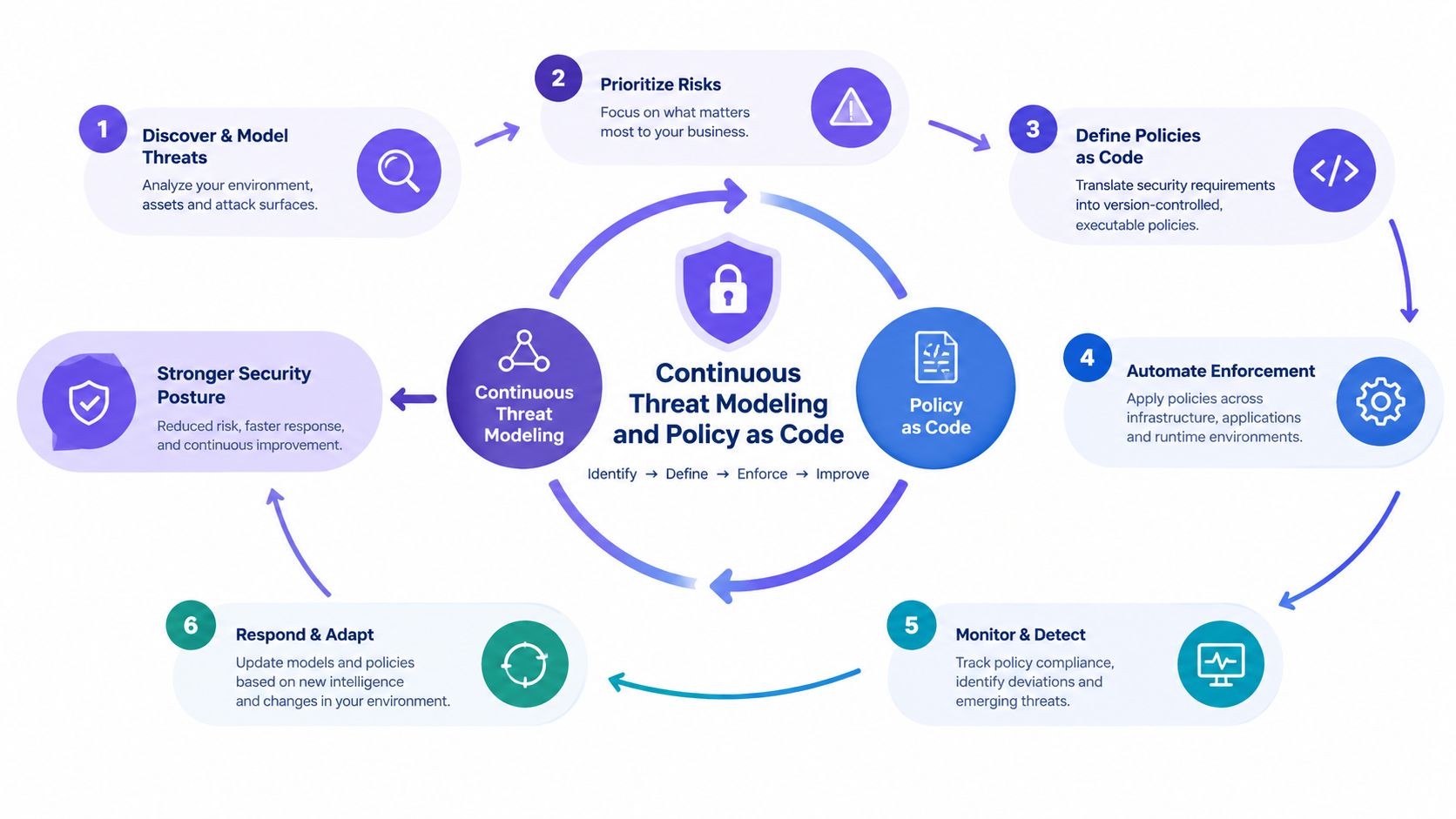
Continuous threat modeling doesn't mean forcing security engineers into every planning meeting. It means extracting security-relevant decisions from normal engineering work, then checking whether implementation still matches those decisions.
Build a living model
Start with the system boundary and the decisions that matter. Identify data stores, trust boundaries, authentication assumptions, privileged operations, external integrations, and failure consequences. Then connect those decisions to repositories, services, teams, and delivery workflows.
A practical operating loop looks like this:
- Capture intent: Record security requirements in planning tickets, architecture notes, or design reviews using language developers can implement.
- Map the system: Associate requirements with services, repositories, APIs, data flows, and deployment environments.
- Generate threats: Evaluate changes against the current architecture instead of relying on a review performed months earlier.
- Verify implementation: Check pull requests and deployments for deviations from approved requirements.
- Refresh continuously: Update the model when tickets, source code, service metadata, or architecture changes.
The application risk assessment guide is relevant for teams formalizing this connection between application context, threats, and delivery decisions.
Make policies executable
Policy as Code turns a security expectation into a machine-evaluable rule. “Use approved authentication for sensitive operations” is a useful requirement, but it isn't enforceable until the team defines what approved means, where the rule applies, what evidence satisfies it, and what happens when code violates it.
Effective policies have four properties:
- Machine-executable: A repository, pull request, pipeline, or deployment can be evaluated consistently.
- Time-bound: Exceptions have an expiry rather than becoming permanent bypasses.
- Auditable: The system records the rule, decision, owner, evidence, and approval path.
- Risk-sensitive: High-risk violations can block a merge, while lower-risk issues can create tickets or warnings.
Research on policy enforcement in developer workflows emphasizes these distinctions. The practical benefit is consistency across repositories and pipelines. Developers don't need to remember every control, and security teams don't need to repeat the same review manually.
Blocking every deviation creates friction and encourages bypasses. Blocking only the violations that represent unacceptable risk, while routing manageable exceptions through an expiring and traceable path, creates a control developers can work with.
Securing AI-Native Development Workflows
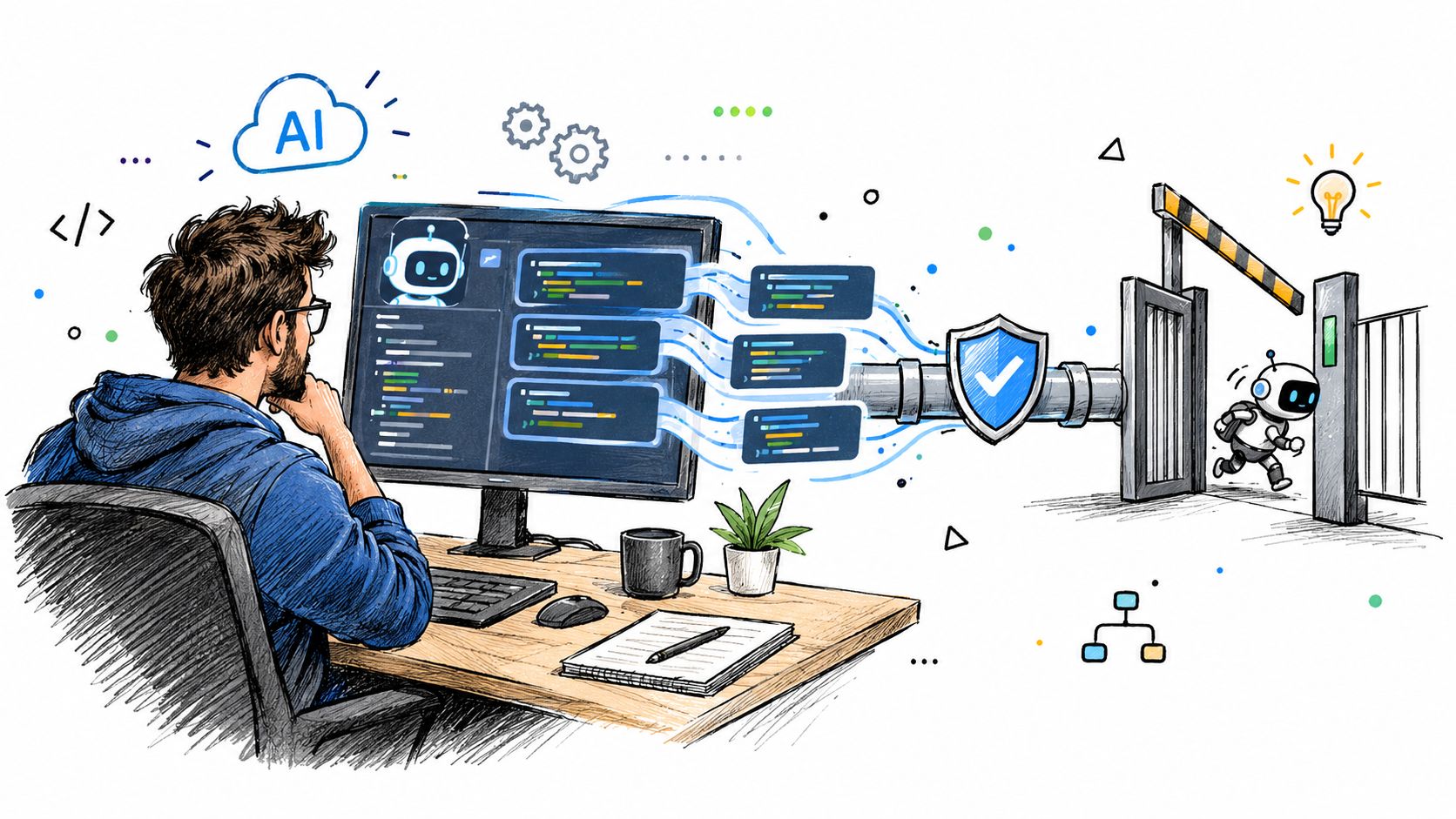
AI-assisted development changes the shape of the security problem. Code generation can happen inside an IDE, through a coding agent, or as part of an automated pull request workflow. The developer may review the result, but the person requesting the code isn't necessarily examining every dependency choice, data flow, permission boundary, or error-handling path created by the agent.
The answer isn't to ban AI coding. It isn't realistic to expect a human to manually inspect every generated line either. Application security solutions need to move security context into the generation and review workflow, where the agent and developer can use it before unsafe patterns spread across repositories.
Guardrails must carry architectural intent
A generic secure-coding prompt is too weak for a real application. An AI coding agent needs to know which identity provider the service uses, which data requires encryption, which libraries are approved, whether a service can call an external endpoint, and which repository owns a sensitive interface.
That context should come from the living threat model and repository metadata, not from a developer repeatedly pasting policy into a chat window. The platform should surface relevant requirements in the IDE, explain why a generated change conflicts with them, and provide a path to revise the code or request an exception.
The guide to AI coding security offers a useful reference point for thinking about guardrails around AI-assisted development.
Keep humans focused on decisions
Automation should handle repetitive checks, not eliminate accountability. A coding agent can validate approved frameworks, detect prohibited data flows, check dependency policy, and prepare evidence for a review. A developer or security owner should still decide whether a new trust boundary is acceptable or whether a requirement needs to change.
Forrester identifies the growth of AI-enabled applications, software supply chain concerns, and the increasing influence of developers as forces reshaping AppSec buying and practice in its State of Application Security 2025 research. The implication is practical: a platform that works only in a central security console won't govern the places where AI-generated code is created.
A strong workflow gives the agent constraints before generation, feedback during editing, checks at pull request time, and evidence after deployment. It also records which policies were applied, which findings were accepted, and which human approved an exception. That record becomes essential when teams need to understand not just what code an agent produced, but why the organization allowed it into production.
Use Cases for Regulated and Fast-Moving Industries
A financial services team launching a new customer payment feature faces two questions at once. Can the engineering group deliver the feature safely, and can the organization later demonstrate to an auditor that the security decisions were intentional, approved, and implemented?
Traditional documentation often separates those questions. Architects create a diagram, security reviewers write comments, developers implement code, and compliance teams collect evidence later. By then, the design may have changed, the original reviewers may not remember the decision, and the evidence may no longer match the deployed service.
Financial services
A stronger workflow starts with the feature design. The team records the payment flow, authentication assumptions, sensitive data handling, external providers, and failure behavior. The security system maps those decisions to repositories and pull requests, then checks whether implementation introduces an unapproved data path or bypasses a required control.
If the change violates a high-risk policy, the merge can stop. If the issue is understood and acceptable for a limited period, the team can record an exception with an owner, rationale, and expiry. The audit trail is created during engineering rather than reconstructed during an audit window.
This approach doesn't make compliance automatic. It makes compliance evidence a byproduct of normal work. Architecture decisions, review outcomes, implementation checks, and exception records remain connected instead of being scattered across documents and ticket comments.
Health technology
HealthTech teams have a similar need for traceability, with additional sensitivity around patient information, clinical workflows, and third-party integrations. A design review should identify where sensitive records enter the system, which services may access them, how support personnel authenticate, and what happens when an integration fails.
The important control is not merely a completed threat model. It's the ability to detect drift. If a repository introduces a new integration or changes an authorization boundary, the system should refresh the relevant security context and prompt a review. That keeps security decisions attached to the application as it evolves.
Media and high-scale platforms
Media platforms often prioritize rapid launches, public APIs, content workflows, and a broad network of internal and external services. Their risk isn't limited to a single release. It can arise when a new recommendation service, content processor, identity integration, or advertising component changes the trust relationships across the platform.
Security leaders also need to connect technical controls with broader resilience planning. For teams reviewing risk transfer alongside preventative controls, an ABS Insurance Brokers cyber insurance resource provides useful context on how cyber insurance fits into a wider risk management program. Insurance can't compensate for weak engineering controls, but it can sit alongside documented prevention, response, and recovery practices.
How to Evaluate and Integrate the Right Platform
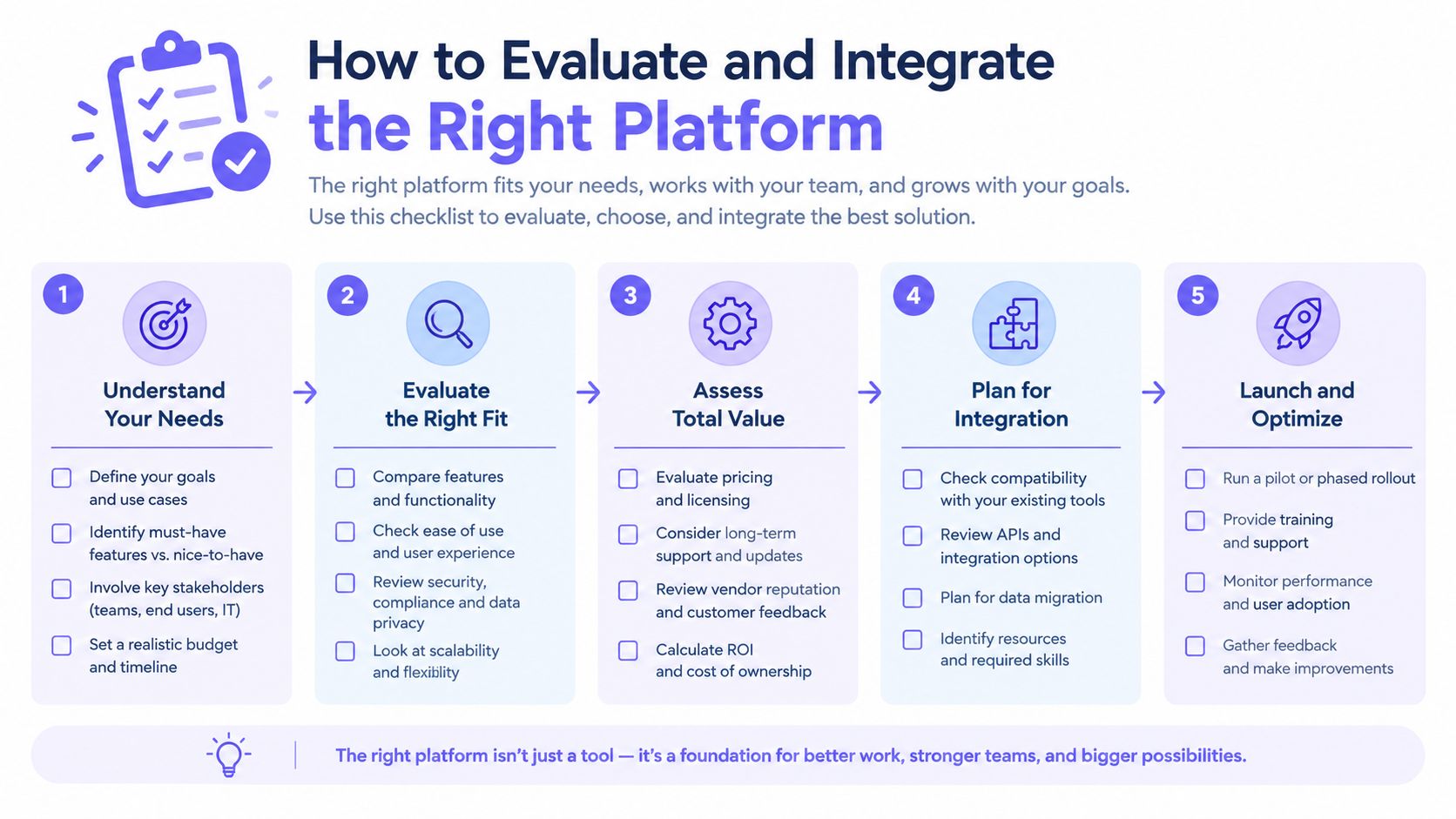
Evaluate application security solutions as workflow infrastructure, not as collections of features. A long product checklist can hide the central failure mode: the platform may detect risk but leave developers to interpret it in a separate console.
Start with a representative application, a real repository, and an existing delivery path. Don't use a carefully prepared demonstration project. Include the dependencies, pull requests, planning artifacts, deployment metadata, and recurring exceptions that create work for your team today.
Test the decision loop
Ask vendors to demonstrate how one finding moves from discovery to resolution. Can the platform show the relevant code path, explain exploitability, identify the owner, create a useful ticket, and verify the fix? Can it distinguish a policy violation that should block a merge from one that needs review?
Then test the design loop. Give the platform a change in a ticket or architecture document and determine whether it updates the security context, surfaces the right requirements in the IDE, and checks the resulting pull request. If the system requires security staff to manually rebuild context for every change, it won't scale with delivery.
Use practical evaluation criteria
- Workflow coverage: Verify integrations with planning tools, source control, IDEs, pull requests, CI/CD, and deployment systems your teams already use.
- Signal quality: Measure false-positive churn, duplicate findings, unsupported severity claims, and the percentage of alerts that reach an owner with a clear next step.
- Decision latency: Track how long design reviews, remediation decisions, and exception approvals take after the platform is introduced.
- Evidence quality: Check whether the system can reconstruct the relationship between a requirement, threat model, code change, approval, and deployment.
- Control flexibility: Confirm that policies support warnings, tickets, merge blocking, time-limited exceptions, and retained evidence.
- Recovery from documentation gaps: Test whether the platform can infer useful security context from source code and repository structure when formal design material is incomplete.
A pilot should end with a decision record, not a feature scorecard. Choose the platform that helps teams make correct decisions with fewer handoffs, even if another product reports more findings. Detection still matters, but the lasting advantage is a living security context that turns detection into action.
DevArmor provides continuous threat modeling, security design reviews, and Policy-as-Code enforcement across planning tools, IDEs, source control, and delivery workflows. If your team needs to connect approved design decisions with pull request checks and AI-assisted coding guardrails, visit DevArmor to evaluate how it fits your application security program.
Table of Contents
Subscribe