Application Risk Assessment Workflow
 Reza Khosravi
Table of Contents
The most popular advice about application risk assessment is also the least useful: run a scanner, assign a severity, and work down the list. Scanning matters, but a vulnerability count isn't a risk model. It doesn't tell you whether an exposed endpoint can reach regulated data, whether an attacker can abuse a business workflow, or whether an existing control changes the decision.
A practical application risk assessment starts earlier and stays alive longer. Security intent belongs in the feature design, the repository, the pull request, and the deployment context. That approach gives engineers actionable guardrails while giving security and compliance teams a traceable explanation of why a change was approved.
Why Point-in-Time Application Risk Assessments Fail
A point-in-time assessment assumes the application is stable long enough for a document to remain accurate. Most delivery teams don't work that way. A service gains a new API, a ticket changes an authorization rule, an agent generates a helper function, or a third-party integration acquires access to a different data set. The assessment may still describe the previous architecture while the running system follows another path.
The problem isn't that the document was poorly written. The problem is that the process treats risk as an event instead of a property of an evolving system. A periodic review can identify exposure, but it can't govern every material change between reviews.
A practical application of risk management should therefore distinguish between assessment evidence and security context. Evidence includes findings from code analysis, dependency checks, design reviews, runtime telemetry, and deployment records. Security context explains which assets matter, which trust boundaries exist, what threats were considered, and which controls the business accepted.
The historical warning
This gap has existed for longer than current delivery practices. A 2006 survey distributed to more than 20,000 corporations, based on over 600 corporate responses, found that roughly two-thirds of organizations most exposed to reverse-engineering risk lacked adequate controls. Among the top 15 industries at risk, 27% had no controls, 35% relied on developers to decide without policy or corporate guidance, and only 36% had both anti-reverse-engineering tools and consistent guidance aligned to risk appetite (historical application risk assessment survey).
The lesson isn't that teams need more documents. It's that security decisions fail when ownership and policy remain implicit. A later application security survey found that 66% of companies had an application security program, while only 23% had a policy covering the complete application lifecycle (application security survey findings). Having security activity isn't the same as governing risk from design through operation.
Replace the gate with a feedback loop
The better model records a decision when a feature is planned, tests the decision as code changes, and reopens it when the relevant context changes. A design review might require authorization checks for an administrative action, encryption for a sensitive data flow, or an approval step before a service can call an external model. The pull request then verifies whether the implementation still satisfies that decision.
This doesn't mean blocking every uncertain finding. It means reserving hard gates for explicitly defined conditions, such as a trust boundary violation or an unapproved data exposure, while routing lower-confidence issues to review. The result is faster feedback, fewer late surprises, and a risk register that reflects the application engineers are building.
Scoping Assets and Mapping Data Flows
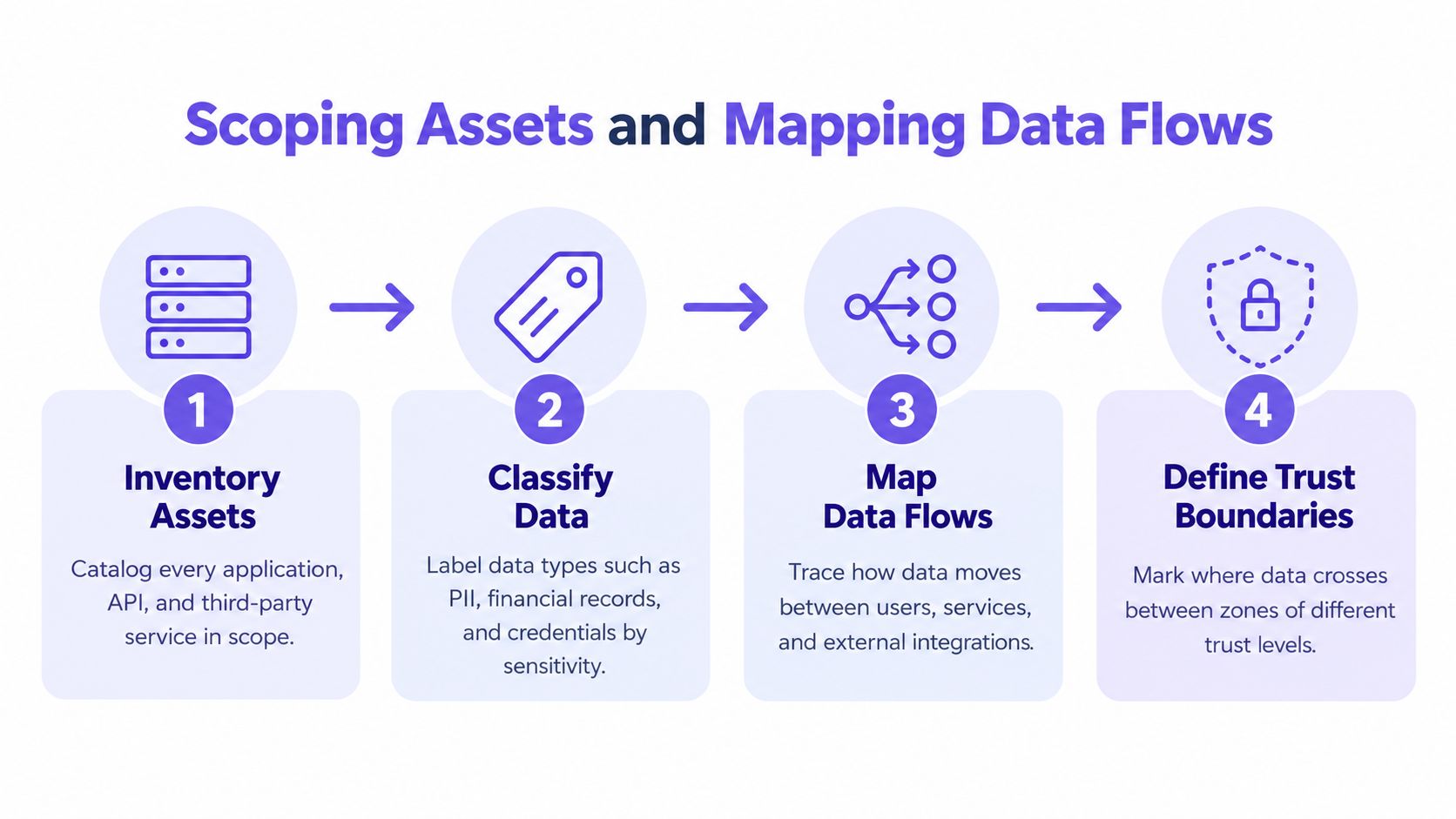
An assessment becomes unreliable when its scope starts with a convenient system diagram rather than the system itself. Begin with the application's current artifacts, then confirm the business importance of each component. Pull service names, repositories, deployment metadata, API specifications, ownership records, and planning tickets into one working inventory.
The inventory should cover more than production services. Include background workers, internal tools, queues, databases, identity providers, observability systems, payment services, analytics platforms, and vendors that process or receive application data. A forgotten staging integration can create a meaningful exposure if it shares credentials or production-like data.
Start with an evidence-backed inventory
Use repository metadata and infrastructure definitions to identify what exists, then use tickets and design documents to understand why it exists. Assign an owner to each asset, record its environment, and capture its relationship to other services. If the inventory can't explain who owns a component or which data it handles, that uncertainty is itself an assessment finding.
A useful inventory record includes:
- Asset identity: Application, service, API, repository, queue, database, or external provider.
- Business purpose: The customer or internal process that depends on it.
- Data handled: Inputs, outputs, stored records, credentials, tokens, and telemetry.
- Exposure: Public endpoint, partner access, employee access, service-to-service access, or internal-only use.
- Control context: Authentication, authorization, encryption, logging, isolation, backup, and deployment safeguards.
- Ownership: Engineering team, product owner, security contact, and operational escalation path.
This is more useful than a static catalogue because the team can update it from changes already occurring in delivery workflows. A new repository dependency, API route, or external integration should create an event for review instead of waiting for the next assessment workshop.
Trace flows, not just components
Data-flow mapping should answer four questions: where data enters, where it is transformed, where it is stored, and where it leaves the trust boundary. Trace user requests through gateways, identity services, application logic, data stores, asynchronous queues, and third-party systems. Mark credentials and tokens separately from business data because they can create a different path to compromise.
Classify data by sensitivity and consequence rather than by technical format alone. Personal information, health records, financial records, source code, and credentials require different controls and different evidence. Teams working in healthcare may also benefit from a focused resource on healthcare compliance with Trace, particularly when data obligations span internal services and external processors.
Make trust boundaries explicit
A trust boundary exists wherever assumptions change. Examples include a browser-to-API transition, a customer-to-tenant boundary, a service-to-service call, a cloud account boundary, or an application-to-model-provider connection. For every boundary, document the identity presented, the authorization decision, the data crossing it, and the failure behavior.
A thorough attack surface analysis should include reachable paths, not merely the number of assets. A dormant service with no sensitive access may need less attention than a small API that can invoke privileged workflows. Keep the model connected to source control and planning artifacts so changes to routes, permissions, dependencies, or integrations can trigger targeted reassessment.
Scoring Likelihood and Business Impact
Risk scoring should help people make decisions, not create a decorative number. The practical foundation is straightforward: identify the scenario, estimate likelihood, estimate impact, record existing controls, and state the remaining uncertainty. The score should explain why a team will fix, monitor, accept, transfer, or avoid the risk.
Likelihood should reflect more than exploit availability. Consider attacker motivation, required skill, exposure, reachable assets, authentication strength, existing detections, and whether an attacker can chain the weakness with another condition. A low-level code finding may become serious when it sits on a public API with a path to privileged data. A technically severe issue may deserve less urgency when it isn't reachable and strong compensating controls are verified.
Impact needs an equally concrete business frame. Assess data loss, regulatory consequences, revenue disruption, downtime, customer trust, operational recovery, and intellectual property exposure. The application security risk assessment methodology also separates technical exposure from control maturity and compliance context, a useful distinction for regulated environments.
Score scenarios, not isolated findings
Write findings as attack scenarios. “Improper authorization in invoice endpoint” is more actionable than “high-severity access-control issue.” The scenario should state who could exploit it, what they could reach, which business process is affected, and which control would prevent or detect the abuse.
Use a consistent scale, but allow reviewers to override a score when evidence supports it. A risk register entry should include:
- Scenario: The plausible misuse or failure.
- Likelihood rationale: Exposure, attacker capability, reachability, and defenses.
- Impact rationale: Data, business process, regulatory, and operational consequences.
- Control effectiveness: What prevents, limits, detects, or recovers from the event.
- Decision: Remediate, monitor, accept, transfer, or redesign.
- Owner and evidence: Responsible team, due condition, test, and review record.
A quantitative research model describes application risk as a function of breach cost, vulnerability density, countermeasure efficiency, and compliance index. It also classifies applications into five tiers, which demonstrates why raw vulnerability density shouldn't stand in for business risk.
Use tiers to allocate attention
The following classification is intentionally qualitative. It gives engineering and security teams a shared vocabulary without pretending that every application can be reduced to the same formula.
| Risk Tier | Business Impact | Data Sensitivity | Assessment Frequency |
|---|---|---|---|
| Critical | Failure could materially disrupt a core business service or trigger severe regulatory or customer consequences | Highly sensitive records, privileged credentials, or critical intellectual property | Continuous change monitoring with review for material design changes |
| Important | Failure could disrupt a significant process or expose meaningful business information | Sensitive customer, employee, financial, or partner data | Regular review plus event-triggered reassessment |
| Strategic | Risk affects an important product capability, growth initiative, or external dependency | Business-sensitive data or access with meaningful downstream reach | Review at major feature and architecture changes |
| Internal function support | Failure primarily affects internal productivity or a bounded operational process | Internal data with limited external exposure | Review when ownership, access, or architecture changes |
| General function support | Failure has contained business consequences and limited reach | Low-sensitivity data with narrow access | Periodic review and change-based validation |
Don't let a neat matrix conceal weak assumptions. A threat-modeling benchmark warns that mathematically tidy ratings can mislead when they aren't grounded in realistic attack paths, business impact, and feasible countermeasures (threat modeling research and benchmark). The score is a decision aid. The written rationale is what makes that decision defensible.
Operationalizing Controls with Policy-as-Code
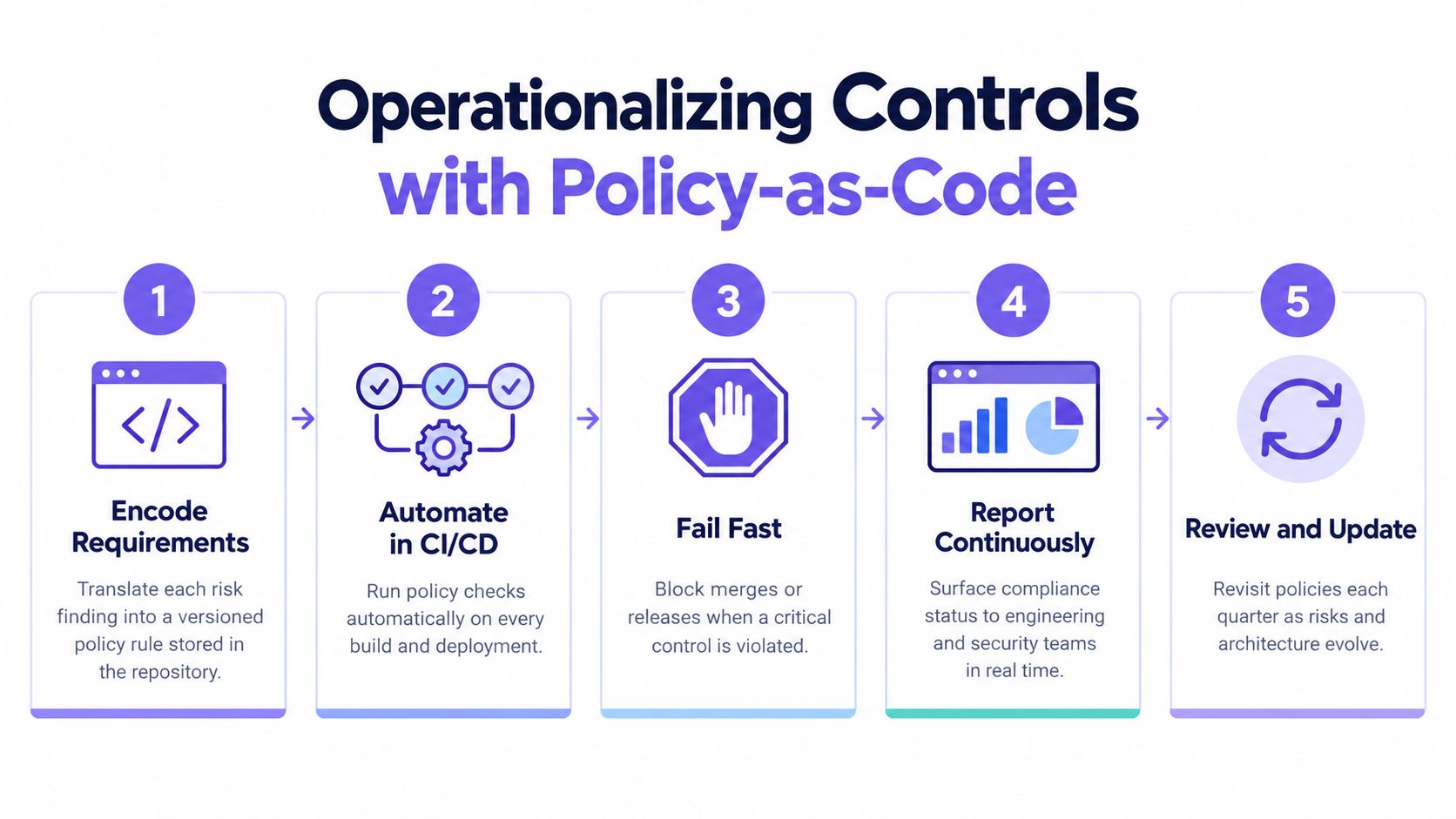
Risk assessment only creates value when it changes implementation behavior. Policy-as-Code turns approved security decisions into versioned rules that can run where developers already work, including pull requests, build pipelines, deployment workflows, and infrastructure changes.
Start with the decision, not the rule syntax. For each material threat, define the required outcome and the evidence that proves it. “Protect the administrative export” might become a policy requiring an explicit authorization check, tenant scoping, audit logging, and a test covering unauthorized access. The policy should identify the design decision it enforces and the owner responsible for reviewing exceptions.
Turn controls into testable requirements
A useful control has a clear subject, condition, action, and evidence. Avoid rules that merely check whether a tool ran. A completed scan doesn't prove that an exposed endpoint is authorized correctly or that a model-connected workflow can't disclose restricted data.
Encode requirements such as:
- Data-boundary control: A service handling sensitive data can't send it to an unapproved external integration.
- Identity control: Privileged actions require an approved identity and an authorization decision tied to the resource.
- Dependency control: New packages or providers require ownership, provenance, and review under the applicable supply-chain policy.
- Deployment control: Production changes must preserve required logging, secret handling, and network restrictions.
- Exception control: A waiver needs an owner, rationale, expiry condition, and compensating control.
Store policies beside the application or in a governed policy repository. Versioning matters because reviewers need to know which requirement applied when a change was approved. The policy should produce a readable result for engineers and an auditable record for security teams.
Enforce proportionately in pull requests
Run checks early, but don't make every warning a merge blocker. Hard blocking fits violations with clear evidence and material consequences. Ambiguous findings should create a review task with context, suggested remediation, and an explicit decision path.
A pull request should show the affected trust boundary, linked threat, policy result, changed control, and test evidence. If the implementation diverges from the approved design, the system should ask for a new decision rather than implicitly treating the old review as valid.
Policy-as-Code implementation guidance can help teams structure this connection between requirements and enforcement. The important operating principle is simple: every blocking rule needs a reason developers can understand. Otherwise, teams bypass controls, security inherits exception queues, and the assessment program becomes another source of delivery friction.
Measure control quality
Review policies when architecture, threats, or business obligations change. Track whether rules produce useful findings, whether teams resolve them, and whether exceptions remain open without ownership. A policy that generates constant false positives isn't rigorous. It's poorly specified.
The strongest workflows combine automated verification with human judgment. Automation handles repeatable evidence collection and enforcement. Engineers and security practitioners decide whether the model, scenario, and business context remain correct.
Governing AI-Assisted Code and Runtime Risk
AI-assisted development changes the unit of review. A pull request may contain code generated from a prompt, modified by an agent, assembled from unfamiliar dependencies, and connected to tools or APIs that weren't part of the original design. Traditional scanners can identify some symptoms, but they won't reliably explain whether the agent had permission to make the change or whether the resulting workflow violates an approved trust boundary.
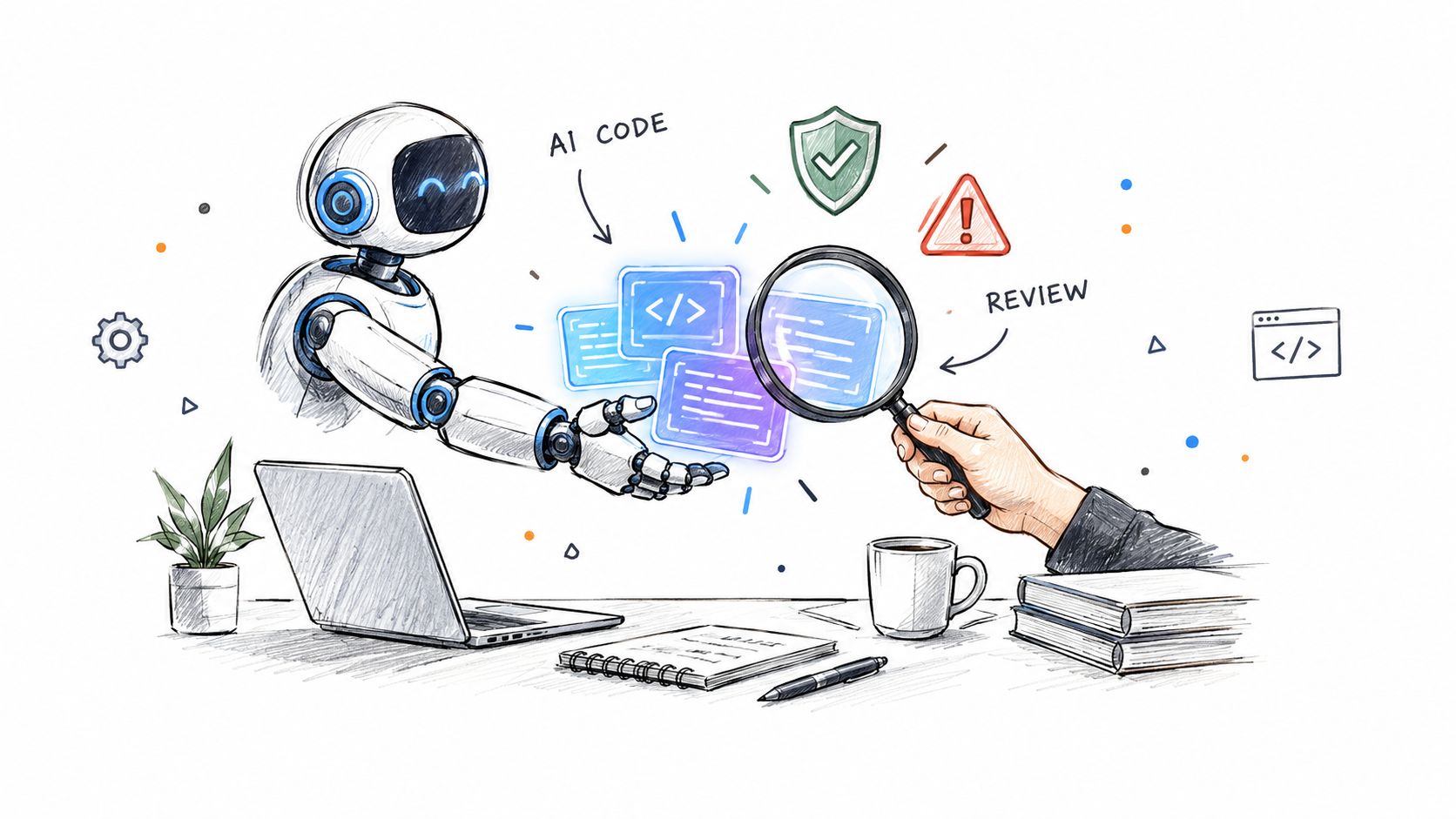
The answer isn't to ban generated code or to approve it automatically. Treat the coding agent as a delivery participant with defined authority, supplied context, and observable actions. The application risk assessment should record what the agent can access, which repositories and tools it can invoke, what data may enter its context, and which changes require human review.
Set boundaries before agents write
Define review boundaries around consequences, not authorship. An agent may be allowed to refactor internal code but not alter authorization middleware, add a production integration, change secrets handling, or modify a policy without approval. The boundary should be machine-readable where possible and visible in the agent's working context.
Provide secure prompting context that includes the relevant data classifications, trust boundaries, prohibited actions, required controls, and approved patterns. Don't rely on a generic instruction to “write secure code.” The agent needs the same design decision that a human engineer would use.
A practical boundary model includes:
- Permitted changes: Low-impact refactoring, test generation, documentation, or bounded implementation work.
- Review-required changes: Authentication, authorization, data access, external calls, dependency additions, and infrastructure modifications.
- Prohibited autonomous actions: Production deployment, policy weakening, secret retrieval, or changes that cross an unapproved trust boundary.
- Required evidence: Tests, dependency provenance, threat-model updates, and a reviewer decision for exceptions.
Teams evaluating broader AI governance can use Kagool's AI risk management guide as additional context for assigning ownership and documenting controls.
Add runtime evidence to the model
Generated code can look safe in isolation while creating risk through live behavior. API business logic, token scope, service identity, default configuration, and third-party failure modes often require runtime context. An independent 2025 benchmark reported that 55% of organizations experience API business logic attacks daily, weekly, or monthly (API and bot attack research).
Runtime assessment should connect observed routes and identities to the design model. Check whether a service accesses more data than intended, whether an agent-created endpoint exposes an unsafe workflow, and whether a token can call functions outside its stated purpose. This isn't a reason to abandon static analysis. It's a reason to combine code evidence with reachability and live behavior.
Verify the source of each change
Require generated changes to retain ordinary software controls: code review, tests, dependency checks, ownership, and deployment traceability. Where possible, preserve the prompt or task context that led to a security-sensitive change, but don't treat the prompt as proof of safety. The approved design, implementation evidence, and runtime verification remain the basis for the decision.
Building a Continuous Security Context
A durable application risk assessment program maintains a living record of how the application works, what it protects, and which controls the organization has accepted. That record should update when repositories, tickets, APIs, infrastructure, dependencies, or ownership change. Manual documentation can still support a review, but it shouldn't be the only mechanism keeping architecture knowledge current.
The operational loop is compact:
- Observe change in planning tools, source control, infrastructure, and runtime activity.
- Identify affected context, including assets, data flows, trust boundaries, threats, and policies.
- Reassess material risk using the existing rationale and new evidence.
- Verify implementation through tests, pull-request checks, deployment evidence, and runtime controls.
- Record the decision so engineers, security teams, and auditors can reconstruct what happened.
This model supports regulated organizations because it connects compliance evidence to actual engineering decisions. Audit-friendly architecture documentation should show the relevant scope, approved risks, control requirements, review outcomes, and exceptions. It shouldn't force an engineer to recreate months of decisions from chat messages and outdated diagrams.
Make adoption manageable
Don't start by modeling every application in equal detail. Choose a critical customer-facing workflow or sensitive data flow, establish the inventory and trust-boundary conventions, then connect the model to the team's planning and pull-request process. Expand only after engineers can see that the workflow gives them useful context rather than another queue.
The main success measure isn't the size of the risk register. It's whether teams can answer, quickly and consistently:
- What changed?
- Which assets and flows are affected?
- What threat does the change introduce?
- Which policy applies?
- What evidence proves the control works?
- Who accepted any remaining risk?
A scanner still belongs in that system, but it should supply evidence to a broader decision process. Continuous, design-driven governance reduces late rework, limits alert fatigue, and gives developers a practical way to move quickly without losing security intent.
DevArmor provides continuous threat modeling, security design reviews, and Policy-as-Code enforcement across planning, coding, and deployment workflows, including guardrails for AI-assisted development. Visit DevArmor to connect application risk decisions with implementation evidence and audit-ready security context.
Table of Contents
Subscribe