
SOC 2 Evidence Collection: A Practical Guide for 2026
 Reza Khosravi
Table of Contents
Your auditor's request list is open, engineering is preparing a release, and someone has uploaded an access export named final-approved. It lists the users, but nobody can find who reviewed it. Meanwhile, the deployment policy in the evidence folder doesn't match the rule currently enforced in GitHub.
That's the problem with SOC 2 evidence collection: having files isn't the same as being able to prove a control operated. Build the workflow around traceability, complete populations, and attributable decisions. Otherwise, you'll spend the audit explaining documents instead of demonstrating controls.
Build an Evidence Map Before You Collect Anything
Start with a control register, not a shared drive. Give every in-scope control a row containing its Trust Services Criteria mapping, owner, operating frequency, population definition, evidence source, and examination-period dates. Add the procedure the owner follows, rather than copying a policy statement that nobody can execute.
Map by control, not by system. GitHub might provide evidence for change approvals, privileged access, and policy enforcement, but those are separate assertions. A repository export doesn't automatically prove all of them.
Evidence sources by control area
Use these mappings as a starting point, then refine them against your actual control language and selected criteria.
| Control area | Trust Services Criteria | Primary evidence source | Artifacts to capture |
|---|---|---|---|
| Access reviews | Security | Identity provider and access listings | Quarterly export with reviewer sign-off |
| Change management | Security, Processing integrity | Source control and CI/CD | Pull request approvals and deployment logs |
| Vulnerability management | Security | Scanner and ticketing exports | Scan reports and dated remediation tickets |
| Incident response | Security, Availability | Incident management tool | Ticket timeline and post-incident review |
| Backups and recovery | Availability | Cloud backup console | Backup job logs and restore test results |
| Confidentiality controls | Confidentiality | Data stores and key management | Encryption and key configuration exports |
| Policies | All criteria | Policy repository | Versioned policies with employee acknowledgments |
For access reviews, identify which directory supplies the account population and where reviewers record decisions. For change management, connect the approval record to the deployment, not merely to a merged pull request. Vulnerability evidence needs the finding's lifecycle, including disposition and remediation dates.
Incident records should show how responders handled the event, while backup evidence should distinguish successful backup jobs from successful restoration. For confidentiality, identify the configuration authority for encryption and keys. Policy evidence needs both the applicable version and the acknowledgment record.
Make ownership actionable
Assign a named operational owner and a collection method to each row. Write down whether the evidence arrives through an API, a scheduled export, or an owner's documented procedure. Also record where the authoritative artifact will remain available.
If you're coordinating multiple frameworks, the ISO 27001 framework guide provides useful context for organizing shared control ownership. Reuse supporting artifacts where appropriate, but preserve each framework's assessment context.
Practical rule: An evidence-map row should tell another engineer what to retrieve without requiring a meeting with its author.
The scale makes this worth doing early: Secure.com says a typical SOC 2 audit in 2026 required more than 150 pieces of evidence. A map turns that collection effort into assigned work instead of a late scramble through consoles and chat history.
How to Pull Complete Control Populations, Step by Step
A population is the full set of events or items to which a control applies. It isn't the collection of successful examples an owner happens to remember. Before anyone selects evidence for testing, make the boundaries reproducible.
The GRC Engineering Club's explanation of audit evidence distinguishes sufficiency, the quantity needed relative to risk, from appropriateness, the evidence's relevance and reliability. A large export can still be inappropriate if it represents the wrong system or review window.
Extract records without losing their meaning
Freeze the examination boundary. Put the agreed start and end dates, time zone, systems, and environments in the register. Preserve subsequent scope changes as amendments so an exporter doesn't apply today's scope to historical activity.
Define what belongs in the population. For deployment controls, specify whether the population includes production releases, rollbacks, hotfixes, and infrastructure changes. For privileged access, distinguish grants, revocations, role changes, and periodic review events instead of mixing unlike activities.
Export from the authoritative system. Use the platform's export function or API and retain the query parameters, filters, pagination handling, and collection time. A screenshot of a dashboard count is useful corroboration, but it isn't a substitute for the underlying event records.
Normalize without replacing the original. Create a control-indexed record containing the control ID, event timestamp, actor, system, approval, result, exception, and immutable source reference. Keep the raw export alongside it so a reviewer can trace transformed fields back to their origin.
Reconcile the count. Compare the extracted population with the source system using identical filters and date boundaries. Investigate differences caused by pagination, deleted repositories, archived projects, service-account permissions, or mismatched time zones before treating the export as complete.
Document exclusions before sampling. Record each exclusion's identifier, reason, and supporting scope decision. Don't remove failed changes, emergency activity, or inconvenient records merely because they'll require explanation.
A collection checklist helps engineers avoid losing context during extraction.
Preserve history before the platform removes it
The common shortcut is exporting the most recent activity and labeling it the population. That fails when the request covers an earlier interval the export never included. Check retention settings before collection begins, especially for rolling logs and workflow histories.
Where historical records are split across tools, maintain a manifest describing each source segment and its coverage. A CI migration, for example, may require combining deployment records from the retired runner and its replacement. Retain their original identifiers and document how you detected duplicates.
The finished deliverable is a reconciled population package: the raw export, normalized index, query details, count comparison, exclusion register, and source references. Give it a stable version so the auditor's selection doesn't change underneath them when someone refreshes a report.
Sample Sizes Auditors Typically Pull by Frequency
Typical sample sizes by control frequency
These are planning benchmarks, not a sample-size policy your team can adopt independently.
| Control frequency | Typical sample size reported by SOC 2 Auditors |
|---|---|
| Quarterly | About 2 |
| Weekly | 5–9 |
| Large population, such as many deployments | About 25 |
| Daily or multiple times per day | Auditor-determined based on population and risk |
| Where deviations warrant expanded testing | Toward 40–60, subject to the available population |
The auditor determines the final sample size. The cited guidance explains that AT-C Section 205 calls for a sample sufficient to reduce sampling risk to an acceptably low level, with selection methods that reasonably represent the population. Frequency is an input, not the whole decision.
A control's risk, evidence characteristics, population size, and observed deviations affect the testing approach. Don't turn a benchmark into a promise that the auditor will request only that many records. Also, don't interpret expanded-testing ranges as permission to sample more distinct items than exist.
Keep selection reproducible
Agree on who performs selection and how the selected identifiers will be delivered. If the auditor uses random or systematic selection, preserve the population version and the method or selection parameters they provide. That allows the selection to be traced without engineering substituting easier examples.
For deployment testing, provide a manifest that links selected release identifiers to their approvals, policy checks, deployment outcomes, and applicable exceptions. Keep the manifest separate from the population so collecting supporting artifacts doesn't accidentally alter the selection universe.
Don't preselect your cleanest changes and call them representative. Give the auditor the reconciled population and preserve their selections.
Understand why deviations change the work
Suppose a selected deployment has no attributable approval. The next question isn't whether you can find a different deployment with a better record. The auditor may need to establish whether the problem was isolated, related to a workflow branch, or present throughout a broader interval.
That can mean additional selections, more investigation, or a different assessment of the control. Engineering should examine whether the same condition affected emergency releases, automation identities, or repositories using inherited branch protection.
At kickoff, confirm the anticipated testing approach, expected sample sizes, and treatment of low-volume populations. Then build retrieval workflows around source identifiers, rather than hard-coding a fixed number of evidence requests into your collection process.
Quality Checks That Make Evidence Hold Up
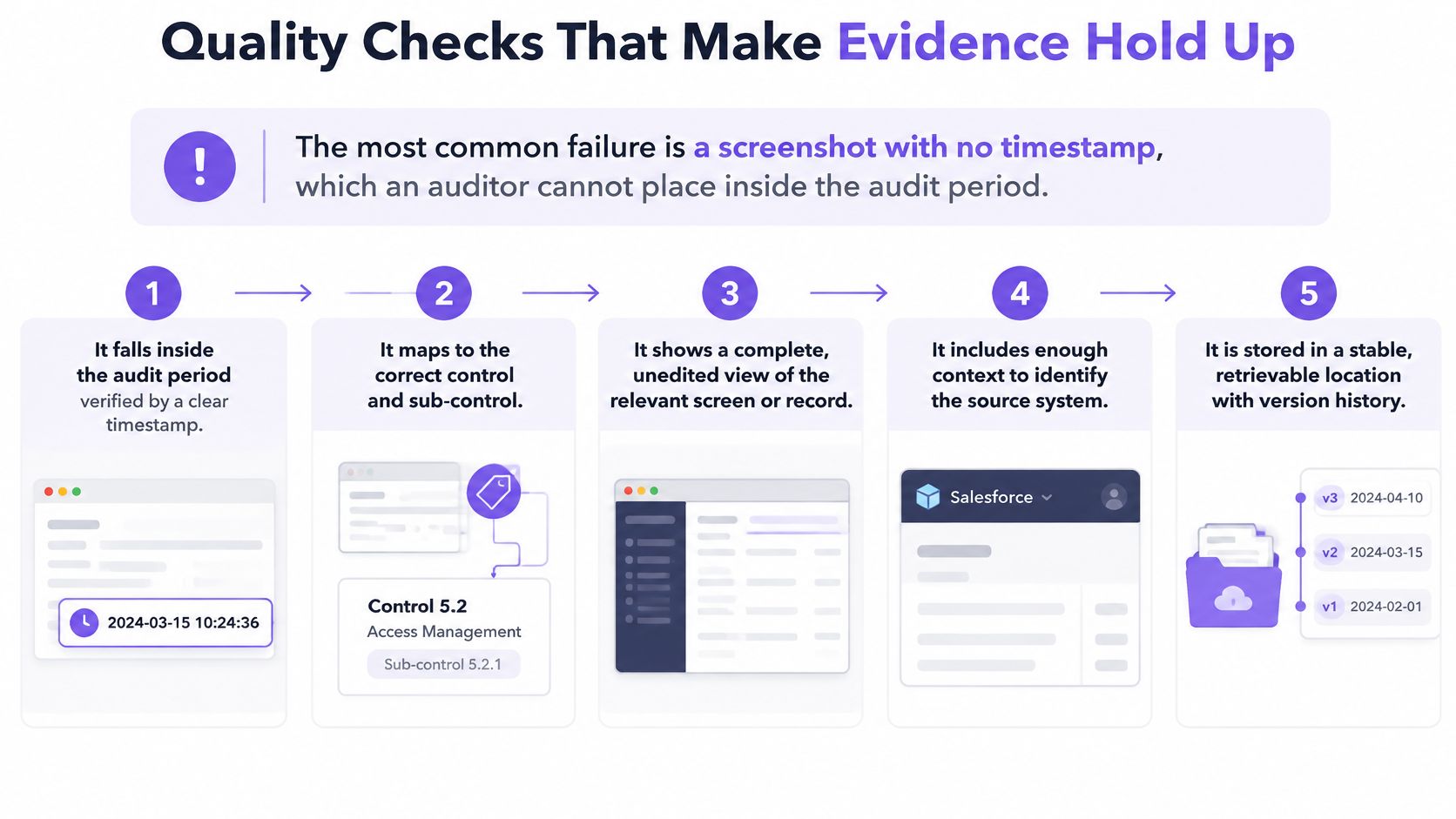
A screenshot without a timestamp creates an immediate problem: the auditor can't place the displayed state inside the examination period. A visible setting might demonstrate what's configured now, but it doesn't establish when that setting applied.
The more important failure is often missing proof of operation, not a missing security mechanism. DataBrackets' SOC 2 evidence guidance identifies timing, ownership, completeness, sign-offs, and documented exceptions as essential to defensible evidence.
Run an artifact acceptance gate
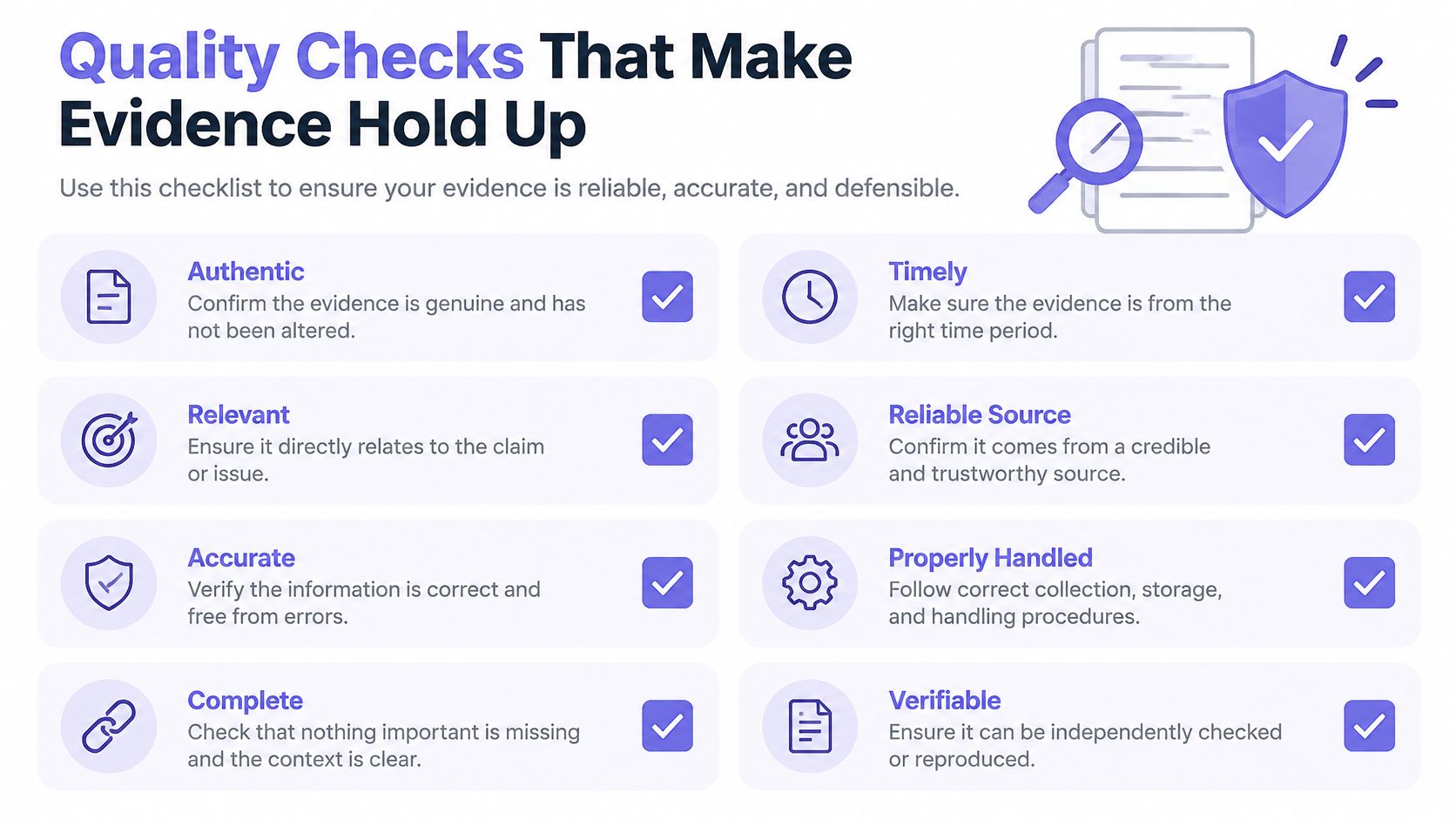
Before uploading an artifact, have a reviewer check:
- Period coverage: The relevant activity has a clear timestamp inside the applicable interval. Distinguish the event time from the export time.
- Authoritative origin: The record identifies the system that performed or recorded the activity. An internally written summary needs corroborating source records.
- Complete context: Preserve the relevant record, including unfavorable results and linked activity. Explain necessary redactions rather than omitting fields.
- Attributable approval: Capture reviewer identity, decision, and approval time. A user list alone doesn't prove anyone reviewed access.
- Exception treatment: Attach the root cause, impact assessment, compensating action, and remediation date when the control didn't operate as intended.
Use this acceptance check before an artifact enters the submission queue.
Say an access-review export lists accounts and entitlements but omits the reviewer's name. Re-exporting the same list won't fix the approval gap. Attach the contemporaneous ticket or workflow decision that identifies who reviewed that exact population.
Policies without version history, monitoring gaps, wrong-period exports, unexplained redactions, and undocumented exceptions deserve the same scrutiny. Don't create a retrospective approval and present it as if it happened during the original review.
Prepare for how auditors test
Inquiry needs an owner who can explain the procedure and its failure handling. Observation needs a live walkthrough with the relevant system context and timing visible. Inspection needs the actual exported artifact, while reperformance needs the inputs and decision rule necessary to reproduce the result.
An independent check can corroborate a configuration without proving its historical operation. For example, if email authentication is relevant to a scoped control, use mailX to verify your DMARC policy, then preserve the result with its collection time and supporting configuration history. Don't mistake a current lookup for evidence covering the entire examination.
For software controls, post-implementation verification provides a useful engineering model: connect the approved requirement to the implemented change and verification result. A passing artifact should let the reviewer establish what happened, when, where, under whose authority, and with what outcome without guessing.
Keeping Evidence Coherent Across Systems and Time
Say a repository's deployment policy changes partway through the examination. Engineers replace a manual approval with an automated policy check, but the control description and evidence instructions still reference the old process. The auditor receives records from both workflows with no explanation of the transition.
Neither workflow is necessarily defective. The problem is that nobody recorded which procedure applied when, who authorized the change, or whether the replacement addressed the same control objective.
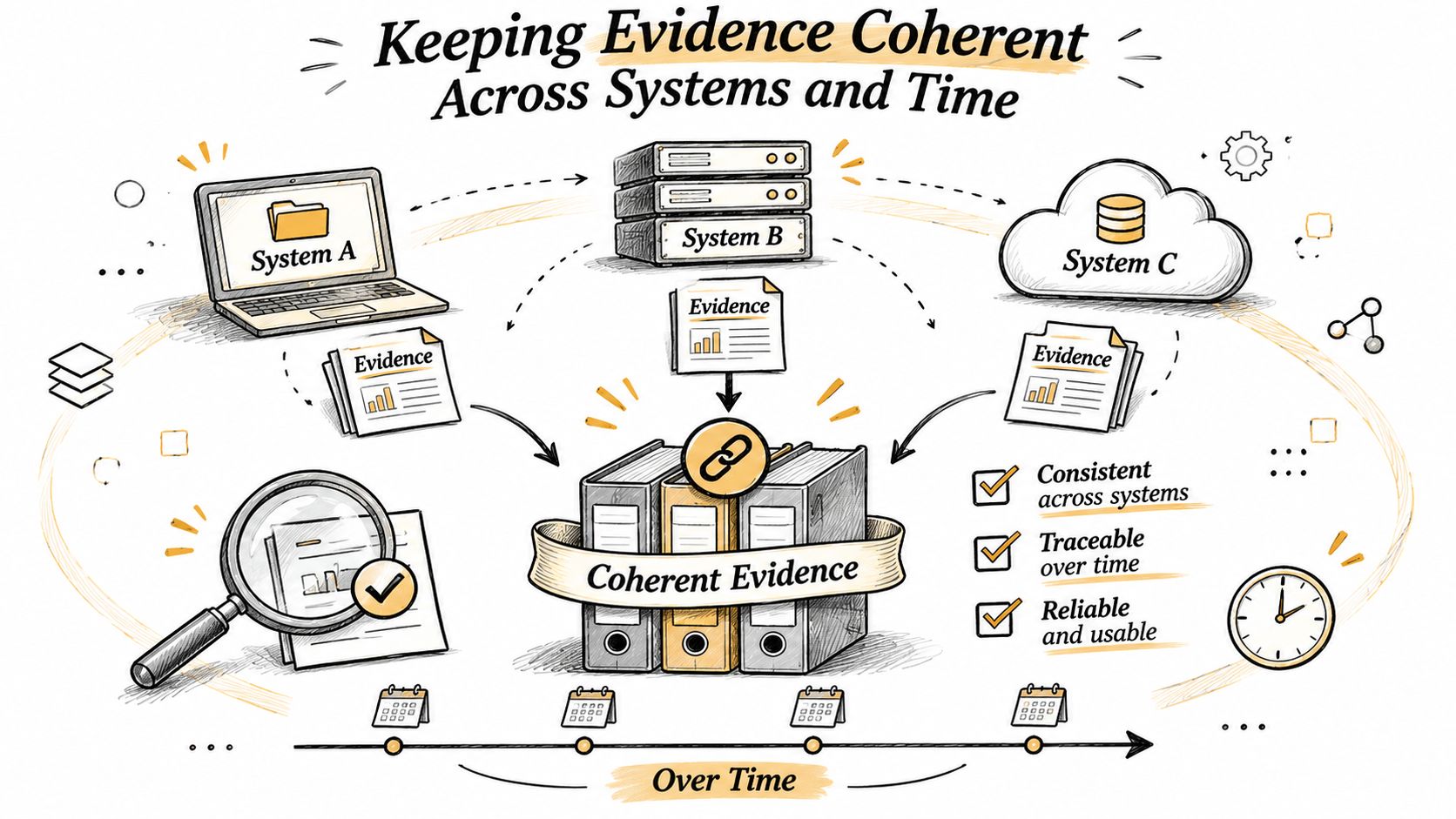
Secure.com's evidence-collection guidance describes the fragmentation across identity systems, source control, ticketing, CI/CD, cloud logs, HR records, and incident tools. Security, engineering, IT, legal, and HR may each own part of the supporting record.
Track transitions as evidence-bearing changes
Maintain a change record whenever a repository, deployment policy, service boundary, or threat model changes in a way that could affect a control. Include the effective time, affected control IDs, approving owner, replaced procedure, replacement procedure, and evidence-source changes.
For the deployment-policy scenario, preserve the old configuration and its effective interval. Link the approved migration to the new policy definition, activation record, and verification outcome. Don't overwrite the old control description and leave earlier artifacts apparently inconsistent with it.
A coherent evidence chain connects records across systems without pretending they all came from the same source.
If documentation is missing, reconstruct the sequence from source-control history, workflow definitions, tickets, and deployment records. Preserve reviewer identity and approval context, and clearly label what you reconstructed. We can reconstruct security context directly from a team's source code, mapping systems and risks even when documentation is missing, but reconstructed context doesn't manufacture historical authorization.
Automate collection, not assurance
Automation can retrieve artifacts and flag changed configurations. It can't, by itself, establish that the control was appropriately designed, authorized, operated by the correct person, or effective for the scoped risk.
Choose telemetry deliberately. MANDATE's guide to telemetry types for security detection is useful when deciding which operational signals support monitoring assertions. Preserve the link between the signal, the detection rule, and the response record rather than archiving alerts without disposition.
Treat AI-generated code and review output as activity records requiring attributable authorization, not independent assurance. A generated explanation of a policy change isn't proof that an authorized reviewer accepted it.
Preserve the transition, not just the latest state.
Run a monthly change review against the control register. Identify changed sources, retired repositories, ownership transfers, and stale collection jobs; assign corrective work before the next export. Teams coordinating frameworks can use the ISO 27001 and SOC 2 comparison to organize shared work without treating their assessment requirements as interchangeable.
Confirm Your Evidence Set Before the Auditor Asks
Run a readiness pass before distributing the submission package. Treat it as an engineering acceptance review, with explicit blockers and assigned follow-up, rather than a presentation about how much evidence you've collected.
For a final scope cross-check, browse the Trust Services Criteria checklist from IT Cloud Global, LLC. Use it to challenge omissions in your register, not to replace the control descriptions and scope agreed with your auditor.
Make a go-or-no-go decision
| Readiness check | What the reviewer does | No-go condition |
|---|---|---|
| Period coverage | Match expected control occurrences to available records | An expected interval lacks support |
| Artifact acceptance | Inspect selected artifacts from each control area | Timing, origin, approval, or context remains unclear |
| Population reconciliation | Compare the manifest with source-system results | An unexplained difference remains |
| Exception handling | Inspect disposition and remediation records | Impact, ownership, or corrective action is unresolved |
| Owner walkthrough | Ask the operator to demonstrate the actual procedure | The explanation conflicts with the evidence |
Perform the checks in that order. Missing coverage should be identified before engineers spend time polishing individual attachments. Likewise, an unexplained population difference should be resolved before the package is presented as ready for selection.
For each control area, record go or no-go, the reason, and the responsible owner. A material gap should block submission readiness even if everything else looks tidy. Assign a remediation date and distinguish between correcting the current process and recovering historical evidence, because those are different tasks.
Test the handoff, not just the files
Ask the control owner to retrieve an artifact using only the manifest. Then have them explain the procedure, identify a failure path, and show how an exception would be handled. This exposes broken references and undocumented operational knowledge before an auditor depends on them.
Package supporting records so the reviewer can follow the selected item without receiving unrelated production data. Use restricted access, stable filenames, and a submission manifest that records which version was shared.
Before upload, inspect exports, screenshots, logs, and attachments for protected health information, payment-card data, secrets, and unrelated personal information. Remove sensitive content from the submission copy without obscuring the evidence's meaning, and retain an explanation of any redaction. No PHI, PCI, or similarly regulated data should be submitted to our Services unless expressly agreed in writing.
Keep the final action small enough to start immediately. This week, choose the control with the weakest evidence and rebuild its population from the authoritative system. Resolve the first unexplained gap, attach the missing decision context, and give the owner a repeatable collection procedure.
DevArmor helps with SOC 2 and ISO 27001 compliance by documenting security architecture and decisions as audit-ready artifacts. Visit DevArmor to explore how continuous threat modeling, security reviews, and policy enforcement can connect your evidence to the software changes it needs to support.
Table of Contents
Subscribe


