
Post Implementation Verification: A Step-by-Step Playbook
 Reza Khosravi
Table of Contents
Your release has passed every pipeline gate. The authentication tests are green, the deployment completed, and nobody changed the session-timeout policy. Yet after a library upgrade, an idle session stays active beyond its approved lifetime. The configuration still contains the timeout value. The running application no longer enforces it.
Post implementation verification is how you catch that gap. You connect an approved security decision to the deployed implementation, test its behavior, and keep checking after production changes. A successful deployment is evidence that software shipped, not that its security design survived.
Release Checks That Confirm the Design Still Holds
The session-timeout scenario exposes two different failures: an approved control never reaches production, or a deployed control stops matching its approved design. Your release checks need to detect both without turning every deployment into a full security assessment.
Start with a compact checklist that asks for evidence, not reassurance. A statement such as “authentication tested” doesn't identify the decision, deployed artifact, test conditions, or expected result.
Release checks, the question each answers and proof to keep
| Check | Question it answers | Evidence to keep | Pass criterion |
|---|---|---|---|
| Control mapping | Which approved decision or threat-model control does this change touch? | Decision ID linked to the commit | Every impacted control has an owner and a decision ID |
| Change impact | What else moved with the code? | Dependency, API, data-store and policy diff | Impact set reviewed by a second person |
| Runtime behavior | Does the control work in a production-like environment? | Test run logs and telemetry | Results meet the acceptance threshold set before the test |
| Negative and authorization paths | Does the control block what it should block? | Denied-access and attack test results | Every denied case returns the expected denial |
| Configuration drift | Does live configuration still match the approved design? | Config snapshot compared with the baseline | No unapproved difference, or a logged exception |
| Open exceptions | Which accepted risks are still running? | Exception record with owner and expiry date | No exception past its expiry date |
A check without a linked approved decision is a test result, not verification. A test can establish that the application displays a re-authentication prompt. The approved decision establishes which actions require that prompt and whether the backend must reject requests without fresh authentication.
That distinction affects test quality. Figr's guide to writing effective test cases is useful when translating a control into explicit preconditions, actions, and expected results. Keep the security decision attached so a reviewer can judge whether those expectations are sufficient.
Practical rule: Store evidence that another engineer can inspect and reproduce, not a screenshot of a green status badge.
Don't require an elaborate document for every row. A commit-linked deployment record, machine-readable test output, and a configuration comparison may be enough for a narrow change. High-risk authorization changes need more scrutiny than a documentation correction.
Copy this table into your release template and apply it to your most recent deployment. Mark missing evidence plainly. The empty cells identify where your release process currently relies on trust rather than proof.
Run the Verification Sequence From Decision to Evidence
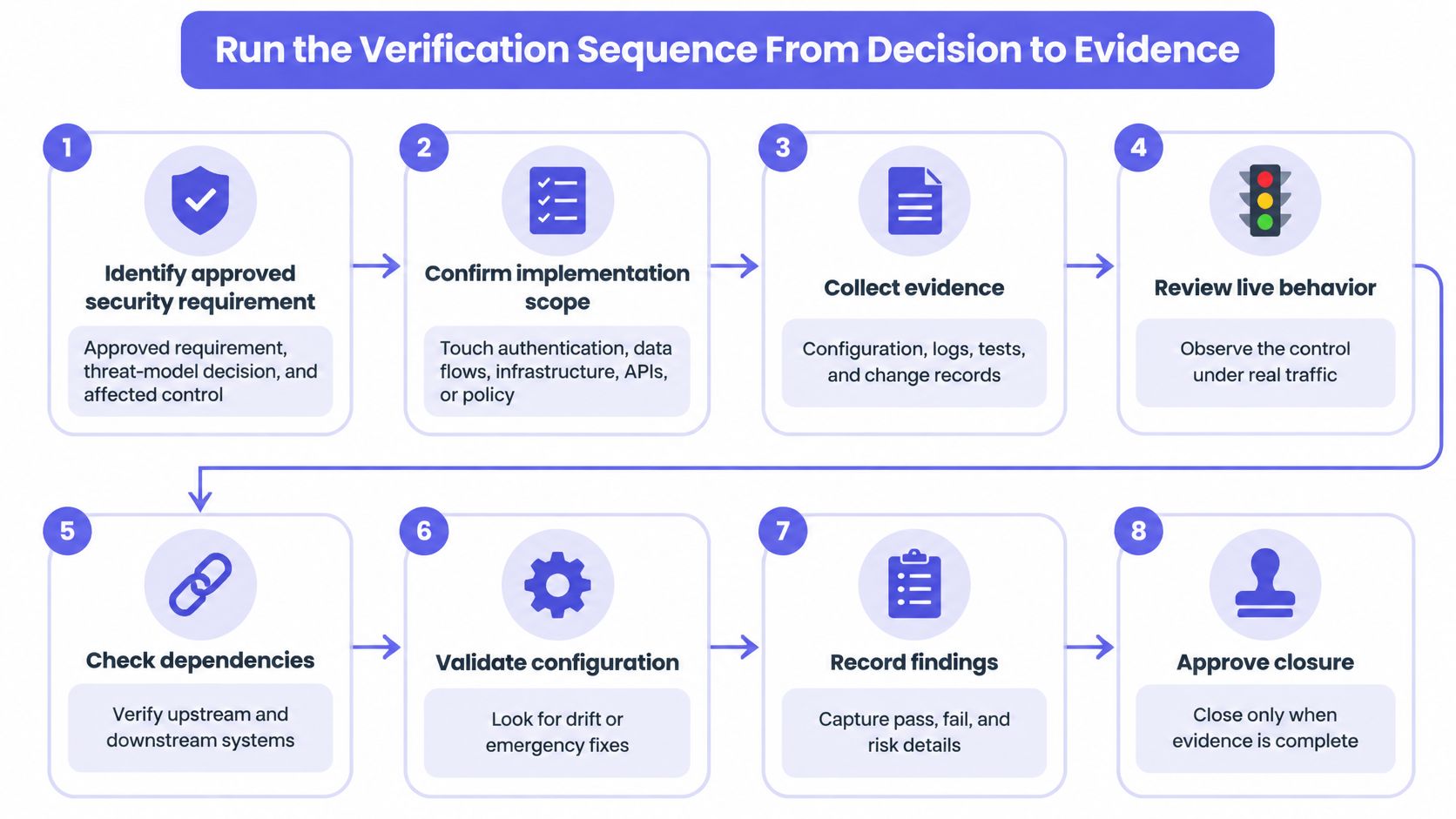
Use this sequence whenever a change touches authentication, data flows, infrastructure, APIs, or policy. Keep the assessment proportional to the affected controls, but don't let a small code diff stand in for an impact assessment.
The U.S. Government Accountability Office's post-implementation review guidance treats review as a feedback mechanism for comparing intended objectives with actual costs, schedules, operating expenses, and benefits, then recommending corrective action. For a release team, the practical implication is straightforward: close the review with a supported decision and an owner for corrective work, not just a completed meeting.
The control-level standard is equally direct. NIST control CM-4(2) calls for verifying impacted controls after changed code is installed in the operational system, checking that they are implemented correctly, operate as intended, and produce the desired security or privacy outcome.
Use the sequence below to organize that evidence.
Establish scope and observable outcomes
Identify the approved requirement and write the assessment plan. Record the security requirement, threat-model decision, affected control, scope, procedures, environment, reviewer roles, and evidence location. This prevents the team from choosing convenient tests after seeing the implementation. Use explicit verification requirements to distinguish the security outcome from the mechanism chosen to deliver it.
Compute the change-impact set. Inspect modified code, infrastructure, APIs, dependencies, data stores, and policies, including calling services. A shared authentication-library change can affect applications outside the repository being released. Ask service owners to confirm the boundaries rather than assuming the changed component is the entire assessment scope.
Map each impacted control to a test and an observable signal. For re-authentication, pair an executable protected-action test with an audit event showing why access was allowed or denied. The test establishes behavior under controlled conditions; the signal lets operators recognize that behavior after deployment. Record expected event fields without collecting credentials or sensitive session material.
Deploy the release artifact into a representative environment. Use production-shaped, sanitized data and relevant topology, feature flags, identity providers, and cache behavior. Record material differences from production. Otherwise, a passing result may establish only that the control works under staging's simpler conditions.
At DevArmor, our process starts by fetching business context and design specifications automatically through safe, configurable integrations. Its last step automatically pushes design controls and guardrails to downstream tools. Teams still need to specify the runtime evidence that demonstrates those controls work.
Exercise behavior and resolve findings
Run positive, negative, boundary, failure, rollback, and authorization paths. Write acceptance thresholds before execution so the team can't redefine success around an unexpected result. Check both user-visible behavior and server-side enforcement. A hidden button isn't proof that an unauthorized API request will fail.
Inspect logs, alerts, and configuration drift. Compare the deployed state with the approved baseline and correlate telemetry with the test run. An expected denial without its required audit event may leave incident responders unable to distinguish an attack from an application fault. Investigate unexplained differences rather than treating the baseline as optional documentation.
Record anomalies, residual risk, and a named remediation owner. Missing evidence is an unresolved result, not a pass. Block promotion when the affected control requires proof before exposure, or route a dated exception to the authorized risk owner. Separate test-environment failures from control failures, but give both a disposition.
Reassess after the fix. Rerun the failing path and relevant adjacent paths against the corrected artifact. A closed engineering ticket proves that someone completed work; it doesn't establish that the security outcome changed. Preserve the original failure and follow-up result together.
- Decision ID: The approved requirement defining protected administrative actions.
- Policy rule: The rule requiring fresh authentication for those actions.
- Commit: The implementation that adds enforcement, not merely the prompt.
- Artifact hash: The exact build installed in the assessed environment.
- Test evidence: Logs showing allowed access after re-authentication and denied access without it.
- Final disposition: Reviewer approval, remediation, or an authorized exception.
- Pull the traceability chain. Confirm that the evidence belongs to the artifact being released.
- Complete the release checks. Mark unresolved rows explicitly rather than assuming another team owns them.
- Apply the decision rule. Record approval, blocking findings, or the authorized exception.
- Book re-verification. Assign the owner and trigger before closing the review.
Pre-release testing limits exposure, while post-deployment checks establish what runs. Don't replace either with the other. Where a production check could disrupt users, use a controlled account, constrained traffic, and an agreed rollback condition.
A worked control-to-evidence chain
Say the approved design requires fresh authentication before an administrator changes a user's privileges. Keep an immutable link set containing:
The test should attempt the administrative API directly as well as through the interface. It should also establish that cancelling the prompt doesn't leave a usable authorization state.
For a login rate-limit change, put the boundary test at the approved limit and test behavior on either side. Take the rate-limit store offline for the failure test, then compare the observed fallback behavior with the approved design. During the drift check, confirm that the production limit matches the authorized value.
Apply the pass test to the whole result: correct implementation, intended operation, intended outcome. Finish only when every impacted control has evidence from this release and a reviewer can reproduce a selected result without depending on the author's explanation.
Confirm Controls Still Work Under Real Traffic
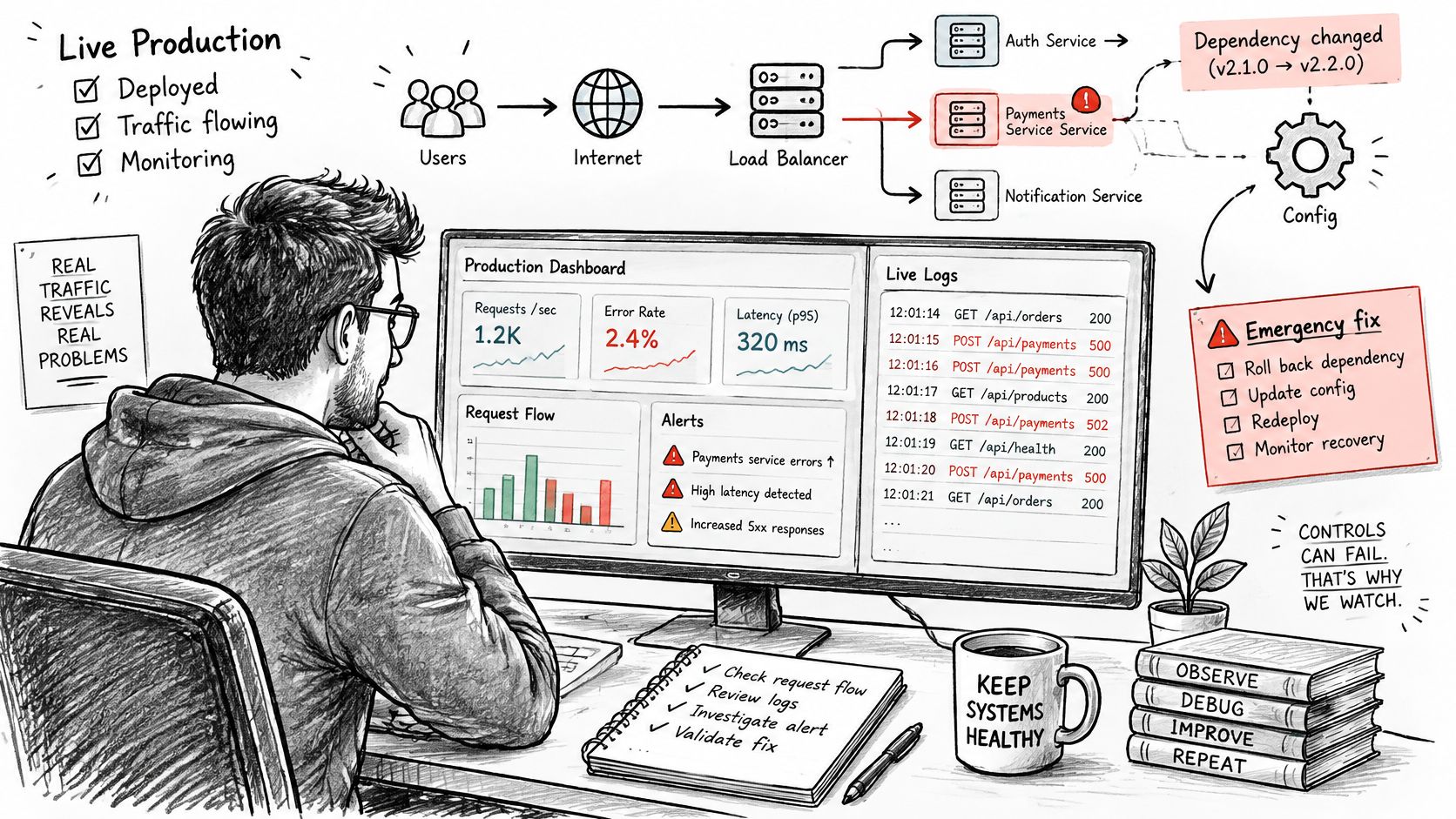
A clean deployment can still leave a control ineffective under live traffic, changed dependencies, configuration drift, or an emergency fix. Pre-release evidence describes the assessed conditions. Operators need evidence about the conditions users encounter.
The NIST DevSecOps reference model calls for post-deployment monitoring of security, performance, defects, and configuration, with operational feedback informing engineering changes and post-mortems. Treat that feedback as part of verification, not a separate dashboard nobody reviews.
Connect the control record to the production signals operators use.
Make runtime evidence actionable
For each control, identify the signal that demonstrates operation and the incident pattern that suggests failure. Attach relevant rollback and hotfix records, along with any exception's expiry date. Extend your application security checklist with those operational references.
For session expiry, observe expiration events alongside eligible session activity. An absence of expiry events might reflect low traffic, broken instrumentation, or failed enforcement. A controlled synthetic session can help distinguish those explanations.
Record realized behavior and remediation speed, not only a pass/fail label. A failed control restored promptly and a failed control left exposed need different management decisions.
Re-verification triggers by change type
| Change type | What to re-verify | When to run it |
|---|---|---|
| Architecture or trust boundary change | Full traceability chain for every affected control | Before the change is merged |
| New data flow or data store | Data handling controls and their telemetry | Before the first production write |
| Deployment topology change | Controls on the moved or new components | After the first deploy to each environment |
| Dependency or library upgrade | Controls that depend on the upgraded component | Before the next release |
| Emergency hotfix | The affected control now, then a full re-check | Immediately, then at the next scheduled review |
| Exception nearing expiry | The risk the exception covers | Before the expiry date |
For architecture changes, assess the proposed design before merge, then verify the resulting implementation when it becomes executable. A design review alone can't establish runtime behavior.
As a working cadence, review runtime signals weekly for controls with open exceptions and monthly for the rest. Reopen the evidence chain immediately when a trigger fires rather than waiting for the calendar review.
Return to the hypothetical timeout failure: the team traces the control to its approved decision and finds that expiry events dropped to zero after the library upgrade despite eligible traffic. The dependency change triggers re-verification, and a controlled session confirms that expiry no longer applies. The team contains the deployed exposure, blocks further release promotion, and requires a passing follow-up assessment before proceeding.
Measure Whether Verification Itself Is Working
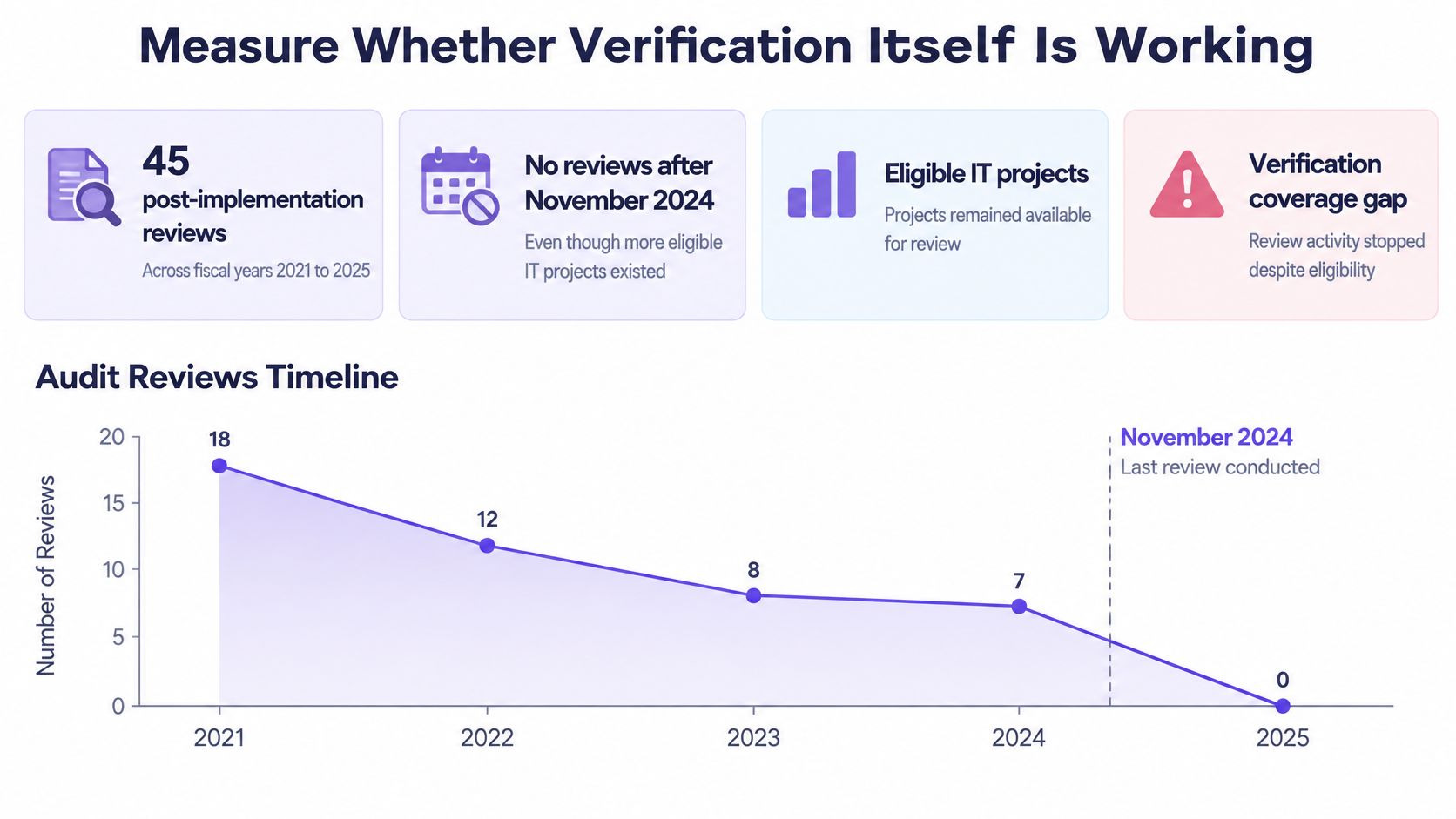
The Social Security Administration Office of Inspector General audit found that SSA conducted 45 post-implementation reviews during fiscal years 2021 through 2025, but none after November 2024, despite additional completed eligible IT projects; it also found that the reviews conducted didn't comply with federal and agency requirements.
Those are separate failures. Coverage asks whether eligible implementations receive reviews. Conformance asks whether those reviews follow the required method, evidence standards, timing, and documentation.
The audit's review interruption makes the governance issue visible.
Verification program metrics and warning signs
Use these as operational indicators, with warning conditions agreed by the release and security owners.
| Metric | Formula or definition | Warning sign |
|---|---|---|
| Verification coverage | Impacted controls with current evidence divided by all impacted controls | Any control on the live release below full coverage |
| Evidence freshness | Age of the newest test result for each control | Evidence older than the last change to that control |
| Time to remediate failed checks | Days from a failed check to a verified fix | Fixes still open after the release window closes |
| Production escape rate | Production defects divided by pre-release plus production defects | A rising trend across successive releases |
| Review completion | Eligible releases with a completed review divided by all eligible releases | Any silent period with no reviews |
Define the defect population before calculating escape rate. Mixing security-control defects in production with every cosmetic defect found before release creates a reassuring but meaningless denominator. Mark periods with no relevant defects as not applicable rather than inventing a rate.
Read the indicators together
High review completion with stale evidence suggests administrative closure rather than current assurance. Strong coverage alongside increasing production escapes suggests weak test conditions, incomplete acceptance criteria, or an inaccurate impact set.
Faster remediation isn't automatically improvement either. Check whether engineers verified the fixes or closed findings faster without proper validation. Distinguishing false positives and false negatives helps prevent noisy failures from obscuring missed controls.
A silent period in review completion is a finding to investigate, not an empty space to omit from the report.
Also sample completed reviews for conformance. Confirm that reviewers retained the required artifacts and applied the approved procedure; a completion timestamp can't establish either.
Start with a manageable retrospective: choose a metric and calculate it across your last ten releases. Treat that as a diagnostic exercise, not a benchmark. Compare the result with the team's expectation, then investigate the releases that explain the difference.
Fix Gaps, Skipped Reviews and Failed Checks
The most misleading false pass is a test that confirms what exists rather than how it behaves. Reading a timeout setting, finding an authorization middleware declaration, or detecting an encryption flag doesn't establish that the live request path enforces the intended protection.
NIST's control assessment guidance distinguishes correct implementation, intended operation, and desired outcomes, and calls for assessment depth and coverage sufficient to expose implementation errors and document anomalies. Use that distinction when diagnosing a clean report that doesn't match production behavior.
Verification symptoms, causes and fixes
| Symptom | Likely cause | Fix |
|---|---|---|
| Checks pass but the control fails in production | Tests only read static configuration | Add a runtime test that exercises the control on a live-like path |
| Every test is a success case | Happy-path-only test suite | Add negative, boundary and failure tests for each control |
| Impacted controls missing from the report | Change-impact set stops at the changed service | Add dependent services and data-store owners to the impact review |
| Evidence looks complete but cannot be traced | Developer-written results with no independent review | Assign a second reviewer who can rerun the test |
| Threat model no longer matches the code | Model not refreshed after an architecture change | Re-run the threat model on the changed components before sign-off |
| Test passes but production differs | Nonrepresentative test data | Replay sanitized, production-shaped data |
| Reviews skipped after a release | No workflow trigger for verification | Make verification a required pipeline gate that logs any exception |
Repair the assessment, not just the report
Static checks are useful for identifying prohibited settings quickly. Keep them, but add a behavioral test wherever runtime routing, caching, identity state, or failure handling can change the outcome. Replacing a fast configuration check isn't necessary; treating it as sufficient is the mistake.
An impact review that stops at the changed service misses callers that interpret its responses differently. Bring dependent-service and data-store owners into scope review, especially when a shared control has inconsistent integrations.
Developer-authored evidence can be technically sound, but the author shouldn't be the only person deciding whether it proves the requirement. Assign an independent reviewer who can rerun the test. For high-risk changes, that reviewer needs relevant domain expertise and authority to reject an unsupported result.
A threat model last refreshed before a material architecture change can't support sign-off for the changed design. Likewise, an empty staging database can't demonstrate behavior involving production-shaped data or load. Document these limitations as assessment gaps, not caveats buried beneath an approval.
Pick a failed check from last quarter and trace its evidence chain backward. Find the step that allowed the defect through, then change that step's input, ownership, or acceptance rule. Adding another approval meeting won't help if reviewers still receive the same incomplete evidence.
Decide Whether to Sign Off the Release
Use a decision rule that the release owner can apply without negotiating the meaning of green during the sign-off meeting.
Sign off when every impacted control has current evidence, results meet their preset thresholds, and no exception has expired.
Block when a control fails a runtime or negative-path test, or a high-risk control has no evidence.
Accept with a named exception only when the authorized risk owner signs the residual risk and sets both an expiry date and a re-verification date.
An exception isn't a passing result. Keep the failed or incomplete assessment visible, record compensating measures, and identify who can stop the release if those measures aren't available. Deadline pressure doesn't make an unknown security outcome acceptable.
Prepare the decision record
At DevArmor, our review process runs instantly and is traceable, while security teams retain oversight. Customers remain responsible for evaluating outputs through code review, security testing, and compliance validation, including determining suitability for their use cases.
This week, run the checklist against your most recent deployment and record which row you couldn't fill. Assign that gap an owner before the next release.
DevArmor connects approved security decisions to implementation checks, with coverage metrics, drift detection, and per-release attestations. Visit DevArmor to explore how implementation verification can fit your development workflow while your security team retains review oversight.
Table of Contents
Subscribe


