Iso 27001 Soc 2
 Reza Khosravi
Table of Contents
The popular advice is to choose between ISO 27001 and SOC 2 as if they were interchangeable badges. That advice is wrong. ISO 27001 and SOC 2 solve related assurance problems through different operating models, and application security leaders who treat them as substitutes usually create duplicated controls, conflicting ownership, and evidence gaps that appear during audit.
The practical decision isn't “Which framework is better?” It's which customer, geographic, and regulatory pressure arrives first, and how will your team keep one security program synchronized as both frameworks evolve? A company may need ISO 27001 for international procurement while its US customers demand a SOC 2 report. The winning approach is not two disconnected compliance projects. It's one evidence architecture with framework-specific mappings, owners, review cycles, and proof.
The Question Most Security Leaders Get Wrong About ISO 27001 and SOC 2
ISO 27001 and SOC 2 overlap, but they aren't equivalent. ISO 27001 certifies an information security management system, while SOC 2 provides an attestation over defined systems and services against the AICPA Trust Services Criteria. That difference changes what your team must build, document, operate, and prove.
The adoption record alone shows that ISO 27001 has become a broad international assurance framework. The ISO Survey 2024 reported 96,709 valid certificates covering 179,877 sites worldwide, compared with 36,362 certificates in the 2019 survey and 48,671 in 2023 (ISO's 2026 journal issue). SOC 2 remains especially important for service organizations selling into markets where customers expect an auditor's report tied directly to operational controls.
The mistake is assuming that one certification automatically supplies the other program's proof. ISO 27001 may establish strong governance, risk treatment, documented procedures, and control ownership. SOC 2 still asks whether controls operated effectively for the defined system and observation period. A certificate can support readiness, but it doesn't replace evidence of recurring execution.
The real decision is synchronization
Running both programs creates a shared-control problem. Access reviews, incident response, vendor management, change control, backup practices, and continuity planning may support both frameworks, but each program can require different evidence formats, timing, scope boundaries, and reviewer expectations.
Practical rule: Treat the frameworks as two reporting views over one controlled security operation, not as two independent checklists.
A disconnected approach produces predictable failure modes:
- Duplicate ownership: Two teams maintain separate control narratives for the same access review or change process.
- Conflicting risk records: ISO risk treatment decisions don't match the risks represented in SOC 2 system documentation.
- Evidence drift: A policy changes, but the screenshots, tickets, approvals, and testing records still reflect the old process.
- Late audit discovery: An ISO artifact demonstrates design intent, while the SOC 2 auditor finds no consistent operating evidence.
Your architecture lead, application security team, compliance owner, and engineering managers need a shared control inventory. Each control should have one accountable owner, a defined frequency, a source system, an evidence location, and mappings to the relevant ISO clauses, Annex A controls, or Trust Services Criteria.
That's the operational question most comparisons omit: Can your team produce consistent, time-stamped proof from the same underlying process without creating a second bureaucracy? If the answer is no, selecting a framework first won't solve the problem.
What ISO 27001 and SOC 2 Actually Require
ISO 27001 is a management-system standard. An organization defines the scope of its Information Security Management System, assesses information security risks, selects treatment actions, establishes policies and processes, and demonstrates continual improvement. Certification evaluates conformity with the management-system requirements in Clauses 4 through 10 and applicable Annex A controls.
The ISO process also requires artifacts that are easy to underestimate. Your team needs a scope statement, risk assessment, risk treatment plan, Statement of Applicability, documented objectives, internal audit activity, management review, corrective action records, and controlled documentation. An accredited certification body performs the external certification audit, followed by ongoing surveillance activity and later recertification.
SOC 2 is different. It's an attestation engagement over a defined system or service against the AICPA Trust Services Criteria. Security is mandatory, while Availability, Processing Integrity, Confidentiality, and Privacy are included when relevant to the selected scope (Atlant Security's framework comparison). A licensed service auditor evaluates the description of the system, the controls selected for the report, and the evidence supporting the auditor's opinion.
Framework Fundamentals Compared
| Attribute | ISO 27001 | SOC 2 |
|---|---|---|
| Core object | The organization's ISMS | A defined system or service |
| Assurance output | Certification issued by an accredited certification body | Attestation report issued by a qualified service auditor |
| Scope logic | Organizational and ISMS boundaries | Service description, systems, processes, and selected Trust Services Criteria |
| Mandatory focus | Clauses 4 through 10 and applicable Annex A controls | Security |
| Optional focus | Annex A applicability follows risk treatment and scope | Availability, Processing Integrity, Confidentiality, and Privacy, when relevant |
| Evidence emphasis | Governance, risk treatment, documented operation, review, and improvement | Control design and operating evidence tied to the report scope |
| Operating model | Risk-based management system | Auditor-tested service controls |
ISO 27001 is broader and governance-heavy. It asks whether your organization manages information security as a functioning system, not merely whether individual safeguards exist. That makes it useful when procurement teams, regulators, or international customers want a globally recognized certification.
SOC 2 is narrower and evidence-heavy. It asks whether controls for a defined service are designed and operating in a way that supports the selected Trust Services Criteria. That makes it particularly practical for SaaS and cloud providers whose customers want assurance about the service they consume.
For a plain-language explanation of the ISO structure, review this ISO 27001 framework guide. Use it to understand the management-system foundation before you start mapping individual controls.
Side by Side on Scope, Controls, and Evidence
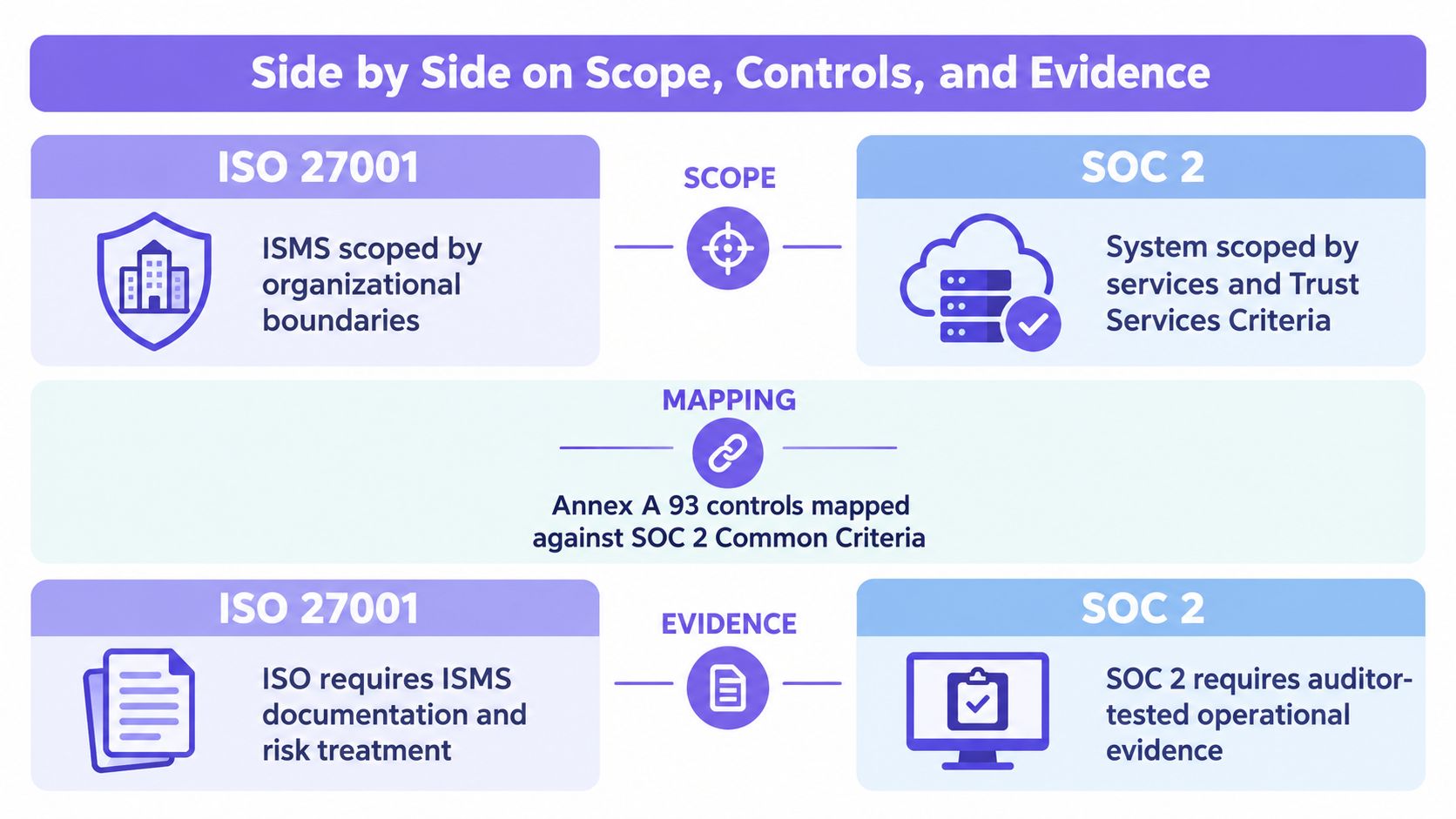
Scope determines the audit you face. ISO 27001 scopes the ISMS around organizational boundaries, information assets, locations, services, and relevant interfaces. SOC 2 scopes a system, service, or product through its system description and the Trust Services Criteria selected for the report.
That distinction matters for application security. An ISO scope may include corporate identity, engineering, cloud operations, people processes, suppliers, and supporting infrastructure. A SOC 2 scope may focus on a particular SaaS platform, its production environment, supporting services, and the processes that affect customer data. A control can exist in both programs while being tested against different boundaries.
Where the controls overlap
ISO/IEC 27001:2022 reduced Annex A to 93 controls grouped into four themes, replacing the prior 114-control structure (RiskWatch's comparison). SOC 2 control counts vary with scope and the Trust Services Criteria selected, so there isn't a universal one-to-one inventory.
The overlap is strongest where both frameworks care about repeatable security operations:
- Access management: Joiner, mover, leaver workflows, privileged access, authentication, and periodic reviews.
- Change management: Pull request approvals, testing, segregation of duties, release records, and emergency change handling.
- Logging and monitoring: Security event collection, alert handling, investigation records, and review evidence.
- Incident response: Escalation paths, response plans, exercises, incident records, and corrective actions.
- Vendor risk: Supplier due diligence, contract requirements, service reviews, and risk decisions.
- Continuity: Recovery planning, resilience measures, backup controls, and testing records.
The overlap doesn't mean the evidence is interchangeable. ISO may require documented risk treatment and management-system records that a SOC 2 engagement doesn't request. SOC 2 may require recurring operational evidence across the defined observation window, while an ISO audit may examine whether the ISMS and controls conform during the certification or surveillance audit.
Evidence has a different shape
ISO evidence often proves that the organization has established and maintained a coherent management system. Examples include the Statement of Applicability, risk registers, treatment decisions, internal audit results, management review minutes, corrective action tracking, and controlled policies.
SOC 2 evidence must connect directly to the report scope and control wording. Examples include access review outputs, tickets, deployment records, vulnerability remediation records, monitoring alerts, incident investigations, and samples showing that personnel performed the control as described.
The certificate and the report answer different questions. ISO asks whether the ISMS conforms to the standard. SOC 2 asks whether defined service controls support an auditor's attestation.
The auditor relationship differs too. An ISO certification body conducts certification and surveillance audits under a certification scheme. A SOC 2 service auditor evaluates the attestation engagement and issues a report. Your evidence strategy must reflect those authorities, not assume that a favorable result in one engagement eliminates the other.
The 2026 Reality of Managing Both Frameworks at Once
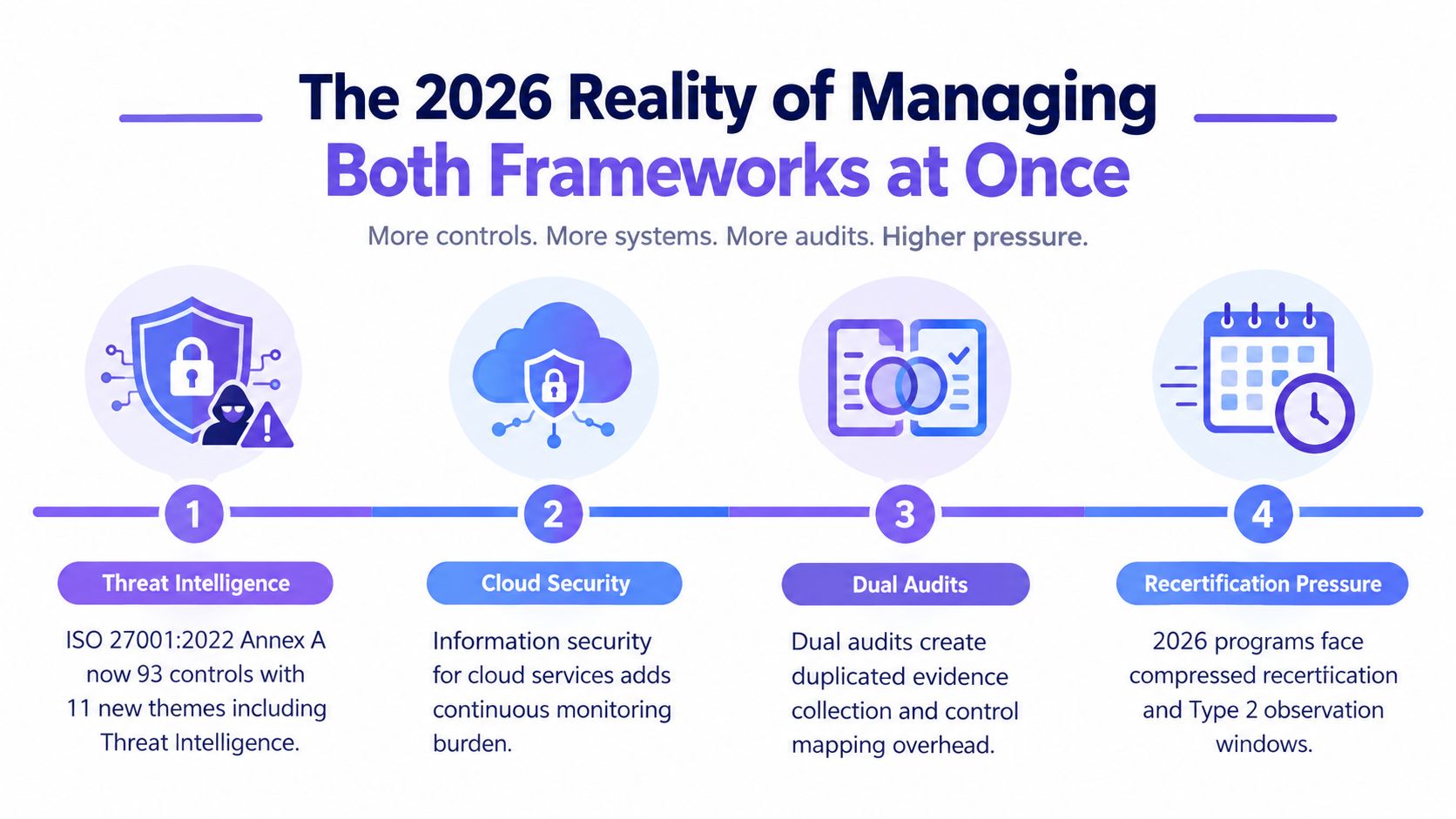
Running ISO 27001 and SOC 2 together is an operating model, not a paperwork exercise. In 2026, teams are handling standards transitions, revised audit expectations, and evidence planning at the same time. The ISO 27001:2013 transition cutoff passed on October 31, 2025. Organizations still using the older version need a full certification audit against ISO 27001:2022, rather than a lighter transition audit, as outlined in DataBrackets' framework comparison.
That work reaches beyond a control spreadsheet. Reassess applicability, update the Statement of Applicability, revise risk treatment decisions, refresh policies, confirm control ownership, and demonstrate that the updated requirements operate in practice. The 2022 Annex A structure also places newer emphasis on areas such as Threat Intelligence and information security for the use of cloud services.
SOC 2 brings a separate deadline. SSAE 23 applies to engagements beginning on or after December 15, 2025. Service auditors and the teams supporting those engagements must account for that change. Evidence accepted in an earlier engagement may not satisfy a later auditor, scope, or reporting expectation.
Synchronization points leadership must fund
The operational risk sits between ownership, scope, and timing. Application security leaders should fund and staff these coordination points:
- Control ownership: Assign one accountable owner to each shared control, with separate owners for framework-specific artifacts.
- Evidence traceability: Link every exhibit to its control statement, source system, collection date, reviewer, and audit period.
- Audit calendars: Coordinate ISO surveillance or certification work with SOC 2 planning, observation windows, internal reviews, and remediation deadlines.
- Scope governance: Record changes to products, cloud services, repositories, suppliers, and organizational boundaries before they create audit ambiguity.
- Remediation control: Maintain one gap register with framework tags, risk priority, responsible owner, due date, and validation evidence.
Do not let two compliance managers request similar proof from engineering through separate channels. Build one shared evidence pipeline, then generate framework-specific packages from it. SOC 2 can reuse ISO control design, but it still needs operating proof, consistent timing, and scope-specific evidence. ISO still requires its own governance and continual-improvement records. Continuous threat modeling and automated artifact generation should feed this pipeline, so architecture changes, ownership decisions, and supporting evidence remain aligned across both programs.
How Continuous Threat Modeling Supports Both Audits
A threat model should be a living record of security decisions, not a document created for a launch meeting and forgotten. It can give auditors a current view of architecture, trust boundaries, data movement, abuse cases, design assumptions, and risk treatment.
Start with architecture reality. Generate or refresh data flow diagrams from repositories, infrastructure-as-code, service metadata, deployment configuration, and planning records. The result should show which services handle sensitive information, where trust boundaries sit, which identities cross them, and which external providers support the system.
Build evidence from decisions
A current diagram is useful, but the decision trail matters more. For each material threat, record the affected asset, attack path, likelihood and impact rationale, chosen treatment, rejected alternatives, accountable owner, and verification method. This supports ISO risk treatment while answering the SOC 2 question behind many evidence requests, namely how the organization identified and addressed risks.
A STRIDE-aligned threat register can organize application and platform threats without replacing the broader enterprise risk process. The register should connect directly to requirements, design reviews, tickets, code changes, tests, and release approvals. When a service changes, the model should identify which assumptions became stale and trigger a review.
Map artifacts to both programs
| Artifact | ISO 27001 Reference | SOC 2 Control |
|---|---|---|
| Data flow diagram | Annex A.8 and ISMS risk assessment | CC6.6, system boundaries and transmission controls |
| STRIDE-aligned threat register | Risk assessment and risk treatment requirements | CC3.2 and CC6.6, risk identification and logical access context |
| Control mapping matrix | Statement of Applicability and Annex A applicability | Common Criteria mappings and control description |
| Design review record | Annex A.8, secure system engineering context | CC1.4 and CC8.1, monitoring and change management |
| Policy-as-code output | Applicable Annex A controls and documented operation | CC6, CC7, and CC8 evidence where policy enforcement affects the service |
| Release attestation | Risk treatment verification and performance evaluation | Operating evidence for change, security, and monitoring controls |
The strongest pipeline produces both human-readable exhibits and machine-verifiable records. Policy-as-code can enforce repository and deployment requirements, while pull request outcomes, approvals, exceptions, and remediation records provide an audit trail.
A platform such as DevArmor can support this model by generating continuous threat models from development artifacts, placing security design reviews in tools such as Jira, GitHub, VS Code, and Cursor, and applying policy-as-code checks to pull requests. Its role here is not to replace the auditor or the ISMS owner. It is to keep architecture decisions, code-level checks, and release evidence connected.
For a practical treatment of the workflow, see this threat modeling process guide. The important design choice is the source of truth. Don't create one threat model for ISO and another for SOC 2. Maintain one current security context, then map its artifacts to each framework.
Choosing the Right Framework for Your Scenario
Framework fit depends on who buys from you, where those buyers operate, and what assurance language appears in their procurement process. The same technical security program can produce different commercial value depending on the market.
A US B2B SaaS startup
A SaaS startup selling to mid-market US enterprises should prioritize SOC 2, because customer due diligence often asks for a service-focused attestation report. The team should define the production service boundary, document the system description, select the relevant Trust Services Criteria, and build evidence around access, change, incident, vendor, and availability processes.
ISO 27001 can wait if international procurement and regulated-sector requirements aren't yet affecting the pipeline. It shouldn't wait forever. Once the company expands into international markets or begins selling to buyers that expect formal certification, ISO 27001 may become the framework that secures the next group of contracts. Plan the second program before the first one hardens into disconnected tooling.
A European HealthTech firm
A HealthTech company handling patient data across the EU, UK, and Switzerland should lead with ISO 27001:2022 when procurement teams and regulated customers ask for internationally recognized certification. The firm needs a defensible ISMS scope, documented risk treatment, controlled policies, supplier governance, and evidence that management reviews the system and addresses corrective actions.
SOC 2 becomes commercially important when US healthcare payers or technology partners require an attestation report. The HealthTech team should build its control inventory with SOC 2 mappings from the start, but it shouldn't force the ISO program into a US service-report structure. The second framework will require service-specific evidence and auditor-tested operating proof.
A global Media platform
A global Media platform serving both consumers and enterprise customers faces the dual-track reality immediately. Consumer-facing systems may require strong privacy, availability, and platform governance, while enterprise buyers may ask for SOC 2 evidence and international partners may expect ISO 27001 certification.
The correct choice isn't sequential substitution. It's shared infrastructure with separate reporting views:
- One asset and service inventory
- One risk and threat register
- One control ownership matrix
- One evidence catalog
- Separate ISO and SOC 2 scope statements
- Framework-specific audit calendars and remediation views
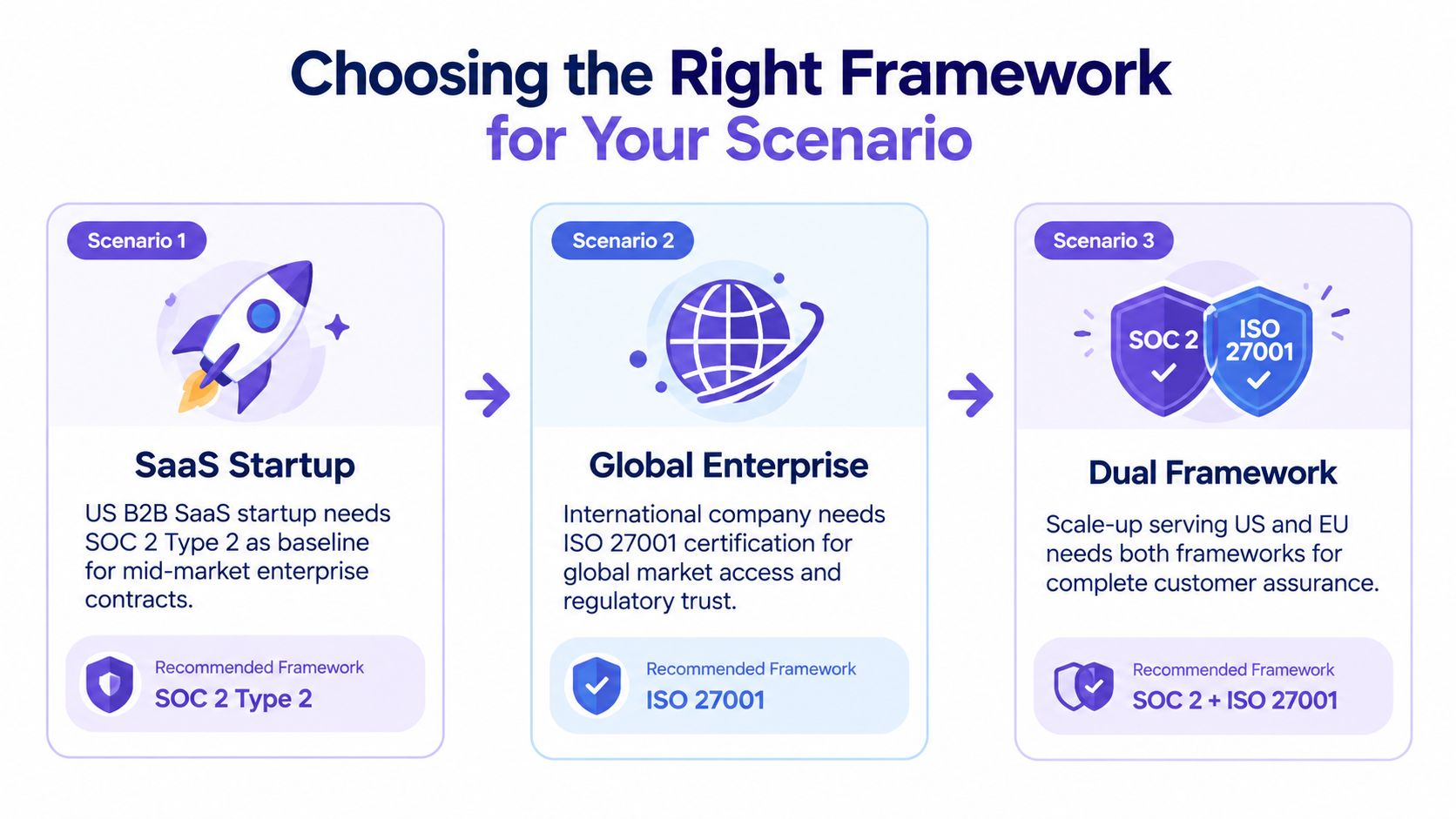
The second framework often follows as the company expands its geography, regulated-customer base, or enterprise sales motion. Don't promise that one program automatically compresses the other into a short administrative exercise. The shared foundation reduces duplication, but framework-specific scope, evidence, and review requirements remain.
A Direct Recommendation for Application Security Leaders
Stop asking which framework is superior. Ask three questions: Where are your customers? What does the sales cycle require? How often do your controls and architecture change?
If you sell primarily to US enterprises, start with SOC 2. Build toward a Type 2 report when customers need evidence that controls operated over time, not merely a description of intended design. If your pipeline depends on European regulated buyers or UK public-sector procurement, start with ISO 27001:2022 and build the ISMS properly. Don't reduce it to an Annex A checklist. The certification depends on the management system, risk treatment, documented operation, and continual improvement.
If both markets matter, run both programs through one evidence pipeline. Maintain one control owner per process, one source for architecture and threat decisions, one remediation register, and one change record. Then generate separate packages for the ISO certification body and SOC 2 service auditor.
Pick the gap analysis before the badge
A gap analysis should answer operational questions, not merely mark controls green or red:
- Which customer requirement is blocking revenue?
- Which systems and services belong in the first scope?
- Which controls already operate consistently?
- Which artifacts prove operation, and which only describe intent?
- Which owners can produce evidence without manual chasing?
- Which architectural changes could invalidate the current scope?
- Which framework-specific artifacts remain missing?
Application security leaders should connect the analysis to the software delivery lifecycle. The application security posture guidance is useful for framing how design decisions, implementation checks, and release evidence fit into a broader security operating model.
For a startup with no SOC 2 and an enterprise pipeline closing soon, commission a readiness assessment, define the service boundary, and prioritize the controls that directly affect the report. Don't promise a report before evidence can demonstrate consistent operation. For a mature international company, establish ISO 27001:2022 governance while mapping shared controls to SOC 2, then schedule the audits around the same evidence calendar.
Your first concrete move should be a cross-functional workshop with application security, engineering, IT, legal, sales, and the control owners. Leave with a buyer-backed framework priority, a written scope, a shared control inventory, and an evidence map. If those four decisions aren't documented, you're not choosing a framework. You're postponing the hard work.
DevArmor helps application security teams maintain living threat models, run security design reviews in existing developer workflows, and enforce policy-as-code with traceable review outcomes. Visit DevArmor to see how one security context can produce architecture decisions, implementation evidence, and audit-ready records for ISO 27001 and SOC 2.
Table of Contents
Subscribe