
10 Snyk Competitors for Modern AppSec Teams
 Reza Khosravi
Table of Contents
The popular advice is to replace Snyk with whichever scanner has the longest feature list. That's the wrong starting point. The best Snyk competitor depends on what's failing: dependency coverage, code analysis, cloud checks, developer adoption, or the security decisions that get lost between design and deployment.
Snyk is a broad application-security platform, but a team focused on software composition analysis (SCA), static application security testing (SAST), infrastructure as code, cloud, or supply-chain risk may need a different balance of depth, workflow integration, deployment options, and cost. The choice also depends on whether you want another scanner or a system that keeps threat models and security requirements current as software changes.
Compare scanning coverage, developer experience, enforcement, threat modeling, governance, pricing transparency, and implementation effort. Regulated FinTech and HealthTech teams should also examine data handling and the quality of audit evidence, not just what a scanner detects. AppSec teams are often working in crowded stacks: research published by the Linux Foundation found that many organizations use several application-security tools, making integration and reduced handoffs practical buying criteria.
Here are ten alternatives, divided in practice between scanner-first platforms and tools that can help maintain security context across the development lifecycle. For a quick look at another option, see the Syrnyk Xyz entry.
1. DevArmor
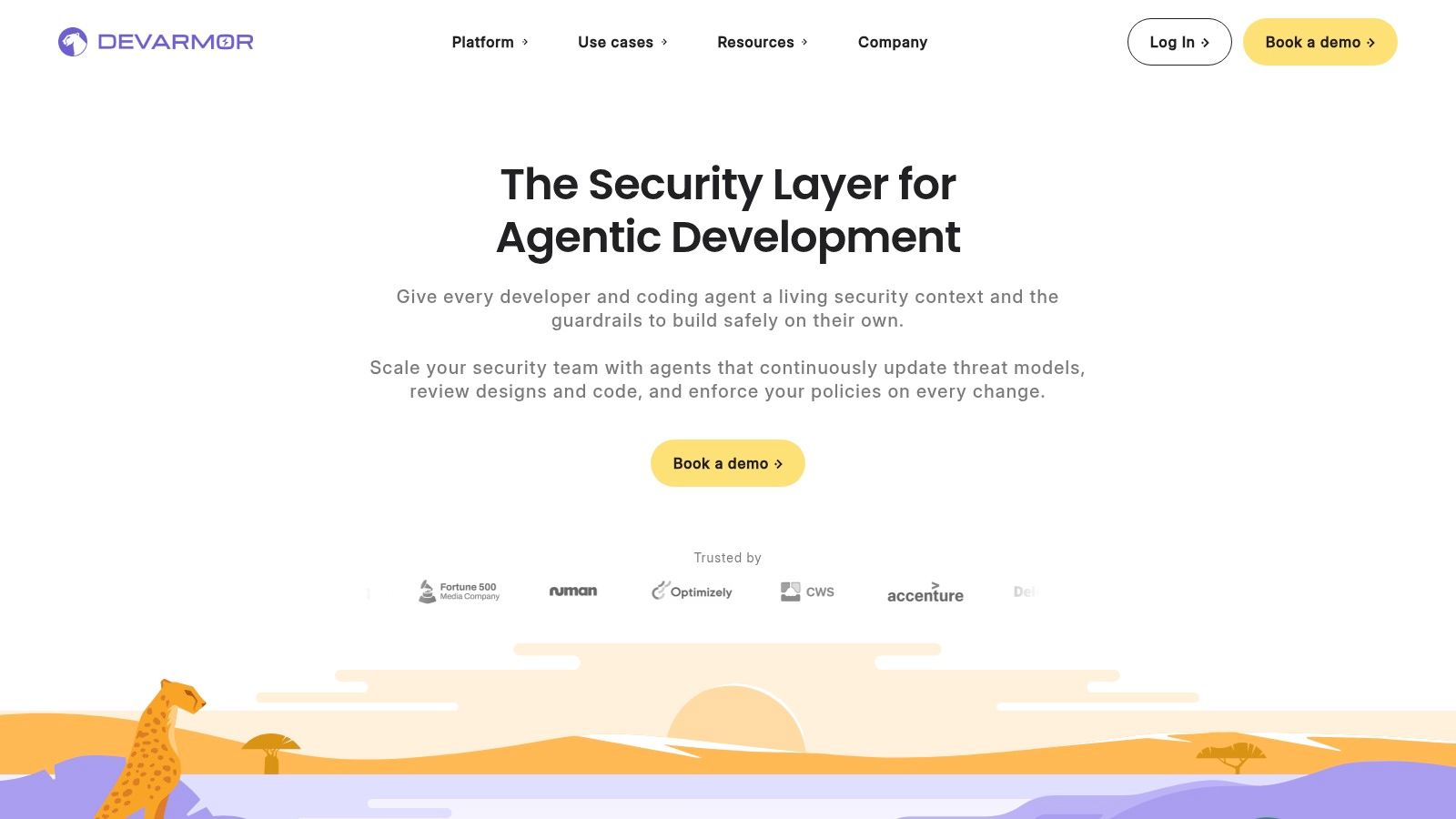
Most Snyk alternatives are scanner-first platforms. DevArmor starts earlier: it maintains continuous threat models and design reviews, generating and updating security context from engineering artifacts such as tickets, design documents, repositories, and service metadata. Security guidance connects to tools teams already use, including Jira, Google Docs, GitHub, VS Code, Cursor, and MCP.
That position matters when design decisions change during implementation. DevArmor can apply Policy-as-Code to pull requests, optionally block merges that violate approved controls, and link decisions to code changes and deployments. It also supplies security context and guardrails for AI-assisted coding, an area scanner-first platforms do not cover. Teams that need security intent preserved across design, implementation, and release should weigh it as a complement to, or replacement for, a scanner.
Practical rule: Don't compare DevArmor with a scanner by counting vulnerability types. Test whether your team can trace a design requirement to a pull request and its release evidence.
Treat the marketing claims the way you would any vendor's. DevArmor's website describes threat-model generation measured in minutes, and its published Universal Music Group customer story describes application modeling shrinking from a workshop-driven process spanning weeks to a fraction of that time. Neither claim is independently verified, so test both against your own workflow before buying. For regulated buyers, DevArmor describes its architecture records as audit-friendly and says it is pursuing SOC 2 certification; if your organization requires completed certification, verify the current status before shortlisting.
Pricing is the catch. Quotes depend on usage and features, so buyers cannot size the cost without a sales call. Choose DevArmor when living threat models, in-workflow design reviews, implementation verification, and merge enforcement are requirements, not extras.
2. Aikido Security
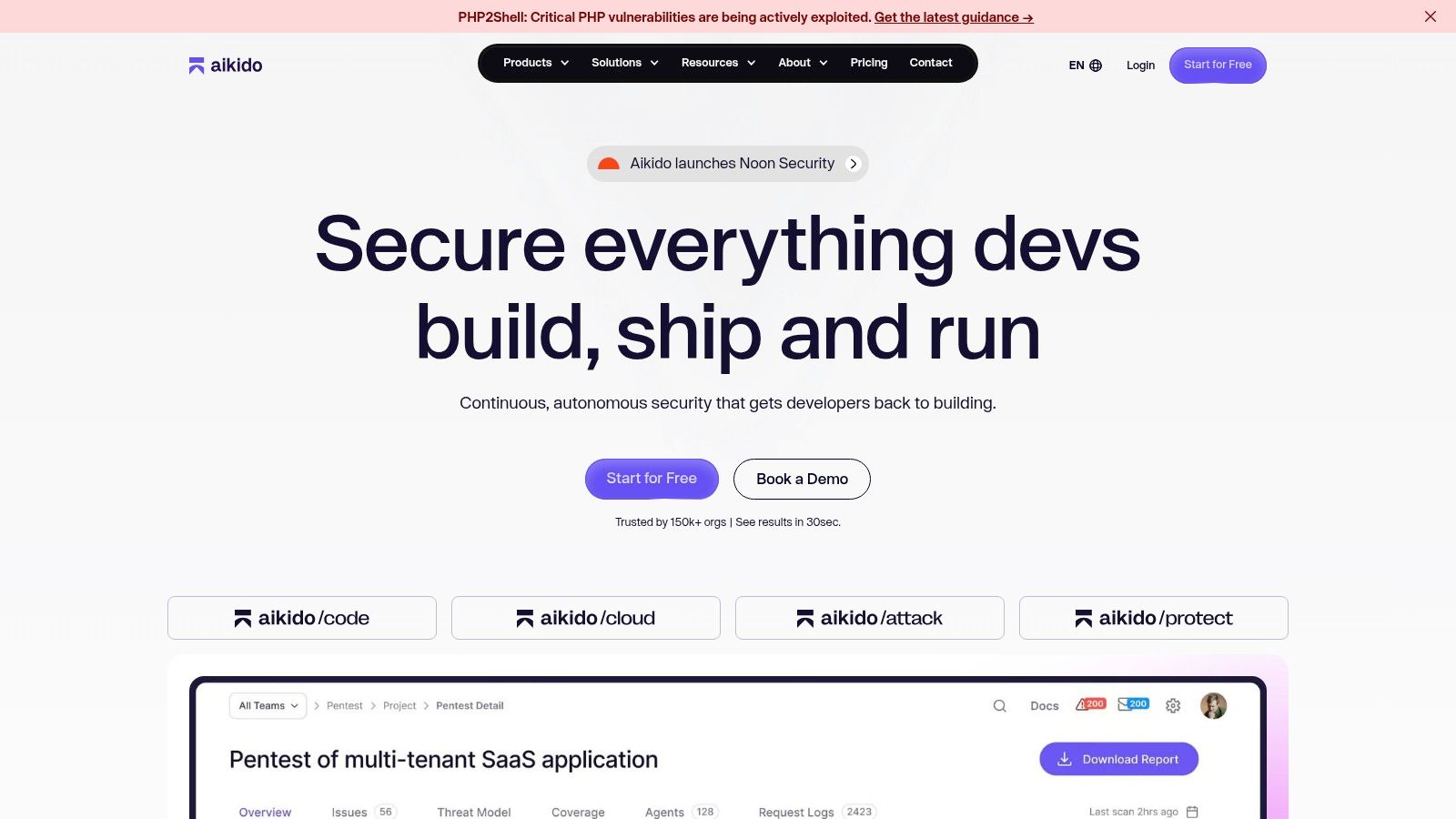
Aikido is a close scanner-first alternative for engineering teams that want code and cloud checks in developer workflows. Its listed capabilities include SAST, SCA, secrets detection, IaC and container scanning, IDE integrations, pull-request checks, and CI/CD gates. Dependency reachability and prioritization can help teams focus investigation, while AI-assisted triage and fixes may reduce manual effort.
The draw is breadth in a developer-oriented package. Teams can evaluate the free Developer plan for up to two users, then confirm pricing and package scope for paid Code and Cloud offerings. Enterprise controls and advanced modules may require a sales conversation, and wider coverage still takes configuration and tuning.
Aikido's boundary is clear: it scans software and cloud configurations, but it isn't a continuous threat-modeling or design-review system. Teams that need security requirements to stay connected to architecture decisions will need to evaluate that separately. For broader context on how buyers assess these platforms, see this guide to application security solutions.
Choose Aikido when you want a broad set of checks, developer-facing results, and a small-scale evaluation path. Don't assume breadth removes alert management work. During a proof of concept, measure whether findings are actionable and whether teams can consistently enforce checks without overwhelming pull-request review.
3. Semgrep
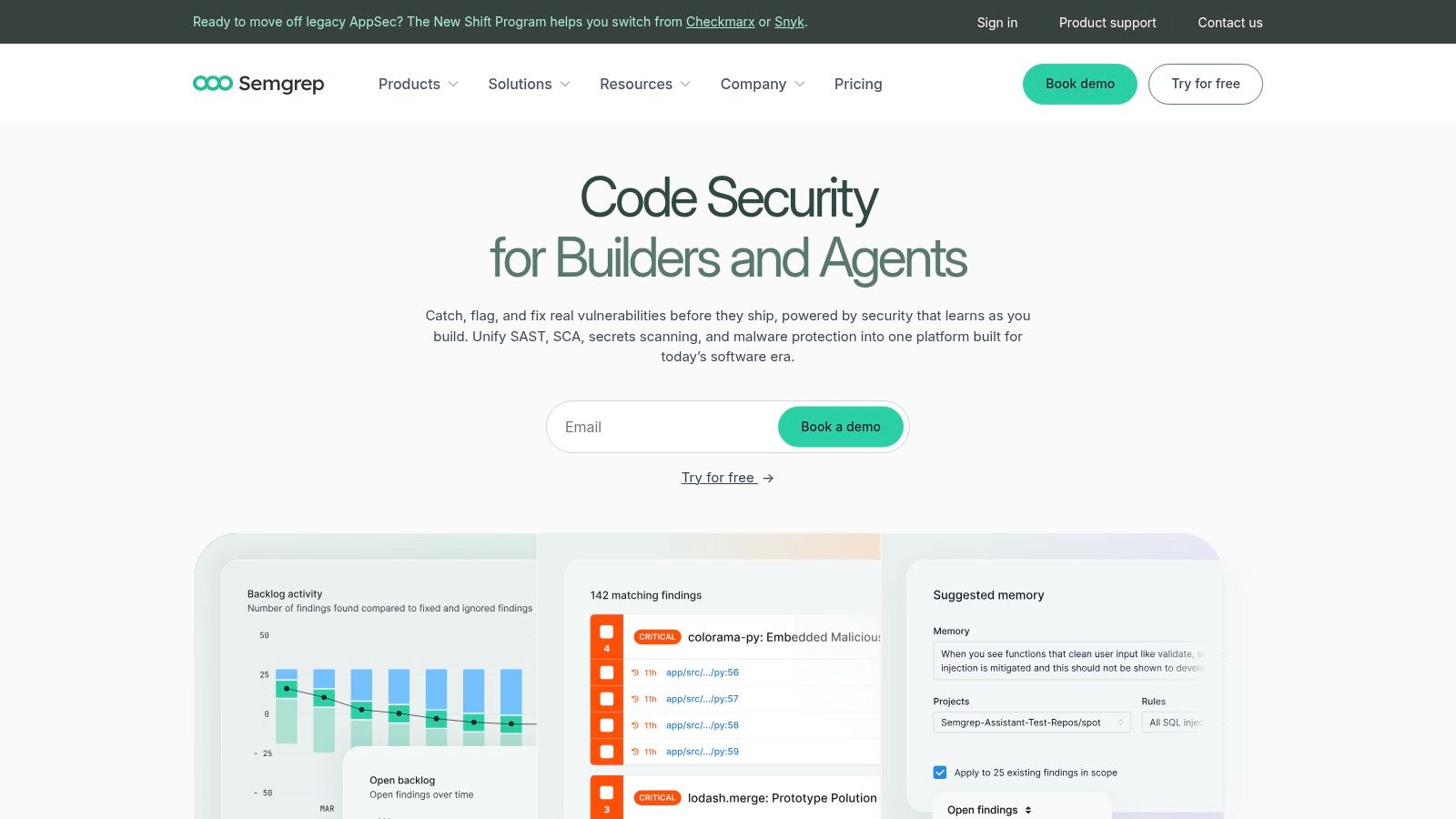
Semgrep is the code-centric choice for teams that want control over what their scanner flags. Its platform combines SAST with supply-chain analysis and secrets detection, and supports custom rules for organization-specific patterns. Cross-file and taint analysis, dependency reachability, and CI/CD integrations make it a natural fit for teams that want security checks close to code review.
The advantage is adaptability: security engineers can encode internal standards rather than rely only on a vendor's default rules. That flexibility comes with maintenance. Teams need to select, tune, and own their rules, and should confirm plan limits and feature availability for their contributor and repository needs.
Semgrep offers a free plan, while the supplied plan information lists a Teams starting price of $30 per month per contributor. Check the current scope and terms directly with Semgrep before budgeting. Published entry pricing makes initial comparison easier, but the actual cost also includes the time needed to manage rules and triage results.
For code-centric teams, rule ownership is a feature only if someone owns the rules.
Semgrep is not a replacement for continuous architecture-level threat modeling or design review. Choose it when customizable code analysis and CI integration matter more than one platform spanning the entire security lifecycle.
4. Mend.io
Mend.io belongs on the shortlist when an organization needs application-security coverage across source code, open-source components, and containers. Its listed capabilities include SAST, SCA, remediation workflows, and security features for AI-generated code. Separate Mend AI capabilities address AI inventory, security, and governance, which may be relevant if the evaluation reaches beyond conventional dependency scanning.
The purchase requires close attention to packaging. Pricing is listed per contributing developer, but buyers should confirm which functions are included in each package and how the vendor defines the billable scope. That model may suit some engineering organizations and fit poorly with others, so test it against actual repository and contributor patterns rather than relying on a headline rate.
Mend is a stronger match for buyers seeking enterprise application-security breadth than for teams whose primary need is keeping threat models current. A platform can identify risky components and code patterns without maintaining a live connection between design decisions and implementation. If dependency-risk analysis is central to the evaluation, this overview of software composition analysis provides useful context for the category.
Before choosing Mend, run representative repositories through the modules you plan to buy. Confirm the results developers will see, how remediation work is assigned, and which features require separate licensing. Choose it when the package matches your code and dependency priorities and the licensing model works for your organization.
5. Checkmarx One
Checkmarx One is a broad enterprise AppSec platform for organizations that need multiple testing approaches and more deployment choice. Its core packages include SAST, SCA, API security, and application-security posture management. Buyers can also assess options for DAST, container security, IaC, and secrets detection, with AI-assisted remediation features available in some packages.
A major differentiator for regulated or infrastructure-constrained environments is the range of deployment options: SaaS, self-hosted, and on-premises. That flexibility makes Checkmarx worth evaluating where hosting, data residency, or air-gapped requirements shape procurement. It also adds decisions for the buyer. Clarify the operational responsibilities, feature availability, and support model for the deployment you're considering.
Pricing requires a custom quote based on modules, developer scope, and deployment model. Ask for a written breakdown that separates included capabilities from add-ons, then compare it with your current stack. Broad coverage can help consolidation, but it can also be more platform than a team seeking only SCA or SAST needs.
Choose Checkmarx One when a mature security program needs broad testing coverage and deployment flexibility. Don't buy on a module list alone. Test the developer workflow, the quality of findings, and the effort required to operate the selected configuration. Start with Checkmarx to scope the specific package and deployment option.
6. Veracode
Veracode is a strong candidate when an organization needs several testing approaches, policy-oriented workflows, and centralized reporting. Its offerings include SAST, SCA, and DAST, with binary analysis useful when the team can't provide source code for a scan. Developer integrations and AI-assisted remediation options also belong in the evaluation.
There's a clear case for this breadth in regulated environments. Veracode's 2024 State of Software Security research analyzed 1,007,133 applications and found that 42% contained security debt, meaning flaws left unresolved for more than a year. The same study reported that 71% of organizations had some security debt, underscoring the need to assess not just discovery, but also prioritization and sustained remediation (Veracode's 2024 research).
The buying challenge is scope. Veracode's modules and pricing need to be confirmed with the company, and buyers should decide which testing methods they intend to operate. Central reporting is useful only if teams can route findings to owners and verify fixes without creating an unmanageable backlog.
Veracode focuses on testing and risk management, not living design-security context. Choose it when breadth of testing and policy workflows are priorities, especially where binary analysis is useful. Evaluate scan turnaround, developer feedback, and the evidence available for internal governance before committing. See Veracode's platform for current offerings.
7. GitHub Advanced Security
For teams already hosting code on GitHub, Advanced Security has a practical advantage: security findings appear in the repository and pull-request workflows developers already use. Its products separate Secret Protection from Code Security, so buyers can assess and license those capabilities independently. The listed features include code scanning, dependency-related security, secret scanning, push protection, and AI-assisted remediation.
That repository-native experience can reduce friction, but it doesn't remove the need to manage findings. Test whether alerts have useful ownership and triage paths, and confirm which features are available for the repositories in scope. Public-repository security features are available without charge, while private-repository use requires a paid product that charges per active committer.
The platform is a less obvious fit when an organization relies on another source-control system or needs a broader workflow that spans planning and design. Repository scanning also doesn't provide ongoing threat-model updates or design reviews. Teams evaluating enforcement should compare repository protections with requirements that can be linked back to approved security decisions. This guide to Policy-as-Code tools can help frame that distinction.
Choose GitHub Advanced Security when GitHub is already central to development and repository-native feedback is the priority. Confirm licensing and workflow compatibility before rollout, particularly if teams use multiple source-control platforms. Review GitHub Advanced Security for the current product structure.
8. GitLab Ultimate
GitLab Ultimate is the strongest fit on this list for organizations that want code hosting, CI/CD, and security capabilities inside one DevSecOps platform. SAST and dependency scanning are available with scope that varies by tier. Ultimate adds security dashboards and cross-project vulnerability management, while built-in CI/CD connects scanning with pipelines and merge requests.
The appeal is fewer handoffs between development and security tools. A self-managed deployment option may also suit organizations with specific infrastructure constraints. But the security features you need may require a higher-tier plan, so compare the actual tier requirements with the cost of your existing source-control and pipeline setup.
Integration is the deciding factor. If your developers already work in GitLab, security checks can sit close to the delivery process. If the organization uses another source-control and CI/CD stack, assess migration and integration effort before treating GitLab as a simple scanner replacement. Also distinguish pipeline enforcement from continuous threat modeling: scans and dashboards won't, by themselves, keep architecture decisions synchronized with changing code.
Choose GitLab Ultimate when consolidation around GitLab is a real objective, not just a line item in a security procurement. Test pipeline feedback and cross-project review with the teams expected to own remediation. Check the current GitLab Ultimate pricing and plan details.
9. Sonatype Nexus One
Sonatype Nexus One is the specialist choice when the main problem is open-source components and software-supply-chain governance. Its capabilities focus on SCA and component intelligence, policy-based enforcement across development and build workflows, repository firewall controls, SBOMs, and governance. Repository Firewall can block or quarantine risky components before they progress through a pipeline.
That focus matters because an inventory alone doesn't establish that dependencies are governed continuously. A 2025 survey reported by Lineaje found that some security professionals lacked the tools or processes to analyze SBOMs for vulnerabilities. Treat that as a buying prompt: ask whether the platform can connect inventory to policy, ownership, and remediation, rather than merely produce an artifact.
Nexus One is more supply-chain-focused than a general-purpose SAST platform. Buyers should confirm which capabilities are included in the proposed package and whether it addresses their source-code testing needs. Pricing is typically sales-led, so request a quote that clearly identifies modules and enforcement scope.
Choose Sonatype Nexus One when controlling packages and dependencies is the central requirement. Pair it with code analysis or design-review capabilities if those are also part of your risk model. Explore Sonatype Nexus One for current packaging and demo details.
10. Black Duck Polaris
Black Duck Polaris suits teams seeking centralized security testing and policy oversight across an application portfolio. Its listed coverage includes SAST, SCA, DAST, IaC analysis, and secrets detection, with pull-request scanning and IDE and source-control integrations. Issue-tracker workflows, pipeline gates, centralized policy, reporting, and SBOM generation round out its enterprise focus.
The breadth can help teams reduce the number of separate scanners they operate. It can also make a quote harder to compare, since package-based and à la carte options are available and pricing is by request. Buyers should evaluate the specific modules they need, how findings move into issue trackers, and whether policy settings can match their release process.
Black Duck is a scanner-first platform, not a system for maintaining design-stage threat models as software changes. That's not a weakness if your main gap is detection and portfolio reporting. It is a gap if your security program needs traceability from design decisions through implementation and deployment.
Choose Polaris when broad testing coverage and centralized oversight matter more than continuous design-security context. During evaluation, measure whether teams can act on results inside their existing workflows and whether the proposed package replaces tools you already run. See Black Duck's platform for current options.
Snyk Competitors: Top 10 Solutions Compared
| Platform | Core Security Coverage | Workflow & Differentiator | Best Suited To | Strength / Fit | Pricing |
|---|---|---|---|---|---|
| 🏆 DevArmor | Continuous threat modeling, design reviews, Policy-as-Code, implementation verification, AI guardrails | ✨ Living security context across planning, IDEs, pull requests, and deployments; audit-ready records | 👥 Regulated, fast-moving FinTech, HealthTech, and media teams | ★ Strong for design-stage security and keeping models current | 💰 Custom quote; based on usage and features |
| Aikido Security | SAST, SCA, secrets, IaC, containers, and cloud checks | IDE and pull-request feedback, CI/CD gates, AI-assisted triage | 👥 Teams seeking broad code and cloud scanning | ★ Broad scanning in developer workflows | 💰 Free plan for up to 2 users; paid plans are quote-based |
| Semgrep | SAST, dependency analysis, secrets detection | ✨ Custom rules and CI/CD integration | 👥 Teams wanting customizable code-security checks | ★ Flexible rules; effectiveness depends on tuning | 💰 Free plan; Teams from $30/month per contributor; Enterprise custom |
| Mend.io | SAST, SCA, container, and AI-generated-code security | Dependency remediation workflows; separate Mend AI capabilities | 👥 Teams prioritizing code, open-source, and AI risks | ★ Useful coverage for common AppSec needs | 💰 Per contributing developer; confirm package terms |
| Checkmarx One | SAST, SCA, API security, DAST, and more | ✨ Modular platform with SaaS, self-hosted, and on-premises options | 👥 Larger organizations with varied hosting or compliance needs | ★ Broad coverage and deployment flexibility | 💰 Custom quote |
| Veracode | SAST, SCA, DAST, including binary analysis | Policy-oriented workflows and centralized reporting | 👥 Organizations needing multiple testing methods | ★ Binary analysis works when source code is unavailable | 💰 Contact vendor; confirm modules and pricing |
| GitHub Advanced Security | Code scanning, dependency security, secret scanning | ✨ Security built into GitHub repositories and pull requests | 👥 Teams already hosting code on GitHub | ★ Convenient repository-native feedback | 💰 Public-repository features free; private use is paid |
| GitLab Ultimate | SAST, dependency scanning, vulnerability management | ✨ Security integrated with source control and CI/CD | 👥 Teams seeking an all-in-one DevSecOps platform | ★ Centralized security dashboards; self-managed option | 💰 Higher-tier plan; check current plan pricing |
| Sonatype Nexus One | SCA, open-source and software supply-chain security | Policy enforcement, Repository Firewall, SBOM capabilities | 👥 Organizations focused on dependency and package risk | ★ Specialist component intelligence and controls | 💰 Request a demo for pricing |
| Black Duck Polaris | SAST, SCA, DAST, IaC, and secrets | Policy, reporting, SBOMs, and pipeline gates | 👥 Teams managing security across an application portfolio | ★ Broad testing coverage and centralized oversight | 💰 Package-based or à la carte; quote required |
Choose for the Risk You Need to Control
There isn't one universal winner among Snyk competitors. Choose based on the failure you're trying to prevent, then check whether the product fits how developers plan, code, review, and release software.
For broad scanner coverage and consolidation, put Aikido and Black Duck on the shortlist. Aikido combines code and cloud checks in a developer-oriented platform; Black Duck brings a wide range of testing and portfolio-level oversight. Test alert quality and module scope instead of assuming a long feature list will reduce work.
For customizable code analysis, choose Semgrep. It gives teams room to build rules around internal standards and offers a published starting price, but the organization must own rule quality and maintenance. For broader enterprise application-security needs, evaluate Checkmarx, Veracode, and Mend.io against your required testing methods, deployment constraints, and package terms. Don't treat them as interchangeable: verify what each quoted configuration includes.
For tightly integrated delivery stacks, GitHub Advanced Security fits GitHub-native teams, while GitLab Ultimate suits organizations standardizing on GitLab for source control and CI/CD. Sonatype Nexus One is the more focused choice when software-supply-chain governance and control of open-source components lead the requirement.
Choose DevArmor when you need continuously maintained threat models, in-workflow design reviews, and policy enforcement across design, code, deployment, and AI-assisted development. That's a different job from scanning for vulnerabilities. DevArmor's strength is connecting requirements and security decisions to the implementation, rather than acting as another scanner in a crowded toolset.
For FinTech, HealthTech, and similarly regulated organizations, evaluate more than detection coverage. Review evidence quality, implementation burden, data-handling requirements, and traceability. Financial services have a specific dependency challenge: Veracode's 2024 sector analysis found that 78.6% of critical security debt came from third-party dependencies (Veracode's financial-services analysis). Use that finding to shape your test cases, not as a substitute for testing your own repositories and release controls.
Run a short, workflow-based proof of concept using a representative application and a sample of pull requests. Include your actual compliance and release requirements, then record what developers must configure, which alerts they can act on, what policies can block a release, and what evidence the platform produces. Buy the tool that controls your real risk with the least added friction.
DevArmor provides continuous threat modeling, in-workflow security design reviews, and Policy-as-Code enforcement for teams evaluating alternatives to scanner-first AppSec platforms. If your priority is keeping security decisions connected to code changes and releases, visit DevArmor to see how it fits your development workflow.
Table of Contents
Subscribe


