Security Policy Updates That Actually Scale in 2026
 Reza Khosravi
Table of Contents

Only 9% of enterprises have fully integrated security policy management into development and deployment workflows, while 61% still rely on manual or reactive processes, according to a 2026 Cloud Security Alliance survey of 515 IT and security professionals reported by IT Brief Asia. That gap explains why security policy updates still arrive as documents, wait for review, and reach production after the system they're meant to govern has already changed.
The fix isn't another policy template or a larger compliance calendar. Treat each update as a delivery artifact, with version control, automated tests, explicit enforcement points, runtime telemetry, and a rollback path. The same engineering discipline you apply to application code belongs in every rule that can block a deployment, reject a request, or restrict an AI agent.
Why Most Security Policy Updates Stall Before Production
Security teams rarely fail at drafting a policy. They fail at converting intent into a controlled delivery artifact.
A rule often begins in a PDF, ticket, or wiki page. Ownership is unclear, approval is scattered across Slack, and the reasoning behind an exception disappears when someone later asks why it was granted. There is no production-like test environment, and the same requirement may be translated differently for cloud identity, endpoint management, Kubernetes, and network enforcement. By the time an engineer implements it, the original risk context has weakened.
The result is drift across the delivery chain. The written policy says one thing, the executable control says another, and the deployed bundle may be older still. The Cloud Security Alliance survey reporting found that 92% of respondents found it difficult to gain a view of security policies across cloud environments, while roughly two-thirds reported at least one business-critical application outage caused by a misconfigured security policy during the previous 12 months.

Why the wiki-of-record fails
A wiki works for human-readable guidance. It does not provide the controls required for an enforcement decision.
It cannot reliably show which version is active, whether negative tests passed, which environments received the rule, or how to restore the previous bundle. Auditors expose those gaps. Incident responders expose them sooner, because they need the active policy, commit, owner, and change history without reconstructing a conversation.
Regulatory change makes point-in-time documentation harder to defend. ISO/IEC 27001:2022 was published on 25 October 2022, replacing the 2013 version, and organizations certified to the earlier version had until 31 October 2025 to transition. The ISO 27001 revision guidance describes a fixed transition that required organizations to refresh policies, controls, and certification evidence. The ISO Survey 2024 reported 96,709 valid ISO 27001 certificates across 179,877 sites worldwide. That scale makes policy maintenance an operating capability, not an occasional document exercise.
The delivery contract
Every security policy update needs five fields of accountability:
- A version: Identify the exact revision in Git and in the runtime bundle.
- A test: Run known-good, known-bad, and regression fixtures before promotion.
- An owner: Assign one person or team to approve risk and exceptions.
- An enforcement point: State whether the rule applies in pre-commit, CI, admission, runtime, or an agent tool-call layer.
- A rollback path: Test how operators disable or revert enforcement without changing application code.
For regulated or specialized services, ISO 27001 for zero-knowledge services offers a useful reference for connecting governance with evidence and operational controls. Keep that work organized with an application security implementation checklist, rather than scattering requirements across disconnected documents.
AI-agent policies need the same contract, with explicit limits on tools, data access, prompts, and high-impact actions. Runtime admission checks should reject an unapproved agent configuration even if its source change passed application tests. CI gates catch policy regressions early; admission checks protect the actual deployment boundary.
Practical rule: An update without a commit, test result, enforcement target, or rollback owner is not ready for production.
Versioning Policies the Way You Version Code
Start with a dedicated Git repository. Don't bury executable policy inside an infrastructure repository where ownership and review become ambiguous, and don't put it in a web editor that hides diffs.
A workable layout separates policy domains while keeping one delivery process:
iam/for authentication, authorization, and privilege rulesnetwork/for ingress, egress, and service-to-service restrictionsdata/for classification, retention, and movement controlsendpoint/for device and workload requirementsai-agent/for model prompts, tools, data access, and action limits
Each folder should contain the executable rule files, fixtures, and a CHANGELOG.md. Use Rego with Open Policy Agent, Cedar where its authorization model fits, and the surrounding test and deployment configuration required by the enforcement system.
Make review metadata mandatory
Use Conventional Commits with a policy scope, such as policy(iam): require phishing-resistant authentication for admin paths. The commit message isn't the audit record by itself, but it gives reviewers and release automation a consistent signal.
Every pull request should include the owner, risk tier, affected services, blast radius, test evidence, effective date, expiry date, and rollback plan. Put the same core metadata in every policy file so a rule remains understandable outside the pull request.
| Field | Purpose | Example |
|---|---|---|
owner | Names the accountable team or engineer | product-security |
severity | Describes the consequence of non-compliance | high |
version | Identifies the rule revision | 1.4.0 |
effectiveDate | Defines when enforcement begins | 2026-09-10 |
expiryDate | Forces review of temporary or changing controls | 2027-03-10 |
Tag bundles by environment, for example v1.4.0-staging and v1.4.0-prod. Sign the tags and verify them in the deployment system. The staging tag should identify the candidate artifact, while the production tag should be created only after the required gates pass.
Refuse two shortcuts: policy bundles edited through a web UI with no reviewable diff, and shared-drive YAML that nobody owns. Both create files, but neither creates trustworthy change history.
A policy update without a commit hash is unsigned. Downstream gates should treat it as untrusted.
Testing Policy Updates Before They Reach Production
Testing policy isn't the same as testing application behavior. A policy can be syntactically valid and still deny a legitimate workflow, widen access through an unintended condition, or become ineffective because another rule shadows it.
Run the checks in a fixed CI order. Teams should be able to see the same sequence in every pull request, regardless of which policy domain changed.
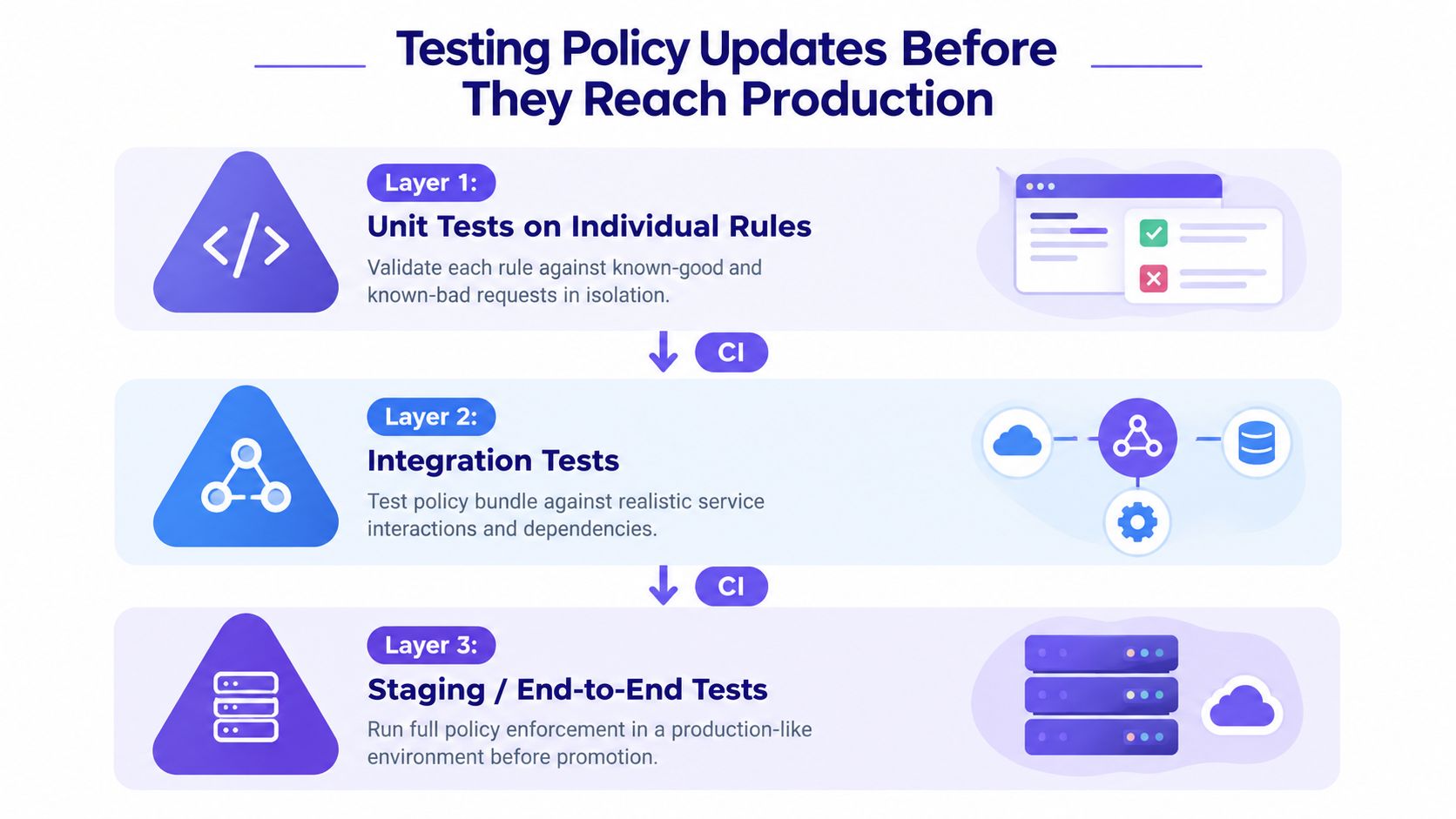
Layer one tests individual rules
Begin with unit tests for each rule. Use known-good and known-bad request fixtures, and assert both the decision and the message returned to the caller. A deny without a useful explanation creates avoidable triage work, especially when an engineer needs to distinguish a real violation from an outdated fixture.
For Rego policies, run opa test. For configuration and infrastructure checks, follow with conftest verify. Where Kubernetes resources require admission-style validation, run kyverno apply against the candidate manifests.
The Policy-as-Code examples show the kind of executable control structure teams can adapt for pull requests and deployment checks.
Layer two compares the proposed bundle
Unit tests won't reveal every interaction between rules. Generate a plan diff against the live bundle and produce a structured report containing:
- New denies: Requests that were previously allowed and will now be blocked.
- Removed allows: Access paths that disappear after promotion.
- Shadowed rules: Rules that can never take effect because another rule wins first.
- Widened conditions: Rules whose match criteria now cover more resources or identities.
Set the gate to zero new shadowed rules. A shadowed security rule gives reviewers the appearance of coverage without enforcement.
Layer three uses a staging canary
Replay a sampled slice of production traffic against the candidate policy inside an admission-controller dry run. Compare decisions against a pre-agreed false-positive budget, and fail the gate if the canary produces more than a 0.5% increase in denies, as specified by the operating standard for this workflow.
The full command sequence should be visible in CI:
opa testconftest verifykyverno apply- Canary replay
Skip staging only for a critical-severity change, and require a named engineer to accept the on-call risk in writing. Emergency speed can justify a shorter path, but it shouldn't erase accountability or testing evidence.
A 16-month empirical study across 11 engineering organizations reported that mature Policy-as-Code implementations achieved a 91% pipeline-stage compliance verification pass rate, reduced audit preparation cycles by an average of 58%, and nearly eliminated ad-hoc security gate bypasses. The study on automated compliance and security enforcement in CI/CD evaluated enforcement styles including OPA with Rego, Conftest gates, Sentinel workflows, and Kubernetes admission webhooks.
Where Policy Updates Should Actually Enforce
A policy doesn't belong in one enforcement location by default. Place it at the earliest point that has enough context to make a reliable decision, then add runtime enforcement where bypass risk or changing context demands it.
Build-time checks are cheap and fast. Use pre-commit hooks and linters for secrets, banned APIs, license headers, and obvious unsafe configuration. These checks shouldn't carry complex business context because developers need immediate feedback and a low-cost correction path.
CI gates can evaluate merged code, infrastructure plans, dependency changes, and deployment metadata. They're the right place for controls that need repository context, reviewers, and a complete proposed change. CI is also easier to audit than an undocumented runtime exception, but it can be bypassed if teams allow emergency deploy paths without equivalent admission checks.
Admission controllers, service-mesh policies, sidecars, and API gateways see identity, provenance, namespace, and runtime context. They catch changes that arrive outside the normal pipeline, but false positives are more expensive because the request may already be on a critical path.
Use a placement matrix
| Policy Category | Build/Pre-commit | CI Gate | Admission/Runtime | Agent Guardrail |
|---|---|---|---|---|
| Secrets and banned APIs | Strong fit | Confirm and block | Limited value | Inspect generated code |
| IAM and privilege changes | Basic linting | Required review gate | Enforce live identity context | Restrict identity-related tool calls |
| Network egress | Validate declarations | Compare infrastructure plan | Enforce actual traffic boundary | Limit destinations and network tools |
| Data movement | Check labels and schemas | Review proposed flows | Enforce runtime access and destination | Block sensitive data in prompts and outputs |
| Kubernetes configuration | Validate manifest shape | Test complete bundle | Enforce admission decision | Prevent agents from changing protected resources |
| AI-agent tools | Check configuration | Review permissions and prompts | Observe tool activity | Enforce tool scope, data access, and action limits |
AI workloads need an additional layer. Agent guardrails should operate at the prompt and tool-call boundary, where the system can restrict data exfiltration, tool permissions, and action blast radius before an agent performs a consequential operation. A CI-only rule won't reliably control an agent that receives new instructions or discovers a new tool at runtime.
The same logic applies to communication systems. When reviewing Email Security Tools, treat the selected controls as policy inputs that need ownership, testing, and runtime evidence, not as a static product checklist.
Empirical assessment has shown the value of reusing identical controls across CI/CD and Kubernetes admission. In that assessment, reused policies correctly identified all intentionally introduced insecure configurations with no observed false positives or false negatives. The research on governance consistency across enforcement points also highlights the central risk: executable policy must stay synchronized with changing artifacts, or drift between checkpoints weakens continuous compliance.
Rolling Out and Rolling Back Without Drama
A security policy update is a feature deploy with a different failure mode. Application code usually breaks a feature. A policy can block the feature, the deployment path, or the operator trying to restore service.
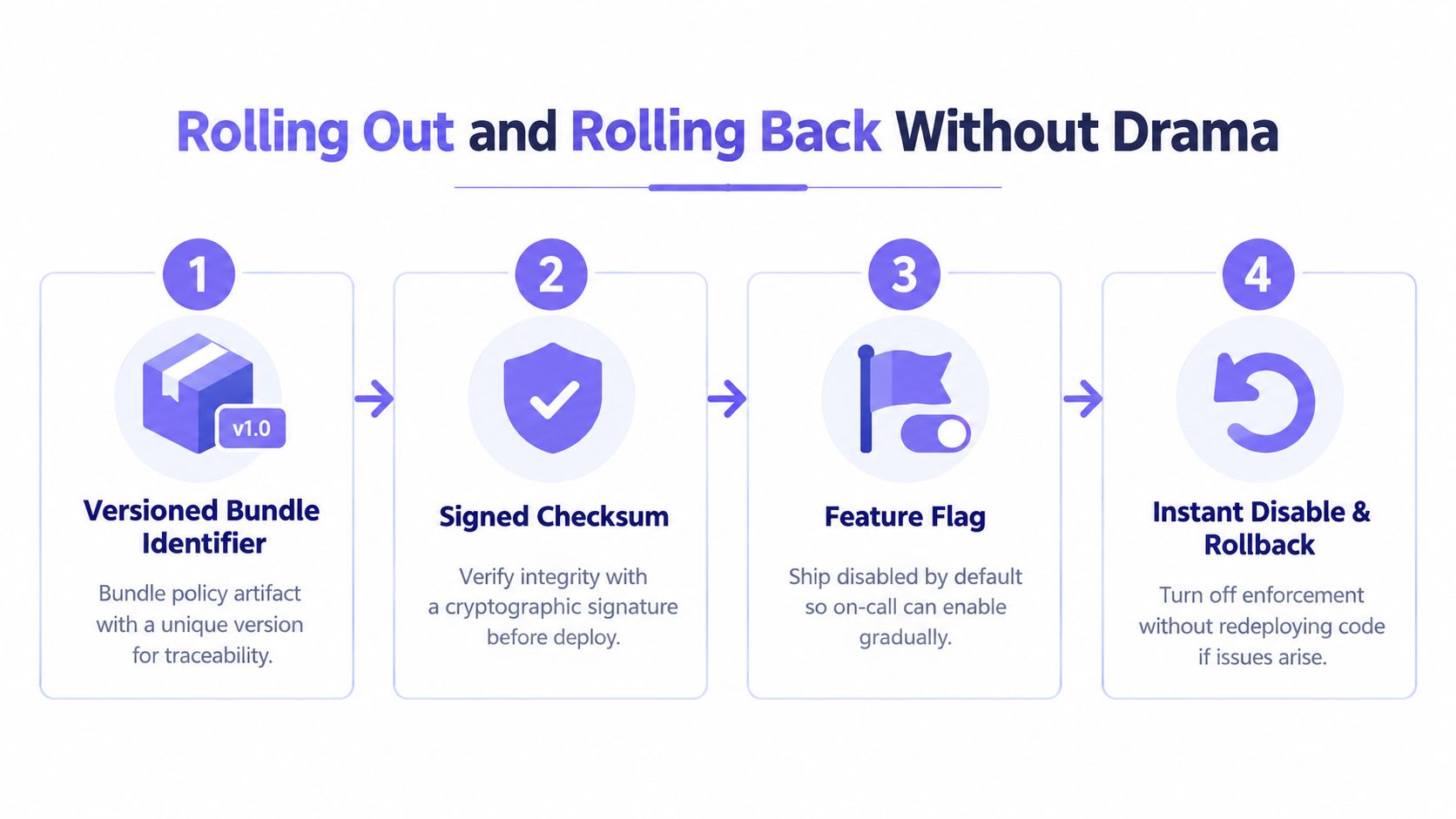
Create a versioned bundle identifier and attach a signed checksum to the artifact. Add a feature flag that lets on-call disable enforcement without reverting application code. For high-risk controls, use blue and green policy environments. The green bundle serves canary workloads, while the blue bundle continues serving the established production cohort. A registry switch then changes the selected bundle without rebuilding services.
Limit the blast radius first
Don't begin with a global rollout. Scope the change by namespace, team, workload tag, or canary cluster, and define the abort criteria before enabling enforcement.
A practical rollout sequence looks like this:
- Publish the candidate: Register the signed bundle and record its checksum, owner, and intended cohort.
- Enable a canary: Turn on enforcement for a narrowly scoped workload group and watch denial rates, latency, and resource saturation.
- Expand by cohorts: Move additional namespaces or teams only after the canary meets the pre-agreed criteria.
- Promote or disable: Flip the feature flag to expand enforcement, or disable it immediately if the policy causes harm.
For a high-risk egress allowlist or agent tool-permission change, keep the previous bundle available as the blue environment. Rollback should select that bundle, preserve the failed bundle's logs, and create an incident or rollout record that explains the decision.
Make rollback auditable
A rollback isn't deletion. Record the active bundle before the change, the bundle selected during rollback, the operator, the trigger, and the affected cohort. Keep deny and allow events associated with the bundle that produced them, even after the runtime switches back.
Tell developers that enforcement is disabled, what temporary exposure exists, and which team owns reactivation. Add an expiry to every emergency disablement, with a named person responsible for reviewing it. A rollback that remains disabled indefinitely is an untracked policy exception.
Teams automating release controls can connect this runbook to application security automation, provided the automation preserves approval, version, and rollback evidence instead of turning deployment into an opaque action.
Monitoring Drift and Closing the Feedback Loop
A policy update without telemetry is a guess that survived staging.
Consider a representative incident. A team enables a new egress-deny rule, and the initial metrics look healthy. Two hours later, a batch job reaches an internal endpoint that the canary never exercised, and the new rule blocks it. Without bundle-aware telemetry, responders see a failed job. With it, they see the exact policy version, rule, workload, and decision that caused the failure.

Instrument the decision, not just the service
Drift detection should compare policy bundle versions across clusters and flag workloads that match a policy but aren't bound to the live bundle. Count denied requests by bundle version, rule identifier, resource, namespace, and caller identity. That turns a generic outage signal into an actionable policy diagnosis.
Every denied event should create or enrich a ticket containing:
- Bundle SHA: The exact artifact that made the decision.
- Resource identity: The workload, service, or request target.
- Rule identifier: The control that fired.
- Decision context: The relevant identity, environment, and matched conditions.
- Disposition: Whether the event was fixed, waived, or rolled back.
The feedback loop closes when each deny, waiver, and exception becomes an annotated regression fixture in the policy repository. A batch job that was legitimately blocked should produce a known-good test case after the team decides whether to change the rule or change the workload. A malicious request should become a known-bad fixture that protects the control from future relaxation.
Dashboards that prove the program is alive
Track policy version coverage, so operators know which workloads run the approved bundle. Track mean time to detect drift, waiver aging, and rollback frequency. Review the ratio of drift incidents found by automation versus humans, because a program that depends on incident discovery is still operating reactively.
This is the operational answer to the broader compliance problem. Recent reporting on cybersecurity and data protection describes a shift toward continuous monitoring and tighter vendor oversight, while also identifying continued overreliance on point-in-time assessments. The 2025 cybersecurity and data protection review is useful context for why living controls need traceable evidence, especially as incident reporting, vendor obligations, and sector requirements change.
A 90-Day Operating Plan for Continuous Policy Updates
A continuous policy program needs a calendar, named owners, and artifacts that reviewers can inspect. Use the first 30 days to create the delivery foundation, the next 30 to prove enforcement at high-risk points, and the final 30 to make drift visible.
Days 1 through 30 build the path
Inventory policies across IAM, network, data, endpoint, Kubernetes, and AI-agent workflows. Mark each rule as executable, advisory, duplicated, ownerless, or obsolete. Stand up the Git repository, define the metadata header, add fixtures, and wire the first CI pipeline.
The milestone artifact is a tagged policy bundle and a CI pipeline pull request that demonstrates the complete path from policy change to test result. Don't try to migrate every document first. Start with controls that can cause a material deployment or access decision.
Days 31 through 60 prove enforcement
Onboard the three enforcement points with the highest blast radius. For many teams, that means IAM authorization, Kubernetes admission, and network egress, but use your own incident and architecture data to choose.
Add plan diffs, shadowed-rule detection, and staging replay. Run the first staged rollout with a named rollback owner and written abort criteria. The milestone artifact is a rollout ticket that records the candidate bundle, cohort, test evidence, owner, and rollback procedure.
Days 61 through 90 close the loop
Turn on drift alerts and bind runtime decisions to bundle identifiers. Retire the wiki as the enforcement system of record, while keeping a generated human-readable view for engineers and auditors. Publish a weekly metrics review covering four leading indicators:
- Policy-to-PR cycle time: Target less than 48 hours for ordinary updates.
- Passing plan diffs: Track the percentage of policy changes that pass structured comparison before promotion.
- Mean time to rollback: Measure how quickly operators can restore the previous safe bundle.
- Automated drift detection: Compare incidents found by automation with those discovered by humans.
The operating cadence should stay lightweight. Hold weekly Policy-as-Code office hours, conduct a monthly exception review, and run a quarterly threat-model-driven policy refresh. AI-assisted development makes that refresh more important, not less. A 2026 web application security report describes organizations automating policy updates so they deploy alongside application changes, while compliance trends require teams to account for phishing-resistant authentication, supply-chain risk, AI regulation, and post-quantum readiness.
Policy updates scale when the team can answer four questions without searching through messages: what changed, who approved it, where is it enforced, and how do we undo it?
DevArmor helps teams connect living threat models and security design decisions to Policy-as-Code checks on pull requests, CI/CD workflows, and AI-assisted development guardrails. Visit DevArmor to see how your team can make security policy updates traceable from design through deployment.
Table of Contents
Subscribe