Security in SDLC Phases: A Practical Implementation Guide
 Reza Khosravi
Table of Contents
More than 30% of applications contain at least one security flaw at their first scan, and that figure rises to approximately 90% in ten-year-old software. Security in SDLC phases works when teams continuously connect requirements, design decisions, code, dependencies, releases, and production evidence, rather than waiting for a final security gate.
That distinction matters because a secure development lifecycle isn't just a sequence of reviews. It's a chain of assumptions. A product team approves an authorization model, an architect records a trust boundary, a developer implements it, a pull request changes it, a dependency introduces a new path, and a deployment alters the runtime configuration. If nobody verifies that the approved assumption still matches what shipped, the organization has security activity without security traceability.
The hidden failure is traceability drift. Documents remain approved while repositories, tickets, dependencies, and environments move on. Scanners can identify many defects, but they can't by themselves prove that the architecture reviewed last quarter is the architecture running today, or that a pull request still complies with the threat model behind the original approval.
Why Security Debt Accumulates Across the SDLC
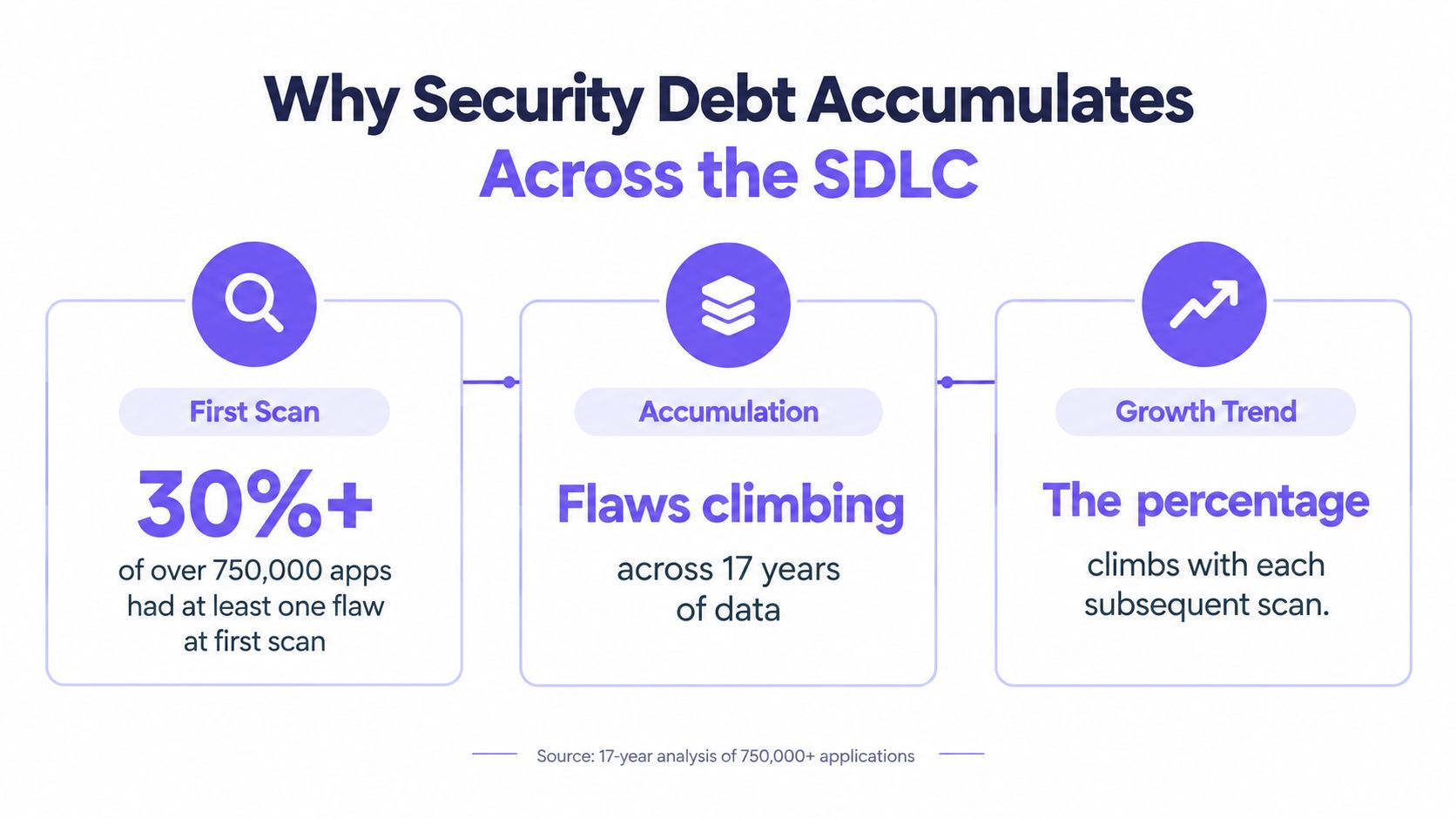
Application security risk doesn't begin at release. An analysis covering more than 750,000 applications across 17 years found that over 30% had at least one security flaw at their first scan. The proportion increased as applications aged, reaching approximately 53.5% for two-year-old applications, 69.4% for five-year-old applications, and about 90% for ten-year-old applications, as reported in Veracode's State of Software Security analysis.
The same research estimated a 27% probability of introducing one or more new flaws in any given month. That changes how security leaders should think about the SDLC. Risk isn't a defect category that appears during a release candidate review. It is an accumulating property of changing requirements, architecture, implementation, dependencies, deployment settings, and maintenance work.
The failure of the final gate
A final penetration test still has value, but it can't preserve security across a changing system. By the time a reviewer finds an architectural weakness at release, the team may have built APIs, data stores, permissions, tests, and operational procedures around that decision. The release gate can identify the problem, but it can't make the rework cheap.
The more damaging failure is often less visible. A design review approves one data-flow assumption, while the implementation uses a different service boundary. A dependency changes without the original threat model being updated. A deployment introduces a configuration that wasn't part of the tested architecture. Each change may look reasonable in isolation, yet the combined system no longer matches the approved security context.
Practical rule: A control that isn't linked to the artifact it governs becomes difficult to enforce and nearly impossible to prove later.
Security debt is also a supply-chain problem
Third-party code makes drift harder to control. The 2024 State of Software Security findings reported that roughly 70% of applications contained flaws in third-party code, and that fixing those vulnerabilities took organizations 50% longer than fixing first-party flaws, according to Veracode's 2024 findings. Half of known open-source flaws remained unresolved for approximately 11 months.
The evidence also describes security debt as an ownership and workflow problem. Unresolved flaws affected 42% of applications and 71% of organizations, while 46% of organizations had persistent high-severity flaws classified as critical security debt, according to the same report. A dependency scanner can raise an alert, but the organization still needs to know which service owns the dependency, which release introduced it, whether the threat model assumed it, and what exception evidence supports continued use.
Security in SDLC phases therefore means more than assigning a tool to every stage. It means preserving a verifiable relationship between the decision, the control, the implementation, and the running artifact. Without that relationship, a one-time review creates confidence that expires as soon as the system changes.
Embedding Security Activities in Each SDLC Phase
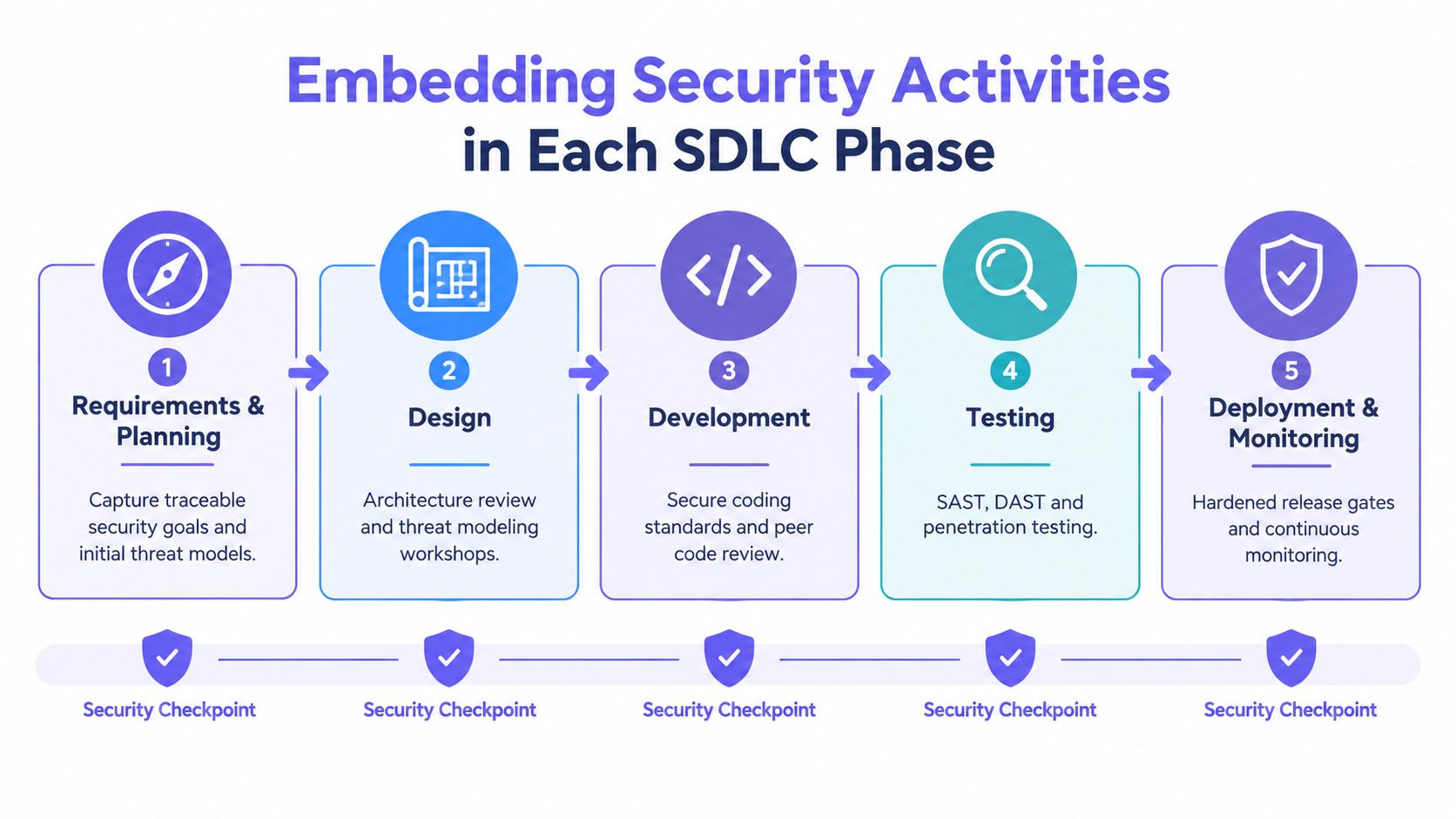
A secure SDLC assigns security work to every phase, but the durable output isn't a checklist. It's evidence that remains attached to the changing software artifact. Requirements should produce testable security goals. Design should produce decisions and threat-model assumptions. Development should produce policy evidence in code review. Deployment should prove which verified build reached which environment, and maintenance should feed new findings back into requirements and design.
Requirements and planning
Start with the system's security obligations before architecture work begins. Record the data handled, trust assumptions, access expectations, regulatory constraints, and misuse cases alongside functional requirements. A requirement such as “customers can download invoices” needs a security counterpart that defines whose invoices each customer may access.
Version those requirements rather than leaving them in a static planning document. Link them to tickets and acceptance criteria, so a later change can show which security assumption changed and which downstream design or test needs review.
Design
Design reviews should evaluate the architecture against the requirements, not merely record that a meeting occurred. Threat modeling should identify trust boundaries, data flows, privileged operations, and failure behavior, then assign decisions or mitigations to named owners.
The useful gate isn't “security reviewed.” It's “the architecture satisfies these requirements, these assumptions remain valid, and these unresolved risks have an explicit owner.” That distinction prevents approval language from outliving the design it was meant to govern.
Development and testing
Developers need controls where code changes happen. Secure coding standards, dependency selection, secret detection, and pull-request policy checks should run in the repository workflow, with findings linked to the affected requirement or design decision. A merge rule should fail the specific violated control, not turn every security concern into an opaque pipeline failure.
Testing then validates more than known vulnerability patterns. It should verify abuse cases, authorization behavior, dependency exposure, runtime configuration, and the continued alignment between implementation and threat model. Automated checks provide repeatability, while targeted human review remains important for architectural and business-logic risks.
Deployment and maintenance
Deployment should verify configuration, environment separation, build integrity, release approval, and the identity of the artifact being promoted. The evidence needs to answer what changed, which controls ran, which exceptions were accepted, and where the build was deployed.
Maintenance closes the loop. Monitoring, incident response, dependency updates, and configuration changes should update the relevant threat model and requirements instead of creating a separate operational record. If a production finding can't be traced back to an owner and an architectural assumption, the team has detection without learning.
A practical phase-level evidence chain looks like this:
- Requirement: A versioned security goal with acceptance criteria.
- Design decision: A threat-model assumption, control, or approved exception.
- Implementation: A repository, dependency, pull request, and policy result.
- Release evidence: A verified build, deployment record, and environment status.
- Maintenance feedback: A finding, remediation owner, and updated security context.
Connecting NIST SSDF Outcomes to Workflow Automation
NIST's Secure Software Development Framework groups practices into four outcomes: preparing the organization, protecting software from tampering and unauthorized access, producing well-secured software, and responding to vulnerabilities. The value of the framework is not in creating another parallel security process. It gives teams a way to map security outcomes onto the workflow they already operate, as described in NIST SP 800-218.
The implementation challenge is traceability. A policy document may say that architecture decisions require review, source code must be protected, builds need integrity controls, and vulnerabilities require response. An auditor, incident responder, or engineering manager still needs to see how those requirements applied to a particular release.
Turn decisions into versioned policy metadata
Store each security requirement and threat-model decision as structured, versioned metadata. Associate it with the relevant ticket, repository, service, dependency, pull request, and deployment evidence. When the requirement changes, the relationship should show which implementation and release artifacts need reassessment.
This approach turns the SSDF outcome groups into workflow behavior:
- Prepare the organization: Define ownership, security requirements, approved development practices, and exception authority.
- Protect software: Protect source, dependencies, build configuration, artifacts, and release permissions from unauthorized change.
- Produce secured software: Check design intent, secure coding rules, dependencies, tests, and pull requests as work progresses.
- Respond to vulnerabilities: Route findings to accountable owners, record remediation decisions, and update the development process when recurring weaknesses appear.
Fail narrowly, preserve context
A workflow should fail the control that was violated. If a pull request introduces an unapproved dependency, show the relevant dependency policy and the decision that governs it. If an implementation conflicts with an approved design constraint, surface that constraint in the review rather than returning an unexplained generic failure.
Automation works better than periodic audits here. Manual reviews can approve a document, but they don't reliably compare that document with every subsequent repository and deployment change. Workflow automation can preserve the relationship continuously, while security leaders retain authority over thresholds, exceptions, and risk acceptance.
The result is not a larger compliance archive. It's a more useful record, one that connects organizational preparation to protected artifacts, secured implementation, and vulnerability response without forcing developers to reconstruct the chain after release.
Continuous Threat Modeling Versus Point-in-Time Reviews
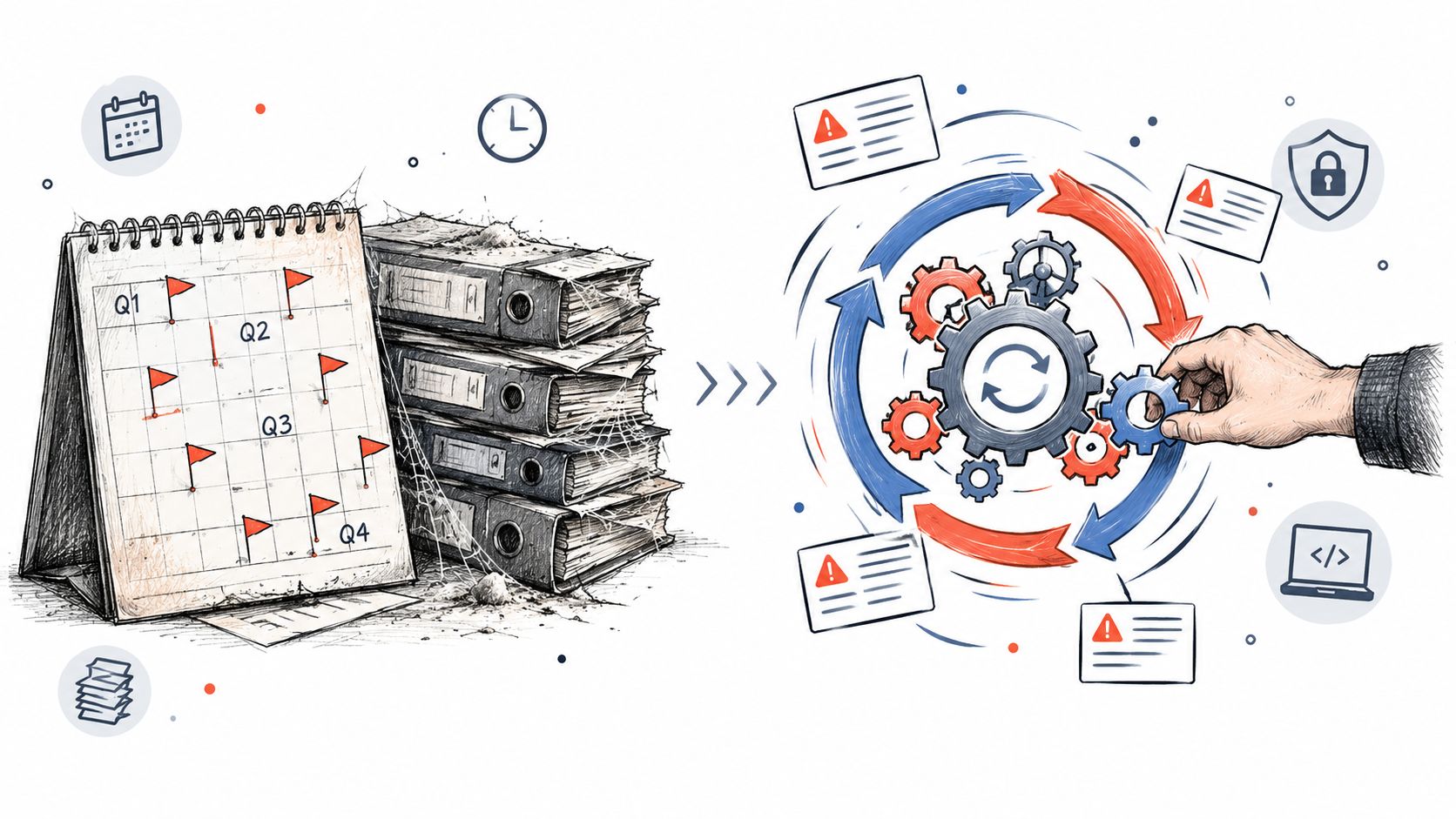
Point-in-time reviews are easy to schedule and easy to misunderstand. A team holds a design meeting, approves a threat model, completes a release review, and stores the documents. The problem begins when the ticket changes, a repository diverges, a dependency updates, or the deployment architecture shifts without reopening the original decision.
Continuous threat modeling treats the security context as a living relationship between development artifacts. It can draw from tickets, design documents, repositories, and service metadata, then surface relevant feedback in tools such as Jira, GitHub, VS Code, Cursor, and MCP. The objective isn't to replace human judgment. It's to reduce the time between a change and the security decision that governs it.
Learn how a continuous threat modeling process can preserve that context as software changes.
Two operating models
| Point-in-time review | Continuous security context |
|---|---|
| Approves a design or release at a milestone | Re-evaluates assumptions as linked artifacts change |
| Produces a document that may age separately from code | Connects requirements, decisions, pull requests, and deployments |
| Relies on meetings and manual handoffs | Surfaces feedback in planning and developer workflows |
| Finds drift after it has accumulated | Flags a mismatch closer to the change that introduced it |
| Measures completion of a review | Measures coverage, latency, evidence, and remediation outcomes |
The trade-off is operational. Continuous context requires disciplined artifact relationships, versioning, and policy ownership. It can also generate noise if every repository change triggers a full review. The answer isn't to abandon automation. It's to scope controls by affected service, design decision, data boundary, or dependency, and to escalate only when the change crosses a meaningful security assumption.
DORA reports that high-performing teams spent 50% less time remediating security issues than low-performing teams, and recommends integrating security reviews, approved libraries, and automated security requirements into design, development, testing, and release work, as documented in DORA's pervasive security guidance. The mechanism is shorter feedback latency. A design check can prevent an insecure architecture, a pull-request control can stop a policy violation before merge, and an automated test can repeatedly validate the requirement as implementation changes.
Metrics that expose drift
Track measures that distinguish prevention from detection:
- Design-review coverage: The share of applicable features with early security review.
- Feedback latency: The median time between finding creation and developer feedback.
- Policy evidence coverage: The percentage of pull requests with the required security evidence.
- Post-release remediation time: How long security issues remain open after deployment.
These metrics shouldn't become targets that teams game by closing tickets quickly. Pair them with evidence that early review coverage is improving, exceptions are explicit, and the production system still matches the approved model.
Governance for AI-Assisted and Agentic Development
AI-assisted development changes the control point. The question isn't only whether generated code contains a vulnerability. It's whether the developer or coding agent had the right security context before selecting a design, adding a dependency, handling sensitive data, or opening a pull request.
A 2025 Cloudsmith survey reported that 42% of developers said their codebases were predominantly AI-generated, while 67% said they reviewed code before deployment and 29% felt very confident detecting vulnerabilities in AI-assisted code, according to coverage of the survey's findings. The same reporting found that 17% of developers had no AI-use control policies, and only about one-third used tools to enforce AI-specific policies.
Those figures point to a governance gap before scanning begins. A scanner sees the generated output. It doesn't necessarily know whether the code violates an approved data boundary, uses a prohibited service, introduces an unreviewed dependency, or contradicts a threat-model decision.
Give agents constraints, not just feedback
Preventive controls should provide context at the point of creation:
- Approved design context: Tell the developer or agent which trust boundaries, authorization rules, and data-handling assumptions apply.
- Tool and data permissions: Limit which repositories, systems, and sensitive inputs an agent can access.
- Dependency policy: Check whether a proposed package, version, or license is acceptable before it enters the change.
- Review requirements: Require human review for security-sensitive changes, even when generated code passes automated checks.
- Merge enforcement: Block a pull request when it violates a mapped policy or lacks required evidence.
Read more about security controls for AI-assisted coding workflows.
The evidence to retain should describe more than the final scan result. It should show which approved security requirements applied, which policy checks ran, what changed in the threat model, who reviewed the change, and which deployment carried the result. Prompts and generated code may change repeatedly, so governance needs to anchor on durable decisions and artifacts rather than attempting to preserve every transient interaction.
The practical balance is important. Overly broad blocking rules push developers toward workarounds, while post-generation scanning alone catches problems too late. Effective governance gives agents enough security context to make safer choices, reserves hard blocks for clear policy violations, and keeps an auditable path from design intent to merged code.
Building Audit-Ready Security Context for Regulated Industries
Regulated teams don't need more documents for their own sake. They need reliable evidence that a security requirement was defined, a design decision was reviewed, a control was enforced, and the released software still matches the approved assumptions.
That chain matters in FinTech, HealthTech, and Media, where changes can affect sensitive data, access rights, platform integrity, and external obligations. SOC 2 and ISO 27001 activities become difficult when reviews live in meeting notes, approvals sit in email, and deployment evidence must be reconstructed from several systems.
Replace document archives with linked evidence
A useful audit record connects:
- The requirement: What security or compliance outcome applied.
- The decision: Which architecture, threat-model assumption, or exception addressed it.
- The implementation: Which repository, dependency, pull request, and policy result demonstrate execution.
- The release: Which build and deployment carried the approved change.
- The response: How later findings, incidents, or changes affected the original decision.
This structure also helps teams prepare for practical evidence requests. A resource such as this SOC 2 audit checklist for Church Extension illustrates the kind of control and evidence categories organizations commonly need to organize, even when their systems and audit scope differ.
Reconstruct context when documentation is incomplete
Formal documentation is often missing or stale, especially in fast-moving teams. Security leaders still need a defensible account of what the system does and why it was approved. Reconstructing context from source code, repositories, tickets, and deployment metadata can provide a starting record, but reconstructed evidence should be marked clearly and routed for human validation rather than treated as an original approval.
DevArmor is one platform option for this operating model. It generates continuous threat models and design-review context from development artifacts, surfaces security feedback in developer workflows, and supports Policy-as-Code enforcement on pull requests with traceable outcomes. Sector-focused governance can also produce architecture decisions and review traces suitable for audit preparation.
Teams aligning controls with the ISO 27001 framework should map evidence to the control objectives they operate, rather than copying a generic checklist. The strongest record is the one an engineer can use during delivery and an auditor can follow after release.
The central test is simple: can the organization prove, for a specific release, that the approved security assumptions still match the code and production configuration? If the answer depends on searching old meeting notes, asking several teams for screenshots, or trusting that no major change occurred, the SDLC has drifted beyond its evidence.
DevArmor helps teams maintain a living security context across requirements, threat models, repositories, pull requests, and deployments, with workflow-based policy enforcement and audit-ready evidence. Visit DevArmor to evaluate how continuous threat modeling and traceable security design reviews can reduce drift without turning every release into a manual security checkpoint.
Table of Contents
Subscribe