Reflected Cross Site Scripting Attacks: A Security Overview
 Reza Khosravi
Table of Contents

Reflected cross-site scripting is what happens when an application takes input from a user and stuffs it straight back into the response without encoding it for the right context. The victim clicks a crafted link, and their browser runs the injected script under the site's own origin, giving the attacker full access to that session.
How Reflected XSS Actually Works
Think of a parrot that repeats whatever you say to it. Someone teaches it a nasty phrase, walks it over to an unsuspecting listener, and suddenly there's a problem. The parrot isn't the attacker, it just faithfully delivered the harm. A vulnerable web server does the same thing: it echoes back whatever the attacker fed it, and the browser treats that response as legitimate code from a trusted source.
You see this pattern everywhere. A search page that drops your query into the results heading. An error page that repeats the parameter that caused the failure. A login redirect that displays whatever status message got passed in. If the application slots that value into executable HTML, an attribute, a script block, or a URL context without proper encoding, the browser has no way to tell it apart from the site's own code.
The defining characteristic is timing. Reflected XSS lives in a single request and a single response. The payload doesn't get stored anywhere.
That timing is what distinguishes reflected XSS from its cousins:
| XSS Type | Trigger Mechanism | Persistence | Main Remediation Focus |
|---|---|---|---|
| Reflected | Crafted request triggers immediate reflection | Gone after the response | Context-aware output encoding |
| Stored | Saved content gets displayed later | Lives in the application's data | Validate, sanitize, and encode |
| DOM-based | Client-side JavaScript writes input to an unsafe sink | Tied to request or browser state | Safe DOM APIs and client-side review |
The attack chain itself is disarmingly simple:
- Attacker slips a payload into a URL parameter or form field.
- Victim clicks the link or submits the form.
- The server bakes that value right into the response.
- The browser parses it and runs whatever code got injected.
The most common reflection points tend to be search and filter parameters (especially when the query shows up in a heading), error messages that echo invalid values, redirect and login flows that display return URLs or status text, and tracking parameters that somehow make it into rendered markup.
Why Framework Defaults Aren't Enough
Modern frameworks help. They ship with templating engines that escape by default, and that eliminates a whole class of trivial mistakes. But they don't eliminate the problem. Developers routinely bypass escaping with raw HTML helpers, concatenate strings by hand, or drop data into contexts the framework doesn't automatically protect.
Code reviews miss things too. Reflection points hide in shared layouts, middleware layers, and legacy endpoints that nobody's touched in years. A clean review of a single controller won't catch it when the actual injection happens in a partial template three layers down.
Here's a useful question to keep in your back pocket: Can user-controlled input reach the response, and what context does it land in? Answering that question drives both threat modeling and code review. Teams should trace the full path before assuming input filtering did the job. Proper encoding at the output context, backed by tests and review rules, is what stops the parrot from repeating executable instructions.
A reflected cross-site scripting attack works like a poisoned message passed through a trusted receptionist. The attacker prepares the payload, the victim unknowingly delivers it, and the application echoes it back without recognizing the danger. The browser then treats that response as legitimate code from a site the user trusts.
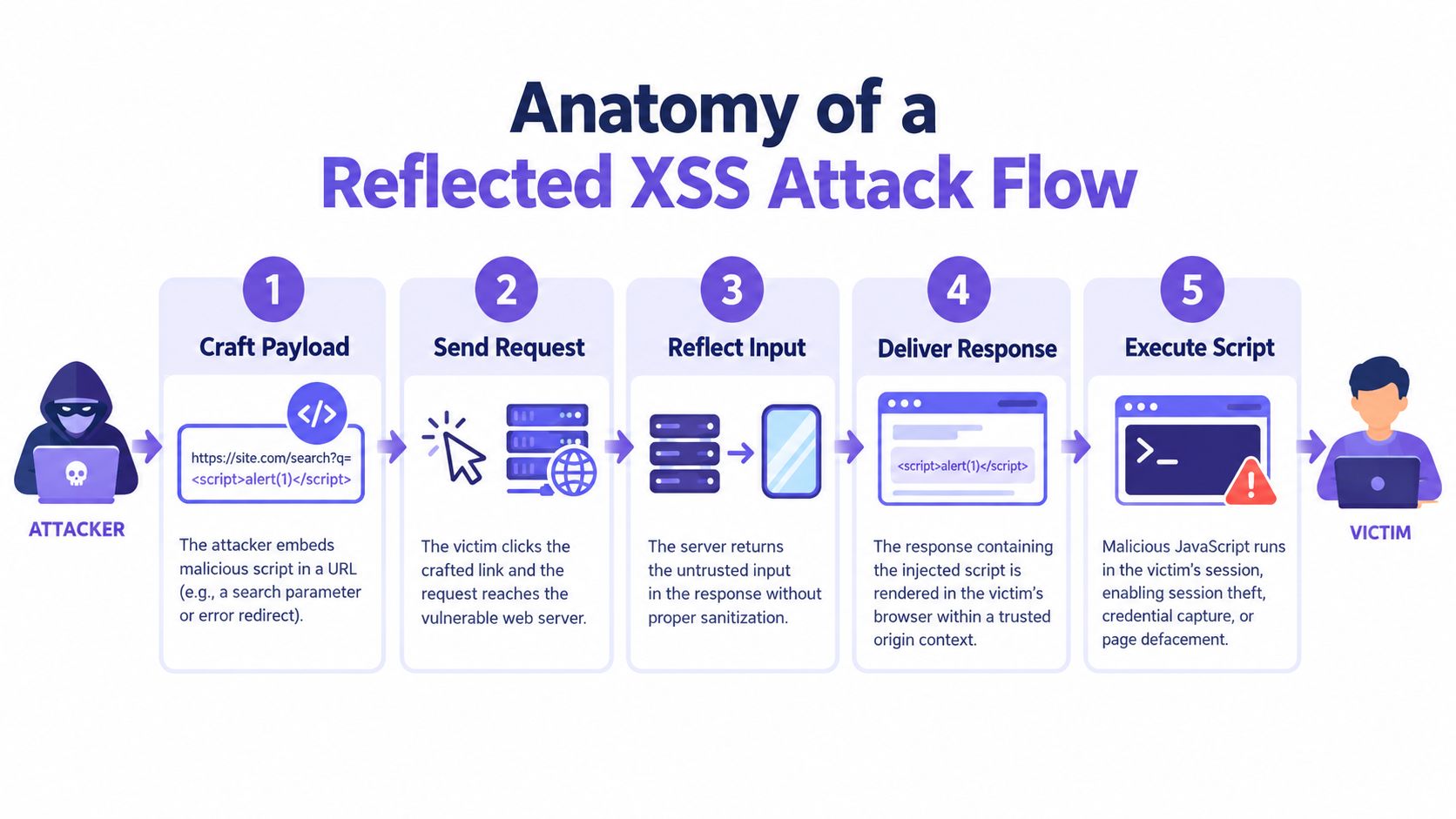
The infographic above walks through the full chain: from crafted input to server reflection to browser execution, showing exactly where a routine feature turns into an attack path.
Follow the Request
The flow typically starts when an attacker slips malicious input into a search parameter, an error redirect, a login return value, or an analytics tag. They don't need to touch the database. A carefully crafted link does the job, provided the application reflects that value straight into the next response.
- Craft the payload: The input lands wherever a product normally expects a benign search term or status message.
- Send the request: A victim clicks the link, often delivered through email, chat, or a page that looks perfectly legitimate.
- Reflect the input: The server inserts the parameter into the generated HTML without encoding it for the context where it ends up.
- Render the response: The browser receives the page from a trusted origin and parses the reflected content as though it belongs there.
- Execute the script: If that content reaches an executable location, the browser runs it inside the victim's session.
The core problem isn't that a parameter exists. It's that untrusted data crosses into an executable browser context without proper output encoding — and the server never saw anything wrong.
Think about it concretely. A search page displays "Results for" followed by whatever query you typed. An error page repeats an invalid account name. A login flow echoes a return URL. Each of these features feels completely harmless during day-to-day use. But each one becomes a reflection point the moment a developer concatenates strings or reaches for a raw HTML helper.
Spot the Weak Context
Input sanitization often breeds a false sense of safety, because security actually depends on where the value lands. Encoding that works for visible HTML text falls apart inside an attribute, a JavaScript string, a stylesheet, or a URL. A filter might strip one familiar attack pattern while missing an alternate representation the browser still interprets just fine.
During design review, trace the value from request handling all the way to final rendering:
- Search and filter views frequently mirror query terms in headings, empty-state messages, and pagination links.
- Login redirects may reflect destination or error parameters across multiple authentication screens.
- Analytics integrations introduce risk when tracking values get copied into markup or inline scripts.
- Error handlers often echo back malformed input because someone prioritized diagnostic detail over safe rendering.
For a broader look at how XSS shows up in real application features, check out these real-world XSS attack examples.
Connect Features to Controls
The practical question for engineering teams comes down to this: Can user-controlled data reach the response, and what browser context receives it? If you can't answer with confidence, treat the path as high risk until you've verified it.
A sound implementation keeps data and markup separate, applies context-aware encoding at the point of output, avoids inline script construction, and tests every reflection point. CI checks can then catch raw rendering helpers, unsafe string concatenation, and missing regression tests before a feature ever merges. That approach transforms the five-stage attack chain into five review checkpoints — and makes reflected cross-site scripting far easier to prevent than to investigate after release.
Reflected XSS sticks around because the underlying mistake is surprisingly easy to reintroduce. A team can understand the vulnerability, use a modern framework, and still ship a new search filter, redirect message, or error handler that quietly returns untrusted input as HTML.
Think of it less as a forgotten rule and more as a loose thread in a large garment. One shared template, legacy endpoint, or raw-rendering shortcut can reopen the same weakness across dozens of screens.
Awareness Has Not Removed the Risk
Framework defaults handle most routine cases, but they can't judge every output context or business decision. A developer might disable automatic escaping to preserve formatting, concatenate a value inside an attribute, or pass request data through a helper that treats it as pre-approved markup.
So reflected XSS evolves rather than disappears. Interactive applications now contain more redirects, client integrations, server-rendered fragments, and error states, each creating another path where input travels from a request into a response.
A secure framework is a safety rail, not a completed security review. The application still decides where data goes and whether that context is executable.
Point-in-time testing adds another gap. A scanner might flag a vulnerable endpoint after release, while a manual review examines only the changed controller and misses reflection in a shared view. Meanwhile, the finding joins a backlog and the original design assumptions become harder to reconstruct.
Treat Reflection as a Process Signal
For fintech and healthtech teams especially, this pattern deserves process-level attention. An application that reflects user input can reintroduce the defect whenever a feature, dependency, template, or authentication flow changes.
Common organizational causes include:
- Review boundaries: Security checks focus on individual files instead of tracing data from request to rendered response.
- Scanner backlogs: Findings arrive without ownership, context, or a clear merge-blocking policy.
- Design drift: Approved threat models describe one response path, while implementation later adds another.
- Context confusion: Teams validate input broadly but fail to encode it for HTML, attributes, JavaScript, or URLs.
This isn't about blaming developers. Under delivery pressure, trusting a helper, existing pattern, or passing test is a reasonable call. The missing safeguard is usually shared context and continuous verification, not effort or awareness.
Build Continuous Control
A stronger approach records which features accept user-controlled values, where those values appear, and which encoding rule applies. Pull-request checks can then flag raw rendering or missing regression tests, while security design reviews confirm that new response paths match the approved decision.
DevArmor supports this model by connecting threat models, design reviews, repository changes, and policy-as-code enforcement inside delivery workflows. That creates a living checkpoint against regression instead of relying on a yearly review or an ever-growing scanner queue.
The practical goal is straightforward: make every reflection point visible, assign an approved control, and verify it whenever code changes. When prevention follows the application continuously, reflected XSS becomes a managed process risk rather than a recurring surprise.
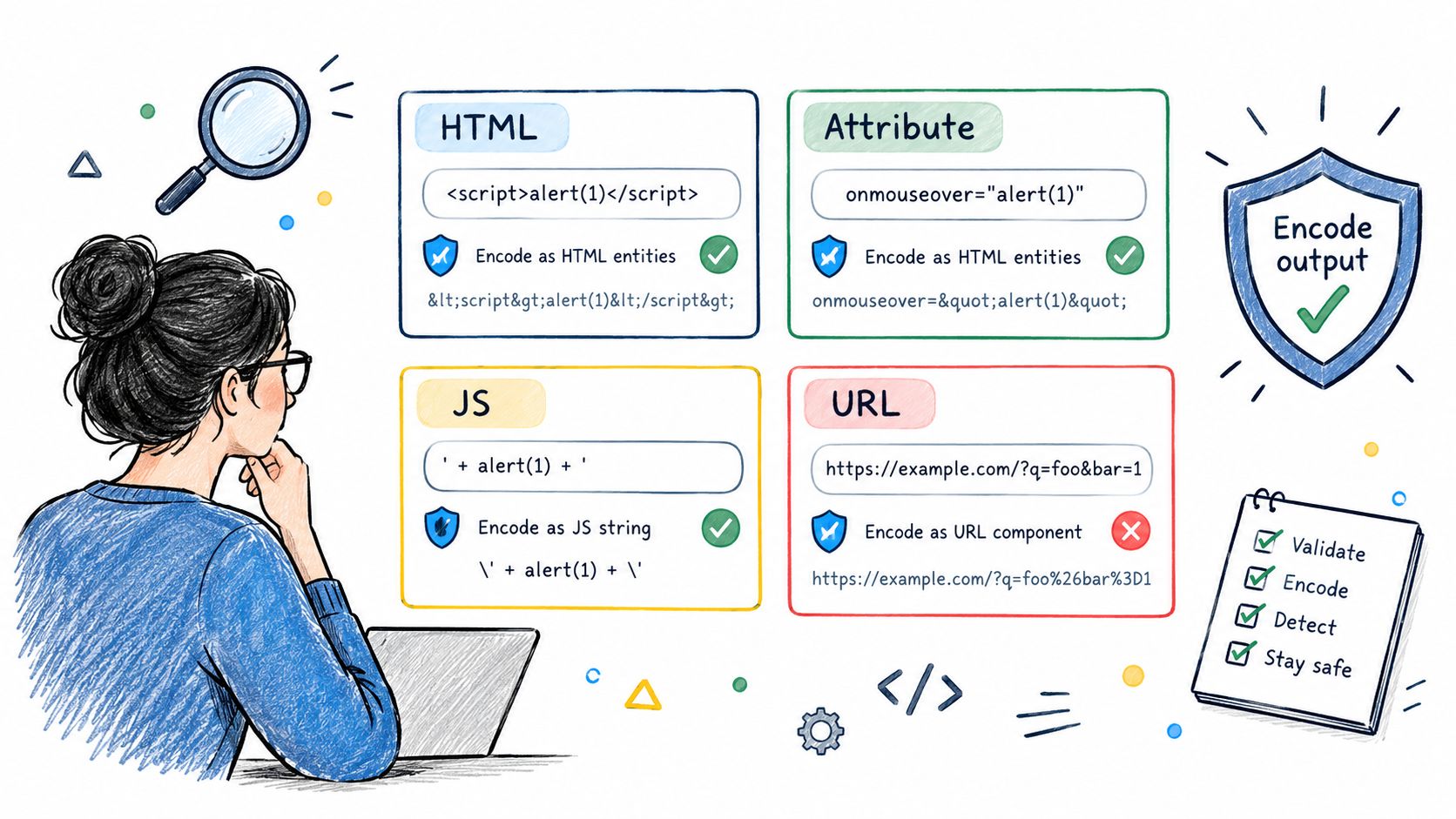
Reliable prevention starts by asking where untrusted data lands, not merely whether it looks suspicious. Reflected cross site scripting can appear in HTML text, an attribute, JavaScript, or a URL, and each context needs a different defense.
Encode for the Output Context
Treat user input like wet paint. It may be harmless on one surface, yet damaging when brushed onto another. Generic sanitization often creates false confidence because removing familiar tags does not make a value safe inside a script block or event attribute.
Use framework output encoding by default, and avoid raw rendering helpers unless the value is proven safe:
response.getWriter().print(
HtmlUtils.htmlEscape(searchTerm)
);
For URL components, encode the component before constructing the URL, rather than encoding the finished address. Learn more about Java URL encoding patterns to keep URL data separate from markup.
Apply these rules consistently:
- HTML text: escape markup characters before insertion.
- Attributes: escape quotes and delimiters, then prefer fixed attribute names.
- JavaScript: keep data outside inline scripts and pass it through safe JSON serialization.
- URLs: allow only expected schemes and encode individual parameter values.
Output encoding is the primary defense because the browser interprets meaning from context.
Test Every Reflection Point
Automated scanning helps, but it should confirm a review rather than replace one. For each request value, trace source, transformation, template, response context, and browser behavior.
A practical regression test submits a harmless marker containing characters such as quotes, angle brackets, and ampersands, then asserts that the response contains encoded text, not executable markup. Repeat the test for search results, redirect messages, validation errors, and tracking parameters.
A useful checklist asks:
- Can a request parameter reach the response?
- Is automatic escaping disabled anywhere?
- Does a shared partial render the value differently?
- Are URL schemes restricted before rendering?
- Does the test cover every output context?
File handling deserves equal care. A recent advisory showed why extension-only allowlists can miss script-bearing content, reinforcing the need for content validation and sanitization in upload flows. SecureOps practices also support detection and response capabilities needed for XSS vulnerabilities, as illustrated by scaling secure operations in media.
Block Regressions in CI
Make secure patterns enforceable. A pull-request rule can flag raw HTML helpers, string concatenation in templates, inline script construction, and newly added reflection points. Pair those rules with mandatory tests, then require security approval when a developer intentionally bypasses encoding.
DevArmor connects these checks to living threat models and approved design decisions, so policy can block unsafe merges instead of producing another ignored alert. The strongest guardrail is simple: every reflection path must name its context, encoding method, and regression test before release.
Preventing reflected cross-site scripting at scale takes more than a secure template or a passing scanner. Teams need a living connection between product decisions, code changes, and enforcement rules, so a new search field or redirect can't quietly reopen an old reflection path.
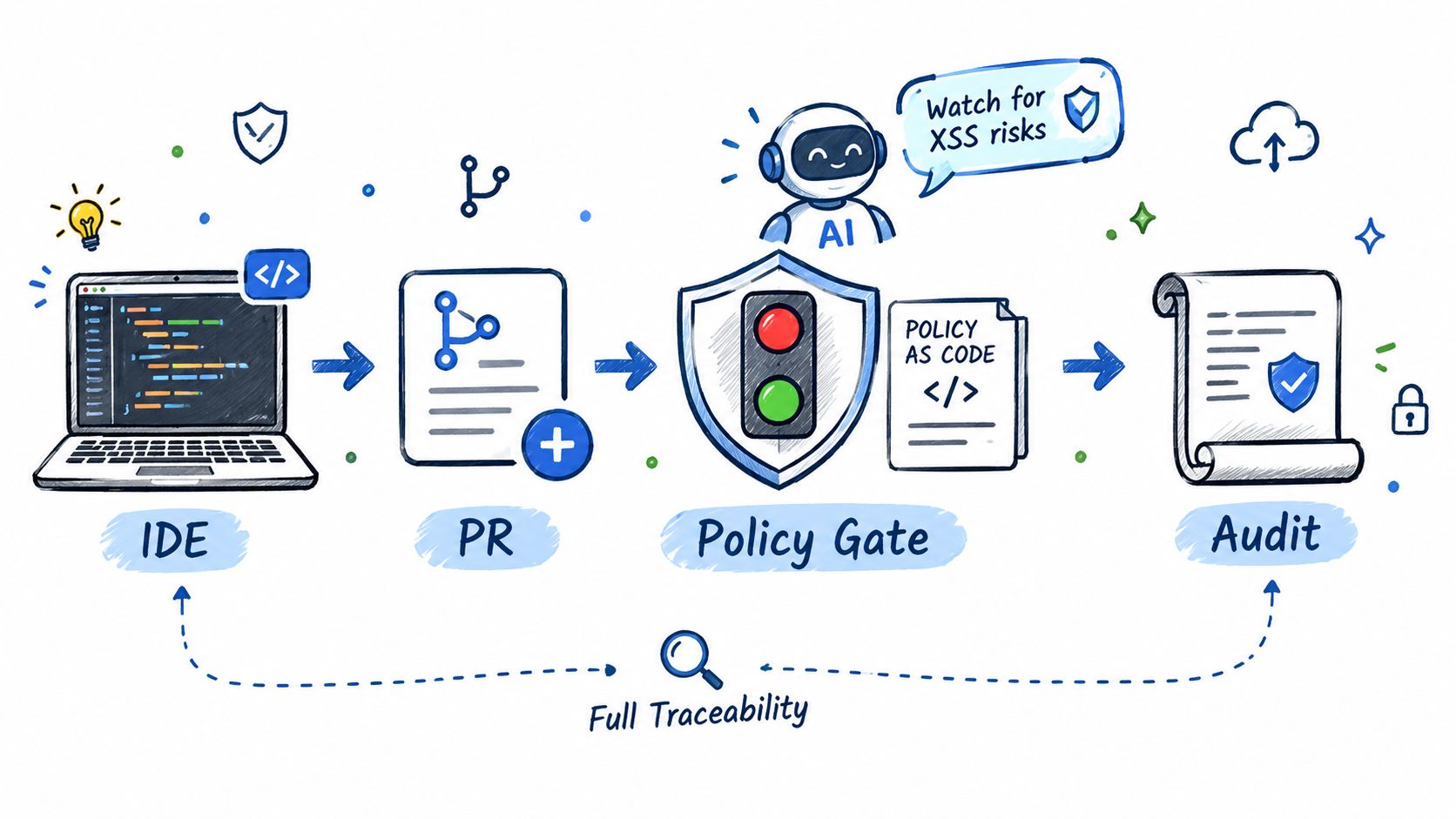
Turn Threat Models Into Delivery Context
A useful threat model works like a map that updates when the roads change. It records which request values are untrusted, where they get rendered, which browser context receives them, and what control protects each path.
That context can be generated from tickets, design documents, repositories, and service metadata. When a pull request adds a filter parameter or changes an error view, the relevant security decision shows up right beside the implementation instead of sitting buried in some old review document.
A control is easier to maintain when it travels with the feature it protects.
For engineering teams, each reflected input should have an explicit record:
- Source: query parameter, form field, redirect value, or header.
- Context: HTML text, attribute, JavaScript, or URL.
- Required control: context-aware encoding, safe serialization, or strict validation.
- Evidence: regression test, reviewer decision, and deployment trace.
This structure also cuts down on alert fatigue. Instead of asking engineers to chase every generic scanner result, CI can focus attention on changes that violate an approved design decision or introduce an untested reflection point.
Enforce Policies on Pull Requests
Policy-as-code turns secure development guidance into a repeatable merge decision. Rules can flag raw rendering helpers, template string concatenation, inline script construction, and new request values that reach responses without a matching test.
A practical rule set might require:
- Every reflected parameter must identify its output context.
- Automatic escaping can't be disabled without security approval.
- Tests must assert encoded output for quotes, angle brackets, and ampersands.
- Redirect destinations must use an approved scheme and allowlist.
- Exceptions must reference a documented design decision and expiration date.
The result is traceable enforcement that holds up under scrutiny. Review records show which policy ran, what changed, who approved an exception, and whether the control passed.
Read also: how CI/CD pipeline security can reinforce code review controls.
Secure AI-Assisted Coding
AI coding tools can repeat unsafe patterns fast, especially when the prompting context leaves out the application's encoding requirements. Guardrails should give the agent approved output rules and block merges when generated code uses prohibited sinks or bypasses escaping.
Inside the IDE, developers can see the relevant threat model before committing code. In CI, the same policy verifies that the implementation matches the approved decision, stopping an apparently harmless generated change from reintroducing reflected cross-site scripting.
DevArmor connects design reviews, repository changes, developer tools, and pull-request enforcement into one security context. Teams can make controls visible early, preserve audit-friendly evidence, and stop regressions before release. Book a DevArmor walkthrough to see how continuous threat modeling and policy checks can protect your delivery workflow.
Counting reflected XSS findings only tells you so much. A team might report fewer open issues because scanning frequency dropped, not because the underlying problem went away. The real question is whether your controls actually work across the full delivery lifecycle, from initial design through production verification.
Start with leading indicators that surface prevention efforts before an incident lands:
- Design review coverage: What percentage of features handling request data gets reviewed for output context and encoding?
- Policy pass rate: What percentage of pull requests clear reflected XSS rules without someone stepping in manually?
- Regression coverage: What percentage of known reflection points have automated tests guarding them?
- Remediation time: What is the median window between a confirmed finding and a verified fix?
- Exception age: How many encoding or validation exceptions have outlived their expiration date?
The strongest security metric is a shrinking attack surface, backed by evidence, not a fatter compliance spreadsheet.
Connect Metrics to Risk
Pair those leading indicators with outcome measures. Track confirmed reflected XSS findings by application, severity, exposed feature, and whether they've shown up before. A repeat finding in the same template points to a process breakdown. A first-time issue in a newly shipped flow might mean you need a design control, not another scanner.
Review trends monthly against your own historical baseline. External prevalence data can add useful context, but it shouldn't become the target. A lower internal recurrence rate, faster verified fixes, and broader review coverage matter more than claiming you beat an industry average.
For regulated teams, tie each control to the business outcome it serves:
- FinTech: Protect authenticated transactions and the customer trust sitting behind them.
- HealthTech: Reduce risk around portals handling sensitive patient workflows.
- Media: Protect large audiences and high-volume publishing paths.
Build Audit-Ready Evidence
SOC 2 and ISO 27001 prep gets dramatically easier when evidence is a byproduct of normal delivery, not a quarterly scramble. For each material change, preserve the approved design decision, the threat model update, the pull-request policy result, test output, exception approval, and deployment reference.
Automatically generated architecture diagrams and review traces can answer common auditor questions without reconstructing decisions from scattered Slack threads and email chains. DevArmor connects planning artifacts, repositories, developer workflows, and Policy-as-Code outcomes into a single record of what changed, which control applied, and who approved it.
Run a quarterly review to check whether documentation still matches reality. Sample completed changes, confirm that reflection points and controls align with what production is actually doing, and close out stale exceptions.
DevArmor helps teams measure prevention, maintain living security context, and produce audit-ready evidence without the overhead. Explore DevArmor and connect reflected XSS controls to every delivery decision.
Table of Contents
Subscribe