CI/CD Pipeline Security: A Practical Guide
 Reza Khosravi
Table of Contents
77% of organizations experienced at least one software supply chain incident in the previous 12 months, yet only 40% rated malicious-package detection as in place and just 28% had secrets detection active, according to Docker's 2026 software supply chain security research. That gap highlights the core CI/CD security issue. The absence of scanners is not the main problem. The challenge is providing reliable proof that workflow logic, permissions, dependencies, and automated agents still enforce the security decisions the organization intended to make.
A secure pipeline is more than a sequence of checks. It is a privileged execution system that can read source code, obtain credentials, build artifacts, assume cloud identities, and promote software into production. If an attacker changes the workflow itself, abuses a reusable action, injects untrusted text into an AI review, or exploits a mutable dependency, the pipeline can become the attack path while every familiar security tool continues to report a reassuring green status.
Why CI/CD Pipeline Security Matters Now
10.6% of 4,875 analyzed incidents were attributed to traditional software supply-chain attacks in a 2024-2025 research corpus. A separate 2024 industry study found that 63% of participating organizations had experienced a software supply-chain attack during the previous two years, while 100% of large enterprises in the sample had been affected at some point, according to Stingrai's supply-chain attack statistics.
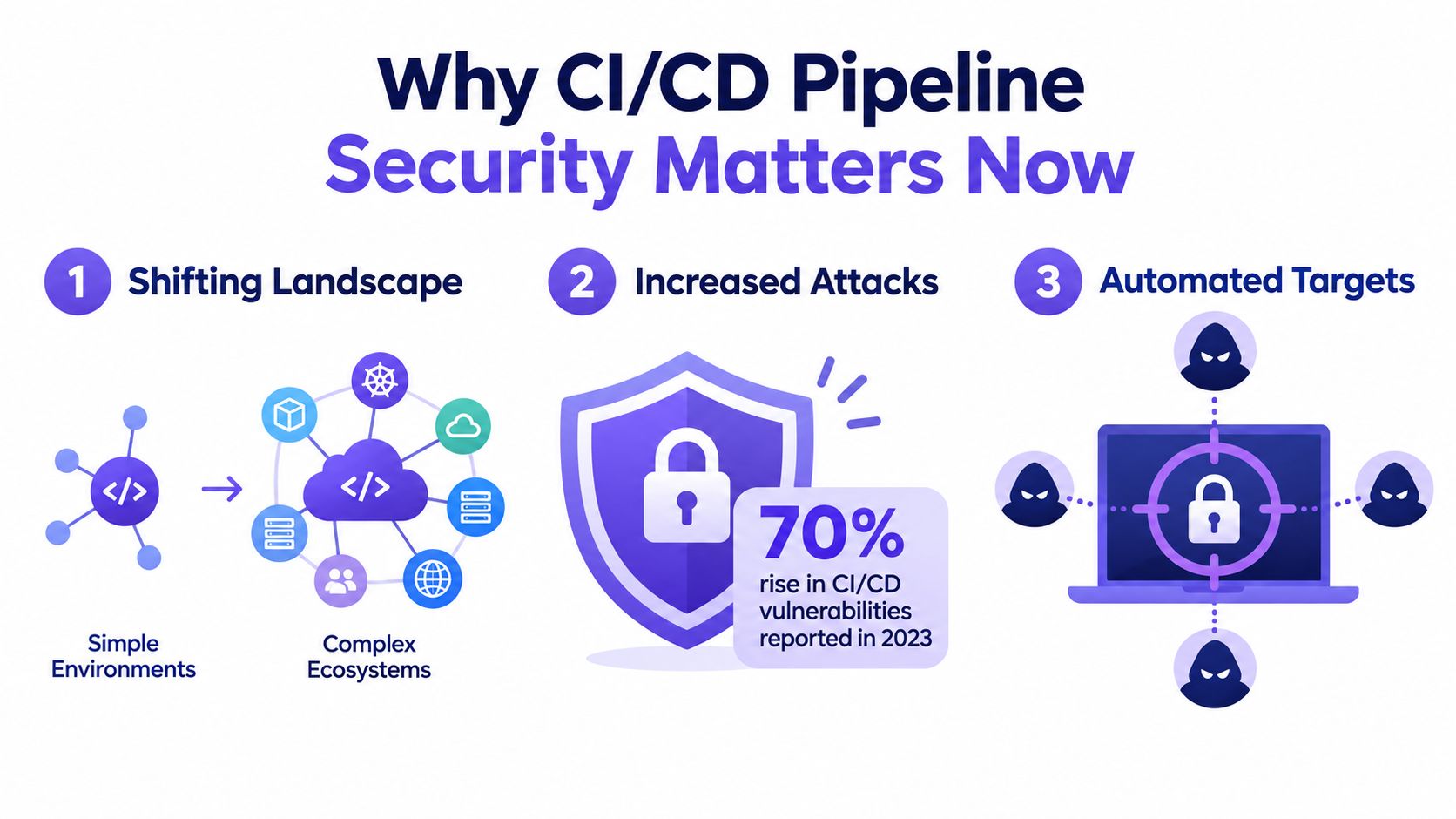
Modern delivery systems connect source control, package registries, cloud identities, containers, infrastructure-as-code, reusable workflows, hosted runners, and AI-assisted automation. Each integration can turn a minor configuration change into privileged execution. The threat is therefore not limited to vulnerable dependencies. Workflow conditions, action references, permissions, generated instructions, and approval logic can all change what reaches production.
Evidence from 324,672 open-source repositories shows how persistent this exposure is. 83,635 repositories, or 25.76%, passed at least one credential into CI/CD pipelines. The study also found that 83.56% of script usage referenced outdated versions, 97.86% of repositories used at least one old version, and 146 repositories still used versions with known vulnerabilities, according to the repository analysis published on arXiv. These results describe recurring control failures, not isolated mistakes by inexperienced developers.
The pipeline is a security boundary
Perimeter controls cannot compensate for an altered build process. An attacker who influences a workflow may change an artifact, extract a deployment credential, poison a cache, or modify the validation step intended to block the release. The pipeline can become the attack path while ordinary scanners still report a clean result.
Workflow integrity must therefore receive the same scrutiny as source integrity. Version and review workflow files, pin third-party actions to immutable references, restrict trigger permissions, separate trusted from untrusted execution, and assign owners to reusable automation. Good version control in CI/CD supports that foundation, yet repository history cannot prove that the active workflow still matches the approved design.
Practical rule: Treat workflow changes as privileged code changes. Review permissions, identities, inputs, actions, and deployment effects, not only the commands being executed.
The harder question is whether the organization can continuously prove that workflow logic has not become the attack vector as dependencies and AI-assisted tools evolve. Security tooling matters only when its findings change that execution path.
The Gap Between Scanning and Enforcing
A scanner can report a dangerous configuration while the pull request still merges. That happens when security controls run in report-only mode and findings enter a backlog without a named owner, deadline, or release consequence.
The pipeline then looks protected while remaining permissive. A secrets scanner may identify a credential only after it reaches a commit. A dependency tool may flag a vulnerable package after the release is built. A workflow analyzer may detect excessive permissions while the change continues toward production. Detection creates visibility. Enforcement changes the decision.
The operational gap is visible in the difference between incident experience and control coverage. Docker found that 77% of organizations had experienced a software supply chain incident in the previous 12 months, while 40% had malicious-package detection and 28% had secrets detection active, as reported in its software supply chain security report. A separate 2026 review describes a common failure mode: pipelines contain scanners that report findings but do not stop insecure code from shipping. It also reports that 80% of repository workflows have insecure default permissions, according to Astra's CI/CD security tools coverage.
What enforcement actually means
Blocking every finding creates bypass pressure, emergency overrides, and a security team that developers learn to route around. Effective enforcement connects each finding to a defined decision:
- Block automatically: Exposed credentials, untrusted workflow execution with privileged access, unsigned release artifacts, and violations of explicit production policies.
- Require an owner: Findings that need product or architecture context, such as a new external service or a changed trust boundary.
- Record and monitor: Lower-risk issues that do not justify delivery friction yet, provided an owner and review date are assigned.
The merge decision must be deterministic. Developers need to know which policy failed, what evidence triggered it, who may approve an exception, when that exception expires, and where the outcome is recorded.
A green dashboard is not evidence of security if the delivery workflow can ignore every red finding.
Measure control behavior, not scanner count. Submit a test pull request containing a forbidden change and confirm that the policy blocks it. Trace an approved exception to its decision and expiry. Verify which workflow version built an artifact and which identity promoted it. These tests show whether the workflow logic itself remains an enforced security boundary as dependencies and AI-assisted tools change.
Protecting Secrets and Credentials in the Pipeline
Credential exposure follows repeatable paths. A developer commits a cloud token, a diagnostic command prints an environment variable, an untrusted pull request receives secrets, or a service account keeps broad access because narrowing it requires coordination across teams.
Replace long-lived credentials with OIDC-based identity wherever the cloud provider and CI/CD platform support it. A job can request a short-lived identity tied to repository, branch, workflow, or environment claims. Grant only the permissions required for that job. Keep production credentials unavailable to untrusted pull request execution.
Build a blocking secret control
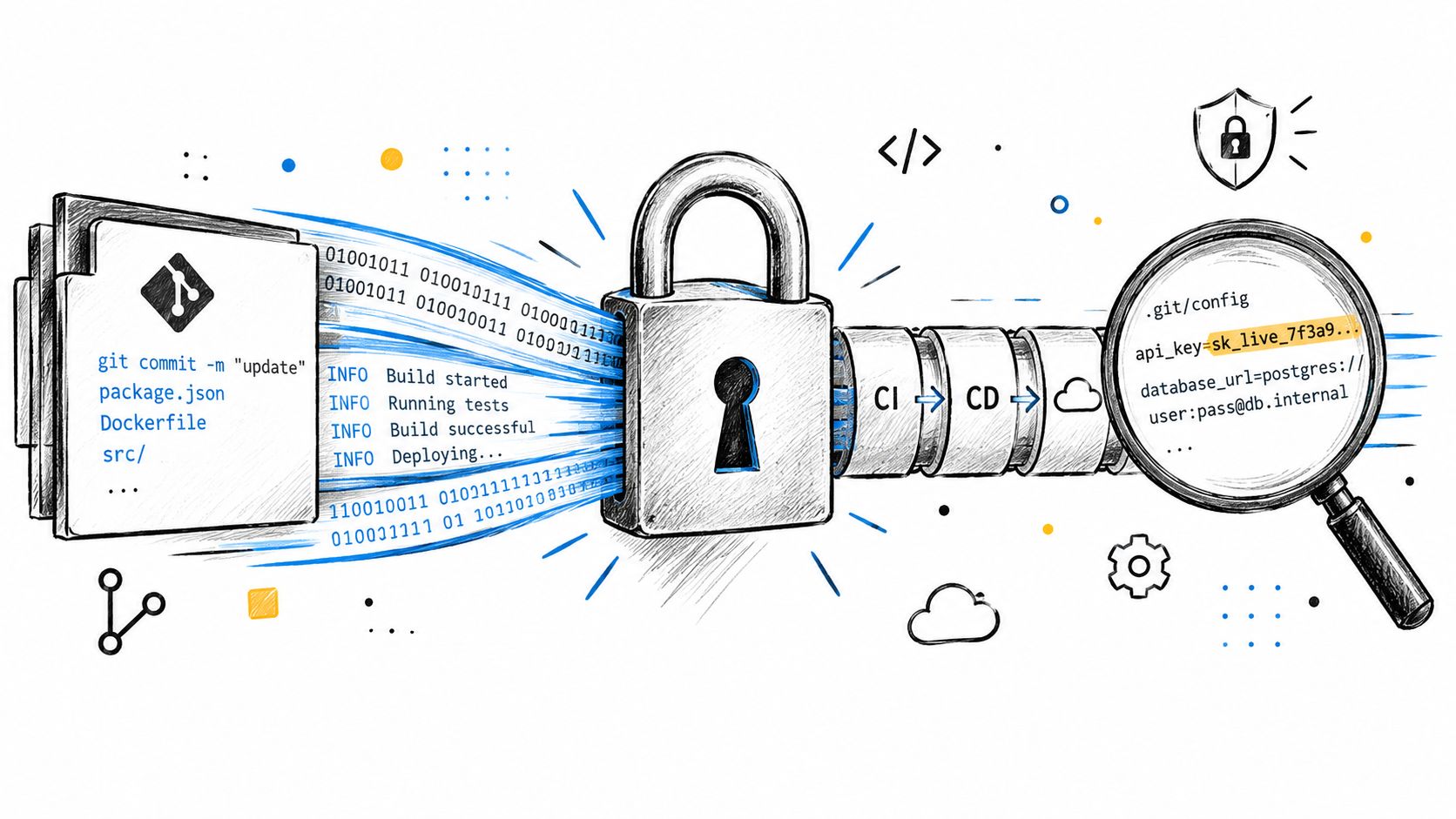
Secret detection needs several enforcement points. Run it before accepting a commit, during pull request evaluation, against workflow changes, and across logs and generated artifacts where practical. The control should identify the exposed value, revoke or rotate it, block the merge, and retain enough evidence for incident review without storing the secret itself.
Inject credentials by environment instead of placing them in repository configuration. Separate build, test, staging, and production identities, then make deployment approval depend on the target environment. Log masking limits accidental disclosure, but it cannot stop an overpermissioned token or a malicious step that uses a credential without printing it.
The repository study cited earlier found that 25.76% of the analyzed repositories passed at least one credential into CI/CD pipelines, according to the 2024 repository study cited above. Credential flow therefore belongs in workflow design and policy review, not only in post-incident cleanup.
Control dependency drift at the same time
Pipeline inputs age as well. The same study reported that 83.56% of script usage referenced outdated versions, 97.86% of repositories used at least one old version, and 146 repositories used versions with known vulnerabilities, as shown in the same repository findings.
Pin actions, scripts, and dependencies to reviewed immutable references where possible. Generate an SBOM at build time, verify package provenance before promotion, and review lockfile and base-image changes as supply-chain changes. A dependency update should trigger vulnerability analysis and workflow impact analysis. A package can alter build behavior even when its published vulnerability status appears clean.
A practical minimum control set is:
- Identity: Prefer short-lived federated identities and scope them to the job and environment.
- Detection: Scan commits, pull requests, workflow definitions, logs, artifacts, dependencies, and images.
- Response: Revoke exposed credentials automatically or through a documented rapid-response path.
- Traceability: Record which workflow, commit, identity, and policy decision produced each release artifact.
These controls test whether credentials and dependencies remain governed by workflow logic, rather than merely appearing in a scanner's coverage report.
Integrating Threat Modeling with Policy-as-Code
Policy-as-Code works best when it expresses an approved security decision, not an arbitrary collection of scanner rules. A rule that says “block this file pattern” may catch a symptom, but it doesn't tell the team which trust boundary changed, which identity is affected, or whether an exception is acceptable.
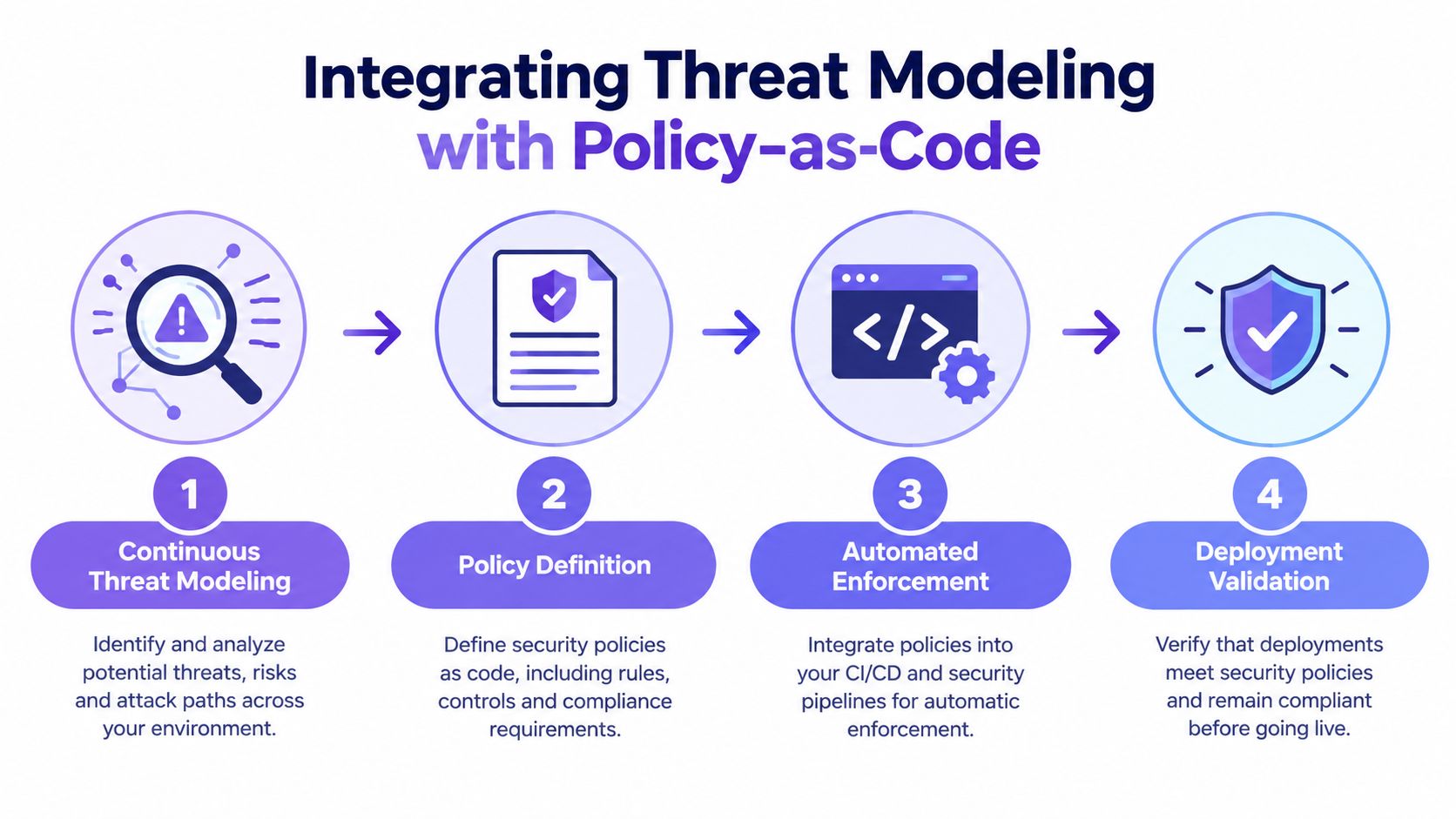
A living threat model provides that missing context. It should identify assets, actors, entry points, privileged actions, data flows, and assumptions about the pipeline. When a repository adds a deployment target, a workflow starts consuming pull request text, or an AI agent receives write access, the model should record the change and produce a reviewable requirement.
Turn design decisions into pull request controls
The useful chain looks like this:
- Threat model: The workflow processes untrusted pull request input and can access deployment credentials.
- Security decision: Untrusted input must never execute in a privileged job.
- Policy: Privileged workflows can't run on untrusted fork content, and user-controlled fields can't flow into shell execution.
- Pull request result: The check identifies the changed workflow path, explains the violated decision, and blocks the merge unless an authorized owner approves an exception.
- Deployment validation: The release retains the policy result and the identity that approved the change.
This structure prevents a common failure mode, where a security document says one thing and a workflow does another. It also gives developers a useful answer to “why is this blocked?” The control points to an architectural requirement rather than presenting an unexplained tool verdict.
Keep the model current
Static threat models become unreliable when tickets, repositories, and infrastructure change independently. Connect review context to the artifacts that move. A design review in Jira or GitHub should be associated with the affected repository and workflow, while developer feedback should appear in the tools where the change is being made.
For teams evaluating this approach, DevArmor's explanation of Policy-as-Code describes a model in which security decisions become enforceable controls across the delivery workflow. The important design principle is broader than any individual product: every blocking policy should have an owner, a rationale, a scope, and an auditable outcome.
A policy engine should also distinguish changed behavior from unchanged background risk. If a pull request only updates application copy, it shouldn't trigger the same review as a change to a reusable deployment workflow. If a workflow gains access to a new cloud account, the control should raise the risk level and require the corresponding design decision.
Threat modeling becomes operational when the pull request can prove that implementation matches intent. Without that connection, the organization has documentation and automation, but no dependable way to verify that the two still agree.
Balancing Enforcement with Development Velocity
Blocking merges creates friction. That friction is justified when a change can expose a production credential or grant untrusted code privileged execution, but it becomes counterproductive when teams receive vague findings, false positives, or policies nobody has reviewed.
Report-only mode is useful during rollout. It reveals the repository's current state, helps teams tune rules, and exposes ownership gaps without immediately disrupting releases. It isn't a security control by itself. Once a policy has a clear rationale and an agreed remediation path, leaving it permanently informational turns a known risk into an accepted default.
Choose controls by consequence
A practical rollout separates high-confidence, high-impact violations from findings that require judgment.
| Control type | Default action | Reason |
|---|---|---|
| Exposed credential | Block and rotate | The secret may already be usable |
| Privileged workflow with untrusted input | Block pending review | The workflow can convert input into execution |
| Unsigned or unverifiable release artifact | Block promotion | Consumers can't establish provenance |
| New external integration | Require design approval | The trust boundary has changed |
| Low-confidence dependency warning | Report with ownership | Immediate blocking may create noise |
The exact policy depends on the product and regulatory context, but the decision logic should remain explicit. In regulated teams, an exception isn't a deleted finding. It should name the approver, justification, affected scope, compensating control, and expiration condition.
A useful enforcement path starts with changed files and high-risk workflow capabilities. Block newly introduced violations first, then reduce existing debt through a separate remediation program. This avoids making every legacy issue a release emergency while ensuring that the baseline doesn't get worse.
Make the secure path the easy path
Developers bypass security when the approved route is slow or ambiguous. Provide reusable workflow templates, safe action references, documented identity patterns, and clear error messages. Give product teams a local or pull request preview of the policy result so they can fix issues before waiting for a release attempt.
The most important question is whether the control stops the change at the right point. If the scanner reports after artifact publication, it may be too late. If the rule blocks an innocuous change because it can't understand context, teams will seek exemptions. Velocity comes from predictable controls, not from removing controls.
Securing AI-Native and Agentic Workflows
AI-assisted development changes the threat model because the workflow may now interpret untrusted text, retrieve repository content, call tools, and propose or execute changes. The risk isn't limited to generated code quality. A prompt injection in an issue, pull request comment, test fixture, or documentation file can influence an agent that has access to secrets or write permissions.
Consider a code-review agent connected to a pull request. It reads the diff, summarizes findings, and can open a remediation branch. If the agent receives untrusted instructions from the repository and can also call a deployment tool, the workflow has combined interpretation with privilege. A conventional dependency scanner may report a clean result while the agent itself becomes the attack path.
Constrain the agent, not just its output
Start by defining what the agent can read, write, execute, and approve. Separate analysis from mutation. Give the review agent a read-only token, run it in an isolated environment, and require a human or policy-controlled workflow for changes that affect deployment, permissions, secrets, or infrastructure.
In Cursor, VS Code, or an MCP-connected workflow, the secure context should travel with the task. The agent needs the applicable architecture decision, prohibited data flows, approved dependencies, and required review conditions. It shouldn't have to infer these rules from scattered documents or rely on a prompt that developers may accidentally omit.
The SpecStory agent governance overview offers useful background for thinking about agent permissions, activity, and oversight. The operational test is straightforward: can you reconstruct what instructions the agent received, what tools it called, what files it changed, and which policy allowed the result to merge?
Verify workflow logic continuously
AI workflows need the same controls as other privileged automation, with extra attention to instruction boundaries:
- Untrusted input: Treat issue text, comments, pull request content, and generated documents as data, not authoritative instructions.
- Tool access: Allow only the tools required for the current task, and separate read, write, and deploy capabilities.
- Secret access: Keep secrets out of agent context unless a narrowly defined operation requires them.
- Change control: Require policy evaluation for generated workflow, infrastructure, dependency, and permission changes.
- Provenance: Record the model or agent action, source revision, tool calls, and final human or automated approval.
DevArmor's guidance on AI coding security describes the role of secure guardrails and policy context inside AI-assisted coding workflows. The broader lesson is that generated code doesn't deserve a weaker path to production. If anything, agentic changes need stronger evidence because the decision process includes dynamic interpretation that can change as prompts, tools, and repository content change.
Verifying Pipeline Security Effectiveness
A pipeline security program is incomplete until the team tests whether its controls work under realistic change. Documentation can say that secrets are blocked, permissions are restricted, and artifacts are signed. Verification asks whether a pull request can still bypass those controls.
Start with the workflow graph, not the security dashboard. Reconstruct triggers, reusable workflows, action references, inputs, secrets, identities, runners, artifact movement, deployment environments, and approval points from the repository and platform configuration. This is especially important when formal architecture documentation is missing or no longer trusted.
Run a focused verification cycle
Use a repeatable review that covers both prevention and evidence:
- Test trigger boundaries. Submit controlled changes through fork, branch, comment, issue, and dispatch paths. Confirm that untrusted inputs can't reach privileged jobs.
- Test permission changes. Remove or expand workflow permissions in a test branch and confirm that the policy detects the change and applies the intended merge decision.
- Test dependency integrity. Attempt controlled dependency confusion and typosquatting scenarios in an isolated environment. Verify registry precedence, lockfile behavior, provenance checks, and promotion gates.
- Test credential handling. Place test markers in commits, logs, artifacts, and pull request content. Confirm detection, blocking, rotation, and evidence retention.
- Test runner isolation. Validate that jobs can't read state from earlier workloads or reach systems outside their approved network and identity scope.
- Test artifact traceability. Starting with a release artifact, identify the source revision, workflow version, builder identity, SBOM, signatures, approvals, and policy results.
Preserve proof for review
Auditors and incident responders need more than a screenshot of a passing job. Retain immutable or access-controlled records of policy evaluations, approvals, exceptions, artifact provenance, and workflow revisions. Make the evidence understandable to someone who didn't configure the pipeline.
Implementation verification should connect the approved design to the actual code and deployment behavior. DevArmor's implementation verification workflow is one example of a product approach that reconstructs and checks this relationship across delivery artifacts.
Finally, repeat the tests when reusable workflows, dependencies, runners, cloud identities, or AI agents change. CI/CD pipeline security is effective only when the organization can demonstrate that a control still blocks the threat it was designed to stop.
DevArmor helps teams maintain a living security context across design reviews, repositories, IDEs, pull requests, and deployments, then express approved decisions as Policy-as-Code with optional merge blocking. Visit DevArmor to evaluate how continuous threat modeling and implementation verification can make workflow security enforceable and audit-ready.
Table of Contents
Subscribe