
Open Source Policies Teams Can Actually Enforce
 Reza Khosravi
Table of Contents
Most open source policies fail in practice. They're approved, filed, and linked from a wiki page nobody opens during a pull request. Months later, an auditor, a customer, or a vulnerability disclosure asks a harder question than whether a policy exists. They ask which rule applied to the exact dependency, model output, and commit that shipped, and who approved it at that moment. If your team can't answer from the artifact itself, you don't have a control. You have a document describing a control you intended to build.
Why a Policy PDF Is Not a Control
The 2025 Open-Source-Monitor reports that 62% of companies lack an OSS policy and only 36% have a documented one. The more damning number sits underneath it. Even among organizations with controls, just 52% have a compliance process for employees.
That gap is exactly what engineering leads feel. A license checklist signed in March doesn't describe the lockfile shipping in June. Repositories gain contributors, tickets change scope, transitive dependencies move, and a maintainer publishes a new release under different terms. Your approval was accurate once. It decays every day after.
Companies already review the right topics, including license obligations, project participation and confidentiality risks, and project usefulness or reputation. The problem isn't topic selection. It's that a one-time review can't track later change on its own.
A rule is real only when it lives in four places:
- Planning: The ticket records why a component or model is needed and what risk it introduces.
- The IDE: The developer sees the constraint while writing code, not after review.
- The pull request: The check runs against the actual diff and dependency state.
- The release gate: The shipped artifact is verified before publication.
Ask one question of every policy line: which exact version, dependency, or commit proves this rule was applied?
If nobody can point to that proof, rewrite the rule as a decision with an owner and evidence.
What Every Open Source Policy Must Decide
Open source isn't a licensing side issue. A European Commission study published in 2021 estimated that companies in the European Union invested approximately €1 billion in open source software during 2018, generating an estimated positive economic impact of €65 billion to €95 billion. Components carrying that much value need stewardship, not just permission.
Start with decisions, not prose. Copy the Default owner and Audit evidence columns into your policy first, and draft language only after every row has both.
| Policy area | Decision | Default owner | Enforcement point | Audit evidence |
|---|---|---|---|---|
| Licensing | Allow, restrict or ban licenses for use and for distribution | Legal with engineering | Intake and release | License inventory mapped to the SBOM |
| Inbound contribution | CLA or DCO, and review of third-party patches | OSPO or maintainers | Pull request | Signed DCO or CLA record on the commit |
| Outbound publication | When internal code may be released, and under which license | Legal and product | Release approval | Publication decision plus the license file |
| Dependency intake | Approved sources, pinned versions, hashes, minimum maintenance signals | Engineering with security | Build pipeline | Allowlist match, hash and SBOM entry |
| Vulnerability handling | Severity thresholds, support period, disclosure and escalation timelines | Product security | Release gate | Ticket linked to CVE, version and fix |
| AI-generated code | Model, prompt and suggested-dependency provenance, plus required human review | Engineering manager | IDE and pull request | Model id, review note and license check |
| Exceptions | Who may waive a rule, the expiry, and what the waiver covers | Security leadership | Exception register | Expiry tied to a commit, version or image digest |
Licensing decides allow, restrict, or ban separately for internal use and for distribution. Legal and engineering own it together, it's enforced at intake and release, and the evidence is a license inventory tied to the SBOM, not a spreadsheet updated quarterly.
Exceptions are where policies usually leak. A waiver must name who approved it, what risk was accepted, and when it expires. Tie that expiry to a commit, version, or image digest. A waiver living in email, with no artifact attached, will outlive the code it was meant to cover.
License Categories and Default Decisions
Engineers shouldn't need a legal meeting for every package. They need defaults they can apply at intake, with a clear escalation path when a license falls outside the allowlist. A practical guide to types of open source licenses helps teams agree on category language before arguments start package by package.
| License category | Examples | Main obligation | Default policy |
|---|---|---|---|
| Permissive | MIT, Apache-2.0, BSD-2-Clause, BSD-3-Clause | Keep notices and attribution | Allow |
| Weak copyleft | MPL-2.0, LGPL-2.1, EPL-2.0 | Share changes to the licensed files | Allow after engineering review |
| Strong copyleft | GPL-2.0, GPL-3.0, AGPL-3.0 | Extends to combined distributed or network-served works | Restrict; legal sign-off before shipping |
| Source-available or custom | Business-source licenses and model licenses with use restrictions | Terms vary and may limit use | Legal decision required |
Keep the ban and restrict lists short, and give each entry one plain sentence explaining why. Engineers follow rules they understand. They route around rules that look arbitrary.
Transitive dependencies are where this breaks. A permissive library can pull in a strong copyleft package two levels down, and nobody notices because nobody chose it directly. Your SBOM must record the license of every component, not only direct dependencies, and the release gate should fail when a restricted license appears in a shipped artifact.
Record the category inside each SBOM entry so the check runs automatically. Route any custom or model license to legal even when the package is popular. Popularity isn't a license review.
Write split decisions as separate rows. If a license is allowed for internal tooling but blocked in shipped product, encode both. One merged note gives the release gate nothing enforceable to test.
How to Gate Open Source from Repo to Release
A license scan tells you what terms apply. It doesn't tell you whether the code in your image is the code you approved. Treat provenance and composition as supply-chain controls, and build the gate so a clean repository can't produce a dirty artifact.
NIST software supply chain security guidance recommends trusted-source rules such as repository allowlists, minimum coding and reputational requirements, and digitally signed source packages, plus software composition analysis to identify publicly known vulnerabilities. I'd turn that into six sequential gates.
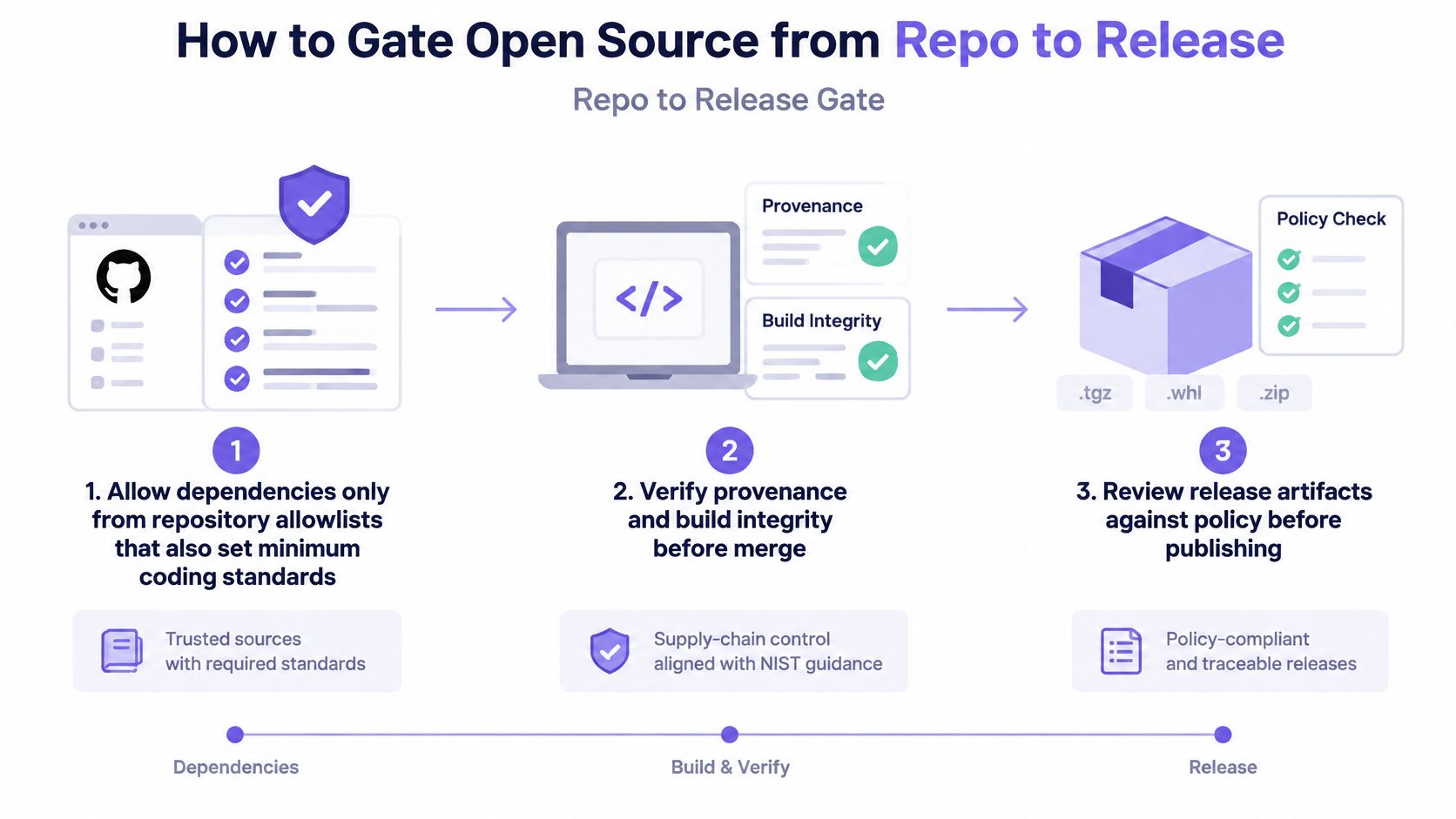
The Six Gates in Order
- Allowlist the source: Permit dependencies only from approved repositories that meet minimum coding and reputational requirements. A package outside the allowlist doesn't get debated in the pull request. It gets rejected before the build.
- Pin and record provenance: Require digitally signed source packages where available, and record an immutable version plus hash before compilation. Floating version ranges make later reconstruction guesswork.
- Generate or validate an SBOM: If an upstream project can't produce one, generate it yourself or contribute that capability upstream. Don't waive the inventory because a supplier lacks tooling.
- Scan the source dependencies: Run SCA against the declared dependency tree to find known vulnerabilities and restricted licenses early, while replacement is still cheap.
- Scan the built artifact: Run binary composition analysis on the compiled output, package, and container image. This catches what source scanning structurally cannot see.
- Block on missing evidence: Stop the release when provenance, vulnerability, or inventory evidence is absent. Missing evidence isn't a warning. It's a failed control.
Why Source Scanning Is Not Enough
Source-only scanning misses components introduced during compilation, packaging, container-image construction, or runtime assembly. A base image layer, a build plugin, a statically linked library, or a package manager's post-install step can all add code that never appears in your repository. The failure this sequence prevents is specific: a compliant source repo producing a noncompliant runtime image.
Good tooling helps you see the declared tree clearly, and a solid software composition analysis practice is the right foundation for gate four. It just can't be the last gate. What ships is the binary, so the binary is what you verify.
The same discipline applies to the merge itself. When a dependency update collides with local changes, understanding Git conflict markers from AppJet is a useful reference for resolving the conflict deliberately instead of accepting one side blindly and losing a pinned version or a security patch in the process.
Policy sentence worth adopting: An SBOM is an operational duty of the consumer, not an optional supplier feature.
Write that into your intake standard. It ends the argument about whose job the inventory is, and it gives gate six something concrete to enforce on every release.
Vulnerability Duties That Outlast the Merge
Approving a dependency is the cheapest moment in its life. The expensive moments come later, when a critical advisory lands two years into a support window and somebody has to decide, under time pressure, whether your product is affected. Your policy has to answer that question before the advisory exists.
The European Union's Cyber Resilience Act draws a line your policy should copy. According to the European Commission guidance on the CRA and open source, manufacturers integrating open-source components must perform a cybersecurity risk assessment, include the assessment and selected technical measures in product documentation, exercise due diligence over third-party components, and handle vulnerabilities throughout the product support period.
Manufacturer Versus Steward
Ordinary use isn't stewardship, and conflating them creates either panic or complacency. An organization acting as an open-source software steward, meaning it systematically and sustainably supports a commercially relevant open source product, must establish a cybersecurity policy covering secure development and vulnerability handling, cooperate with market-surveillance authorities, and report actively exploited vulnerabilities and certain severe incidents.
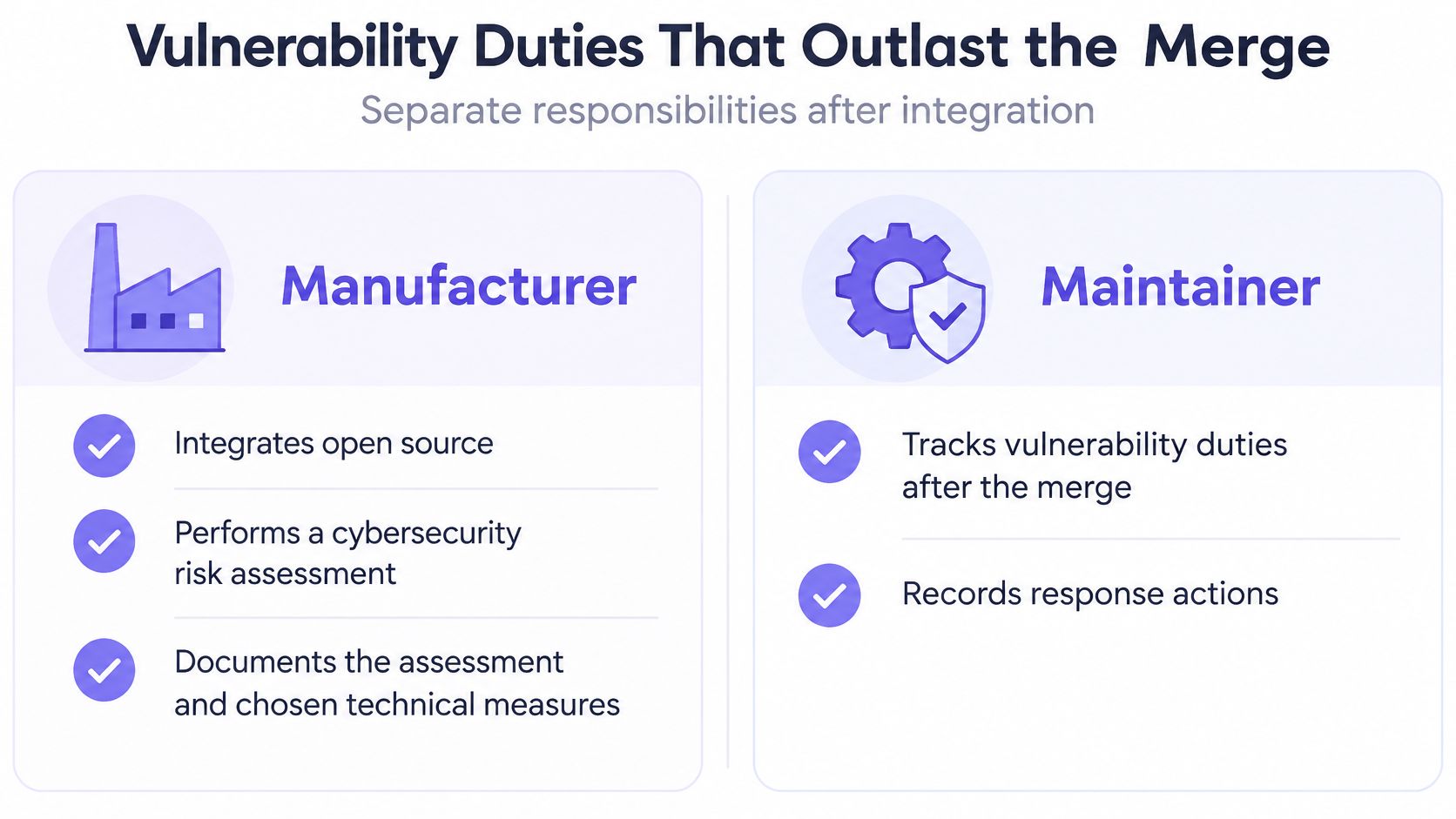
Your policy should state, product by product, which role you're in. A team consuming a library owes due diligence and lifecycle handling for its own product. A team publishing and sustaining a library others build on may owe the heavier steward duties. Those are different budgets, different staffing, and different reporting clocks.
Fields Every Dependency Record Needs
For each dependency that ships, record fields an on-call engineer can act on without archaeology:
- Named owner: A person or team who answers for this component today, not the engineer who added it years ago.
- Support-period expectation: How long you'll maintain versions containing it, and what triggers an upgrade or replacement.
- Severity thresholds: Which findings block release, which start a timed remediation, and which get monitored.
- Disclosure and escalation timelines: Who gets paged, who tells customers, and how fast.
- Evidence retention: How long scan results, decisions, and approvals are kept.
- Release block: An explicit rule that unresolved critical issues stop shipment.
Then map each control to a repository, an SBOM entry, a threat model, a pull request, and a deployed version. An auditor should be able to reconstruct whether a vulnerability decision was made, approved, implemented, and verified, without interviewing anyone.
Contrast two ways of adopting a logging library. In the first, a team approves it once, merges it, and forgets it. In the second, a named owner still answers for it three years into the support window, severity thresholds are already written, and the SBOM entry points to every deployed version containing it. When the advisory lands, the first team starts investigating. The second team starts patching.
That difference is the whole policy. Everything else is formatting.
Open Source Rules for AI Written Code
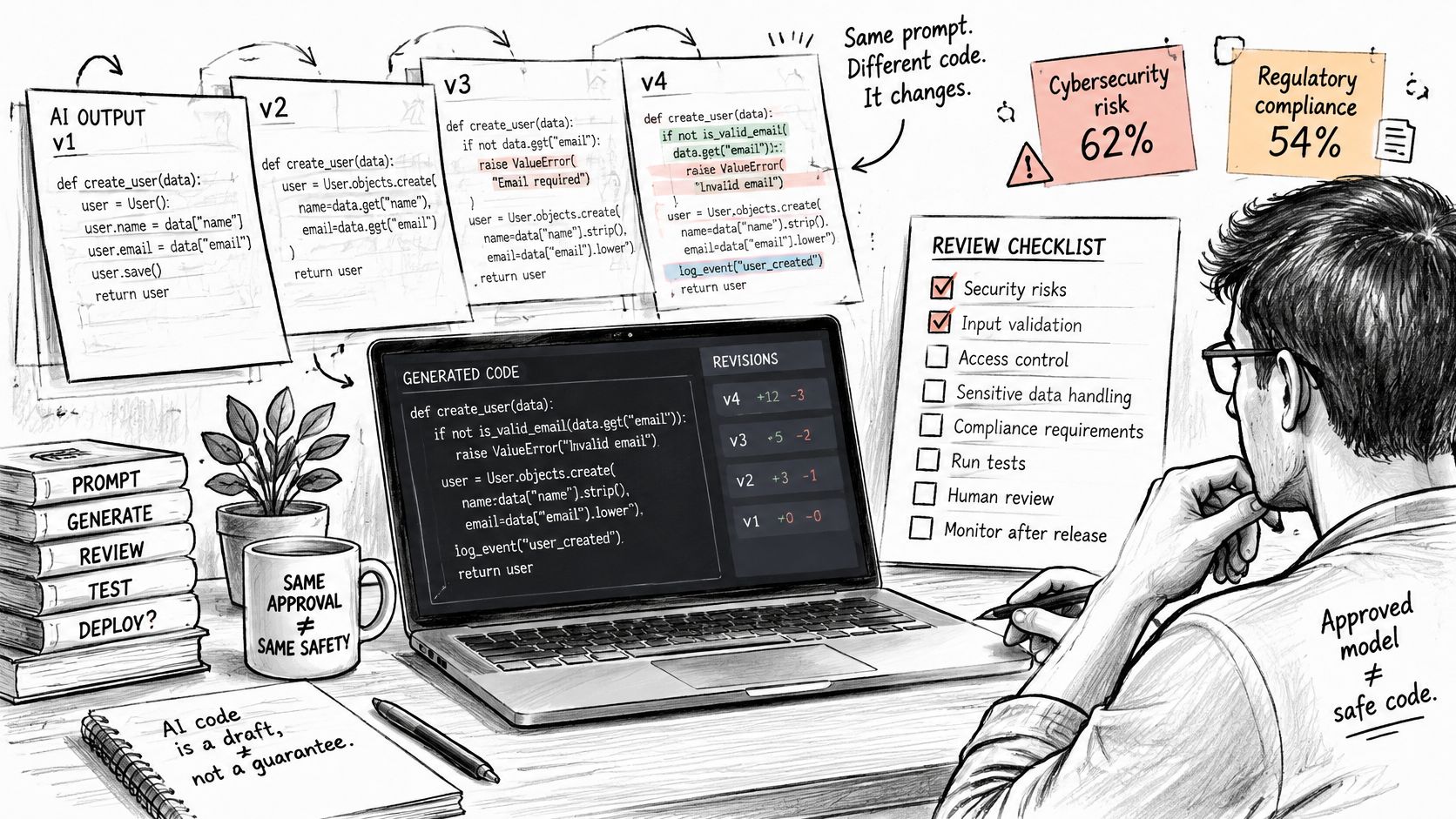
Approving a model doesn't approve its output. Generated code is a changing artifact, and it needs the same provenance discipline you'd apply to any third-party contribution, plus checks conventional dependency governance never had to run.
McKinsey research on open source technology in the age of AI identifies cybersecurity at 62%, regulatory compliance at 54%, and intellectual property at 50% as leading risks associated with open source AI, and reports security and compliance concerns as the leading adoption barrier at 56% among organizations not yet using it.
The Failure Mode Scanners Miss
Dependency scanners read declared licenses. They struggle with transformations. Fine-tuning, code generation, and model-to-application packaging can drop or obscure restrictive terms while the label still looks clean, so the obligation survives in the artifact even when the lockfile looks innocent. If the policy only scans packages, the exact model output and commit that shipped can pass unchecked.
This is a workflow problem before it is a legal one. The control has to run where generation happens and bind each rule to the dependency suggested, the file produced, and the merge that carries it. Treat AI coding security as part of open source governance, with checks inside the review path instead of a separate experiment after release.
Four Questions for Every Pull Request
Your policy must answer these at review time, in writing:
- Inheritance: Does the generated code inherit restrictions from the model or its training data, and who made that determination?
- Provenance: How are the model id, model version, and prompt recorded alongside the change?
- Suggested dependencies: What review does an AI-suggested package get before it enters the allowlist? I'd require the full intake gate, with no shortcut for confident-sounding suggestions.
- License type: How does the reviewer distinguish an OSI-approved code license from a model license or a usage restriction? They aren't interchangeable, and a model license can limit uses a code license would permit.
These questions matter more as steward obligations and broader product duties phase in on a staged timetable. A generated file merged today becomes part of a supported product tomorrow, and "the model wrote it" won't reconstruct your reasoning for an auditor.
No AI-suggested dependency or generated file merges without a human-readable rationale and evidence captured at review time.
That merge rule costs minutes per pull request. Reconstructing provenance across a year of unrecorded generations costs weeks, and sometimes it can't be done at all.
Policy Clauses Teams Can Adapt
Good clauses are short enough to encode as checks. If a clause needs a paragraph of interpretation before an engineer can act, it'll be interpreted differently by every team that reads it. Write plain sentences, name the artifact, and state what happens when the condition fails.
Three Clause Patterns
Allowlist clause. New runtime dependencies come only from named registries, must be pinned to an exact version, and a direct dependency with no release in 18 months needs a named owner before merge. That last condition does quiet, valuable work. It forces someone to accept maintenance risk explicitly instead of letting an abandoned package drift into production because it still compiles.
Exception clause. A waiver names the package, the version or image digest, the risk accepted, the approver, and an expiry no longer than 90 days, after which the build fails closed. Failing closed is the point. An exception that requires someone to remember to revisit it won't be revisited. An exception that breaks the build on expiry gets renewed deliberately or fixed.
Contribution clause. Inbound patches require a DCO sign-off on the commit. Outbound publication of internal code needs legal sign-off and an explicit license file in the repository before the release is tagged. Both directions matter. Teams routinely govern what comes in and improvise what goes out.
A Logging Library Under Pressure
Say a fintech service adopts a logging library the same week a critical advisory lands against it. The intake gate has already recorded the version and hash, so the team knows exactly which services pulled the affected release. The release gate blocks deployment until the named owner links either a fix or a 90-day exception naming the accepted risk.
The team ships the patched version to most services and makes a brief exception for one legacy service that requires a longer migration. The exception is tied to that service's image digest, so it cannot automatically cover new deployments. When it expires, the build fails, and the migration is completed rather than delayed again.
After the incident closes, the support-period owner remains on the record. The next advisory starts with a named human and a current SBOM entry, not a search through old pull requests.
Publishing an Internal SDK
Now say a product team wants to publish an internal SDK so customers can integrate faster. The contribution clause forces two decisions before launch. Legal picks the outbound license and confirms the code contains nothing the company can't release. Product then decides whether the company is merely publishing code or committing to sustain it as a steward, with the vulnerability handling and reporting duties that role carries.
That second decision changes the staffing conversation. Publishing is an event. Stewardship is a commitment with an on-call flavor. Teams that skip the question discover their answer during the first serious vulnerability report, which is the worst possible time.
Keep every clause at this length. If you can't turn it into a pull-request check, a build condition, or a register entry, it's commentary, not policy.
Enforce the Policy Where Code Is Written
You don't need a new framework. You need one focused week of wiring decisions you have already made into the tools engineers already use.
- Assign the owners: Take the seven policy areas and give each one named owner, including exceptions. Shared ownership means no ownership during an incident.
- Wire the gates: Add the dependency allowlist, the hash and SBOM entry, and the critical-vulnerability block to merge and release checks. Start with blocking only on critical findings so the gate earns trust instead of resentment.
- Add AI provenance to the template: Put model id, prompt summary, suggested dependencies, and the human review note into your pull-request template, so generated code is reviewed like any other third-party code.
- Expire every waiver: Tie each exception to an expiry date and an image digest, and let the build fail when it lapses.
- Keep context where work happens: Store the threat model and dependency decision alongside tickets and repositories, so a lockfile change updates the record instead of waiting for a quarterly spreadsheet.
The test of a real policy is simple. A new engineer or an auditor opens the version running in production and can see which rule applied, who approved it, and what evidence backed the decision. When that takes minutes, your open source policies are controls. Until then, they're intentions.
If your open source policies still live in documents that drift from the code, DevArmor keeps threat models, design reviews, and policy-as-code checks tied to the exact pull requests and changes that ship, inside the tools your engineers already use. Visit DevArmor to see how continuous, in-workflow enforcement turns policy lines into audit-ready evidence without slowing delivery.
Table of Contents
Subscribe


