
HIPAA Compliant Software Development: A Step-by-Step Guide
 Reza Khosravi
Table of Contents
The usual advice for HIPAA compliant software development starts with encryption, access control, and a checklist. That's useful, but it misses the engineering problem: a team can implement those controls and then introduce an unreviewed data flow in its next deployment. A telemetry field, support export, or AI integration can change who receives patient information without changing the product's interface.
HIPAA readiness is a continuously verified data-flow property, not a permanent label attached to a codebase. The practical job is to connect each sensitive flow to an accountable owner, an approved design, enforceable controls, and evidence from the version you shipped.
Deciding Which HIPAA Role Your Product Plays
Decide whose information you handle and on whose behalf before choosing your compliance architecture. A health-related feature doesn't automatically establish your HIPAA role, and a consumer-facing interface doesn't automatically exclude you.
The HHS guidance for health app developers directs teams to evaluate an app's function, information collection, and services; HIPAA, the FTC Health Breach Notification Rule, FDA requirements, COPPA, and information-blocking rules can overlap. Translate that evaluation into boundaries engineers can implement.
HIPAA role by product scenario
| Product scenario | Likely HIPAA role | Engineering consequence |
|---|---|---|
| App stores patient records for a clinic | Business associate of a covered entity | BAA with the clinic and full ePHI safeguards in scope |
| Consumer app tracks health data with no provider link | Often outside HIPAA; FTC Health Breach Notification Rule may apply | Check breach notification duties and consent flows |
| API receives ePHI from a provider's EHR | Business associate or subcontractor | BAA chain extending to each downstream vendor handling ePHI |
| Mobile SDK in a provider's app sends telemetry | Business associate analysis when telemetry contains PHI | Map SDK data fields before integration |
| Same product serves covered entities and direct consumers | Mixed roles | Separate data flows and a documented boundary per user type |
| AI feature sends clinical notes to a third-party model provider | Subcontractor question for the model provider | Vendor agreement and documented ePHI handling, or don't send ePHI |
A clinic records application puts the vendor relationship and patient-record workflows in scope. A standalone consumer tracker calls for a different applicability assessment, including breach-notification and consent behavior, rather than copying the clinic application's legal assumptions.
An EHR API requires attention to the downstream chain. Trace forwarding, retries, error reporting, and storage, not just the endpoint that initially receives the record.
Watch the less visible boundaries
For a mobile SDK, inspect actual telemetry fields and outgoing requests. For a mixed-use product, enforce the user-type boundary in routing, storage, permissions, and vendor configuration rather than relying on a marketing distinction.
The same scrutiny applies to people accessing records. MedicalVirtual's Medical Virtual Assistants resource is relevant when mapping outsourced clinical administration: identify which tasks require record access, then scope identities and permissions around those tasks.
AI features require an equally explicit destination map. At DevArmor, we send document content to third-party AI providers acting as our service providers to generate security reviews. That processing belongs in your vendor evaluation; don't assume an architecture-review document is safe to upload if it contains patient details.
Our HealthTech governance offering sits alongside compliance use cases for FinTech and Media, but sector support doesn't replace a product-specific applicability decision. Write down the role for every product surface before writing code that touches health data.
What HIPAA Requires From Your Code
The HIPAA Security Rule names no preferred language, cloud provider, framework, or encryption product. It establishes protection objectives, leaving your organization to select and justify controls appropriate to its risks.
The HHS Security Rule overview organizes safeguards into administrative, physical, and technical categories and identifies access control, audit controls, integrity, authentication, and transmission security within the technical framework. Your implementation needs to protect the confidentiality, integrity, and availability of electronic protected health information, or ePHI.
The mapping below is a practical engineering baseline, not a claim that each listed technique independently satisfies an entire safeguard.
HIPAA safeguards mapped to engineering controls
| Safeguard area | Engineering control | Evidence to keep |
|---|---|---|
| Administrative: risk analysis and management | Threat model per feature with a risk register | Signed risk decisions and residual risk acceptance |
| Technical: access control | Unique IDs, least-privilege roles, MFA for staff | Access review exports on a documented schedule |
| Technical: audit controls | Structured audit events with actor, time, action, and resource | Sample audit trail and retention settings |
| Technical: integrity | Input validation, hashing, and signed build artifacts | Test results and build provenance records |
| Technical: transmission security | TLS on every ePHI path and encrypted service-to-service calls | Configuration scan reports |
| Physical: facility and devices | Cloud provider with signed BAA, encrypted storage, and region settings | Provider attestations and BAA |
Choose controls around the failure mode
Authentication establishes who is requesting access. Authorization determines whether that identity can perform the requested action on that particular record. A successful login must never become permission to retrieve every patient record.
Test the backend with identities from different tenants, staff roles, and service accounts. Include direct API calls, exports, asynchronous jobs, and administrative operations, because interface restrictions don't protect alternate access paths.
Integrity needs similar precision. Input validation constrains accepted values, hashes can help detect changes, and signed artifacts establish build provenance. None of those techniques alone proves that a clinical record changed through an authorized workflow.
Practical rule: Describe the failure a control prevents before selecting the product that implements it.
Keep the responsibility split explicit
A cloud provider can operate secure facilities, but your team still chooses service permissions, deployment regions, backup destinations, and endpoint behavior. Encrypted storage and region settings support your security architecture; they aren't substitutes for managing laptops, removable media, or other devices that might hold ePHI.
There are real trade-offs. Centralizing sensitive data can simplify permissions and monitoring, but it also concentrates availability dependencies. Adding narrowly scoped services can improve isolation while increasing the number of identities, network paths, and operational configurations you must verify.
Choose the architecture your team can operate reliably, then document the reasoning. Pick an ePHI path in your current product and trace it through every safeguard area, including recovery and administrative access, before expanding the review to the rest of the system.
How to Run a Risk Analysis on Your Architecture
Start with a working risk register for a bounded system, not a questionnaire covering the entire company. Each entry should identify the flow, realistic failure, existing protection, proposed treatment, owner, and acceptance decision.
The HHS risk-analysis guidance calls for an accurate, thorough assessment of risks to ePHI without prescribing a particular methodology. Use a repeatable process that your engineers can update when the architecture changes.
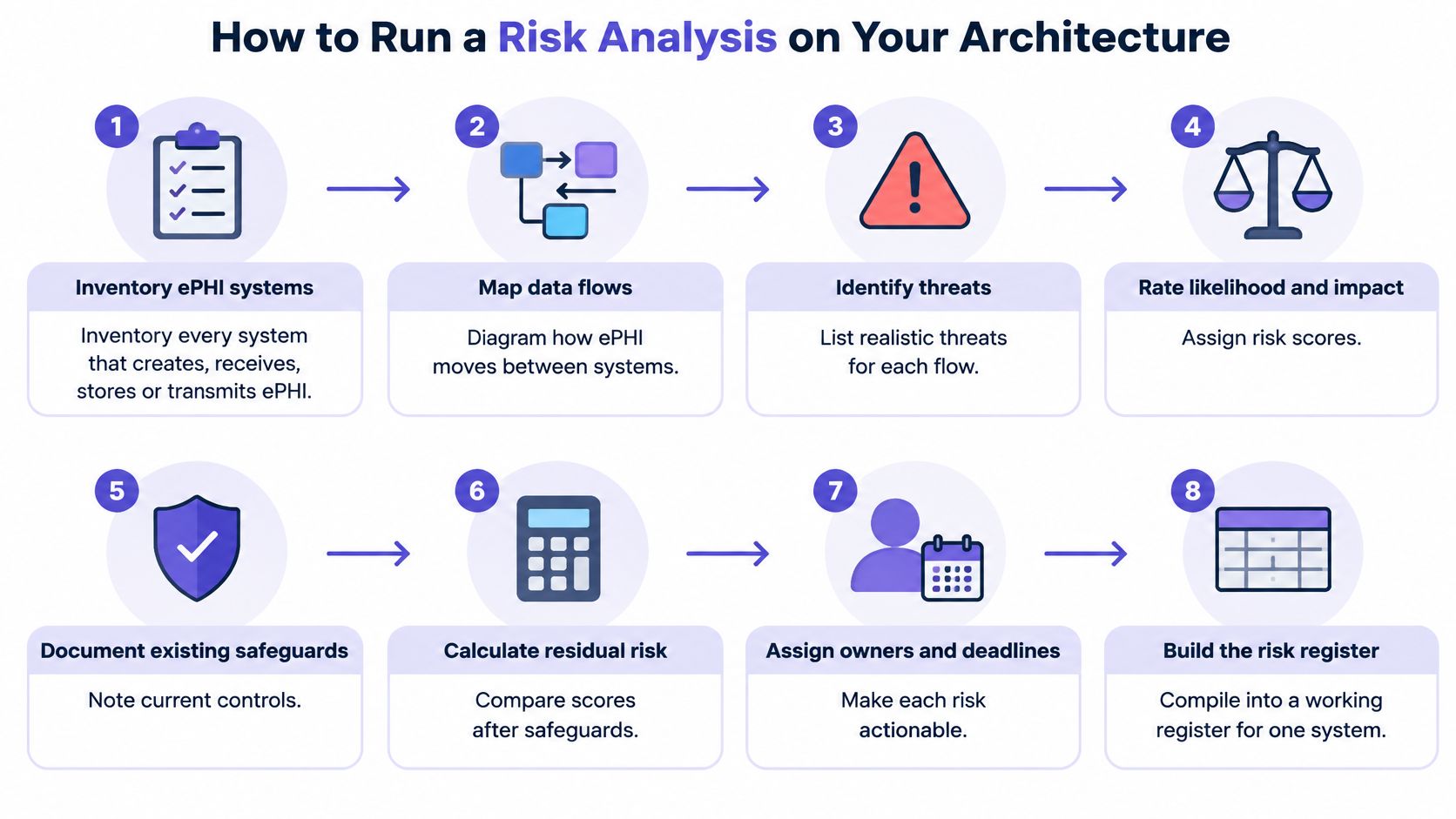
Build an actionable register
Inventory the systems handling ePHI. Include databases, object storage, queues, caches, logs, backups, analytics, and support exports. Record the data categories and purposes so a vaguely named integration doesn't conceal another patient-data repository.
Draw the flows and trust boundaries. Show where information crosses tenant, service, environment, organization, or vendor boundaries. Include retry queues and failure destinations, because error handling can send data somewhere the primary workflow doesn't.
Identify misuse and failure scenarios. Write concrete statements such as a debug handler serializes a clinical payload, or a developer role can query unrelated tenants. Describe the precondition and consequence rather than listing generic threats without an affected resource.
Rank likelihood and impact consistently. A simple low, medium, and high scale is a reasonable starting method. Define the labels with examples, and distinguish confidentiality loss from incorrect records or unavailable care workflows.
Assign an accountable owner. Name a person who can arrange remediation and establish a target date. A team name alone makes it too easy for application, platform, and security engineers to assume someone else owns the finding.
Select and connect mitigations. Record existing safeguards before proposing administrative, physical, or technical changes. Link each new mitigation to a design decision and verification method, such as a permission test, configuration assertion, or operational exercise.
Document residual risk and acceptance. Reassess the scenario after the proposed controls, noting assumptions and remaining exposure. Record who accepted that exposure and the circumstances that would invalidate the decision.
Establish material-change reassessment. Attach review triggers to vendor, integration, deployment, and processing changes. Update affected entries rather than scheduling a fresh assessment only when someone requests a compliance document.
A completed assessment isn't proof of compliance. Risk analysis starts the work; risk management requires implementing treatments, checking whether they work, and revisiting the result.
Reassess the changed flow
Say a product team adds an analytics SDK to a patient portal. Review the emitted fields, destination, identifiers, retention behavior, and vendor relationship, then update the affected risks and tests. You don't need to rewrite unrelated models, but you do need to inspect what the SDK sends.
Keep review inputs sanitized as well. Our services must not receive PHI, PCI, or similarly regulated data unless expressly agreed in writing. Don't send PHI to a review tool without the necessary written agreement and approved handling arrangement.
Keeping Threat Models Current as Code Changes
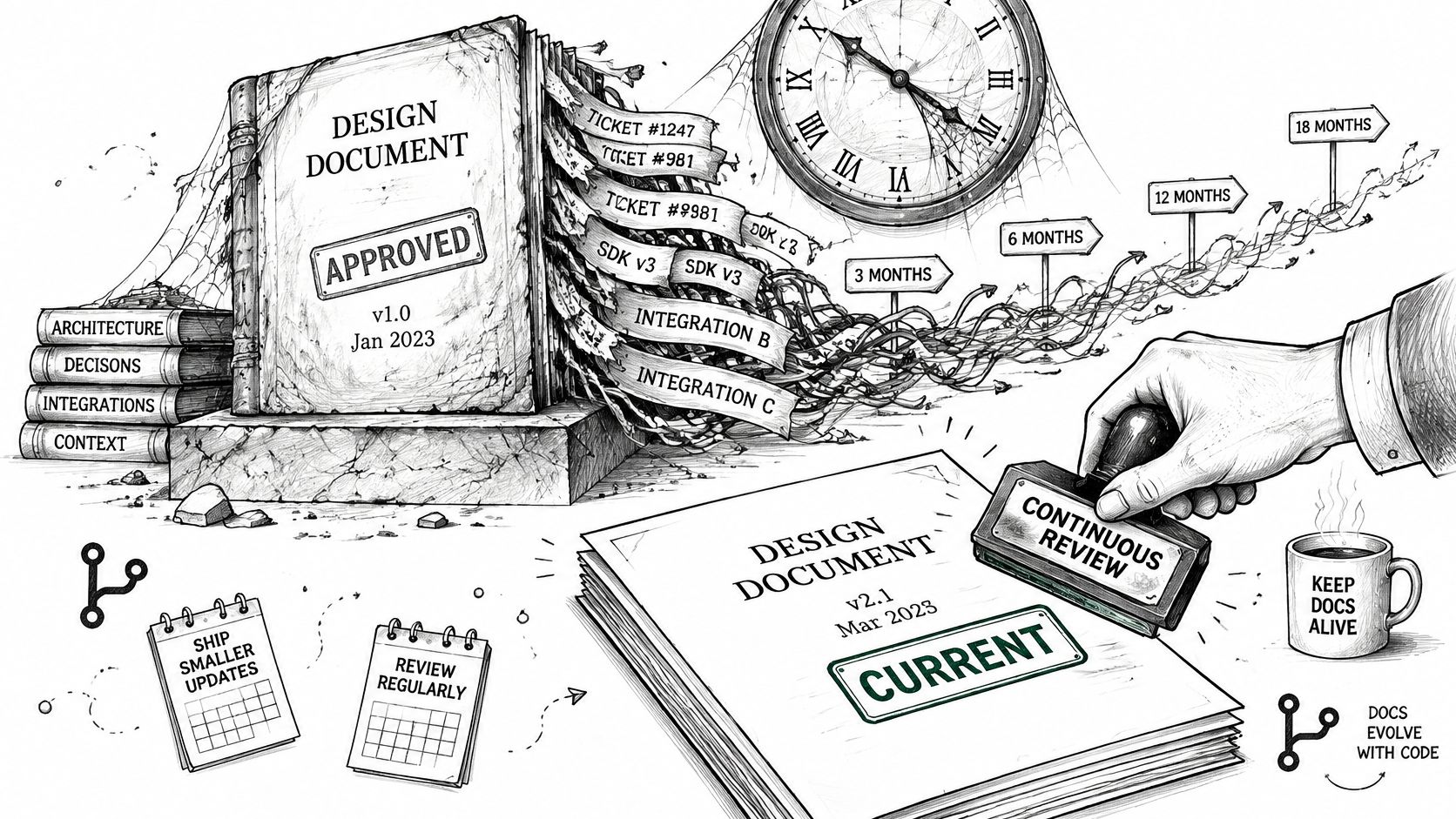
A design document gets approved. Engineers then add tickets, replace dependencies, enable an SDK, and change a background worker while the approved diagram remains untouched. Eventually, reviewers assess a system that no longer resembles production.
Continuous threat modeling means refreshing security context from tickets, design documents, repositories, and service metadata. The useful output isn't another diagram generated on demand. It's a clear identification of which assumptions a change invalidates and which decisions need review.
Changes that trigger a threat model update
| Change | What to reassess | Enforced at |
|---|---|---|
| New third-party SDK or analytics tool | Data-flow map and vendor BAA check | Before the first merge |
| New AI coding assistant or agent with repo access | Scope of ePHI exposure and prompt context rules | Before enabling it for the team |
| Schema change adding a field with health data | Access rules, logging, and encryption at rest | Design review |
| Dependency with a critical unpatched vulnerability | Risk rating and patch or disable decision | Within the documented patch window |
| New region, cloud service, or backup target | Residual risk and provider attestations | Before production deployment |
| Changed authentication or session logic | Authorization tests and access model | Before release |
These are recommended workflow gates, not a universal regulatory schedule. Define patch windows and escalation rules in your own risk-management program.
Make model updates reviewable
Our platform generates threat models and architecture reviews in minutes from existing artifacts, with reviews inside developers' workflows. Surface the affected security question in Jira, GitHub, or VS Code so the engineer changing a service can answer it while the implementation context is fresh.
The connection between threat modeling and compliance becomes useful when a model has a version, affected components, review status, and linked changes. Generated content still needs validation by engineers who understand the system.
Prove continued effectiveness
The HHS proposed Security Rule changes would make safeguards including MFA, removal of default passwords, offline backups, timely critical patching, and regular testing more explicit. These are proposals, not requirements to describe as already enacted; the document also addresses unpatched-software risks and testing the impact of disabling software outside production first.
That operational qualification matters. Removing a vulnerable package without testing its dependencies can interrupt a clinical workflow, while leaving it enabled without a recorded decision leaves the exposure unmanaged.
A current threat model should explain the deployed system, not merely preserve the system someone intended to build.
Link each affected model to a pull request check. An integration change shouldn't merge until the relevant assumptions have been reviewed.
Turning Safeguards Into Release Gates
Start with authorization regression tests. A feature that returns another tenant's record is unsafe even if its transport and storage encryption work perfectly. Test denied actions as deliberately as successful requests.
The HHS-hosted security risk-assessment guidance connects protection of ePHI with risk-based safeguards, including access and audit controls. Translate those objectives into pipeline decisions your team can reproduce, rather than treating a policy statement as implementation evidence.
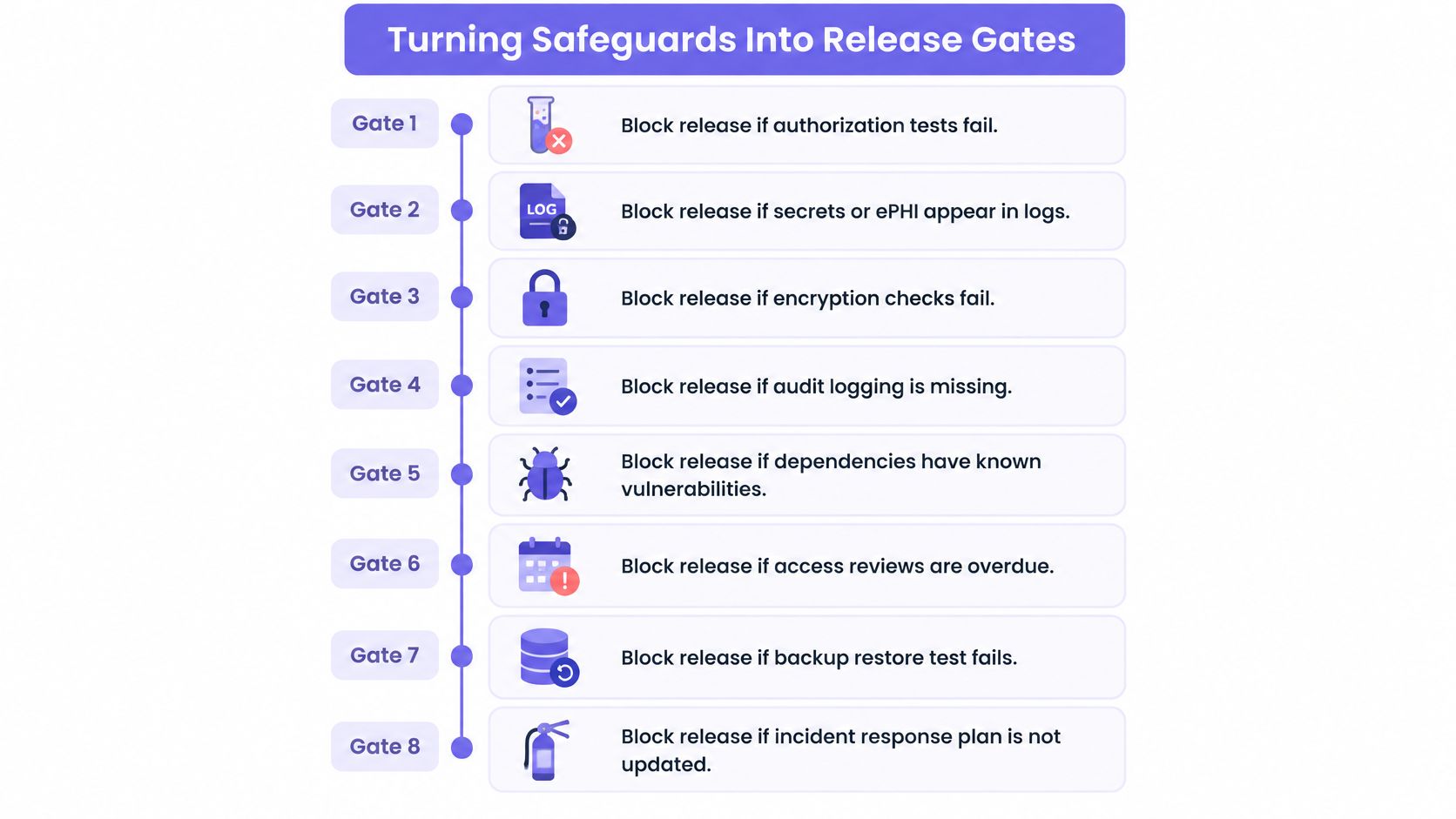
Block specific failures
- Authorization tests fail. Block the release when role, tenant, record, or service-account restrictions break. Retain the failing request scenario and test result so remediation addresses the actual bypass.
- Secrets or ePHI appear in logs. Run synthetic sensitive payloads through success and error paths, then inspect captured output. Keep redacted findings and test reports, not another copy of the sensitive content.
- Encryption or key-management configuration is missing. Check infrastructure definitions and effective deployment settings. Preserve configuration results identifying the resource and approved policy.
- Audit events are incomplete. Assert actor, time, action, and resource fields for sensitive operations. Retain representative sanitized events and schema-validation results.
- A vendor lacks an approved data-flow decision. Require the applicable BAA and processing approval before enabling an ePHI destination. Save the approval reference with the integration change.
- A critical dependency remains unpatched without a decision. Require remediation or a security-approved, time-bounded exception. Retain the affected version, exposure analysis, owner, and follow-up date.
- Production ePHI enters an unapproved environment. Use synthetic or properly de-identified development and staging records. Enforce approved-source and destination rules on import and restore jobs.
Keep exceptions accountable
Use Policy-as-Code on pull requests to connect blocked merges to approved requirements. Our reviews check every code change against the customer's architecture and security requirements, and every review is traceable to an approved design decision or threat model.
Allow overrides only with documented security-owner approval, scope, compensating controls, and an expiration condition. Otherwise, an emergency bypass can become the normal deployment path.
Encryption alone doesn't restrict an overprivileged user. Replace broad developer database grants with scoped, audited roles and controlled elevation. For debugging, log allowlisted metadata and correlation identifiers instead of serializing request bodies and trying to redact them afterward.
Recovery needs executable proof too. Run restores into approved isolated environments, verify record integrity and application behavior, and exercise incident escalation rather than accepting a written plan as a successful test.
Choose the gates your team can enforce this sprint and make them required checks. Start with authorization, sensitive-output detection, and configuration validation if those currently depend on a reviewer remembering to inspect them.
Building Audit Evidence Before Your Next Release
Prepare for a direct review question: show how this requirement traces to evidence. A policy document describes intent; a linked design decision, implementation review, and deployment result demonstrate what your team did.
Build an evidence chain that starts with the requirement and ends with the released artifact. Give each item an owner and a refresh trigger so preparation doesn't depend on whoever remembers where a screenshot was saved.
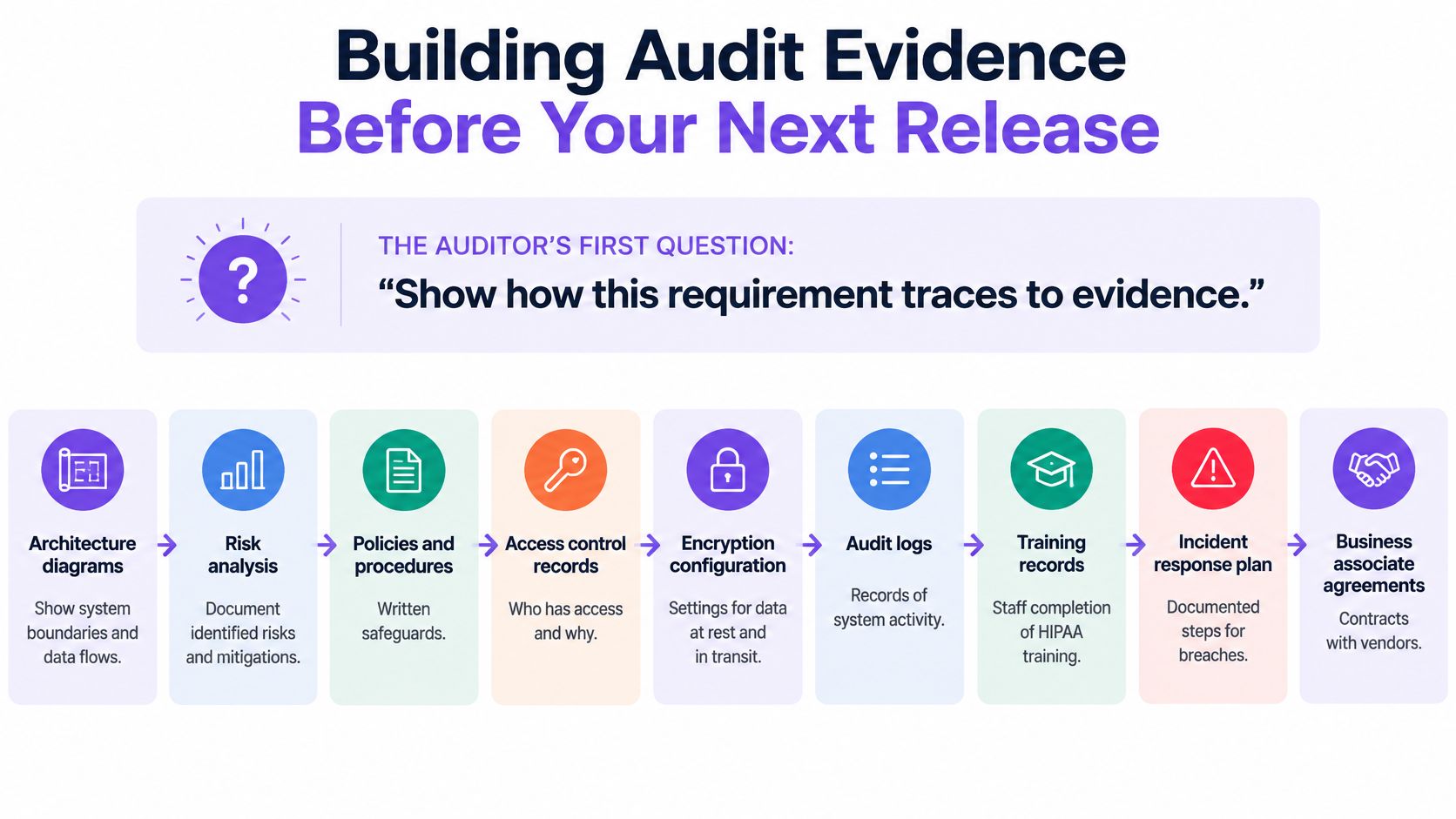
Audit artifacts, owners and refresh cadence
| Artifact | Owner | Refresh cadence |
|---|---|---|
| Architecture diagrams and data-flow maps | Engineering lead | On every material change |
| Threat models and risk register | Security owner | Per feature and on each trigger |
| Design decisions and review traces | Tech lead | Per pull request |
| Access review exports | IT or security admin | On the organization's documented review schedule |
| Pipeline test results and build provenance | Platform team | Per release |
| Restore drill records | Operations lead | Per restore drill |
| Incident tabletop notes | Incident lead | After each exercise |
These are operating recommendations, not universal HIPAA-prescribed artifact cadences. Keep the underlying policies, training records, vendor agreements, and incident procedures alongside the technical evidence.
Preserve context, not just files
Attach evidence to stable identifiers: the requirement, threat scenario, decision, pull request, build, and deployment. A passing test from an unidentified environment is much weaker than a result tied to the deployed commit and effective configuration.
For vendor diligence, a resource such as the Purple data and security overview can help structure questions about a supplier's handling practices. Don't treat a public overview as proof of your own configuration or contractual coverage; retain the relevant agreement and your assessment.
Our platform supports compliance work such as SOC 2 and ISO 27001 by documenting security architecture and decisions as audit-ready artifacts. Security teams retain oversight of our instant, traceable review process, including what was approved and why.
Verify the implementation behind the approval
Use post-implementation verification to compare approved decisions with code and deployment behavior. Security approval should identify what was reviewed, while engineering evidence establishes whether the released implementation matches it.
Evidence test: Another engineer should be able to follow the record without asking the original author to reconstruct the decision.
Run your next release through this checklist. Mark artifacts that are missing, stale, or assembled manually, then fix the weakest link before shipping, especially where no one can connect an approved safeguard to current implementation evidence.
DevArmor offers continuous threat modeling, in-workflow security reviews, and policy enforcement that connect architecture decisions to code changes and deployments. Visit DevArmor to evaluate that workflow against a sanitized design document and a pending pull request, then identify which HIPAA-related controls your team can enforce and evidence before its next release.
Table of Contents
Subscribe


