
How to Design a Git Code Review Workflow That Scales
 Reza Khosravi
Table of Contents
Your queue has pull requests waiting for approval, reviewers are approving diffs they barely read, and a security issue slipped through last week that someone swears was visible in review. That pattern isn't a people problem. It's a governance problem. A solid Git code review workflow treats review as a measurable control with owners, gates, and evidence, not as a courtesy check before merge. When you design it that way, latency drops and findings surface earlier.
Why Your Code Review Workflow Feels Broken
Monday starts with a backlog. A feature pull request has sat untouched since Thursday, a hotfix needs approval before a release window closes, and two reviewers left comments that contradict each other. The author rebases, force pushes, and pings the channel again. Someone finally approves to unblock the release, mostly because CI is green and the diff looks plausible at a glance.
That sequence feels familiar because many teams installed a pull request mechanism and assumed review would follow. It doesn't. Opening a pull request creates a place for discussion. It doesn't guarantee review coverage, informed participation, or a clear standard for merge readiness. Under delivery pressure, reviewers optimize for clearing their queue, authors optimize for getting approval, and nobody owns the security question hiding inside the change.
The stakes are measurable. A large-scale empirical study of 3,126 GitHub projects found that stronger code-review coverage and participation were associated with better security outcomes, including a negative relationship between pull-request review and the number of reported security bugs. That doesn't prove review alone prevents vulnerabilities. It does position coverage and participation as controls you can measure at repository scale, alongside branch protection and merge criteria.
What Breaks First Under Load
Volume exposes weak design quickly. Large diffs arrive without context, reviewers can't tell which comments block merge, and automated checks run after a human has already spent attention on trivial issues. AI-generated changes make this worse because authors can produce code faster than reviewers can reconstruct intent. The diff expands, but the evidence behind it stays thin.
- Unclear ownership: Nobody knows whose approval authorizes a sensitive change.
- Missing intent: The pull request describes what changed, not why it's safe.
- Late findings: Security concerns appear after merge, when fixes compete with new work.
A review that everyone can approve and nobody must own isn't a control. It's a comment thread.
A healthy workflow reverses those defaults. Authors arrive with small changes and documented risk, automation handles deterministic checks first, and named reviewers make traceable decisions. Speed comes from removing ambiguity, not from asking tired reviewers to skim faster.
What the Data Says About Review Coverage and Security
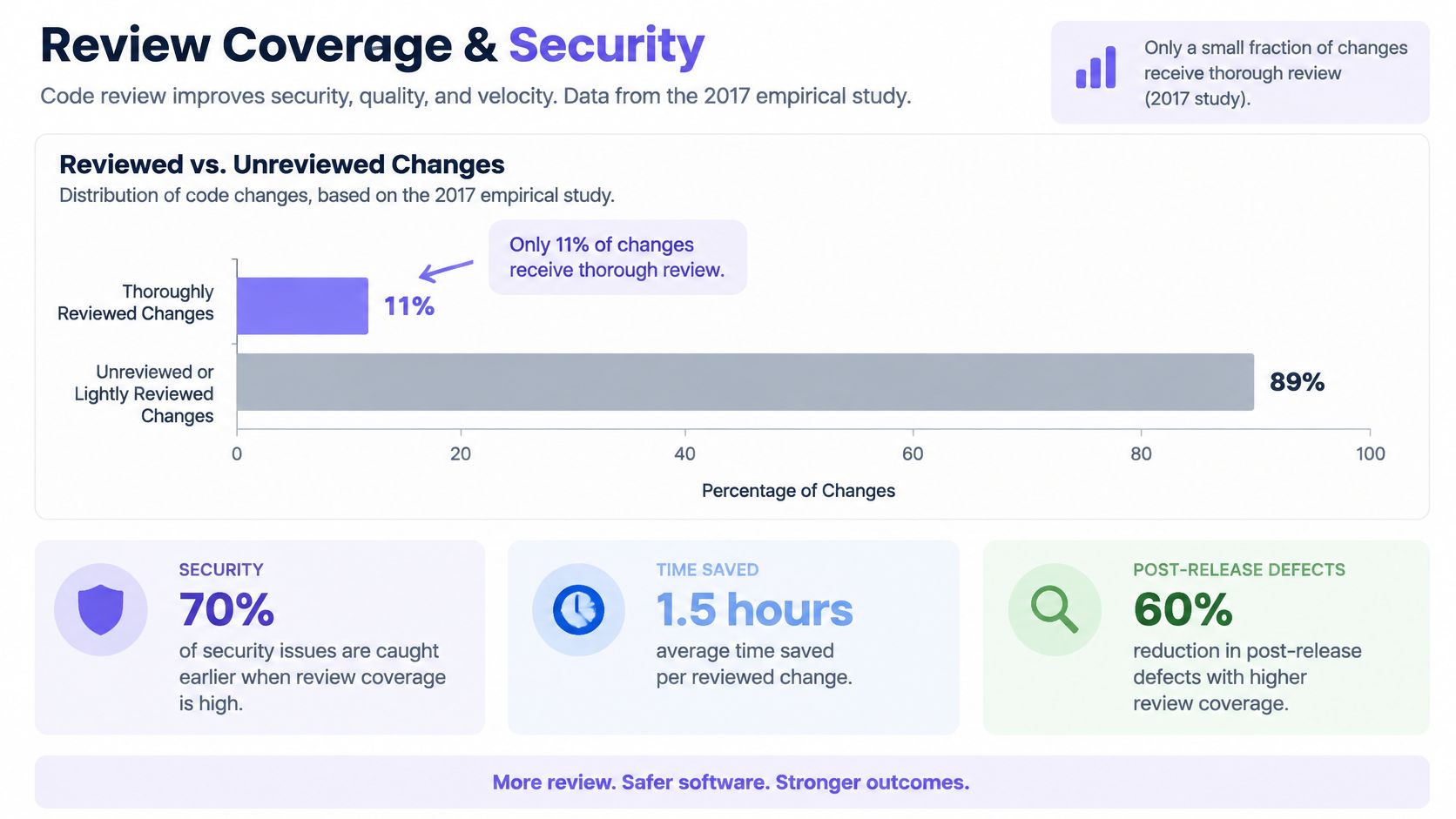
Review coverage becomes useful as a governance control when teams define what they measure: the share of changes reviewed, who took part, and whether feedback was addressed before integration. The Berkeley study discussed earlier examined review and security outcomes across a broad dataset. Its findings support treating review coverage as a measurable control, not merely an administrative step.
The chart highlights a practical problem: thorough review does not reach every code change. Increasing coverage helps only when reviews involve people able to assess the code's risks. A nominal approval without context may satisfy a rule while missing a security flaw.
Different reviewers bring different expertise. One may check behavior against requirements, another may recognize operational hazards, and a security specialist may catch a changed trust boundary. Reviewer topology, who participates and how their responsibilities fit together, therefore affects the quality of oversight.
A 2019 study of GitHub open-source pull requests found that, on average, 62% of pull requests involved multiple reviewing developers, with rates varying substantially between projects. That open-source figure is a reference point, not a universal target. The governance question is whether the right expertise reaches changes with meaningful risk, and whether the workflow makes conflicting or unresolved feedback visible.
Make Reviewer Participation a Governance Control
Approval rules should match the change. A code owner's review for maintainability does not replace security expertise on an authentication change. Requiring several approvals for every small edit, however, creates queues and can turn approval into routine box-checking.
Set controls according to risk:
- Branch protection: Require review before merge so coverage does not depend on the author's discretion.
- Required reviewers by path: Direct sensitive files to owners with relevant expertise.
- Explicit resolution: Keep merge blocked while blocking comments remain unresolved.
A documentation edit and a permissions change do not warrant identical gates. Track review coverage, reviewer participation, and unresolved findings across repositories, then adjust policies where the evidence shows gaps. This makes review a measurable engineering control while keeping approval accountable to people with the right context.
Designing the Core Pull Request Workflow
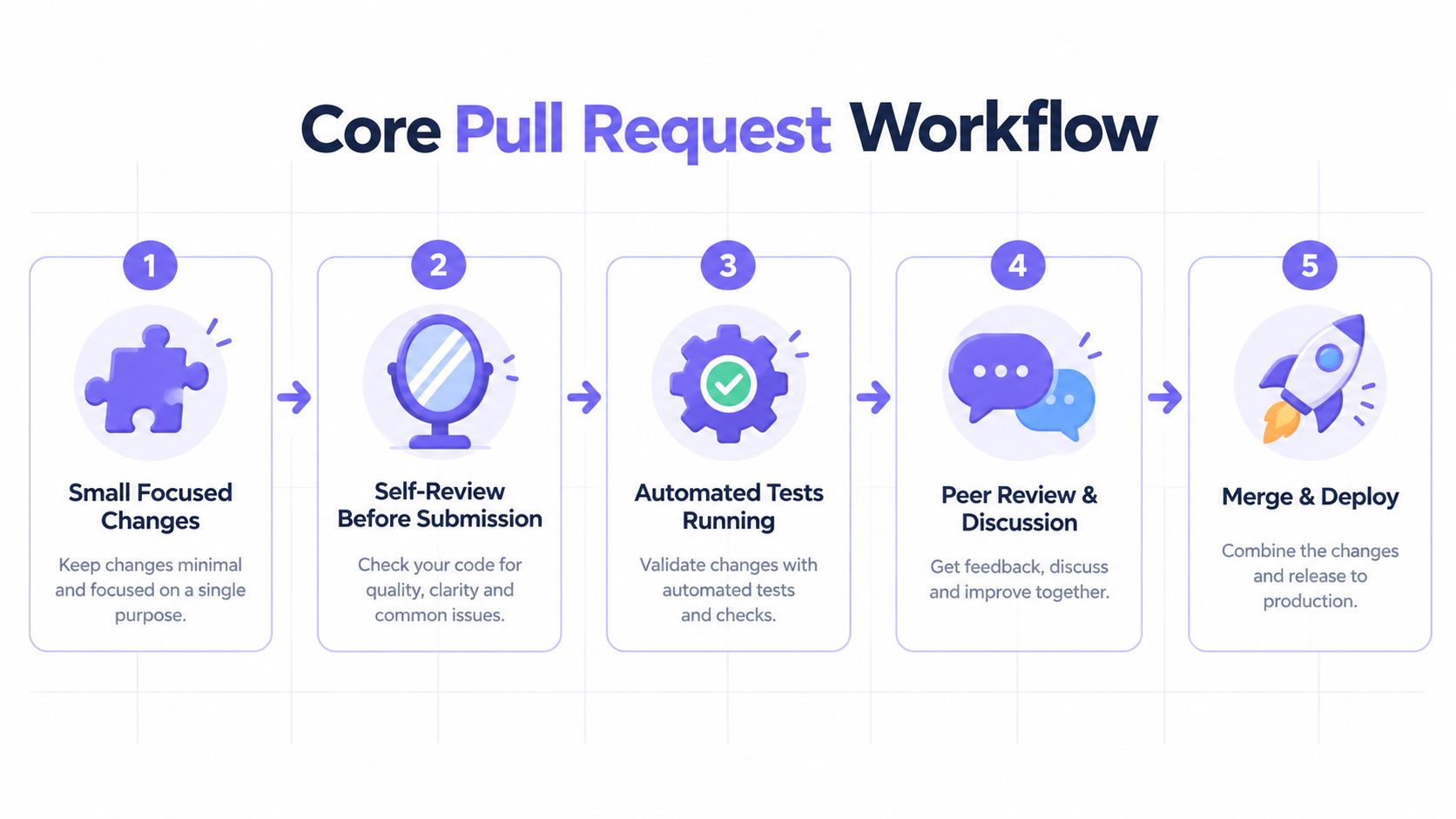
Start before the pull request opens. Authors should self-review the full diff, run automated tests locally or in CI, and split work that mixes refactoring, behavior changes, and configuration into separate reviewable units. Small changes aren't aesthetic preference. Microsoft research found that review usefulness declines as review size grows, with the decline becoming noticeable at 20 or more changed files. The same research context matters for capacity planning, since reviewers spend roughly six hours per week on reviews and the median interval from request to complete sign-off is about 24 hours, as described in that Microsoft research.
The pull request description carries the security context reviewers can't infer from code alone. Link the ticket or design decision, state the intended behavior, identify changed data flows or trust boundaries, and note rollback or migration risk. If a change touches authentication, billing, or personal data, say so plainly. Reviewers shouldn't have to reverse engineer intent from commit messages.
Selecting Reviewers and Closing the Loop
Request one or two reviewers with relevant code ownership instead of broadcasting to an entire team. Broadcasting diffuses accountability and produces either silence or shallow approvals. Distributed teams need that clarity even more, and teams building capacity across time zones sometimes evaluate LATAM developers as part of staffing a review rotation that can respond during overlapping working hours. Whoever you assign, make the expected lens explicit, such as behavior, tests, operations, or security.
Reviewers inspect behavior and maintainability, ask for evidence where claims are unsupported, and mark comments as blocking or non-blocking. Authors respond with commits or clarifications, and do not resolve threads without explanation. That back and forth creates the audit trail.
Practical rule: If a reviewer can't explain why a change is safe to merge from the pull request record alone, the record isn't finished.
The merge gate should be boring and predictable. CI passes, required approvals are present, and every blocking comment is resolved. If new commits materially change the diff after approval, dismiss stale approvals and request a fresh look. That discipline protects authors too, because nobody can later claim a risky change was approved when it wasn't.
Enforcing Policy as Code on Every Pull Request
A pull request that changes an authentication rule should not depend on a reviewer spotting a committed secret or a forbidden configuration value. Make those checks deterministic and run them on every pull request, before human reviewers spend time on design judgment. Policy as code turns security requirements into versioned, testable controls, while reviewers remain accountable for decisions that require context.
Start with traceability. Map each rule to an approved design decision, security requirement, or threat model entry. When a rule blocks a change, the author should be able to identify the requirement and the person authorized to approve an exception. Teams can adapt how policy as code enforcement works in practice to their repositories. Tools differ. DevArmor, for example, can post consolidated pull request checks tied to approved requirements. The governance principle is the same: make each control explicit, versioned, and testable.
Block Only What You Can Defend
A merge gate earns trust when its findings are explainable and proportionate. Classify results by consequence: blocking violations enforce mapped, approved requirements; warnings flag risk for reviewer judgment; informational findings suggest improvements without stopping delivery. If every finding blocks, developers seek overrides, and those overrides begin to replace the written policy.
Apply the distinction to the rule itself. Block exposed secrets and credentials, and require rotation; deleting the value from the current diff does not address exposure. Block a change that crosses a defined architecture boundary without an approved decision. Keep style suggestions and minor quality issues non-blocking, so reviewers can focus on behavior and risk.
Automation handles repeatable checks. Humans still need to assess whether a new data flow matches the product promise or whether a fallback creates an unsafe failure mode. That division preserves human accountability while giving reviewers clearer evidence. It also gives auditors a traceable chain from requirement to policy rule to pull request outcome, rather than relying on sampled comment threads and hoping the relevant control was discussed.
Integrating Security Design Reviews Without Adding Meetings
A pull request that changes an authorization boundary can expose a design flaw before it reaches production, provided reviewers can see the decision the code is meant to implement. Separate review ceremonies often happen after those decisions have hardened into code and deadlines. At that point, findings feel like rework and are easier to defer. Put design context into the pull request instead, where the merge decision is made.
Keep the threat model current as tickets, repositories, and service metadata change. Reviewers need to see today's assets, entry points, and assumptions, not a diagram left over from project kickoff. Teams can use a structured threat modeling process to establish what to track, then surface relevant details in their existing workflow. Freshness matters more than document volume.
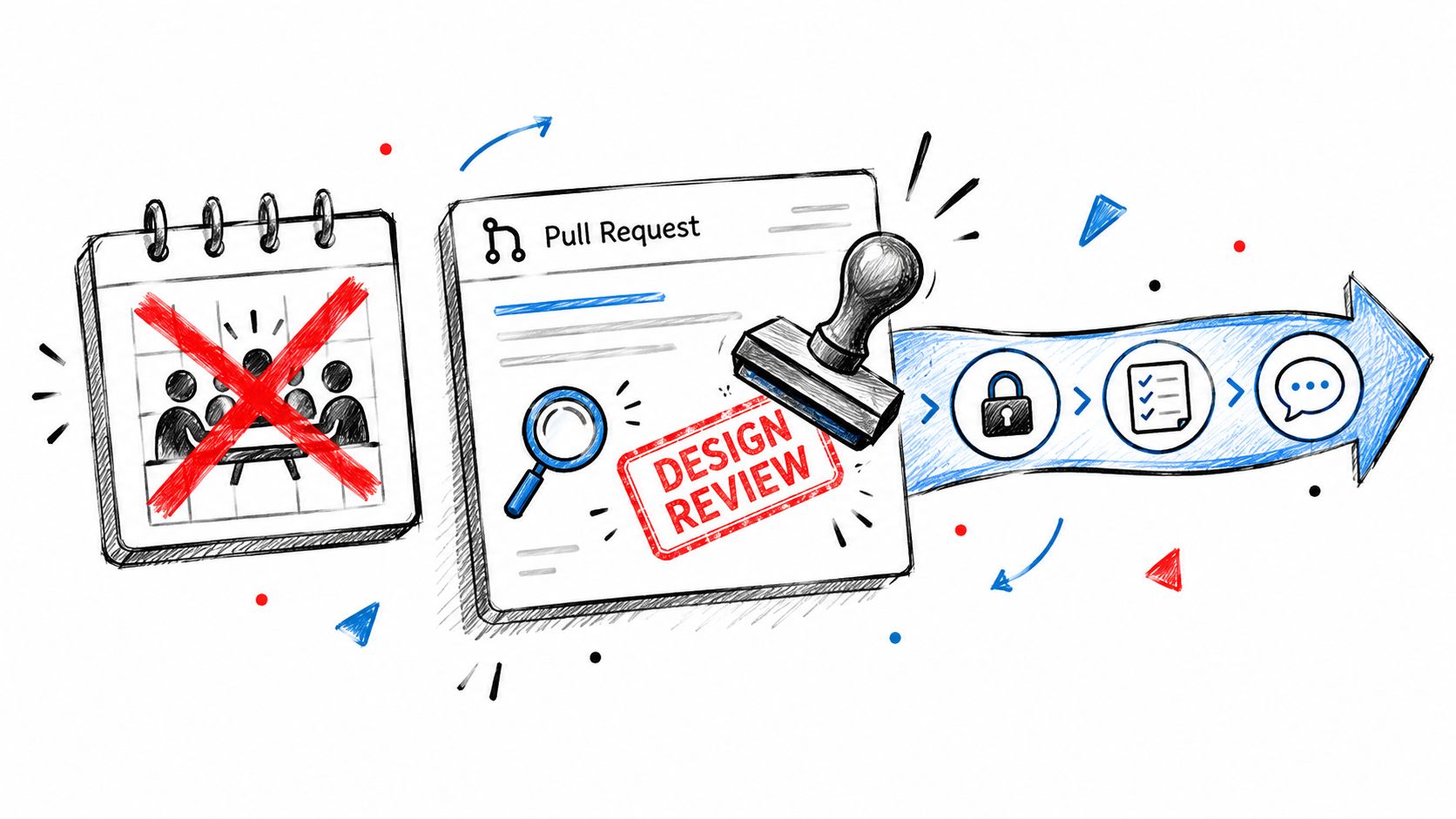
Attach each pull request to its originating ticket, acceptance criteria, architecture decision, and relevant threat model entries. Show that context in GitHub, Jira, VS Code, or the tools the team already uses. Under deadline pressure, reviewers are unlikely to consult a separate portal. With the decision visible, they can check whether the implementation still matches the approved intent.
For example, a change that adds an external service should identify the new caller, data store, or trust boundary. A permission change may reveal an assumption that the design relied on but the code does not enforce. Configuration and deployment changes also deserve context, since application code alone may not show their security impact.
Route scrutiny by evidence in the diff and its metadata. New endpoints, authorization logic, sensitive data handling, and infrastructure changes can trigger design context automatically. Routine, low-risk changes can stay in standard review; high-impact changes can bring the relevant security decision to the reviewers without scheduling a meeting. This makes review coverage a governance control: teams can trace which changes received scrutiny and whether implementation followed the approved design. Developers see why a change needs attention, while security engineers spend less time reconstructing decisions after the fact.
Managing AI-Assisted Review Without Losing Control
Adding an AI reviewer feels like an obvious speed win. The evidence should slow that assumption down. A 2025 industrial study of 4,335 pull requests found that automated reviews increased average pull-request closure time from 5 hours 52 minutes to 8 hours 20 minutes, while practitioners reported modest quality improvements alongside faulty reviews and irrelevant comments. More feedback isn't the same as better feedback, especially when authors must triage plausible but wrong suggestions.
That finding doesn't mean AI review has no place. It means teams need governance for severity, ownership, and appeal. Decide in advance when automated feedback can block, when it should suggest, and when it stays informational. A model flagging a possible injection flaw on a new endpoint deserves human attention. A model requesting stylistic rewrites across a large diff mostly creates churn. Guidance on where AI fits across the software development lifecycle helps place those boundaries, but repository owners still need local rules tied to their risk profile.
Measuring Whether Automation Helps
Don't judge an AI reviewer by comment volume. Track outcomes that reveal whether it's improving the Git code review workflow or taxing it.
| Signal | What to watch |
|---|---|
| Time to first review | Whether automation shortens waiting or just adds a queue |
| Review iterations | Whether comments resolve cleanly or trigger cycles |
| Developer acceptance | Whether authors apply findings or dismiss them as noise |
| Reverted changes | Whether merged quality actually improves |
Human accountability needs an explicit line. AI can summarize evidence, compare a diff against stated requirements, and flag inconsistencies. It shouldn't become the only reviewer for high-impact changes, and its comments shouldn't create audit evidence unless they're tied to an approved requirement or threat decision. Assign a human owner who can accept, reject, or escalate automated findings. Without that owner, you've added coordination load and called it assurance.
Reducing Review Latency With a Practical Checklist
Latency rarely comes from one slow reviewer. It accumulates from oversized diffs, missing context, unclear approval authority, and automation that generates work instead of decisions. The checklist below combines those threads into moves a team can adopt incrementally, starting with the repositories where review pain and risk are highest.
The cross-artifact gap deserves special attention. A recent analysis of AI-generated pull requests found that most received no review and that reviewed AI-authored changes were largely dominated by AI agents rather than humans, highlighting the need for explicit human accountability. When related changes span services, tickets, and agent-generated commits, review them as a change set with shared intent, not as isolated diffs that each look harmless alone.
A Checklist You Can Run This Week
- Enforce small diffs: Split refactors from behavior changes and require authors to self-review before requesting others.
- Automate deterministic checks: Run policy and tests before human review, and block only on mapped violations.
- Carry design context: Link the ticket, decision, and threat assumptions in every pull request description.
- Name reviewer roles: Assign owners by expertise and define whose approval authorizes sensitive changes.
- Protect human sign-off: Require accountable human approval for high-impact and AI-generated changes.
Measure whether the changes work. Track time to first review, merge latency, review iterations, reverted changes, and whether security findings are caught before merge. Engineering leaders who want a broader delivery view can compare those signals with GitHub DORA metrics for founders to connect review health with deployment outcomes. Don't chase a single number. A faster merge that increases reverts isn't progress, and higher comment counts don't prove safer code.
Speed and assurance compound from the same habits, small changes, visible intent, explicit ownership, and evidence at merge time.
Start with one repository, publish the rules where authors open pull requests, and review the metrics with the team after a few delivery cycles. Adjust thresholds that create queues without reducing risk. A Git code review workflow earns trust when developers experience it as protection against rework and incidents, not as a toll booth.
If your pull requests carry code but not the security decisions behind it, DevArmor can connect continuous threat modeling, in-workflow design review, and policy-as-code enforcement on GitHub pull requests. Visit DevArmor to see how your team can keep living security context attached from ticket to merge, with traceable decisions your reviewers and auditors can use.
Table of Contents
Subscribe


