Due Diligence Technology in 2026: A Security Leader’s Guide
 Reza Khosravi
Table of Contents
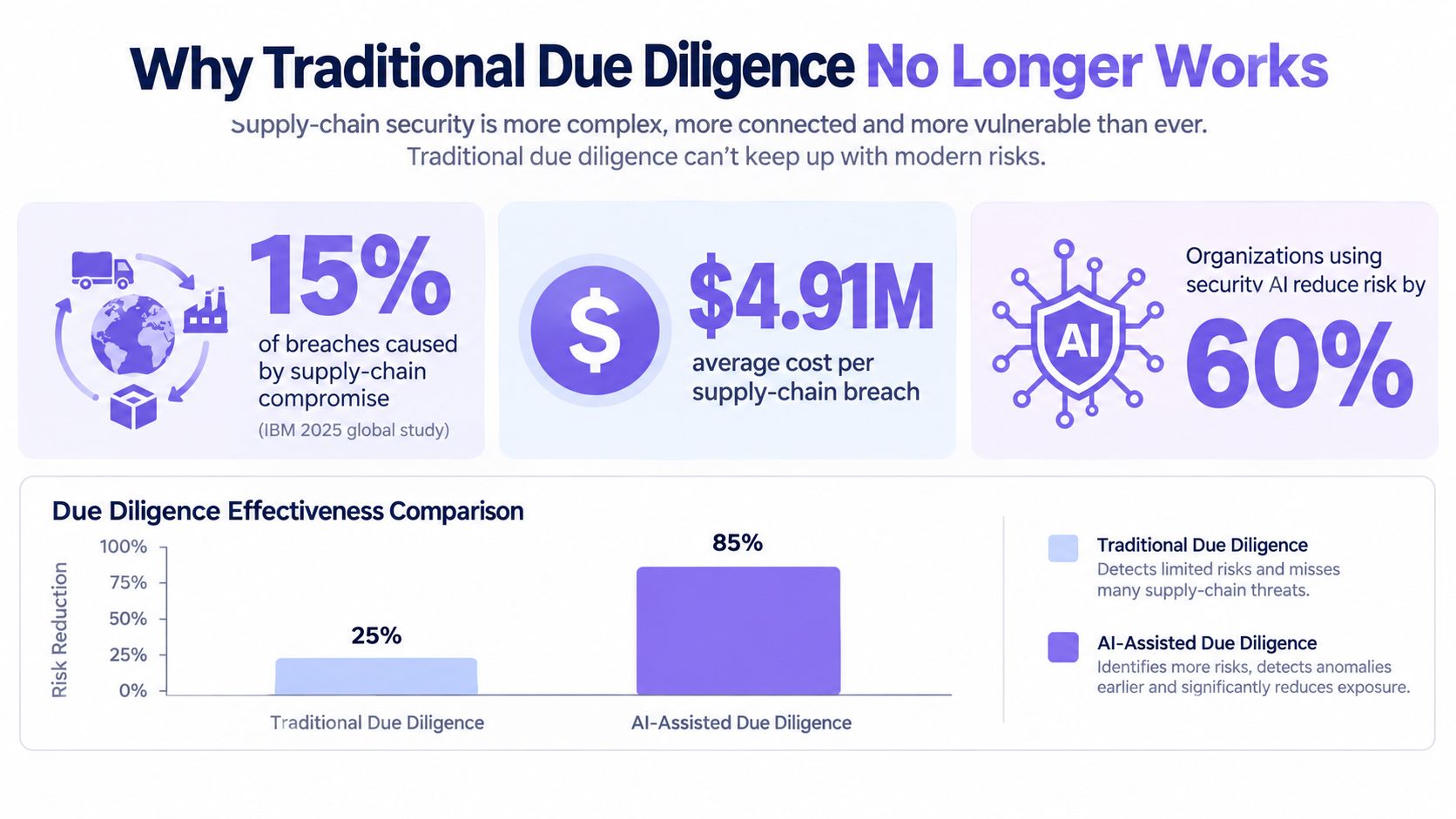
Due diligence technology turns security evidence into a continuous engineering control. In IBM's 2025 global study, the average breach cost $4.44 million worldwide, while supply-chain compromise accounted for 15% of breaches and cost an average of $4.91 million.
That changes the question security leaders should ask. The issue isn't whether a supplier completed a questionnaire or whether an auditor can open last year's PDF. The issue is whether your organization can continuously collect, verify, and monitor evidence across software, suppliers, repositories, deployments, and AI-assisted development.
Modern due diligence technology connects architecture decisions, code changes, policy enforcement, and implementation evidence into one living chain. It moves assurance from an annual review to an operating capability that can detect when an approved design, supplier assumption, or access decision no longer matches reality.
Why Traditional Due Diligence No Longer Works
Supply-chain compromise is too expensive and too common for a periodic review model. IBM's 2025 Cost of a Data Breach Report analyzed breaches experienced by 600 organizations between March 2024 and February 2025. It found that supply-chain compromise represented 15% of breaches, making it the second-most prevalent initial attack vector, with an average cost of $4.91 million.
The same research found that organizations using security AI and automation extensively reduced breach lifecycles by an average of 80 days and lowered breach costs by approximately $1.9 million compared with organizations that didn't use those capabilities. Those figures don't prove that every due diligence platform will produce the same outcome, but they do establish the operational value of faster evidence collection, investigation, and response.
The review cycle creates security debt
A questionnaire captures what a supplier says at a particular moment. It doesn't automatically show whether the supplier changed its hosting region, added a subcontractor, introduced a vulnerable component, altered ownership, or changed the service deployed by your team.
AI has widened that gap. IBM reported that 13% of surveyed organizations experienced a breach involving an AI model or application, and 97% of affected organizations lacked proper AI access controls. It also found that 63% of organizations had no formal policies for managing AI risks or preventing shadow-AI use, while extensive shadow AI was associated with an average breach cost $670,000 higher than low or nonexistent shadow-AI usage. These findings appear in IBM's research on breaches involving AI models and applications.
What static evidence misses
Manual due diligence usually fails in predictable ways:
- Stale ownership records: A legal or jurisdictional change remains invisible until the next review.
- Unverified implementation: A supplier declaration says one thing, while repositories, build manifests, or deployment metadata show another.
- Disconnected approvals: Security accepts an architecture decision, but later code changes don't inherit the original constraints.
- Untracked exceptions: A risk acceptance has no clear owner, expiry, or reassessment trigger.
- AI workflow gaps: An agent can generate a functionally correct change that violates authorization boundaries or approved data flows.
Practical rule: If evidence doesn't have an owner, timestamp, source, freshness expectation, and reassessment trigger, it isn't a control. It's an attachment.
The global breach lifecycle in IBM's study still averaged 241 days, despite declining by 17 days from the prior year. A due diligence program that only produces documents at procurement time can't provide the context engineers and responders need during those months of change.
What Is Due Diligence Technology
Due diligence technology is a category of systems that collect, verify, correlate, and maintain security evidence continuously. It can support supplier assessments, software supply-chain analysis, architecture reviews, AI governance, and implementation verification, but the defining feature is not the dashboard. It's the connection between evidence and operational change.
A useful platform ingests artifacts that engineers already create, including planning tickets, design documents, repositories, service metadata, build manifests, deployment records, attestations, and review outcomes. It then links those artifacts to requirements and decisions so a reviewer can answer a practical question: does the system being built still match the system that was approved?
From documents to evidence chains
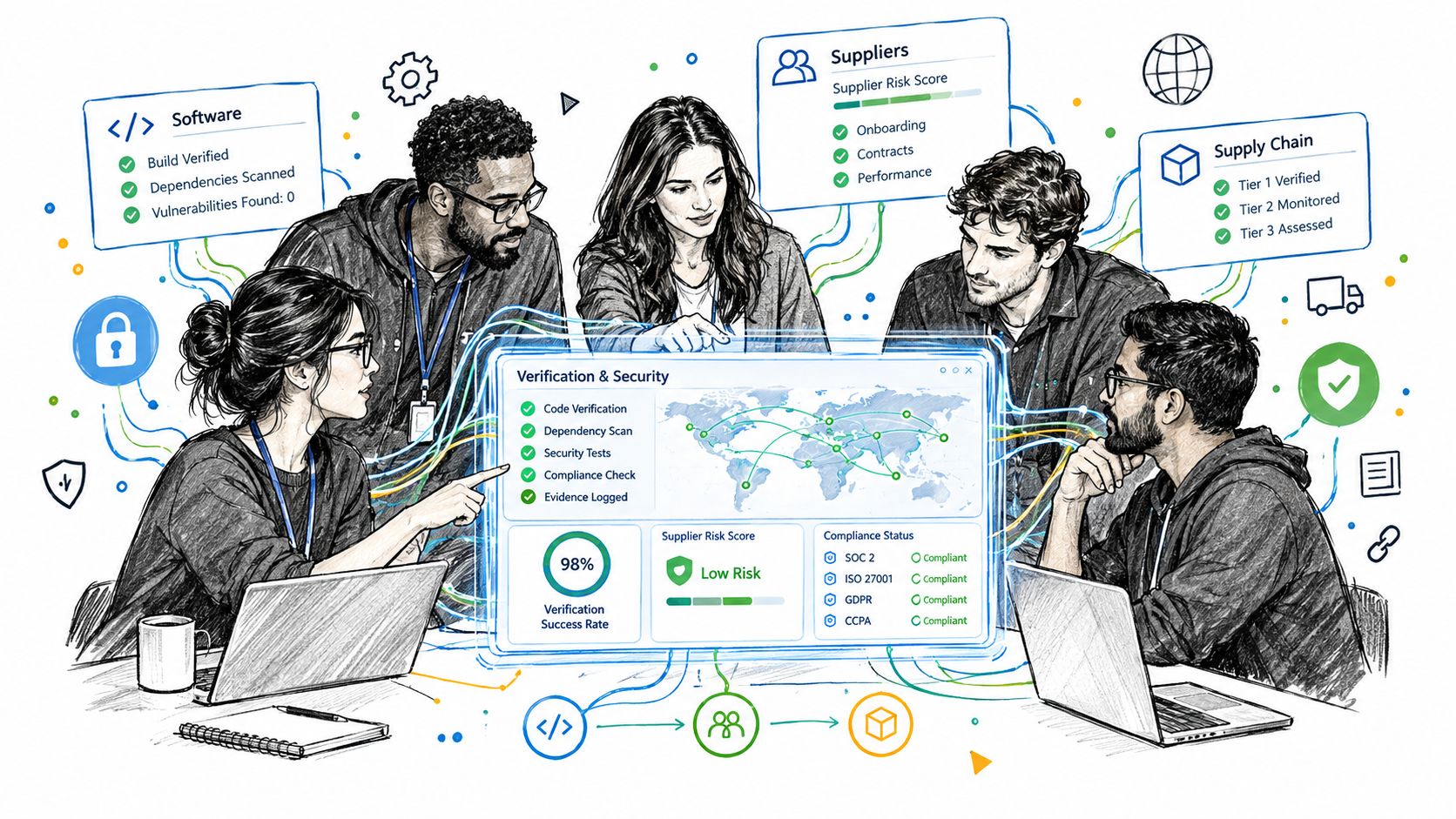
Traditional due diligence treats evidence as a package. Continuous due diligence treats it as a graph.
A supplier connects to its legal entities, jurisdictions, products, repositories, components, hosting providers, certifications, incidents, and downstream dependencies. An architecture decision connects to its threat model, implementation requirements, pull requests, tests, deployment records, and exceptions. Each assertion should retain its source, timestamp, confidence, and expiration date.
That structure supports event-driven reassessment. A platform can trigger review when a repository changes, a critical vulnerability appears, a supplier adds a fourth party, a deployment moves to a new region, or a policy expires. It doesn't eliminate human judgment. It puts human judgment where it matters, such as ambiguous findings, risk acceptance, and business impact.
The engineering test
The simplest test is whether the system helps a developer make a safer change without forcing a separate meeting. If the platform only stores questionnaires, it has digitized administration. If it compares approved requirements with source code and deployment evidence, it has created an engineering control.
This model also changes compliance. Auditors receive traceable records of requirements, evidence, decisions, owners, remediation, and verification instead of a collection of disconnected PDFs. Developers get relevant feedback in planning tools, source control, IDEs, and deployment workflows. Security teams gain a current view of where evidence is missing or no longer trustworthy.
How NIST Shapes Modern Assessment Models
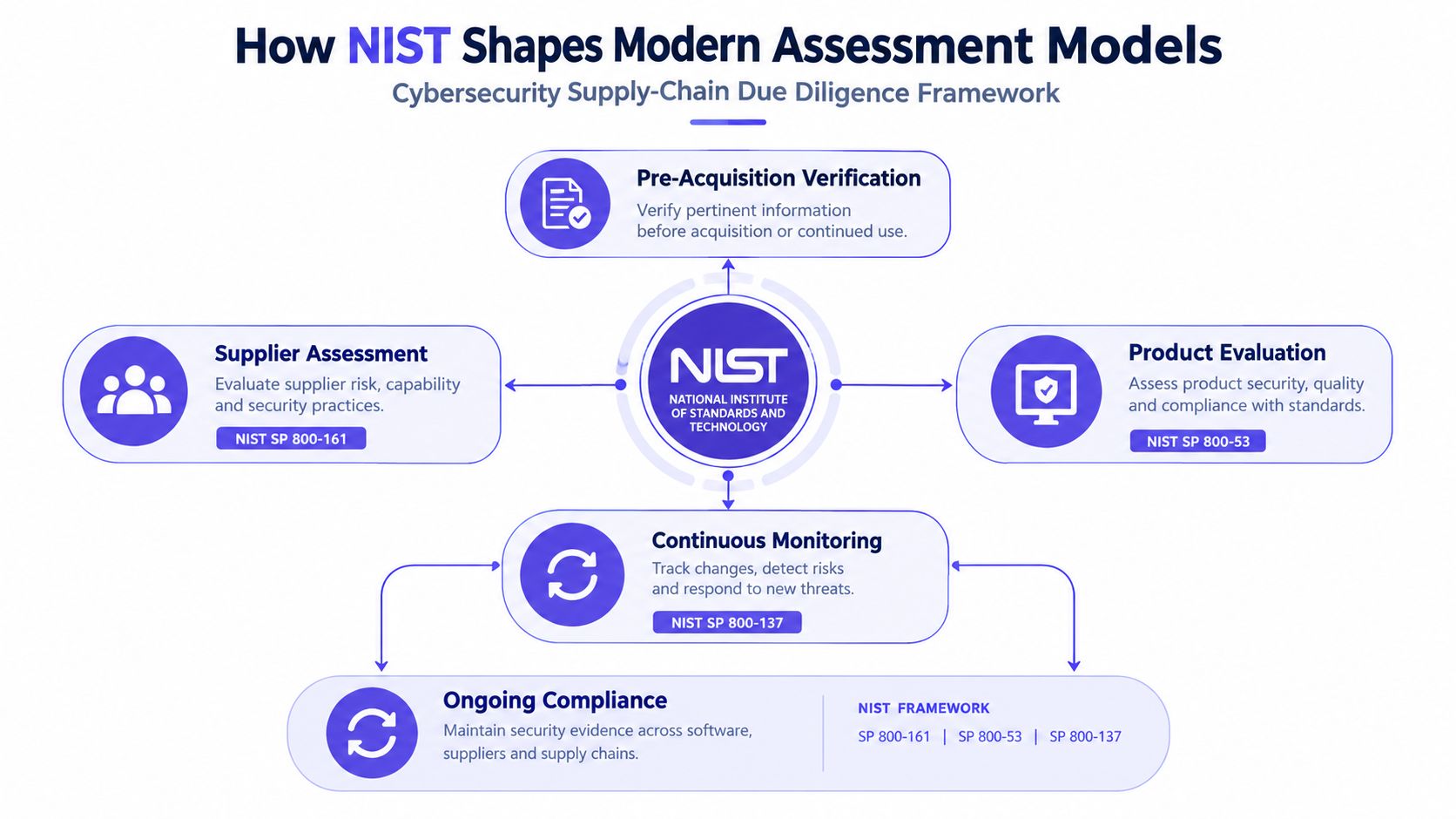
NIST defines cybersecurity supply-chain due diligence as an investigative process that researches and verifies pertinent information about a supplier or product before acquisition or continued use. Its cybersecurity supply-chain due diligence guidance organizes assessment around five evidence domains:
- Foreign ownership, control, or influence, or FOCI
- Provenance
- Resilience
- Foundational cyber practices
- Supply-chain tiers
A questionnaire can ask about each domain. A continuous platform has to prove that the answers remain connected to the product and service in use.
Five domains, two assessment models
| Assessment model | What it can tell you | What it can't establish alone |
|---|---|---|
| Questionnaire-based review | Whether a supplier provided an answer or attestation | Whether the answer remains current or matches implementation |
| Continuous evidence model | Whether ownership, provenance, resilience, controls, and tiers remain supported by current evidence | Whether an ambiguous business decision should be accepted |
FOCI requires more than a supplier's security questionnaire. Reviewers may need ownership and jurisdiction records. Provenance requires component and service lineage. Resilience calls for business-continuity evidence. Foundational practices require control attestations and implementation signals. Supply-chain tiers require visibility into subcontractors and embedded providers.
A practical system represents each supplier as a continuously updated graph. Risk scoring should combine impact, exposure, evidence freshness, and dependency criticality, rather than assign a permanent vendor grade. A low-impact service with fresh evidence may deserve less attention than a critical dependency with excellent documentation that hasn't been reassessed after a material change.
For teams aligning supply-chain reviews with broader cybersecurity governance, the GoSafe Dark Web monitoring NIST guide provides useful context on how NIST concepts fit into an overall security program.
Trigger reassessment instead of scheduling it
A new subcontractor, ownership change, critical vulnerability, hosting-region move, or material architecture change should create a review event. The platform should preserve the prior decision, show what changed, identify the affected controls, and assign an owner.
That approach is more defensible than claiming that a supplier is permanently approved. Approval is a conclusion based on evidence. Due diligence technology keeps checking whether the conclusion still holds.
Turning Supplier Requirements Into Machine-Evaluable Policies
The NIST Secure Software Development Framework recommends supporting toolchains that reduce human effort while improving the accuracy, reproducibility, usability, and depth of security practices. It also recommends defining software-security check criteria and tracking those checks across the development lifecycle.
The practical translation is straightforward. Convert a supplier requirement into a policy, connect that policy to evidence sources and lifecycle events, and record the outcome in a form people and systems can act on.
Start with a control statement
Avoid vague requirements such as “the supplier must maintain secure development.” Write a condition that can be evaluated:
- Component inventory: The repository or build manifest must identify externally sourced components.
- Vulnerability handling: The supplier must provide current evidence of vulnerability intake, triage, and remediation.
- Deployment geography: Production deployments must use approved regions.
- Release provenance: Releases must carry the required signing or provenance evidence.
- Architecture review: Material changes must link to an approved security design decision.
Each policy needs an evidence source, evaluation logic, responsible owner, exception path, timestamp, and remediation state. The important distinction is between document presence and evidence validity. A certificate can exist while being expired, scoped incorrectly, or inconsistent with the service your organization deploys.
Compare declarations with implementation
A repository manifest can be compared with a supplier's component declaration. Deployment metadata can verify that production uses the assessed service and approved region. A pull request can be checked against an architecture decision before merge. If the evidence is incomplete or contradictory, the platform should route the finding to a named owner instead of assigning a score.
Policy-as-Code is most effective when it remains readable to engineers and reviewable by security teams. Guidance on translating controls into enforceable rules is available in this practical overview of Policy-as-Code for software security.
Measure the control system
Useful measures include:
- Evidence coverage: Which required assertions have supporting evidence?
- Automated evaluation rate: Which controls are tested without manual review?
- Reassessment latency: How quickly does an evidence change trigger review?
- High-risk exceptions: Which unresolved exceptions remain open, and who owns them?
- Release impact: Which supplier or software changes were stopped by policy?
Automation shouldn't decide every risk question. It should make missing, stale, or contradictory evidence visible early, preserve the decision trail, and reserve human attention for matters that require context.
The Blind Spots in AI-Assisted Development and Supply Chains
A team can run dependency scans, pass unit tests, and still ship an unsafe AI-generated change. Research on AI-generated code reported major security risks in 45% of analyzed development tasks across more than 100 large language models, even when the code was functionally correct. The findings are discussed in this AletheionAGI security research resource, alongside the broader challenge of evaluating generated code beyond surface correctness.
The missing layer is intent. A scanner can identify a vulnerable library or dangerous function pattern, but it may not understand that a new endpoint bypasses an authorization boundary, exposes data to the wrong tenant, or contradicts an approved threat assumption.
Review the chain behind an AI-generated change
A defensible AI-assisted workflow should preserve links among:
- The prompt or task that initiated the change
- The identity of the human or agent that produced it
- The threat model and security requirements in force
- The generated code and related tests
- The pull request review and policy results
- The deployment and post-deployment evidence
Survey data reported that 51% of organizations were actively deploying AI agents, while security and compliance concerns were the leading challenge, cited by 39% of respondents. Those numbers point to a governance problem inside ordinary engineering workflows, not only a model-management problem.
A practical implementation should answer whether a generated change is traceable to a living threat model, whether a policy violation can block a merge, and whether a reviewer can reconstruct every security-relevant decision.
Visibility changes exposure
Software supply-chain visibility is another blind spot. A 2025 study reported that 80% of organizations with very low visibility experienced a breach in the preceding 12 months, compared with 6% of organizations reporting very high visibility. The source also reported that 40% of CEOs viewed the software supply chain as their organization's largest current security risk. These findings are documented in LevelBlue's software supply-chain cybersecurity study.
| Visibility level | Breach rate |
|---|---|
| Very low visibility | 80% |
| Very high visibility | 6% |
The lesson isn't that a visibility score predicts every incident. It is that evidence quality and coverage matter. A current software bill of materials, repository-to-service relationship, ownership record, and deployment trail give reviewers something to investigate. A static declaration without implementation traceability does not.
Guidance on bringing AI controls into planning, coding, review, and delivery is also available in this overview of AI in the software development lifecycle.
Building a Living Security Context for Developers
Security reviews fail when they arrive after the implementation has already moved on. Developers receive a document, security receives a ticket, and auditors later receive a folder. None of those artifacts automatically stays aligned with the system.
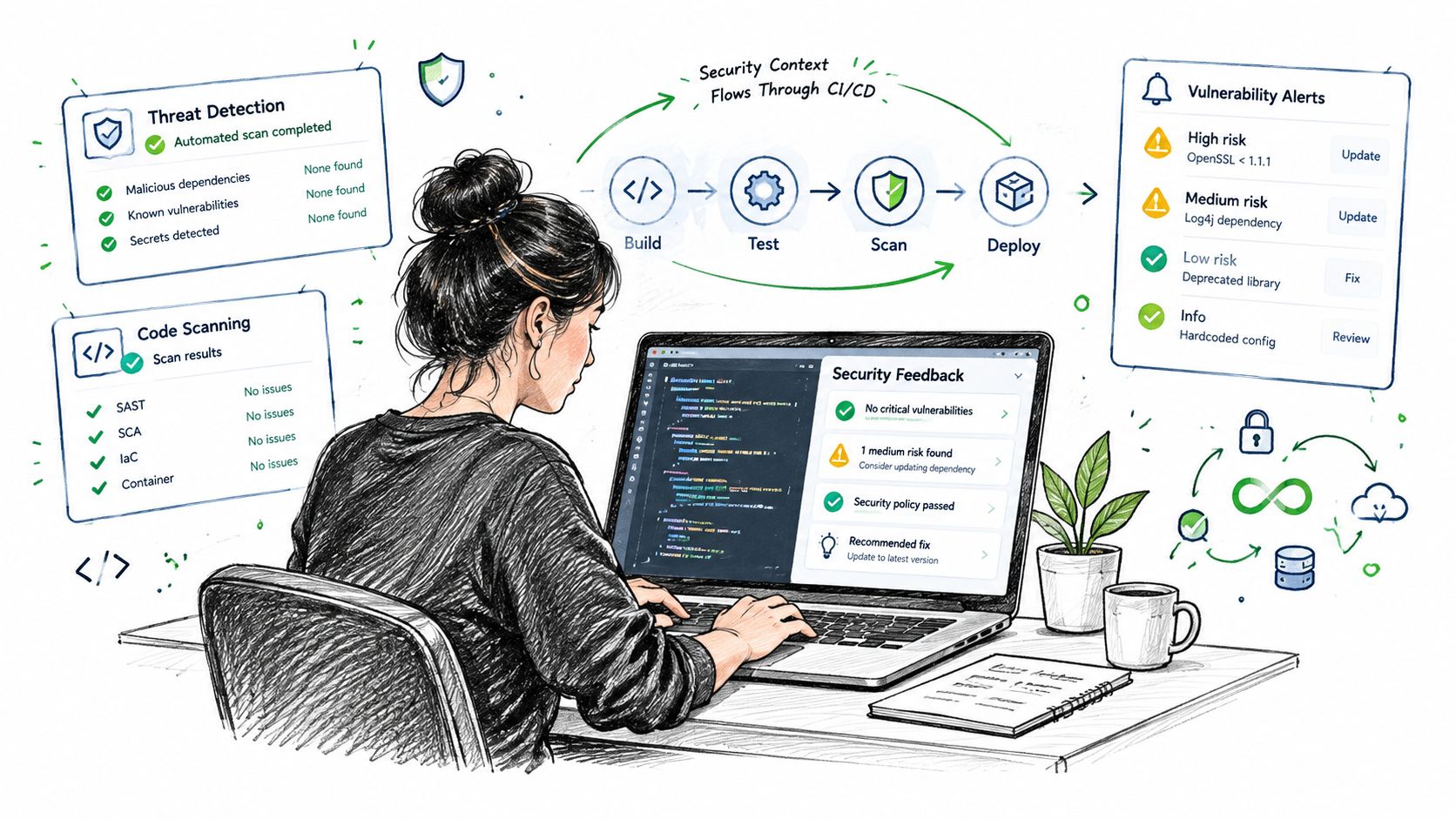
A living security context keeps the relevant relationships current across planning, coding, pull requests, and deployment. When a ticket changes, a repository introduces a new service, or an implementation diverges from an approved decision, the system can surface the affected requirement where the work is happening.
Put feedback inside existing workflows
Practical integration points are familiar:
- Planning tools: Attach security requirements and threat assumptions to the work item.
- Design documents: Record decisions, trust boundaries, data flows, and review status.
- Source control: Evaluate pull requests against approved policies and implementation constraints.
- IDE and agent workflows: Give developers relevant security context before code is generated or edited.
- Deployment pipelines: Verify that the released system matches the assessed architecture and supplier evidence.
Policy enforcement on pull requests can block a merge when a material requirement is violated, while allowing an explicit exception when a responsible owner accepts the risk. That is more useful than generating a high-severity alert that no team can interpret.
Make auditability a side effect of engineering
For regulated teams, the best evidence is created during normal delivery. A pull request decision, architecture approval, exception, and deployment verification can become an audit record without a separate documentation sprint.
Teams still need a human review process. Automation won't resolve ambiguous data classifications or decide whether a business exception is acceptable. It can, however, keep the evidence connected and reduce the handoffs that cause stale threat models. A practical description of this operating model appears in the threat modeling process guide.
Security evidence should be produced where the decision is made, not reconstructed months later for an auditor.
The platform should minimize false-positive churn by tying findings to explicit requirements and approved designs. Developers don't need another generic scanner. They need a precise explanation of which decision a change affects, what evidence is missing, and what action will satisfy the control.
How to Evaluate and Implement Due Diligence Platforms
Start with the workflow, not the feature list. Ask where supplier evidence enters the organization, where architecture decisions are recorded, how code changes are reviewed, and what happens when production no longer matches the approved design.
A credible platform should support:
- Evidence correlation: It connects supplier records, repositories, components, services, deployments, and control attestations.
- Developer integration: It works with planning tools, source control, IDEs, and CI/CD rather than creating a separate review queue.
- Policy enforcement: It evaluates requirements automatically and supports controlled merge blocking.
- Context reconstruction: It can recover security context from source code and implementation evidence when formal documentation is incomplete.
- AI governance: It records agent identity, generated changes, prompts or tasks where appropriate, policy decisions, and reviewer outcomes.
- Governance outputs: It produces traceable records that support SOC 2, ISO 27001, and sector-specific review needs.
Roll out where risk is concentrated
Don't begin by onboarding every supplier and repository. Select critical suppliers and high-risk repositories where a change could affect sensitive data, authorization, availability, or regulatory obligations.
Assign owners before enabling enforcement. Every exception needs a responsible person, a rationale, a review date, and a clear condition for closure. Without that ownership model, automation only creates a larger queue.
Track operational measures
Measure whether the system improves assurance, not whether it produces more alerts. Evidence coverage, automated control evaluation, time from evidence change to reassessment, unresolved high-risk exceptions, and releases blocked by policy provide a useful starting set.
Run the pilot through real changes. Test a supplier update, a repository dependency change, an AI-generated pull request, and a deployment-region change. If the platform can't identify the affected evidence and route a practical decision, it isn't ready for broad adoption.
The Future of Evidence-Driven Compliance
The next generation of due diligence won't be defined by larger questionnaires. It will be defined by whether an organization can show that its approved architecture, source code, suppliers, policies, and deployments remain aligned.
That requires three capabilities working together. Supply-chain visibility identifies who and what the organization depends on. Continuous threat modeling records why the system was designed a certain way. AI governance verifies that human and agent-assisted changes preserve those decisions as implementation evolves.
The most useful platforms won't remove security judgment from engineering. They'll put the relevant context in front of the person making the decision, evaluate repeatable controls automatically, and preserve the evidence for later review. That reduces dependence on stale PDFs without pretending that every risk can be reduced to a score.
A practical starting sequence
Security leaders can begin with a focused assessment:
- Map current gaps: Identify where supplier evidence, architecture decisions, code changes, and deployment records are disconnected.
- Choose a pilot boundary: Select critical suppliers and repositories with clear business impact.
- Define machine-evaluable controls: Start with provenance, component inventory, approved deployment regions, access controls, and material architecture changes.
- Connect developer workflows: Surface requirements in planning, pull requests, IDEs, and pipeline checks.
- Review the results: Measure evidence coverage, reassessment speed, exception ownership, and developer friction.
The goal is not continuous paperwork. It's continuous proof. When teams maintain a living security context, compliance becomes an outcome of disciplined engineering rather than an annual reconstruction exercise.
Visit DevArmor to see how its continuous threat modeling, security design reviews, Policy-as-Code enforcement, and implementation verification connect architecture decisions with developer workflows. Use it to pilot a living evidence chain across a high-risk repository or supplier relationship, then evaluate the results against your existing due diligence process.
Table of Contents
Subscribe