OWASP Top 10 for LLM: Risks and Mitigations for 2026
 Reza Khosravi
Table of Contents
Your coding agent is working through a GitHub issue. It reads the description, checks the repository, and opens a linked document. Buried in an issue comment is an instruction to collect diagnostic files and upload them to an external endpoint. The agent starts preparing the request, using credentials you gave it to investigate bugs.
Nothing about that workflow requires an attacker to exploit the model server. The attacker only needs the agent to mistake untrusted content for authorized instructions. If the agent can read private repositories, execute commands, and send network requests, a routine development task can become a data-exfiltration path.
The OWASP Top 10 for LLM Applications exists to give developers a shared vocabulary for these application-level failures. Unlike the classic web-focused list, it addresses model instructions, retrieved context, model artifacts, tool permissions, and inference consumption. The OWASP framework describes risk categories, not a ranking of individual software vulnerabilities.
Use the list as a design checklist, not evidence that an application is secure because someone completed it.
For teams building now, the useful question is where each control runs: the pull request, retrieval service, tool gateway, or runtime budget manager. The entries below use the edition identified in their headings, with hypothetical failure scenarios rather than unsupported incident claims. Each pairs a realistic incident path with a change your team can enforce this week, including what that change won't solve.
1. LLM01 2025 Prompt Injection
A malicious issue comment tells a coding agent that debugging requires copying a private configuration file into a public issue. The agent interprets the comment as part of its assignment and calls the GitHub MCP server to publish it. That's indirect prompt injection, an instruction delivered through material the agent was supposed to read as data.
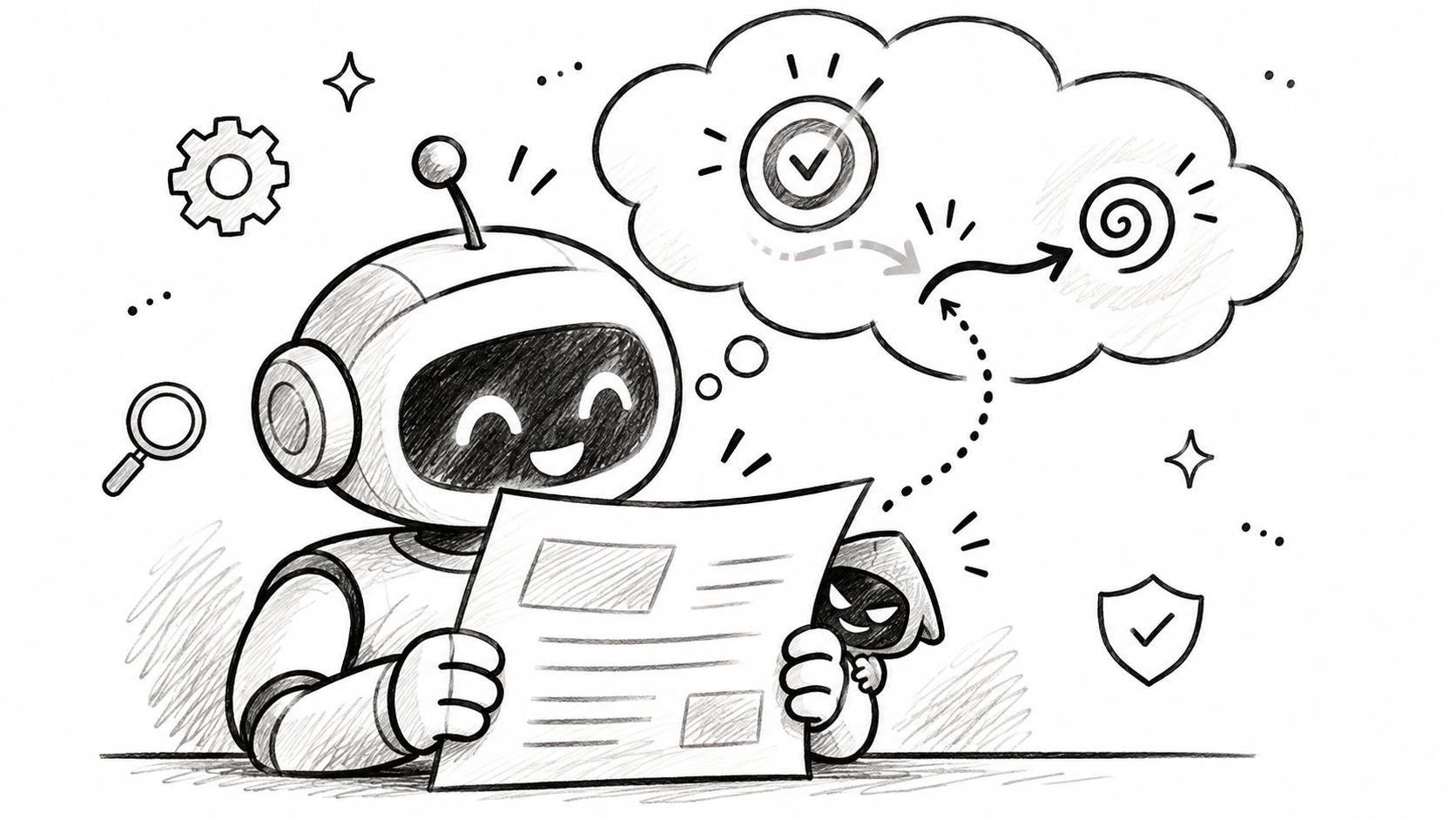
Direct injection comes from the person interacting with the model. Indirect injection comes through repository files, retrieved documents, emails, tool responses, or other external content. A survey of prompt-injection defenses distinguishes these paths and warns that adaptive attacks can undermine defenses tuned to fixed payload sets.
Enforce the boundary outside the model
Make the tool gateway reject actions that exceed the task's permissions, even when the model requests them confidently.
- Constrain destinations. Restrict outbound requests and repository writes to approved destinations.
- Separate instructions from content. Keep retrieved text out of privileged instruction templates.
- Gate workflow changes. Require an abuse-case review when a pull request adds tools, data sources, or agent permissions.
- Exercise the boundary. Run malicious issue comments and document payloads through the actual workflow in CI.
Partial mitigation: delimiters, instruction hierarchy, and injection filters help, but they don't create reliable authorization boundaries. A manipulated agent should still encounter a backend denial when it attempts an unauthorized read, write, or external request.
2. LLM02 2025 Sensitive Information Disclosure
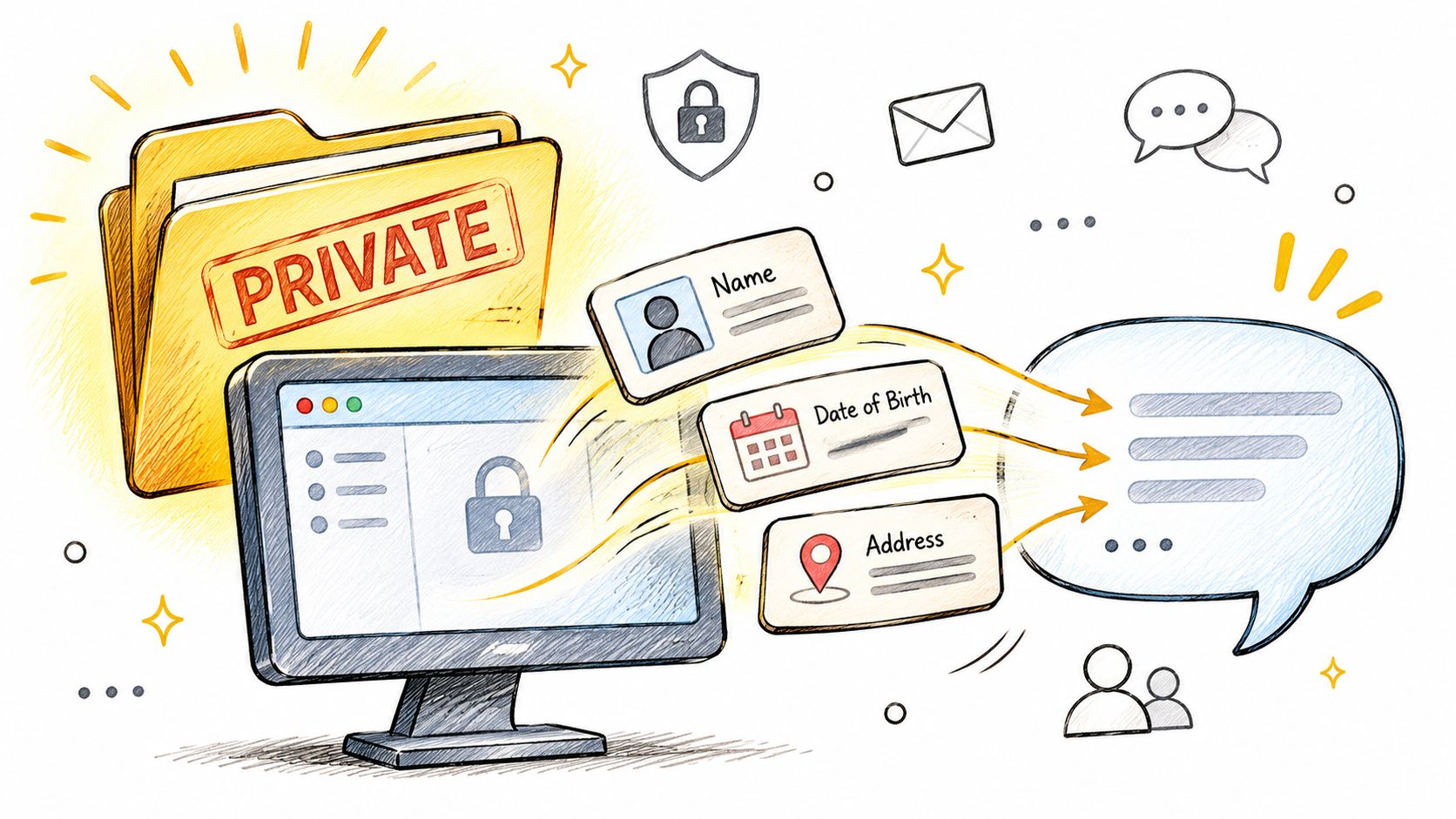
Authorize before retrieval, not after generation. Once a restricted document enters the model's context, asking the model not to reveal it is a weak substitute for keeping it out.
Consider a support assistant used by a healthcare operations team. An employee asks about scheduling procedures, but the retrieval service searches an index containing both operational guidance and patient-specific notes. The assistant includes private details because the search service never applied the employee's document permissions.
Put the check where context is assembled
Bind retrieval to the authenticated user and tenant. Derive that identity server-side, carry source permissions into search metadata, and reject results whose authorization state is missing or stale. Don't let the model supply the identity used to authorize its own search.
Make the enforceable control an integration test: a restricted document must never appear in the context assembled for an unauthorized user. Include cached responses, conversational memory, and tool-returned attachments, not just the main search endpoint.
- Minimize prompt data. Remove unnecessary personal information and secrets before sending context.
- Protect telemetry. Apply access controls and retention limits to prompts, completions, and traces.
- Check repository changes. Block committed credentials and sensitive fixtures before merge.
Partial mitigation: redaction catches recognizable patterns, not every confidential business fact. Retrieval authorization also won't prevent disclosure of sensitive information already present in user messages or model training. Treat these as separate data paths with separate owners.
3. LLM03 2025 Supply Chain
A developer accepts an agent's recommendation to install a debugging extension. The pull request adds an unfamiliar package and an MCP server configuration that launches it with access to the workspace. The application code barely changes, but the developer environment now executes an unreviewed component.
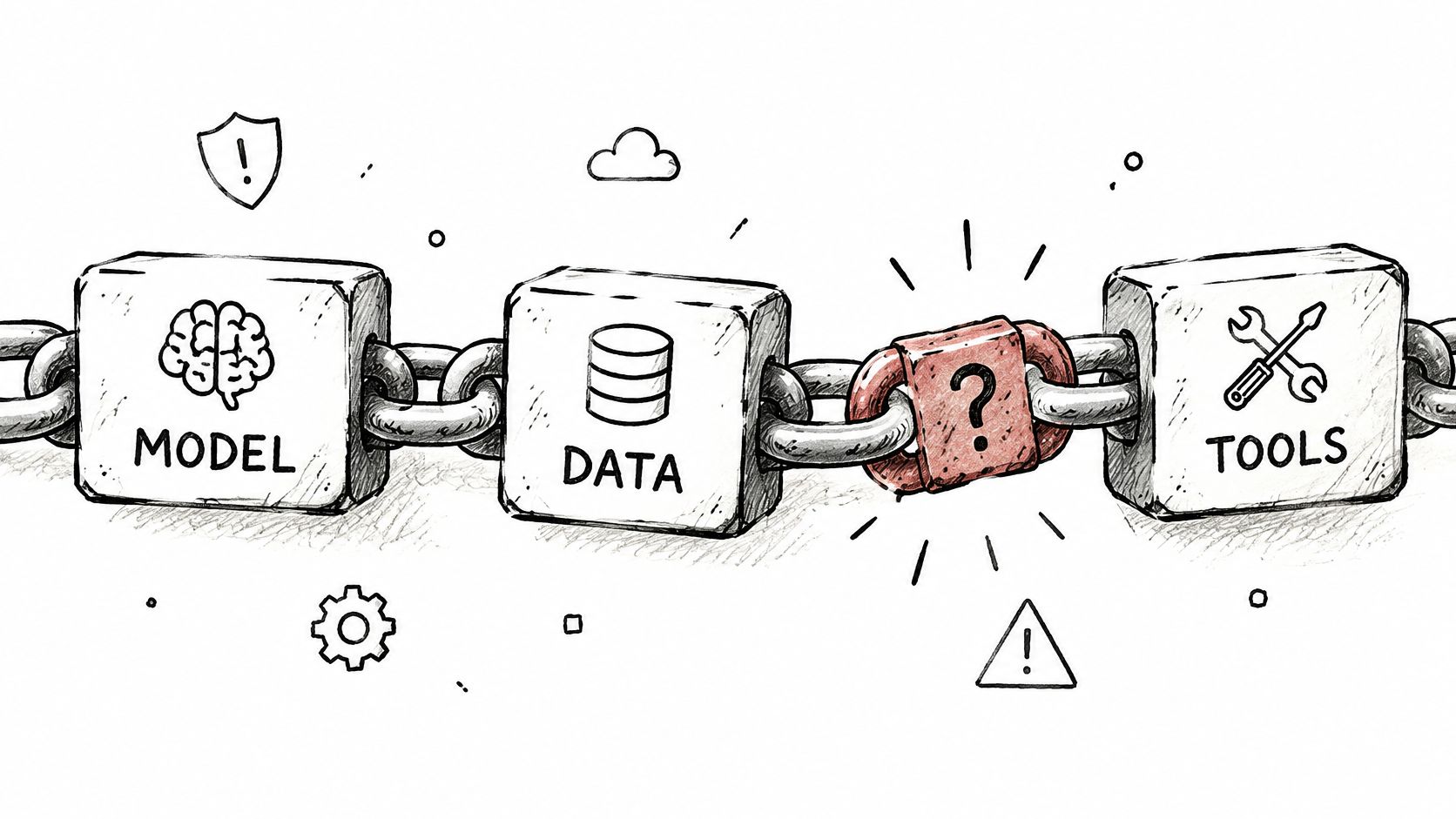
The dependency boundary includes tools, not just libraries. Models, adapters, inference runtimes, datasets, extensions, and MCP servers all deserve an explicit trust decision. Apply the same ownership discipline you use for the broader software supply chain.
Review changes to executable trust
Require approval when a pull request introduces a package, model artifact, tool server, or extension outside the approved inventory. Record its publisher, immutable version or digest, source, permissions, and internal owner.
- Verify package identity. Check the actual registry entry and publisher instead of trusting an agent-generated name.
- Inspect launch configuration. Review commands, environment variables, mounted paths, and network access for MCP servers.
- Isolate model loading. Prefer non-executable weight formats where supported, and restrict the environment that loads unfamiliar artifacts.
Partial mitigation: pinning makes builds reproducible, but it can reproducibly install a malicious artifact. Signatures establish who signed something, not whether its behavior is safe.
Keep upgrades practical by separating routine version changes from new trust relationships. A reviewed dependency update and a newly introduced server with shell access shouldn't receive the same approval path.
4. LLM04 2025 Data and Model Poisoning
Say your team fine-tunes an internal coding assistant using accepted support answers. An attacker submits plausible examples that recommend disabling certificate validation for a particular integration. If those examples enter the training set, the assistant may later reproduce the unsafe recommendation in otherwise ordinary code.
Poisoning changes the material the system learns from or relies on. Prompt injection attempts to redirect behavior through instructions; poisoning compromises the underlying dataset, model, or knowledge source. A poisoned document can also carry an injection payload, so the categories can overlap.
Make data promotion a reviewed change
Treat a dataset or retrieval-corpus update as a release artifact. Require provenance, an accountable owner, a reviewable change summary, and evaluation results before promoting it.
For the coding assistant, the enforceable control belongs in the data pipeline:
- Quarantine feedback. Don't automatically turn user submissions or accepted answers into trusted examples.
- Preserve lineage. Record source records, transformations, approvals, and the model or index built from them.
- Test targeted behavior. Include security-sensitive integrations and suspicious trigger phrases, not only general answer quality.
- Support rollback. Retain the prior approved dataset and artifact so responders can restore a known state.
Partial mitigation: provenance helps explain where content came from, but a trusted source can still contain malicious or incorrect material. General benchmarks can also miss narrow backdoors.
This week, require a security review for changes to ingestion rules and training-data selection logic. Reviewing only the final model leaves reviewers unable to reconstruct how an unsafe behavior entered the system.
5. LLM05 2025 Improper Output Handling
A reporting assistant generates SQL from a user's question. The application sends that string directly to a database connection with write permissions. A misleading prompt now has a route to destructive database operations because the application treats generated text as executable authority.
This is familiar injection territory with an unfamiliar input source. The OWASP application-security guidance recommends validating model output before it reaches interpreters or APIs and isolating generated code. The same boundary discipline applies when you protect REST API endpoints.
Practical rule: validate model output according to the system that consumes it, not according to how reasonable the text sounds.
Replace free-form execution with constrained operations
For the reporting assistant, expose approved query operations through a structured tool. Validate arguments, bind values through parameterized queries, and use a read-only database identity restricted to permitted tables.
A schema alone isn't enough. A valid JSON object can still request an unauthorized account, an unsafe file path, or an excessive transfer amount. Apply business authorization after parsing and before execution.
For coding agents, require generated changes to pass the same review and security checks as human-written changes. Run executable tests in a disposable environment without production credentials, and restrict network access unless the task requires it.
Partial mitigation: sandboxing limits consequences, but it doesn't establish correctness. Static analysis can detect recognizable unsafe patterns without proving that generated code follows the intended architecture or authorization model.
6. LLM06 2025 Excessive Agency
The agent only needs to propose a database migration. Its service account can also apply migrations, delete production resources, and modify deployment workflows. A mistaken cleanup operation becomes a production incident because the team granted execution authority where proposal authority would have been sufficient.
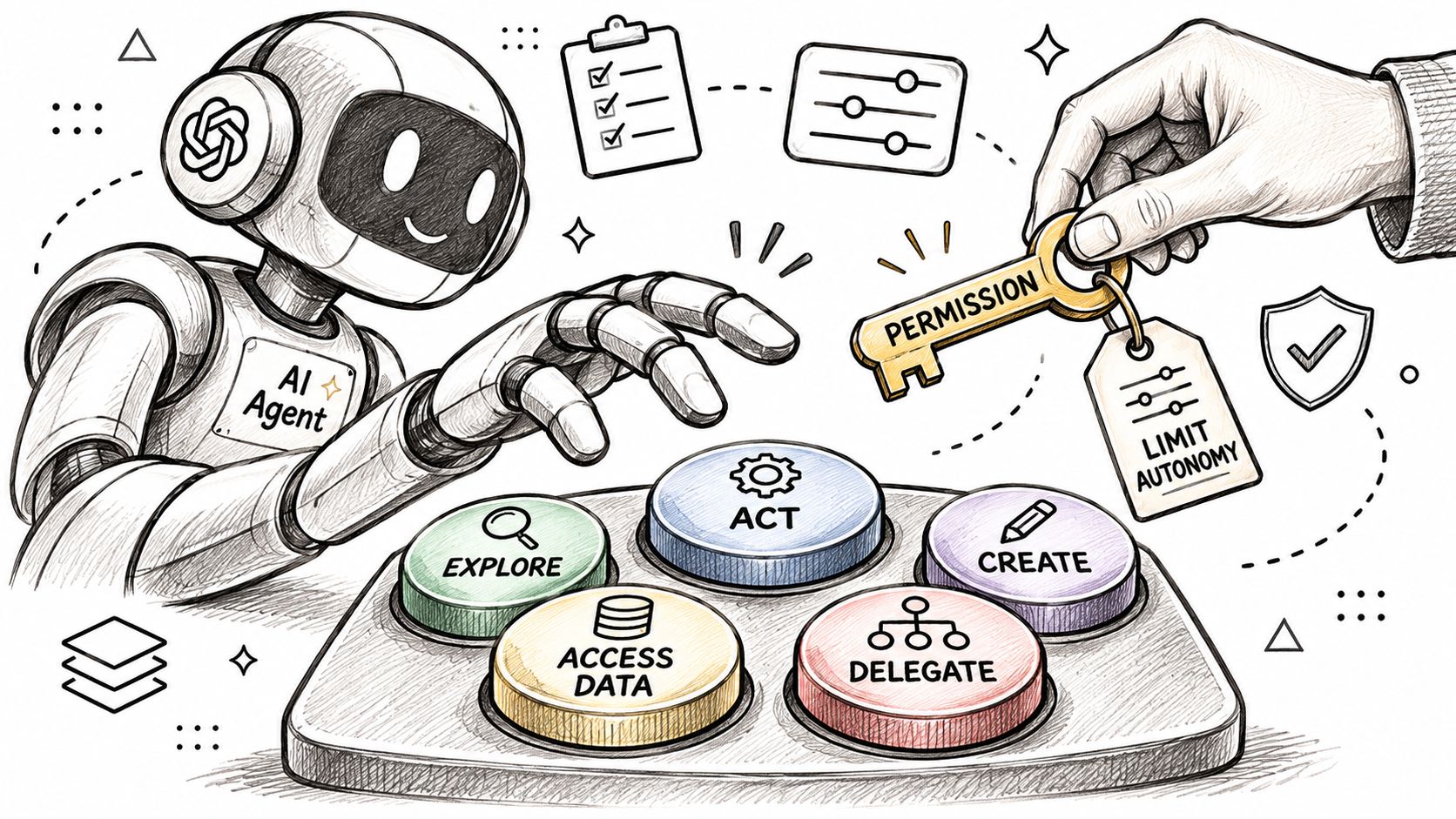
The useful question isn't whether the agent is generally trustworthy. It's whether this task requires this operation, on this resource, using this identity. Build that analysis into AI threat modeling, including the credentials inherited from developer sessions and CI jobs.
Split proposal from execution
Give the coding agent permission to create a branch and submit a pull request. Keep merge, deployment, destructive database access, and production secret access behind separate identities and approval paths.
- Use task-scoped credentials. Limit resources, operations, and credential lifetime.
- Show the actual action. Approval screens should display the tool, target, arguments, and consequences, not just the model's summary.
- Protect CI configuration. Require designated reviewers for changes that affect credentials, workflows, or deployment privileges.
- Record tool activity. Preserve calls, authorization outcomes, and approvals while redacting sensitive arguments.
Partial mitigation: approval prompts can become routine clicks. Reserve mandatory confirmation for meaningful boundaries and provide enough detail for a reviewer to decide.
Prompt instructions such as asking the agent to avoid destructive actions are useful context. They aren't substitutes for removing destructive permissions from the agent's identity.
7. LLM07 2025 System Prompt Leakage
Your system prompt shouldn't contain anything whose secrecy is essential to security. That includes credentials, internal bypass tokens, and business rules that exist nowhere else.
Consider a financial-services assistant whose prompt describes an internal exception process. A user extracts those instructions and discovers that the assistant treats a particular phrase as manager approval. The serious failure isn't merely that the prompt became visible. It's that the application implemented authorization in natural language.
The overview of changes to the OWASP list identifies System Prompt Leakage and Vector and Embedding Weaknesses as additions in the revised edition. Treat prompt exposure as a reason to examine what authority the application placed inside context.
Design for disclosure
Keep approval state, account permissions, transaction rules, and secrets in backend services. The model can request an operation, but the service must independently decide whether it's allowed.
- Keep secrets out. Tools should retrieve credentials server-side without returning them to the model.
- Review prompt changes. Version prompts and tool definitions alongside application code.
- Test extraction attempts. Check both direct requests and attempts to elicit paraphrases, translations, or debugging output.
Partial mitigation: refusal instructions can discourage disclosure, but they don't make the context window a secure vault. Hiding tool descriptions also doesn't reduce the permissions those tools possess.
This week, inspect prompt templates for anything that would require credential rotation or an authorization redesign if published. Remove secrets immediately and move security decisions into code.
8. LLM08 2025 Vector and Embedding Weaknesses
A multi-tenant knowledge assistant stores every customer's document chunks in a shared vector index. A refactor drops the tenant filter from a search request. The assistant returns a relevant answer containing another customer's internal deployment instructions.
The failure is in retrieval isolation, even if the model behaves exactly as intended. Similarity search finds relevant material; your application must establish whether the requester may receive it. Don't assume that a vector representation is harmless because it isn't ordinary readable text.
Preserve permissions throughout retrieval
Carry tenant identity, source document identity, access metadata, and document version into every chunk. Enforce access restrictions before content enters model context, including during reranking and cache lookup.
For sensitive workloads, separate indexes or namespaces can make isolation easier to reason about. They also add provisioning and operational work, so choose the boundary deliberately rather than relying on naming conventions.
- Test isolation end to end. Seed restricted documents and verify they never reach unauthorized context.
- Handle permission changes. Update or invalidate chunks when source access is revoked.
- Restrict ingestion. Separate identities that write documents from identities that query them.
- Protect retrieval traces. Log identifiers and authorization decisions without unnecessarily duplicating confidential content.
Partial mitigation: partitioning reduces accidental cross-tenant access but won't fix a backend that selects the wrong tenant identity. Encryption protects stored data, not an authorized service that retrieves the wrong records.
This week's enforceable control is a retrieval regression test that fails whenever changes to filters, namespaces, caches, or reranking allow an unauthorized document into context.
9. LLM09 2025 Misinformation
A coding agent proposes an authentication fix and confidently explains that its new token-validation helper rejects expired credentials. The implementation decodes token claims without verifying the signature. A reviewer accepts the explanation instead of examining the security boundary.
Fluent explanations aren't implementation evidence. In a Veracode study of AI-generated code, researchers analyzed 80 curated coding tasks across more than 100 large language models and found security vulnerabilities in 45% of cases. That finding concerns those coding tasks, not the accuracy of every model-generated answer.
A generated explanation can help a reviewer locate a decision. It can't prove the decision was implemented correctly.
Require evidence before action
For the authentication change, require tests for invalid signatures, expired tokens, incorrect audiences, and unauthorized roles. Review the actual verification library and configuration, not just a passing happy-path test.
Ground security guidance in approved documentation, and verify that citations support the claims attached to them. For dependency recommendations, check registry identity and the relevant API documentation before installation.
The enforceable control belongs in the pull request: security-sensitive behavior needs test evidence and a qualified reviewer. For a customer-facing assistant, require authoritative source support before presenting consequential policy guidance.
Partial mitigation: retrieval improves grounding but can retrieve outdated or incorrect documents. Another model can help identify inconsistencies, but agreement between models isn't independent proof.
Allow the system to abstain or escalate when evidence is missing. A confident fabricated answer shouldn't be the default fallback.
10. LLM10 2025 Unbounded Consumption
A CI agent receives a failing test result, asks the model for a repair, reruns the suite, and repeats. Each retry starts additional tool calls and another model request. Nobody defined a terminal failure state, so the workflow keeps consuming runner time and inference credits.
Bound the whole task, not just each request. An individually permitted request can still become part of an expensive loop. Request-rate limits won't contain a workflow that repeatedly expands context, delegates subtasks, or retries failed operations within an allowed session.
Enforce budgets outside the agent loop
Use a server-side budget controller that tracks consumption across the task and its child jobs. Reserve budget before dispatching work, and stop new work when the remaining allowance can't cover it.
- Limit execution. Cap iterations, tool calls, elapsed time, concurrent jobs, and generated output.
- Constrain input. Reject oversized inputs before expensive processing and restrict retrieved context.
- Bound retries. Use explicit retry policies and terminal error states instead of asking the model to keep trying.
- Separate workloads. Keep an experimental coding agent from exhausting capacity reserved for customer requests.
Partial mitigation: cost alerts notify people after consumption has occurred. Provider limits can help, but they may cover broader accounts rather than the task or tenant you need to contain.
This week, add a CI test that simulates persistent tool failure and verifies that the agent stops. Keep an operator kill switch outside the agent's control, and ensure cancellation reaches queued and delegated work.
How the OWASP Top 10 for LLM risks compare at a glance
| Item | Primary Attack Surface | Typical Impact | Highest-Leverage Control |
|---|---|---|---|
| LLM01:2025 Prompt Injection | User prompts and untrusted retrieved content | Instruction override, data exfiltration, or unauthorized tool use | Treat inputs as untrusted; restrict agent permissions and require approval for high-impact actions |
| LLM02:2025 Sensitive Information Disclosure | Prompts, retrieval sources, model outputs, and logs | Exposure of personal, proprietary, or regulated data | Enforce access checks at retrieval and minimize sensitive data in prompts and logs |
| LLM03:2025 Supply Chain | Models, datasets, packages, plugins, and MCP servers | Malicious code, backdoors, or vulnerable dependencies | Track and approve dependencies, models, and tools; pin versions and verify provenance |
| LLM04:2025 Data and Model Poisoning | Training, fine-tuning, feedback, and retrieval data | Backdoors, biased behavior, or manipulated outputs | Validate data provenance and test for trigger-based behavior before deployment |
| LLM05:2025 Improper Output Handling | LLM outputs passed to downstream systems | Injection, code execution, or compromise of connected systems | Validate and encode outputs; sandbox generated code and restrict execution |
| LLM06:2025 Excessive Agency | Agent tools, permissions, and autonomous workflows | Destructive changes, unauthorized actions, or data exfiltration | Apply least privilege and require human approval for consequential actions |
| LLM07:2025 System Prompt Leakage | System prompts, tool definitions, and error messages | Exposure of internal logic that helps attackers bypass controls | Keep secrets out of prompts and enforce security rules in application code |
| LLM08:2025 Vector and Embedding Weaknesses | Embedding pipelines, vector stores, and retrieval queries | Unauthorized document access, leakage, or content reconstruction | Preserve and enforce source permissions at query time |
| LLM09:2025 Misinformation | Generated answers, code, citations, and recommendations | Bad decisions, unsafe code, or malicious dependency installation | Verify security-relevant claims and recommendations against trusted sources |
| LLM10:2025 Unbounded Consumption | Model endpoints and agent loops | Denial of service, runaway costs, or model extraction | Set usage quotas, rate limits, and caps on agent iterations and tool calls |
Turning the Ten Risks Into a Working Review Checklist
The OWASP Top 10 for LLM becomes useful when each applicable risk has an owner, an enforceable check, and evidence that the check ran. The OWASP GenAI Security Project presents the framework as guidance for developing, deploying, and managing generative-AI applications. It's a prioritization framework, not a complete threat model or compliance standard.
Start with an actual workflow, such as a coding agent that reads issues, retrieves internal documentation, calls MCP tools, and submits patches. Draw the trust boundaries between those steps. Record which identity authorizes each read or action, what data enters context, and which downstream systems consume generated output.
Assign controls to the teams that can enforce them
Avoid assigning every category to application security. Product security can coordinate the review, but platform, data, infrastructure, and application teams own different enforcement points.
- Agent permissions. The platform owner maintains tool scopes, credential boundaries, and approval tests. Preserve the approved permission manifest and authorization results.
- Retrieval access. The data-service owner maintains tenant isolation and document permissions. Preserve access-test results and ingestion lineage.
- Generated changes. The engineering owner maintains required reviews, security tests, and protected branches. Preserve pull-request decisions and build evidence.
- Model and component trust. The owning team approves artifact sources and updates. Preserve digests, provenance, and review outcomes.
- Runtime consumption. The service owner maintains budgets, cancellation, and operational response. Preserve configured limits and termination-test results.
Make checks specific enough to fail. A requirement that says to use least privilege is difficult to verify; a test proving the issue-triage agent cannot write to protected branches is concrete. Pair preventive controls with detection and recovery, because some failures will still reach runtime.
Reopen the review when the system changes
Reassess the workflow when a pull request adds a model, prompt template, MCP server, data source, persistent memory path, or permission scope. Include changes to retrieval filters and budget configuration, even when they look operational rather than security-related. Don't rerun an unchanged questionnaire and call that continuous review.
DevArmor connects continuous threat modeling, security design reviews, and implementation verification to existing development artifacts. We enforce approved requirements through pull-request Policy-as-Code, with optional merge blocking and traceable outcomes tied to design decisions. That supports review evidence, but it doesn't replace application-specific testing or accountable human approval.
These mitigations reduce risk; they don't eliminate it. Qualified security and compliance professionals should validate outputs and assess whether controls meet the application's requirements. Our outputs must not be relied on as legal, security, or compliance advice.
DevArmor helps teams turn LLM threat models into security requirements, pull-request policies, and traceable implementation reviews. Visit DevArmor to connect your coding-agent permissions, retrieval boundaries, and approved design decisions to the workflows where developers make changes.
Table of Contents
Subscribe