Null Pointer Exception Explained: Diagnose and Prevent It
 Reza Khosravi
Table of Contents
Null pointer exceptions are considered the number one uncaught crashing exception in production environments across managed runtimes. They happen when code tries to use a missing object, but the visible crash is usually only the final symptom of a null value introduced earlier.
A null reference isn't an object waiting to be used. It's the absence of an object. When Java code treats that absence as a real value, the runtime stops the operation and reports a NullPointerException, commonly shortened to NPE. The error looks simple because the failing statement is often simple. The investigation isn't.
The durable fix is rarely “add a null check on line 42.” A reliable fix identifies which contract allowed null to travel through the system, decides whether absence is valid, and then enforces that decision through types, validation, tests, and build-time tooling.
The Reliability Cost of Null Failures
A production incident rarely begins with a dramatic algorithmic failure. A request reaches a service, a lookup returns nothing, a mapper leaves a field unset, or an external payload omits a value. Several layers continue operating until one method call finally assumes the object exists. The resulting stack trace points to the last line in that chain, not necessarily to the decision that created the problem.
That pattern explains why null failures remain central to incident response. One paper characterizes null pointer exceptions as the “number one” uncaught crashing exception in production, while another notes that managed runtimes such as Java and .NET expose null dereferences as exceptions rather than silent memory faults. The runtime gives teams a visible failure, but visibility doesn't automatically reveal the original defect. The systems research on null dereferences provides that broader context.
Why the same crash keeps returning
Suppose a service reads a customer from a repository. The repository returns no match, the service converts that result into a DTO, and a controller logs customer.getName().toString(). A check added at the controller may stop this particular request from crashing, but it doesn't answer whether a missing customer should produce a not-found response, a default value, or a domain error.
That distinction matters for reliability and security. A null may represent an invalid request, a missing permission-controlled record, incomplete configuration, or malformed data crossing a trust boundary. Treating every case as an empty string can hide a contract violation and send incomplete state into later operations.
Practical rule: Fix the crashing expression, then find the earliest point where the program permitted an unexpected null.
Null failures also create maintenance cost. A team that patches symptoms one by one accumulates inconsistent behavior, scattered checks, and uncertainty about which methods accept null. For organizations modernizing older services, a structured Software Modernization Intelligence guide can help frame this work as an architectural reliability concern rather than a collection of isolated defects.
The most useful question isn't “where did Java throw?” It's “who produced a value that violated the next component's expectation?”
How Null Dereferences Actually Fail
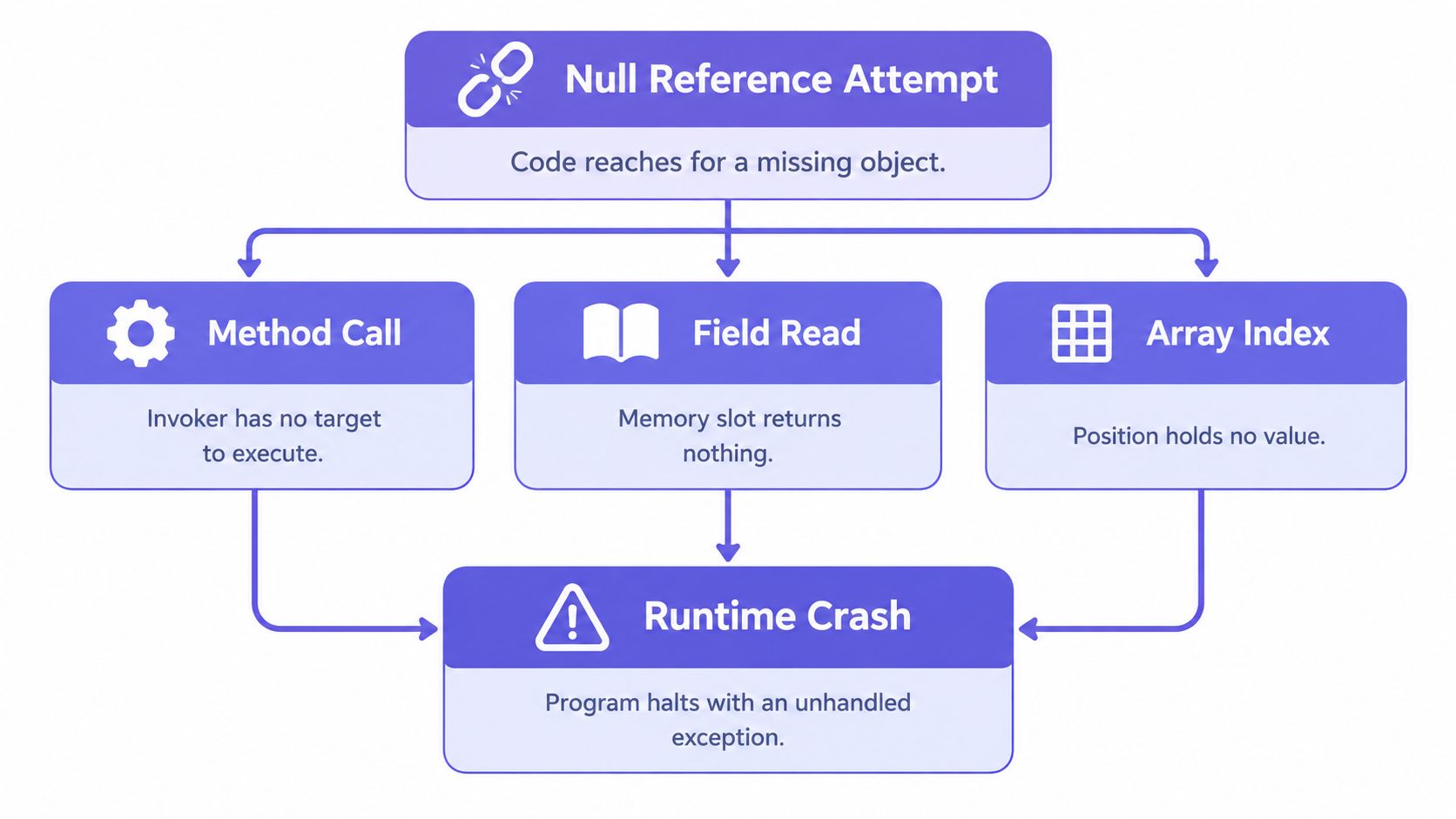
Java has included NullPointerException since JDK 1.0. Oracle's documentation describes it as an exception thrown when code uses null where an object is required, including calling a method, reading or writing a field, or taking the length of a null array reference. The language specification treats these operations as abrupt completions, meaning normal evaluation stops and control moves into exception handling or terminates the current operation.
Consider the difference between holding a reference and holding an object:
User user = findUser(id);return user.getName();The variable user can contain a reference to a User instance, or it can contain null. The declaration compiles because traditional Java types don't always express whether a reference may be absent. The failure occurs only when getName() requires a target object and the runtime finds none.
The operations that trigger the exception
Common dereference operations include:
- Method calls:
user.getName()requiresuserto exist. - Field access:
user.profilerequiresuserto exist before the field can be read. - Array use:
items.lengthoritems[index]requires a non-null array reference. - Unboxing: assigning a nullable wrapper such as
Integerto anintcan require Java to extract a primitive value from a missing object.
Multiple dereferences can appear on one line:
return order.getCustomer().getAddress().getCity().trim();The runtime may fail because order, getCustomer(), getAddress(), getCity(), or the value returned by trim()'s receiver is null. The line is compact, but it contains a chain of contracts. Helpful NPE messages in modern Java releases can identify the null expression more precisely, yet developers still need to determine why that expression was allowed to be absent.
The difference between Java and languages with stricter nullability systems is a design difference, not merely a syntax preference. Java often discovers the violation at runtime. A nullable type system, annotations, or static analyzer can flag a possible violation while code is being written or built. Guidance in this overview of code safety issues is useful when deciding whether a failure belongs in runtime handling, static checking, or both.
A runtime NPE therefore often signals an upstream contract failure. The dereference is where the program noticed the problem. The producer, mapper, lookup, deserializer, or API boundary may be where the problem began.
Reading Stack Traces to Find the Source
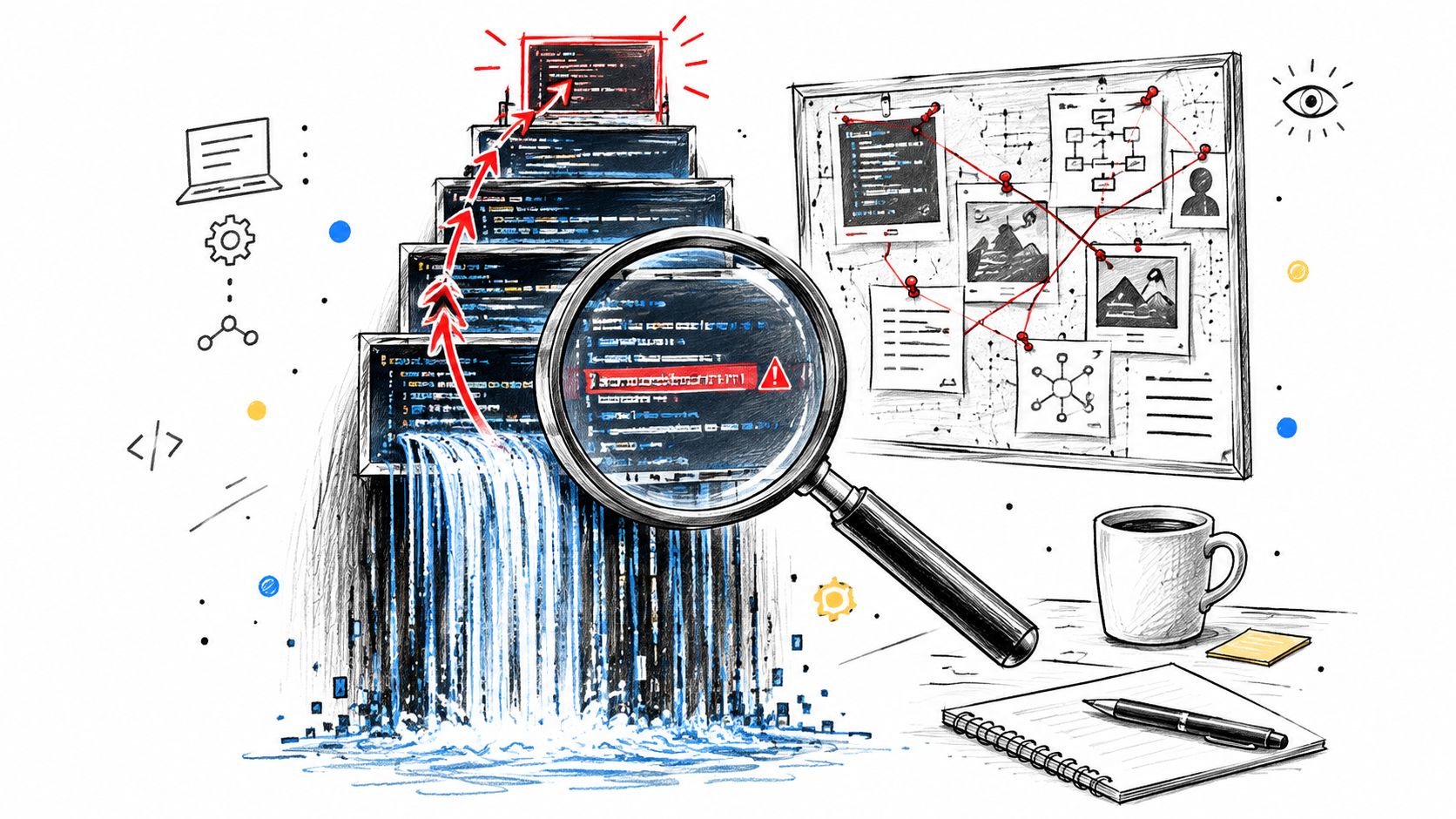
Start with the exception type and message, then locate the first stack frame belonging to your application. That frame tells you where execution stopped. It doesn't prove that the method on that line created the null.
For example:
java.lang.NullPointerException: Cannot invoke "String.trim()"because the return value of "User.getEmail()" is nullat AccountService.normalizeEmail(AccountService.java:48)at AccountController.update(AccountController.java:91)The useful clue is the expression identified in the message. If the message is less specific, inspect every dereference on the reported line and split chained expressions into named values. This turns an opaque statement into observable checkpoints.
A practical tracing sequence
Capture the complete failure context. Keep the exception message, stack trace, request or job identifier, and relevant input shape together. A line number without context encourages guesswork.
Separate the expression. Replace a chain such as
order.getCustomer().getAddress().getCity()with local variables. Log or inspect each value in a safe way, while avoiding sensitive data in production logs.Trace the producer backward. Find where the null-bearing value was assigned or returned. Check constructors, repository results, map lookups, DTO conversion, deserialization, and service responses.
Test the boundary assumption. Ask whether the producer is allowed to return null. If no result is valid, represent that possibility explicitly. If it isn't valid, reject it at the boundary with a meaningful error.
Follow alternate paths. A value may be initialized in the normal path but omitted during retries, partial updates, error handling, or older payload formats. Review every assignment and return path, not only the successful branch.
Research on null dereference debugging emphasizes that the crashing statement is often downstream from missing initialization, absent lookup results, or unexpected values entering through serialization and APIs. A root-cause workflow such as reliability team failure analysis offers a useful way to document the producer, violated expectation, detection point, and corrective control.
A small example
User user = usersById.get(userId);String city = user.getAddress().getCity();There are at least three questions here. Can the map omit the key? Can getAddress() return null? Can the city field be absent? Adding if (user == null) addresses only one possibility. The correct design might return a not-found result, reject an invalid record, or define an address as optional and handle it explicitly.
When the stack trace points into a shared utility, inspect its callers. The utility may be correct to require a non-null argument. The caller may be the component that failed to honor that requirement.
Defensive Coding Patterns That Actually Work
Null safety works best when each layer states what absence means. A missing record may be valid, while a missing payment gateway is an invalid state. The code should make that distinction visible rather than leaving callers to infer it.
| Approach | Best fit | Trade-off |
|---|---|---|
| Explicit guard | Method inputs and required collaborators | Clear failure, but repetitive if used everywhere |
Optional | Return values that may have no result | Makes absence visible, but can become awkward for fields or parameters |
| Nullable annotations | Public APIs and shared modules | Helps tools reason about contracts, but requires consistent adoption |
| Static analysis | Data-flow paths across a codebase | Finds issues before runtime, but needs configuration and developer attention |
| Runtime validation | API, configuration, and deserialization boundaries | Produces controlled errors, but detects violations only when executed |
Use guards for invalid states
Reject required dependencies during construction:
this.paymentGateway =Objects.requireNonNull(paymentGateway, "paymentGateway is required");The same rule applies to required requests. Validate them at the boundary, before business logic runs. A nearby, descriptive failure prevents an invalid object from moving through several layers and obscuring the original contract violation.
Represent valid absence directly
A repository lookup that may find no record can return Optional<User>. That return type tells the caller to select an outcome, such as a not-found response or a domain-specific exception. Optional works best for results where absence is expected. Wrapping every field or parameter in it often makes APIs harder to use without clarifying the domain.
For text conversion where null is acceptable, String.valueOf(value) can keep a logging statement from causing another failure. Use it for diagnostics only. Applying it to required business data could produce the string "null" and hide the actual defect.
Static null-safety mechanisms and annotations form a strong prevention layer because they make null contracts machine-checkable, as described by CWE-476 guidance on null pointer dereference. Static code analysis for Java can model data flow from sources to sinks and identify paths that line-by-line review misses. Runtime checks still matter for values arriving from databases, users, files, and external services.
The crashing line is often only the detection point. Trace the value upstream to its producer, then identify which contract allowed null to travel that far. Layer the controls according to that path:
- At boundaries: Validate payloads, configuration, and required fields.
- In APIs: Document nullable and non-null behavior with annotations or types.
- During builds: Run analysis and fail on newly introduced violations.
- At runtime: Add meaningful guards and diagnostics where static certainty is impossible.
- In tests: Cover missing lookup results, omitted fields, partial objects, and malformed input.
Teams reviewing broader failure controls can consult the RapidNative crash prevention guide. Layering matters more than choosing one technique. Assign each layer a clear responsibility for enforcing the contract.
Integrating Prevention Into Secure Workflows
A null dereference belongs in a secure development workflow because it often crosses trust boundaries. An API payload, database row, message, or configuration value can be incomplete for ordinary reasons, but code that assumes completeness may also mishandle malformed or unauthorized state. Preventing the crash improves availability while making boundary assumptions easier to review.
Static analysis is most effective when it runs before production. A developer can inspect a warning in an IDE, a pull request can report a newly introduced path, and a build can enforce the rules that the team has agreed are essential. The workflow should distinguish actionable contract violations from cases where absence is intentional and documented.
Turn lessons into enforceable controls
A useful policy starts with a concrete failure mode:
- Boundary policy: External inputs must be validated before business logic consumes them.
- API policy: Shared methods must declare whether inputs and outputs may be null.
- Lookup policy: Missing records must use an explicit result model or domain error.
- Analysis policy: New nullability warnings require review or remediation.
- Test policy: A bug fix must include a regression test for the violated contract.
Policy-as-code makes those expectations repeatable. Instead of relying on a reviewer remembering a past incident, the repository can apply a documented rule during code review. A practical introduction to this model is available in policy-as-code for software security.
Keep controls useful
Overly broad rules create alert fatigue. If a tool flags every nullable value without distinguishing required boundaries from intentional absence, developers learn to suppress warnings. Configure checks around high-value paths, such as request mapping, persistence adapters, shared service APIs, and security-sensitive decisions.
A good pull request check should show:
- The violated contract. For example, a method marked non-null receives a value from a nullable lookup.
- The path to the dereference. Developers need the source and sink, not just a warning label.
- The required action. Validate, change the return type, handle absence, or document a justified exception.
- The review record. Store why a suppression exists and who approved it.
DevArmor is one option for teams that want continuous threat modeling, security design reviews, and policy enforcement connected to planning tools, source control, IDEs, and coding workflows. Its policy-as-code controls can place review outcomes in the delivery process, while implementation verification connects approved decisions to code changes and deployments.
This approach also helps with AI-assisted coding. Generated code may introduce a null path that looks locally reasonable but violates an existing service contract. A living security context, explicit API requirements, and automated review checks give both human developers and coding agents constraints they can apply before a merge.
Building a Long-Term Prevention Mindset
A team that treats NPEs as isolated line failures will keep rediscovering the same class of defect. A team that treats nullability as an architectural contract can ask better questions during design, implementation, review, and incident analysis.
The durable workflow is straightforward:
- Locate the detection point. Read the stack trace and isolate the exact dereference.
- Identify the producer. Trace assignments, returns, lookups, mappings, and external inputs backward.
- Classify absence. Decide whether null is valid, invalid, or evidence of a different domain state.
- Encode the decision. Use types, annotations,
Optional, validation, or explicit exceptions. - Automate the check. Run static analysis and policy enforcement in the developer workflow.
- Protect the fix. Add a regression test that represents the original contract violation.
The key shift is from “How do I stop this line from crashing?” to “What value contract should exist between these components?” That question produces smaller debugging loops, clearer APIs, and fewer hidden assumptions.
Review your most failure-prone boundaries first. Look at deserializers, repository adapters, map lookups, DTO mappers, configuration loading, and code recently generated or changed with AI assistance. For each boundary, document whether absence is expected and make the implementation prove that it handles the answer.
DevArmor helps teams connect continuous threat modeling, security design reviews, and policy-as-code enforcement to the code and workflows where nullability decisions are made. Visit DevArmor to evaluate how those controls can support safer reviews, implementation verification, and more traceable prevention of recurring software defects.
Table of Contents
Subscribe