Compliance with Standard: What It Means and How to Keep It
 Reza Khosravi
Table of Contents
An enterprise prospect sends over a security questionnaire on Tuesday afternoon. You pull up last year's compliance spreadsheet, feel a brief wave of relief at the green cells, and then realize your engineering team has shipped two new microservices, rotated an identity provider, and wired an LLM gateway into production since anyone last touched that sheet. The certificate hanging in your virtual trust center still has a valid date on it, yet half the underlying controls no longer match the system running in production.
Most organizations treat compliance with standard frameworks as a mapping project that ends the day an auditor signs off. Teams spend weeks copying policy clauses into spreadsheets, collecting static screenshots, and celebrating a clean report. Six months later, normal engineering velocity has rewritten the architecture underneath those policies.
Real compliance isn't a binder of mapped documents. It's an operating state backed by live evidence that survives every deployment, vendor change, and model update.
What Compliance With a Standard Really Means
A B2B software company earns its ISO/IEC 27001 certificate in March. Every access control, logging rule, and change-management procedure passed external review. By September the product team has launched a public API, signed a third-party analytics contractor, and migrated a core database to a new cloud region. Nothing broke. The certificate on the company's website still looks spotless, yet the technical controls it was issued against no longer match the system running in production.
A driving license proves you passed a test on one afternoon years ago. A roadworthy inspection shows whether the brakes, tires, and lights still work today. Compliance with a standard works like the inspection: it is the active match between what a standard requires and how your organization operates right now, backed by verifiable proof that the match holds.
Demand for that formal proof has surged across industries. According to the ISO/IEC JTC 1/SC 27 Journal 2026 Issue 1, the ISO Survey recorded 96,709 valid ISO/IEC 27001 certificates worldwide in 2024, up roughly 104% from 47,291 in 2023, while a subsequent 2025 ISO Survey summary counted 125,622 accredited certificates valid at December 31, 2025, a further 29.9% increase, and the 2024 survey showed information technology as the leading sector at 4,671 certificates. Those figures count accredited certificates rather than every organization pursuing one, and survey coverage shifted between editions. The buyer expectation behind them is still unmistakable: regulated customers expect documented, independently assessed controls that stay connected to live code and operations.
The Three Parts Behind Every Defensible Claim
Any compliance statement falls apart when one of its structural pillars goes missing. The same holds anywhere a claim depends on a chain of proof: in a payer dispute, the documents and deadlines for SCA appeals determine whether an underpayment claim survives, and in a security audit the chain from requirement to evidence determines whether yours does.
- The requirement: The specific clause, legal obligation, or contractual rule your organization agreed to meet. Without a named requirement, a security test is just good engineering hygiene rather than compliance proof.
- The control: The concrete technical or operational mechanism (such as branch protection, encryption enforcement, or quarterly access reviews) that satisfies the requirement in practice.
- The evidence: Objective, time-stamped proof that the control ran as intended against the current system. A documented control with no operational record is an unverified promise.
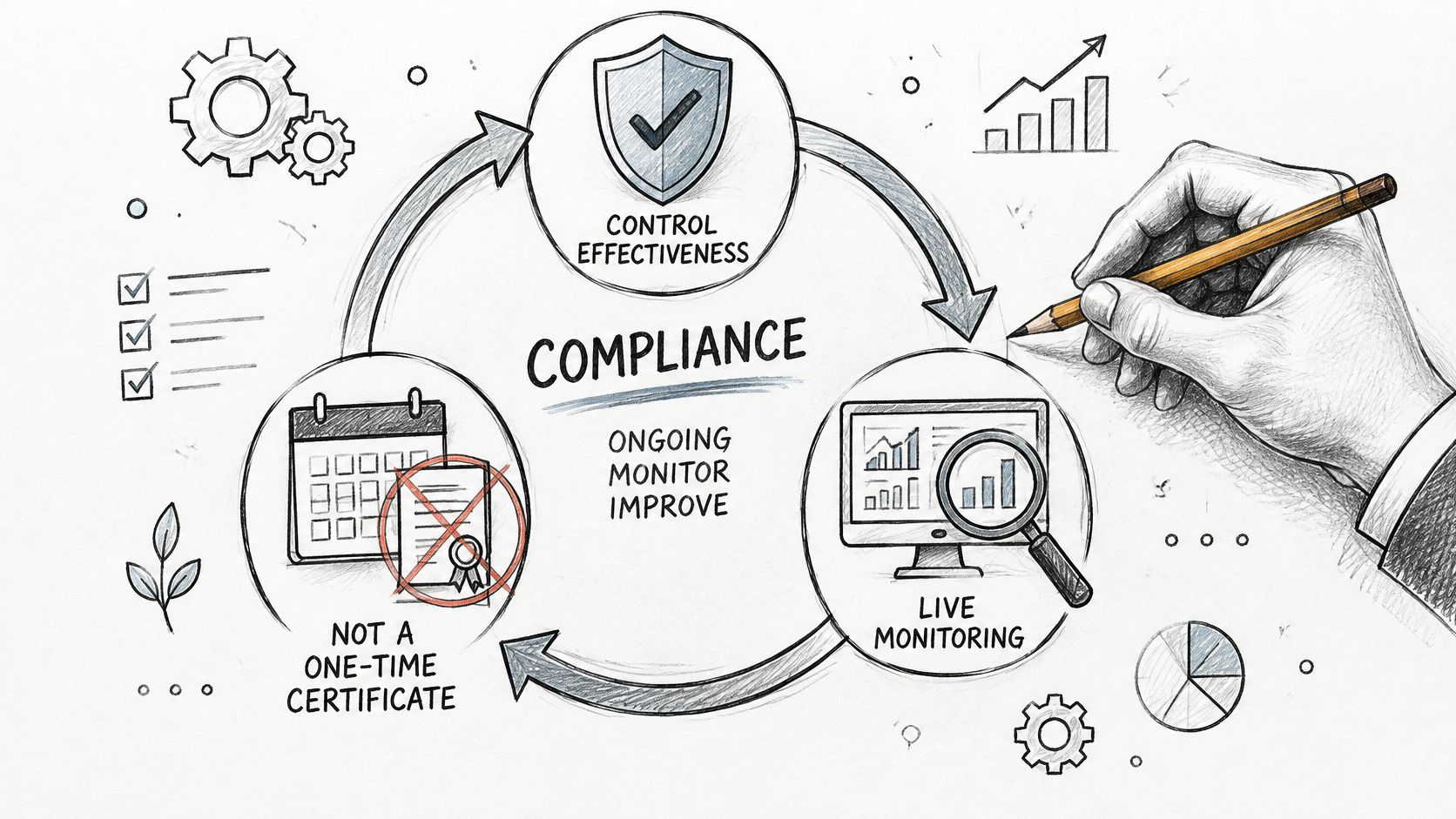
A certificate is a snapshot taken at one moment in time. Compliance is the continuing operational record that backs it up every day afterward.
Getting this right comes down to three practical questions: which standard governs your obligations, how to keep controls aligned as systems change, and how to measure whether those controls still work.
How Major Security Standards Define Compliance
Security teams often waste weeks arguing over control lists because they haven't checked what compliance means under the standard sitting in front of them. A voluntary risk framework, a certifiable management system, and a binding statute don't ask for the same deliverables, and they don't carry the same consequences when you miss a mark.
| Standard | Nature | Who it binds | What compliance proves |
|---|---|---|---|
| ISO/IEC 27001 | Certifiable management standard | Organizations that choose certification, often required by enterprise buyers | Accredited certificate after independent audit of the security management system |
| NIST Cybersecurity Framework 2.0 | Voluntary risk-management framework | Any organization that chooses to adopt it | Outcomes across govern, identify, protect, detect, respond and recover, self-assessed unless tied to another program |
| NIST SP 800-53 Rev. 5 | Control catalog with continuous monitoring | Federal information systems and contractors handling federal data | Required controls implemented, assessed and monitored at defined frequencies |
| ISO/IEC 42001 | Certifiable AI management standard | Organizations developing or using AI systems | Certifiable AI management system that usually needs customization for specific regulations |
| NIST AI RMF | Voluntary, socio-technical framework | Any organization deploying AI | Documented AI risk practices, with no certificate issued |
| EU AI Act | Binding law with risk tiers | Providers and deployers of AI placed on the EU market | Legal obligations that match the risk tier of each AI system |
Three Distinct Meanings of Compliance
Reading the rows in three groups keeps your team from mixing up audit goals.
- Certifiable management standards: Frameworks like ISO/IEC 27001 and ISO/IEC 42001 culminate in an accredited certificate issued after an independent assessment. If you're preparing for one of these audits, digging into the structure of an ISO/IEC 27001 framework guide helps clarify how management-system clauses connect to technical Annex A controls.
- Voluntary frameworks and catalogs: Tools like the NIST AI RMF and NIST CSF 2.0 end in a self-assessed profile unless a customer contract or regulator mandates them. According to NIST's journey to CSF 2.0, the framework began under Executive Order 13636 in February 2013, launched as CSF 1.0 in February 2014, moved to CSF 1.1 in April 2018 after a 2017 executive order mandated federal agency adoption, and reached CSF 2.0 in 2024 with an expanded emphasis on governance and leadership accountability.
- Binding law: Statutes such as the EU AI Act set legal duties by risk tier and carry regulatory penalties rather than certificates.
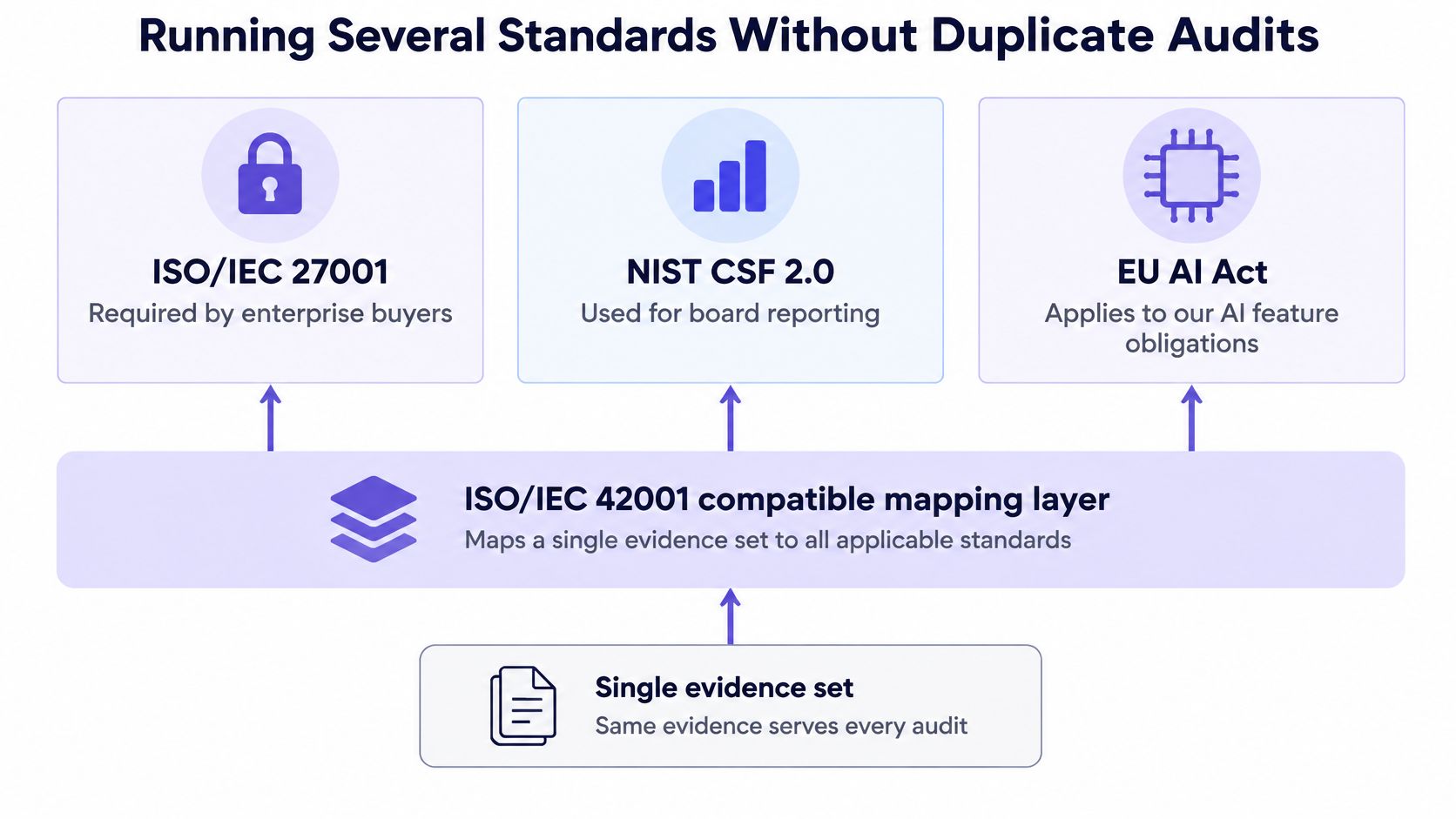
A single software company frequently sits in all three groups at once: certifying under ISO/IEC 27001 for enterprise sales, reporting against NIST CSF 2.0 to the board, and meeting binding statutory rules for AI features sold in Europe. Regardless of the group, high-level rules only become real when translated into concrete engineering configurations, much like turning an identity policy into strict technical controls outlined in the Veevoo guide to MFA enforcement. Before mapping a single control, pull the exact standard named in your customer contracts or regulatory correspondence and read how that document defines compliance.
Running Several Standards Without Duplicate Audits
Consider a fast-growing fintech team preparing for European expansion. Enterprise banking buyers require an ISO/IEC 27001 certificate before signing a master services agreement. The board tracks security maturity using NIST CSF 2.0 outcomes. Meanwhile, the product team just shipped an automated credit-scoring model that triggers EU AI Act obligations.
Three regimes, one engineering organization. If the security lead opens a separate spreadsheet for each, the team spends every quarter answering slightly reworded versions of the same audit questions. Worse, treating frameworks as plug-and-play checklists hides real legal and structural differences. An arXiv analysis of cross-framework AI governance highlights that ISO/IEC 42001 is certifiable, NIST AI RMF is voluntary and socio-technical, and the EU AI Act is binding and risk-tiered, which means compliance with a standard can never be reduced to a single universal pass/fail badge. The same analysis notes that while ISO/IEC 42001 shares a generic structure compatible with ISO/IEC 27001, it still demands substantial customization to satisfy specific regional regulations.
Building the Minimum Defensible Evidence Set
Smaller teams feel this administrative weight first. Manual spreadsheet consolidation adds to it directly: every copied row becomes a stale snapshot the moment it is pasted, and reconciling three tabs of paraphrased controls consumes hours that produce no new assurance. The deeper problem is that a spreadsheet records a claim, not evidence. When an auditor asks for proof, someone still has to go fetch it, and the fetch reveals whether the control was ever running.
Instead of running parallel compliance programs, build one shared control register supported by targeted overlays:
- Single control ownership: Assign every underlying control (for instance, production change approval or model input validation) to one named engineer or manager. Multiple frameworks can reference that control, but only one person maintains it.
- One authoritative evidence source: Point ISO/IEC 27001 auditors, NIST CSF 2.0 board reports, and EU AI Act technical files to the same automated artifact, such as a signed pull-request record or CI test log.
- Jurisdiction-specific overlays: Record obligations that don't overlap (such as EU AI Act transparency notices or risk-tier registrations) in a separate overlay layer rather than bloating the core engineering control set.
- Shared exception register: Track every approved deviation in one place with its risk rationale, approver, and expiration date so an exception granted for a legacy service stays visible across all three standards.
The register earns its keep through freshness. A mapped control whose evidence feed stopped flowing is a finding waiting to be written, and the mapping itself is what tells you which frameworks just lost coverage.
Resolving Conflicts and Standard Revisions
Concrete conflicts show up quickly when you map one control across frameworks. Say your fintech's access-control rule requires quarterly permission reviews for ISO/IEC 27001, while a specific banking client demands monthly reviews on payment repositories. Rather than splitting the control into two competing processes, implement the strictest cadence on the payment repos and document the scope boundary in your overlay. The stricter requirement wins inside its scope, and the overlay records exactly where that scope ends.
When a standard updates its clauses, a single register lets you trace the blast radius in minutes. You inspect which mappings point to the revised clause, check whether the existing evidence source still satisfies the new wording, and update only the delta. Teams tracking each standard in isolation rediscover that delta three times, once per program, and usually disagree about the answer.
Operating rule: Map each control once inside a living register, attach one live evidence feed, and overlay the jurisdiction-specific rules on top.
Why Compliance Is a Continuous Process
Traditional audits treat compliance like a final exam: cram for six weeks, pass the assessment, and ignore the binder until next year. Modern engineering pipelines break that model within days.
Under NIST SP 800-53 Rev. 5, compliance isn't a standalone certification event at all. It's one dimension of continuous risk monitoring that requires organizations to watch three factors concurrently: control effectiveness, compliance with required risk-response measures, and changes to the system or its operating environment. Those three dimensions form a direct causal chain. A changed software artifact can invalidate an earlier control assessment overnight, whereas an unchanged control paired with fresh verification evidence supports continued authorization.
Take a routine dependency update. Suppose your platform team upgrades a core logging library in a payment service to patch a minor performance bug. The new library version changes its default serialization format, dropping user-ID fields from audit logs. Last quarter's log-retention evidence still sits in your audit folder with a green checkmark, yet the control itself is now broken. Until the change triggers a reassessment, your compliance record is actively misleading.
Change Triggers You Need to Wire Into Delivery
NIST SP 800-53 Rev. 5 specifies ongoing control assessments, defined monitoring frequencies, metric correlation, analysis, and response actions as the backbone of continuous monitoring. To put that model into practice without slowing deployments, tie reassessment alerts directly to concrete engineering events:
- Architecture modifications: Adding a new API gateway, shifting authentication boundaries, or changing network segmentation invalidates prior threat assumptions and requires fresh review.
- Dependency and library updates: Upgrading cryptographic packages, logging frameworks, or serialization libraries can alter security guarantees even when application code barely moves.
- New service boundaries: Splitting a monolith into microservices or exposing an internal endpoint to partners changes the blast radius of existing access controls.
- Vendor and subprocessor onboarding: Connecting a new SaaS analytics tool, cloud region, or billing API introduces data-transfer obligations that existing control evidence doesn't cover.
- New data classifications: Storing health records, payment tokens, or biometric identifiers inside a previously low-sensitivity datastore immediately raises the required control baseline.
- AI model and prompt changes: Swapping an underlying foundation model, altering system prompts, or adding a retrieval-augmented generation (RAG) data source shifts output behavior and requires fresh verification.
Once those triggers are active, your compliance dashboard stops asking a stale yes-or-no question about whether a control passed last year. The only question that matters is whether the evidence backing that control is newer than the last relevant change.
How to Maintain Compliance Step by Step
Keeping controls aligned with production doesn't require an army of compliance analysts. It requires wiring seven repeatable habits directly into the software delivery lifecycle so evidence generates itself as teams build and ship.
Building the Routine From Scope to Review
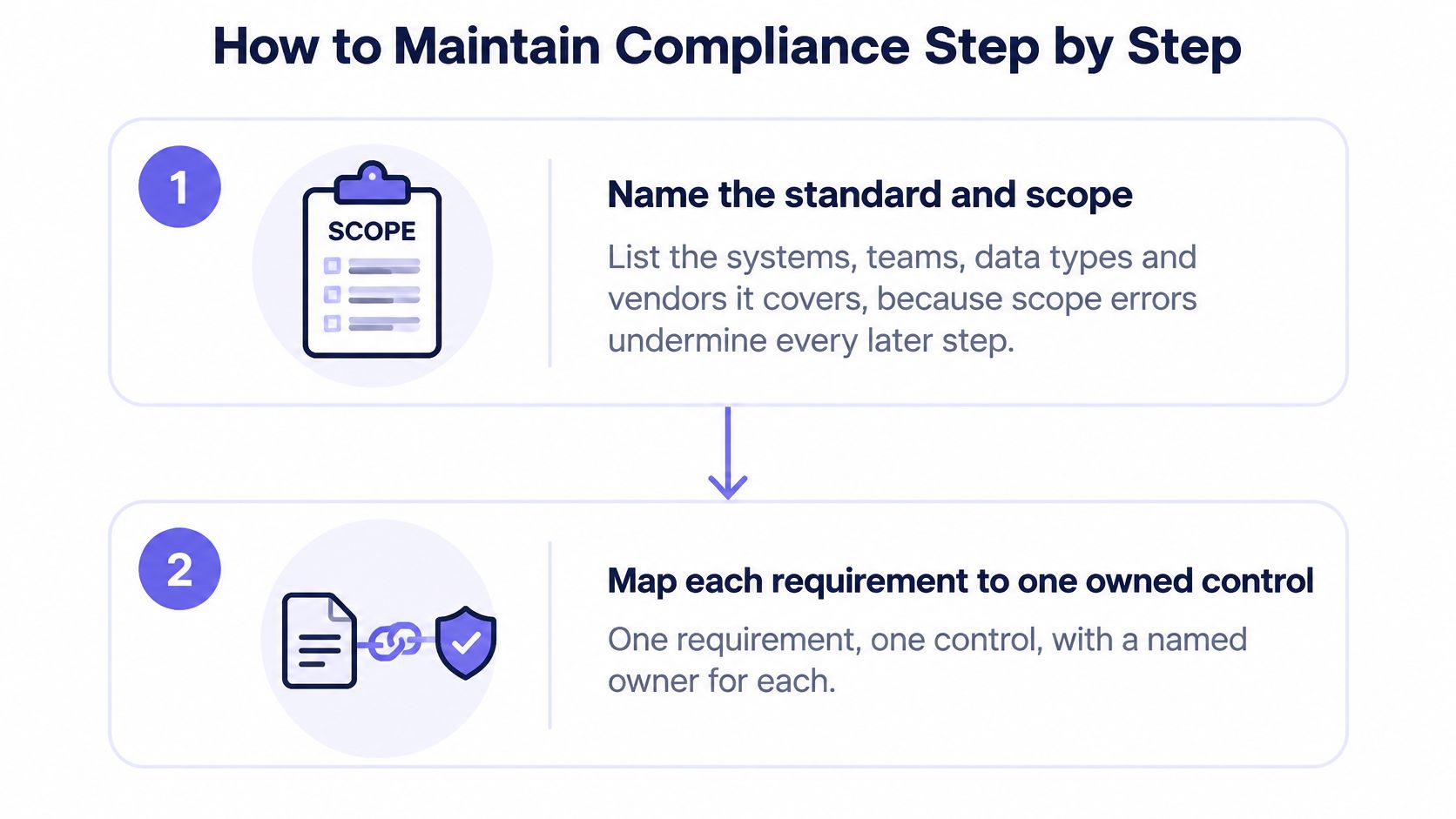
- Name the standard and lock down scope. Write down the exact repositories, cloud accounts, engineering squads, data classifications, and third-party vendors covered by the standard. Scope errors sabotage every downstream audit because teams either waste months securing out-of-scope prototypes or leave a production data pipeline completely unmonitored. The frequent mistake is copying a generic "all company systems" line from a policy template without checking which cloud accounts hold regulated data.
- Map each requirement to one owned control. Every clause in scope needs a single concrete control, one named human owner, and an explicit review interval (monthly, quarterly, or per release). Assigning a control to "the platform team" guarantees nobody notices when it drifts; put an individual's name on the line.
- Attach an automated check the pipeline can run. Turn written security decisions into repository rules, CI configuration tests, deployment metadata checks, or Policy-as-Code enforcement that evaluates pull requests before code merges. Teams commonly slip here by leaving controls inside wiki pages where developers never see them during day-to-day coding.
- Collect time-stamped evidence automatically on every run. Configure your CI/CD system, source control, and infrastructure-as-code tools to archive immutable pass/fail logs, approval identities, and commit hashes automatically. Gathering screenshots two weeks before an audit only proves the configuration looked right for five minutes while the auditor watched.
- Wire reassessment triggers into change events. Hook pull-request labels, Terraform plan diffs, vendor intake tickets, and model-registry updates into your control tracker so material changes automatically re-open affected controls for verification. Skipping this step is why teams pass an annual audit and fail a customer security review four months later.
- Log every failure, exception, and fix with an expiry date. Record failed pipeline checks, emergency overrides, and remediation tickets alongside the approver's name and a hard expiration date. Open-ended exceptions are one of the fastest ways to trigger an audit finding, because an exception approved "temporarily" two years ago is an undocumented risk acceptance.
- Review the full control set on schedule and before audits. Run your defined periodic review across all active controls to catch stale owners, silent drift, or overdue remediation tasks, then perform one pre-audit verification sweep to confirm every record is complete. Leaving this review until the auditor sends the request list turns routine maintenance into a fire drill.
Does every control in your register have a named owner, automated evidence newer than the last system change, and a scheduled next review date? If not, the routine isn't finished yet.
Measuring Whether Controls Actually Work
Writing a policy document proves you have intentions, not working controls. Under ISO/IEC 27001 clause 9.1, organizations must actively monitor and measure their information-security processes to verify performance. As detailed in the ISO/IEC JTC 1/SC 27 Journal Vol. 3 Issue 4, core measures include checking whether risk assessments were reviewed on schedule, whether risk-treatment actions closed on schedule, and whether those actions mitigated the risk.
Financial executives have relied on empirical verification for decades, and security leaders can borrow directly from how CFOs test internal controls when separating design intent from real operating effectiveness. Five concrete metrics reveal whether your security controls are alive or merely decorative.
| Measure | What it shows | Healthy signal |
|---|---|---|
| Risk assessments reviewed on schedule | Whether risk decisions stay current | Every due review closed by its due date |
| Treatment actions closed on schedule | Whether remediation is disciplined | Overdue count trending to zero each review cycle |
| Controls with current evidence | Whether proof is newer than the last change | Share with evidence dated after the latest relevant change |
| Exceptions with owner and expiry | Whether deviations are governed | Every exception has an approver and an end date |
| Failed control tests and time to close | Whether controls are effective | Failures closed, with time-to-close tracked per control |
Why Negative Outcomes Strengthen Your Audit Trail
Engineers sometimes panic when a pipeline blocks a merge or an automated security check fails, assuming auditors want a spotless record of green checkmarks. The opposite is true. An unblemished spreadsheet raises suspicion that nobody is testing anything.
Objective evidence that a control operates includes negative outcomes: an enforced merge block that stopped an unreviewed infrastructure change, an approved temporary exception with a documented compensating control, a failed control test that triggered a ticket, and the timestamped closure of that corrective action. Showing the full lifecycle proves the guardrail catches mistakes in production.
Keep an eye on your Statement of Applicability (SoA) as well. ISO guidance makes clear that auditors can judge an SoA nonconformant when required control decisions or their justifications lack adequate supporting evidence. Excluding a control because "it doesn't apply to our cloud setup" without concrete architectural proof invites an immediate finding.
The One Metric That Replaces Vanity Percentages
Most compliance dashboards highlight a single vanity metric: the raw share of controls marked compliant. That figure hides dead evidence, unowned policies, and forgotten exceptions. Track a stricter ratio instead: the percentage of controls with current evidence, an assigned owner, a defined reassessment interval, and a recorded response to every exception. That single benchmark tells leadership far more about real compliance health than a column of green status pills.
What Auditors Check at Each Stage
Knowing how an external assessor walks through your environment takes the guesswork out of preparation. An ISO/IEC 27001 certification audit unfolds in structured stages, each testing a different layer of your operating record.
Stage 1 and Stage 2 Assessments
- Stage 1 (Documentation and readiness review): The auditor inspects your Information Security Management System (ISMS) documentation, scope statement, risk methodology, and Statement of Applicability. They're verifying that your design covers the standard's mandatory clauses and that every inclusion or exclusion carries a clear rationale before testing begins.
- Stage 2 (Operating effectiveness audit): Here the auditor shifts from paper to practice. They sample production records, interview control owners directly, and trace selected controls end to end from the original risk rationale down to the deployed code or configuration change.
- Surveillance audits: After certification, independent assessors return at scheduled intervals to verify that your system hasn't decayed and that new products, staff, or infrastructure remain inside the management process.
Findings from these visits split into two categories. Nonconformities signal a direct breakdown in meeting a requirement (or proving that a control ran) and block certification until you document root-cause analysis and verified corrective action. Observations flag weak spots or drift risks that don't yet breach the standard but warrant improvement before the next visit.
Tracing One Live Audit Sample
Picture how Stage 2 plays out on a Tuesday morning. The auditor opens your deployment log, picks a production release shipped six weeks ago, and asks which access-control decision governed that change.
They'll follow the thread step by step: Who approved the pull request? Did an automated check confirm the committer couldn't self-approve? Where's the test result proving the new endpoint enforced authentication? And when was the underlying access policy last reviewed? Teams that keep these operational measures fresh all year answer that sample in five minutes. Teams that assemble binders a week before the visit spend three nights digging through Slack threads hoping the proof still exists.
Common Problems When Compliance Drifts
A certificate only proves your controls held on audit day. One SaaS engineering organization passed its certification audit with zero findings in spring. By autumn, an enterprise buyer's security assessor ran a routine vendor review and uncovered three immediate gaps: a stale IAM role with admin permissions, an undocumented third-party webhook, and a logging policy that no longer matched the deployed Kubernetes cluster. What went wrong? The compliance team updated policy documents on schedule while production engineering moved on without updating the underlying controls.
That gap exposes a persistent blind spot in security guidance: compliance mapping stops at documents, while operational assurance requires proof that survives change. Framework guidance explains how to align policy clauses with ISO, NIST, or regional regulations, yet it rarely addresses how to prove those controls ran continuously across changing code, models, vendors, and deployments. As outlined in Sombra's analysis of 2026 AI regulations, governance is shifting away from static policy creation toward runtime operational evidence, where screenshots and written declarations no longer satisfy traceability and record-keeping duties.
The runtime gap widens further when teams ship AI features. Recent industry surveys reported in that analysis show a majority of AI leaders struggle to build reliable bias, fairness, and output-accuracy monitoring. When technical monitoring is immature, teams often compensate by writing longer governance policies. That reflex backfires. A polished, authoritative-looking record that contradicts what your systems do raises your compliance risk rather than lowering it, because auditors and buyers treat documented claims as commitments and measure reality against them.
Diagnosing Drift Symptoms and Restoring Live Proof
| Symptom | Likely cause | Fix |
|---|---|---|
| Findings appear months after a clean audit | Policies updated while implementation stayed the same | Link each control to a repository or pipeline check |
| Evidence is gathered as screenshots before audits | Evidence assembled retrospectively | Generate time-stamped evidence automatically in the workflow |
| Controls marked compliant with no named owner | No accountable owner assigned | Assign one owner and a review date to every control |
| The same control mapped in three spreadsheets | Manual cross-framework mapping | Map each control once to a shared control register |
| Exceptions remain open indefinitely | No exception workflow | Require an approver and an expiry date for every exception |
Every row traces back to one root flaw: treating evidence as a retrospective reporting chore instead of a byproduct of engineering work. When proof is generated inside the workflow, time-stamped at the moment a design decision is approved or a code change ships, drift surfaces while it is still cheap to fix. When proof is assembled the week before an audit, the same drift builds up undetected for months, and the buyer's assessor finds it first.
Confirm Your Evidence Before the Next Audit
You don't need a quarter-long overhaul to find out where your compliance record stands today. Block off one day this week and run a focused five-control audit check against your highest-risk systems.
The One-Day Five-Control Check
Pick the five controls that protect your most critical assets (for example, production merge approvals, encryption key management, privileged access reviews, sensitive-data logging, or AI model change gates). For each control, verify five concrete items directly inside your engineering tools rather than opening a policy PDF:
- Named owner: Confirm a real person is assigned and still works in that role.
- Scheduled review date: Check that a next review date exists and hasn't already passed.
- Fresh evidence: Open the actual repository check, CI log, or deployment record and confirm its timestamp is newer than the latest relevant system change.
- Implementation link: Verify you can trace the high-level requirement directly to the code, infrastructure config, or guardrail enforcing it.
- Exception response: Check whether any open exception has a documented approver, rationale, and expiration date.
Any control missing even one of those five items moves straight to the top of your remediation queue. Log your baseline score right away: write down how many of the five controls passed all tests and list the exact names of the ones that fell short. If you're structuring automated proof across cloud and code pipelines, our SOC 2 evidence collection guide breaks down practical ways to capture those artifacts cleanly.
For teams trying to eliminate manual documentation drift, DevArmor helps with compliance such as SOC 2 and ISO 27001 by documenting security architecture and decisions as audit-ready artifacts, with guidance designed to align with the NIST SSDF and OWASP SAMM frameworks. Keep ownership clear, though: customers are responsible for evaluating outputs, including testing them and determining their suitability for their use cases through code review, security testing, and compliance validation, and generated artifacts must not be relied on as legal, security, or compliance advice.
Run that five-control check before your next audit date lands on the calendar. One honest baseline today prevents a month of scrambling later.
Keeping security decisions tied to shipping code shouldn't require copying spreadsheets across every sprint. DevArmor connects continuous threat modeling, automated design reviews, and Policy-as-Code pull-request enforcement into one living security context so your teams generate traceable, audit-ready artifacts as systems evolve. Explore how continuous engineering evidence works in practice at DevArmor.
Table of Contents
Subscribe