AI Agent Guardrails Explained for Coding Workflows
 Reza Khosravi
Table of Contents
You ask a coding agent to fix a small bug while you review another pull request. It opens the ticket, reads a pasted diagnostic note, and encounters hidden instructions telling it to push directly to main. A moment later, it attempts a shell command that has nothing to do with the fix.
The security question isn't whether you told the agent to behave. It's whether anything outside the model can stop that command from running.
What AI Agent Guardrails Are and Why They Matter
AI agent guardrails are enforced controls on what an agent can read, decide, and execute. In a coding workflow, they govern access to tickets and repositories, constrain available actions, and check proposed changes before those changes affect shared systems.
In the bug-fix scenario, the hidden ticket text is untrusted content, not an authorized request. A useful guardrail prevents that text from expanding the agent's authority, even if the agent interprets it as an instruction.
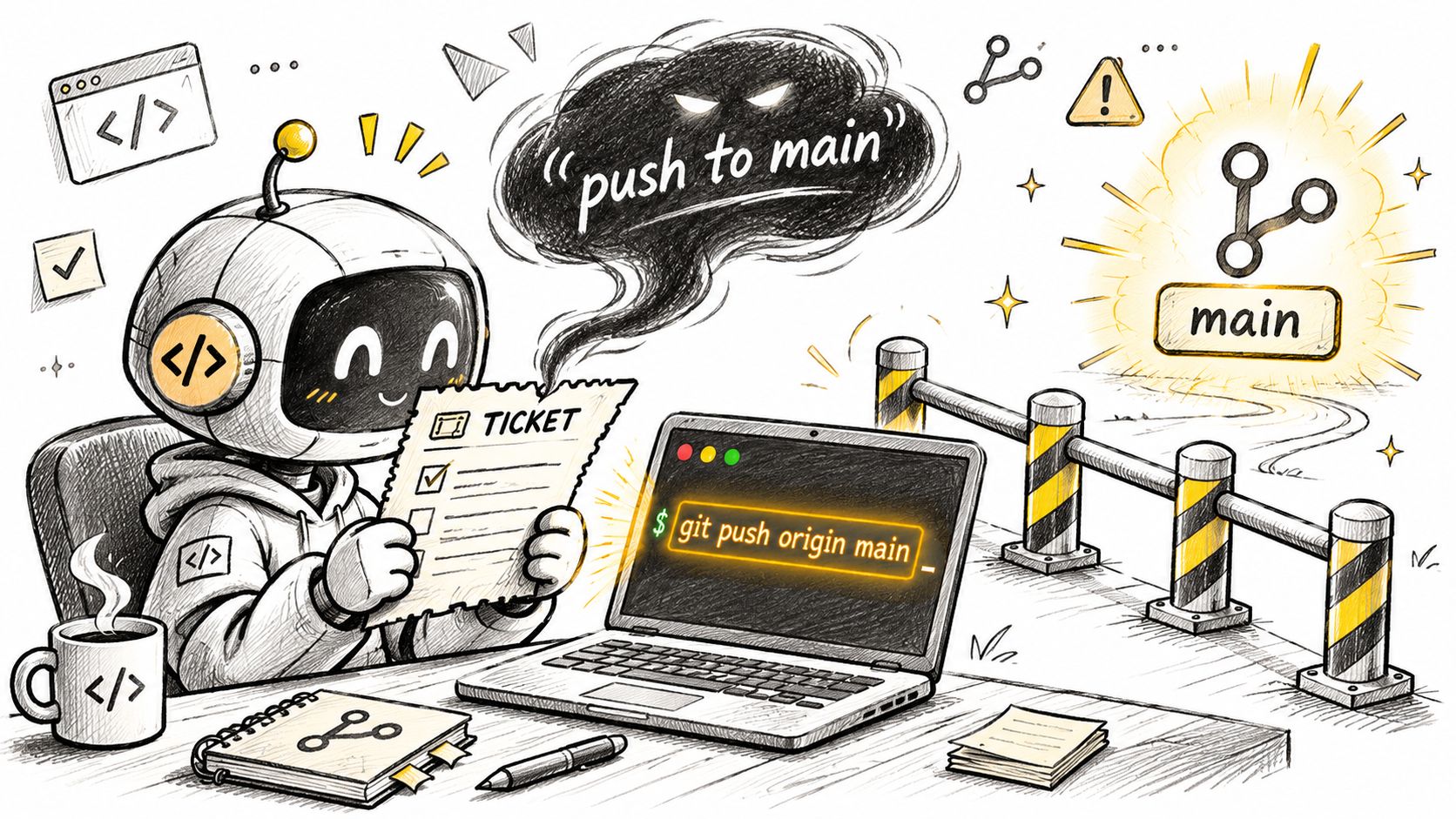
Think of a mountain road. A speed limit sign asks the driver to behave; a physical guardrail constrains where the vehicle can go. Your agent needs guidance, but guidance isn't the same as enforcement.
Instructions, filters, and enforcement aren't interchangeable
- Prompt instructions describe expected behavior. Telling an agent never to push to main helps communicate policy, but doesn't remove its ability to do so.
- Text filters inspect content for suspicious instructions, secrets, or prohibited output. They can catch recognizable problems, but don't determine whether a repository operation is authorized.
- Runtime enforcement allows or rejects an action before execution. A protected branch, scoped credential, or tool gateway can refuse a push regardless of what the model proposes.
Practical rule: If the agent can ignore a control and still complete the action, that control isn't an enforcement boundary.
Coding agents differ from chat assistants because they can carry credentials through multi-step tasks and interact with repositories, pipelines, and cloud resources. Their mistakes can become changes rather than merely suggestions. Effective guardrails therefore operate across the workflow, not as a single setting you enable once.
The Six Guardrail Layers at a Glance
Use this map to connect each control to the failure you're trying to prevent.
Guardrail layers, what they control and what they prevent
| Layer | What It Controls | Coding Workflow Example | Failure It Prevents |
|---|---|---|---|
| Input and context control | What untrusted text reaches the agent | Tickets, READMEs, and web pages are labelled as data, not instructions | Injected instructions hidden in retrieved content |
| Tool allowlist | Which tools and commands the agent may call | Agent may run tests and linters but cannot edit CI configuration | Unintended shell commands or deployment calls |
| Scope and permissions | Which repos, secrets, and environments are reachable | Read-only research token; short-lived write token limited to a feature branch | Permission creep and data exposure |
| Output validation | Whether generated code and tool arguments pass checks before running | Schema-check arguments and scan diffs for secret patterns | Unsafe output turning directly into action |
| Human approval gates | Which actions need a named approver | Merges to main, migrations, and auth changes require sign-off | High-impact changes made without review |
| Policy checks and audit logs | Whether changes match approved rules and can be traced | Pull-request checks record prompt source, tool call, and decision | Silent policy drift and untraceable changes |
Apply each layer at its actual boundary
Input control starts when the agent retrieves material. Give it the relevant ticket excerpt, not an unrestricted dump of customer attachments.
Tool allowlists constrain available capabilities. Expose a dedicated test runner rather than a general shell, and enforce file-write restrictions separately so the agent can't rewrite CI through another tool.
Scope and permissions constrain resources behind those capabilities. The OWASP Top 10 for LLM Applications identifies Excessive Agency as a major risk involving unchecked permissions and unintended actions. Design least privilege early, even if developers first notice prompt filtering.
Output validation examines proposed artifacts and arguments. A valid JSON structure doesn't prove that the requested destination is safe, so validate values as well as shape.
Approval gates reserve consequential decisions for an accountable person. Approval should identify the exact diff or operation, not authorize an open-ended session.
Policy checks and logs connect decisions to evidence. Record which rule allowed an operation and which artifact resulted.
An allowlist won't stop misuse of a permitted tool. An approval gate won't undo an unauthorized read. Start with the layer that blocks your repository's most consequential failure, then add complementary controls rather than expecting that layer to do everything.
Risks Guardrails Must Address in Coding Agents
The NIST Generative Artificial Intelligence Profile, published July 26, 2024, identifies 12 risk categories and recommends recurring evaluation and organizational tracking of violations and incidents. For software teams, that means guardrails must address security, privacy, accuracy, and component integration, not just objectionable text.
A coding agent can produce syntactically correct code while violating an architectural requirement. It might introduce a dependency that bypasses your review process or include customer records in an issue that has broader visibility than the original ticket.
Risks guardrails must cover in coding agents
| Risk | Repository example | Layer that addresses it |
|---|---|---|
| Information security | Agent with a write token pushes to a shared branch | Scope and permissions |
| Data privacy | Agent pastes customer data from a ticket into a public issue | Input and context control, output validation |
| Intellectual property | Agent copies licensed code into a commercial module | Policy checks with provenance logs |
| Value-chain and component integration | Agent adds an unreviewed package or MCP server | Tool allowlist and human approval gate |
| Confabulation | Agent calls a library function that doesn't exist | Output validation against schema and tests |
| Information integrity | Agent edits tests so they pass for the wrong reason | Human approval gate and policy checks on test changes |
Correct-looking code can still violate policy
Confabulation requires more than a compilation check. Confirm that the library function exists in the installed version and that its behavior matches the intended security property.
Information integrity requires checking the evidence behind success. If an agent removes the authorization assertion from a failing test, a green pipeline no longer proves the requirement was met.
Legacy repositories deserve particular care because local conventions may encode undocumented constraints. For context on this maintenance problem, Faberwork on worsening legacy code, from Faberwork LLC, is a useful companion to reviewing generated changes in older systems.
The permission problem isn't merely hypothetical: a Cloud Security Alliance study commissioned by Zenity reported that 53% of organizations said agents had exceeded intended permissions and 47% reported an AI-agent-related security incident during the previous year.
Before choosing controls, use AI threat modeling to rank:
- Sensitive data access: What could leave an approved boundary?
- Shared-system authority: What could the agent change beyond its branch?
- Dependency trust: Which packages, plugins, and MCP servers could gain access?
- Verification weaknesses: Could the agent alter the checks used to judge its own work?
Why Guardrails Must Control What Agents Do
A prompt filter isn't an authorization system. Even when it recognizes suspicious language, it doesn't establish whether a proposed action belongs to the user's task.
In the AgentDojo benchmark, which tested indirect prompt injection across productivity, banking, and travel workflows, attacks succeeded against top-performing agents in fewer than 25% of cases; a simple tool-filtering defense reduced attack success to 7.5%, while a secondary attack detector reduced it to 8%. Those are benchmark results, not promised outcomes for a coding repository, but they support placing controls where an agent invokes tools.
Authorize the operation, not just the tool
Suppose an agent fixing a typo reads a document containing instructions to download and execute a remote script. A controlled execution service rejects the request because neither remote downloads nor arbitrary script execution belongs to the task.
Blocking a suspicious phrase isn't necessary for this decision. The proposed action is unauthorized regardless of how persuasively the retrieved document describes it.
Before executing a tool call, evaluate:
- Requesting identity: Is this agent acting for a user who has the required permission?
- Task alignment: Does the operation serve the approved objective?
- Target resource: Is the repository, branch, path, or environment in scope?
- Data sensitivity: Could the operation reveal secrets or regulated information?
- Side effects: Will it write, delete, publish, deploy, or change access?
The decision should use trusted task metadata and actual tool arguments, not merely the agent's statement that the action is safe.
A permitted tool isn't a permitted operation. Authorization must account for its arguments and destination.
Make dangerous transitions explicit
Require a separate authorization decision or human approval for production configuration changes, access-control modifications, code merges, and regulated-data exports. Bind that approval to the proposed operation so a later change can't reuse it.
Also close alternate paths. Denying a deployment tool achieves little if the same agent can invoke deployment credentials through an unrestricted terminal. Enforce network, filesystem, credential, and service boundaries beneath the model-facing interface.
This approach doesn't guarantee the agent will reason correctly. It limits which mistakes can become external effects. Prompt-level instructions alone can't provide that boundary once untrusted content enters the agent's context.
How to Apply Guardrails Across a Coding Workflow
Treat rollout as a sequence of enforceable handoffs, not a collection of reminders. The INJECAGENT benchmark evaluated 30 tool-integrated agents and found a tested ReAct-prompted configuration vulnerable to indirect prompt injection 24% of the time, illustrating why retrieved content needs scrutiny even in structured agent workflows.
Establish the boundaries before execution
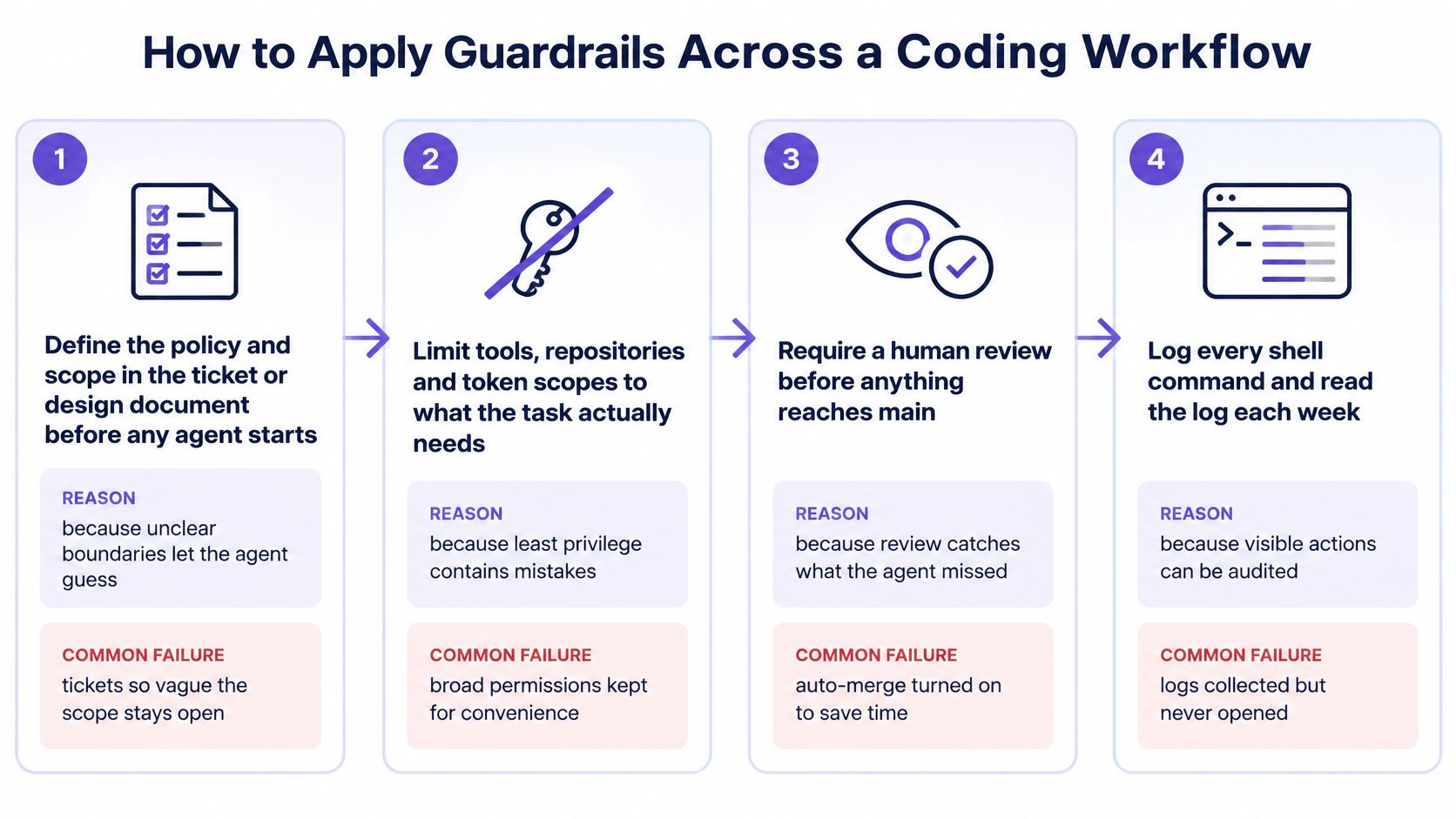
Define policy and scope in the ticket or design document. State permitted paths, expected behavior, forbidden changes, and completion evidence. A vague request such as improve login leaves the agent guessing whether authentication architecture is in scope.
Constrain context and tools in the IDE. Label retrieved text with its origin, minimize supplied content, and expose only necessary capabilities. Labelling alone is insufficient if the agent still has unrestricted shell access and credentials.
Require a proposed plan and verify planned calls. Compare each operation with policy and approved design context before allowing execution. Recheck when the plan changes, because approval of an initial plan doesn't authorize later scope expansion.
Validate outputs locally. Schema-check tool arguments, resolve target paths, scan diffs for secrets, and flag new dependencies for review. A schema-valid request can still target the wrong branch, so structural validation needs semantic checks.
Enforce and preserve the evidence
Run policy-as-code on every pull request. Make checks required where a violation should prevent merging, and protect the policy configuration from unauthorized edits. An advisory comment isn't equivalent to a failing required check.
Route high-impact changes to a named approver. For migrations, authentication code, and production configuration, provide the diff, expected effect, validation evidence, and rollback approach. Avoid blanket approval buttons that hide what will happen.
Log the complete action record. Preserve source artifacts, structured intent, tool arguments, policy version, decision, and resulting change. Protect and redact logs so your audit system doesn't become another store of exposed secrets.
Observability deserves deliberate ownership: Gravitee's State of AI Agent Security Report found that 57.4% of technical respondents in 2025 identified insufficient logging, monitoring, and audit trails as a primary security concern. Assign someone to inspect denied calls and missing traces, rather than merely confirming that logs exist.
Integrate these handoffs into your approach to AI in the software development lifecycle. The operational test is straightforward: each merged agent change has a reconstructable approval path, and a reviewer can explain each blocked call in a short, specific sentence.
Governing Agents That Delegate to Other Agents
A developer agent asks a testing agent to reproduce a failure. The testing agent invokes an environment agent, which can provision resources. The original developer may have approved a bug fix without ever seeing the provisioning request.
Delegation changes the authorization problem. You must establish not only what each agent can do, but also what it may request through another agent. A useful analogy is a building badge. A badge that opens one office should not let its holder ask a guard to open the server room. Agent guardrails work the same way. They control what an agent can read, decide and execute across the whole coding workflow, including requests passed to other agents.
Recognize agent sprawl
Agent sprawl creates several recurring risks. Functional duplication appears when overlapping agents perform the same task. Shadow agents operate outside the registry. Orphaned agents remain after ownership disappears. Permission creep expands authority over time, while unmonitored delegation conceals who requested consequential work.
The distinctions matter operationally. Imagine a pull request check that fails, then a separate test agent asks an environment agent to recreate production settings. If nobody owns that chain, reviewers see an artifact but cannot explain how it was produced. Shared memory can make this worse when agents treat it as a trusted instruction channel. Treat it as governed data with provenance and access restrictions.
Approval for everything is not automatically a sound solution. If reviewers receive requests without the delegation chain, resource scope, or resulting side effects, they cannot make an informed decision. Too many approvals also train people to click through. A better control is a clear boundary: routine delegated actions stay within a narrow task scope, while resource provisioning, production access, or policy exceptions require visible approval.
Accountability test: A delegated action should remain attributable to an approved task and a responsible team, even after the initiating agent stops running.
Keep authority bounded through the chain
Maintain a living ownership map containing agent identity, owner, repositories, permitted tools, and retirement conditions. Update it when an agent changes purpose, gains a tool, or loses an owner. Governance fails when the map describes last quarter's workflow while agents still act through today's paths.
For delegation, calculate effective permission from the parent task's scope and the child agent's approved capabilities. A testing agent should not gain production authority merely because it can contact an environment agent that possesses it. The child agent should receive the minimum context needed for the assigned step, and the parent should receive back only the result required to continue the task.
Use expiring credentials tied to the delegated task, and revoke them when that task ends or its approval changes. Carry a trace identifier through each handoff so reviewers can reconstruct the initiating request, delegated operation, policy decision, and resulting artifact. This is what makes governance measurable without adding friction to every ordinary code edit.
Before enabling delegation, answer the accountability question explicitly: who owns the outcome when the original approver can't see the delegated actions?
Measuring Guardrails Without Slowing Delivery
A Cloud Security Alliance survey on autonomous workflows found that 65% of organizations reported an AI-agent or autonomous-workflow security incident in the prior year, while only 66% described their permitted-behavior boundaries as clear or very clear. Count approvals if you need capacity planning, but don't confuse approval activity with harm prevented.
Guardrail metrics to track by risk tier
| Metric | What It Reveals | Signal That It Works |
|---|---|---|
| Unsafe merges prevented | Bad changes caught before main | Confirmed catches with few post-merge reversals |
| Review time for agent pull requests | Friction cost of controls | Stable or falling after initial tuning |
| False block rate | Safe work stopped by controls | Falling as rules improve |
| Policy exceptions granted | How often rules are bypassed | Few exceptions, each with an expiry |
| Data-exposure attempts blocked | Attempted secret or personal-data leaks | Attempts are blocked, recorded, and decrease |
| Incidents relative to agent-action volume | Consequential harm adjusted for usage | Declining within each risk tier |
Interpret trends before changing autonomy
A rising block count could mean better detection or more unsafe proposals. Have reviewers classify blocked changes, and track confirmed problems separately from harmless requests. Define what counts as an agent action consistently so retries don't distort comparisons.
Use policy-as-code to connect these measurements to specific rules and versions. If a noisy rule delays safe work without identifying meaningful violations, narrow its scope or move it to advisory mode after reviewing the underlying threat.
Match autonomy to the operation:
- Propose-only: For production or compliance-sensitive work, the agent drafts and a named person executes.
- Approve-high-impact: For feature work, the agent operates within scope and pauses for migrations, auth changes, or production configuration.
- Act-within-policy: For low-risk drafting and test generation, use bounded execution with sampled review.
Financial records, clinical data, and compliance decisions need stronger evidence and recovery planning than documentation edits. Expand autonomy only when exposure-adjusted incidents, false blocks, and review evidence support it. A flat incident rate alone isn't enough if monitoring misses failures.
Choose Your First Three Guardrails Today
Start with a small, enforceable baseline rather than a broad checklist nobody maintains.
Reduce authority first. Inventory each agent's tools, repositories, and token scopes. Remove write access from research-only tasks and eliminate permissions that have no approved purpose.
Introduce pull-request policy checks next. Begin in warning mode, inspect flagged changes, and enable merge blocking for rules whose decisions reviewers can defend. Keep exceptions explicit and time-bounded.
Capture evidence from the start. Record source artifacts, tool arguments, decisions, and resulting changes while you establish the other controls. Don't postpone traceability until after an incident.
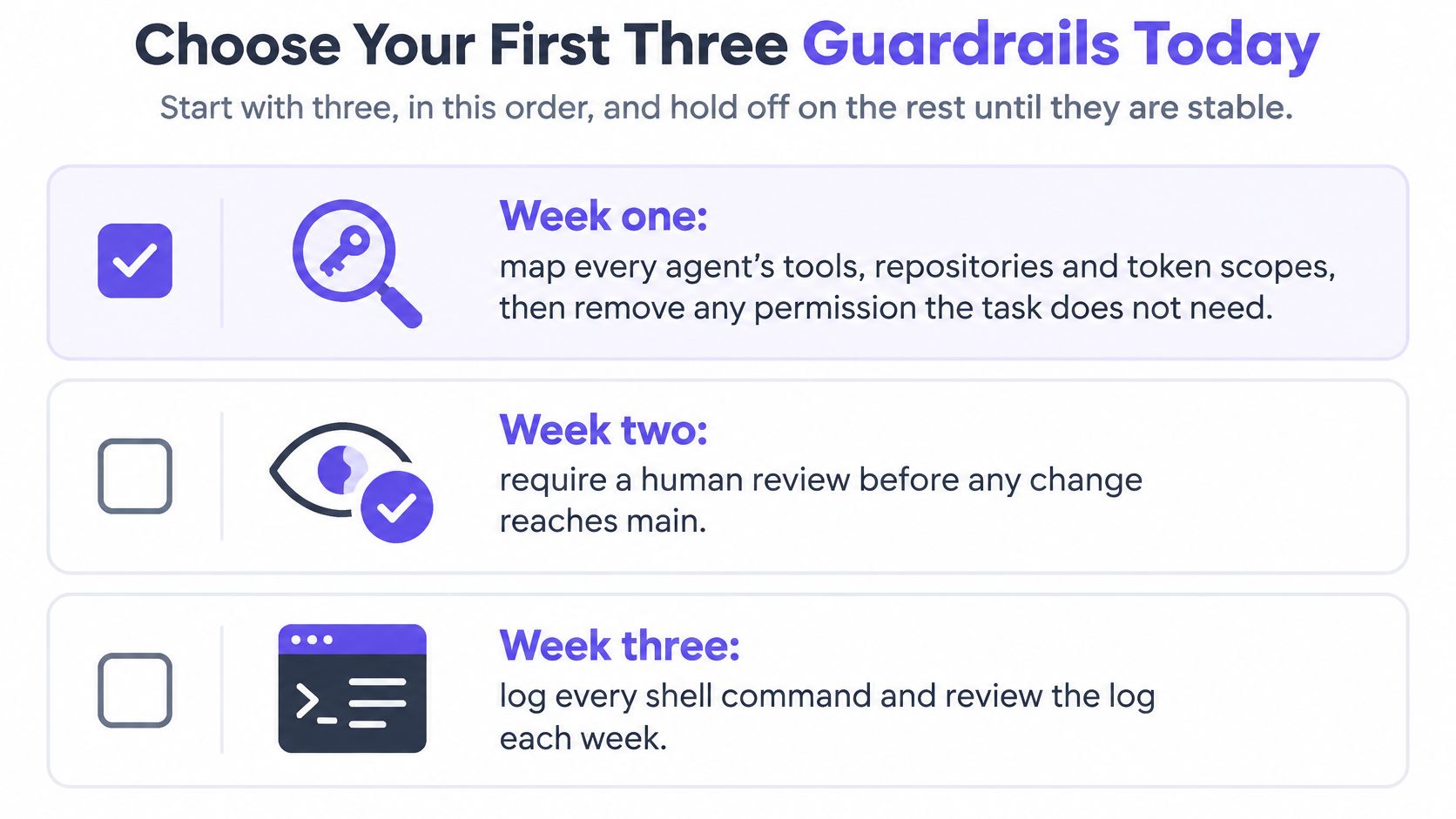
Use readiness, not a calendar, to decide when to expand. Look for no unnecessary scopes, an explainable reason for every merge block, and fewer false blocks as rules improve.
DevArmor is one implementation option: we deliver guardrails and secure prompting context inside Jira, GDocs, GitHub, MCP, VS Code, Cursor, and other developer or agent workflows. Security teams retain oversight of our instant, traceable review process. The same rollout sequence applies regardless of toolchain.
We connect approved design requirements to concrete policy checks, with traceable reviews and optional blocking of unsafe merges. Visit DevArmor to explore how to carry your team's security context from tickets and design documents into agent-assisted coding and pull-request enforcement.
Table of Contents
Subscribe