Why Is Traceability Important in AppSec
 Reza Khosravi
Table of Contents
The most popular advice about traceability is also the least useful: create a requirements matrix, store it with the project, and update it before an audit. That produces paperwork, not necessarily evidence. A spreadsheet can show what someone intended to connect. It can't prove that the reviewed design became the tested build that reached production.
Why is traceability important in application security? Because security decisions lose their value when they become detached from implementation. A living traceability system connects requirements, threat-model mitigations, design choices, code changes, test evidence, build outputs, deployments, and accountable identities. It gives engineers a way to enforce security in the delivery workflow, not merely explain it afterward.
That distinction matters more as software supply chains grow complex and AI-assisted development changes who, or what, influences a change. The practical objective isn't to collect every possible record. It's to preserve enough trustworthy context to answer a difficult question quickly: why was this exact production change approved, tested, and deployed?
The False Confidence of Disconnected Records
Most engineering organizations already have the ingredients people associate with traceability. Jira contains requirements. GitHub contains commits and pull requests. Confluence contains architecture notes. CI systems store test results, while deployment platforms record releases. Yet these records often sit beside one another rather than forming a defensible chain.
A Jira ticket may describe a security requirement, but the pull request might reference only a feature ticket. The architecture document may have changed after implementation. The build may contain a dependency version that wasn't present during review. An approval may identify a person without proving which artifact that person examined. During normal delivery, these gaps remain invisible because teams remember the surrounding context. During an incident, memory becomes an unreliable integration layer.
Practical rule: A record is not evidence of traceability until it can be connected to the exact artifact, identity, decision, and deployment it claims to describe.
A useful traceability chain must connect requirements, design decisions, source changes, build outputs, deployments, and responsible identities. A document repository alone can't establish that shipped software matches what was reviewed, as explained in software supply-chain accountability guidance. This is the difference between document existence and evidence quality.
Test the chain, not the archive
Assessing traceability starts with a reconstruction exercise. Select a production change and work backward from the deployed artifact. Can the team identify its source revision, build record, dependency state, approvals, security rationale, test evidence, and deployment destination without relying on a former employee's memory?
Then work in the other direction. Select a security requirement or threat-model mitigation and ask which code implements it, which tests verify it, and which running services depend on it. If the answer ends at a design document, the organization has documentation coverage but not implementation traceability.
Four qualities expose weak evidence:
- Completeness: The chain includes intent, implementation, verification, release, and ownership rather than only a ticket and a commit.
- Immutability: Records can't be rewritten after approval, and changes retain their historical state.
- Identity assurance: Approvals and automated actions belong to identifiable people, services, or agents.
- Cross-tool linkage: Relationships remain navigable across Jira, GitHub, CI, artifact storage, and deployment systems.
More records can make the problem worse
Disconnected records don't just slow audits. They can create false confidence. A team may point to a signed approval, an archived test report, and a current architecture document, yet still lack proof that all three describe the same release.
That risk is particularly serious in regulated environments. A checklist can demonstrate that a process exists, but it can't automatically demonstrate that the process governed the software now operating. Traceability earns its place when it reduces ambiguity during a vulnerability investigation, supports targeted impact analysis, and preserves the reasoning behind a security decision after tools and personnel change.
Anatomy of a Living Security Context
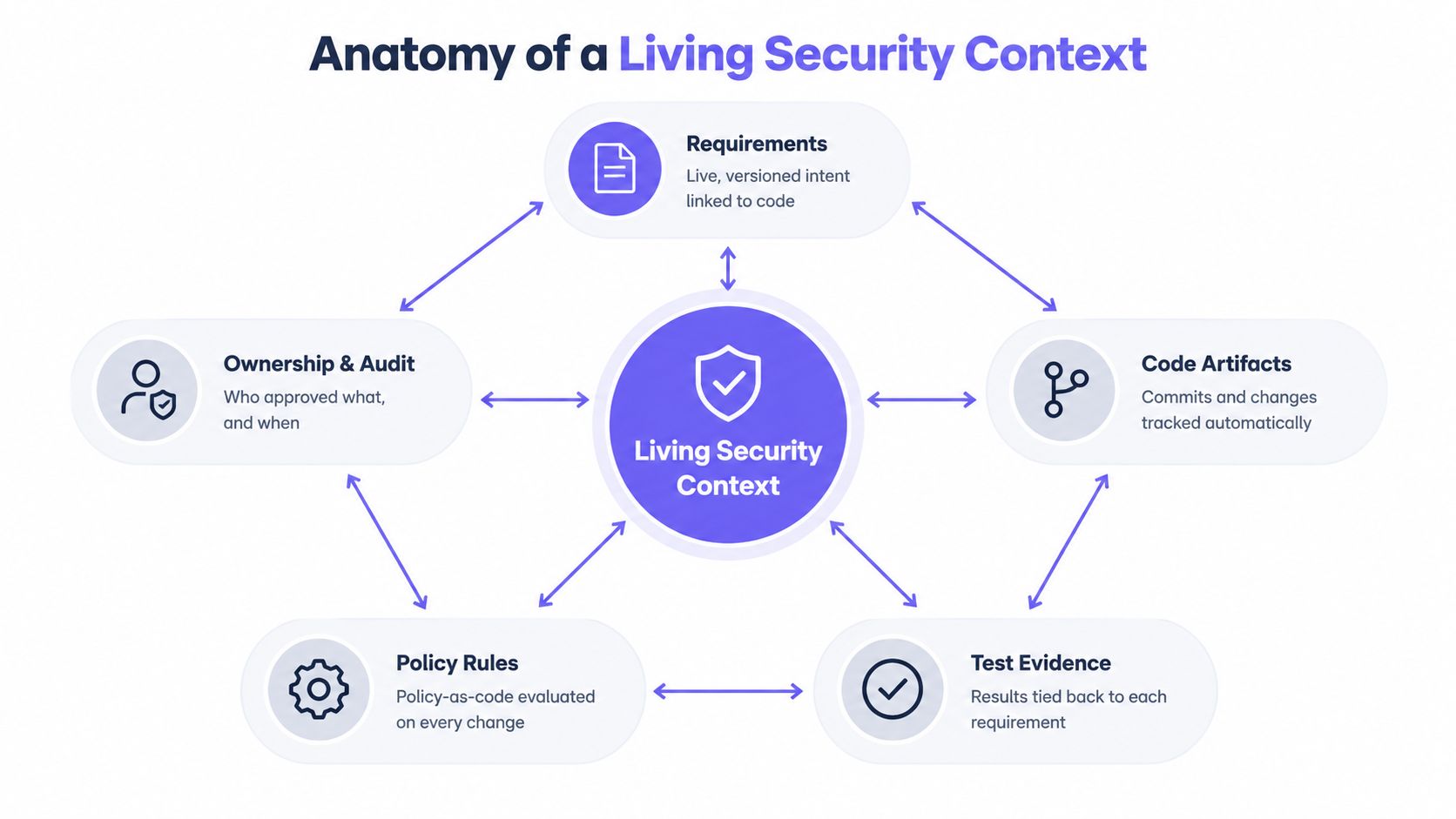
A static traceability matrix usually captures relationships at a specific point in time. A living security context keeps those relationships current as requirements, repositories, dependencies, tests, and deployments change. It behaves less like a completed form and more like an evaluated graph.
NIST describes provenance as the chronology of a system component's origin, development, ownership, location, and changes, potentially including the people and processes involved in modifying it, in its provenance and traceability work. Applied to AppSec, provenance connects an approved security decision to the artifacts that implement it and the environments in which those artifacts run.
The graph has distinct evidence layers
Start with intent. Security requirements, abuse cases, architectural constraints, and threat-model mitigations need stable identifiers and version history. A requirement should remain recognizable even when its wording changes, because downstream links depend on identity rather than a fragile text match.
Next comes implementation. Link the requirement to design decisions, services, repositories, files, commits, pull requests, and relevant configuration. The link should explain more than “implemented by.” It should show which control or design choice translates the security intent into software behavior.
Then attach verification. Tests, scans, review outcomes, and deployment checks should point back to the requirement or mitigation they validate. A green pipeline alone doesn't prove that the right control was tested. The meaningful question is whether the evidence covers the intended risk.
Finally, connect operation and ownership. Build outputs, dependency manifests, deployment records, environments, approving identities, and responsible teams complete the chain. This lets a security reviewer see not only what changed, but where the change runs and who owns the decision.
Evaluate relationships continuously
A living graph can expose several failure modes automatically:
- Orphaned code: A security-sensitive change has no mapped requirement or approved rationale.
- Untested mitigation: A threat-model control exists, but no current verification evidence is attached.
- Unimplemented requirement: An approved security requirement has no linked code or deployment.
- Stale approval: The implementation changed after the decision or test evidence was produced.
- Unowned finding: A policy violation has no accountable resolver.
This model changes design review. Instead of asking engineers to recreate context in a meeting, the review system can surface the missing edge that blocks approval. That doesn't eliminate judgment. It directs judgment toward the relationships that determine risk.
Operational Value in Incident Response and Audits
Traceability becomes operationally valuable when a team can move in both directions. From a security requirement, it should reveal the relevant design, implementation, tests, and deployments. From a vulnerable component or code change, it should reveal the affected requirements, mitigations, owners, and release decisions.
The FDA describes traceability as connecting hazards to the implementation and testing of mitigations, and calls it essential to understanding product design, development, testing, and risk management in its software guidance for medical devices. The same logic applies to application security. When a control changes, teams need to identify what the control protects and what evidence demonstrates that it still works.
Incident response needs scope, not just speed
Suppose a dependency vulnerability affects a library used by several services. A flat inventory can identify versions, but it may not explain which threat-model assumptions depended on the library, which compensating controls exist, or which deployments contain the affected build.
Bidirectional links support targeted questions:
- Which production artifacts contain the affected component?
- Which services and environments received those artifacts?
- Which hazards, requirements, and mitigations connect to the component?
- Which tests verified those mitigations?
- Which approvals and release decisions authorized deployment?
- What must be patched, retested, or withdrawn?
This approach prevents two expensive mistakes. Teams won't treat the entire estate as equally exposed when only a defined path is affected, and they won't patch a component without revalidating the controls that depended on its behavior.
The pharmaceutical supply chain offers a useful operational analogy. FDA interoperability assessments recorded progress in using machine-readable identifiers and required data elements, including 71.9% of specialty-product packages at AmerisourceBergen in 2023, compared with 20.4% in 2018 and 7.2% in 2017, as reported in this analysis of pharmaceutical traceability. The point isn't that software should copy pharmaceutical processes. It is that unique identities and standardized records make targeted response possible.
Audits should consume normal delivery evidence
Audit preparation fails when teams assemble evidence as a special project. A better system captures approvals, test results, artifact metadata, signatures, deployment records, and ownership as delivery occurs. Documentation then describes an operating process rather than substituting for one.
Teams that need to improve their document-handling practices can also consult LinkShip's guide to tracking docs, particularly when evidence spans multiple systems and contributors. Document tracking supports the record layer, but it must remain connected to source, build, and deployment evidence to establish what shipped.
Securing AI-Assisted and Agentic Development
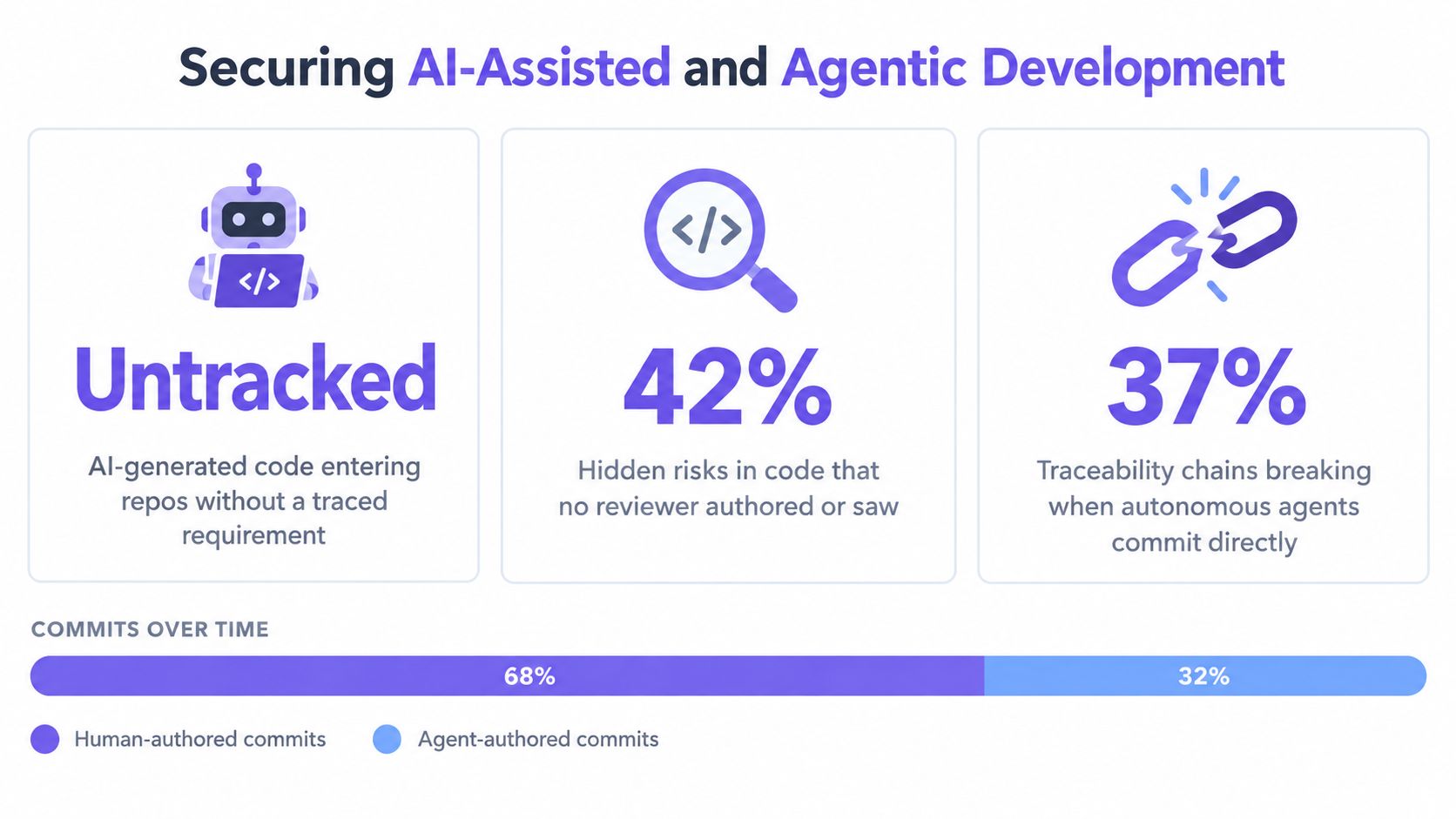
Human-centered traceability assumes that a developer writes or understands the change, commits it, and explains it in a pull request. AI-assisted development weakens that assumption. A commit author may have accepted generated code, an agent may have modified files through a tool call, and an automated reviewer may have influenced the final result without appearing in the repository history.
Recent survey reporting found that 81% of cybersecurity leaders lacked visibility into how AI was being used across application-development workflows, while 65% had observed more vulnerabilities after adopting AI coding tools, according to Security Boulevard's reporting on AI-generated code concerns. Those figures describe a provenance problem as much as a code-quality problem.
Separate the provenance questions
AI development needs at least three distinct forms of provenance:
- Content provenance: What code, configuration, tests, or documentation did an automated system generate or modify?
- Decision provenance: Which requirement, threat-model mitigation, policy, or human judgment justified accepting the change?
- Execution provenance: Which model, agent, tool, identity, or workflow performed the action?
A pull request can answer none of these completely. Its author may be a human who didn't inspect every generated line. Its description may mention a ticket but omit the security policy that allowed the change. Its commit may not distinguish an IDE suggestion from an autonomous agent operating with repository access.
The answer isn't indiscriminate surveillance or permanent storage of sensitive prompts. Retain minimum viable provenance instead. Record the relevant tool or agent identity, the material code or configuration output, the applicable policy decision, the human review boundary, and the resulting build and deployment evidence. Store sensitive context selectively, with access controls and retention rules appropriate to the organization's risk.
Guardrails must operate before merge
A developer using AI React Native coding tools still needs the same security context as a developer writing React Native code manually. The difference is that the context must reach the coding workflow quickly enough to influence generation, review, and correction.
Useful controls include:
- Require an approved requirement or threat-model node for security-sensitive changes.
- Show relevant design constraints and prohibited patterns inside the IDE or agent workflow.
- Require generated changes to pass the same policy checks as human-authored changes.
- Record whether an agent created, modified, reviewed, or merely suggested the change.
- Block merges when the change lacks rationale, ownership, or verification evidence.
AI can accelerate implementation without accelerating accountability. A secure workflow preserves the link between the generated content, the decision that permits it, and the evidence that validates it.
Implementing Continuous Policy Enforcement
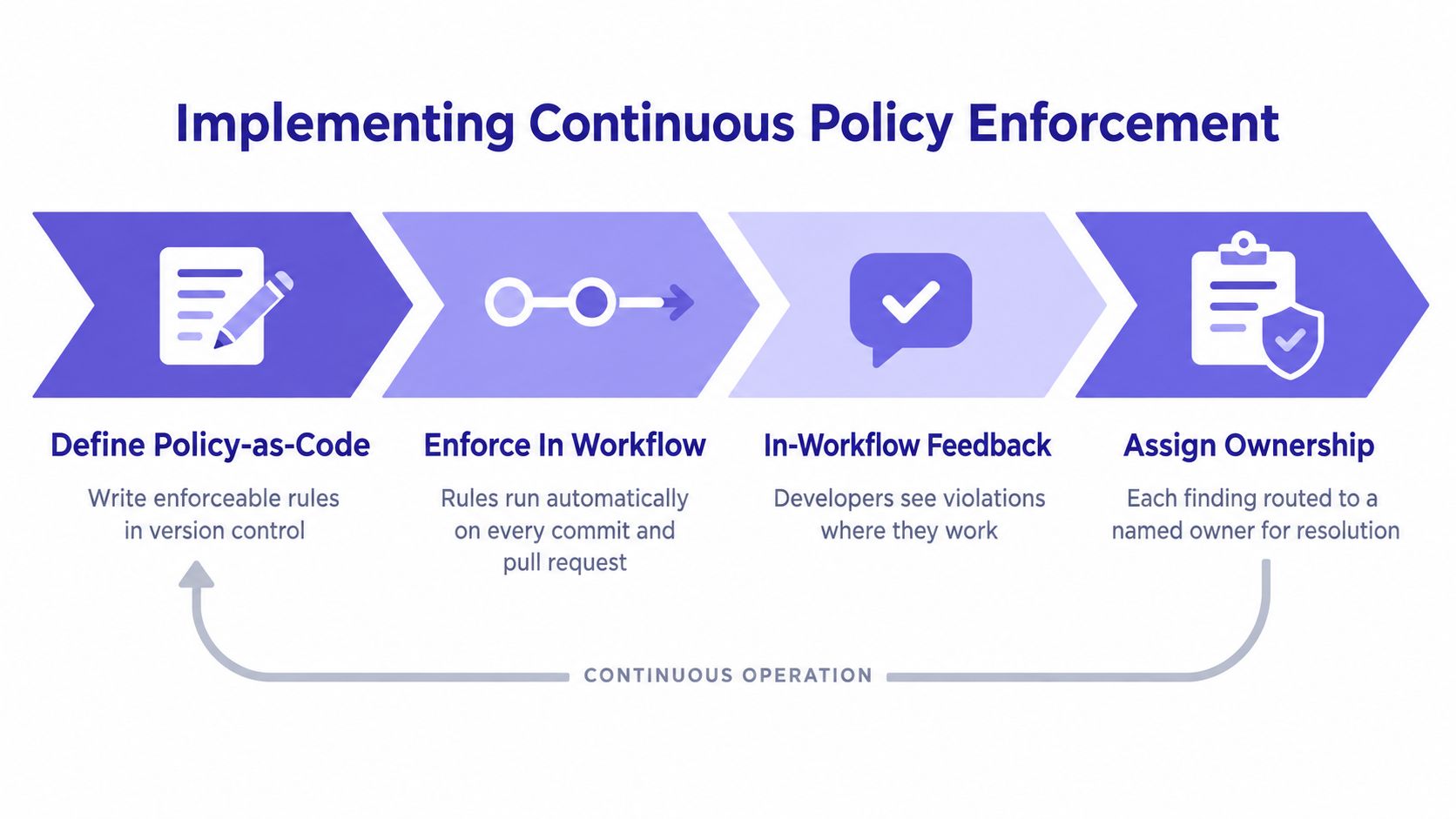
Continuous traceability works when engineers encounter it inside the tools where they already make changes. The system should not depend on developers updating a separate matrix after every pull request. It should derive relationships from planning records, source control, CI, design reviews, and deployment metadata, then enforce the missing connections at meaningful gates.
Start with stable security identifiers
Give every security requirement and threat-model mitigation a durable identifier. Store its description, owner, status, rationale, and verification expectations in version control or a system that preserves history. Avoid using prose alone as the key, because wording changes can break links and create duplicate controls.
Connect those identifiers to:
- Architecture decisions and approved patterns
- Jira issues and implementation tasks
- Pull requests and changed files
- Test cases and results
- Dependency findings and compensating controls
- Build artifacts and deployment targets
The relationship should be machine-readable. A pull request that changes authentication middleware, authorization policy, cryptographic configuration, or sensitive data handling should trigger a requirement check rather than rely on the author's memory.
Put enforcement at the review boundary
Policy-as-code should evaluate each relevant change and return an actionable result. A failed check might state that a modified authorization component has no linked security requirement, that a threat-model mitigation lacks current test evidence, or that a dependency update requires revalidation of a connected control.
The enforcement sequence is straightforward:
- Detect: Identify changed assets, affected services, dependencies, and security-sensitive patterns.
- Resolve: Find the requirements, design decisions, mitigations, and owners connected to those assets.
- Validate: Check for current review approval, test evidence, policy compliance, and deployment constraints.
- Respond: Provide feedback in GitHub, the IDE, Jira, or the agent interface, with a clear path to resolution.
A useful policy-as-code approach treats a policy failure as a missing relationship or unacceptable decision, not as a generic scanner alert. That distinction reduces noise. Developers can fix a missing rationale or attach the required evidence instead of searching through an undifferentiated findings backlog.
Keep component changes in scope
Third-party components need their own trace links. FDA guidance recommends connecting identified hazards to design requirements and test reports while reviewing release bulletins, known error reports, specifications, patches, documentation, and real-world user experience for incorporated components, as described in its guidance on off-the-shelf software.
For an updated library, preserve the component identity, version, vulnerability finding, affected threat-model nodes, compensating controls, test results, and deployment approvals. This lets engineers scope revalidation to the controls connected to the change rather than rerunning an unexplained test suite.
The enforcement system should also assign ownership. A blocked pull request without a responsible team creates delay, while a named owner with contextual feedback creates a manageable workflow.
Building an Audit-Ready Software Factory
An audit-ready software factory doesn't produce a large evidence package at the end of a release. It produces software with evidence attached as a natural property of planning, implementation, verification, and deployment.
Consider a security-sensitive change moving through a mature workflow. A requirement receives a stable identifier and links to a threat-model mitigation. The design review approves a pattern. A developer or coding agent modifies the mapped repository. The pull request records the rationale, policy evaluation, review identity, and test results. CI binds the build output to its source revision, and deployment records identify where that output runs.
If the change violates policy, the workflow stops at the review boundary. If it passes, the organization retains a coherent explanation of what was approved and what shipped. The audit doesn't need to reconstruct the process from screenshots and chat history because the process already generated connected evidence.
Measure evidence quality through delivery behavior
Traceability succeeds when it improves decisions without becoming a second delivery system. Useful measures are qualitative and operational:
- Can responders identify affected components and deployments from a vulnerability finding?
- Can reviewers find the design rationale behind a security-sensitive change?
- Can engineers distinguish current evidence from stale approval records?
- Can auditors receive a coherent chain without a manual evidence hunt?
- Can teams identify unowned requirements, orphaned code, and untested mitigations?
- Do policy checks provide feedback early enough for developers to act?
Watch for counterproductive signals. A growing record count doesn't prove stronger traceability. Excessive manual fields encourage copied explanations, stale links, and approval fatigue. A high volume of low-context findings can make developers bypass the process rather than trust it.
The strongest model keeps security context close to source code and delivery tools. Requirements evolve with the system, policies run against actual changes, and verification records remain connected to the artifacts they validate. Teams can use a platform such as DevArmor to maintain that living context across planning, IDE, source control, threat modeling, policy enforcement, and deployment evidence. For teams defining the required control relationships, verification requirements guidance provides a useful reference point.
Traceability matters because it turns security from a retrospective explanation into an active control. It tells engineers what a change must satisfy before merge, tells responders what a vulnerability affects after release, and tells auditors why the organization considers the software acceptable.
DevArmor connects security requirements, threat models, design decisions, code changes, and deployment evidence so teams can enforce traceability inside their existing delivery workflows. If you need living security context for human and AI-assisted development, visit DevArmor to see how continuous reviews and policy enforcement can support faster, audit-ready releases.
Table of Contents
Subscribe