ThreatModeler Competitors: 10 Options Compared for 2026
 Reza Khosravi
Table of Contents
A regulated team's design review is waiting for a calendar slot while pull requests keep merging. The threat model in the wiki describes an older architecture, not the services, dependencies, and deployment paths shipping today. That gap is where a tool comparison needs to start.
I judge these ThreatModeler competitors against four practical tests: can they build or refresh context from existing artifacts, integrate with developer and CI workflows, enforce policy as code, and produce evidence an auditor can use? This list covers ten options. ThreatModeler isn't one of the supplied items, so I make no claims about its features, pricing, or customers. DevArmor is the publisher's product, assessed against the same tests, with its limits stated, including pricing transparency and setup effort. For a broader look at AI software options, browse leading AI chat models.
Enterprise depth usually means slower setup and quote-based pricing. Free tools remove procurement friction, but automation and collaboration become your team's responsibility.
1. IriusRisk
IriusRisk is the strongest fit when threat modeling is a centralized enterprise program rather than an occasional engineering exercise. Its questionnaire-driven and diagram-based workflows support repeatable models across product portfolios. Pattern and rule libraries can generate threats and countermeasures mapped to frameworks such as PCI DSS, GDPR, and NIST 800-53. That reduces the manual translation work security teams often face during reviews and audits.
The platform also supports developer workflow and testing integrations, enterprise SSO, APIs, portfolio dashboards, and governance reporting. Those features matter when a security leader needs to compare risk across applications, not just inspect one diagram. The trade-off is operational. Teams need disciplined model ownership, useful source data, and administrators who can maintain the patterns as technology changes.
IriusRisk is a good choice when standards mapping, centralized governance, and portfolio visibility outweigh fast self-service onboarding. Its enterprise-oriented, quote-based pricing can be significant, so smaller teams should validate scope before committing.
Where it fits in a regulated release train
IriusRisk can provide strong evidence of decisions, risks, and control mappings. It's less convincing if your main requirement is automatic reconstruction of current security context from repositories and tickets, followed by merge enforcement. Confirm how thoroughly the integrations preserve links between a model, a specific code change, and a deployment.
For a closer comparison with a workflow-first option, see this IriusRisk alternative comparison.
2. Security Compass SD Elements
Security Compass SD Elements is aimed at teams that want threat modeling connected to developer enablement. It can generate contextual security requirements and threat content from project data, provide just-in-time training, and map requirements to recognized standards. Imports from tools such as Microsoft Threat Modeling Tool and diagrams.net help teams avoid abandoning existing modeling work.
Its strength is not just threat enumeration. SD Elements can connect requirements, developer guidance, training, integrations across the SDLC, and program reporting. That makes it useful for organizations trying to scale consistent security practices across many engineering groups without asking every developer to become a threat-modeling specialist.
The integration question
The key buyer test is whether guidance becomes an enforceable delivery control or remains a recommendation shown during development. SD Elements supports governance and audit reporting, but prospective buyers should verify exactly how requirements reach source control and CI, whether an unsafe pull request can be blocked, and how approval evidence remains attached to the implementation.
Pricing is subscription-based and enterprise-oriented, with no public price listed. Complex technology stacks may also require onboarding and content tuning. That setup can be worthwhile for a large program, but it's a poor fit for a small team seeking a lightweight tool with immediate policy-as-code enforcement.
3. DevArmor
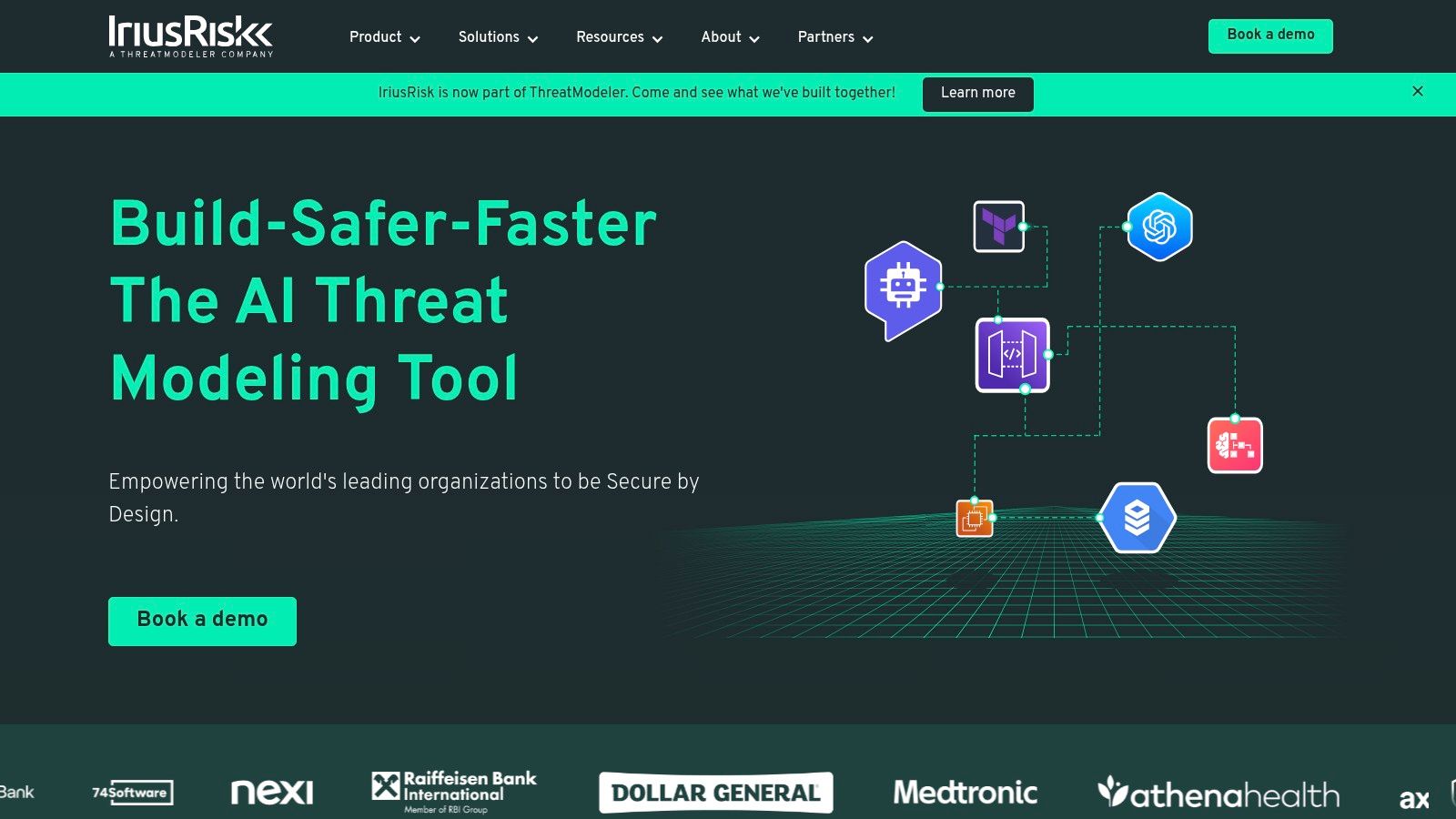
DevArmor takes a workflow-first position. It builds security context across design, code, and deployment from tickets, design documents, repositories, and service metadata. Engineers can review security decisions inside tools they already use, including Jira, Google Docs, GitHub, VS Code, Cursor, and MCP, rather than maintaining a separate model that quickly falls behind.
That approach fits teams whose architecture changes faster than its documentation. DevArmor can reconstruct context from existing artifacts and connect approved design decisions to implementation changes and deployments. Policy-as-code runs on pull requests, with optional merge blocking. Review outcomes remain traceable to the decision that created the control.
Where DevArmor is strongest
DevArmor is aimed at teams that need continuous threat modeling and drift control, particularly in regulated, fast-moving environments. Its workflow is designed to reduce meeting-based reviews, scanner noise, and security debt caused by stale models. Guardrails and prompting context for agentic and AI-assisted coding can also pass security context to coding agents instead of leaving it with a human reviewer.
The platform produces architecture documentation, decision traces, and review artifacts that can support SOC 2 and ISO 27001 evidence collection. DevArmor is pursuing SOC 2 certification, so buyers should distinguish evidence-generation support from a completed certification. The publisher cites customer endorsements on its site. Treat those as vendor claims rather than independent verification.
Customer-reported examples describe threat models and architecture reviews generated in minutes, including one claim that work previously taking weeks was reduced to minutes. Another customer reports automatic review of approximately 99% of pull requests. These figures are customer-reported and not independently verified, so they should guide questions during evaluation rather than serve as expected results.
Limits and procurement reality
DevArmor pricing is based on usage or features, with detailed costing handled through sales. The site offers an ROI calculator, demo booking, and early-access options, but no complete public price list. That may slow procurement for small teams.
Setup requires alignment with engineering workflows. Enterprise integrations, repository access, policy design, and agreement on the source of record all take work. A team seeking only a standalone diagram editor may find the platform heavier than necessary. A team that needs security decisions to remain connected to changing tickets, code, and deployments may consider that setup effort justified.
4. ThreatTree
ThreatTree is a practical option for teams that want to start modeling quickly without committing to a large enterprise program. Its SaaS workspace combines data-flow diagrams, suggested threats, attack-tree decomposition, and risk registers. Cloud elements for AWS, Azure, and Google Cloud help teams represent common infrastructure patterns without drawing every component from scratch.
The platform supports likelihood and impact scoring, tagging against ISO 27001, NIST 800-53, CIS, PCI, NIST CSF, and SOC 2, plus PDF reports for boards and audits. JSON and STIX 2.1 exports are useful if the model needs to move into another system. Optional client-side encryption can also matter when teams don't want model content exposed beyond the intended workspace.
Good starting point, limited enforcement depth
ThreatTree's free plan lowers the barrier to a pilot. Collaboration and reporting are stronger than a collection of local diagram files, and the exports give teams a path toward evidence reuse. The limitation is its position in the delivery workflow. Enterprises should verify the depth of integrations with repositories, issue trackers, CI systems, and merge controls rather than assume that a good export equals continuous enforcement.
Suggested threats still require expert review in complex domains. A model can be technically neat and still miss business logic, identity assumptions, or unusual trust boundaries. ThreatTree works best for a team that needs collaborative modeling and audit-ready outputs, but doesn't yet require a fully automated SDLC control plane.
5. Threagile
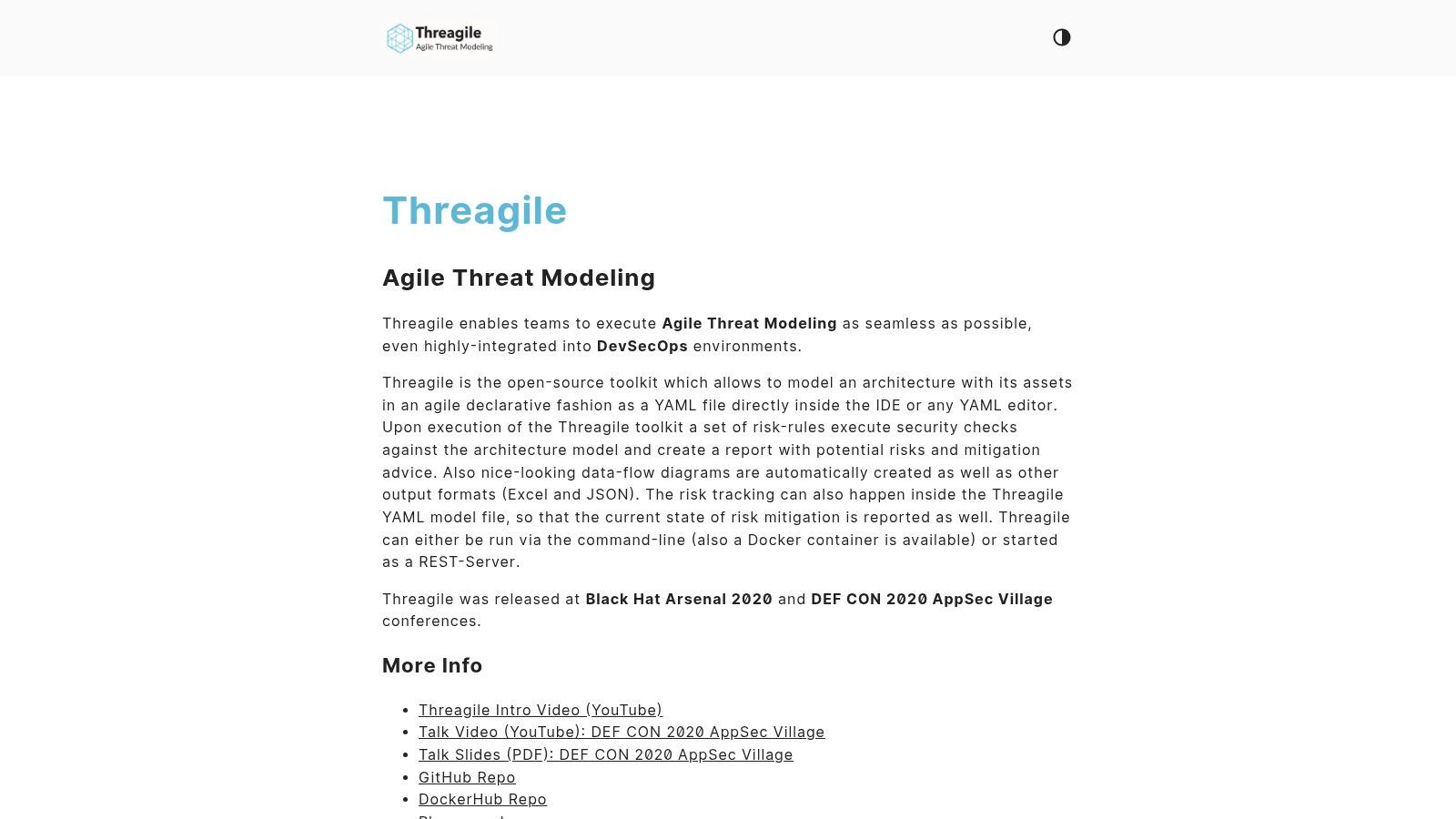
Threagile treats threat modeling as code. Teams describe architecture and assets in YAML, then generate risks, mitigations, diagrams, and reports. That model fits engineering organizations that already review Infrastructure as Code and configuration changes through version control.
The toolkit offers a CLI, Docker, and REST server options for CI/CD integration. It can generate data-flow diagrams and export results to Excel and JSON. Rule-based risk detection and mitigation advice provide a repeatable starting point, while the YAML model makes changes visible in code review.
Best for engineering-led programs
Threagile is free and automation-friendly. It can run inside an engineering pipeline without the procurement process associated with enterprise SaaS. Version-controlled models also create a useful history of architectural changes, provided the team reviews and maintains them.
The cost is shifted into implementation. Engineers need to learn the YAML structure, tune rules, and build the surrounding governance layer. Portfolio reporting, enterprise permissions, audit workflows, and polished collaboration generally require custom work.
Practical rule: Choose Threagile when your team wants control over the model and pipeline, not when it wants a finished governance program out of the box.
Threagile can support CI checks, but buyers must define what counts as failure and how a failing result blocks delivery. It's a strong fit for infrastructure-heavy teams with DevSecOps skills. It's less suitable for organizations that need nontechnical stakeholders to manage models through a mature shared workspace.
6. OWASP Threat Dragon
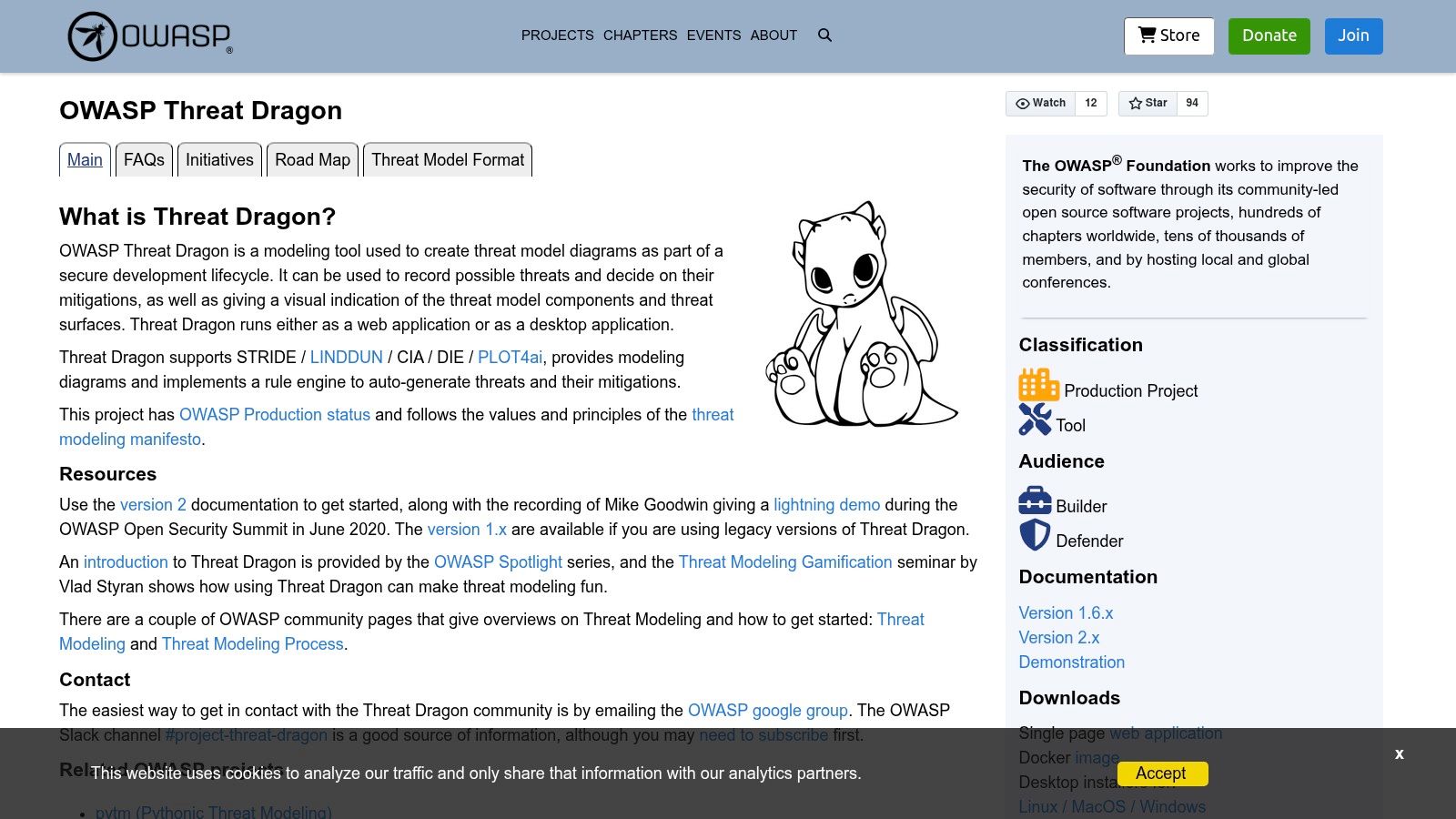
OWASP Threat Dragon is the sensible open-source choice for teams that want a low-friction way to learn and standardize basic threat modeling. It runs as a web application and desktop application, supports data-flow diagrams with STRIDE prompts, and provides reporting. OWASP governance, community examples, a Threat Model Library, and a Cookbook give new practitioners useful reference material.
The strongest advantage is flexibility without procurement. A team can pilot it, teach a common modeling approach, and adapt the tool without depending on a commercial contract. It's also a reasonable fit for security workshops where the immediate objective is to identify design threats and document mitigations.
Where the team must build around it
Threat Dragon isn't a portfolio governance system. It doesn't provide the same out-of-the-box rollups, automated artifact ingestion, or SDLC enforcement expected from a continuous platform. Collaboration and evidence management depend on how the organization stores files, assigns ownership, records approvals, and connects models to tickets and releases.
Advanced automation and integrations are therefore a DIY project. Teams can extend open tooling, but someone must own the extensions and keep them working as repositories and delivery systems change. Threat Dragon works well when the organization values openness and learning. It's weaker when an auditor needs a traceable chain from an approved design decision to a blocked merge and verified deployment.
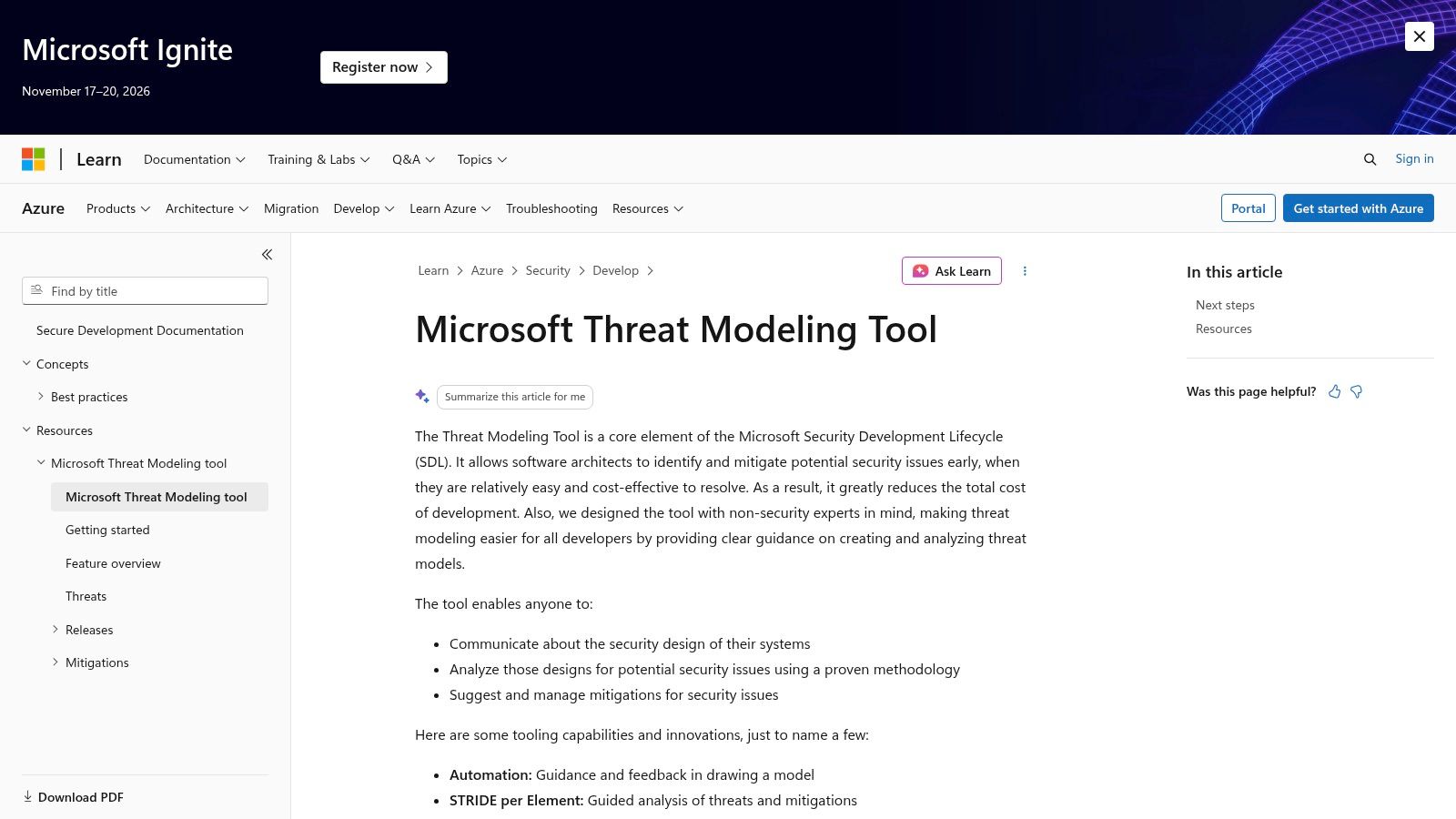
7. Microsoft Threat Modeling Tool
Microsoft Threat Modeling Tool is a free Windows application built around Microsoft's SDL approach. It guides users through data-flow diagram modeling and STRIDE-per-element analysis, then produces reports for design and verification activities. Microsoft's documentation and how-to guidance make it a straightforward entry point for teams that need a recognized methodology without buying a platform.
It works particularly well in early-stage programs. Security engineers can establish modeling habits, run architecture sessions, and create repeatable documentation. Budget-constrained teams can also use it as a baseline before deciding whether continuous modeling justifies a commercial investment.
The file-based boundary
TMT's main limitation is workflow continuity. Collaboration relies on file exchange and process discipline, and the Windows-only client limits where teams can work. It doesn't provide the artifact-driven refresh, modern SaaS collaboration, or developer-workflow automation expected from newer alternatives.
That doesn't make it ineffective. It makes ownership important. Someone must keep the file current, link findings to work items, record approvals, and check whether implementation matches the model. Without those controls, the model becomes another static document.
Teams comparing STRIDE with risk-centric methods can use this guide to compare STRIDE and PASTA threat modeling. TMT is a good methodology-led starting point, but it won't by itself enforce policy at pull requests or create deployment evidence.
8. foreseeti securiCAD
foreseeti securiCAD is for teams that need attack simulation and quantitative decision support, not just a categorized threat list. Teams model IT, operational technology, cloud, and hybrid architectures, then simulate attack paths to produce heat maps and prioritized risks. That approach can help security leaders explain why one mitigation deserves attention before another.
The product has editions for on-premises and cloud enterprise use, an AWS SaaS assessment offering called Vanguard, and a Professional edition. Its positioning suits critical infrastructure and complex enterprise environments where architecture has many dependencies and a checklist alone doesn't answer the prioritization question.
Strong analysis, heavier adoption
securiCAD's value depends on model quality and calibration. A poorly represented architecture produces misleading conclusions, even if the simulation looks precise. Teams need analysts who understand both the environment and the assumptions behind the model.
The product is enterprise-oriented, with pricing and deployment details typically handled through sales. It also isn't primarily a developer-workflow SaaS. Buyers seeking IDE feedback, automatic pull-request reviews, or merge blocking should treat securiCAD as a risk-analysis capability and verify what must be integrated around it.
This is a good choice when executives need modeled attack paths and risk prioritization across complex environments. It's less direct for teams whose first requirement is keeping design controls synchronized with daily source changes.
9. Isograph AttackTree
Isograph AttackTree is designed for formal attack-tree analysis in safety, automotive, aerospace, and cybersecurity programs. Its GUI supports attack, threat, and mitigation trees, consequence-driven analysis, and standards-aligned assessment for ISO 21434, J3061, and ISO 26262. Integration links such as Jama support collaboration with engineering and requirements systems.
The product handles complex models well when analysts need to decompose an attacker objective, show alternative paths, and connect mitigations to consequences. It's a mature choice for organizations where formal analysis and standards evidence matter more than developer self-service.
Analyst-first rather than pipeline-first
AttackTree isn't a developer-workflow SaaS. Its natural users are security, safety, and systems analysts. That's an advantage when the organization has a formal assurance process. It's a constraint when teams expect every engineer to receive contextual feedback inside an IDE or pull request.
Pricing is commercial and typically quote-based. Implementation also requires methodology discipline, training, and a process for moving decisions into engineering work. The tool can contribute strong evidence, but buyers should verify how easily it connects analysis to source changes, approvals, and deployment verification.
Teams evaluating formal methods should also compare threat modeling frameworks before selecting a product. Isograph is strongest where the framework and assurance case come first, not where continuous repository-driven refresh is the primary requirement.
10. Amenaza SecurITree
Amenaza SecurITree is built for rigorous attack-tree analysis in aerospace, defense, critical infrastructure, and other high-assurance environments. It supports qualitative and quantitative risk analysis, large models, training resources, and licensing options that include node-locked, floating, and time-limited arrangements.
The platform makes sense when analysts need detailed attacker objectives, dependencies, consequences, and mitigations. Its long-standing focus on formal attack-tree work is a strength for organizations with established assurance practices and demanding analysis requirements.
Deep modeling, limited SDLC embedding
SecurITree focuses on attack-tree analysis rather than continuous automation inside the software delivery lifecycle. It won't be the obvious choice for a team that wants threat context reconstructed from repositories, design documents, or tickets and then enforced at pull requests.
Pricing is handled through sales, and total ownership includes licensing, training, analyst time, and governance. The product can produce defensible analysis, but the organization must connect that analysis to development workflows, issue tracking, source control, and deployment evidence.
SecurITree is therefore a specialist tool. Choose it when high-assurance attack-tree depth is the requirement. Don't choose it solely because you need a modern developer-facing control plane.
Top 10 Threat Modeling Tools Comparison
| Solution | Core features | Quality (★) | Price / Value (💰) | Target (👥) | Unique selling points (✨) |
|---|---|---|---|---|---|
| IriusRisk | Pattern/rule libraries; standards mapping; workflow & portfolio dashboards | ★★★★ | 💰 Enterprise (quote) | 👥 Regulated enterprises, security/GRC teams | ✨ Mature standards coverage & governance |
| Security Compass SD Elements | Automated security requirements; integrations; training & program reporting | ★★★★ | 💰 Subscription / enterprise | 👥 Large orgs scaling dev-sec programs | ✨ Just-in-time training + contextual content |
| 🏆 DevArmor | Continuous threat models from tickets/repos/docs; in‑workflow design reviews; Policy-as-Code on PRs; implementation verification; AI guardrails | ★★★★★ | 💰 Flexible / usage-based (contact sales) | 👥 Fast-moving, regulated engineering teams (FinTech/HealthTech/Media) | ✨ Living security context + PR enforcement tied to approved designs |
| ThreatTree | DFD editor; auto attack-trees; likelihood×impact scoring; audit exports; optional client-side encryption | ★★★★ | 💰 Free plan + paid tiers | 👥 Small→mid teams; privacy-conscious users | ✨ Quick onboarding + client-side encryption |
| Threagile | Threat modeling-as-code (YAML); CLI/CI/CD integration; auto diagrams & reports | ★★★★ | 💰 Free / open-source | 👥 DevSecOps, IaC teams | ✨ Code-reviewable models and pipeline automation |
| OWASP Threat Dragon | DFDs with STRIDE prompts; community model library; web & desktop apps | ★★★ | 💰 Free / open-source | 👥 Teams piloting open tooling & educators | ✨ Community-driven resources and examples |
| Microsoft Threat Modeling Tool | STRIDE-guided DFDs; threat generation; built-in SDL guidance & reporting | ★★★ | 💰 Free | 👥 Windows-based or budget-conscious teams | ✨ Official Microsoft SDL methodology & docs |
| foreseeti securiCAD | Model-based attack simulation; heat maps & prioritized attack paths; large-model support | ★★★★ | 💰 Enterprise (sales) | 👥 Critical infra, cloud & enterprise risk teams | ✨ Quantitative attack simulation for decision support |
| Isograph AttackTree | Advanced attack/mitigation tree GUI; standards-aligned templates; collaboration links | ★★★★ | 💰 Commercial / quote | 👥 Safety/security analysts (automotive, aerospace) | ✨ Mature formal attack-tree analysis & standards support |
| Amenaza SecurITree | Rigorous attack-tree modeling & quantification; flexible licensing & training | ★★★★ | 💰 Commercial / licensing | 👥 High-assurance sectors (defense, aerospace, critical infra) | ✨ Proven in high-assurance domains with training programs |
Matching Each Shortlist to Your Delivery Model
The best choice depends on where security work fails today. If models drift as repositories and tickets change, prioritize continuous context and implementation verification. DevArmor is the clearest fit in this group because it generates and refreshes models from existing artifacts, places reviews in Jira, Google Docs, GitHub, VS Code, Cursor, and MCP, and links approved decisions to code and deployments. IriusRisk and SD Elements provide stronger centralized governance and standards-oriented program management, but buyers should verify how automatically they refresh design context and how directly they enforce delivery controls.
For IDE and CI integration, start with DevArmor, Threagile, and SD Elements, but for different reasons. DevArmor places feedback in developer tools and can run policy checks on pull requests. Threagile gives engineering teams a code-centered model with CLI, Docker, and REST options, but the organization must build much of the surrounding governance. SD Elements is strong for requirements, training, and SDLC coverage, while the exact enforcement path needs validation during procurement.
For policy-as-code and merge gating, DevArmor is the most direct match in this list because its controls can run on pull requests with optional merge blocking and traceable outcomes. Threagile can support CI enforcement, but the team must define rules, failure conditions, and integrations. ThreatTree, OWASP Threat Dragon, and Microsoft TMT are better treated as modeling and documentation tools unless a separate control layer connects their outputs to source control.
For audit readiness, IriusRisk and SD Elements suit organizations that need portfolio reporting, standards mapping, governance, and consistent program evidence. ThreatTree adds collaborative modeling, PDF reporting, and JSON or STIX 2.1 exports. Isograph AttackTree and SecurITree are stronger when the auditor or assessor expects formal attack-tree analysis. DevArmor focuses on architecture documentation, decision traces, review outcomes, and implementation evidence. It's pursuing SOC 2 certification, so don't represent that certification as complete.
Migration and procurement
Preserve existing models where the tool supports useful exports. ThreatTree offers JSON and STIX 2.1. Threagile offers Excel and JSON. Microsoft TMT and OWASP Threat Dragon rely on files, so include those files in the migration plan and preserve their history, ownership, and approval context.
Pilot one repository before procurement. Use a service with real dependencies, an active release path, and a design change likely to affect security controls. Decide which system becomes the source of record for controls, then test whether every tool can maintain that link after the architecture changes.
Pricing varies sharply. Microsoft TMT, OWASP Threat Dragon, and Threagile are free or open options. ThreatTree offers a free plan. IriusRisk, SD Elements, securiCAD, Isograph AttackTree, and SecurITree use enterprise or commercial pricing that is generally quote-based. DevArmor uses usage or feature-based pricing quoted through sales, so request a scope-specific estimate rather than assuming a simple seat price.
The threat-modeling process itself can become a delivery bottleneck. A Security Compass survey reported that only 25% of organizations conducted threat modeling during requirements or design, fewer than 10% applied it to at least 90% of applications, and more than 60% believed the practice could be fully automated while only 28% had reached that level of automation. The survey summary shows why coverage and workflow latency belong in the evaluation, not just diagram quality.
The risk is not theoretical. Verizon's 2025 breach analysis reviewed more than 22,000 security incidents, including 12,195 confirmed breaches, and found that vulnerability exploitation accounted for 20% of initial access, up 34% from the prior year. Third-party involvement doubled to 30%, while credential abuse remained at 22% of initial access, according to the 2025 Data Breach Investigations Report executive summary. Those conditions favor tools that keep architecture, dependencies, identities, and delivery decisions connected as systems change.
Run a bounded pilot on one service, with explicit pass or fail criteria for CI merge blocking, model refresh after a design change, and the quality of audit evidence. If a tool can't pass those tests without a manual meeting and a separate spreadsheet, it isn't solving the release-train problem.
DevArmor provides continuous threat modeling, workflow-based security design reviews, and policy-as-code enforcement across design, code, and deployment. If your team needs living security context, pull-request controls, and traceable evidence rather than another static diagram, visit DevArmor to evaluate the platform.
Table of Contents
Subscribe