
Cyber Incident Response Plan Sample for Auditors
 Reza Khosravi
Table of Contents
The most popular advice about incident response is to download a template, fill in the contacts, and publish it. That produces a document, not a response capability. A useful cyber incident response plan sample must tell people what they can decide under pressure, what they must preserve, and how they'll prove that each action was authorized.
Build the plan as an auditable operating system. Every escalation, containment action, evidence record, communication, recovery approval, and remediation change should have an accountable owner and a traceable source artifact.
Why a Static Incident Plan Is Not Enough
Publishing a plan doesn't establish that responders can execute it. Your incident commander needs current service owners, working access, usable recovery procedures, and authority to make disruptive decisions. Your auditor needs records showing what those people did.
Those are different requirements. Treat documented intent, operational readiness, and demonstrated execution as separate outcomes.
Verizon's 2025 Data Breach Investigations Report analyzed 22,052 security incidents and 12,195 confirmed breaches across 139 countries. Credential abuse accounted for 22% of breaches, vulnerability exploitation for 20%, ransomware appeared in 44%, and third-party involvement doubled to 30%. Your playbooks should therefore cover these scenarios directly, not bury them in optional appendices.
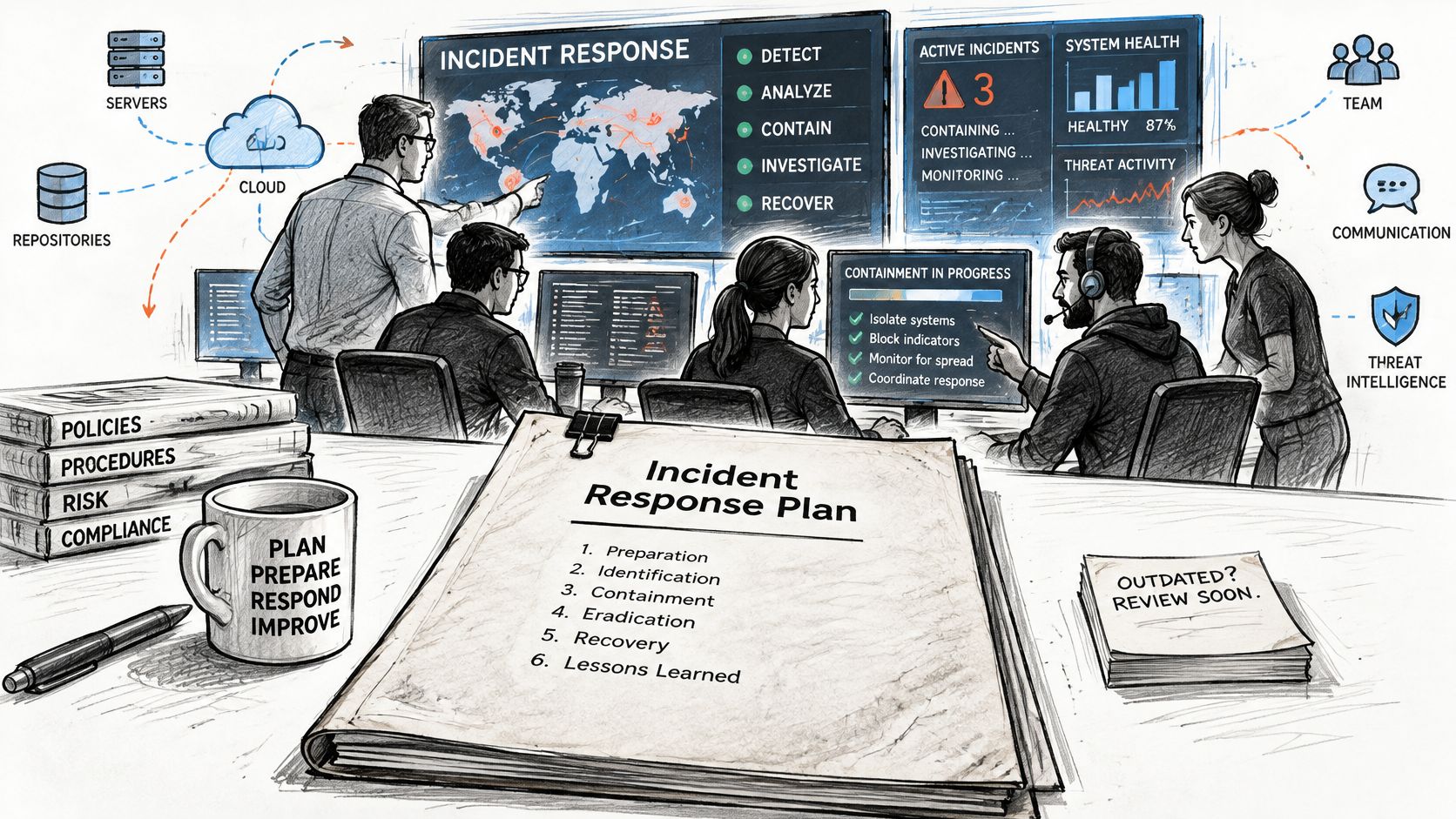
Define the operational outcome
A responder should be able to move from an alert to an authorized action without reconstructing your organization's architecture. Connect affected services to their repositories, deployments, dependencies, and responsible teams.
Test the plan against these practical questions:
- Preparation: Can responders access the tools and instructions if normal identity or collaboration services are unavailable?
- Classification: Can the duty analyst distinguish an investigation from a declared incident?
- Coordination: Can engineering identify who may approve isolation or an emergency change?
- Accountability: Can a reviewer trace the action back to its evidence and decision owner?
A plan is executable when another qualified responder can take over without relying on the previous responder's memory.
Don't make a PDF the authoritative source for changing operational details. Keep policy stable, but reference maintained runbooks, service catalogs, escalation schedules, and evidence registers. Preserve the version used during each event so later updates don't overwrite the historical record.
That distinction matters during an audit: the current procedure shows what you expect now, while the incident's retained version shows what responders were instructed to do then.
Build a Reference-Ready Plan Structure
Organize the plan around the questions people ask during an incident, not around a narrative they must read from beginning to end. The incident commander needs authority; an engineer needs an executable procedure; legal needs facts and obligations; an auditor needs the record.
Use the following structure as the navigation layer.
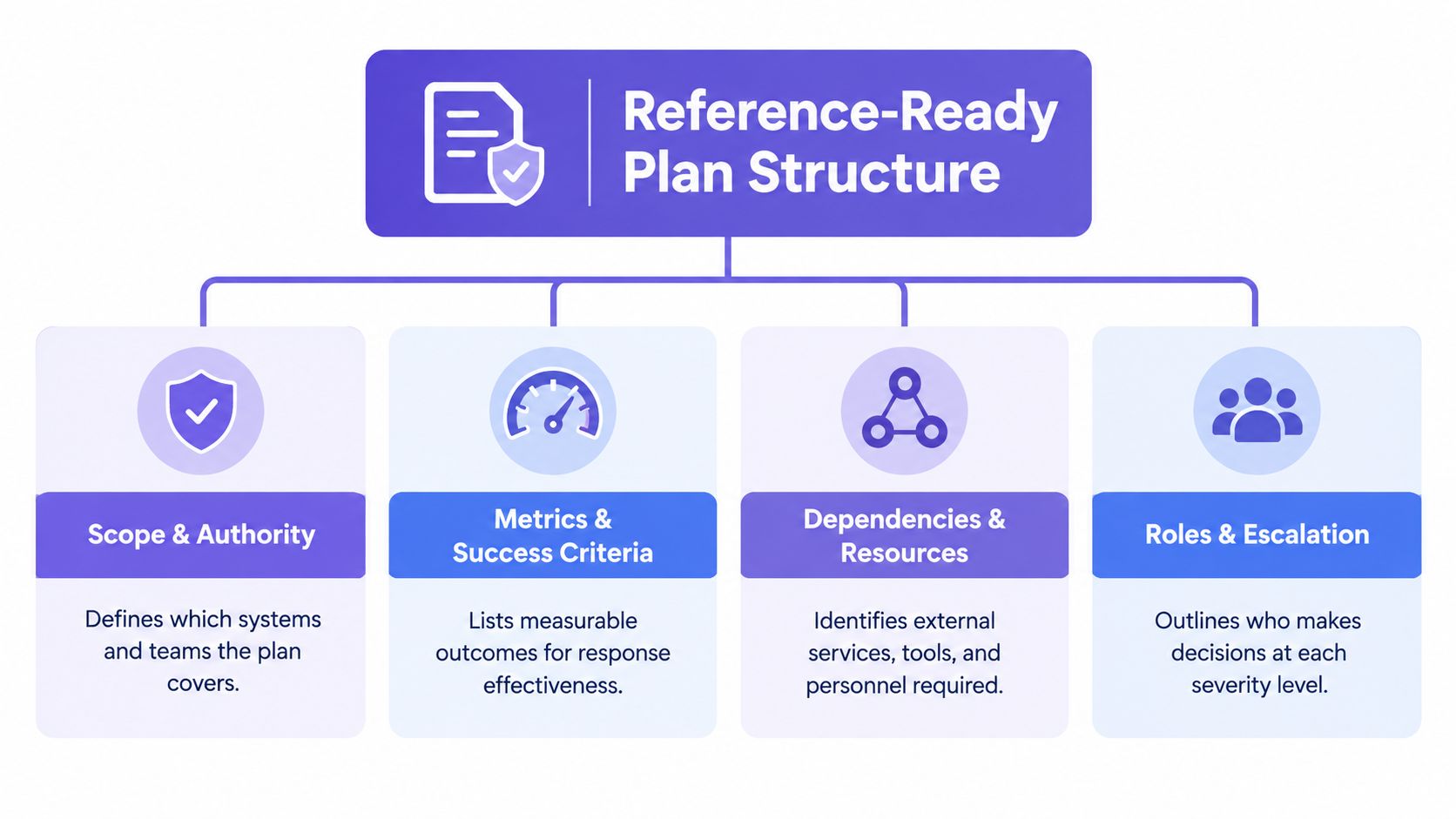
| Plan category | Contents | Primary lookup |
|---|---|---|
| Scope and authority | Coverage, exclusions, declaration rights, emergency permissions | Can we act? |
| Metrics and success criteria | Response objectives, recovery criteria, measurement definitions | What outcome is required? |
| Dependencies and resources | Services, suppliers, tools, backups, responder access | What do we depend on? |
| Roles and escalation | Decision owners, alternates, severity rules, handoffs | Who decides? |
| Operational playbooks | Lifecycle procedures and scenario-specific actions | What happens next? |
| Communications and assurance | Approvals, evidence handling, recovery records, control mappings | What must we retain? |
Make references durable
Give every procedure a stable identifier, accountable maintainer, approved version, and review trigger. A service isolation runbook should identify its prerequisites, execution permissions, rollback conditions, and required output record. A link to a dashboard alone isn't a procedure.
Keep sensitive operational details behind appropriate access controls, but make the navigation layer available to authorized responders through an independent fallback. Test that fallback during exercises rather than assuming someone has an offline copy.
Use bidirectional references where practical. The incident record should identify the relevant deployment, and the emergency deployment record should identify the incident that authorized it. That lets different reviewers enter through their own systems without losing context.
A reference-ready structure also separates the plan from its evidence. The plan defines what should happen; the evidence register identifies what happened. Don't paste raw logs, customer information, or forensic exports into a broadly accessible policy document merely to make it look complete.
Set Scope Authority and Readiness Targets
Start with a governance entry that engineering, security, and business leadership can approve. Avoid language such as “take appropriate action” unless the plan defines who decides what appropriate means.
Copyable scope and authority entry
| Field | Sample language to adapt |
|---|---|
| Purpose | Coordinate investigation, harm reduction, service restoration, and accountable incident handling. |
| Applicable systems | Covers [services], [cloud environments], [repositories], [identity systems], and [supplier-managed dependencies]. |
| Incident definition | An event that threatens confidentiality, integrity, or availability and requires coordinated action beyond routine operations. |
| Exclusions | Routine defects remain under normal operations unless security indicators, data impact, or escalation criteria apply. |
| Declaration authority | [Duty security lead] or [designated alternate] may declare an incident and appoint an incident commander. |
| Containment authority | The incident commander may authorize production isolation after assessing business impact, within [approved emergency boundaries]. |
| External notification | Legal or privacy approval is required before release, with [delegate] handling unavailable approvers. |
| Required records | Incident record, decision log, action timeline, evidence register, communications history, and recovery approval. |
Separate policy authority from operational permission. Leadership may authorize emergency isolation, but the assigned engineer still needs working credentials and a tested execution path. Document both, including how temporary access is granted and later removed.
Define measurable objectives
IBM's 2025 Cost of a Data Breach research reported a USD 4.44 million global average breach cost and a mean 241 days to identify and contain a breach. These are research averages, not suitable deadlines for your responders.
Set organization-specific targets instead:
- Acknowledgement: [Target] from alert receipt, measured through the paging record.
- Containment: [Target by severity], with the containment condition explicitly defined.
- Recovery: [Service-specific target], approved by the business owner.
- Notification: [Applicable obligation and deadline], validated by legal or privacy.
- Review: [Post-incident review deadline], assigned to a named owner.
Record detection, acknowledgement, declaration, containment, eradication, recovery, and closure timestamps with a consistent time reference. Preserve pauses and exceptions rather than adjusting timestamps to make performance appear better.
Readiness must also have evidence: responder training, tested contact channels, accessible inventories, backup tests, forensic tooling checks, and current external support arrangements. An approved plan without those prerequisites should be recorded as a readiness gap.
Assign Roles and Severity-Based Escalation
A contact list tells responders whom to call. It doesn't tell them who can approve downtime, accept residual risk, or release a customer statement.
ISO/IEC 27035-2's planning guidance identifies management commitment, policies, an incident-management team, internal and external relationships, technical support, training, testing, and lessons learned as core planning elements. Convert those elements into explicit assignments, not committee membership.
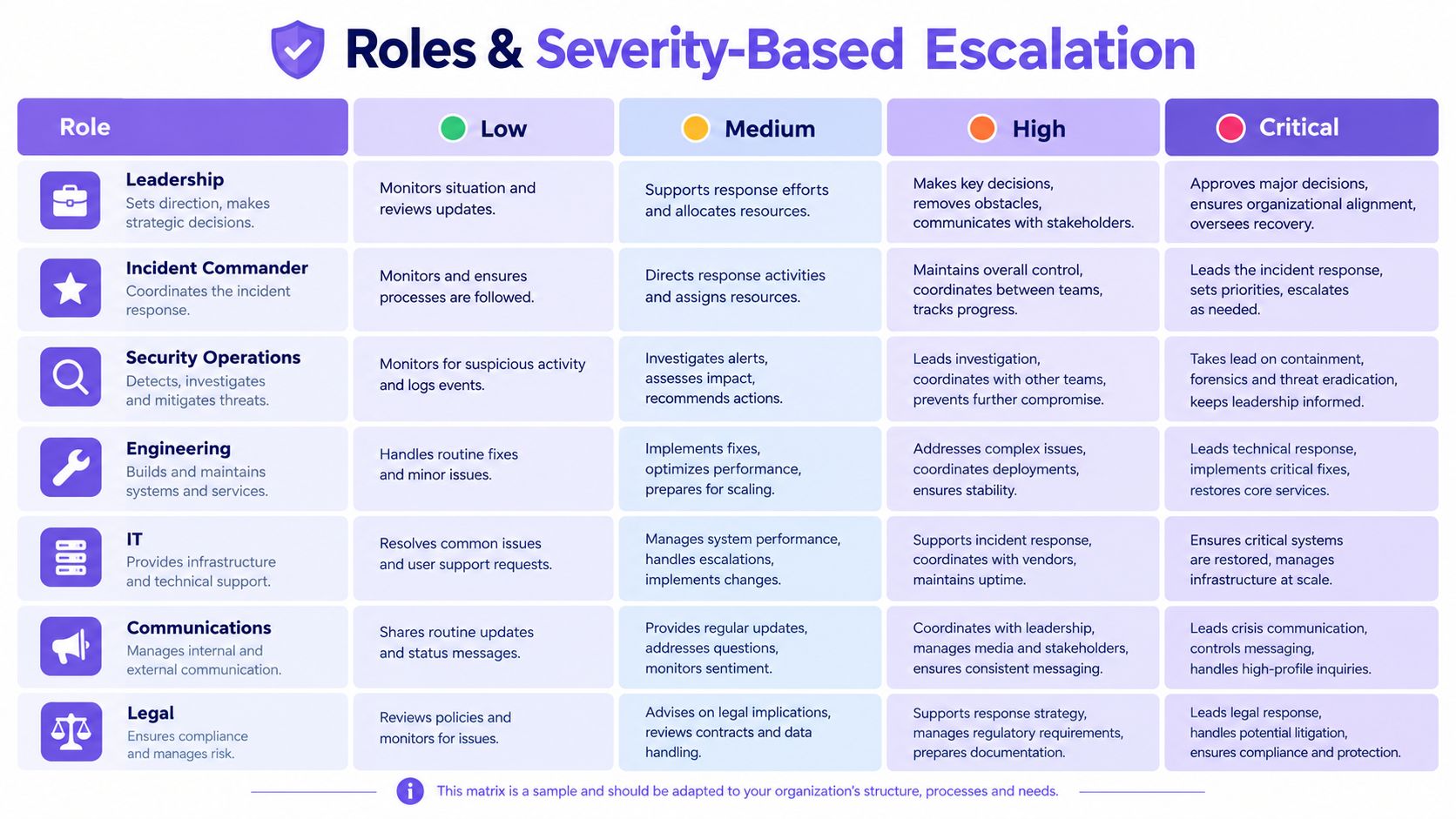
Adaptable decision ownership
Use this as a RACI-style starting point. Assign named people and alternates locally, and identify who is responsible, accountable, consulted, and informed for each action.
| Role | Decision and required input | Output and handoff |
|---|---|---|
| Leadership | Accept major business trade-offs using impact assessment | Recorded risk decision to commander |
| Incident commander | Set priorities using technical and business findings | Action assignments and shift handover |
| Security operations | Assess compromise using alerts and investigative evidence | Findings to engineering and commander |
| Engineering | Select application containment and remediation using service context | Change and validation records |
| IT | Execute endpoint and identity actions using affected asset lists | Execution results to investigators |
| Communications | Prepare audience-specific updates using approved facts | Versioned message and distribution record |
| Legal and privacy | Assess notification duties using data and jurisdiction findings | Advice, approval, or escalation |
| Business continuity | Select fallback operations using service impact | Restart recommendation to business owner |
| External responders | Deliver assigned specialist work within agreed scope | Findings and evidence transfer record |
Escalate on impact and uncertainty
Use low for a bounded suspected event, medium for confirmed compromise without established major impact, high for sensitive-data concerns or material service impact, and critical for an active, expanding threat requiring executive trade-offs. These are sample definitions, not universal classifications.
Supplier involvement or active exploitation should trigger specialist review even when the initial severity remains uncertain. Don't wait for complete attribution before notifying the people who may need to act.
An escalation entry should contain declaring person, timestamp, known facts, unresolved questions, affected services, provisional severity, decisions requested, and next review time. Require the receiving owner to acknowledge the handoff. If they're unavailable, use the documented alternate rather than leaving the request in a chat channel.
Write Scenario-Specific Response Playbooks
Write playbooks as conditional instructions. “Disable every account” is not a safe universal response, and “patch immediately” doesn't explain whether the attacker still has access.
Each entry needs a trigger, authorized action, evidence requirement, decision gate, and exit condition. Use the NIST incident-handling guide's documentation and preservation practices to start recording investigative actions when an incident is suspected, including relevant volatile evidence and how collected material is accounted for.
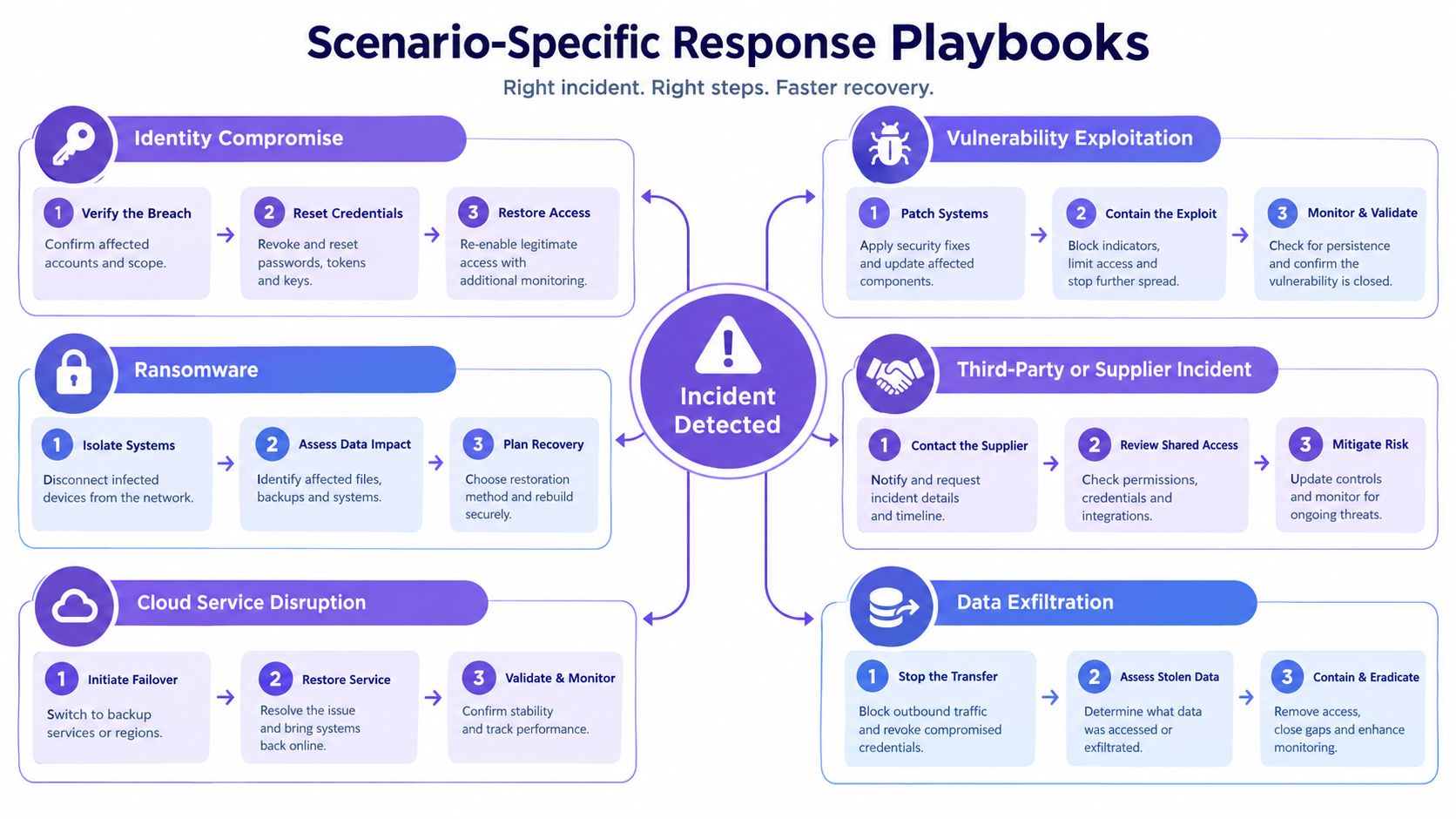
Identity compromise and vulnerability exploitation
Identity compromise: Trigger on credible unauthorized account activity. Security operations should validate the activity, preserve authentication and administrative logs, and identify downstream sessions or credentials. The authorized identity owner may disable the account, revoke sessions, or rotate credentials according to the affected service's dependency risks.
Prioritize privileged identities and accounts with access to sensitive services. Recovery requires validation of legitimate access, review of unauthorized changes, and evidence that the suspected access path has been addressed.
Vulnerability exploitation: Trigger on evidence of exploitation or credible indicators affecting a deployed component. Connect the vulnerable asset to its service owner, repository, deployed version, and exposure. If continued exposure creates unacceptable risk, use an approved isolation or mitigation procedure while preserving relevant host and application evidence.
Don't equate a successful patch with eradication. Close the playbook only after reviewing persistence concerns and verifying the remediation against the deployed environment.
Ransomware and supplier incidents
- Ransomware: If encryption or related destructive activity is suspected, isolate affected systems through authorized controls and assess identity, backup, and shared-service exposure. Preserve relevant evidence before destructive rebuilding when feasible. The recovery gate requires a clean restoration path, an assessed data-impact position, and a business-approved restart.
- Third-party compromise: When a supplier reports an incident or shared access appears compromised, activate the supplier contact and map affected integrations. Consider restricting tokens, connections, or data exchange according to business impact. Retain supplier notices, access decisions, responsibility boundaries, and independent validation of your own exposure.
For both scenarios, identify what your team can verify directly. A supplier's assurance or an available backup isn't sufficient closure evidence by itself.
Cloud disruption and AI-assisted activity
Cloud service disruption: First determine whether the event is an availability problem, a security incident, or both. Preserve provider notices and your own configuration history; inspect dependencies before invoking failover. Authorize restoration only after validating the destination environment, access controls, data consistency, and acceptable operating limits.
AI-assisted code or agent activity: Trigger on unauthorized changes, suspicious tool use, or a remediation that conflicts with approved security requirements. Suspend the affected agent, risky deployment, or automated workflow within delegated authority. Preserve repository history, pipeline records, available prompts and tool actions, and relevant approvals under your retention rules.
For closure, the engineering owner should demonstrate what changed, which permissions were restricted, and how the corrected implementation matches the approved security decision. Treat suspected data exfiltration as a cross-cutting investigation path across every scenario, with legal and privacy involvement based on the facts.
Manage Communications and Evidence Preservation
Assume, for this sample, that responders have confirmed misuse of a production credential but haven't established whether customer information was accessed. The internal update must separate those facts rather than describing the event as either harmless or a confirmed data breach.
Adaptable status message
Incident status: Unauthorized credential use is confirmed for [service]. Responders have completed [verified action]. Customer-data access remains under investigation. [Owner] is assessing [question], and the next approved update is due at [time].
Attach the supporting evidence references to the internal record, not necessarily to the external message. Record who drafted the update, who approved it, its version, its audience, and when it was distributed.
Use distinct routing rules:
- Technical coordination: Restricted response channel with an independent fallback if the primary environment is affected.
- Business-owner notification: Impact, decisions needed, workarounds, and the next update.
- Customer communication: Approved facts, relevant service effects, and any action recipients need to take.
- Supplier coordination: Specific requests, affected integrations, response owner, and agreed next contact.
- Legal or regulatory review: Facts relevant to applicable obligations, with unresolved questions clearly identified.
Define update cadence by severity and audience using local placeholders. For a practical companion when designing approval paths and channel handoffs, consult Ciphar's incident response communication workflows. Keep your own approved procedure authoritative.
Evidence preservation entry
| Field | Required entry |
|---|---|
| Custodian | Named person accountable for preservation |
| Origin | Source system, collection method, and relevant scope |
| Timing | Collection time, source time reference, and known limitations |
| Integrity | Hash or other integrity reference where available |
| Storage | Controlled evidence location and retention instruction |
| Access | Authorized users and access history |
| Custody | Collection, transfer, receipt, and handling records |
| Decision supported | The finding or authorization the artifact informs |
Don't collect everything indiscriminately. Capture what supports investigation and obligations while controlling access to sensitive information.
Record known, suspected, and unknown findings separately. A log may support a conclusion about account access without establishing what data the user viewed. Preserve that limitation, and don't assume that retaining a message or artifact automatically establishes legal admissibility.
Make Recovery a Business Decision
Restoring a server isn't the same as restoring a trustworthy service. The business owner must decide whether the proposed operating state is acceptable, using technical findings, continuity needs, and unresolved risks.
Google Cloud's recovery guidance reports that 98% of surveyed organizations had a ransomware playbook, yet fewer than half included backup verification and frequency, and only 30% included a predefined chain of command. Possessing a playbook doesn't demonstrate restoration capability.
Require a recovery decision packet
The engineering lead should prepare a recommendation, not merely announce that restoration completed.
- Clean restoration path: Backup validation, restore-test results, protected backup access, and evidence that the destination is suitable.
- Business tolerances: Validated recovery time objective and recovery point objective, including any expected data loss.
- Dependencies: Required identity, supplier, network, and application services, with their readiness status.
- Operating constraints: Capacity reserved for forensic work, restricted features, manual processes, and monitoring requirements.
- Approval: Business owner, technical validator, unresolved risk owner, and rollback conditions.
Recovery rule: The person who can execute a restore shouldn't automatically be the person who accepts the business risk of reopening the service.
If forensic work limits production capacity, make the trade-off explicit. The commander and business owner should decide whether to maintain reduced operations, invoke manual processes, or allocate separate investigation resources. Record the reasoning and the consequences they accepted.
Close the incident without losing the follow-through
Link recovery approval to the affected service and the change used to restore it. Record validation results, not just an approval checkbox.
The post-incident review should reconstruct the timeline, distinguish root causes from contributing conditions, and examine decisions made with incomplete information. Assign corrective actions with owners, due dates, and acceptance evidence.
Separate operational closure from corrective-action completion. Services may be restored while longer-term changes remain open, provided leadership accepts that position and the tracking process stays active. Don't keep an incident nominally open to hide weak remediation ownership, or close it to remove overdue work from view.
Map the Sample to Compliance Evidence
An auditor-friendly plan makes a defensible distinction between control design, control operation, and incident-specific performance. Design describes the approved process. Operation shows that people followed it. Performance shows whether their actions achieved the intended result.
Use the following mapping as an evidence organization aid for SOC 2 and ISO 27001 discussions, not as a claim that these entries satisfy either framework. The ISO 27001 framework overview provides context for placing incident management within broader security governance.
| Plan entry | Example evidence | Accountable owner | Review or update trigger |
|---|---|---|---|
| Risk and scope | Service inventory and assessed impact | Security governance | Material system change |
| Policy and authority | Approved policy and delegated permissions | Executive sponsor | Authority change |
| Roles and training | Assignments, acknowledgements, exercise records | Response lead | Personnel change or failed exercise |
| Monitoring and triage | Alert, investigation record, classification rationale | Security operations | Detection gap |
| Response actions | Decisions, execution records, exceptions | Incident commander | Incident or playbook failure |
| Recovery | Validation results and restart approval | Business owner | Changed recovery dependency |
| Vendor management | Responsibility records and supplier coordination | Supplier owner | Integration or contract change |
| Evidence retention | Custody, access, and disposal records | Evidence custodian | Revised obligation |
| Corrective actions | Assigned work and acceptance evidence | Remediation owner | Review finding |
Build an inspectable evidence packet
Keep a compact index for each high-severity event. Include the applicable plan version, declaration, decision timeline, evidence register, communication approvals, restoration decision, review findings, and linked remediation.
Map each artifact to the control your organization defined. Don't attach a framework label after the event merely because the record looks relevant.
Use NIST's lifecycle concepts to check coverage, ISO's planning elements to check governance, and CISA's business-impact and playbook concepts as review lenses for prioritization and completion. These are organizing aids, not interchangeable certifications or proof of compliance.
Finally, test retrieval. Ask someone outside the response team to reconstruct a containment approval from the evidence packet. If they need a private conversation with the responder to understand who approved what, the record isn't ready.
Automate Traceable Actions in Developer Workflows
Connect response controls to the tools engineers already use, but don't let automation become an unreviewed decision-maker. A pipeline can enforce a required approval; it can't independently accept your organization's business risk.
NIST SP 800-61r3 places incident response within the broader CSF 2.0 risk-management model. Apply that integration by making response requirements part of planning, implementation, release, and operational review rather than a separate emergency document.
Enforce state transitions
Use policy-as-code enforcement to validate required fields and approvals at meaningful workflow boundaries. For example, configure a recovery transition to require the commander, business owner, legal or privacy disposition, evidence location, and restoration plan.
| Workflow event | Proposed automated check | Human decision |
|---|---|---|
| Emergency pull request | Incident reference and approved remediation requirement exist | Reviewer accepts implementation |
| Risky deployment | Relevant incident hold has been cleared | Authorized owner permits release |
| Agent-generated change | Required policy checks and review are complete | Engineer approves merge |
| Architecture change | Inventory and threat-model review are assigned | Service owner confirms context |
| Remediation completion | Validation evidence matches the approved decision | Security reviewer accepts closure |
Keep human override authority explicit. Require an identified approver, documented reason, permitted scope, expiry condition, and subsequent review. A generic administrator bypass with no incident reference defeats the control.
Automation should also preserve the evidence needed to explain its actions. Record the policy version, evaluated inputs, result, override if any, and resulting deployment reference.
Don't freeze all delivery indiscriminately. Scope restrictions to affected repositories, services, credentials, or environments where the evidence supports that boundary. Broader restrictions may be justified, but an accountable person must own the operational consequences.
Refresh inventories and threat models when the incident reveals an undocumented dependency or invalid design assumption. Otherwise, engineers may fix the immediate symptom while leaving the approved security context inaccurate.
Use Auditor-Ready Checklists and Cross-References
Keep the quick-reference layer short enough to use during an event. Each checkbox should point to a procedure or retained artifact, not repeat the full instruction.
Readiness before an incident
- People: Primary responders and alternates have acknowledged their duties.
- Access: Emergency tools, communication fallback, and protected plan copies have been tested.
- Systems: Service ownership, dependencies, and recovery prerequisites are current.
- Practice: Exercise findings have assigned owners and acceptance criteria.
First-hour actions during an event
- Record: Open the incident entry and preserve the initial alert.
- Classify: Assign provisional severity and identify declaration authority.
- Coordinate: Confirm the commander, technical owners, and required advisers.
- Protect: Begin justified containment and preservation under approved authority.
- Communicate: Issue a factual internal update and schedule the next review.
Treat “first-hour” as a response checklist label, not a universal service commitment. Your approved objectives still determine deadlines.
Closure evidence after recovery
- Validation: Retain service checks and the restart approval.
- History: Reconcile the timeline, decisions, communications, and evidence index.
- Change: Link remediation to reviews, pull requests, and deployments.
- Follow-through: Assign corrective work and record closure approval.
Use source-code audit practices when reviewers need to connect remediation claims with implementation evidence.
| Need | Consult |
|---|---|
| Declare or classify | Authority entry and severity criteria |
| Find the current procedure | Versioned runbook register |
| Isolate a service | Containment permission and service playbook |
| Preserve material | Evidence entry and custodian |
| Approve a message | Audience-specific approval route |
| Authorize recovery | Recovery packet and business-owner decision |
| Verify remediation | Linked change and acceptance record |
Maintain an incident-record index covering event, service, repository, evidence, decisions, communications, approvals, and corrective actions. Use stable identifiers rather than unsupported URLs copied into chat.
Trigger maintenance when personnel, suppliers, cloud architecture, attack scenarios, compliance obligations, or automated development workflows change. Failed exercises should also trigger revision. Assign a maintainer to each affected entry and retain the review outcome.
DevArmor offers continuous threat modeling, in-workflow security design reviews, and policy enforcement that connect approved security decisions to code changes and deployments. Visit DevArmor to explore how that living security context can support traceable remediation and audit-ready review evidence alongside your incident response process.
Table of Contents
Subscribe


